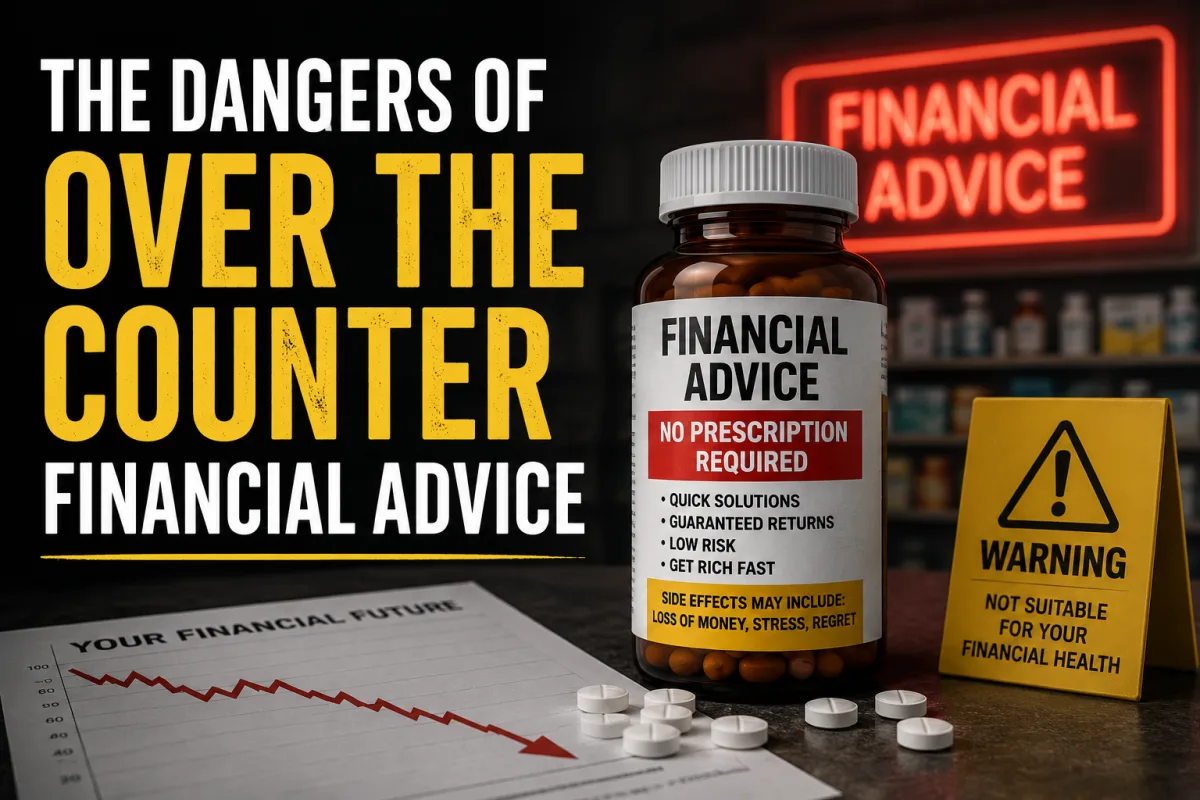
The Dangers of Over the Counter Financial Advice
The easiest financial advice to find is often the most dangerous. It comes packaged in short videos, confident posts, casual conversations, family gatherings, workplace whispers, WhatsApp groups, and bold claims from people who sound certain because certainty attracts attention.
Buy land. Join this money market fund. Take a policy. Invest in this stock. Try crypto. Buy Treasury bills. Start forex trading. Put everything in property. Avoid property. Don’t save cash. Save more cash. Debt is bad. Debt is leverage. Insurance is a scam. Insurance is protection. The market is about to rise. The market is about to crash.
The problem is not that all these statements are false. Some may be useful in the right situation. The danger is that financial advice without context can become financial harm. A medicine that heals one patient can injure another. A financial product that suits one investor can damage another. The missing ingredient is diagnosis.
That is why “over the counter financial advice” is such a powerful phrase. It captures the modern habit of consuming financial recommendations the way people buy non-prescription medicine: quickly, casually, and often without understanding the condition being treated. The analogy is not perfect, but it is revealing. Even basic medicine carries warnings, dosage instructions, side effects, and contraindications. Yet many people take investment recommendations with fewer questions than they would ask before swallowing a tablet.
Money decisions deserve better care. A person’s financial life is not a generic condition. It is a combination of income, age, dependants, debts, assets, goals, tax position, employment stability, health, responsibilities, beliefs, fears, habits, and time horizon. Advice that ignores those details is not advice in the full sense. It is information, opinion, marketing, entertainment, or persuasion.
That distinction matters because people act on what they hear. A disclaimer such as “not financial advice” does not erase influence. A viewer may still move savings, take a loan, buy an asset, surrender an insurance policy, or enter a risky scheme because a confident person online made the decision feel obvious.
In Kenya, the risk is amplified by a fast-growing financial marketplace. Consumers encounter banks, SACCOs, insurers, pension providers, fund managers, stockbrokers, digital lenders, real estate sellers, crypto promoters, forex educators, chama investments, and social media personalities. Different products fall under different regulators. The Capital Markets Authority licenses and supervises capital markets intermediaries, including investment advisers and fund managers, while the Retirement Benefits Authority regulates retirement benefits schemes and the Insurance Regulatory Authority oversees insurance industry participants.
This regulatory structure is important, but it does not remove personal responsibility. Regulation can set standards, license providers, supervise markets, and offer channels for complaints. It cannot sit beside every investor before they click, sign, transfer, or commit.
The first defence is financial literacy. The second is self-knowledge. The third is the discipline to ask, “Suitable for whom?” before asking, “Is this a good investment?”
Why financial advice cannot be separated from the person receiving it
There is no universally best investment. There are only investments that may be suitable for a particular person under particular circumstances at a particular time.
A 25-year-old software engineer with no dependants, stable income, low debt, and a 30-year investment horizon may be able to tolerate volatility in pursuit of long-term growth. A 62-year-old retiree who depends on savings for monthly expenses may need liquidity, stability, and income. The same equity fund that is reasonable for the first investor may be inappropriate for the second if it exposes essential retirement income to large short-term losses.
A business owner with irregular cash flow may need a larger emergency reserve than a salaried employee with predictable income. A parent preparing for school fees in twelve months should not invest that money in a high-risk asset simply because someone says the returns are attractive. A young professional saving for retirement may need growth assets. A person saving for rent next month needs safety and access.
Suitability is the core issue. A good product can be unsuitable. A legitimate investment can be poorly timed. A low-risk product can still be wrong if it prevents a young saver from building long-term wealth. A high-return opportunity can be destructive if it forces a household to gamble with emergency funds.
This is why investor profiling matters. Before choosing an investment, a person should understand their own financial profile. That profile should include age, income stability, savings, debts, dependants, goals, investment horizon, liquidity needs, risk tolerance, risk capacity, tax considerations, existing assets, insurance protection, and behavioural tendencies.
Risk tolerance and risk capacity are often confused. Risk tolerance is emotional. It asks how much volatility a person can endure without panic. Risk capacity is financial. It asks how much loss a person can absorb without damaging essential goals. A person may feel brave enough to take risk but lack the financial capacity to survive a large loss. Another person may have strong financial capacity but low emotional tolerance, making panic selling likely.
Good advice considers both. Over the counter advice usually considers neither.
The difference between financial education and financial advice
Financial education and financial advice are not the same thing.
Financial education explains principles. It teaches how compound interest works, why diversification matters, how inflation erodes purchasing power, how insurance transfers risk, why fees affect returns, and how debt can either build or destroy wealth. Education can be broad because principles are broadly useful.
Financial advice recommends action. It says, based on your circumstances, you should contribute this amount, buy this product, reduce this debt, increase this cover, choose this asset allocation, or avoid this investment. Advice must be personal because action has consequences.
This distinction protects both the learner and the educator. A financial article can teach why money market funds are used for liquidity. It should not imply that every reader should put all savings in one. A video can explain how Treasury bills work. It should not tell every viewer to buy them without considering goals, timing, tax, liquidity, and alternatives. A speaker can explain why equities build long-term wealth. They should not suggest that a retiree use rent money to trade shares.
Education gives people tools. Advice directs those tools toward a specific life. Confusing the two creates danger. A person may hear a general lesson and treat it as a personal prescription.
The better approach is to consume financial education actively. Instead of asking, “What did this person tell me to buy?” ask, “What principle did I learn, and how does it apply to my own situation?”
For example, the principle may be that long-term investors need assets that can grow faster than inflation. That does not automatically mean buying the first stock, fund, or property being promoted. It means the investor should examine their time horizon, risk level, and available instruments before choosing an appropriate growth strategy.
Why social media makes generic advice more powerful
Financial advice used to travel slowly. It came from banks, insurance agents, brokers, newspapers, radio, books, seminars, relatives, and professional advisers. Today, advice travels through algorithms. The person giving the advice may be licensed, experienced, conflicted, uninformed, compensated, anonymous, lucky, or simply entertaining. The platform does not always make the difference clear.
Social media rewards confidence, simplicity, controversy, and speed. Good financial planning rewards accuracy, nuance, patience, and restraint. These incentives do not naturally align.
A careful adviser might say, “This depends on your goals, risk tolerance, liquidity needs, income stability, tax position, and existing portfolio.” That answer is responsible, but not viral. A finfluencer might say, “This is where smart money is going.” That answer is vague, but exciting. It gives the viewer a feeling of inside access.
International regulators have increasingly focused on the risks created by online financial influencers. IOSCO’s work on retail investor online safety has identified finfluencer activity as an area requiring better practices because online influence can expose retail investors to unsuitable or misleading financial content.
The danger is not only misinformation. It is decontextualized information. A statement may be technically true and still harmful when applied by the wrong person. “Equities outperform over the long term” may be true in many markets, but it does not mean short-term school fees should be invested in equities. “Real estate can build wealth” may be true, but it does not mean every plot being sold is a good investment. “Debt can create leverage” may be true, but it does not mean a person with unstable income should borrow aggressively to speculate.
Social media also compresses time. A viewer sees someone else apparently making money quickly and feels late. That feeling is dangerous. Wealth that took years to build is often presented as though it appeared overnight. Losses are hidden. Failed trades are not posted. Sponsored products are not always obvious. Screenshots can be selective. Confidence can be rented.
The result is financial envy disguised as education.
The psychology that makes people vulnerable
Generic advice works because it speaks to emotions before reason has time to respond. Investors are not purely rational calculators. They are human beings with fear, ambition, insecurity, hope, regret, pride, and social pressure.
Fear of missing out is one of the strongest forces. When people believe others are becoming rich without them, caution begins to feel like stupidity. They stop asking whether the investment fits their plan. They ask whether they can enter before it is too late. FOMO turns investing into a race, and races produce poor decisions.
Herd behaviour is closely related. If many people appear to be doing something, the decision feels safer. But crowds can be wrong. A long queue outside an opportunity does not prove value. It may prove marketing success.
Authority bias is another trap. People trust confident speakers, formal titles, expensive clothes, professional language, large followings, media appearances, and association with known brands. These signals may be relevant, but they are not proof of competence or integrity. A person can sound sophisticated while selling an unsuitable product.
Recency bias makes people chase whatever has recently performed well. If property prices rose in a certain area, everyone wants land there. If a stock doubled, everyone wants the stock. If crypto rallied, everyone becomes a digital asset expert. Recent performance becomes a story about permanent opportunity.
Overconfidence completes the pattern. After one good decision, an investor may believe they have special insight. They increase risk, ignore diversification, and confuse luck with skill. Markets often punish this slowly, then suddenly.
Financial literacy helps because it creates mental friction. It slows the emotional leap from excitement to action. It gives the investor questions to ask before money moves.
The hidden conflict behind some “free” advice
Free advice is not always free. Sometimes it is paid for through commissions, product charges, referral fees, spreads, platform incentives, or sales targets.
This does not mean commission-based advisers are automatically dishonest. Many professionals who earn commissions still serve clients responsibly. The issue is transparency. A client should understand how the adviser is compensated and whether that compensation could influence the recommendation.
When someone recommends a pension plan, insurance policy, unit trust, property project, trading course, loan product, or investment platform, the consumer should ask a simple question: “How are you paid if I say yes?”
If the answer is unclear, caution is appropriate.
Conflicts of interest can affect advice in subtle ways. An adviser may recommend the product that pays them more rather than the one that best fits the client. A salesperson may emphasize benefits and minimize limitations. A content creator may promote a platform because they earn referral income. A property marketer may present projected returns without discussing vacancy, legal title, infrastructure risk, liquidity, or maintenance costs.
Good advice does not require the absence of compensation. Professionals deserve to be paid. But good advice requires disclosure, competence, suitability, and accountability.
The consumer’s role is not to distrust everyone. It is to understand incentives.
What a real investor profile should include
An investor profile is a financial diagnosis. It helps determine which strategies are appropriate and which should be avoided.
The first element is purpose. What is the money for? Retirement, emergency savings, school fees, a home deposit, business expansion, medical reserves, income generation, wealth preservation, or speculation? Money without a purpose is vulnerable to every persuasive opportunity.
The second element is time horizon. When will the money be needed? Money needed within months should be treated differently from money intended for retirement in 30 years. Time horizon determines how much volatility the investor can reasonably accept.
The third element is liquidity. How quickly must the investor access the money if life changes? A high-return opportunity with poor liquidity may be unsuitable for someone without emergency savings.
The fourth element is income stability. A government employee, entrepreneur, freelancer, farmer, commission-based salesperson, and small business owner may face very different cash-flow patterns. Irregular income often requires larger buffers.
The fifth element is debt. An investor with high-interest debt may need debt reduction more urgently than new investment exposure. Paying off expensive debt can be a powerful guaranteed return.
The sixth element is dependants. A single person with no dependants has different obligations from a parent supporting children, siblings, elderly parents, or extended family. Dependants affect insurance needs, emergency savings, and risk capacity.
The seventh element is existing assets. A person already heavily exposed to property may not need more property. A person whose pension is conservatively invested may need growth elsewhere. A person whose wealth is tied to one employer’s shares may need diversification.
The eighth element is risk tolerance. How does the investor respond when values fall? Do they panic? Do they sell? Do they check prices daily? Do they understand volatility? The best portfolio on paper is useless if the investor cannot stay with it.
The ninth element is knowledge. Some investments require more understanding than others. A person should not buy products they cannot explain in plain language.
The tenth element is values and behaviour. Some people need automation because they struggle with discipline. Others need restrictions because they are tempted by speculation. A good plan respects human nature.
Case study: the same investment, three different outcomes
Consider a money market fund. It is often presented as a safe place to keep funds while earning a return. For one investor, it may be excellent. For another, it may be inadequate. For a third, it may become a trap.
A salaried worker building an emergency fund may use a money market fund well. The goal is liquidity and capital preservation. The investment matches the purpose.
A 30-year-old saving for retirement over three decades may use a money market fund for emergency cash, but if all long-term wealth remains there, the portfolio may not grow enough after inflation. The product is safe in the short term but may be insufficient for long-term wealth creation.
A retiree who needs monthly income may find a money market fund useful for near-term expenses, but not necessarily enough for a 25-year retirement. They may need a broader mix of income, inflation protection, and growth.
The product did not change. The person changed. Suitability changed.
Now consider land. For a high-income professional with diversified investments, strong cash flow, emergency savings, clean title verification, and a long holding period, land may be a reasonable part of a wealth strategy. For a young worker who borrows heavily to buy speculative land far from infrastructure, it may become a cash-flow burden. For a retiree who needs income, land that produces no rent may fail to meet the most important need.
Again, the asset did not change. The context changed.
Questions to ask before following any financial recommendation
Before acting on financial advice, an investor should slow down and ask structured questions.
What problem is this recommendation solving? If the problem is unclear, the product may be unnecessary. Good financial decisions begin with needs, not products.
How does this fit my goals? An investment for retirement should be judged differently from money for rent, school fees, or business working capital.
What is the time horizon? If the investment requires five years, money needed in six months should not go there.
What can go wrong? Every serious investment has risks. If only benefits are being discussed, the conversation is incomplete.
How liquid is it? Can the money be accessed quickly? Are there penalties, lock-in periods, surrender charges, or market conditions that could delay exit?
What are the fees? Fees reduce returns. They may include management fees, transaction costs, surrender charges, advisory fees, spreads, commissions, and taxes.
Who regulates the provider? Depending on the product, the relevant regulator may be the CMA, RBA, IRA, Central Bank of Kenya, SACCO Societies Regulatory Authority, or another authority. A legitimate provider should be verifiable through the relevant regulator or official registry.
How is the person recommending it compensated? Compensation does not invalidate advice, but undisclosed compensation should raise concern.
What assumptions are being used? Projected returns may depend on inflation, occupancy, market growth, interest rates, currency stability, or future demand. Assumptions should be visible.
What happens if returns are lower than expected? A resilient plan survives disappointment. A fragile plan requires everything to go right.
Do I understand this well enough to explain it to someone else? If not, more education is needed before commitment.
How to evaluate a financial adviser
A good financial adviser does more than recommend products. They help a client understand trade-offs, prioritize goals, manage risk, and make decisions that fit the client’s life.
The first test is listening. If an adviser recommends a product before understanding your finances, they are selling before diagnosing. A serious adviser asks about income, expenses, assets, liabilities, dependants, goals, insurance, taxes, emergency funds, retirement plans, and risk comfort.
The second test is licensing or professional standing. For capital markets products in Kenya, investors can check whether relevant firms and intermediaries are licensed by the Capital Markets Authority. CMA’s public materials and licensing reports identify regulated market participants, and the Capital Markets Act requires specified market intermediaries such as investment advisers, fund managers, stockbrokers, dealers, investment banks, and authorized depositories to hold valid licences.
For retirement products, investors should pay attention to the Retirement Benefits Authority’s role in regulating and supervising retirement benefits schemes and protecting the interests of members and sponsors.
For insurance products, consumers should confirm that insurers, brokers, agents, and other intermediaries are properly licensed through the Insurance Regulatory Authority’s registries and licensing information.
The third test is clarity. A good adviser can explain recommendations in plain language. They should discuss benefits, risks, fees, alternatives, and consequences of doing nothing.
The fourth test is documentation. Serious advice should leave a paper trail: fact-find forms, risk profiles, policy documents, fund fact sheets, statements, contracts, disclosures, and written recommendations. Verbal promises are weak protection.
The fifth test is alignment. The adviser should be able to explain why the recommendation fits your specific profile. “Many people are buying this” is not a suitability argument.
The sixth test is pressure. Be cautious when an adviser creates urgency without a clear reason. Phrases such as “last chance,” “guaranteed returns,” “only for selected investors,” or “you will regret missing this” should slow you down, not speed you up.
Red flags in financial advice
Bad advice often has a recognizable smell. It promises too much, explains too little, and pressures the listener to act quickly.
One red flag is guaranteed high returns. Low risk and high return rarely live together. If returns are unusually attractive, the risk must be identified. If no risk can be explained, the investor should be suspicious.
Another red flag is secrecy. Legitimate investments do not require secrecy from spouses, lawyers, accountants, regulators, or trusted advisers. If someone tells you not to ask too many questions, ask more.
A third red flag is unclear regulation. The provider should be able to explain who regulates the product and how the investor can verify registration or licensing.
A fourth red flag is complicated language used to avoid simple explanation. Complexity is sometimes necessary, but it should become clearer after explanation, not more confusing.
A fifth red flag is pressure to borrow. Borrowing to invest can magnify gains, but it can also magnify losses. Anyone encouraging aggressive borrowing should explain downside scenarios carefully.
A sixth red flag is reliance on testimonials. Testimonials show that someone claims to have benefited. They do not prove suitability, sustainability, or legality.
A seventh red flag is no discussion of fees. Every financial product has economics. If the provider is not explaining how they make money, the investor does not yet understand the product.
An eighth red flag is advice that ignores existing obligations. A person with no emergency fund, heavy debt, and dependants should not be pushed into illiquid or speculative investments without a full discussion of risk.
Why “not investment advice” is not enough
Disclaimers have become common in online finance content. A creator may discuss a stock, fund, asset class, or trading strategy and then say, “This is not financial advice.” The phrase has value, but it is not magic.
The viewer may still interpret the content as guidance. They may still copy the trade. They may still believe the creator knows something they do not. They may still act without assessing suitability.
A disclaimer protects the speaker more than the listener. The listener still needs judgment.
Online audiences should treat financial content as a starting point for research, not the final step before action. A useful video can introduce a concept. A thoughtful article can explain a principle. A podcast can broaden perspective. But none of these replaces a personal financial plan.
The investor should ask, “What would need to be true for this recommendation to make sense for me?” That question turns passive consumption into active analysis.
When self-directed investing is appropriate
Not every investor needs a professional adviser for every decision. Self-directed investing can be appropriate when the investor has sufficient knowledge, simple goals, emotional discipline, and enough time to research and monitor decisions.
A person building an emergency fund, contributing regularly to a diversified retirement plan, or learning basic long-term investing may not need complex advice. Education and disciplined execution may be enough.
Professional advice becomes more valuable when the situation is complex. Complexity may come from high income, business ownership, tax planning, inheritance, divorce, retirement transition, cross-border assets, multiple dependants, estate planning, concentrated wealth, large insurance needs, or major investment decisions.
The self-directed investor should still create rules. They should define asset allocation, contribution amounts, emergency reserves, rebalancing frequency, maximum exposure to speculative assets, and conditions for selling. Without rules, self-directed investing can become emotional trading.
Self-directed investing works best when humility is present. The investor understands that markets are uncertain, mistakes happen, and no one is above risk.
How investor profiles change over time
Financial advice must be reviewed because people change. A recommendation suitable at 28 may be unsuitable at 48. A strategy that worked before marriage may need revision after children. A portfolio built during employment may need redesign before retirement.
A young adult may prioritize emergency savings, debt control, career development, and long-term growth. A growing family may need life insurance, medical cover, education planning, housing decisions, and more liquidity. A mid-career professional may need retirement acceleration, diversification, estate planning, and tax efficiency. A pre-retiree may need debt reduction, income planning, pension review, and risk management. A retiree may need cash-flow stability, healthcare reserves, inflation protection, and succession clarity.
This is why “buy and forget” is not always wise. Long-term investing does not mean ignoring life changes. It means staying committed to principles while adjusting tactics as circumstances evolve.
A financial plan should be reviewed at least annually and whenever major events occur: marriage, birth of a child, job loss, business expansion, illness, inheritance, property purchase, relocation, divorce, retirement, or death of a family member.
The role of financial literacy as consumer protection
Financial literacy is often described as empowerment, but it is also protection. It helps people identify bad advice before it becomes a bad decision.
A financially literate person understands that return must be compared with risk. They know that liquidity matters. They understand inflation. They ask about fees. They recognize that diversification reduces dependence on one outcome. They know that past performance does not guarantee future returns. They understand that debt has a cost. They know that tax treatment can affect net results. They are less easily impressed by confident claims.
Financial literacy does not require becoming a professional analyst. It requires enough knowledge to ask better questions, avoid obvious traps, and know when expert help is needed.
At its best, financial literacy turns consumers from targets into decision-makers.
A better way to consume financial content
Financial content is not the enemy. Good public education can help millions of people save more, reduce debt, understand pensions, buy insurance wisely, invest patiently, and avoid scams. The goal is not to reject all public advice. The goal is to classify it correctly.
When reading or watching financial content, separate four categories.
The first category is education. This teaches a concept. It is useful when it improves understanding.
The second category is opinion. This reflects a person’s view. It may be thoughtful or flawed, but it should not be mistaken for fact.
The third category is marketing. This promotes a product, service, platform, course, or opportunity. It may contain useful information, but it has a sales objective.
The fourth category is personalized advice. This should be based on your financial profile and should explain why a recommendation fits you.
Most online content falls into the first three categories. Very little is truly the fourth.
Once this is clear, financial content becomes less dangerous. The investor can learn broadly, research carefully, and act personally.
The disciplined investor’s rule
The disciplined investor has one rule: no recommendation becomes action until it passes through personal context.
That context includes goals, time horizon, liquidity, risk tolerance, risk capacity, debt, dependants, taxes, existing assets, fees, regulation, and alternatives.
This rule slows down impulsive decisions. It protects emergency funds from speculation. It protects retirement savings from fads. It protects families from products they do not understand. It protects investors from mistaking popularity for suitability.
It also creates confidence. When an investment fits a plan, the investor can hold it with more discipline. They are less likely to panic because they know why they own it. They are less likely to chase every new opportunity because they know what role each asset plays.
Wealth is not built by reacting to every confident voice. It is built by aligning decisions with a clear financial life.
The prescription should fit the patient
Over the counter financial advice is tempting because it is easy. It removes the burden of thinking. It offers a shortcut through complexity. It makes wealth feel like a product to buy rather than a system to build.
But money does not respond well to shortcuts that ignore reality. The right investment for a person depends on who they are, what they need, what they already have, what they owe, how long they can wait, how much risk they can carry, and what failure would cost.
The question is not whether stocks, bonds, pensions, insurance, property, money market funds, SACCOs, Treasury bills, businesses, or offshore assets are good or bad. The question is whether they are suitable, understood, affordable, properly regulated, and aligned with the investor’s goals.
A mature investor does not ask strangers to prescribe their financial future from a distance. They learn principles. They build a profile. They verify providers. They understand incentives. They compare alternatives. They seek qualified help when needed. They make decisions slowly enough for wisdom to enter.
Financial literacy is the antidote to blind imitation. Personal context is the antidote to generic advice. Discipline is the antidote to hype.
The next time a recommendation sounds obvious, pause. Ask what diagnosis produced the prescription. Ask who benefits if you act. Ask what could go wrong. Ask whether it fits your life.
Your money is not generic. Your advice should not be generic either.
 Article
 Article
 Article
 Article
 Article
 Article
 Article
 Article