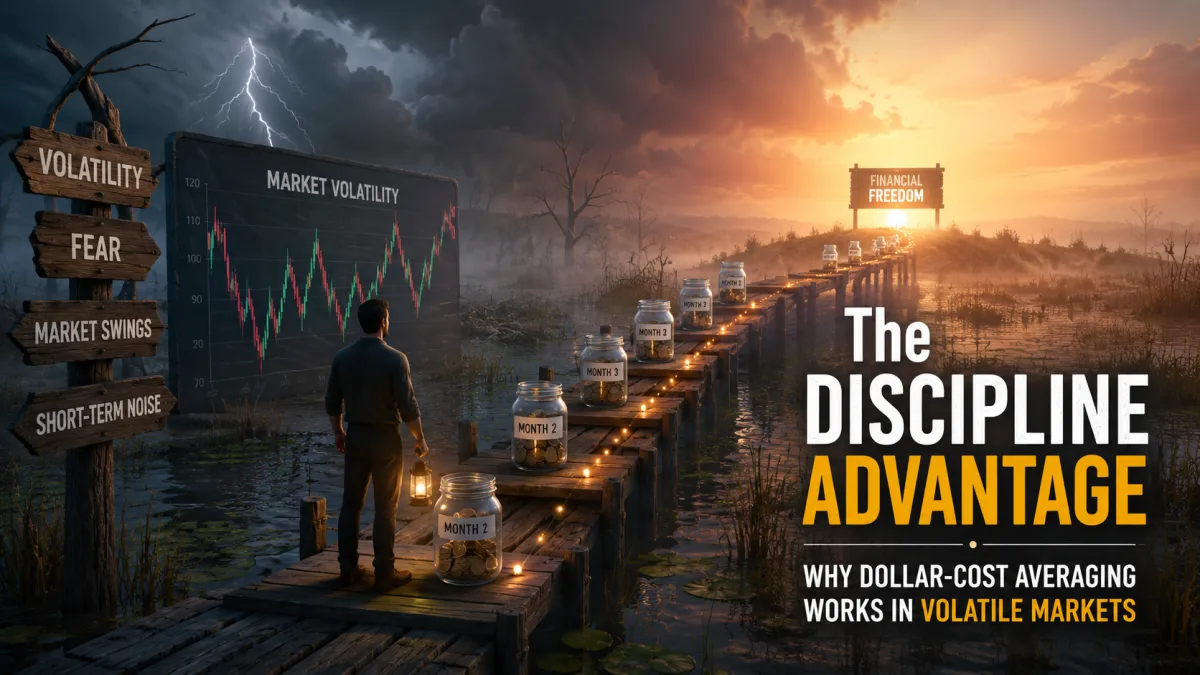
The Discipline Advantage: Why Dollar-Cost Averaging Works in Volatile Markets
Volatile markets test investors emotionally long before they test them financially. A portfolio that looked stable a month ago suddenly swings sharply. Headlines grow more dramatic. Experts disagree publicly. One day markets rally strongly. The next day they erase those gains. Investors begin asking the same difficult question: should I keep investing while prices are falling?
This is where many long-term financial plans begin to break down. Not because the investor lacks intelligence, but because uncertainty changes behavior. Fear encourages waiting. Falling prices create hesitation. Rising prices create urgency. People who intended to invest for decades suddenly focus on what happened this week.
Dollar-cost averaging exists partly to solve this emotional problem.
Dollar-cost averaging is the practice of investing a fixed amount of money at regular intervals regardless of market conditions. Instead of trying to predict the perfect time to invest, the investor commits to consistency. The same amount may be invested weekly, monthly, or quarterly whether markets are rising, falling, or moving sideways.
The strategy sounds simple, but its simplicity hides an important psychological advantage. Dollar-cost averaging replaces prediction with process. It removes the need to decide constantly whether now is the “right” moment to invest. The investor keeps buying through good markets, bad markets, recessions, recoveries, fear, optimism, and uncertainty.
In volatile markets, this discipline becomes especially powerful. Falling prices stop looking like interruptions to the plan and start becoming part of the plan. Lower prices mean the fixed investment amount buys more shares. Higher prices mean the existing shares may grow in value. Over time, the investor accumulates ownership across many market conditions rather than depending on one entry point.
Dollar-cost averaging does not eliminate risk. Markets can decline for long periods. Investments can lose value. Some assets fail completely. The strategy also does not guarantee profits or protect against all losses. But it addresses one of the greatest dangers in investing: emotional decision-making during uncertainty.
The long-term investor’s challenge is not merely finding good investments. It is remaining invested long enough for compounding to matter. Dollar-cost averaging helps create that consistency.
Why Volatility Feels So Dangerous
Volatility is the movement of prices over time. In the stock market, volatility means prices rise and fall, sometimes sharply. A volatile market may experience large daily or monthly swings driven by economic data, interest rates, corporate earnings, geopolitical events, investor sentiment, inflation concerns, or unexpected crises.
Most investors say they understand volatility in theory. The difficulty begins when volatility becomes personal. A market decline feels different when retirement savings are involved. Watching account balances fall can create anxiety, even when the investor planned for long-term growth.
The emotional discomfort of volatility exists because humans are naturally loss-sensitive. A decline often feels more powerful emotionally than a gain of the same size. This can lead investors to make reactive decisions at the wrong time.
Some stop investing during downturns because they fear further losses. Others sell investments entirely and wait for “certainty” before returning. The problem is that certainty rarely appears before markets recover. By the time optimism returns, prices may already be much higher.
This creates a damaging pattern. Investors buy after markets rise because confidence feels strong. They stop investing after markets fall because fear feels strong. Emotion reverses rational behavior.
Volatility also creates the illusion that successful investing depends mainly on timing. Investors begin searching for the perfect entry point, believing they must avoid every decline. In reality, even professional investors struggle to consistently predict short-term market movements.
Dollar-cost averaging accepts that volatility is unavoidable. Instead of trying to escape market swings entirely, it uses consistency to reduce the pressure of timing decisions.
How Dollar-Cost Averaging Works
The structure of dollar-cost averaging is straightforward. The investor chooses a fixed amount of money and invests it on a regular schedule. For example, someone may invest $500 every month into a diversified investment portfolio.
When prices are high, the fixed amount buys fewer shares. When prices are low, the same amount buys more shares. Over time, the investor accumulates shares at a range of prices rather than relying on one purchase point.
This creates an average purchase cost that reflects many market conditions. The investor does not need to guess whether today’s market is expensive or cheap. The process continues automatically.
Imagine two months in the market. In the first month, an investment costs $100 per share. A $500 investment buys five shares. In the second month, the price falls to $50 per share. The same $500 now buys ten shares. The investor has accumulated more ownership during the decline.
This is one of the most misunderstood parts of market volatility. Falling prices feel painful when looking at existing balances, but they can benefit long-term investors who are still buying assets regularly. Lower prices increase the future ownership acquired by ongoing contributions.
Dollar-cost averaging changes the investor’s relationship with volatility. Instead of seeing every decline as purely negative, the investor recognizes that lower prices may improve long-term accumulation.
The Emotional Advantage of Automation
The greatest strength of dollar-cost averaging may not be mathematical. It may be behavioral.
Investing consistently through volatile markets is emotionally difficult when every contribution requires a fresh decision. Fear, headlines, market commentary, and social pressure can interfere with long-term thinking.
Automation reduces this friction. Automatic investment plans move money into investments on a predetermined schedule without requiring constant emotional evaluation. The investor no longer debates every market move. The system continues operating.
This matters because human behavior often damages investment returns more than market performance itself. Investors chase rising markets, panic during declines, abandon strategies prematurely, and react emotionally to short-term news. A disciplined automated system helps prevent these interruptions.
Dollar-cost averaging creates structure. The investor knows exactly what will happen next month regardless of headlines. Income arrives. Contributions are made. Shares are purchased. The process continues.
Over time, this routine can reduce anxiety because investing becomes normal rather than dramatic. The investor stops viewing each market decline as a crisis requiring immediate action and begins viewing volatility as part of long-term ownership.
Why Market Timing Is So Difficult
Many investors abandon dollar-cost averaging because they believe they can wait for a better opportunity. This belief is understandable. Buying before a decline feels painful. Waiting for lower prices sounds rational.
The problem is that successful market timing requires two correct decisions, not one. The investor must know when to exit or wait and when to re-enter. Missing either decision can damage long-term returns.
Markets also recover unpredictably. Some of the strongest market gains occur close to periods of sharp declines. Investors who wait too long for “clarity” may miss significant rebounds.
The emotional challenge becomes severe during major downturns. Negative news dominates headlines. Economic fears feel reasonable. Waiting for certainty appears cautious. Yet the best long-term buying opportunities often exist when confidence is weakest.
Dollar-cost averaging avoids the need to predict exact turning points. It accepts uncertainty as permanent. Instead of asking, “Is this the bottom?” the investor asks, “Am I continuing to follow the plan?”
This distinction matters because consistent participation often matters more than perfect timing. Long-term wealth building depends heavily on remaining invested across decades, not on correctly predicting every short-term movement.
Volatility Can Benefit Long-Term Investors
Most people naturally prefer rising markets because growing balances feel good. But for investors still in the accumulation phase, volatility can actually create opportunities.
When prices fall, future contributions buy more shares. This means downturns can improve long-term accumulation for disciplined investors who continue investing consistently.
Imagine someone investing every month over twenty years. During that period, markets will almost certainly experience recessions, corrections, crashes, recoveries, booms, and periods of fear. If the investor continues contributing through these cycles, the lower prices during downturns may become valuable purchase opportunities in hindsight.
This does not mean declines are pleasant. Watching investments lose value is difficult. But a long-term investor who continues buying productive assets during downturns may benefit from future recoveries.
The key word is long-term. Volatility helps only if the investor survives emotionally and financially long enough to continue participating. Someone forced to sell during a downturn because of poor planning, excessive debt, or panic may not experience the eventual recovery.
Dollar-cost averaging works best when paired with a long time horizon, emergency savings, manageable debt, and realistic expectations about market behavior.
The Difference Between Investing and Speculating
Volatile markets often blur the line between investing and speculation. During sharp market movements, people become obsessed with short-term price changes. They search for quick gains, sudden trends, and dramatic predictions.
Dollar-cost averaging encourages a different mindset. It focuses on ownership rather than prediction. The investor is not trying to outguess every market movement. They are steadily acquiring assets over time.
This distinction is important because productive investing usually depends on patience. Businesses grow gradually. Profits compound over years. Dividends accumulate slowly. Retirement accounts build through repeated contributions.
Speculation often focuses on immediate price movement. Investing focuses on long-term value creation.
A person using dollar-cost averaging into diversified investments is building ownership across many market conditions. They are accepting that short-term volatility exists while believing that long-term productive assets can grow over time.
This approach reduces the temptation to constantly react to noise. It encourages the investor to think like an owner rather than a trader.
Dollar-Cost Averaging and Retirement Accounts
Retirement investing is one of the most common real-world applications of dollar-cost averaging. Employees contribute regularly from paychecks into retirement accounts regardless of market conditions. Every pay period creates another investment contribution.
This structure naturally applies dollar-cost averaging. During strong markets, contributions buy fewer shares. During weak markets, they buy more. Over decades, the investor accumulates assets across many economic cycles.
This is one reason retirement plans can be powerful despite market volatility. The investor does not need to identify perfect entry points. The process of regular contributions creates ongoing participation.
Many people underestimate how important this consistency becomes over time. A person investing steadily through difficult markets may eventually benefit from shares purchased during periods of pessimism.
Retirement accounts also encourage long-term thinking because the money is intended for future use rather than immediate spending. This longer time horizon can make volatility easier to tolerate. A decline this year matters differently when the money may not be needed for decades.
Why Consistency Often Matters More Than Intensity
Some investors believe successful investing requires large lump-sum investments or dramatic market calls. While large investments can be powerful, consistency often matters more than occasional intensity.
A person who invests moderate amounts regularly for decades may build substantial wealth because time and compounding amplify repeated contributions. The habit itself becomes valuable.
Dollar-cost averaging supports this consistency because it turns investing into a recurring behavior rather than an occasional event. The investor does not wait for motivation, confidence, or perfect market conditions. Contributions continue automatically.
This approach also reduces regret. A lump-sum investment made just before a market decline can feel emotionally painful even if the long-term outcome remains positive. Dollar-cost averaging spreads purchases over time, reducing the emotional pressure of a single entry point.
Consistency creates resilience. A process that can continue during both optimism and fear is more valuable than a strategy that works only when confidence is high.
The Psychological Trap of Waiting for the “Right Time”
One of the biggest barriers to investing is the belief that a better moment will appear soon. Investors wait for lower prices during strong markets and wait for stability during weak markets. The result is often endless hesitation.
The “right time” rarely feels obvious in real time. Markets may look expensive before rising further. They may look dangerous before recovering strongly. Economic forecasts change constantly.
Dollar-cost averaging solves this problem by removing the requirement to identify the perfect moment. The investor participates continuously rather than conditionally.
This does not mean valuation and risk are irrelevant. Long-term investors should still understand diversification, asset allocation, fees, and risk tolerance. But dollar-cost averaging recognizes that waiting for ideal conditions can become a permanent excuse for inaction.
Investing requires accepting uncertainty. There will always be reasons to wait. Interest rates may rise. Inflation may remain high. Elections may create uncertainty. Geopolitical tensions may increase. Recession fears may grow. Yet markets continue moving through all of these conditions over time.
The disciplined investor understands that uncertainty is not an exception to investing. It is the normal environment of investing.
Dollar-Cost Averaging During Market Crashes
Market crashes are the ultimate emotional test for dollar-cost averaging. Continuing to invest while prices fall sharply can feel irrational because fear dominates public conversation.
Yet historically, some of the most powerful long-term buying opportunities have occurred during periods of deep pessimism. Investors who continued buying during severe downturns often acquired assets at significantly lower prices than those available during optimistic periods.
This does not mean every decline should be celebrated. Market crashes can involve job losses, economic hardship, business failures, and real financial stress. Some investors may genuinely need liquidity during these periods. That is why emergency savings and reasonable debt levels are so important.
But for investors with stable finances and long time horizons, continuing to invest during downturns can strengthen future results. Lower prices increase future ownership for the same contribution amount.
The difficulty is emotional survival. The investor must trust the long-term process even when short-term conditions feel frightening. Dollar-cost averaging provides structure during these moments because the decision has already been made in advance.
The investor does not need to decide whether now is the exact bottom. They simply continue following the plan.
The Relationship Between Dollar-Cost Averaging and Compounding
Compounding occurs when investment returns begin generating additional returns over time. Dividend reinvestment, capital appreciation, and repeated contributions all contribute to this process.
Dollar-cost averaging supports compounding because it keeps new money entering the investment system consistently. Each contribution becomes another base capable of future growth.
At first, contributions usually drive most portfolio growth. Later, investment returns begin contributing more significantly. Over long periods, the portfolio itself may begin generating more growth than the annual contributions.
This transition is one of the most important moments in long-term investing. It means accumulated capital is beginning to do meaningful work alongside labor income.
Dollar-cost averaging helps investors reach this stage because it keeps contributions moving through different market conditions. The investor does not stop participating during volatility. The compounding engine continues receiving fuel.
Dollar-Cost Averaging Is Not a Guarantee
Although dollar-cost averaging offers important behavioral advantages, it is not a guarantee against losses. Markets can decline for extended periods. Investments can underperform. Poor asset selection can still create disappointing outcomes.
The strategy also does not always outperform lump-sum investing mathematically. If markets rise steadily over time, investing a larger amount earlier may produce stronger returns because more money is exposed to growth sooner.
But the comparison is not purely mathematical. Many investors struggle emotionally with investing large amounts all at once, especially during uncertain markets. Dollar-cost averaging can reduce emotional pressure and increase the likelihood that the investor actually follows through consistently.
The best strategy is often the one an investor can maintain during real-world conditions. A theoretically superior plan that collapses during volatility may be less effective than a disciplined, sustainable approach.
Dollar-cost averaging should also be paired with proper diversification, realistic expectations, emergency reserves, and an asset allocation appropriate for the investor’s goals and risk tolerance.
The Importance of Asset Allocation
Dollar-cost averaging determines how money enters investments over time. Asset allocation determines where that money goes.
Asset allocation refers to the mix of investments in a portfolio, such as stocks, bonds, cash, and other assets. The appropriate allocation depends on age, goals, time horizon, risk tolerance, income stability, and financial needs.
A younger investor saving for retirement decades away may tolerate a higher allocation to stocks because they have more time to recover from volatility. Someone approaching retirement may prefer more stability and income-producing assets.
Dollar-cost averaging cannot compensate for an unsuitable asset allocation. An investor heavily concentrated in speculative assets may still experience severe losses and emotional stress. Diversification remains important.
The combination of diversification and dollar-cost averaging can create a more resilient long-term strategy because the investor participates across many market conditions while spreading exposure across many assets.
Why Headlines Can Be Dangerous for Investors
Financial media often focuses on immediate drama because urgency attracts attention. Headlines emphasize crashes, rallies, predictions, crises, and sudden opportunities. This constant noise can make investing feel like a daily emergency.
Dollar-cost averaging creates distance from this emotional environment. The investor does not need to react to every headline because the strategy already defines the next step.
This is important because headlines often exaggerate short-term significance. Events that feel overwhelming today may become minor footnotes years later. Meanwhile, long-term investors continue accumulating assets through the noise.
The disciplined investor learns to separate information from emotional stimulation. Markets will always provide reasons to feel anxious or euphoric. Dollar-cost averaging keeps the focus on long-term participation rather than short-term reaction.
Building Wealth Through Habit Rather Than Prediction
Many people assume wealth in the stock market comes mainly from brilliant predictions. In reality, much long-term wealth comes from repeated disciplined behavior.
Regular investing, reinvesting dividends, controlling costs, avoiding emotional decisions, staying diversified, and remaining invested over long periods often matter more than identifying the next short-term market movement.
Dollar-cost averaging supports this habit-based approach. The investor does not need to prove superior forecasting ability. They need consistency.
This makes investing more accessible because success becomes less dependent on prediction and more dependent on process. A person does not need to know next month’s market direction to benefit from long-term ownership in productive assets.
The market rewards patience more reliably than excitement. Dollar-cost averaging encourages patience by normalizing steady participation.
How Young Investors Benefit From Volatility
Younger investors often fear market declines because they see account balances fall. Yet younger investors may actually benefit from volatility if they continue investing consistently.
Someone early in their investing journey usually contributes far more money than they withdraw. This means lower prices allow them to accumulate more shares during the years when they are building their ownership base.
Paradoxically, a severe market decline early in an investor’s accumulation phase may be less damaging long-term than a severe decline occurring near retirement, especially if the younger investor remains employed and continues contributing.
This does not mean young investors should seek risk recklessly. But it does mean volatility should be understood in context. Time changes the meaning of market fluctuations.
A younger investor’s greatest asset is often not current portfolio size, but future contributions and time for compounding. Dollar-cost averaging helps convert those future contributions into growing ownership over decades.
How Older Investors Can Use Dollar-Cost Averaging
Dollar-cost averaging is not only for young investors. Older investors can also use the strategy, particularly when investing new cash gradually or managing emotional concerns about entering markets during uncertain periods.
Someone nearing retirement may use dollar-cost averaging to reduce the anxiety of investing a large lump sum immediately before potential volatility. Gradual investing can create emotional comfort and reduce regret risk.
However, older investors must also consider time horizon and withdrawal needs. Someone close to needing the money may require a more conservative allocation and stronger liquidity planning.
The strategy should always fit the investor’s stage of life. Dollar-cost averaging is a tool, not a complete financial plan.
Common Mistakes With Dollar-Cost Averaging
The first mistake is stopping contributions during market declines. This interrupts the very mechanism that allows the strategy to benefit from lower prices.
The second mistake is investing without an emergency fund. Investors forced to sell assets during downturns because of short-term cash shortages may not experience the long-term benefits of staying invested.
The third mistake is using dollar-cost averaging while taking excessive investment risk elsewhere. A disciplined contribution schedule cannot protect against poor diversification or speculative concentration.
The fourth mistake is constantly changing the strategy. Increasing contributions during optimism and stopping during fear defeats the purpose of consistency.
The fifth mistake is expecting quick results. Dollar-cost averaging is a long-term accumulation strategy, not a rapid wealth shortcut. Its strength appears over years and decades, not weeks.
The sixth mistake is focusing too heavily on short-term account values. The strategy works through repeated accumulation across time. Obsessing over daily movements can create unnecessary stress.
Dollar-Cost Averaging and Financial Freedom
Dollar-cost averaging matters because wealth building usually depends more on repeated ownership than dramatic financial events. Most people build portfolios gradually through years of contributions, not sudden windfalls.
Every contribution represents a small transfer of income into ownership. Over time, these repeated investments can grow into meaningful financial assets capable of generating dividends, appreciation, and future flexibility.
The process may feel slow at first because contributions drive most of the growth. Later, accumulated assets begin contributing more significantly. Eventually, the portfolio itself may become an important source of financial strength.
This is the deeper value of dollar-cost averaging. It turns investing from a series of emotional decisions into a structured habit of ownership.
Financial freedom rarely appears overnight. It is often built quietly through repeated disciplined actions continued over long periods. Dollar-cost averaging supports exactly that kind of behavior.
A Practical Dollar-Cost Averaging Checklist
Choose a realistic investment amount that can be maintained consistently.
Select a regular schedule, such as weekly or monthly contributions.
Automate investments whenever possible to reduce emotional interference.
Build an emergency fund so market downturns do not force asset sales.
Maintain a diversified investment portfolio appropriate for your goals and risk tolerance.
Continue investing during market declines unless your financial situation genuinely changes.
Avoid obsessing over daily market movements and short-term headlines.
Review asset allocation periodically, but avoid constant reactive changes.
Reinvest dividends where appropriate to strengthen compounding.
Measure success by long-term participation and ownership growth rather than short-term market predictions.
The Quiet Strength of Consistency
Volatile markets create emotional pressure because uncertainty feels dangerous. Prices move sharply. Predictions conflict. Fear and optimism alternate constantly. Investors begin searching for certainty in an environment where certainty does not exist.
Dollar-cost averaging offers a different approach. Instead of trying to predict every movement, it builds a system that functions through movement. It accepts that markets will rise and fall. It assumes volatility will return repeatedly over time. It replaces emotional timing with disciplined participation.
The strategy works not because it eliminates uncertainty, but because it allows the investor to continue acting despite uncertainty.
That consistency matters more than many people realize. Long-term wealth building depends heavily on staying invested through multiple economic cycles. Investors who continue accumulating productive assets through recessions, recoveries, inflation scares, interest rate changes, and market declines often benefit from the eventual growth of those assets over time.
Dollar-cost averaging helps investors remain in the game long enough for compounding to matter. It transforms volatility from a reason to stop investing into a condition under which investing continues.
The market will always provide reasons to hesitate. Prices will sometimes feel too high. Declines will sometimes feel too severe. Headlines will always sound urgent. The disciplined investor understands that waiting for perfect clarity may mean waiting forever.
Instead, they continue investing steadily. Month after month. Year after year. Through optimism and fear alike.
That is the real power of dollar-cost averaging. Not prediction. Not excitement. Discipline repeated long enough for ownership to grow.
 Article
 Article
 Article
 Article
 Article
 Article
 Article
 Article