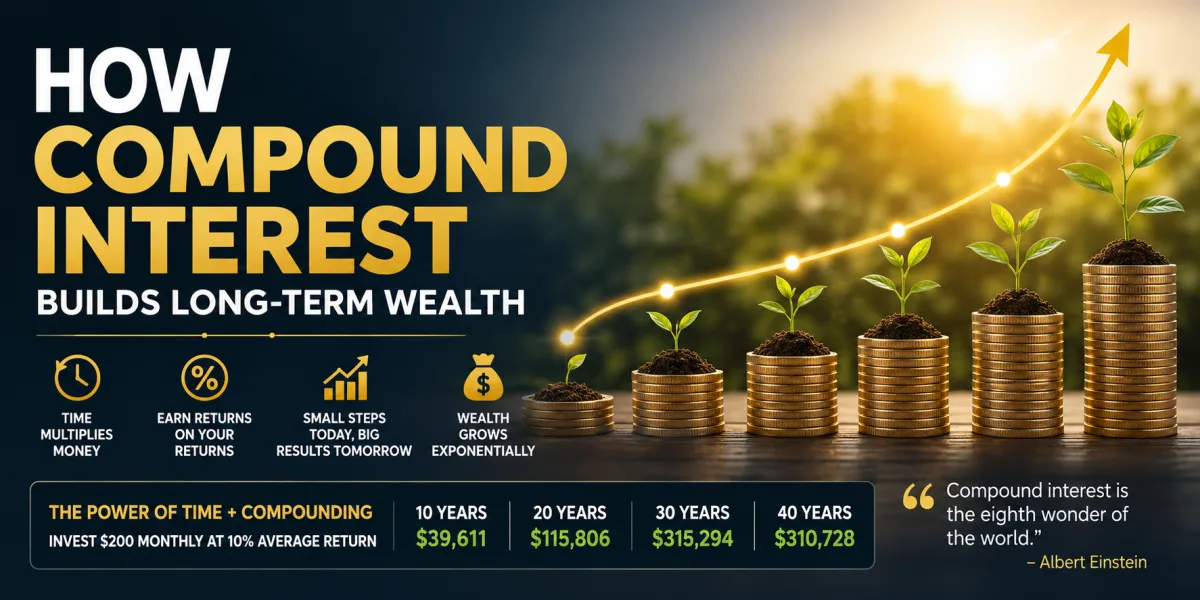
The Compounding Engine: How Time Turns Small Money into Long-Term Wealth
Compound interest is often described as magic, but that description can be misleading. Magic suggests something mysterious, sudden, and effortless. Compounding is none of those things. It is mathematical, slow at first, and deeply dependent on discipline. It does not reward impatience. It rewards time.
The basic idea is simple: money earns a return, and then that return begins earning returns of its own. Interest earns interest. Dividends buy more shares. Investment gains increase the base from which future gains can grow. Over long periods, the growth pattern can become powerful because the original contribution is no longer doing all the work. The accumulated returns begin carrying part of the load.
The Securities and Exchange Commission’s Investor.gov describes compound interest as “interest you earn on interest” and illustrates the concept with a simple example: if $100 earns 5 percent in one year, it becomes $105; if it earns another 5 percent the following year, the investor earns 5 percent not only on the original $100 but also on the previous $5 of interest.
That example is small, but the principle is enormous. Compounding explains why early investing can be so valuable, why reinvested dividends matter, why fees quietly damage portfolios, why high-interest debt can become dangerous, and why wealth often appears slow before it appears sudden.
Long-term wealth is rarely built by one heroic investment. It is usually built through repeated contributions, reinvested returns, reasonable costs, patience, and the refusal to interrupt the process unnecessarily. Compounding turns consistency into acceleration.
The mistake many people make is that they judge compounding too early. They invest $100, earn a few dollars, and decide nothing meaningful is happening. They save for six months and feel disappointed by the balance. They compare their progress to someone else’s finished portfolio and conclude they are too far behind. But compounding is not impressive in its early years. It is laying track. The speed comes later.
To understand compounding is to understand one of the most important truths in personal finance: time is not merely a backdrop. Time is an asset.
The Difference Between Simple Interest and Compound Interest
Simple interest is earned only on the original principal. If $10,000 earns 5 percent simple interest each year, it earns $500 annually. After ten years, it has earned $5,000 in interest, assuming no changes. The growth is linear.
Compound interest is different. The interest or return is added to the base, and future returns are calculated on the larger amount. In the first year, $10,000 at 5 percent becomes $10,500. In the second year, 5 percent is earned on $10,500, not just the original $10,000. The second year’s return is $525. The difference looks small at first. Over time, it widens.
This widening gap is the engine of long-term wealth. Compounding changes the shape of growth. Instead of moving in a straight line, money begins to curve upward as the base grows. The curve is slow in the beginning because the base is small. Later, when the base is larger, the same percentage return produces a larger dollar amount.
This is why the early years of investing require faith in the process. The account may not look dramatic. The investor may feel that contributions are doing all the work. That is normal. In the beginning, contributions are doing most of the work. The purpose of the early years is to build the base that later compounding can work on.
The First Lesson: Time Matters More Than Timing
Many new investors obsess over the perfect moment to begin. They wait for markets to fall. They wait for better economic news. They wait for interest rates to change. They wait until they have more money. They wait until they feel confident. The problem is that waiting can become expensive because compounding needs time more than it needs perfect timing.
The SEC’s compound interest calculator is built around the variables that drive growth: initial investment, regular contributions, length of time, estimated return, and compounding frequency. The calculator’s structure itself teaches an important lesson: time and contributions are central inputs, not afterthoughts.
Consider two investors. One begins at 25 and invests modestly every month. Another begins at 40 and invests more aggressively. The later investor may contribute more money in total, but the earlier investor has given compounding more years to work. The early dollars have more time to earn returns, reinvest, and grow.
This does not mean market price never matters. Valuation, risk, and expected returns matter. But for ordinary long-term investors, the habit of investing consistently often matters more than the attempt to identify the perfect entry point. Time in the market is powerful because compounding cannot operate on money that remains permanently outside the system.
The best moment to begin was often earlier. The next best moment is when the financial foundation is ready and the investor can begin responsibly.
The Second Lesson: Small Amounts Become Powerful When Repeated
One reason people delay investing is that their first contribution feels too small. They think $25, $50, $100, or $200 cannot matter. In isolation, that may be true. A single $100 investment will not create financial independence. But repeated contributions change the equation.
FINRA’s guidance for new investors notes that even small investments can grow over time and benefit from compounding, which it describes as interest earned upon interest.
This is one of the most democratic features of compounding. It does not require a large first deposit. It requires a beginning, a system, and persistence. A person who invests $100 per month is not merely investing $1,200 per year. They are building a habit that can grow with income. When raises come, the contribution can rise. When debt is paid off, the old payment can be redirected. When bonuses arrive, part can be invested. The original contribution may be small, but the system can expand.
The real value of a small contribution is that it creates identity. The saver becomes an investor. The investor learns to own assets. The habit becomes normal. Over time, that habit may matter more than the size of the first deposit.
Compounding is not offended by small beginnings. It is offended by inconsistency.
The Third Lesson: Reinvestment Accelerates the Engine
Compounding becomes stronger when returns are reinvested. In a savings account, this means interest stays in the account and begins earning more interest. In an investment portfolio, it may mean dividends are used to buy more shares, bond interest is reinvested, or capital gains remain invested instead of being spent.
Reinvestment is the difference between harvesting the fruit and planting the seeds. There are times when taking income is appropriate, especially for retirees or investors who need cash flow. But for people in the wealth-building phase, reinvestment allows the portfolio to accumulate more ownership.
Imagine an investor who owns a diversified stock fund that pays dividends. If the dividends are taken as cash and spent, they provide current income. If they are reinvested, they purchase more shares. Those additional shares may generate future dividends. Over long periods, this process can meaningfully increase total return.
The important point is not that dividends are guaranteed or that reinvestment eliminates risk. Stock prices can fall, dividends can be reduced, and markets can underperform. The point is that reinvestment gives compounding more material to work with. It keeps the engine running.
The Fourth Lesson: The Early Years Feel Disappointing
Compounding is emotionally difficult because its benefits are back-loaded. In the early years, the account balance may grow mostly because of contributions. The returns may feel small. A $1,000 account earning 7 percent grows by $70 before taxes and fees. That is not dramatic. A $100,000 account earning 7 percent grows by $7,000. A $1 million account earning 7 percent grows by $70,000.
The percentage is the same. The dollar result changes because the base changes.
This is why wealth often appears slow, then faster. The person who has been investing for 20 years may seem to be gaining wealth effortlessly, but that visible acceleration rests on years of invisible base-building. The late-stage compounding is funded by early-stage patience.
Beginners should expect the first years to feel modest. That feeling does not mean the plan is failing. It means the plan is still in its foundation stage. The goal is to keep adding capital, reinvesting returns, and avoiding mistakes large enough to interrupt the process.
Compounding Requires a Financial Base
Compounding works best when the investor is not constantly forced to withdraw money. This is why emergency savings matter. A person who invests every month but sells investments whenever a car repair or medical bill appears may never allow the portfolio to compound properly.
The Federal Reserve’s 2026 household economic well-being materials show why this matters: many adults still face difficulty with modest emergency expenses, and the Fed tracks the share of adults who could cover a $400 emergency expense using cash or its equivalent.
Emergency savings protect compounding. They keep short-term shocks from forcing the sale of long-term assets. They also reduce the likelihood that an investor will use high-interest debt during emergencies, which can compound against them.
A strong sequence is to build a starter emergency fund, control high-interest debt, begin investing through a retirement plan or brokerage account, and continue building cash reserves as risk requires. The sequence can vary, but the principle remains: the investment engine needs protection.
Cash is not the enemy of compounding. Properly used, cash protects compounding by preventing forced withdrawals.
Compounding Can Work Against You
Compound interest is not automatically your friend. It works for whoever owns the interest stream. If you own investments, compounding can work for you. If you carry high-interest debt, compounding can work against you.
Credit card debt is a common example. When interest is added to a balance and the balance is not paid, future interest may be charged on a larger amount. The borrower’s past spending begins creating new costs. Minimum payments can keep the account current while barely reducing the principal. The debt becomes a reverse investment.
This is why paying down high-interest debt can be one of the most powerful financial moves a household makes. Eliminating a credit card balance charging a high interest rate may provide a guaranteed improvement to cash flow and reduce the compounding pressure working against the borrower.
Compounding is neutral. It does not care whether it is growing your assets or your liabilities. The financial goal is to put compounding on your side as early and as often as possible.
Fees Also Compound Against Investors
Investment fees may look small, but they reduce the amount of money that remains invested and earning returns. A 1 percent fee does not sound dramatic in one year. Over decades, it can meaningfully reduce the final portfolio because the dollars paid in fees no longer compound for the investor.
The SEC warns that fees and expenses reduce investment returns and can have a major impact over time because they reduce the amount of money in the portfolio earning a return.
This is one reason low-cost index funds and ETFs became important tools for long-term investors. Lower costs do not guarantee better returns, but they reduce a known drag. Future market performance is uncertain. Fees are often visible in advance. Investors should pay only for value they understand.
The compounding lesson is simple: returns compound, but costs compound too. The investor who ignores fees may give away part of the engine.
The Rule of 72
The Rule of 72 is a quick mental shortcut for estimating how long it takes money to double at a given annual return. Divide 72 by the annual return percentage. At 6 percent, money roughly doubles in 12 years. At 8 percent, it roughly doubles in 9 years. At 3 percent, it roughly doubles in 24 years.
The rule is not exact, and actual investment returns are not smooth. Markets do not deliver the same return every year. But the shortcut helps investors understand how return and time interact.
The Rule of 72 also explains why small differences matter. A higher long-term return can shorten the doubling period. A lower return lengthens it. Fees reduce the effective return and therefore slow the doubling process. Inflation can reduce the purchasing power of the final amount. Taxes can reduce what the investor keeps.
Compounding is powerful, but its power depends on the net return after costs, taxes, inflation, and mistakes.
Inflation: The Silent Opponent
Compound growth must be understood after inflation. If money grows at 4 percent but prices rise at 3 percent, the real increase in purchasing power is much smaller than the nominal return suggests. Wealth is not only about having more dollars. It is about having dollars that can buy more real goods and services in the future.
This is why holding too much long-term money in low-yield cash can be risky. Cash may feel safe because the balance does not fluctuate much. But if inflation erodes purchasing power over time, the real value of that cash may decline.
Emergency funds belong in safe, liquid accounts because their purpose is stability. Long-term wealth-building money usually needs exposure to assets that have the potential to outpace inflation over time, such as diversified stocks, bonds, real estate, or business ownership, depending on the investor’s goals and risk tolerance.
The goal is not to invest every dollar. The goal is to match each dollar to its time horizon. Short-term money needs safety. Long-term money needs growth potential.
Why Ownership Matters
Compound interest is often discussed through bank interest, but long-term wealth is frequently built through ownership. Stocks represent ownership in businesses. Equity funds represent ownership in many businesses. Real estate can represent ownership of productive property. Businesses can produce profits that are reinvested. Bonds represent lending relationships that generate interest.
When returns are reinvested, ownership can expand. The investor buys more shares, more fund units, more productive assets, or more claims on future cash flow. Over time, the portfolio becomes a collection of assets that may generate growth and income.
This is the difference between earning only from labor and building wealth through capital. Labor income is tied to hours, skill, and employment. Investment income and capital appreciation can continue beyond a single workday. Most people need labor income to begin. But wealth building requires converting part of labor income into assets.
Compounding is the mechanism that helps those assets grow.
The Power of Starting Early
Starting early gives money more compounding periods. It also gives the investor more time to recover from mistakes, market declines, and income interruptions. A person who begins investing in their twenties does not need to be perfect. They need to be consistent enough to let time work.
The value of starting early is not only mathematical. It is behavioral. Early investors become comfortable with market movement. They learn to contribute through good news and bad news. They experience downturns while balances are smaller. They build identity before wealth becomes large.
By contrast, waiting until midlife can create pressure. The later investor may need to save more aggressively, take more risk, or reduce future spending expectations. Compounding still works later, but it has less time.
The lesson is not that anyone who starts late has failed. Many people begin late because of low income, debt, family obligations, illness, divorce, immigration, business failure, or lack of financial education. The lesson is that once a person understands compounding, delay becomes expensive. The best response is not regret. It is action.
The Power of Increasing Contributions
Compounding works best when the base keeps growing. Investment returns help, but contributions remain crucial, especially in the early and middle years. Increasing contributions over time can dramatically improve long-term outcomes.
A practical strategy is to increase contributions whenever income rises. If you receive a raise, direct part of it to retirement, brokerage investments, debt repayment, or emergency savings before lifestyle spending absorbs it. If a debt is paid off, redirect the old payment toward assets. If a bonus arrives, assign a portion to long-term investing. If side income grows, invest a percentage automatically.
This approach prevents lifestyle inflation from consuming the future. A higher income does not automatically create wealth. A higher savings and investment rate does.
Compounding turns contribution discipline into future acceleration. The more fuel added early, the more future returns have to work on.
Dollar-Cost Averaging and Compounding
Dollar-cost averaging means investing a set amount at regular intervals. For many workers, this happens naturally through retirement contributions from each paycheck. The investor buys shares consistently, whether markets are high or low.
This approach supports compounding because it keeps money entering the system. It also reduces the emotional burden of trying to time the market. Rather than deciding whether today is perfect, the investor follows a schedule.
Dollar-cost averaging does not guarantee profit or protect against loss. It also may underperform lump-sum investing in rising markets. But for people investing from income, it is practical and behaviorally powerful. It turns investing into a routine.
The compounding engine needs regular fuel. Dollar-cost averaging provides it.
Market Volatility Is Part of the Process
One of the great misunderstandings about compounding is that people imagine smooth growth. Real investment returns are not smooth. A portfolio may rise one year, fall the next, stagnate for several years, and then rise sharply. The long-term compounding rate is an average of uneven experience.
This matters emotionally. If investors expect smooth growth, normal volatility feels like failure. They may sell during downturns, stop contributions, or abandon a sound plan. That interruption can damage compounding more than the downturn itself.
Market declines are not pleasant, but they are part of long-term investing. A diversified stock portfolio can lose significant value during bear markets. Bond funds can decline when interest rates rise. International markets can lag. The investor must build a portfolio that matches their ability to stay invested.
Compounding rewards endurance. The investor does not need to enjoy volatility. They need a plan strong enough to survive it.
Compounding and Asset Allocation
Asset allocation is the mix of stocks, bonds, cash, and other investments in a portfolio. It shapes the risk and return profile of the compounding engine.
Stocks generally offer higher long-term growth potential but greater volatility. Bonds may provide income and stability but lower expected long-term growth. Cash provides safety and liquidity but may struggle to outpace inflation over long periods. Real estate, business ownership, and other assets may also play roles depending on the investor.
A young investor with decades until retirement may use a growth-oriented allocation because time can absorb volatility. A retiree may need more bonds and cash because withdrawals are near or ongoing. A person saving for a home in two years should not rely on stock-market compounding for that money.
The compounding strategy must fit the time horizon. A powerful engine in the wrong vehicle can still crash.
The Tax Side of Compounding
Taxes can affect compounding because money paid in taxes is no longer invested. Tax-advantaged accounts can help preserve more of the compounding base.
Traditional retirement accounts may allow tax-deferred growth, meaning taxes are generally paid later when money is withdrawn. Roth accounts may allow qualified withdrawals to be tax-free after after-tax contributions. Taxable brokerage accounts offer flexibility but may generate taxes on dividends, interest, capital gains distributions, and realized gains.
The right account depends on income, eligibility, employer plans, retirement goals, tax rates, and access needs. A person investing for retirement may benefit from using available retirement accounts. A person investing for a goal before retirement may need taxable account flexibility.
The larger principle is that account location matters. Where an investment is held can affect how much of its return remains available to compound.
Why Retirement Accounts Are Compounding Vehicles
Retirement accounts are designed to support long-term compounding. They encourage contributions, provide tax advantages, and often invest over decades. Employer plans can be especially powerful when they include matching contributions.
For 2026, the IRS announced that the employee contribution limit for 401(k), 403(b), most 457 plans, and the federal Thrift Savings Plan increased to $24,500, while the IRA contribution limit increased to $7,500.
Not everyone can contribute the maximum. Many households are balancing rent, food, childcare, debt, medical costs, and emergency savings. But contribution limits show the scale of available tax-advantaged space. Even small contributions can grow into larger habits, and habits can be increased over time.
The best retirement investors usually do not wait until the end of the year to see what is left. They automate contributions. They let every paycheck send money into the compounding engine before daily spending competes for it.
Compounding and Dividends
Dividends are payments some companies make to shareholders. Dividend-focused investors often appreciate the visible cash flow. But for long-term wealth builders, the most powerful use of dividends may be reinvestment.
When dividends are reinvested, they buy more shares. Those shares may produce more dividends. Over time, the investor’s ownership can increase even without adding new outside cash. In diversified funds, dividend reinvestment can become a quiet contributor to total return.
Dividend reinvestment is not risk-free. Companies can reduce dividends. Dividend funds can decline in price. High yields can signal trouble. Investors should not chase yield blindly. A sustainable dividend backed by strong cash flow is different from a high yield created by a collapsing stock price.
The compounding lesson is not “buy the highest dividend.” It is “let the returns you receive continue working when the goal is long-term growth.”
Compounding and Business Ownership
Compounding also appears in business. A business that reinvests profits wisely can grow revenue, improve products, hire talent, build systems, expand distribution, acquire assets, and increase future profits. The same principle applies: returns are reinvested to create larger future returns.
This is one reason long-term stock investors focus on businesses that can reinvest capital at attractive rates. A company that earns strong returns on capital and has room to reinvest may compound internally. Shareholders benefit if the market eventually recognizes the value created.
But business compounding requires quality. Reinvesting profits badly destroys value. A company can expand into poor projects, overpay for acquisitions, take on too much debt, or chase growth that does not produce returns. Not all growth is good growth.
For individual investors, diversified funds reduce the need to identify which businesses will compound best. For stock pickers, understanding business compounding is essential.
The Compounding Trap of Lifestyle Inflation
Compounding wealth requires that some income be converted into assets. Lifestyle inflation interrupts that conversion. As income rises, spending rises with it. A raise becomes a larger apartment, newer car, upgraded phone, more travel, more dining out, and more subscriptions. The person earns more but still saves little.
Lifestyle inflation is dangerous because it feels normal. The new spending quickly becomes the new baseline. Once fixed expenses rise, reducing them becomes difficult. The household may have higher income but no more wealth-building capacity.
The solution is to capture part of every increase. When income rises, send a portion automatically to investments, retirement accounts, emergency savings, or debt payoff. This allows life to improve while still expanding the compounding base.
The goal is not permanent deprivation. The goal is sequencing. Build assets first, then allow lifestyle to rise from a stronger foundation.
Compounding Needs Protection from Panic
The greatest threat to compounding is often not a bad year in the market. It is the investor’s reaction to a bad year. Selling during a downturn can interrupt the process. Stopping contributions when prices are lower can reduce future opportunity. Chasing whatever recently performed well can create a cycle of buying high and selling low.
A written investment plan helps. It should include the purpose of the money, target allocation, contribution schedule, rebalancing rules, emergency fund target, and conditions under which investments may be sold. Decisions made calmly before stress are usually better than decisions made in panic.
Investors should expect declines before they happen. A stock-heavy portfolio may fall significantly. A diversified portfolio is not immune. The question is whether the plan was built with that reality in mind.
Compounding is not only a math problem. It is a behavior problem. The investor must remain invested long enough for the math to matter.
How to Put Compounding to Work
Start with a stable base. Pay essential bills, build a starter emergency fund, and address high-interest debt. Compounding investments are powerful, but they should not be funded by neglecting urgent obligations.
Then choose a long-term account. This may be an employer retirement plan, IRA, Roth IRA, taxable brokerage account, or other appropriate vehicle. If an employer match is available, investigate it carefully. A match can accelerate the compounding process because it adds money beyond the worker’s own contribution.
Choose diversified investments that fit the time horizon. For many investors, low-cost index funds or ETFs provide broad exposure without requiring stock picking. The investment should be understandable enough to hold through market cycles.
Automate contributions. A small amount invested consistently is better than a large intention that never happens. Increase contributions over time, especially after raises, bonuses, debt payoff, or expense reductions.
Reinvest returns when the goal is growth. Keep fees low. Avoid unnecessary trading. Review the plan periodically, but do not confuse reviewing with constantly changing.
That is how compounding becomes a system.
The First Decade Is the Discipline Decade
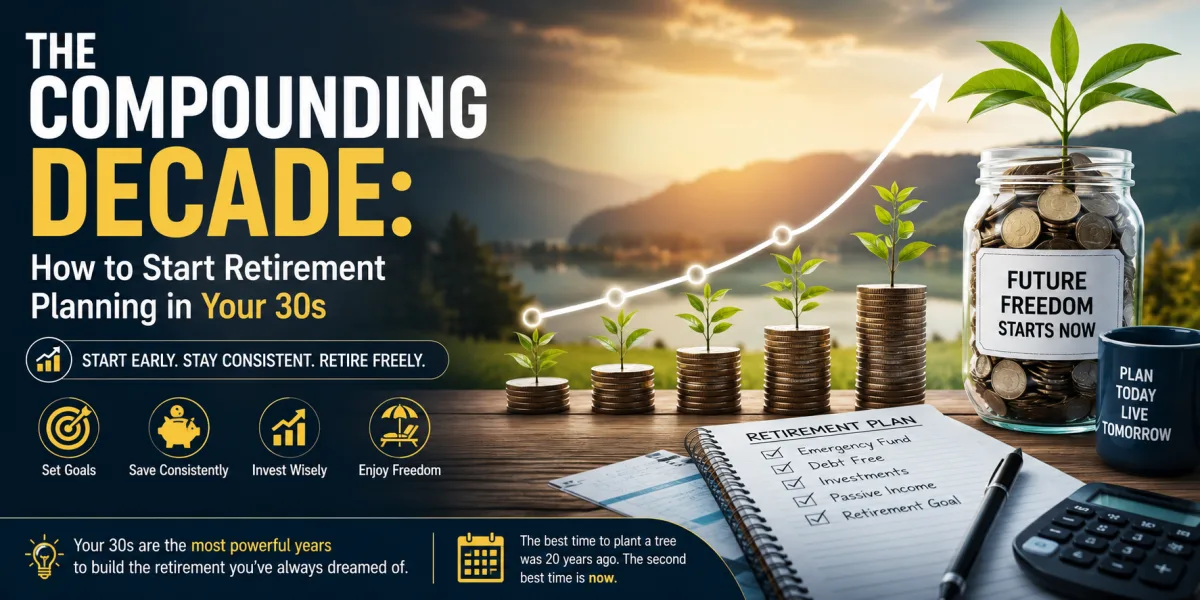
The first decade of investing may feel slow, especially for people starting with modest contributions. But this period is crucial because it builds the base, the habit, and the investor’s emotional tolerance.
During the first decade, the investor learns to contribute during good markets and bad markets. They learn that account values fluctuate. They learn that headlines are not instructions. They learn that dividends and interest can be reinvested. They learn that fees matter. They learn whether their risk tolerance is real or imagined.
Most of all, they learn to keep going.
The discipline decade is where future acceleration is purchased. The investor may not yet see the full reward, but the foundation is being built. Later, when the portfolio is larger, the same percentage return can produce larger dollar changes. The investor who quits early never reaches that stage.
Starting Late Still Matters
People who discover compounding later in life sometimes feel discouraged. They compare themselves to someone who began investing at 22 and assume the opportunity has passed. That is understandable, but unhelpful.
Starting late changes the strategy. It does not make the strategy worthless. A late starter may need a higher savings rate, delayed retirement, income growth, lower expenses, debt reduction, or more careful asset allocation. They may need to use tax-advantaged accounts aggressively and avoid speculative mistakes. But compounding still works over ten, fifteen, twenty, or twenty-five years.
The late starter should focus on what remains controllable: contribution rate, costs, taxes, diversification, debt, income, and behavior. Regret is not a financial plan. Action is.
The Wealth Lesson
Compound interest builds long-term wealth by turning time, reinvestment, and consistency into acceleration. It begins quietly. A small deposit earns a small return. That return earns more. Contributions increase the base. Reinvested dividends add fuel. Low fees preserve more of the engine. Patience allows the curve to bend upward.
But compounding is not automatic wealth. It must be protected. High-interest debt can compound against you. Fees can compound against your portfolio. Inflation can erode purchasing power. Panic selling can interrupt the process. Lifestyle inflation can prevent enough money from entering the system. Poor diversification can expose the plan to unnecessary damage.
The investor’s job is to place compounding on the right side of the ledger. Own assets instead of only obligations. Reinvest instead of constantly withdrawing. Start early if possible. Start now if early has passed. Add money consistently. Keep costs low. Use time wisely. Let the process mature.
Compounding is not a shortcut. It is the reward for refusing shortcuts.
Long-term wealth is built when ordinary dollars are given extraordinary time. The earlier they are invested, the longer they can work. The more consistently they are added, the larger the base becomes. The more patiently they are left alone, the more powerful the engine can grow.
Money does not need to move dramatically to change a life. It needs to move productively, repeatedly, and for long enough. That is the quiet force of compounding: it turns disciplined time into financial strength.
 Article
 Article
 Article
 Article
 Article
 Article
 Article
 Article