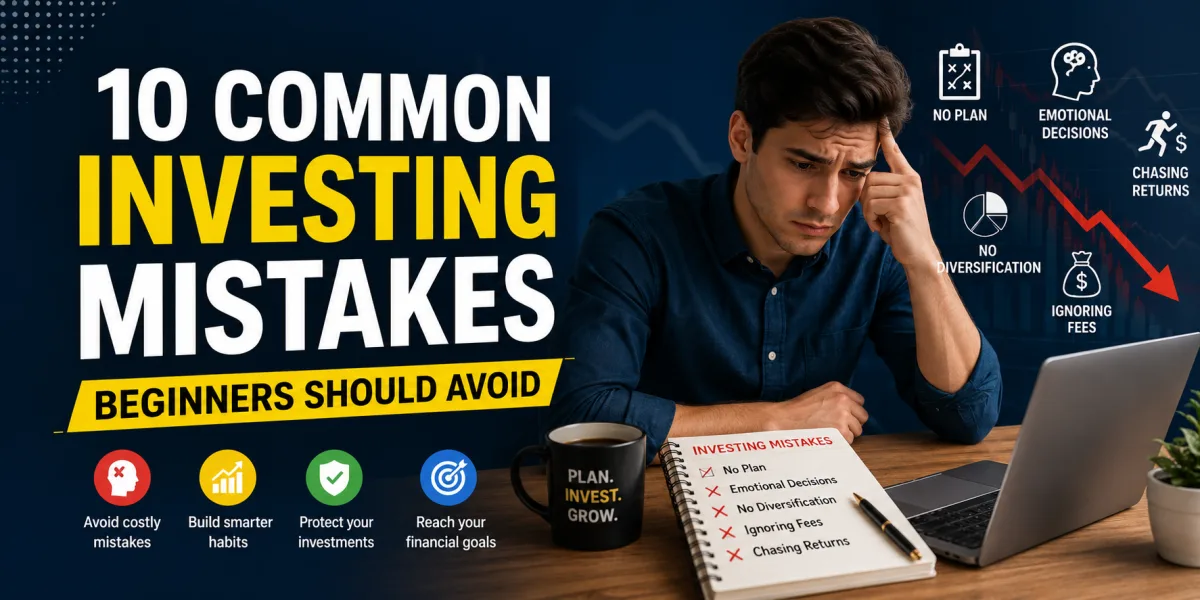
The Investor’s Guardrails: 10 Common Investing Mistakes Beginners Should Avoid
Investing is one of the most powerful tools ordinary people can use to build long-term wealth. It allows income from labor to become ownership. It turns savings into assets. It gives money the chance to compound beyond the hours a person personally works. A good investing plan can help fund retirement, financial independence, education, homeownership, generosity, and future choices.
But investing is also a place where small mistakes can become expensive when repeated for years. Beginners often lose money not because markets are impossible to understand, but because they enter without guardrails. They chase hot stocks. They confuse investing with gambling. They buy what recently went up. They ignore fees. They sell during fear. They put emergency money into volatile assets. They own five investments and assume they are diversified. They follow influencers who sound confident but have no responsibility for the outcome.
The challenge is that investing mistakes rarely announce themselves clearly in the beginning. A bad decision can look brilliant for a few months. A risky asset can rise quickly. A concentrated portfolio can outperform temporarily. A high-fee fund can hide its drag when markets are strong. A lucky trade can create overconfidence. By the time the lesson arrives, the cost may already be large.
That is why beginners need principles before predictions. The goal is not to avoid all risk. Risk is part of investing. The goal is to avoid unnecessary risk, misunderstood risk, and behavior that turns normal market volatility into permanent financial damage.
The Securities and Exchange Commission explains that asset allocation involves dividing investments among categories such as stocks, bonds, and cash, and that the allocation that works best depends on an investor’s time horizon and risk tolerance. The SEC also emphasizes diversification across and within asset categories as a way to help manage risk.
Those ideas may sound basic, but they are the foundation of intelligent investing. Beginners who understand allocation, diversification, fees, time horizon, and behavior can avoid many of the traps that damage portfolios. They do not need to predict the next winning stock. They need to build a system that can survive uncertainty.
The best investors are not mistake-free. They are mistake-aware. They design their portfolios so that one error does not destroy the plan. These ten mistakes are common because they are emotionally tempting. Avoiding them is not about being smarter than everyone else. It is about being disciplined enough not to let excitement, fear, impatience, or ego manage your money.
Mistake 1: Investing Without a Financial Foundation
The first mistake happens before the investment is even chosen. Many beginners start investing before their basic financial foundation is stable. They put money into stocks, crypto, options, or funds while having no emergency savings, high-interest debt, overdue bills, or unclear cash flow. They want growth, but they have not yet built protection.
This is dangerous because investing money is not the same as available money. If a car repair, medical bill, job loss, or rent increase arrives, the investor may be forced to sell investments at the wrong time. If the market is down, that sale turns temporary volatility into a realized loss. The investment plan is interrupted not because the investment was bad, but because the household needed liquidity.
Emergency savings protect the investment plan. Cash may feel less exciting than buying an ETF or stock, but it serves a different purpose. Cash is not there to deliver high returns. It is there to prevent forced decisions. A starter emergency fund can stop a small surprise from becoming debt. A larger emergency fund can protect against income loss or major expenses.
Beginners should also examine high-interest debt before investing aggressively. A credit card charging a high interest rate can compound against the borrower faster than a conservative portfolio can reasonably grow. Paying down expensive debt may offer a powerful guaranteed improvement to net worth and cash flow.
This does not mean every investor must be debt-free or have six months of savings before buying their first fund. Personal finance is not always linear. Some people may invest enough to capture an employer retirement match while also building savings and paying debt. Others may invest small amounts to build the habit. But the foundation must be respected.
A strong beginning sequence is simple: cover essential bills, build a starter cash buffer, avoid new high-interest debt, capture employer matching contributions if available, and then increase long-term investing as stability improves. Investing should make your financial life stronger, not more fragile.
Mistake 2: Confusing Investing with Speculation
Investing and speculation are not the same thing. Investing is the purchase of assets based on a reasonable expectation of long-term value creation, income, or productive ownership. Speculation is a bet that someone else will pay more later, often based on price movement, hype, scarcity, or emotion.
Beginners often enter markets during moments of excitement. A stock is trending. A cryptocurrency is surging. A friend claims to have doubled money quickly. A social media account posts screenshots of gains. The beginner feels that slow investing is foolish when fast money appears available.
The danger is that speculation can masquerade as investing. A person buys a stock without understanding the company, a token without understanding the network, an option without understanding time decay, or a leveraged ETF without understanding daily resets. The purchase is described as an investment, but the reasoning is hope.
Speculation is not always wrong when it is honest, limited, and affordable. Some investors set aside a very small portion of their portfolio for high-risk ideas. The problem begins when speculation becomes the foundation. Rent money, emergency savings, retirement contributions, or borrowed money should not be placed into assets the investor does not understand.
The beginner’s first job is not to get rich quickly. It is to learn how ownership, risk, diversification, and time work. A broad index fund may not create thrilling stories, but it teaches disciplined investing. A speculative trade may teach adrenaline, overconfidence, and regret.
Before buying anything, ask: what do I own, why should it increase in value, what could go wrong, how much can I lose, and how does this fit my plan? If those questions cannot be answered clearly, the purchase is not ready.
Mistake 3: Trying to Time the Market
Market timing is the attempt to move in and out of investments based on predictions about short-term market direction. Beginners often believe they will invest after the next crash, sell before the next downturn, or wait until the economy “looks better.” The idea sounds logical. Buy low, sell high. The problem is execution.
Markets do not send calendar invitations. They can rise while the news is terrible. They can fall after strong economic data. They can recover before investors feel emotionally ready. A person waiting for certainty may remain in cash while markets move ahead. A person selling during fear may miss the rebound.
Market timing requires being right twice: when to exit and when to re-enter. Many investors underestimate how difficult that is. Selling before a decline may feel smart, but buying back during panic requires courage. Waiting until conditions feel safe often means prices have already recovered.
For beginners investing for long-term goals, a more reliable approach is regular contributions. Dollar-cost averaging means investing a set amount on a schedule, such as every paycheck or every month. This does not guarantee profits or prevent losses, but it reduces the pressure to predict the perfect moment.
Time horizon matters. Money needed soon should not be invested aggressively. But money meant for retirement decades away should not be held hostage by short-term headlines. The investor’s goal is to participate in long-term growth, not win every short-term move.
Trying to time the market can feel active and intelligent. In practice, it often becomes emotional delay. A written contribution schedule is usually better than a series of guesses.
Mistake 4: Ignoring Diversification
Diversification is one of the most important protections in investing, yet beginners often misunderstand it. They think diversification means owning several things. But true diversification means owning assets that do not all depend on the same outcome.
An investor who owns five technology stocks may not be diversified. An investor who owns three funds that all hold the same large U.S. companies may not be as diversified as they think. An investor who owns a stock, a sector ETF, and a thematic ETF all tied to artificial intelligence may have multiple tickers but one underlying bet.
FINRA describes diversification as spreading investments both among and within different asset classes, such as stocks, bonds, and cash or cash equivalents. It also explains that asset allocation is the percentage of a portfolio invested in different asset classes.
Diversification works because the future is uncertain. No one knows which company, sector, country, or asset class will lead over every period. Spreading investments reduces the chance that one bad decision or one poor-performing area derails the whole plan.
This does not mean every portfolio must own everything. It means the investor should understand concentration. A total stock market fund may provide broad company exposure. An international fund may add geographic exposure. A bond fund may reduce volatility. Cash may protect short-term needs. Each asset should have a role.
Diversification does not eliminate losses. A diversified stock portfolio can still fall sharply during a bear market. But it reduces avoidable single-company and single-theme risk. Beginners should not try to build wealth by placing their entire future on one idea.
Mistake 5: Paying Too Much in Fees
Fees are quiet. That is why they are dangerous. A fee does not usually feel like a dramatic loss. It appears as a small percentage, a monthly charge, an expense ratio, an advisory fee, a transaction cost, or a spread. Over time, those small numbers can reduce the amount of money that remains invested and compounding.
The SEC warns that investment fees and expenses reduce returns and can have a major impact over time because they reduce the amount of money in the portfolio earning a return.
Beginners should understand expense ratios. An expense ratio is the annual cost of owning a fund, expressed as a percentage of assets. A fund charging 0.05 percent costs far less than a fund charging 1.00 percent. That difference may not seem large in one year, but it matters over decades.
Advisory fees also matter. Paying for good advice can be worthwhile, especially for complex financial lives. But investors should know what they are paying, how the advisor is compensated, whether the advisor is a fiduciary, and what value is being delivered. A fee should be understood, not merely accepted.
Trading costs can matter too. Many brokers advertise commission-free trading, but ETF bid-ask spreads, options costs, margin interest, and fund expenses still exist. “Free” does not always mean costless.
The solution is not to choose the cheapest product blindly. The solution is to compare costs among similar options and pay only for value that is clear. A low-cost broad index fund can be an excellent foundation. A higher-cost strategy must justify its higher hurdle.
Future returns are uncertain. Fees are one of the few things investors can see in advance. Ignoring them gives away part of the compounding engine.
Mistake 6: Chasing Past Performance
One of the most common beginner mistakes is buying whatever recently performed best. A fund had an excellent year. A stock doubled. A sector dominated headlines. A cryptocurrency surged. The beginner assumes recent performance will continue and buys after much of the move has already happened.
This is performance chasing. It feels rational because the investment has evidence of success. But markets often move in cycles. The asset that recently performed best may now be expensive, crowded, or vulnerable to disappointment. Yesterday’s winner can become tomorrow’s laggard.
Past performance can be useful for understanding volatility, strategy, and history, but it should not be treated as a promise. A fund’s recent return may reflect a temporary sector boom. A stock’s recent rise may reflect enthusiasm rather than durable earnings growth. A manager’s strong period may reflect style exposure rather than repeatable skill.
The Investment Company Institute reported that indexed mutual funds and ETFs held $21.82 trillion in assets in May 2026, while active mutual funds and ETFs held $18.75 trillion, reflecting the scale of investor use of low-cost index strategies alongside active approaches. The growth of index investing is partly a response to the difficulty of consistently selecting future outperformers in advance.
Beginners should build portfolios from goals, allocation, cost, diversification, and time horizon, not performance rankings. A fund should be chosen because it fits the plan, not because it appears near the top of a recent list.
Performance chasing often creates a damaging pattern: buy after gains, lose patience during underperformance, sell, and repeat with the next hot idea. That behavior can destroy returns even when the underlying investments are legitimate.
Mistake 7: Taking Too Much Risk Without Knowing It
Many beginners think they are comfortable with risk because they have only experienced rising markets. True risk tolerance is tested when account balances fall, headlines become frightening, and people around them panic.
Risk is not only the possibility of losing money. It is the possibility that an investment behaves differently from what the investor expected. A beginner may buy a “safe” bond fund and be surprised when it declines as interest rates rise. They may buy a dividend stock and be surprised when the dividend is cut. They may buy a sector ETF and be surprised by how concentrated it is. They may buy a leveraged product and be surprised that long-term results do not match the index multiple they expected.
FINRA reminds investors that disclosure documents explain investment risks, fees, and other details that help determine whether an investment is right for them. Reading those documents is not exciting, but it can prevent expensive misunderstandings.
Risk has several forms. Market risk is the risk that broad markets decline. Company risk is the risk that one business disappoints. Interest-rate risk affects bonds. Credit risk affects borrowers and bond issuers. Liquidity risk affects the ability to sell at a fair price. Currency risk affects international holdings. Inflation risk affects purchasing power. Concentration risk affects portfolios tied too heavily to one asset or theme.
The solution is to match risk to purpose. Money needed soon should be safer. Money invested for decades can usually accept more volatility. Speculative positions should be small. Emergency funds should not be invested in volatile assets.
A portfolio should be built for the investor’s worst emotional day, not only their most confident one.
Mistake 8: Trading Too Often
Modern investing apps make trading easy. A person can buy or sell with a few taps. Prices update constantly. News alerts arrive all day. Charts are colorful. The account begins to feel like a game.
But frequent trading can damage beginners in several ways. It encourages short-term thinking. It increases the temptation to react to headlines. It may create taxable gains in taxable accounts. It can lead to buying and selling based on emotion rather than strategy. It can make investing feel like entertainment instead of ownership.
Frequent trading also creates the illusion of control. Doing something feels productive. But in investing, activity and progress are not the same. A person can make many trades and become poorer. Another person can buy a diversified portfolio, contribute regularly, rebalance occasionally, and build wealth quietly.
The problem is not that selling is always wrong. Investments should be sold when they no longer fit the plan, when a thesis changes, when rebalancing is needed, when taxes are being managed thoughtfully, or when the goal requires cash. The problem is trading without a plan.
Beginners should write down why they bought each investment and what would justify selling. Without those rules, every market move becomes a temptation. A long-term portfolio should not be managed like a live sports score.
Patience is not passive when it is intentional. It is a strategy.
Mistake 9: Ignoring Taxes
Taxes are not the first thing a beginner should obsess over, but ignoring them entirely can be costly. Taxes affect account choice, investment location, trading behavior, dividends, interest, capital gains, and withdrawals.
A retirement account, such as a 401(k), IRA, or Roth IRA, may provide tax advantages that support long-term compounding. For 2026, the IRS announced that the employee contribution limit for 401(k), 403(b), most 457 plans, and the federal Thrift Savings Plan increased to $24,500, while the IRA contribution limit increased to $7,500.
In taxable brokerage accounts, selling an investment for a gain can create capital gains taxes. Dividends and bond interest may also be taxable. Frequent trading can produce short-term gains, which may be taxed less favorably than long-term gains depending on the investor’s situation and tax law.
Tax efficiency does not mean avoiding taxes at all costs. A good investment should not be held forever solely to avoid a tax bill if it no longer fits the plan. But taxes should be part of the decision.
Beginners should understand the difference between retirement and taxable accounts, the value of employer matches, the potential advantages of Roth versus traditional contributions, and the tax consequences of selling investments. As portfolios grow, tax planning becomes more important.
The goal is to keep more of what the portfolio earns, legally and thoughtfully.
Mistake 10: Investing Without a Written Plan
The final mistake ties all the others together. Many beginners invest without a written plan. They own random stocks, a few funds, maybe some crypto, perhaps an old retirement account, and no clear explanation of how everything fits together. The portfolio is a collection of decisions, not a strategy.
A written investment plan does not need to be complicated. It should answer several questions. What is the money for? When will it be needed? What accounts will be used? What percentage belongs in stocks, bonds, cash, or other assets? How much will be contributed each month? What investments will be used? How often will the portfolio be reviewed? When will it be rebalanced? What behavior is forbidden?
The plan should also state what the investor will do during market declines. A plan written during calm periods can prevent panic during stressful periods. If the market falls 25 percent, will contributions continue? Will rebalancing happen? Will cash needs be protected? What investments are meant for long-term goals and should not be sold casually?
Without a plan, every headline becomes advice. Every market dip becomes a threat. Every hot stock becomes a temptation. Every friend’s success story becomes a reason to change strategy.
A written plan creates authority. It reminds the investor that the portfolio exists for personal goals, not for daily entertainment. It converts investing from reaction into process.
How Beginners Can Build Better Investing Habits
Avoiding mistakes is easier when good habits are built early. The first habit is automatic investing. Set a recurring contribution to a retirement account, brokerage account, or diversified fund. The amount can start small. The consistency matters.
The second habit is using broad diversification. A low-cost index fund or ETF can provide exposure to many companies or bonds with one purchase. This reduces the pressure to choose winners immediately.
The third habit is reading before buying. Every investment should be understood at a basic level: what it owns, what it costs, how it makes money, why it may lose value, and what role it plays.
The fourth habit is separating emergency money from investment money. Cash needed soon should not be placed into volatile assets. Long-term money can accept more risk because it has time to recover.
The fifth habit is reviewing without obsessing. A monthly or quarterly review is useful. Daily balance checking often creates unnecessary anxiety. Investing should support life, not dominate attention.
The sixth habit is increasing contributions over time. Raises, bonuses, debt payoff, side income, and reduced expenses can all fund larger investments. Wealth building accelerates when contribution rates rise.
The seventh habit is humility. Markets are competitive. No beginner should assume early luck equals skill. Humility leads to diversification, cost control, and patience.
The Beginner’s Strongest Portfolio Is Usually Simple
Beginners often believe sophistication requires complexity. They want many stocks, multiple funds, alternative assets, trading strategies, and constant updates. But a strong beginner portfolio can be simple: emergency cash, a retirement account, a diversified stock fund, perhaps a bond fund depending on risk tolerance, and regular contributions.
Simplicity is not weakness. It reduces the number of decisions that can go wrong. It makes the portfolio easier to monitor. It helps the investor stay invested. It keeps fees visible. It allows the investor to focus on saving more, earning more, and avoiding destructive debt.
As the investor learns, the portfolio can become more refined. But refinement should solve a real problem. Complexity for its own sake is not progress.
A simple plan followed for twenty years will often beat a clever plan abandoned after twenty months.
The Wealth Lesson
Investing mistakes are rarely caused by lack of intelligence. They are usually caused by impatience, overconfidence, fear, poor structure, and weak preparation.
Beginners can protect themselves by building a financial foundation before taking large risks, understanding the difference between investing and speculation, avoiding market timing, diversifying properly, keeping fees low, resisting performance chasing, understanding risk, trading less, considering taxes, and writing a plan.
These rules do not guarantee profits. No investing rules can. Markets will still decline. Some investments will disappoint. Economic cycles will change. Headlines will create fear and excitement. The future will remain uncertain.
But the right guardrails reduce avoidable damage. They help investors survive long enough for compounding to matter. They keep one mistake from becoming a financial disaster. They turn investing from a guessing game into a disciplined wealth-building process.
The beginner’s greatest advantage is not access to secret information. It is the ability to start with humility, use simple tools, avoid obvious traps, and stay consistent for a long time. Wealth is often built less by brilliant moves than by refusing to make destructive ones.
Investing rewards patience, but only if patience is attached to a sound plan. Build the plan. Respect the risks. Keep costs low. Diversify widely. Continue contributing. Let time do its work.
 Article
 Article
 Article
 Article
 Article
 Article
 Article
 Article