The Ownership Choice: Stocks vs ETFs and Which Investment Fits Your Wealth Plan
The question sounds simple: are stocks or ETFs better?
The answer is more useful when the question is reframed. Better for whom? Better for what goal? Better over what time period? Better for an investor with what level of knowledge, discipline, risk tolerance, tax situation, and available time?
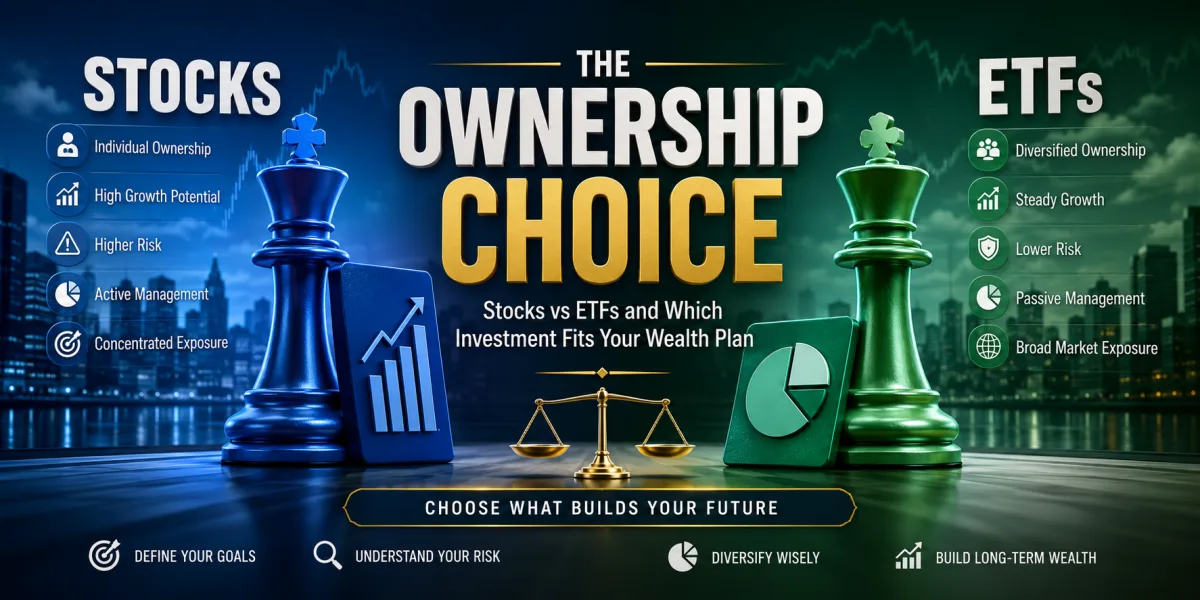
A single stock and an exchange-traded fund can both represent ownership. But they are not the same kind of ownership experience. A stock gives an investor direct exposure to one company. An ETF gives exposure to a basket of securities, often dozens, hundreds, or thousands of holdings inside one fund. One concentrates the bet. The other spreads it. One offers more control. The other offers more built-in diversification. One may produce extraordinary gains if the company performs exceptionally. The other is designed to reduce the risk that one company’s failure damages the entire plan.
The Securities and Exchange Commission explains that stocks represent ownership interests in companies, while ETFs are pooled investment vehicles that hold baskets of securities and trade on an exchange during the day. That distinction is the heart of the comparison: direct ownership of one business versus ownership of a fund that owns many assets.
For many investors, ETFs are the better foundation. They are easier to diversify, often low cost, simple to buy, and less dependent on the investor’s ability to identify winning companies. For some investors, individual stocks can play a useful role. They offer control, customization, tax-management possibilities, dividend selection, and the chance to benefit from deep knowledge of specific businesses. But individual stocks demand more judgment. They also expose the investor to company-specific risk.
The better investment is not always the one with the highest possible upside. It is the one that best serves the investor’s financial life. A portfolio is not built to win an argument. It is built to support goals: retirement, financial independence, income, education, homeownership, security, generosity, and freedom.
The stock-versus-ETF decision is therefore not a contest between good and bad. It is a decision about structure.
What You Own When You Buy a Stock
When you buy a stock, you buy a small ownership stake in a company. If the company grows profits, expands market share, increases dividends, buys back shares wisely, or earns higher investor confidence, the stock may rise. If the company disappoints, loses competitiveness, takes on too much debt, faces regulatory pressure, suffers poor management, or becomes less relevant, the stock may decline.
Individual stocks offer a clean ownership story. If you buy shares of one company, your outcome is tied directly to that company’s business results and investor expectations. This can be rewarding. Long-term shareholders in extraordinary businesses can build significant wealth. A great company purchased at a reasonable price and held for many years can outperform broad market funds dramatically.
But the same concentration that creates upside also creates danger. A company can look strong and still fail investors. Competitive advantages can erode. Technology can shift. Consumer tastes can change. Management can allocate capital poorly. Litigation, fraud, cyberattacks, debt refinancing, commodity cycles, and regulation can damage even established firms.
Owning one stock is not only owning potential. It is owning specific risk.
This is the core challenge for stock investors. To justify buying individual stocks, an investor must either have skill, insight, discipline, or a clear reason for accepting concentration risk. Buying a stock because the brand is familiar, a friend mentioned it, a social media post praised it, or the price recently rose is not a strategy. It is reaction.
What You Own When You Buy an ETF
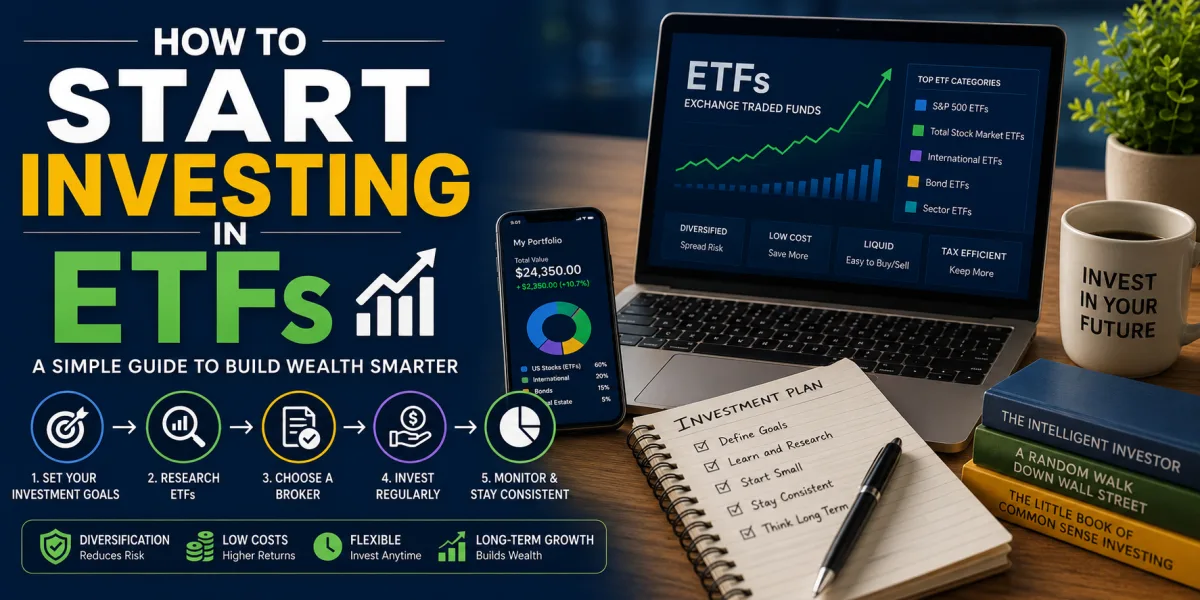
An ETF is a fund that trades on an exchange like a stock. Instead of owning one company directly, investors own shares of the ETF, and the ETF owns a portfolio of securities. Those securities may be stocks, bonds, commodities, or other assets depending on the fund.
The Investment Company Institute describes an ETF as a pooled investment vehicle whose shares can be bought or sold throughout the trading day on stock exchanges at market-determined prices. FINRA notes that most exchange-traded products are ETFs registered and regulated as investment companies, and that ETFs generally focus investments in stocks or bonds and have diversification requirements, though some commodity or currency products may have different protections.
An ETF can be broad or narrow. A total stock market ETF may hold thousands of companies. An S&P 500 ETF holds large U.S. companies represented in that index. A sector ETF may focus only on technology, energy, utilities, healthcare, financials, or real estate. A thematic ETF may focus on artificial intelligence, clean energy, cybersecurity, robotics, or electric vehicles. A bond ETF may hold government bonds, corporate bonds, municipal bonds, or high-yield debt.
The ETF wrapper does not automatically make an investment safe. A broad, low-cost stock market ETF is very different from a leveraged ETF or narrow thematic ETF. The fund’s holdings, strategy, cost, liquidity, and risks matter.
Still, ETFs solve one of the biggest problems beginners face: diversification. Instead of deciding which company will win, the investor can own a basket of companies. This can reduce the damage caused by being wrong about one stock.
The Biggest Difference: Concentration Versus Diversification
The most important difference between stocks and ETFs is concentration.
An individual stock concentrates risk in one company. An ETF usually spreads risk across many holdings. If one company inside a broad ETF struggles, its impact may be small. If the investor owns only that company directly, the impact can be large.
Diversification does not eliminate risk. A broad stock ETF can still fall sharply during a bear market. A bond ETF can decline when interest rates rise. International ETFs can be affected by currency and geopolitical risks. Sector ETFs can suffer when their industry falls out of favor.
But diversification reduces company-specific risk. It helps protect the investor from the possibility that one business performs far worse than expected.
The SEC’s investor education materials explain that asset allocation involves dividing investments among categories such as stocks, bonds, and cash, and that the allocation that works best depends on time horizon and risk tolerance. Diversification is part of that same risk-management logic: investors should understand how different assets contribute to the whole portfolio.
A beginner who owns five individual stocks may feel diversified, but that feeling can be misleading. If all five are technology companies, banks, energy producers, or consumer brands sensitive to the same economic cycle, the portfolio may still be concentrated. A broad ETF can provide wider diversification with one purchase.
This is why ETFs often make sense as the core of a portfolio. They reduce the number of things an investor must get exactly right.
The Case for ETFs
ETFs are especially attractive for investors who want broad exposure, low costs, and simplicity. A person can buy one ETF and own hundreds or thousands of securities. This is difficult to replicate efficiently with individual stocks unless the investor has significant capital, time, and discipline.
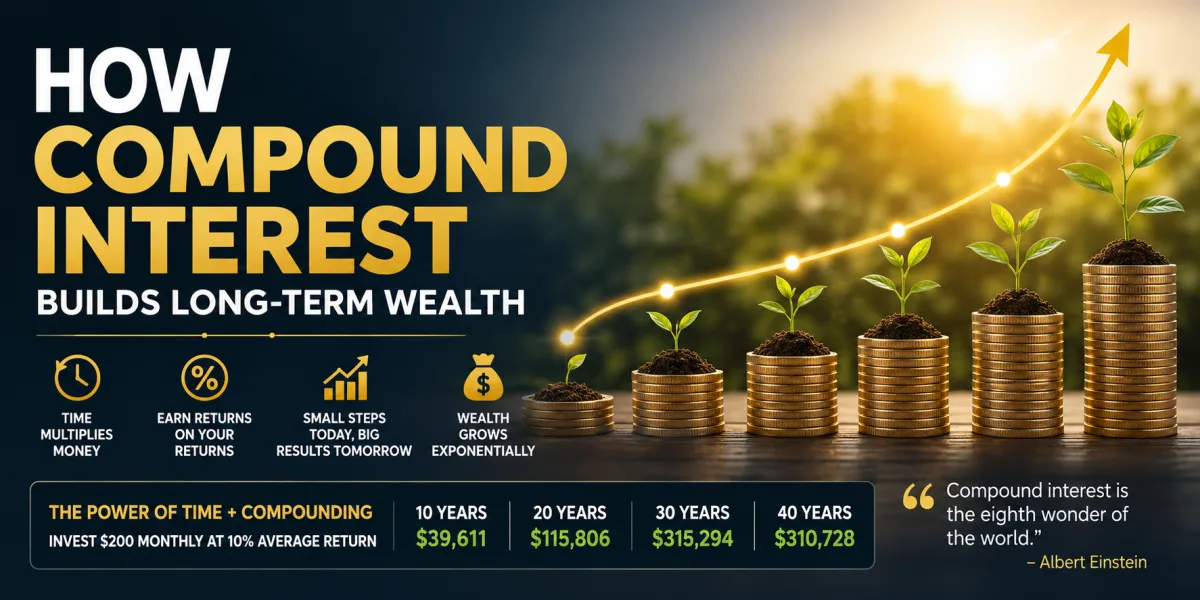
ETFs also make recurring investing easier. A worker can invest each month into a diversified fund without needing to decide which company is most attractive at that moment. This supports dollar-cost averaging, which turns investing into a habit rather than a prediction exercise.
Costs can also be low. Many broad index ETFs charge very low expense ratios because they track benchmarks rather than pay managers to select securities actively. Fees matter because every dollar paid in expenses is a dollar that cannot compound for the investor.
ETFs have also become deeply important in modern markets. The Investment Company Institute reported that U.S. ETF assets reached $15.60 trillion in May 2026, showing how widely investors and institutions now use the structure.
ETFs are not only for beginners. Professional investors, advisors, institutions, retirees, and high-net-worth households use them because they are efficient tools. A simple tool is not an unsophisticated tool. Often, simplicity is exactly what protects investors from unnecessary mistakes.
The case for ETFs is strongest when the investor wants market exposure rather than a company-specific bet. If the goal is to build long-term wealth through diversified ownership, a broad ETF may be the cleanest solution.
The Case for Individual Stocks
Individual stocks offer something ETFs cannot fully provide: direct control.
An investor who buys individual stocks decides exactly which companies to own, how much to allocate, when to buy, when to sell, and what exposures to avoid. This can be useful for investors with strong research skills, tax needs, concentrated knowledge, or a desire to build a customized portfolio.
Individual stocks also allow investors to avoid companies they do not want to own. An ETF may include hundreds of holdings, including companies the investor dislikes, considers overvalued, or believes are poor businesses. Stock selection allows more precision.
Taxes can also be more customizable with individual stocks in taxable accounts. An investor may harvest losses in specific positions, donate appreciated shares, manage holding periods, or decide which lots to sell. ETFs can also be tax-efficient, but individual securities provide more granular control.
Individual stocks can also produce extraordinary gains. A broad ETF owns the winners and the losers. A stock investor who identifies and holds a major winner can outperform. This possibility is real. It is one reason stock picking remains attractive.
But the possibility of outperformance must be weighed against the probability of mistakes. For every investor who picks a long-term compounder, many others buy companies that disappoint, overpay for popular names, sell winners too early, hold losers too long, or concentrate too heavily in familiar businesses.
Individual stocks are better suited to investors who treat them as business ownership, not entertainment.
Risk: Different Kinds, Not Just More or Less
Stocks and ETFs both carry risk, but the types of risk differ.
Individual stocks carry business risk. A company can lose customers, face lawsuits, suffer fraud, mismanage debt, lose a key executive, miss earnings expectations, or be disrupted by competitors. Even if the overall market performs well, one company can perform poorly.
ETFs reduce single-company risk when they are diversified, but they still carry market risk. If the entire stock market falls, a broad stock ETF will likely fall too. If interest rates rise, many bond ETFs may decline. If an ETF tracks a narrow sector, it can behave almost like a concentrated stock portfolio.
ETFs also have structure-specific risks. Some trade with bid-ask spreads. Some may trade at premiums or discounts to net asset value. Some use derivatives, leverage, options, or complex strategies. FINRA has warned that leveraged and inverse ETFs reset daily and are typically inappropriate as intermediate or long-term investments.
The risk question is therefore not simply, “Are stocks riskier than ETFs?” A single stock is usually more concentrated than a broad ETF. But a leveraged ETF, narrow commodity product, or speculative thematic ETF may be riskier than many individual blue-chip stocks.
Investors must look past labels. “Stock” and “ETF” describe form. The real risk comes from what is owned, how much is owned, what price is paid, how long it is held, and how the investor behaves under pressure.
Costs: Commissions, Spreads, and Expense Ratios
Costs matter in both stock and ETF investing.
Many brokers now offer commission-free trades for stocks and ETFs, but that does not mean investing is costless. ETFs charge expense ratios. This annual fee is taken from fund assets and reduces investor returns. Broad index ETFs often charge very low fees, while specialized, active, or complex ETFs may charge more.
ETFs also trade with bid-ask spreads. The spread is the difference between what buyers are willing to pay and sellers are willing to accept. Large, liquid ETFs may have very tight spreads. Thinly traded or specialized ETFs may have wider spreads, which can increase trading costs.
Individual stocks do not have expense ratios, which is one advantage. If an investor buys and holds a stock through a commission-free broker, ongoing fund fees do not apply. But stock investing has hidden costs too. Poor diversification, research time, tax mistakes, emotional trading, and opportunity cost can all be expensive.
The cheapest investment is not always the best investment. But unnecessary cost is a permanent headwind. A high-fee ETF must justify its fee. A stock portfolio must justify the additional concentration and effort.
Control Versus Convenience
Individual stocks offer control. ETFs offer convenience.
Control can be valuable. The investor chooses the exact companies, position sizes, tax lots, and sell decisions. They can avoid sectors, emphasize dividends, overweight industries they understand, or build a portfolio around a specific philosophy.
Convenience is also valuable. An ETF investor can buy broad exposure in seconds. They do not need to read every annual report, compare every balance sheet, or follow every company development. This can be especially useful for people whose wealth-building strategy depends more on consistent saving than superior security selection.
The trade-off is that control increases responsibility. If you choose every stock yourself, you are responsible for portfolio construction. You must understand diversification, valuation, earnings, debt, competitive position, taxes, and risk. If you choose an ETF, you delegate some of those decisions to the fund methodology.
Neither choice is morally superior. The right choice depends on whether the investor’s desire for control is matched by skill and discipline.
Behavior: The Hidden Deciding Factor
The best investment on paper may fail in the hands of the wrong behavior. This is where ETFs often have an advantage for ordinary investors.
Individual stocks invite stories. Stories create emotional attachment. Investors may fall in love with a company, ignore warning signs, average down without discipline, or refuse to sell because admitting a mistake hurts. They may also sell a great company too early because a quick gain feels satisfying.
ETFs can reduce some emotional pressure because the investor is not constantly judging one company’s news. A broad market ETF does not require a reaction to every earnings report. It supports a long-term system: contribute, hold, rebalance, and stay diversified.
But ETFs do not eliminate behavioral mistakes. Investors can chase hot ETFs, buy thematic funds after strong performance, panic sell broad funds during downturns, or overtrade because ETFs are easy to buy and sell.
Behavior is the bridge between investment theory and actual results. A disciplined stock investor may do well. An undisciplined ETF investor may do poorly. But for many beginners, ETFs reduce the number of decisions that can go wrong.
When ETFs Are Usually Better
ETFs are usually better when the investor wants a simple, diversified, low-maintenance portfolio. They are especially useful for beginners, busy professionals, retirement savers, investors without time for company research, and anyone who wants broad market exposure at low cost.
ETFs are also useful when the investor is building a core portfolio. A total stock market ETF, S&P 500 ETF, total international ETF, total bond ETF, or all-in-one allocation ETF can serve as a foundation. The investor can then focus on contribution rate, emergency savings, tax planning, and long-term discipline.
ETFs may also be better when the account balance is small. A person investing $100, $500, or $1,000 may struggle to diversify across individual stocks. With fractional shares this is easier than it once was, but broad ETFs still provide instant diversification.
ETFs are often better when the investor recognizes that they do not have a durable edge in stock selection. This humility is not weakness. It may be one of the most valuable traits an investor can have.
When Stocks May Be Better
Individual stocks may be better for investors who have the knowledge, temperament, time, and risk capacity to evaluate businesses. They may also be useful for taxable investors who want more precise tax control or for investors who want to build highly customized portfolios.
Stocks may fit investors who enjoy reading financial statements, studying industries, evaluating competitive advantages, and thinking in years rather than weeks. They may also fit investors who understand concentration risk and keep position sizes reasonable.
Stocks can be useful for dividend-focused investors who want to select companies based on payout history, balance sheet strength, cash flow, and dividend growth. But even dividend investors must avoid yield traps. A high dividend yield can signal danger if the market expects a cut.
Individual stocks may also be appropriate as a satellite portion around an ETF core. For example, an investor might keep 80 percent or 90 percent of the portfolio in diversified ETFs and use a smaller portion for selected individual companies. This allows learning and potential outperformance without putting the entire financial plan at risk.
The key is position sizing. A stock portfolio can be exciting, but excitement should not endanger retirement security.
The Core-and-Satellite Approach
For many investors, the best answer is not stocks or ETFs. It is both, used differently.
A core-and-satellite strategy uses diversified ETFs as the foundation and individual stocks as smaller satellites. The core provides broad market exposure and stability. The satellites provide customization, learning, conviction, or targeted opportunities.
For example, an investor might hold a broad U.S. stock ETF, international stock ETF, and bond ETF as the core. Around that, they might own a few individual companies they understand well. If one stock disappoints, the core still protects the main plan. If one stock performs exceptionally, it can contribute meaningfully without requiring the whole portfolio to depend on it.
This structure helps balance humility and conviction. The investor admits they may not consistently beat the market but still allows room for selected ideas.
The satellite portion should be sized honestly. A beginner may limit individual stocks to 5 percent or 10 percent of the portfolio. A more experienced investor may allocate more. But the higher the stock allocation, the more responsibility the investor accepts.
Taxes: ETFs and Stocks in Taxable Accounts
Taxes can affect the stock-versus-ETF decision, especially outside retirement accounts.
ETFs, particularly broad index ETFs, are often tax-efficient because of their structure and low turnover. They may distribute fewer capital gains than many actively managed mutual funds. However, ETF investors can still owe taxes on dividends, interest distributions, and gains when shares are sold.
Individual stocks provide tax-lot control. Investors can choose which shares to sell, harvest losses in specific companies, donate appreciated shares, or hold winners to defer capital gains. This can be valuable for taxable investors with larger portfolios.
But tax control only helps if the investor manages it well. Holding a losing stock solely for tax reasons can be a mistake. Selling a strong investment only to harvest a small tax benefit can also be misguided. Taxes matter, but investment quality and portfolio risk matter too.
Inside retirement accounts, many tax differences matter less because trades do not typically create current taxable events. In those accounts, the decision may rest more heavily on diversification, cost, and strategy.
Income: Dividend Stocks Versus Dividend ETFs
Income investors often compare dividend stocks and dividend ETFs. Dividend stocks allow investors to select companies with specific payout histories, yields, industries, and dividend growth records. Dividend ETFs provide diversified income exposure through a basket of companies.
A dividend-stock portfolio may offer more control. The investor can avoid companies with weak balance sheets, select dividend growers, and manage income timing. But individual dividend stocks can cut payouts. If the portfolio is concentrated, one cut can meaningfully reduce income.
A dividend ETF spreads income across many companies, reducing the damage from one company’s cut. But the investor accepts the fund’s methodology, holdings, expense ratio, sector exposure, and distribution pattern. Some high-yield ETFs may own companies with elevated risk.
Income investors should not choose only by yield. A 7 percent yield that is unsustainable may be worse than a 3 percent yield that grows steadily. Dividend safety depends on earnings, free cash flow, debt, industry conditions, and management discipline.
ETFs often provide safer diversification for income-focused beginners. Individual dividend stocks may suit investors willing to analyze payout quality company by company.
Performance: Why the Answer Is Harder Than It Looks
It is easy to find individual stocks that beat ETFs over a past period. It is also easy to find stocks that collapsed, stagnated, or underperformed for years. The problem is not identifying yesterday’s winners. The problem is identifying tomorrow’s winners in advance and holding them through uncertainty.
A broad ETF will not usually produce the best possible return because it owns both winners and losers. But it also avoids the worst possible outcome of choosing the wrong single company. It aims for market exposure, not heroic outperformance.
This is why the “which is better?” question can mislead. Stocks have higher potential dispersion. Some individual stocks will do far better than the market. Some will do far worse. Broad ETFs reduce that dispersion. They trade some upside concentration for broader reliability.
Investors should ask whether they need extraordinary outperformance or whether they need a high-probability path to funding goals. For most households, the second is more important.
Time Commitment
Individual stocks require ongoing research. A serious stock investor should read annual reports, earnings releases, conference call transcripts, balance sheets, income statements, cash flow statements, industry news, competitor results, and management commentary. They should monitor valuation and thesis changes.
ETF investing requires less company-level work. The investor still needs to understand the fund’s objective, cost, holdings, risks, and role in the portfolio. But they do not need to follow every company inside a broad fund.
This matters because time is scarce. A doctor, teacher, engineer, small business owner, parent, or busy professional may earn more by focusing on career and using ETFs for investing than by trying to become a part-time stock analyst. For many people, the highest-return use of time is increasing income, saving more, and investing simply.
Stock picking can be intellectually rewarding. But it should not be confused with necessary work. Many investors can build wealth without it.
Emotional Experience
Owning individual stocks can be emotionally intense. A single earnings report can move the position sharply. A product launch, lawsuit, analyst downgrade, executive departure, or recession fear can affect the stock. The investor may feel forced to decide whether each piece of news matters.
ETFs can make investing less personal. A broad fund does not depend on one CEO, one product, or one quarterly result. This can reduce stress and make long-term holding easier.
However, ETFs can create their own emotional challenges. Broad market declines still hurt. Watching a diversified portfolio fall during a bear market can be painful. The investor may wonder whether “the market” itself is broken.
The right investment is one the investor can hold through discomfort. A theoretically superior strategy is useless if the investor abandons it at the worst moment.
Beginner Investors: Start with ETFs
For most beginners, ETFs are the better starting point. They offer diversification, low cost, accessibility, and simplicity. A beginner usually has more to gain from learning asset allocation, contribution habits, emergency savings, tax-advantaged accounts, and market behavior than from trying to select winning stocks immediately.
A simple ETF portfolio can begin with one broad stock market ETF, a total world stock ETF, a target allocation ETF, or a few funds covering U.S. stocks, international stocks, and bonds. The exact choice depends on goals and risk tolerance.
Once the foundation is built, the investor can learn about individual stocks with a small portion of the portfolio if desired. This creates room for education without making the entire financial plan depend on beginner stock selection.
The goal at the beginning is not to prove brilliance. It is to become consistent.
Experienced Investors: Stocks Can Add Precision
Experienced investors may use individual stocks to express high-conviction views, customize taxes, build dividend portfolios, avoid unwanted exposures, or concentrate in businesses they understand deeply.
But experience should increase humility, not overconfidence. Markets are competitive. Public companies are studied by professionals with access to information, models, management teams, and industry data. An individual investor can still succeed, but they should know what game they are playing.
A good stock investor has a process. They define what they buy, why they buy, what would prove them wrong, how large a position can become, when they rebalance, and how they handle taxes. They do not buy randomly and call it conviction.
For experienced investors, stocks may improve customization. ETFs may still remain the core.
Retirement Investors: Reliability Matters
Retirement investing rewards reliability more than excitement. A retirement portfolio must survive decades, market cycles, inflation, withdrawals, taxes, and emotional stress.
For retirement savers, diversified ETFs often make sense because they provide broad exposure with low maintenance. Target-date funds, total market ETFs, bond ETFs, and balanced ETF portfolios can all support retirement planning.
Individual stocks can play a role, but concentration risk deserves caution. A retiree or near-retiree heavily dependent on a few stocks may face unnecessary danger. If one company cuts its dividend or declines sharply, income and capital can suffer.
Retirement portfolios should be built around asset allocation, withdrawal needs, tax strategy, and risk control. Whether stocks are included should depend on the plan, not excitement about a company.
The Danger of False Simplicity
“Stocks vs ETFs” sounds like a simple either-or decision, but the real issue is portfolio design.
A portfolio of twenty random individual stocks may be less diversified than one broad ETF. A portfolio of five narrow ETFs may be more concentrated than a portfolio of ten carefully selected stocks across sectors. A low-cost broad ETF may be conservative relative to a leveraged ETF. A single stock may be stable relative to a speculative thematic fund, but still concentrated.
Labels are not enough. Investors must understand holdings, risk, cost, liquidity, taxes, and behavior.
The better question is: what role does this investment play?
If it is the core of long-term wealth building, broad ETFs often deserve priority. If it is a high-conviction satellite, individual stocks may fit. If it is short-term speculation, neither label makes it safe. If it is income, sustainability matters. If it is retirement money, diversification matters. If it is taxable money, tax efficiency matters.
A Practical Decision Framework
Choose ETFs if you want broad diversification, low maintenance, low costs, and a simple long-term plan. Choose ETFs if you are a beginner, busy, unsure how to analyze companies, or more interested in building wealth than beating the market.
Choose individual stocks only if you understand the business, accept company-specific risk, have a process for research and valuation, and can size positions responsibly. Choose stocks if you want customization and are prepared for the work that direct ownership requires.
Use both if you want a diversified foundation with room for selected convictions. Keep the ETF core large enough that individual stock mistakes cannot derail the plan.
A reasonable structure for many investors is to keep 80 percent to 100 percent of long-term equity exposure in diversified ETFs or index funds, with 0 percent to 20 percent in individual stocks depending on skill and interest. Some investors should stay entirely with ETFs. Others may responsibly hold more individual stocks. The right percentage is personal.
The allocation should reflect humility, not ego.
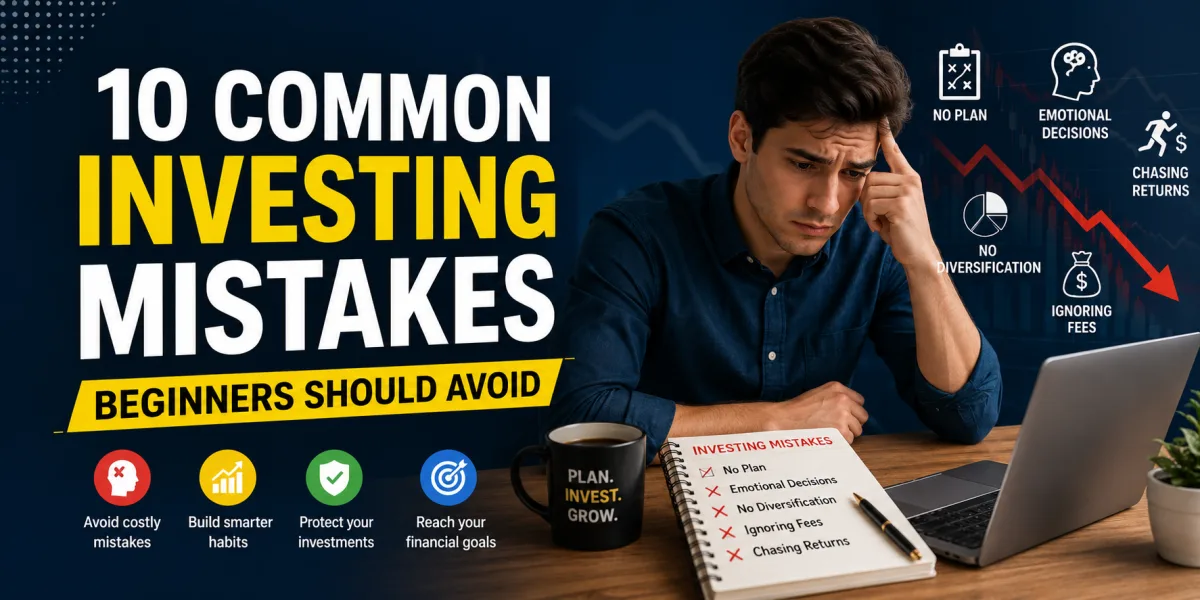
Common Mistakes Investors Make
The first mistake is thinking ETFs are automatically safe. A leveraged, inverse, narrow, or speculative ETF can be highly risky.
The second mistake is thinking individual stocks are automatically better because they have no expense ratio. A stock has no fund fee, but concentration risk can be far more costly than a small ETF expense ratio.
The third mistake is buying too many overlapping ETFs. Owning several funds that all hold the same large companies may create the illusion of diversification without the reality.
The fourth mistake is treating familiar companies as safe investments. A familiar brand can still be overvalued, poorly managed, or vulnerable.
The fifth mistake is chasing recent performance. Whether it is a hot stock or a hot ETF, buying after a run-up without understanding risk can lead to disappointment.
The sixth mistake is ignoring taxes. Frequent trading in taxable accounts can create short-term gains and tax drag.
The seventh mistake is investing without a time horizon. Money needed soon should not be exposed heavily to stock-market volatility.
The eighth mistake is changing strategy during market stress. A plan abandoned in a downturn was not a plan; it was a preference for rising markets.
So, Which Investment Is Better?
For most investors, broad ETFs are better as the foundation. They are diversified, efficient, accessible, and easier to manage. They help investors participate in market growth without requiring them to identify winning companies. They reduce company-specific risk and support consistent investing.
Individual stocks may be better as a supplement for investors with knowledge, discipline, and a desire for customization. They can create higher returns, more control, and more tailored portfolios. But they also create more responsibility and more risk.
The best answer is not universal. A beginner saving for retirement may be best served by low-cost diversified ETFs. A business-savvy investor with a strong process may add individual stocks. A retiree needing reliable income may use dividend ETFs and selected stocks carefully. A high-income taxable investor may combine ETFs with individual securities for tax strategy. A busy professional may choose ETFs entirely and focus energy on earning more and saving consistently.
Better means better suited to the investor’s life.
The Wealth Lesson
Stocks and ETFs are not enemies. They are different ways to own assets.
Stocks offer precision, control, and the possibility of exceptional returns. They also expose the investor to the risk of being wrong about a company. ETFs offer diversification, simplicity, and efficient market exposure. They also require understanding the fund’s holdings, cost, and strategy.
The investor’s job is not to choose the investment that sounds smartest. It is to choose the structure that supports the plan. A sound portfolio should be diversified enough to survive mistakes, inexpensive enough to compound efficiently, simple enough to maintain, and aligned with the investor’s goals and temperament.
For many people, ETFs should form the core. Individual stocks, if used, should be chosen carefully and sized responsibly. The foundation should not depend on excitement. It should depend on durable principles: diversification, cost control, time horizon, risk management, tax awareness, and disciplined behavior.
The market will always reward some stock pickers and humble others. It will always create new ETFs, new themes, new stories, and new temptations. The wealth builder does not need to chase all of them. The wealth builder needs a system that can survive uncertainty.
In that system, ETFs often provide the base. Stocks may provide selected conviction. The better investment is the one that helps you stay invested, manage risk, and build wealth without letting ego write the portfolio.
 Article
 Article
 Article
 Article
 Article
 Article
 Article
 Article