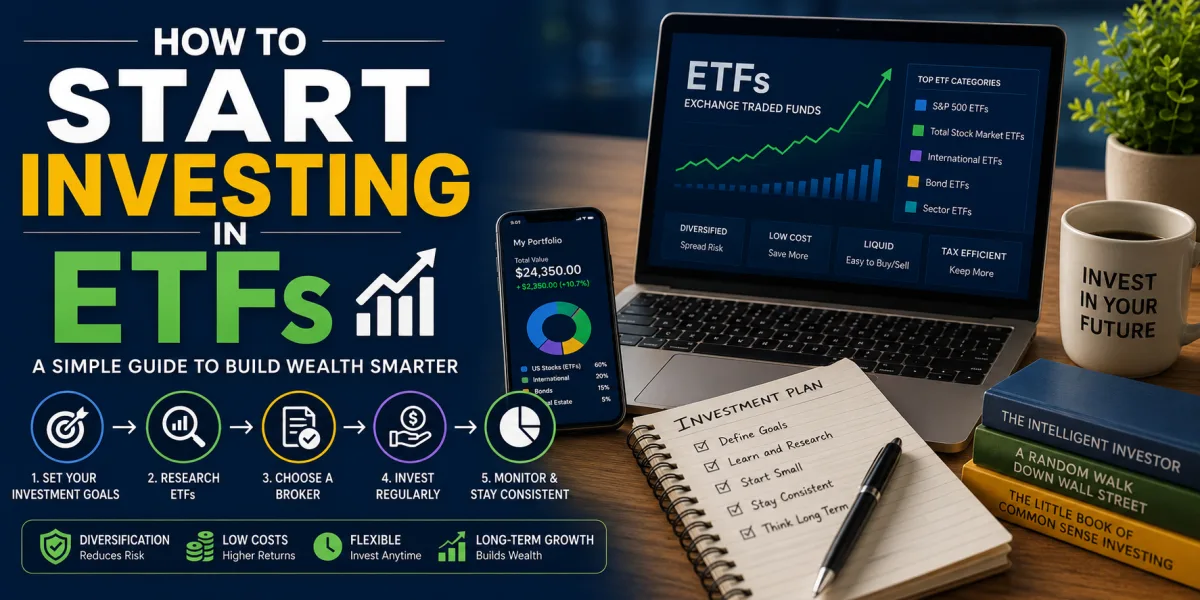
The ETF Starting Line: How New Investors Can Build Wealth with Exchange-Traded Funds
Exchange-traded funds, better known as ETFs, have changed the way ordinary investors build portfolios. A person no longer needs to buy dozens of individual stocks, call a broker, pay high commissions, or study every company in an industry to get diversified market exposure. With one ETF, an investor can own a basket of stocks, bonds, real estate securities, commodities, or other assets. With a few carefully chosen ETFs, an investor can build an entire long-term portfolio.
That simplicity is the great promise of ETFs. It is also the great danger. Because ETFs are easy to buy, investors can mistake access for understanding. A fund with a familiar ticker can hide concentration risk. A low price per share can be confused with a cheap valuation. A high dividend yield can signal danger. A leveraged ETF can look like a shortcut and behave like a trap. A thematic ETF can tell an exciting story while charging higher fees and exposing investors to narrow trends.
ETFs are tools. Used well, they can help investors lower costs, diversify broadly, invest consistently, and participate in long-term wealth creation. Used carelessly, they can become vehicles for speculation, overtrading, and false confidence.
The growth of ETFs shows how important they have become. The Investment Company Institute reported that the combined assets of U.S. exchange-traded funds reached $15.60 trillion in May 2026. That scale reflects how deeply ETFs have moved into retirement accounts, brokerage portfolios, institutional strategies, and everyday investing.
For a new investor, the question is not whether ETFs are popular. The question is how to use them intelligently. The best ETF strategy is usually not complicated. It begins with understanding what an ETF owns, why you are buying it, how much it costs, how it fits into your portfolio, and whether you can hold it through market declines.
Investing is not a contest to find the cleverest ticker. It is a process of turning savings into ownership, managing risk, and allowing time to work. ETFs can make that process simpler, but they do not remove the need for discipline.
What Is an ETF?
An ETF is an investment fund that trades on an exchange, like a stock. Instead of buying one company, the investor buys shares of a fund that holds a portfolio of assets. Those assets might include hundreds of U.S. stocks, international stocks, government bonds, corporate bonds, real estate investment trusts, commodities, or a narrower set of securities tied to a sector or strategy.
The Securities and Exchange Commission explains that ETFs are pooled investment vehicles that hold a basket of securities, and that investors buy and sell ETF shares on an exchange at market prices during the trading day.
This structure gives ETFs a hybrid quality. Like mutual funds, they provide pooled diversification. Like stocks, they can be bought and sold throughout the market day. That combination is one reason ETFs have become so popular.
For example, a total U.S. stock market ETF may hold thousands of companies across technology, healthcare, financials, consumer goods, industrials, utilities, energy, and other sectors. A bond market ETF may hold government and corporate bonds with different maturities. A global ETF may hold companies from many countries. Instead of building those portfolios manually, the investor can buy one fund.
This does not mean every ETF is diversified. Some ETFs are broad. Others are narrow. A fund holding the entire U.S. stock market is very different from a fund holding only cybersecurity companies, uranium miners, electric vehicle suppliers, or a leveraged bet on a single index. The word “ETF” describes the wrapper, not the quality of the investment inside.
Why ETFs Became So Popular
ETFs solved several problems for investors. First, they made diversification easier. A person with a modest amount of money could buy one ETF and own exposure to hundreds or thousands of securities. That helped reduce the risk of relying too heavily on one company.
Second, many ETFs are low cost. Vanguard states that its average ETF expense ratio is 0.04 percent compared with an industry average ETF expense ratio of 0.23 percent, using asset-weighted averages and excluding Vanguard from the industry average. Costs matter because every dollar paid in fees is a dollar that cannot compound for the investor.
Third, ETFs are transparent. Many ETFs disclose holdings regularly, allowing investors to see what they own. This is helpful because a fund name can be misleading unless the investor checks the actual portfolio.
Fourth, ETFs are accessible. Many brokerage platforms now allow commission-free ETF trades and fractional shares, making it easier for investors to start with small amounts. Accessibility, however, is not the same as wisdom. The same ease that helps a disciplined investor automate purchases can tempt an impatient investor into constant trading.
Fifth, ETFs are flexible. They can be used for long-term portfolios, retirement accounts, taxable accounts, income strategies, short-term cash management, sector exposure, or risk management. This flexibility is useful, but it also means ETF menus now include products that are inappropriate for many beginners.
ETF Versus Mutual Fund
ETFs and mutual funds are both pooled investment vehicles. Both can hold stocks, bonds, or other assets. Both can be actively managed or track an index. Both can provide diversification. The differences are mostly in how they trade, how they are priced, and how investors use them.
A mutual fund is usually bought or sold once per day at the fund’s net asset value after the market closes. An ETF trades throughout the day at market prices. This means an ETF investor can place market orders, limit orders, and intraday trades, while a mutual fund investor typically transacts at the end-of-day price.
ETFs often have lower minimum investment requirements because the investor can buy as little as one share, or a fractional share where supported. Mutual funds may have minimums, though many large providers now offer low or no minimums for certain funds.
ETFs can be more tax-efficient than traditional mutual funds in taxable accounts because of the way many ETFs create and redeem shares. This does not mean ETFs are tax-free. Dividends, interest, capital gains distributions, and sales of ETF shares can still create tax consequences.
Mutual funds can still be excellent tools, especially inside retirement accounts or automatic investment plans. Some investors prefer mutual funds because they discourage intraday trading and make automation easier. Others prefer ETFs because of lower costs, flexibility, and tax efficiency.
The better choice depends on the investor’s account type, behavior, fund options, costs, and need for automation. The structure matters, but the underlying investment strategy matters more.
Index ETFs Versus Actively Managed ETFs
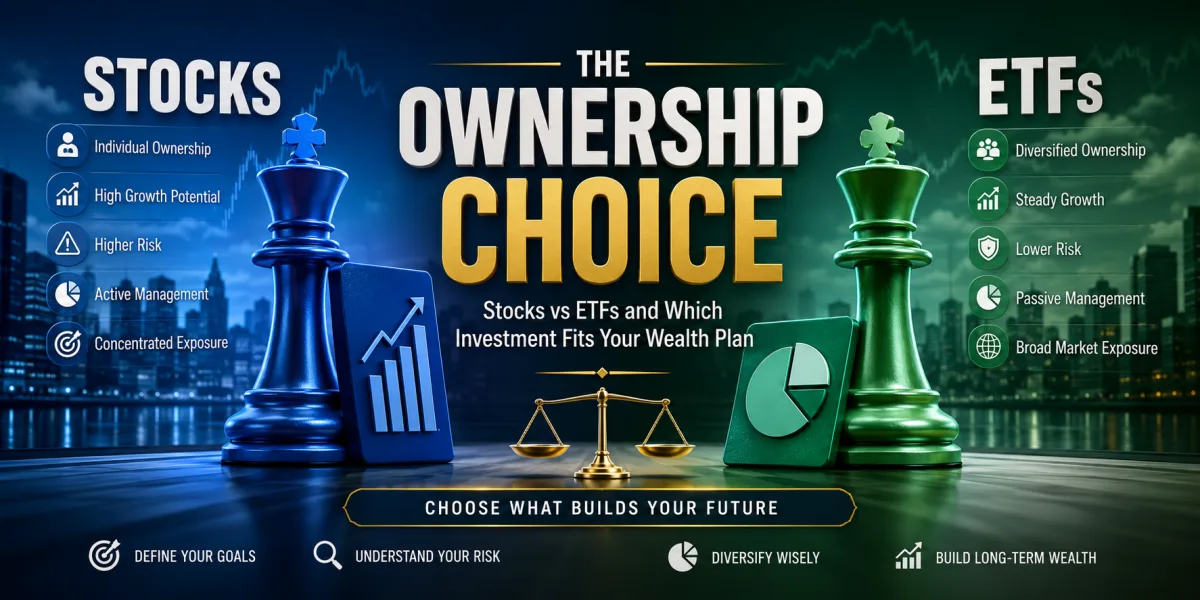
Many ETFs track indexes. An index ETF attempts to follow a benchmark such as the S&P 500, total U.S. stock market, total bond market, international developed markets, emerging markets, or a specific sector index. The fund does not try to pick winners. It tries to mirror the index.
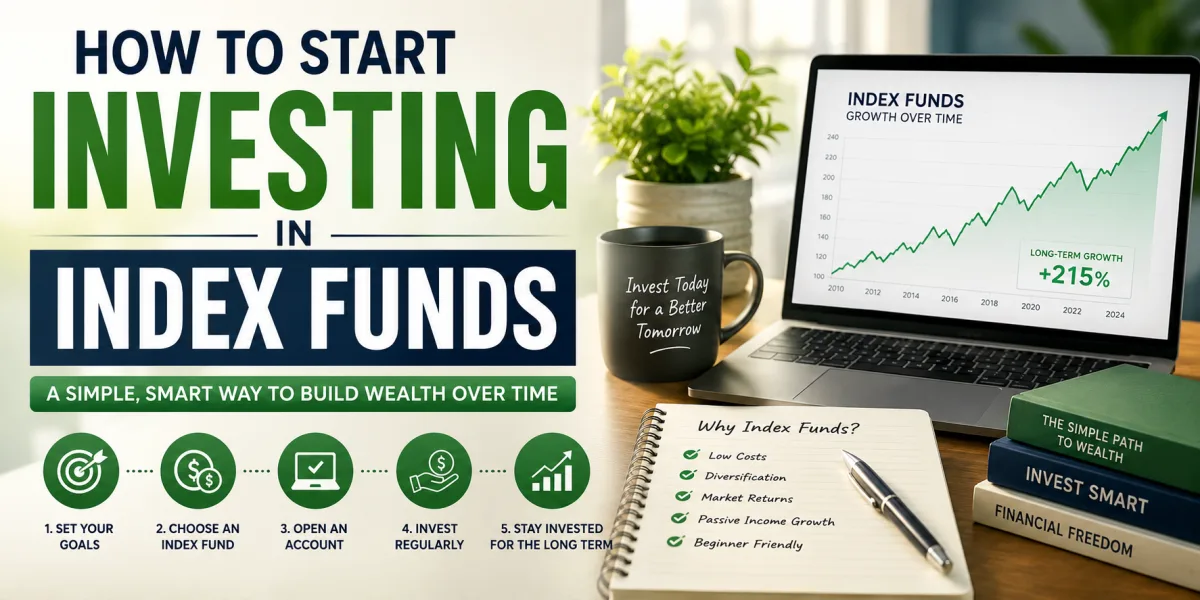
Index ETFs are popular because they tend to be low cost, transparent, and diversified. They are built on a simple idea: instead of trying to beat the market, own the market at a low cost.
Actively managed ETFs are different. Their managers choose securities based on research, strategy, judgment, or quantitative models. Some active ETFs focus on bonds, income, factor strategies, options, themes, or stock selection. They may charge higher fees and may outperform or underperform their benchmarks.
Active ETFs are not automatically bad. Some may be useful, especially in areas where active management has a clearer role, such as certain fixed-income markets. But beginners should understand what they are buying. A broad index ETF and a concentrated active ETF may both be ETFs, but they carry very different risks.
For most new investors, low-cost broad index ETFs are usually the cleanest starting point because they reduce the number of decisions that can go wrong.
The Core ETF Categories
Most ETF portfolios are built from a few broad categories.
U.S. stock ETFs hold shares of American companies. Some track the entire U.S. market. Others track large-cap, mid-cap, small-cap, growth, value, dividend, or sector indexes. A total U.S. market ETF is often a strong core holding because it gives exposure to thousands of companies.
International stock ETFs hold companies outside the investor’s home country. Some focus on developed markets such as Europe, Japan, Canada, and Australia. Others focus on emerging markets such as India, Brazil, Taiwan, South Africa, or parts of Southeast Asia. International exposure can improve diversification because not all countries and markets perform the same way at the same time.
Bond ETFs hold debt securities. They can include U.S. Treasury bonds, municipal bonds, corporate bonds, high-yield bonds, inflation-protected bonds, international bonds, or short-term cash-like instruments. Bond ETFs can provide income and reduce volatility, but they still carry interest-rate risk, credit risk, and inflation risk.
Sector ETFs focus on one slice of the economy, such as technology, healthcare, financials, energy, utilities, consumer staples, real estate, or industrials. They can be useful for targeted exposure but are usually too narrow to serve as a beginner’s core portfolio.
Thematic ETFs focus on trends such as artificial intelligence, clean energy, robotics, cybersecurity, genomics, electric vehicles, space, or blockchain. They can be exciting but often concentrate risk in companies tied to a story. A good story is not the same as a good investment.
Commodity ETFs may track gold, silver, oil, agricultural products, or broad commodity indexes. They behave differently from stock and bond ETFs and can be volatile. They are not necessary for every beginner.
Leveraged and inverse ETFs attempt to deliver multiples of daily index returns or the opposite of daily index returns. FINRA warns that leveraged and inverse ETFs reset daily and are typically inappropriate as intermediate or long-term investments. Beginners should generally avoid them.
Expense Ratios: The Fee That Quietly Compounds
The expense ratio is the annual fee charged by the fund, expressed as a percentage of assets. If an ETF has a 0.05 percent expense ratio, the annual cost is 50 cents per $1,000 invested. If an ETF has a 0.75 percent expense ratio, the cost is $7.50 per $1,000. That difference may look small, but over decades it can matter.
Costs reduce returns. The investor does not usually receive a bill for the expense ratio. Instead, the fee is taken from fund assets, which lowers the investor’s return over time. This invisibility makes expense ratios easy to ignore.
A low-cost ETF is not automatically good, but all else equal, lower costs are an advantage. Broad index ETFs often charge very low expense ratios because they track simple benchmarks and operate at scale. Narrow, active, thematic, leveraged, or complex ETFs often charge more.
Investors should compare expense ratios among similar funds. A total market ETF charging 0.03 percent and another charging 0.30 percent may offer similar exposure with very different costs. Paying more can make sense only if the fund provides something meaningfully better.
The fee question should always be: what am I paying for, and is it worth it?
Bid-Ask Spreads and Trading Costs
ETFs trade like stocks, which means there is usually a bid price and an ask price. The bid is what buyers are willing to pay. The ask is what sellers are willing to accept. The difference is the bid-ask spread.
For large, heavily traded ETFs, the spread may be very small. For thinly traded or specialized ETFs, the spread may be wider. A wide spread is a hidden trading cost because buying at the ask and selling at the bid can reduce returns.
Beginners should use limit orders rather than market orders, especially for less liquid ETFs. A limit order lets the investor set the maximum price they are willing to pay or the minimum price they are willing to accept. This can prevent unpleasant surprises in fast-moving markets.
It is also wise to avoid trading ETFs in the first few minutes after the market opens or just before the market closes, when spreads can be wider and prices more volatile. Long-term investors do not need perfect execution, but they should avoid careless trading.
Tracking Error and Premiums or Discounts
An ETF’s market price can differ slightly from the value of the assets it holds, known as net asset value. When the ETF trades above its net asset value, it trades at a premium. When it trades below, it trades at a discount.
For large liquid ETFs holding liquid securities, premiums and discounts are usually small. For ETFs holding less liquid assets, international securities during closed foreign market hours, bonds, commodities, or niche exposures, premiums and discounts can be wider.
Tracking error measures how closely an ETF follows its benchmark. A fund designed to track an index may underperform slightly because of expenses, trading costs, sampling methods, taxes, or market structure. For most broad index ETFs, tracking error is usually modest. For complex ETFs, it can be more meaningful.
New investors do not need to become ETF mechanics, but they should understand that an ETF is not simply a ticker. It is a vehicle with market pricing, underlying assets, trading costs, and operational structure.
How ETFs Create Diversification
Diversification means spreading risk. If an investor owns one company, that investor is exposed to company-specific risk: bad management, lawsuits, declining sales, fraud, disruption, debt problems, or industry shocks. If the investor owns hundreds or thousands of companies through a broad ETF, one company’s failure has less impact.
Diversification does not eliminate risk. A total stock market ETF can still fall sharply in a bear market. A bond ETF can decline when interest rates rise. An international ETF can suffer from currency movements, geopolitics, or weak foreign markets. But diversification reduces the risk that one holding destroys the entire plan.
There are several layers of diversification. Company diversification spreads exposure across many businesses. Sector diversification spreads exposure across industries. Geographic diversification spreads exposure across countries. Asset-class diversification spreads exposure across stocks, bonds, cash, real estate, and other assets.
Many beginners think they are diversified because they own several ETFs. But if all those ETFs hold similar large U.S. technology companies, the portfolio may not be as diversified as it appears. The holdings matter more than the number of funds.
A simple portfolio can be more diversified than a complicated one. A total U.S. stock market ETF, total international stock ETF, and total bond market ETF can provide broad exposure with only a few holdings. Complexity is not the same as sophistication.
Asset Allocation: The Real Portfolio Decision
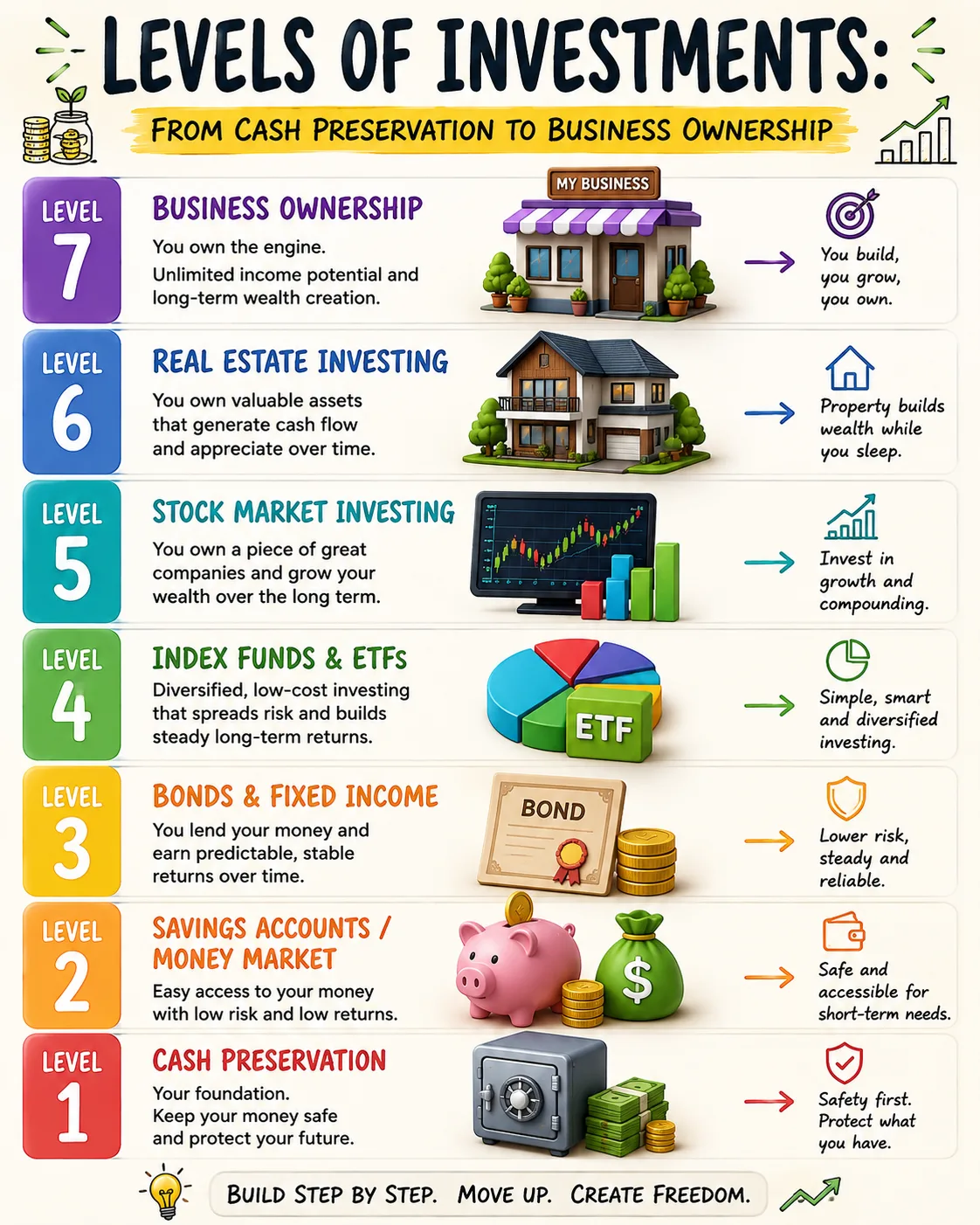
Asset allocation is the mix of stocks, bonds, cash, and other investments in a portfolio. It is one of the most important decisions an investor makes because it drives both risk and expected return.
A young investor with decades until retirement may hold a higher percentage in stock ETFs because they have time to ride out volatility. A retiree depending on portfolio withdrawals may hold more bonds and cash to reduce the risk of selling stocks during a downturn. A person saving for a house in two years should not treat stock ETFs as a safe place for the down payment.
Stocks offer growth potential but can decline sharply. Bonds can provide income and stability but are not risk-free. Cash provides safety and flexibility but may lose purchasing power after inflation. The right mix depends on time horizon, income stability, goals, risk tolerance, and emotional capacity.
An investor’s true risk tolerance is often discovered during market declines. It is easy to say you can handle volatility when markets are rising. It is harder when your portfolio is down 25 percent and bad news is everywhere. A good asset allocation is one you can hold when it is uncomfortable.
Building a Simple ETF Portfolio
A beginner does not need a portfolio with twenty ETFs. A simple structure can work very well.
One approach is the three-fund portfolio: a U.S. stock ETF, an international stock ETF, and a bond ETF. The U.S. stock ETF provides domestic equity exposure. The international stock ETF provides global diversification. The bond ETF provides stability and income. The investor chooses percentages based on goals and risk tolerance.
Another approach is an all-in-one allocation ETF. These funds hold several underlying funds and maintain a target mix of stocks and bonds. Recent investor coverage has highlighted all-in-one ETFs as a way to simplify portfolio management by combining multiple asset classes and rebalancing within a single ETF structure.
All-in-one funds can be useful for investors who want simplicity and do not want to rebalance manually. The trade-off is less customization. The investor accepts the fund’s allocation, holdings, fees, and rebalancing method.
A third approach is a target-date fund, though these are more often mutual funds than ETFs. A target-date fund automatically adjusts its stock and bond mix as the investor approaches a target retirement year. It can be useful inside retirement plans.
The best beginner portfolio is one that is diversified, low cost, aligned with the time horizon, and easy to maintain. If an investor cannot explain each holding in one sentence, the portfolio may be too complicated.
Dollar-Cost Averaging
Dollar-cost averaging means investing a set amount at regular intervals, such as every paycheck or every month. The investor buys more shares when prices are lower and fewer shares when prices are higher. This reduces the pressure of trying to choose the perfect entry point.
For beginners, dollar-cost averaging can be psychologically helpful. It turns investing into a habit rather than a prediction exercise. Instead of asking whether the market is too high or too low this week, the investor follows a plan.
This does not mean dollar-cost averaging always produces higher returns than investing a lump sum immediately. If markets rise over time, earlier investment often has an advantage. But many investors do not have lump sums. They invest from income. For them, regular contributions are natural.
The more important benefit is behavior. A person who invests automatically each month is less likely to stop, forget, or wait forever for the “right time.” In long-term investing, consistency often beats clever timing.
Rebalancing
Rebalancing means returning a portfolio to its target allocation. Suppose an investor wants 80 percent stocks and 20 percent bonds. After a strong stock market, the portfolio may become 88 percent stocks and 12 percent bonds. Rebalancing would involve selling some stocks, buying bonds, or directing new contributions to bonds until the target mix is restored.
Rebalancing forces discipline. It can make the investor trim assets that have risen and add to assets that have lagged. This is emotionally difficult because it often means selling what feels successful and buying what feels disappointing.
Rebalancing can be done on a calendar schedule, such as annually or semiannually, or when allocations drift beyond a threshold. Beginners should avoid over-rebalancing. Too much tinkering can create taxes, trading friction, and unnecessary decisions.
Inside tax-advantaged accounts, rebalancing is usually simpler because trades may not create current taxable events. In taxable accounts, selling appreciated ETF shares can create capital gains taxes, so new contributions can be used to rebalance when possible.
ETFs in Retirement Accounts
ETFs can be useful inside IRAs, Roth IRAs, taxable brokerage accounts, and sometimes employer retirement accounts if the plan offers a brokerage window. The tax treatment depends on the account.
In a traditional IRA or traditional 401(k), investments grow tax-deferred, and withdrawals are generally taxed as ordinary income. In a Roth IRA or Roth 401(k), qualified withdrawals can be tax-free. In taxable accounts, dividends, interest, capital gains distributions, and sales of ETF shares can create tax obligations.
Because of these differences, investors should think about asset location. Broad stock ETFs that generate mostly qualified dividends and low turnover may be tax-efficient in taxable accounts. Bond ETFs, REIT ETFs, and high-income funds may be better suited to tax-advantaged accounts for some investors. The right answer depends on the investor’s tax bracket, account balances, goals, and withdrawal timeline.
Tax considerations matter, but they should not overwhelm the plan. The first priority is building a sensible portfolio. Tax optimization comes after basic investing discipline.
ETFs in Taxable Accounts
Taxable brokerage accounts are flexible. There are no retirement-account contribution limits, and money can generally be accessed before retirement without retirement-account penalties. This makes taxable accounts useful for long-term goals, early retirement, wealth building, or investing beyond retirement-account limits.
ETFs can be attractive in taxable accounts because many broad index ETFs are tax-efficient. They often have low turnover and may distribute fewer capital gains than many active mutual funds. However, taxable investors still owe taxes on dividends and realized gains when ETF shares are sold for a profit.
Tax-loss harvesting is one potential advantage in taxable accounts. If an ETF declines below its purchase price, the investor may sell it to realize a loss that can offset gains or income within tax rules. The investor must follow wash-sale rules and should avoid replacing the fund with a substantially identical investment.
Taxable-account investing should be coordinated with emergency savings. Money needed soon should not be placed in volatile stock ETFs. The flexibility of a brokerage account does not make it risk-free.
Dividend ETFs
Dividend ETFs hold stocks that pay dividends. Some focus on high current yield. Others focus on dividend growth, dividend quality, or companies with long histories of raising payouts.
Dividend ETFs can appeal to investors who want income, but beginners should be careful. A high dividend yield can signal risk. A fund may concentrate in sectors such as utilities, financials, energy, consumer staples, telecom, or real estate. These sectors may underperform growth-oriented markets for long periods.
Dividend income in taxable accounts may create annual tax bills. Qualified dividends may receive favorable tax treatment, but not all distributions qualify. REIT ETF dividends, bond ETF distributions, and certain income strategies may be taxed differently.
Dividend ETFs can be useful, but they should not be confused with guaranteed income. Companies can cut dividends. Funds can change distributions. Prices can fall. Income investing still requires diversification and risk management.
Bond ETFs
Bond ETFs can help reduce portfolio volatility and provide income. They may hold government bonds, corporate bonds, municipal bonds, international bonds, inflation-protected securities, or short-term instruments.
Bond ETFs are not the same as bank savings accounts. Their prices can move. When interest rates rise, bond prices often fall. Longer-duration bond ETFs are more sensitive to interest-rate changes. Lower-quality bond ETFs carry more credit risk. High-yield bond ETFs may behave more like stocks during market stress.
A short-term Treasury ETF may be relatively conservative. A long-term corporate bond ETF may be much more volatile. A high-yield bond ETF may offer higher income but higher default risk. The word “bond” does not automatically mean safe.
Beginners should understand duration, credit quality, yield, and the role the bond ETF plays in the portfolio. If the purpose is stability, a conservative bond fund may be more appropriate than a high-yield fund chasing income.
International ETFs
International ETFs provide exposure outside the investor’s home market. They can include developed markets, emerging markets, or both. International diversification can reduce reliance on one country’s stock market and economy.
Some investors avoid international ETFs because U.S. stocks have performed strongly in certain periods. But past leadership can change. Different countries and regions lead at different times. A global portfolio acknowledges that future winners are not known in advance.
International investing carries additional risks: currency fluctuations, political risk, accounting differences, regulation, liquidity, and economic instability. Emerging-market ETFs can be especially volatile. These risks are real, but they are also part of the reason international assets can behave differently from domestic assets.
A beginner does not need to overcomplicate international exposure. A broad international stock ETF can be enough. The goal is not to predict which country will win next. The goal is to avoid assuming one country will always lead.
Sector and Thematic ETFs
Sector and thematic ETFs are tempting because they tell stories. Artificial intelligence. Clean energy. Cybersecurity. Robotics. Semiconductors. Space exploration. Aging populations. Water scarcity. Electric vehicles. These themes may be real. That does not automatically make the ETF a good investment.
The problem is that popular themes often become expensive. By the time a theme is widely marketed, expectations may already be reflected in prices. A sector can grow rapidly while investors earn poor returns if they overpay. The business story and the investment outcome are not the same.
Thematic ETFs may also be concentrated, expensive, and volatile. They may hold companies only loosely connected to the theme. They may launch near peaks of investor enthusiasm. They may close if assets fail to grow.
Beginners should treat sector and thematic ETFs as optional satellites, not portfolio cores. If used at all, they should be small enough that disappointment does not damage the financial plan.
Leveraged and Inverse ETFs
Leveraged ETFs attempt to deliver multiples of the daily return of an index, such as two times or three times. Inverse ETFs attempt to deliver the opposite of the daily return. These products are designed for short-term trading or hedging, not ordinary long-term investing.
FINRA states that because leveraged and inverse ETFs reset daily, they are typically inappropriate as intermediate or long-term investments. The daily reset can produce returns that differ significantly from what beginners expect over longer periods, especially in volatile markets.
For example, a 2x ETF is not simply a long-term way to double the return of an index. Volatility, compounding, fees, and daily rebalancing can create unexpected outcomes. Research published in 2026 found that leveraged ETFs can perform counterintuitively over multi-year periods, with compounding and volatility explaining much of the difference between index returns and levered ETF returns in the example studied.
New investors should generally avoid leveraged and inverse ETFs. They are not shortcuts to wealth. They are complex trading instruments.
How to Read an ETF Fact Sheet
Before buying an ETF, read the fund’s fact sheet or summary prospectus. The name alone is not enough.
Start with the objective. What is the fund trying to do? Track an index? Generate income? Provide exposure to a sector? Use options? Hold bonds? Follow a factor strategy? Deliver leveraged daily returns?
Next, look at holdings. What does the fund actually own? Are the top ten holdings a large portion of the portfolio? Is the fund diversified or concentrated? Are you comfortable owning those assets?
Then check the expense ratio. Is it low compared with similar funds? If it is high, what are you receiving in exchange?
Review performance, but do not chase it. Past performance is not a guarantee of future results. A fund that recently performed well may simply be benefiting from a hot sector.
Look at yield carefully. Is the yield from dividends, bond interest, options, return of capital, or something else? Is it sustainable? How is it taxed?
Check assets under management and trading volume. Very small or thinly traded ETFs may have wider spreads or closure risk. This does not mean small ETFs are always bad, but beginners may prefer established funds with strong liquidity.
Finally, read the risk section. Fund documents often warn about the exact risks investors later claim they did not expect.
ETF Portfolio Mistakes Beginners Make
The first mistake is buying too many overlapping ETFs. An investor may own an S&P 500 ETF, a large-cap growth ETF, a technology ETF, an artificial intelligence ETF, and a Nasdaq ETF, thinking they are diversified. In reality, the portfolio may be heavily concentrated in the same large technology companies.
The second mistake is chasing recent performance. A fund that did well last year may have already benefited from the trend. Buying after a run-up can lead to disappointment.
The third mistake is ignoring costs. A high expense ratio creates a hurdle the investment must overcome.
The fourth mistake is using sector or thematic ETFs as core holdings. A narrow fund can decline sharply and remain depressed for years.
The fifth mistake is misunderstanding bond ETFs. Bond funds can lose value when rates rise or credit conditions deteriorate.
The sixth mistake is trading too often. ETFs make trading easy, but long-term wealth usually comes from holding productive assets, not constantly reacting to headlines.
The seventh mistake is investing money needed soon. Stock ETFs are not appropriate for next month’s rent, next year’s tuition, or a house down payment needed in the near future.
The eighth mistake is copying someone else’s portfolio without understanding it. A portfolio suitable for a 28-year-old high earner may be wrong for a 62-year-old retiree.
ETF Investing by Life Stage
A young investor may use ETFs to build long-term growth. A portfolio heavily weighted toward diversified stock ETFs may make sense if the investor has stable income, emergency savings, and decades before needing the money. The main challenge is staying invested during downturns.
A mid-career investor may combine growth with stability. As responsibilities increase, such as mortgage payments, children, insurance needs, or business risk, the portfolio may need more balance. Bond ETFs, cash reserves, and tax planning become more important.
A pre-retiree may gradually reduce risk if the portfolio will soon support living expenses. This does not mean abandoning stocks, but it may mean holding enough bonds and cash to avoid selling stocks during a downturn.
A retiree may use ETFs for income, growth, and liquidity. Dividend ETFs, bond ETFs, broad stock ETFs, and short-term Treasury ETFs may all play roles. The main risk becomes sequence of returns: poor market returns early in retirement can damage a withdrawal plan.
The ETF does not determine the strategy. The life stage does.
How Much Should a New Investor Start With?
A new investor does not need a large amount of money to begin. Many platforms allow fractional ETF purchases, making it possible to start with modest amounts. The more important question is whether the investor has a financial foundation.
Before investing, build a basic emergency fund. Pay attention to high-interest debt. If a credit card charges 24 percent interest, investing in ETFs while carrying that debt may be financially backward. No diversified ETF can reliably overcome high-interest debt costs without risk.
Once the foundation is in place, begin with an amount that can be invested consistently. A monthly contribution of $50, $100, $250, or $500 can become meaningful over time if maintained and increased as income grows.
Small starts matter because they build identity. The investor learns how markets move, how account statements look, how dividends appear, and how emotions respond to volatility. The first goal is not to become rich immediately. It is to become an investor who keeps investing.
ETF Investing and Market Crashes
Every ETF investor must prepare for declines. Broad stock ETFs can fall 20 percent, 30 percent, or more during severe bear markets. Sector ETFs can fall much further. International markets can struggle for long periods. Bond ETFs can decline when rates rise.
A market decline is not a sign that ETFs failed. It is part of owning risk assets. The question is whether the portfolio was built for the investor’s time horizon.
If money is needed soon, it should not be heavily invested in stock ETFs. If the goal is decades away, declines may be painful but survivable. In fact, regular investors buying during downturns may accumulate shares at lower prices.
The worst mistake is panic selling after a decline and waiting for comfort before returning. Markets often recover before investors feel safe. A written investment plan can help prevent emotional decisions.
Before investing, ask: what will I do if this portfolio falls 30 percent? If the honest answer is “sell everything,” the portfolio is too aggressive.
The Role of Cash
Cash is not an ETF strategy, but it supports ETF investing. An emergency fund prevents the investor from selling ETFs during a bad market to cover an unexpected expense. Cash also helps with short-term goals.
Cash may be held in a high-yield savings account, money market fund, Treasury bills, or short-term cash equivalent depending on the investor’s situation. Cash will not usually build long-term wealth like stocks can, but it provides stability and choice.
New investors sometimes want every dollar invested. That can be dangerous. A person with no cash cushion may become a forced seller during an emergency. The best investment portfolio is supported by a strong household balance sheet.
ETFs and Dividends
Many ETFs distribute dividends or interest from their underlying holdings. A stock ETF may pay dividends from companies in the fund. A bond ETF may distribute interest income. A REIT ETF may distribute real estate income. These payments can be taken as cash or reinvested.
Reinvesting dividends can accelerate compounding. Instead of spending distributions, the investor buys more shares, which can generate future distributions. Over decades, reinvestment can make a meaningful difference.
However, dividends are not guaranteed. Companies can reduce payouts, bond yields can change, and ETF distributions can vary. In taxable accounts, distributions may create tax obligations even if reinvested.
Beginners should not choose ETFs only by yield. A high-yield ETF may carry high risk. Total return, diversification, tax treatment, and sustainability matter.
ETFs and Taxes
ETF taxes depend on the account and the type of ETF. In retirement accounts, taxes may be deferred or avoided depending on account rules. In taxable accounts, dividends, interest, capital gains distributions, and sales can create taxes.
Qualified dividends may receive favorable tax treatment. Bond interest is usually taxed as ordinary income, though municipal bond interest may be federally tax-exempt in some cases. REIT distributions can have different tax characteristics. Commodity ETFs may have special tax treatment depending on structure.
Capital gains occur when an investor sells ETF shares for more than the purchase price. Holding period matters because long-term gains may be taxed at different rates from short-term gains. Tax rules can change, and investors with meaningful taxable portfolios should consult a tax professional.
Tax efficiency is important, but beginners should avoid letting tax complexity stop them from investing. Start with broad, low-cost, tax-efficient funds, use retirement accounts where appropriate, and learn more as the portfolio grows.
How to Choose Your First ETF
The first ETF should usually be broad, low cost, understandable, and aligned with a long-term goal. A total U.S. stock market ETF, S&P 500 ETF, total international stock ETF, total bond market ETF, or all-in-one allocation ETF is usually easier to understand than a niche thematic fund.
Ask five questions before buying. What does this ETF own? How much does it cost? What role does it play in my portfolio? How long do I plan to hold it? What would make me sell?
If the answer to “what does it own?” is unclear, do not buy yet. If the answer to “why am I buying?” is “because it went up recently,” pause. If the answer to “what would make me sell?” is “when I get scared,” build a plan first.
The first ETF should teach the investor discipline, not speculation.
A Simple First-Year ETF Plan
In the first month, open the right account. This may be an employer retirement plan, IRA, Roth IRA, or taxable brokerage account depending on the goal. Make sure emergency savings and high-interest debt are addressed.
In the second month, choose a simple allocation. For example, decide how much should be in stocks and bonds. A young investor might choose a more aggressive allocation. A conservative investor might choose more bonds and cash.
In the third month, choose low-cost broad ETFs that match the allocation. Avoid adding niche funds until the core is built.
For the rest of the year, invest regularly. Automate contributions if possible. Reinvest dividends if the goal is growth. Review the portfolio quarterly, but avoid daily checking. At year-end, rebalance if needed and increase contributions if income allows.
This plan is not exciting, and that is its strength. Wealth building often looks boring from the outside. The excitement is in the long-term result.
When to Use Professional Advice
Many investors can build simple ETF portfolios themselves, but advice can be valuable in certain situations. If you have complex taxes, inherited assets, concentrated stock positions, business ownership, retirement income decisions, estate planning needs, or emotional difficulty managing investments, a fiduciary financial advisor may help.
Advice should be evaluated carefully. Ask how the advisor is paid, whether they are a fiduciary, what services they provide, what investment philosophy they use, and whether they use low-cost diversified funds. An advisor who sells expensive products without explaining costs may not be acting in your best interest.
A good advisor does more than pick funds. They help align investments with goals, taxes, insurance, estate planning, retirement income, behavior, and risk capacity.
The Wealth Lesson
ETFs are one of the most useful investing tools available to ordinary investors. They can provide diversification, low costs, transparency, flexibility, and access to markets that once required more money and complexity. They allow a person with modest savings to become an owner of thousands of businesses and bonds across the world.
But ETFs do not make investing risk-free. They do not guarantee returns. They do not remove the need to understand what you own. They do not protect impatient investors from chasing trends. They do not turn speculation into strategy simply because the product trades on an exchange.
The beginner’s advantage is simplicity. Start with broad funds. Keep costs low. Match the portfolio to the time horizon. Invest regularly. Rebalance occasionally. Avoid products you do not understand. Ignore short-term noise. Let time and ownership do the heavy lifting.
ETF investing is not about finding the perfect fund. It is about building a durable system. The right ETF portfolio should be understandable enough to hold, diversified enough to survive, inexpensive enough to compound efficiently, and disciplined enough to support your financial life.
The market will always offer new themes, new tickers, new headlines, and new temptations. A serious investor does not need all of them. A serious investor needs a plan, a few strong tools, and the patience to let those tools work.
 Article
 Article
 Article
 Article
 Article
 Article
 Article
 Article