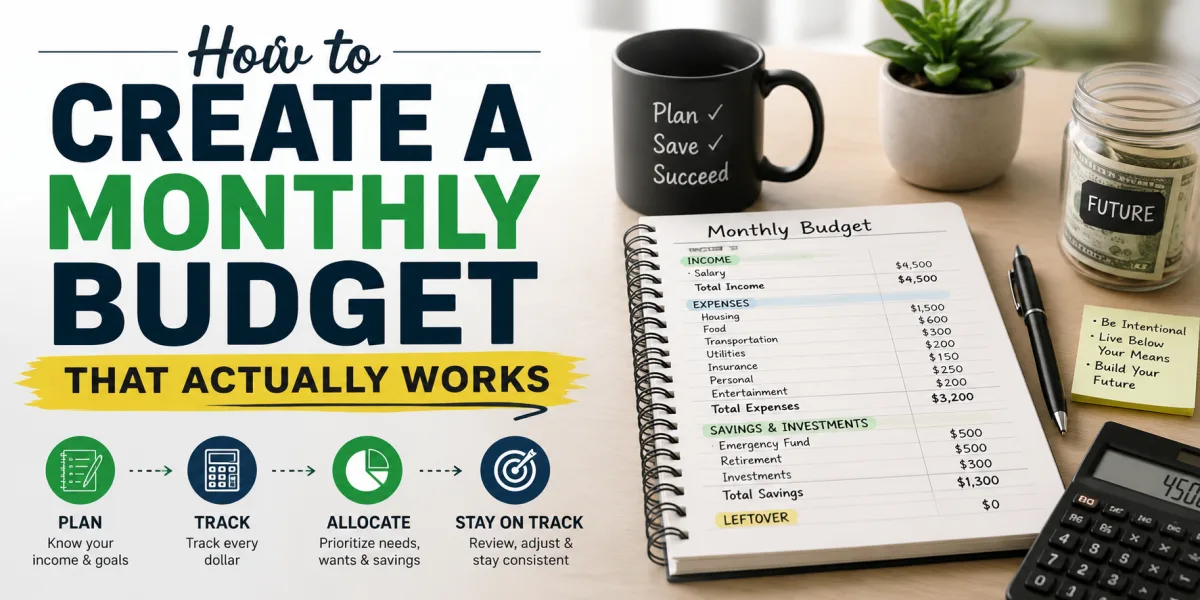
The Working Budget: How to Create a Monthly Budget That Actually Works
A monthly budget fails when it is treated like a wish list. It works when it becomes a decision system.
Most people do not fail at budgeting because they cannot do arithmetic. They fail because the budget they create does not match the life they actually live. It assumes every month is normal. It forgets annual bills. It underestimates groceries. It ignores car repairs, medical copays, school expenses, birthdays, subscriptions, debt payments, and the emotional need to spend occasionally without guilt. It is strict in the wrong places and vague in the places where discipline is needed most.
A working budget is different. It is not built to impress anyone. It is built to survive rent increases, irregular paychecks, rising food prices, holiday spending, unexpected repairs, and the ordinary friction of daily life. It accepts that money is not only numbers. Money is timing, habit, pressure, trade-offs, memory, temptation, fear, and priorities.
The Consumer Financial Protection Bureau’s monthly budget worksheet begins with a basic but powerful structure: list income, list expenses, and subtract spending from income. That simple arithmetic remains the foundation of any budget, no matter how sophisticated the app or spreadsheet becomes.
But the arithmetic is only the beginning. A budget that works must answer practical questions. What money is coming in this month? What bills must be paid before the next paycheck? What expenses are flexible? What costs are irregular but predictable? How much should be saved before spending begins? Which debts need extra attention? What happens if income arrives late? What gets cut if the month is tight?
A budget is not a punishment for spending. It is a plan for using money on purpose. The goal is not to make life smaller. The goal is to make money less chaotic.
Why Most Monthly Budgets Fail
Monthly budgets fail for predictable reasons. The first is unrealistic categories. A person who normally spends $700 a month on groceries writes down $400 because that number feels responsible. The budget looks balanced on paper and collapses by the second week. A budget based on fantasy creates guilt, not control.
The second reason is missing irregular expenses. Car insurance renews every six months. Property taxes arrive once or twice a year. School fees appear suddenly. Tires wear out. Holidays come every year, though people often budget as if December is a surprise. A monthly budget that ignores non-monthly expenses is incomplete.
The third reason is cash-flow timing. A household may technically earn enough for the month but still struggle because bills are due before income arrives. Budgeting by total monthly income can hide timing problems. A rent payment due on the first does not care that another paycheck comes on the fifteenth.
The fourth reason is no room for human behavior. A budget that allows nothing for enjoyment, convenience, generosity, or small pleasures often creates rebellion. People do not usually abandon a budget because it was too generous. They abandon it because it was too rigid to live with.
The fifth reason is lack of review. A budget made once and never adjusted becomes outdated quickly. Prices change. Income changes. Priorities change. A working budget must be reviewed regularly because life keeps moving.
The sixth reason is shame. Many people avoid looking at money because they already feel behind. But avoidance turns small problems into large ones. A budget is not there to judge the past. It is there to organize the next decision.
Start with Reality, Not Goals
A good budget begins with reality. Before deciding what should happen, you need to know what is happening.
Start by gathering the last two to three months of bank statements, credit card statements, payment app activity, loan payments, paycheck deposits, subscriptions, and cash withdrawals. This may feel uncomfortable, but it is the most important step. A budget created without spending history is usually a guess.
Look for actual patterns. How much did groceries cost? How often did you eat out? How much went to transportation? What subscriptions renewed? How much was spent on children, pets, gifts, clothing, medical needs, entertainment, and household supplies? Which expenses surprised you? Which ones were not really surprises but simply forgotten?
The Federal Trade Commission’s consumer guidance continues to point households toward tools for listing income and expenses as part of strengthening financial footing. The method is not complicated, but it requires honesty.
Reality is not the enemy of budgeting. Reality is the raw material. Once you know where money is going, you can decide what should change.
Calculate True Monthly Income
Income is not always as simple as salary divided by twelve. A working budget should use spendable income, not gross income. Gross income is what appears before taxes, insurance premiums, retirement contributions, payroll deductions, union dues, or other withholdings. Spendable income is what actually reaches your account.
For employees with steady paychecks, start with net income. If you are paid twice a month, multiply the paycheck by two. If you are paid every two weeks, you usually receive 26 paychecks per year, which means two months may contain three paychecks. Do not build your ordinary monthly budget around those occasional extra paychecks unless you have a deliberate plan for them.
For irregular earners, use a conservative number. Freelancers, gig workers, commission earners, seasonal workers, and small business owners should not budget from their best month. Use the average of recent low months or the minimum reliable income. Any income above that can be assigned later to debt, savings, taxes, or upcoming expenses.
If income varies, a budget must include a buffer. Irregular income is not automatically a problem, but irregular income without cash reserves creates stress. The goal is eventually to use this month’s income to fund next month’s expenses. That one-month buffer can transform financial anxiety.
Separate Fixed, Variable, and Irregular Expenses
A budget becomes easier when expenses are grouped by behavior.
Fixed expenses are bills that are relatively predictable: rent or mortgage, insurance premiums, loan payments, subscriptions, internet, phone plans, childcare, and minimum debt payments. These are not always easy to change quickly, but they can be reviewed periodically.
Variable expenses change from month to month: groceries, fuel, utilities, dining out, clothing, household items, entertainment, personal care, and small purchases. These categories often hold the most immediate flexibility, but they are also where underestimating is common.
Irregular expenses are predictable but not monthly: car maintenance, annual memberships, holiday gifts, school supplies, medical deductibles, travel, insurance renewals, home repairs, professional licenses, tax preparation, and appliance replacement. These expenses wreck budgets because people treat them as emergencies even when they were foreseeable.
A working budget gives each type of expense a different strategy. Fixed expenses require structural review. Variable expenses require limits and tracking. Irregular expenses require sinking funds.
Build Sinking Funds for Expenses That Do Not Happen Monthly
A sinking fund is money set aside gradually for a known future expense. If car insurance costs $900 every six months, the real monthly cost is $150. If holiday spending usually costs $1,200, the real monthly cost is $100. If annual subscriptions total $600, the real monthly cost is $50.
Sinking funds are powerful because they turn financial surprises into planned expenses. The bill still arrives, but the money is already waiting.
Common sinking funds include car repairs, insurance renewals, holidays, gifts, travel, medical costs, home maintenance, school expenses, annual fees, technology replacement, pet care, and professional expenses. The more unstable your life feels financially, the more useful sinking funds become.
The mistake is trying to create too many sinking funds at once. Start with the expenses that most often disrupt your month. For many households, that means car repairs, medical costs, gifts, and annual bills. Add more categories as the system matures.
A sinking fund is not the same as an emergency fund. A car repair fund handles predictable vehicle maintenance. An emergency fund handles true uncertainty. Both matter.
Use a Budgeting Method That Matches Your Personality
There is no single perfect budgeting method. The best method is the one you can repeat.
Zero-based budgeting assigns every dollar a job. Income minus planned spending, saving, giving, and debt payments equals zero. This does not mean spending every dollar. It means every dollar has a purpose. Zero-based budgeting is excellent for people who need control and clarity.
The 50/30/20 budget divides after-tax income into broad categories: approximately 50 percent for needs, 30 percent for wants, and 20 percent for savings and debt repayment. The California Department of Financial Protection and Innovation’s 2026 financial planning guidance references the CFPB’s flexible budgeting approach using the 50/30/20 framework as one way to balance priorities.
The envelope method gives each spending category a limit. Traditionally, cash was placed in envelopes. Digitally, the same method can be used with separate accounts, budgeting apps, or category trackers. This works well for people who overspend in specific categories.
The pay-yourself-first method prioritizes savings and debt goals before discretionary spending. Money moves automatically to savings, retirement, or debt repayment when income arrives. The household then lives on what remains. This works well for people who spend whatever sits in checking.
A cash-flow budget maps income and bills by date. This is especially useful for people whose main problem is timing rather than total income.
You can combine methods. A household might use 50/30/20 as a rough framework, zero-based budgeting for monthly planning, sinking funds for irregular expenses, and cash-flow tracking for bill timing. The method should serve the household, not the other way around.
Design the Budget Around Paychecks
Many budgets fail because they think in months while bills happen on specific dates. A working budget asks what each paycheck must cover.
If you are paid on the 1st and 15th, list the bills due between the 1st and 14th, then the bills due between the 15th and the end of the month. If one paycheck is overloaded, adjust due dates where possible or hold money from the earlier paycheck for later bills.
Some lenders, utility companies, insurance companies, and subscription providers allow due-date changes. Moving a bill from the first week to the third week can reduce stress without changing total income. This is not glamorous financial advice, but it can make a budget work.
A cash-flow calendar can also help. Write the beginning balance, paycheck dates, bill due dates, transfer dates, debt payments, savings transfers, and expected variable spending. The question is not only whether the month balances. The question is whether the account stays positive every day of the month.
The CFPB’s Your Money, Your Goals toolkit includes separate resources for tracking income and benefits, paying bills, saving, and managing cash flow, reflecting the reality that budgeting is not only about totals but also about timing and obligations.
Give Savings a Line Item
Savings should not be whatever remains at the end of the month. For many households, nothing remains because unassigned money gets absorbed by ordinary life. A working budget treats savings as a bill owed to your future.
Start with an emergency fund. Even a small emergency fund can prevent a minor problem from becoming credit card debt. The Federal Reserve’s 2025 Survey of Household Economics and Decisionmaking found that unexpected expenses such as major vehicle repairs and home or appliance repairs were among the most common financial shocks adults faced.
The first savings goal might be $500 or $1,000. Then one month of essential expenses. Then three months. Then more, depending on income stability, dependents, health needs, job security, and housing situation.
After emergency savings, add sinking funds and longer-term goals. Retirement contributions, house down payment savings, education funds, business reserves, travel funds, and investment contributions should be planned deliberately. A budget that includes only bills and spending is incomplete. Wealth building needs a line item.
Automate savings when possible. Money that moves automatically is less likely to be spent accidentally. Automation does not replace awareness, but it reduces reliance on willpower.
Budget for Debt Repayment Without Ignoring Life
Debt repayment belongs in the budget, but it must be realistic. A plan that sends every spare dollar to debt while leaving no money for irregular expenses may fail when the next surprise arrives. Then the credit card balance rises again, and the borrower feels defeated.
Start with minimum payments on all debts to protect credit and avoid penalties. Then choose a strategy for extra payments. The debt snowball method pays extra toward the smallest balance first, creating quick wins. The debt avalanche method pays extra toward the highest interest rate first, reducing total interest cost. Both can work. The right method is the one you will follow.
High-interest debt deserves urgency because it works against wealth creation every month. But debt repayment should be paired with a small emergency fund. Otherwise, every unexpected expense becomes new debt.
A working budget also asks why the debt formed. Was it an income problem? Medical expense? Job loss? Overspending? Irregular bills? Lack of savings? Family support? Business failure? Without understanding the cause, debt payoff may become temporary.
Set Category Limits Based on Actual Behavior
Category limits should be realistic enough to follow and firm enough to change behavior. If you currently spend $900 on food, setting a $300 food budget may be unrealistic. A better first target may be $750, then $650, then $600 after new habits are built.
Food is one of the most common budget pressure points because it includes groceries, restaurants, takeout, coffee, snacks, delivery fees, convenience meals, and household supplies. If the food budget keeps failing, separate groceries from dining out. The solution may not be “spend less on food” but “reduce delivery from four times per week to once.”
Transportation is another category that often surprises people. Fuel, insurance, parking, tolls, maintenance, repairs, registration, rideshare, public transit, and car payments should not be treated as one vague number. Cars are expensive even when paid off.
Subscriptions should be audited monthly at first. Streaming services, cloud storage, apps, memberships, delivery subscriptions, fitness platforms, software, games, newsletters, and premium accounts can quietly grow. Cancel what does not match current priorities.
Every category should answer a question: is this number based on reality, or on what I wish reality were?
Create a “Flex” Category
A flex category is money set aside for the unexpected but ordinary. It is not a full emergency fund. It is a pressure-release valve inside the monthly budget.
Examples include a last-minute school payment, extra gas, a birthday lunch, medicine, a replacement charger, a small household repair, or a higher-than-usual utility bill. Without a flex category, these small surprises force money out of other categories and make the budget feel broken.
The amount depends on income and household complexity. A single person may need a small flex category. A family with children, pets, cars, and an older home may need more. The key is to admit that the month will not go exactly as planned.
A budget without flex is fragile. A budget with flex can bend without breaking.
Budget for Joy on Purpose
A budget that eliminates all enjoyment often fails because people eventually rebel. Joy should be planned, not denied.
This does not mean ignoring financial limits. It means deciding what kind of spending genuinely improves life and what kind simply leaks money. A person may happily spend on books, family meals, travel, hobbies, fitness, music, or gifts while cutting spending that brings little satisfaction.
The goal is not austerity. The goal is alignment. Spend more intentionally on what matters and less automatically on what does not.
Planned fun money also reduces guilt. If $100 is assigned to personal spending, using it is not failure. It is following the plan. This is especially useful for couples, where each partner may need judgment-free spending money.
Financial discipline becomes more sustainable when it leaves room for being human.
Review the Budget Weekly
A monthly budget should not be reviewed only at the end of the month. By then, the money is already gone. A weekly review gives the household time to adjust.
The weekly review can be simple. Check account balances. Compare category spending against the plan. Look at upcoming bills. Move money if needed. Decide what must be paused. Confirm savings transfers. Review debt payments. Identify any surprise expenses before they grow.
This review does not need to take long. Fifteen to twenty minutes can be enough once the system is established. The habit matters more than the length.
Couples should review money together. One person may handle the details, but both should understand the plan. Budgeting by one partner while the other remains unaware can create resentment and confusion. A budget should be a shared map, not a secret ledger.
Use the End of the Month as Feedback
At the end of the month, do not ask only whether the budget succeeded or failed. Ask what it taught you.
Which categories were accurate? Which were too low? Which expenses were forgotten? Which purchases were worth it? Which ones were regretted? Did income arrive as expected? Did any bill timing create stress? Did savings happen first or last? Did debt go down? Did credit card balances rise?
A working budget improves over time. The first month is usually messy. The second month is more accurate. The third month starts to reveal patterns. After several months, the household begins to understand its true cost of living.
This is where budgeting becomes powerful. It stops being a restriction and becomes intelligence.
Budgeting with Irregular Income
Irregular income requires extra structure. The household must separate income volatility from spending volatility. If both income and spending fluctuate wildly, stress rises quickly.
Start by identifying baseline expenses. These are the costs that must be covered even in a low-income month: housing, utilities, food, transportation, insurance, minimum debt payments, childcare, medicine, and essential communication. This baseline number is your survival budget.
Next, create a priority list for income above the baseline. Extra income should not be treated as random spending money. It should be assigned in order: taxes if self-employed, emergency fund, overdue bills, sinking funds, debt repayment, retirement, and then discretionary spending.
Irregular earners should be especially careful with taxes. Freelancers and gig workers may need to set aside money for estimated taxes because no employer is withholding it. A separate tax savings account can prevent a painful surprise.
The long-term goal is a buffer account. When a high-income month arrives, save enough to support a future low-income month. The budget becomes calmer when income spikes are used to smooth income gaps.
Budgeting When Money Is Too Tight
Sometimes a budget reveals a painful truth: there is not enough income to cover basic expenses. In that situation, budgeting still matters, but it cannot solve everything alone.
If the gap is temporary, triage. Prioritize housing, utilities, food, transportation to work, insurance, medicine, and minimum payments that protect essential stability. Contact creditors before missing payments. Ask about hardship options. Look for assistance programs where eligible. Pause nonessential spending immediately.
If the gap is structural, the solution must include bigger changes. That may mean increasing income, changing housing, refinancing or restructuring debt, selling a car, changing childcare arrangements, taking on temporary work, negotiating bills, accessing benefits, or seeking nonprofit credit counseling.
A budget is a flashlight. It shows the gap. It cannot create income by itself. But seeing the gap clearly is the first step toward making decisions before crisis makes them for you.
The Federal Reserve’s 2025 household well-being report noted that prices remained the most common financial concern among U.S. adults, even as broader financial well-being remained relatively stable. This is why many households need budgets that respond to pressure rather than assume prices are static.
Budgeting Apps, Spreadsheets, or Paper?
The tool matters less than the habit. Some people do well with budgeting apps that sync transactions automatically. Others prefer spreadsheets because they want control. Others need cash envelopes because physical limits help. Some use paper because writing creates awareness.
Use the tool you will maintain. An advanced app ignored after two weeks is useless. A notebook updated every Sunday is powerful. A spreadsheet that helps you make decisions is better than a beautiful dashboard that only creates guilt.
Apps are useful for tracking transactions, identifying subscriptions, setting alerts, and sharing household visibility. Spreadsheets are useful for customization, forecasting, and privacy. Paper is useful for simplicity and focus. Cash envelopes are useful for categories where overspending is physical and immediate.
The best system may combine tools. A budgeting app tracks spending. A spreadsheet forecasts annual expenses. Separate savings accounts hold sinking funds. Calendar reminders protect bill due dates. The system should make money easier to manage, not harder.
Build the Budget in This Order
First, list net income. Use the income that actually reaches your account. If income varies, use a conservative estimate.
Second, list fixed obligations. Housing, utilities, insurance, loan minimums, childcare, transportation, phone, internet, and required subscriptions come first.
Third, list variable necessities. Groceries, fuel, medicine, household supplies, and essential personal care should be based on recent spending, not guesses.
Fourth, list sinking funds. Annual, semiannual, and irregular expenses need monthly amounts.
Fifth, assign savings. Emergency fund, retirement, education, house fund, or other goals should receive money deliberately.
Sixth, assign debt payoff beyond minimums. Choose a snowball or avalanche strategy.
Seventh, assign discretionary spending. Dining out, entertainment, hobbies, clothing, gifts, and personal spending should be included rather than pretended away.
Eighth, add a flex category. The month will not go perfectly.
Ninth, compare total planned spending with income. If the budget is negative, adjust before the month begins. If it is positive, assign the surplus to savings, debt, or a specific goal. Unassigned money tends to disappear.
What to Cut First
When a budget does not balance, start with expenses that are easiest to change and least connected to long-term wellbeing. This often includes unused subscriptions, frequent delivery fees, impulse purchases, premium services, convenience spending, duplicate memberships, and unplanned shopping.
Next, review flexible categories such as dining out, entertainment, travel, clothing, and gifts. The goal is not to eliminate everything. The goal is to reduce what matters least.
Then review fixed expenses. This is harder but often more powerful. Housing, cars, insurance, phone plans, internet, and debt payments can dominate the budget. A household that cuts coffee but keeps an unaffordable car payment may not solve the real problem.
Finally, review income. Sometimes the budget does not need more cuts. It needs more money. Asking for a raise, changing jobs, adding freelance income, selling unused items, taking temporary work, or building a skill can be part of the budgeting strategy.
Cutting expenses is useful. Expanding income can be transformational.
How to Budget as a Couple
Couples need a budget that reflects shared priorities and personal autonomy. The first step is transparency. Both partners should know income, debt, bills, savings, and spending habits. Hidden accounts, secret debt, or unclear expectations damage trust.
Next, decide how money will be managed. Some couples combine everything. Some keep separate accounts and share bills proportionally. Some use a hybrid system with joint accounts for shared expenses and individual accounts for personal spending. The best structure is the one that is fair, transparent, and workable.
Couples should include personal spending money for each partner if possible. This reduces conflict over small purchases. Once the amount is agreed upon, each person can spend it without interrogation.
Schedule a weekly or biweekly money check-in. Keep it practical. Review bills, category balances, upcoming expenses, and goals. Do not use the meeting to relitigate every past mistake. The point is coordination.
A household budget works best when both people feel ownership of the plan.
How to Budget with Children
Children make budgets more complex because needs change constantly. Childcare, school supplies, activities, clothes, medical costs, birthdays, holidays, food, transportation, and technology can all shift as children grow.
Families should create sinking funds for predictable child-related expenses. Back-to-school spending should not be a surprise. Birthdays should not create debt. Sports fees, uniforms, field trips, and seasonal clothing should be anticipated where possible.
Children also benefit from age-appropriate money conversations. A budget does not need to become a source of fear. It can teach trade-offs. “We are choosing this instead of that” is a healthy lesson. Children who see money managed intentionally are more likely to understand limits and planning.
The family budget should also protect parental stability. Emergency savings, insurance, and retirement contributions matter even when children’s needs feel urgent. A parent’s financial security is part of the child’s long-term security.
Budgeting and Inflation
When prices rise, old budget numbers stop working. A grocery category that worked two years ago may now be unrealistic. Insurance premiums, rent, utilities, fuel, and repairs may increase faster than income. Pretending otherwise creates monthly failure.
A working budget should be updated when prices change. This may require raising category limits, reducing other spending, increasing income, or changing habits. Inflation is not a personal failure. But ignoring inflation can become a planning failure.
During high-price periods, focus on categories with repeat purchases. Meal planning, store brands, subscription audits, insurance shopping, energy use, transport efficiency, and avoiding fees can help. But the largest gains often come from structural choices: housing, transportation, debt, and income.
Do not shame yourself for needing to revise the budget. A budget that changes with reality is stronger than one that clings to outdated numbers.
Budgeting for Emergencies
An emergency fund is what keeps a budget from becoming a crisis plan. Without savings, a flat tire, medical bill, delayed paycheck, or broken appliance can push the household into debt. With savings, the same event is still inconvenient but less destabilizing.
Emergency funds should be accessible, safe, and separate from daily spending. A high-yield savings account can work well. The money should not be invested in volatile assets if it may be needed soon.
Start small. The first goal is not perfection. It is protection. A $500 emergency fund can prevent many small problems from becoming credit card debt. Then build toward one month of essential expenses. Then three to six months if appropriate.
Households with unstable income, dependents, health risks, older cars, or single income sources may need larger reserves. The right emergency fund is based on vulnerability, not a universal number.
Budgeting for Wealth Building
A budget that only pays bills is a survival tool. A budget that funds assets is a wealth-building tool.
Once the household is stable, the budget should include retirement contributions, investment accounts, education savings, business reserves, real estate goals, or other long-term assets. Wealth is built when money is directed toward ownership rather than only consumption.
This does not require perfection. Even small automatic contributions can build the habit. A person who invests $50 per month is building identity and momentum. As income rises or debt falls, contributions can increase.
The budget should also protect against lifestyle inflation. When income increases, decide in advance how much will go to savings, investing, debt reduction, giving, and improved lifestyle. Without a plan, raises disappear quietly.
The purpose of budgeting is not merely to spend less. It is to redirect money toward a stronger future.
A Monthly Budget Template That Works
A practical monthly budget can be built with the following structure.
Income: paychecks, business income, benefits, child support, side income, and other reliable cash inflows.
Essential fixed expenses: rent or mortgage, utilities, insurance, phone, internet, childcare, loan minimums, transportation obligations, and required subscriptions.
Essential variable expenses: groceries, fuel, medicine, household supplies, personal care, and basic clothing.
Sinking funds: car repairs, medical costs, annual bills, gifts, holidays, school costs, home repairs, pet care, travel, and technology replacement.
Savings and investing: emergency fund, retirement, education, down payment, business reserve, and other goals.
Debt repayment: minimum payments plus extra payments assigned to the chosen debt strategy.
Discretionary spending: dining out, entertainment, hobbies, clothing upgrades, beauty, personal spending, and convenience purchases.
Flex category: small surprises that do not deserve emergency-fund treatment.
End-of-month assignment: any surplus goes to a defined goal. Any shortfall must be corrected before the month begins.
The First Three Months
The first month is for awareness. Track everything. Do not expect perfection. The goal is to discover the real numbers.
The second month is for adjustment. Raise categories that were unrealistically low. Cut categories that do not match priorities. Add sinking funds for expenses you forgot. Change bill due dates if timing caused stress.
The third month is for discipline. Automate savings. Set weekly reviews. Begin extra debt payments if possible. Create a realistic flex category. Start measuring progress.
By the end of three months, the budget should feel less like a document and more like a rhythm. Income arrives. Money is assigned. Bills are paid. Savings moves. Spending is tracked. Adjustments happen before panic.
Signs Your Budget Is Working
A working budget does not mean every month is easy. It means the system is improving your decisions.
You know what bills are coming. You are less surprised by annual expenses. Credit card balances stop growing. Savings begins to build. You can explain where your money went. You adjust categories without quitting. You feel less afraid to check accounts. You make trade-offs before spending, not after. You have fewer overdrafts, late fees, and panic transfers.
Progress may be slow at first. That is normal. A budget is not successful because it creates instant wealth. It is successful because it creates control.
The Working Budget
A monthly budget that actually works is not the strictest budget. It is the most honest one.
It starts with real income and real spending. It recognizes fixed, variable, and irregular expenses. It plans for timing, not only totals. It gives savings a job. It includes debt repayment without ignoring emergencies. It allows joy without allowing chaos. It is reviewed weekly and adjusted monthly. It tells the truth without shame.
The budget is not there to make every decision for you. It is there to make the consequences visible before money leaves your hands.
When a budget works, it changes the household’s relationship with money. Bills become less surprising. Savings becomes more automatic. Debt becomes more strategic. Spending becomes more intentional. Financial goals become less abstract.
A budget is not a cage. It is a map. And once you can see the map clearly, you can finally choose where the money should go.
 Article
 Article
 Article
 Article
 Article
 Article
 Article
 Article