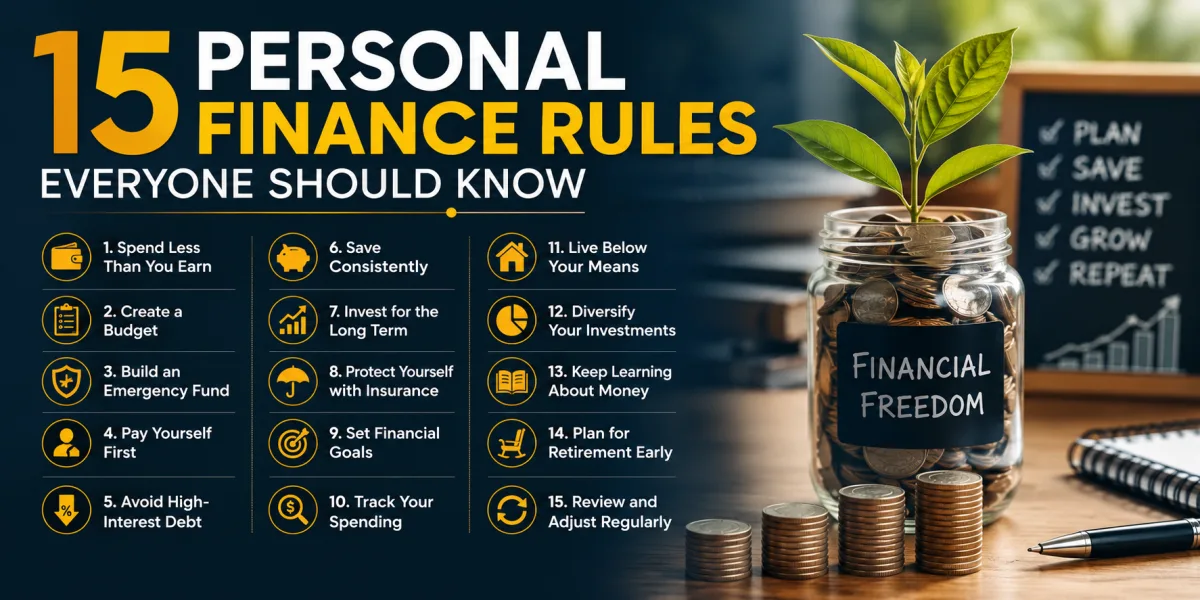
The Money Rules: 15 Personal Finance Principles Everyone Should Know
Personal finance can feel complicated because money touches almost every part of life. It affects housing, food, health, work, family, education, retirement, relationships, freedom, and dignity. It is discussed in the language of interest rates, taxes, credit scores, market returns, insurance deductibles, inflation, asset allocation, and compound growth. For many people, that complexity creates paralysis.
But the foundation of personal finance is not complicated. Most financial stability comes from a set of repeatable rules. Spend less than you earn. Know where your money goes. Keep cash for emergencies. Avoid destructive debt. Invest early. Protect your income. Insure against financial disasters. Keep housing and transportation affordable. Increase your earning power. Do not confuse lifestyle with wealth. These rules are simple to understand, difficult to practice, and powerful when repeated for years.
The rules matter because most people do not get rich from one spectacular decision. They build security through hundreds of ordinary decisions made consistently: saving part of every paycheck, declining debt that would strain the household, investing before feeling ready, paying bills on time, choosing a cheaper car, negotiating income, avoiding financial scams, and letting time compound the results.
The Federal Reserve’s 2026 report on U.S. household economic well-being found that 63 percent of adults said they would cover a hypothetical $400 emergency expense using cash, savings, or a credit card paid off at the next statement. That means many households still face financial fragility when even a modest shock arrives.
Personal finance rules are not meant to shame anyone who is struggling. They are meant to provide direction. A rule is not a magic wand. It cannot instantly fix low wages, medical debt, family obligations, inflation, housing costs, or past mistakes. But rules help organize decisions. They create a hierarchy. They show what to protect first, what to delay, what to automate, what to avoid, and what to build.
Money becomes easier to manage when every dollar has a role. Some dollars protect the present. Some repair the past. Some buy the future. The rules below explain how to assign those roles wisely.
Rule 1: Spend Less Than You Earn
Every financial plan begins with the same equation: income must exceed outflow. If spending consistently rises above income, debt grows. If income consistently exceeds spending, options grow. This rule is obvious, but it is also the rule most easily ignored because modern life makes overspending frictionless.
Credit cards, buy-now-pay-later plans, subscriptions, delivery apps, auto-renewals, lifestyle pressure, and social media comparison can all make spending feel smaller than it is. A household may not feel extravagant and still run a monthly deficit. Money leaks through convenience, not only through luxury.
Spending less than you earn does not mean living miserably. It means creating a gap between income and consumption. That gap is the source of every financial improvement. Emergency savings come from the gap. Debt payoff comes from the gap. Investing comes from the gap. Business capital comes from the gap. Freedom comes from the gap.
If there is no gap, the first task is not investing or optimizing. The first task is restoring margin. That may require reducing expenses, increasing income, changing housing, selling an unaffordable car, negotiating bills, canceling subscriptions, changing habits, or confronting debt. The math must eventually work.
A person earning a high income can still be financially fragile if spending consumes it all. A person earning a modest income can build stability if they protect a small but consistent surplus. Wealth begins when money is not fully consumed by the month in which it is earned.
Rule 2: Track Your Money Before You Try to Control It
You cannot manage what you refuse to measure. Many people create budgets based on what they think they spend, not what they actually spend. The difference can be startling. Groceries are higher. Subscriptions are forgotten. Small purchases are frequent. Dining out is underestimated. Annual bills are ignored. Cash withdrawals disappear into memory.
Tracking is not punishment. It is financial visibility. A budget without tracking is like trying to lose weight without ever looking at food intake, or trying to improve a business without reviewing revenue and expenses.
Start with 30 days of observation. Review bank statements, credit card activity, payment apps, cash withdrawals, subscriptions, and automatic payments. Group spending into categories: housing, utilities, food, transportation, insurance, debt, savings, subscriptions, healthcare, entertainment, gifts, personal care, children, pets, and miscellaneous expenses.
The Consumer Financial Protection Bureau provides budgeting tools built around listing income, listing expenses, and comparing the two. The method is simple, but the honesty required can be difficult.
Once spending is visible, decisions become clearer. You may discover that the problem is not coffee, but car payments. Not restaurants, but rent. Not one large purchase, but twenty small subscriptions. Not lack of income, but lack of timing. Tracking turns vague stress into specific choices.
Rule 3: Build an Emergency Fund Before Life Demands One
An emergency fund is money set aside for unplanned expenses or income disruptions. It is not an investment account. It is not vacation money. It is not a general shopping reserve. It is financial shock absorption.
The CFPB describes an emergency fund as a cash reserve for unplanned expenses or emergencies such as car repairs, home repairs, medical bills, or loss of income. That definition matters because emergencies are rarely convenient. They arrive when the budget is already tight, when work is unstable, or when another expense has just occurred.
The traditional target is three to six months of essential expenses. That is a useful goal, but it can feel overwhelming for someone starting from zero. Begin with a starter fund of $500 to $1,000. Then build one month of essential expenses. Then grow toward three months. Expand to six months or more if income is unstable, you have dependents, you are self-employed, you own a home, or your job search would likely take time.
Emergency money should be safe, liquid, and separate from daily spending. A high-yield savings account, insured savings account, or money market deposit account can work. The goal is access and preservation, not maximum return.
An emergency fund does not stop bad things from happening. It stops bad things from immediately becoming debt, missed payments, or panic.
Rule 4: Pay Yourself First
Most people save what is left after spending. The problem is that modern spending expands to fill available cash. If savings waits until the end of the month, it often receives nothing.
Paying yourself first reverses the order. When income arrives, money moves automatically to savings, retirement, investments, debt payoff, or other goals before discretionary spending begins. The household then lives on what remains.
This rule works because it reduces reliance on willpower. A person may intend to save, but intention is weak against daily friction. Automation is stronger. An automatic transfer to savings every payday turns saving into a default rather than a debate.
Paying yourself first can start small. A person may begin with 1 percent of income, $25 per paycheck, or a fixed weekly transfer. The initial amount matters less than establishing the habit. Over time, the transfer can increase with raises, bonuses, debt payoff, or reduced expenses.
The deeper principle is that your future household is also a bill. Retirement, emergencies, home repairs, healthcare, and future opportunities all require funding. If every current desire gets paid before the future, the future eventually sends a bill with interest.
Rule 5: Avoid High-Interest Debt Like a Financial Fire
Not all debt is equal. A fixed-rate mortgage on an affordable home is different from credit card debt at high interest. A student loan tied to a high-earning career is different from a payday loan. Debt should be judged by cost, purpose, risk, and repayment ability.
High-interest consumer debt is especially dangerous because it reverses compounding. Instead of your money earning returns for you, debt earns returns against you. A credit card balance can grow even while minimum payments are made. The borrower feels like they are paying, but the balance barely moves.
If high-interest debt exists, treat it as an emergency. Make minimum payments on all debts to protect credit, then attack the most destructive balances. The avalanche method pays extra toward the highest interest rate first, minimizing total interest. The snowball method pays extra toward the smallest balance first, creating quick psychological wins. Both can work if followed consistently.
Do not build a lifestyle around borrowed money. Credit cards can be useful payment tools when paid in full. They become wealth destroyers when they finance ordinary living beyond income.
The rule is simple: if the interest rate is high and the debt is funding consumption, eliminate it aggressively and avoid recreating it.
Rule 6: Save for Known Expenses Before They Become Emergencies
Many expenses feel sudden only because they are not monthly. Car insurance renews. Holidays arrive. School supplies are needed. Tires wear out. Property taxes come due. Annual subscriptions renew. Medical deductibles reset. These are not true emergencies. They are irregular expenses.
The solution is a sinking fund. A sinking fund is money set aside gradually for a known future cost. If car insurance costs $900 every six months, the monthly cost is $150. If holiday spending usually costs $1,200, the monthly cost is $100. If annual subscriptions total $600, the monthly cost is $50.
Sinking funds make the budget honest. Without them, a household may appear balanced most months and then collapse when a predictable bill arrives. With them, irregular expenses become part of the monthly plan.
Start with the categories that most often cause stress: car repairs, medical costs, gifts, annual insurance, home maintenance, school expenses, and travel. Keep these funds separate from emergency savings if possible. The emergency fund protects against the unknown. Sinking funds prepare for the known.
This rule prevents one of the most common financial cycles: save a little, face a predictable expense, drain savings, repeat. Planned expenses deserve planned money.
Rule 7: Invest Early, Even If You Start Small
Investing early matters because time is one of the strongest forces in finance. Compound growth occurs when returns begin generating their own returns. The longer the money remains invested, the more time compounding has to work.
The SEC’s Investor.gov compound interest resources show how invested money can grow over time through compounding, depending on contributions, returns, and time horizon. The lesson is not that investment returns are guaranteed. They are not. The lesson is that time gives disciplined investors a powerful advantage.
A young investor does not need a large amount to begin. The first $50 or $100 invested each month teaches the habit. As income rises, contributions can increase. Waiting until you “have enough money to invest” can cost years of compounding.
Investing should usually come after a basic emergency fund and a plan for high-interest debt. But it should not be delayed forever in pursuit of perfect readiness. Retirement accounts, employer plans, IRAs, index funds, ETFs, and diversified portfolios are tools for turning current income into future assets.
The best time to start investing was earlier. The second-best time is when the financial foundation is strong enough to begin and the habit can be maintained.
Rule 8: Use Retirement Accounts Before Tax Advantages Disappear
Retirement accounts are valuable because they combine investing with tax advantages. Depending on the account type, contributions may reduce taxable income now, investments may grow tax-deferred, or qualified withdrawals may be tax-free later.
For 2026, the IRS announced that the employee contribution limit for 401(k), 403(b), most 457 plans, and the federal Thrift Savings Plan increased to $24,500, while the IRA contribution limit increased to $7,500. These limits matter because tax-advantaged space is use-it-or-lose-it. If you do not contribute for a given year, you generally cannot go back years later and reclaim that missed opportunity.
If your employer offers a retirement match, prioritize capturing it if possible. A match is part of compensation. Failing to contribute enough to receive it is like declining part of your paycheck.
The right account depends on your income, tax situation, employer plan, retirement goals, and eligibility. Traditional accounts may help reduce taxable income now. Roth accounts may be valuable if tax-free qualified withdrawals later are attractive. Some people use both.
The rule is not that everyone must max out every account immediately. Many households cannot. The rule is to use available tax-advantaged tools deliberately and increase contributions as your financial life improves.
Rule 9: Keep Housing and Transportation from Eating the Future
Housing and transportation are often the two largest household expenses. If they are too large, the rest of the budget becomes a struggle. People may blame groceries, coffee, or subscriptions when the real problem is rent, mortgage, car payments, insurance, fuel, repairs, and commuting costs.
A home should provide stability, not financial suffocation. A car should provide transportation, not trap the household in debt. Buying or renting at the edge of affordability leaves little room for emergencies, investing, childcare, medical costs, travel, or job changes.
The danger is that lenders and landlords may approve payments that are technically possible but personally stressful. Approval is not the same as affordability. A bank may approve a mortgage based on ratios. It does not know every family obligation, career risk, medical need, or future goal.
Before committing to housing or a vehicle, stress-test the payment. What happens if income drops? If insurance rises? If repairs occur? If childcare begins? If interest rates reset? If property taxes increase? If fuel prices rise? If one partner stops working?
Financial freedom is easier when the biggest fixed expenses are kept reasonable. Once housing and transportation are inflated, small budgeting tricks cannot fully compensate.
Rule 10: Protect Your Credit Before You Need It
Credit is not wealth, but it affects the cost of access. A strong credit profile can help qualify for lower interest rates, better loan terms, rentals, insurance pricing in some places, and financial flexibility. A weak credit profile can make ordinary life more expensive.
The core credit rules are simple: pay on time, keep revolving balances low, avoid unnecessary applications, monitor reports, and correct errors. Payment history and amounts owed are major credit-score factors, so late payments and high credit card utilization can be especially damaging.
AnnualCreditReport.com remains the official source for free credit reports from the major credit bureaus, and regular review can help detect errors or identity theft. The Federal Trade Commission warns consumers to use the authorized source for free credit reports rather than confusing lookalike offers.
Credit should be maintained before it is urgently needed. Trying to repair credit in the middle of a mortgage application, apartment search, or car emergency is stressful. Good credit is built in ordinary months through ordinary discipline.
The goal is not to borrow more. The goal is to ensure that if borrowing becomes necessary or strategic, your past behavior earns you better options.
Rule 11: Insure Against Disasters, Not Inconveniences
Insurance is often disliked because premiums feel like paying for something you hope not to use. But insurance is not meant to make every inconvenience painless. It is meant to protect against events that could damage your financial life severely.
Health insurance protects against medical costs that can overwhelm savings. Auto insurance protects against liability and vehicle losses. Homeowners or renters insurance protects property and liability. Disability insurance protects income if illness or injury prevents work. Life insurance protects dependents if an income earner dies. Liability coverage protects against lawsuits. Business owners may need professional, property, cyber, or liability coverage.
The key is matching insurance to catastrophic risk. A person with dependents may need term life insurance. A worker dependent on earned income may need disability coverage. A renter may need renters insurance even if they own little, because liability and temporary housing can matter.
Insurance should also be reviewed as life changes. Marriage, children, homeownership, business ownership, higher income, divorce, aging parents, or new debt can change coverage needs.
Do not insure everything at any price. But do not leave your entire financial plan exposed to risks that could be transferred affordably.
Rule 12: Increase Income, Not Just Frugality
Frugality is valuable. Waste should be reduced. But there is a limit to how much can be cut. Income has more upside than expense reduction for many people. A household cannot budget its way out of every income problem.
Increasing income may mean negotiating a raise, changing jobs, learning a higher-value skill, freelancing, building a side business, earning credentials, relocating strategically, improving sales ability, or moving into a better-paying industry. It may also mean using current skills more profitably.
The financial benefit of income growth is strongest when lifestyle inflation is controlled. If every raise becomes a larger car payment, nicer apartment, more travel, and more subscriptions, income growth does not build wealth. If part of every raise is directed to savings, investing, debt payoff, and emergency funds, income growth becomes a wealth accelerator.
Expense control creates margin. Income growth expands margin. Wealth building is easier when both work together.
The rule is not “earn more so you can spend more.” The rule is “earn more so your future has more choices.”
Rule 13: Understand Fees Before They Quietly Drain Wealth
Fees are often small enough to ignore and large enough to matter. Banking fees, overdraft fees, late fees, credit card interest, investment expense ratios, advisory fees, fund loads, account fees, loan origination fees, insurance fees, payment-processing fees, and subscription fees can quietly reduce wealth.
The SEC’s Investor.gov warns that investment fees and expenses affect portfolio value over time and encourages investors to compare costs, ask what fees apply, and understand how much an investment must gain before breaking even.
Fees are not automatically bad. Paying for professional advice, insurance, software, or banking services can be worthwhile if the value exceeds the cost. The problem is paying without understanding.
A 1 percent annual advisory fee may sound small, but on a large portfolio over decades, it can represent a substantial amount. A high-fee investment fund must overcome its costs before the investor benefits. A monthly subscription that seems minor becomes meaningful when multiplied by twelve and combined with others.
Review fees annually. Cancel unused services. Compare investment expense ratios. Avoid overdrafts and late payments. Understand loan terms before signing. A dollar saved from unnecessary fees is a dollar that can work elsewhere.
Rule 14: Do Not Confuse Lifestyle with Wealth
Wealth is what you own after obligations. Lifestyle is what people can see. The two are often confused.
A person can drive an expensive car, wear luxury clothing, travel often, dine at costly restaurants, and have little net worth. Another person can live modestly, invest consistently, own appreciating assets, and be quietly wealthy. Visible consumption is not proof of financial strength.
This confusion is dangerous because lifestyle is easy to finance with debt. Wealth is harder to build because it requires restraint. Social media intensifies the problem by displaying spending without showing the balance sheet, credit card debt, family support, leased items, or financial anxiety behind the image.
Net worth is assets minus liabilities. Assets include cash, investments, retirement accounts, business equity, real estate equity, and valuable property. Liabilities include credit card debt, student loans, car loans, mortgages, personal loans, tax debts, and unpaid bills. Wealth grows when assets rise and liabilities become manageable.
The rule is to admire balance sheets more than appearances. Financial independence is built by owning assets, not by performing affluence.
Rule 15: Review Your Money Regularly and Adjust as Life Changes
Personal finance is not a one-time setup. It is a maintenance system. Budgets need updating. Insurance needs reviewing. Investments need rebalancing. Beneficiaries need checking. Debt plans need adjusting. Emergency funds need refilling. Goals need revisiting. Tax laws and contribution limits change. Life changes even faster.
Create a monthly money review. Check spending, savings, debt, upcoming bills, subscriptions, and progress toward goals. Create a quarterly review for net worth, investment contributions, insurance needs, and big expenses. Create an annual review for taxes, retirement contributions, estate documents, credit reports, and long-term goals.
Review does not need to be complicated. The habit matters. Financial drift happens when no one is looking. A regular review catches problems early and keeps money aligned with current priorities.
This rule is especially important during transitions: marriage, divorce, children, job change, business launch, home purchase, caregiving, illness, relocation, inheritance, or retirement. A financial plan that fit your old life may not fit your new one.
Money management is not about finding the perfect plan and freezing it forever. It is about building a system that adapts without losing direction.
How the 15 Rules Work Together
These rules are strongest when connected. Spending less than you earn creates margin. Tracking shows where margin can be found. Emergency savings protects against shocks. Paying yourself first makes progress automatic. Avoiding high-interest debt prevents compounding from working against you. Sinking funds keep predictable expenses from becoming crises. Investing early uses time. Retirement accounts add tax advantages. Affordable housing and transportation protect cash flow. Good credit lowers borrowing costs. Insurance protects against catastrophe. Income growth expands opportunity. Fee awareness prevents leakage. Separating lifestyle from wealth protects priorities. Regular review keeps the system alive.
No single rule solves everything. Together, they form a financial operating system.
A person who follows these principles imperfectly but consistently will usually do better than someone who searches endlessly for advanced tactics while ignoring the basics. Sophisticated strategies cannot compensate for spending more than income, carrying high-interest debt, lacking cash reserves, or failing to invest.
The basics are not basic because they are weak. They are basic because everything else rests on them.
The Wealth Lesson
Personal finance is not only about money. It is about control over future choices. The person with savings can handle emergencies. The person without high-interest debt can breathe. The person who invests consistently can let time work. The person with insurance can transfer catastrophic risk. The person who avoids lifestyle inflation can grow wealth quietly. The person who reviews money regularly can correct course before small problems become large ones.
The 15 rules are not laws of nature. They are guardrails. They help keep daily decisions aligned with long-term security. They are simple enough to understand and demanding enough to require discipline.
Start where you are. If you have no emergency fund, build the first $500. If debt is draining you, create a payoff plan. If you do not track spending, review the last 30 days. If you have never invested, learn how your retirement plan works. If your lifestyle rose with your income, redirect the next raise. If you are financially stable, strengthen insurance, estate planning, and long-term investing.
Progress does not require perfect timing. It requires repeated action. Money responds to habits over time. The earlier those habits begin, the more powerful they become.
The rules are simple. The life they can build is not.
 Article
 Article
 Article
 Article
 Article
 Article
 Article
 Article