
The First $100: How Small Investments Become Real Wealth
One hundred dollars will not make anyone rich by itself. It will not replace a paycheck, fund retirement, buy a house, or create financial independence overnight. But the first $100 invested can do something more important than produce immediate wealth: it can change the direction of a person’s financial life.
The first investment is a line crossed. Before it, money is mostly something earned, spent, saved, borrowed, or owed. After it, money becomes something that can own. It can own pieces of businesses. It can own bonds. It can participate in markets. It can begin working beyond the hours a person personally works. That shift is small in dollars and large in meaning.
Many people delay investing because they believe investing is for people who already have money. They imagine large brokerage balances, financial advisors, complicated charts, and expensive stock prices. They think they must wait until they have $5,000, $10,000, or a perfect financial life. That belief is costly. The habit of investing is often more important at the beginning than the size of the first contribution.
Modern investing platforms, fractional shares, exchange-traded funds, index funds, and low-cost brokerage accounts have made it possible to start with small amounts. FINRA explains that fractional share investing allows investors to buy less than a full share of stock, such as 0.5 or 0.1 shares, depending on how much they want to invest. If a single share costs $1,000 and an investor puts in $100, they could receive 0.1 shares.
This matters because price per share used to be a psychological barrier. A new investor might want to buy a company or fund but feel locked out because one share cost more than they had available. Fractional investing reduces that barrier. A person can begin with the money they have rather than waiting for a larger lump sum.
The deeper question is not whether $100 is enough to become wealthy immediately. It is whether $100 is enough to begin a system. The answer is yes. If used wisely, the first $100 can become the first brick in a long-term financial foundation.
What $100 Can and Cannot Do
The first rule is realism. One hundred dollars invested once will not overcome low income, high-interest debt, lack of savings, or poor financial habits. It will not generate meaningful passive income right away. If the investment doubles, it becomes $200. That is good, but it is not life-changing. The danger of small-start investing is that beginners sometimes expect dramatic results from a tiny base.
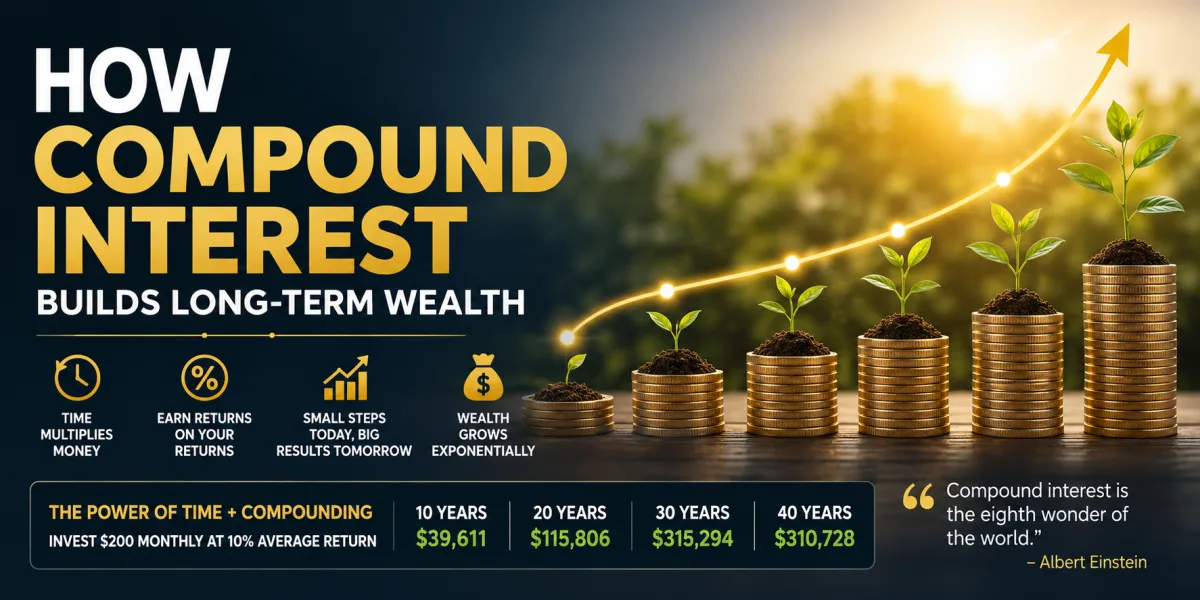
The power of $100 is not the initial amount. The power is repetition. One hundred dollars invested once is a beginning. One hundred dollars invested every month becomes $1,200 per year. Over ten years, that is $12,000 in contributions before returns. Over decades, consistent contributions can become meaningful because the investor adds capital repeatedly and allows compounding to work.
The SEC’s Investor.gov compound interest calculator is built around this principle: initial investment, monthly contributions, time, and return assumptions interact to determine how money may grow. It is not a guarantee of returns, but it demonstrates why time and repeated contributions matter so much.
This is why the first $100 should be treated as a seed, not a lottery ticket. The investor’s job is not to turn $100 into $10,000 through speculation. The investor’s job is to build the habit and system that can turn repeated savings into ownership over time.
Small investing becomes powerful when it is connected to three forces: consistency, diversification, and patience.
Before You Invest: Check the Foundation
Investing should begin with financial context. Not every dollar should be invested immediately. Some dollars have more urgent jobs.
If you cannot cover basic bills, investing may need to wait until cash flow is stabilized. If you have no emergency savings at all, consider building a small starter buffer first. If you carry high-interest credit card debt, paying it down may create a better guaranteed improvement than investing in the market. A credit card charging 25 percent interest is a powerful enemy. A beginner portfolio cannot reliably beat that without taking serious risk.
This does not mean you need a perfect financial life before investing. Waiting for perfection can become another form of procrastination. But the first $100 should not expose the household to danger. If investing that $100 means rent, groceries, medicine, or minimum debt payments cannot be covered, it is not the right time.
A practical sequence works well for many beginners: cover essentials, build a small emergency buffer, pay attention to high-interest debt, then begin investing with small recurring amounts. Some people may do these steps in parallel. For example, they may save $50 and invest $50 each month. The right balance depends on risk, debt, income stability, and emotional comfort.
The first investment should strengthen your financial life, not make it more fragile.
The Best Use of the First $100 Is Education Plus Ownership
The first $100 teaches lessons that reading alone cannot. It teaches what a brokerage account looks like. It teaches how prices move. It teaches how dividends appear. It teaches how market declines feel. It teaches the difference between owning an investment and watching one from a distance.
That education is valuable. Many people remain afraid of investing because markets feel abstract. Once they own even a small amount of a diversified fund, investing becomes less mysterious. They can see that markets rise and fall, that account values fluctuate, and that wealth building is not a straight line.
This experience should be approached carefully. A beginner should not use the first $100 to gamble on a meme stock, a leveraged product, a speculative cryptocurrency, or a company they do not understand. The first investment should teach disciplined ownership, not emotional trading.
FINRA warns that all investments carry some degree of risk and that stocks, bonds, mutual funds, and exchange-traded funds can lose value, even their entire value, depending on market conditions and other factors.
That warning should not scare beginners away from investing. It should focus them. Risk is real. The answer is not avoidance. The answer is diversification, proper time horizon, low costs, and position sizing.
Choose the Right Account
The account you choose determines taxes, access, rules, and sometimes investment options. A new investor with $100 should not overcomplicate this decision, but the account still matters.
A taxable brokerage account is flexible. You can deposit money, invest, sell, and withdraw without retirement-account age restrictions. This can be useful for long-term goals outside retirement or for investors who want access before retirement. The trade-off is that dividends, interest, and realized gains may be taxable.
A Roth IRA can be attractive for retirement investing if you are eligible. Contributions are made with after-tax money, and qualified withdrawals can be tax-free. For 2026, the IRS announced that the IRA contribution limit increased to $7,500, with a catch-up contribution of $1,100 for individuals age 50 and over. A beginner investing $100 is nowhere near the annual limit, but knowing the limit helps frame the account’s purpose.
A traditional IRA may provide tax benefits now, depending on income and eligibility, but withdrawals in retirement are generally taxable. Employer retirement accounts, such as 401(k) plans, may be better first choices if an employer match is available. An employer match is part of compensation. Passing it up can mean leaving money unclaimed.
If you are investing only $100 to learn, a taxable brokerage account may be simplest. If you are investing for retirement and qualify, a Roth IRA may be more powerful. If your employer offers a retirement match, that may deserve priority before separate investing.
The account should match the goal. Money needed soon should not be locked into a retirement strategy. Retirement money should not be casually treated as short-term spending money.
Understand Fractional Shares
Fractional shares are one reason $100 can now go further than it once could. Instead of needing enough money to buy one full share of a company or ETF, an investor can buy a dollar amount. If an ETF trades at $450 per share and fractional trading is available, a $100 investment can buy a fraction of that ETF.
This makes diversification easier. A beginner does not need to choose only low-priced stocks. Share price alone says little about whether an investment is cheap or expensive. A $20 stock can be overpriced. A $400 ETF can be low-cost and diversified. Fractional shares help investors focus on quality and portfolio fit rather than share price.
Still, fractional shares have details to understand. Not every brokerage offers fractional trading for every investment. Transfers between firms may be more complicated. Dividend reinvestment may create fractional positions. Order handling may differ. A beginner should read the brokerage’s rules.
Fractional shares are a tool, not a strategy. They make access easier. They do not make a poor investment good.
Use Broad Funds Instead of Stock Picking at the Beginning
With only $100, the temptation is to find the one stock that can rise dramatically. That temptation is understandable. It is also dangerous. A single stock can fall sharply, stagnate for years, or lose most of its value. Even excellent companies can be poor investments if purchased at the wrong price or held with unrealistic expectations.
Broad funds solve a different problem. Instead of betting on one company, the investor owns a basket. An exchange-traded fund, or ETF, can hold hundreds or thousands of stocks or bonds. FINRA explains that ETFs generally focus investments in stocks or bonds and have diversification requirements, though some exchange-traded products tied to commodities or currencies may have different regulatory protections.
For a beginner, a broad market ETF or index mutual fund is often a sensible first investment. A total U.S. stock market fund, S&P 500 fund, total international stock fund, total bond market fund, or all-in-one allocation fund can provide diversified exposure without requiring the investor to analyze individual companies.
The purpose is not to avoid all risk. Broad stock funds can still decline significantly in bear markets. The purpose is to avoid the unnecessary risk of having the entire first investment depend on one company’s fate.
Investing is not a test of cleverness. It is a process of building ownership intelligently.
Index Funds and ETFs: A Practical Starting Point
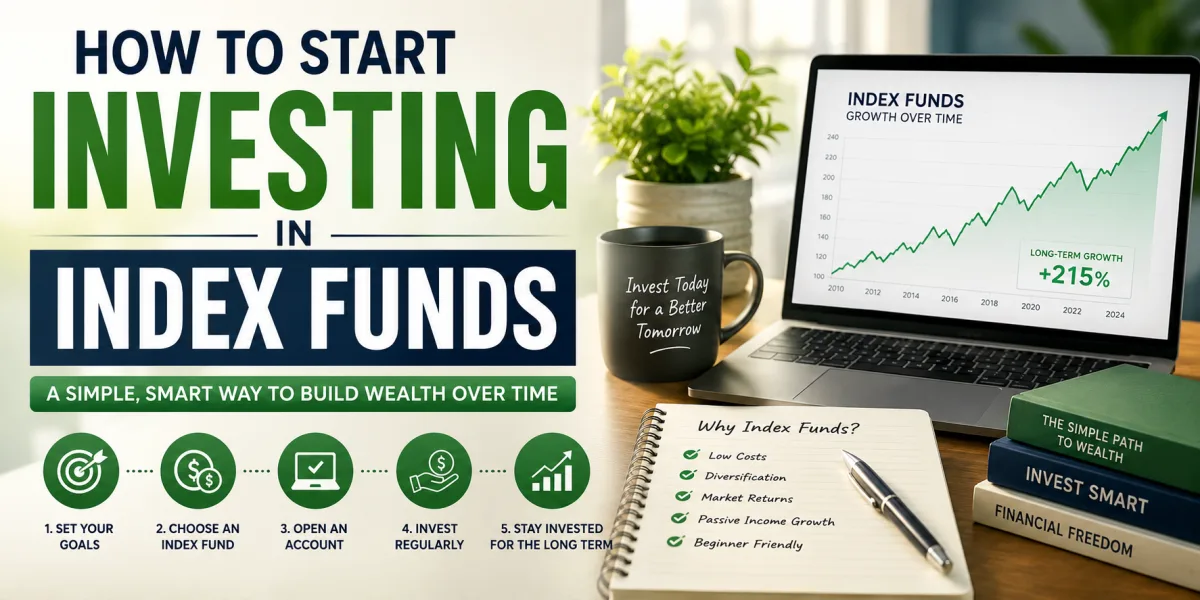
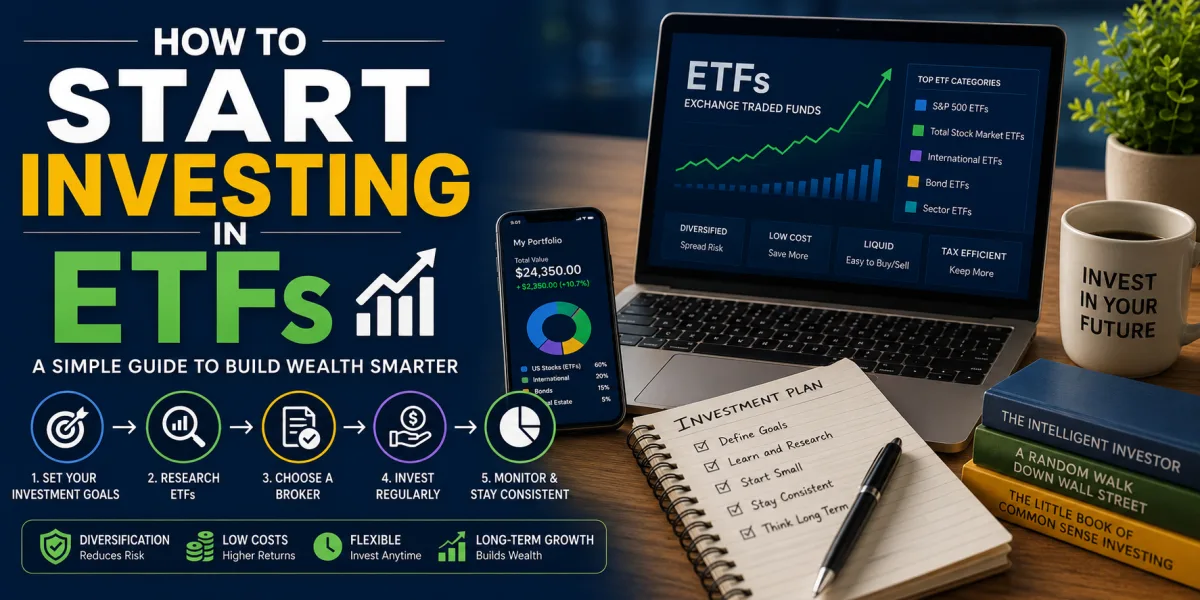
Index funds and ETFs are often good starting tools because they are transparent, diversified, and usually low cost. An index fund attempts to track a market benchmark rather than beat it through active stock selection.
For example, an S&P 500 ETF tracks large U.S. companies. A total U.S. stock market ETF covers a broader set of American companies. A total international stock ETF provides exposure outside the United States. A total bond market ETF provides bond exposure. A target-date fund or allocation ETF may combine stocks and bonds into a single diversified portfolio.
The SEC’s Investor.gov guide to asset allocation and diversification explains that diversification can help manage risk, and that narrowly focused funds may require more than one fund to achieve the diversification an investor seeks.
A beginner with $100 does not need a complicated portfolio. One diversified fund may be enough to begin. The goal is to avoid paralysis. A simple, low-cost, diversified investment held consistently is often better than an elaborate plan that never starts.
As the account grows, the investor can refine the portfolio. But the first step should be understandable and sustainable.
Do Not Confuse Low Share Price with a Good Investment
Beginners often search for stocks under $5, $10, or $20 because they believe cheaper share prices mean more upside. This is a misunderstanding. A stock’s price per share does not tell you whether the company is cheap. Valuation depends on profits, cash flow, assets, debt, growth, competitive position, and the number of shares outstanding.
A company trading at $5 per share can be overvalued, distressed, or highly speculative. A company trading at $500 per share can be reasonably valued. An ETF trading at $300 per share can provide diversified exposure at a low expense ratio. Fractional shares make share price even less important.
What matters is what you own and what you pay relative to value. For funds, that means understanding holdings, expense ratios, diversification, and strategy. For individual stocks, it means understanding the business. Most beginners are better served by avoiding individual stock selection until they understand financial statements, valuation, competitive advantage, and portfolio risk.
The market does not reward investors because they bought more shares. It rewards ownership of assets that grow, pay income, or increase in value relative to the price paid.
Costs Matter More Than Beginners Think
When investing small amounts, costs matter. A $5 monthly fee may sound minor, but on a $100 account it is enormous. That fee equals 5 percent of the starting capital every month. A beginner should avoid platforms, funds, or services where fees consume the account.
Look for no-commission trading, no account minimums, low expense ratios, and no unnecessary subscription costs. Many reputable brokers allow investors to open accounts with no minimum and buy fractional shares or low-cost ETFs. The investor should still read the fee schedule carefully.
Investment fund fees also matter. The expense ratio is the annual cost of owning a fund. A broad index ETF may charge a very low expense ratio. A specialized fund may charge much more. Higher fees reduce returns over time.
The SEC warns that fees and expenses affect portfolio value and encourages investors to understand and compare them before investing.
The first $100 should not be eaten by friction. Keep the structure simple and cheap.
Avoid Get-Rich-Quick Investments
Small accounts can create impatience. A beginner may think, “If I invest safely, my $100 will grow too slowly. I need something that can explode.” That thinking leads many new investors toward speculation: penny stocks, options, leveraged ETFs, meme stocks, crypto hype, trading signals, or social media gurus promising fast gains.
The desire is understandable. Slow growth feels disappointing when the starting amount is small. But speculation often turns small accounts into tuition payments to the market. The beginner loses money, confidence, and momentum.
The first investment should build trust in a process. A diversified fund may not feel exciting, but it teaches ownership. A speculative trade teaches adrenaline. Those are different educations.
If you want to experiment later, create a tiny separate “learning” portion after the foundation is built. Do not put the first $100, emergency money, rent money, or debt-payoff money into high-risk speculation. The goal is to become an investor, not a gambler with a brokerage account.
The $100 Portfolio: Three Simple Options
A beginner with $100 can choose several reasonable approaches.
The first option is a broad U.S. stock market ETF or index fund. This gives exposure to many companies in one purchase. It is simple and growth-oriented, but it can decline significantly during market downturns. It is best for long-term money.
The second option is a total world or global stock ETF. This may include U.S. and international companies, giving broader geographic exposure. It avoids making the investor decide which country will perform best over the long run.
The third option is an all-in-one allocation fund or ETF that includes both stocks and bonds. Recent investor coverage has highlighted all-in-one ETFs as a way to combine multiple asset classes and simplify portfolio management through built-in allocation and rebalancing. This can be useful for investors who want a single diversified holding and do not want to manage multiple funds.
The right choice depends on time horizon and risk tolerance. If the money is for retirement decades away, stock-heavy exposure may be reasonable. If the investor is nervous or closer to needing the money, a balanced fund may be more appropriate. If the money may be needed within a year or two, it probably should not be invested in stocks at all.
The first portfolio should be understandable enough that the investor can hold it during a decline.
Why Time Horizon Comes First
Before investing $100, ask when you may need the money. If the answer is next month, next semester, or next year, the money may belong in savings, not the market. Short-term money should be safe because the market may be down when you need it.
If the money is for retirement, financial independence, or a goal ten or more years away, investing may make sense. Long time horizons allow the investor to tolerate volatility. A stock market decline is painful, but it is less dangerous if the money will not be needed for decades.
Time horizon determines risk capacity. A 25-year-old investing for retirement can think differently from someone saving for a car repair. The same $100 may have different jobs depending on the goal.
Do not invest money simply because investing sounds responsible. Invest money when the goal and timeline fit the risk.
Make the Second $100 Easier Than the First
The first $100 matters because it starts the habit. The second $100 matters because it proves the habit can repeat. Wealth is rarely built from one deposit. It is built from repeated contributions that become normal.
Set up an automatic transfer if possible. The amount can be small: $10 per week, $25 per paycheck, $50 per month, or $100 per month. The key is consistency. Automation turns investing from an event into a system.
If income is irregular, automate a conservative amount and add extra contributions during stronger months. If money is tight, use percentage rules. For example, invest 10 percent of side income, 25 percent of bonuses, or half of every raise. This allows investing to grow with income.
The account balance will move slowly at first. That is normal. Early investing feels small because contributions are doing most of the work. Later, returns may begin doing more of the work. The investor must stay patient long enough to reach that stage.
The first goal is not a large balance. The first goal is a reliable contribution habit.
Use Windfalls Wisely
Small investors can accelerate progress by directing windfalls. Tax refunds, bonuses, cash gifts, overtime, rebates, side income, and sold items can all become investment fuel.
This does not mean every windfall must be invested. If high-interest debt exists, paying it down may be wiser. If emergency savings are weak, cash reserves may come first. But once the foundation is stable, windfalls can move the investing journey forward faster than monthly contributions alone.
Before a windfall arrives, decide its job. Without a plan, extra money often disappears into lifestyle spending. With a plan, it can reduce debt, build savings, fund an IRA, or increase a brokerage balance.
A simple rule works well: divide windfalls into three parts. One part for stability, one part for wealth building, and one part for enjoyment. The percentages can vary, but the principle is useful. Money should improve both the present and the future.
Do Not Check the Account Too Often
A $100 investment will move in small dollar amounts, but those movements can feel emotional to a beginner. If the account falls to $94, the investor may feel like investing failed. If it rises to $108, the investor may feel brilliant. Neither reaction is useful.
Markets fluctuate constantly. A long-term investor should not judge a plan by daily or weekly movement. Checking too often can create anxiety and encourage unnecessary trading.
A better rhythm is monthly or quarterly review. Confirm contributions happened. Review allocation. Make sure the investment still matches the goal. Avoid reacting to headlines.
The purpose of investing is not to create a new source of daily stress. It is to build assets over time.
Learn the Difference Between Saving and Investing
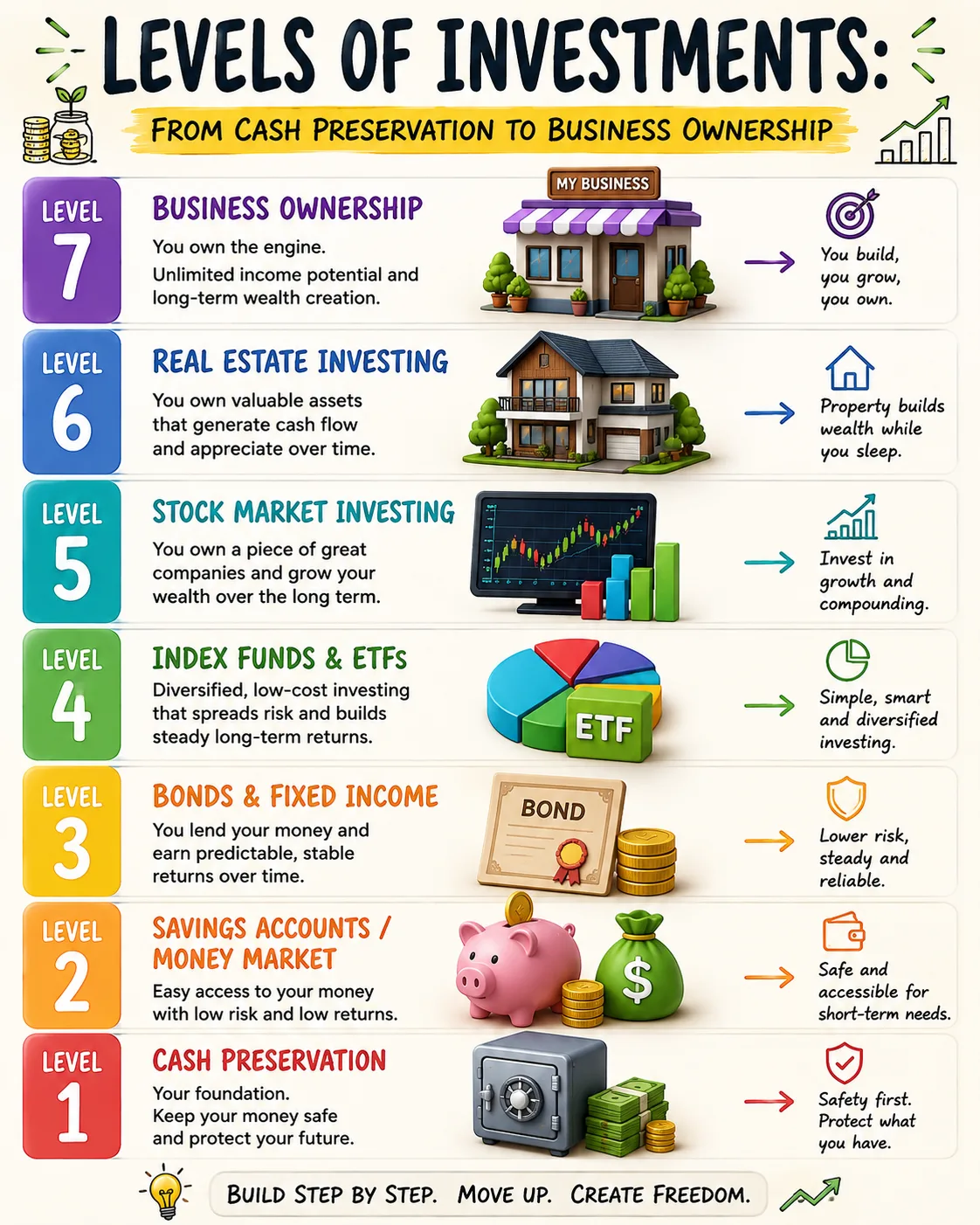
Saving and investing are both important, but they serve different purposes. Saving is for safety and near-term needs. Investing is for growth and long-term goals.
Money for rent, groceries, emergency savings, insurance deductibles, near-term tuition, or a down payment needed soon should usually be saved, not invested aggressively. Money for retirement or long-term wealth can usually take more risk because it has time to recover from market declines.
Confusing these roles creates problems. If you save everything forever, long-term money may fail to grow enough. If you invest emergency money, short-term stability may be at risk.
A healthy financial life uses both. Cash protects the present. Investments build the future.
What About Individual Stocks?
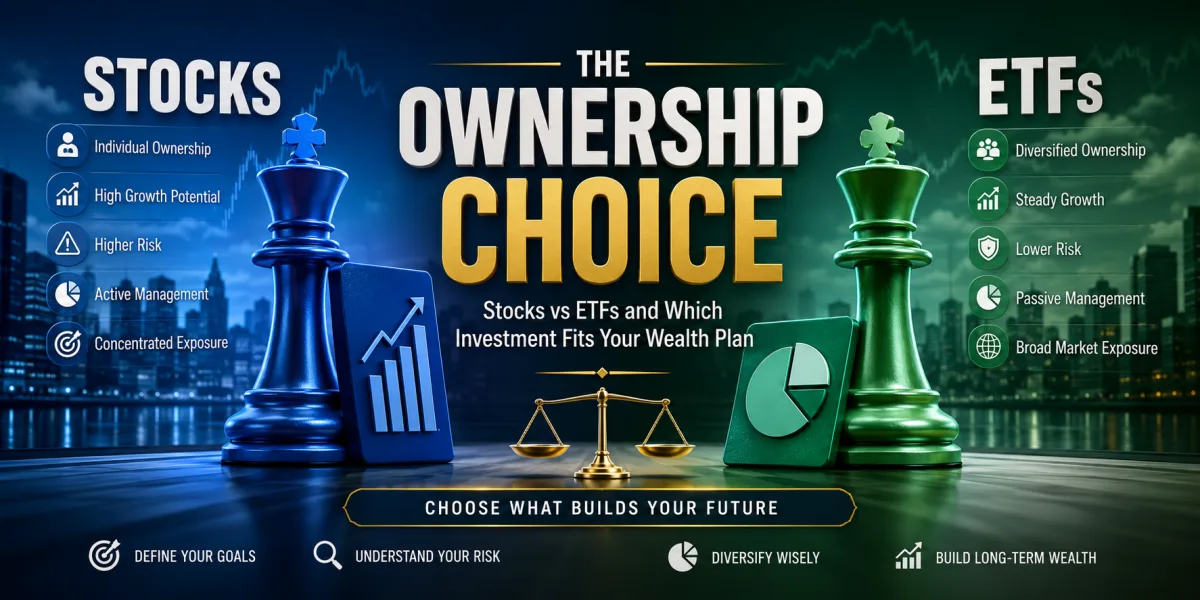
Individual stocks can create wealth, but they also carry company-specific risk. A company can disappoint investors, face lawsuits, lose market share, take on too much debt, suffer management failure, or become obsolete. Even famous companies can go through long periods of poor performance.
A beginner with only $100 may be better served by owning a diversified fund first. After building a core portfolio and learning more, individual stocks can be considered with a small portion of the portfolio if the investor understands the risk.
If you buy individual stocks, ask basic questions. What does the company do? How does it make money? Is it profitable? How much debt does it have? Who are its competitors? Why do you believe it will perform well? What would prove you wrong? How much of your portfolio are you willing to risk on one company?
Buying a stock because a friend mentioned it, a social media post praised it, or its price recently jumped is not investing. It is reaction.
What About Cryptocurrency?
Cryptocurrency attracts beginners because it is accessible, volatile, and surrounded by stories of large gains. It can also produce large losses, scams, platform failures, security mistakes, and emotional trading.
A person starting with $100 should be careful about making crypto their first investment. The volatility can teach the wrong lesson: that investing is about chasing dramatic price moves. If someone chooses to buy crypto, it should be money they can afford to lose, and it should usually be a small speculative portion rather than the foundation of a financial plan.
Beginners should first understand diversified investing, emergency savings, debt management, and risk. Speculation should not replace the basics.
What About Robo-Advisors?
Robo-advisors can be useful for beginners who want help building a diversified portfolio. They typically ask questions about goals, time horizon, and risk tolerance, then recommend a portfolio of ETFs. Some offer automatic rebalancing, recurring deposits, and tax-loss harvesting in taxable accounts.
The advantage is simplicity. The investor does not need to choose every fund. The drawback is cost. Robo-advisors often charge an advisory fee in addition to fund expense ratios. For a small account, the fee may be modest in dollars, but the investor should still understand it.
A robo-advisor can make sense if it helps the investor start and stay consistent. A self-directed low-cost ETF portfolio can be cheaper if the investor is comfortable managing it. The right choice depends on behavior. A slightly more expensive system that keeps someone invested may be better than a cheaper system they abandon.
What About Apps That Round Up Purchases?
Round-up apps invest spare change by rounding purchases and investing the difference. For example, a $4.60 purchase may be rounded to $5.00, with $0.40 invested. These apps can help beginners develop awareness and start small.
The strength is ease. The weakness is that round-ups alone may be too small to build meaningful wealth unless combined with larger recurring contributions. Fees can also matter. A few dollars per month in fees may be large relative to a small balance.
Round-up apps are best viewed as training wheels, not the full bicycle. They can help start the habit, but the investor should eventually move toward intentional contributions.
Build Around Asset Allocation
Asset allocation is the mix of stocks, bonds, cash, and other assets. It matters more than choosing a trendy ticker. Stocks offer growth potential but can be volatile. Bonds may provide income and stability but still carry risk. Cash is stable but may lose purchasing power over time.
A young investor with a long horizon may choose mostly stocks. A conservative investor may prefer a balanced mix. A person investing for a near-term goal should keep more in cash or short-term safer assets.
With only $100, asset allocation may feel unnecessary. But the principle should begin early. The investor should know whether the money is meant for growth, stability, income, or learning. As the account grows, allocation becomes more important.
The habit of thinking in allocation prevents random investing. Every dollar should have a role.
Reinvest Dividends
Some ETFs, mutual funds, and stocks pay dividends or interest distributions. A beginner can often choose to reinvest those payments automatically. Reinvestment uses distributions to buy more shares or fractional shares.
At first, dividends may be tiny. A few cents or a few dollars may not feel meaningful. But reinvestment teaches an important concept: assets can produce cash, and that cash can buy more assets.
Over long periods, reinvested dividends can contribute significantly to total return. The key is patience. Early compounding looks unimpressive because the base is small. Later, the effect becomes more visible.
If the goal is long-term growth, reinvestment is usually sensible. If the investor needs income, taking cash may be appropriate. For a beginner investing $100, reinvestment usually supports the habit of accumulation.
Avoid Overcomplication
A beginner may feel pressure to learn everything before starting: candlestick charts, options, macroeconomics, valuation models, factor investing, tax-loss harvesting, bond duration, international allocation, and market cycles. These topics can matter eventually, but they are not required to invest the first $100 sensibly.
The first step can be simple: open an appropriate account, choose a low-cost diversified fund, invest $100, set up a recurring contribution, and learn steadily.
Overcomplication often hides fear. If you convince yourself that you must understand everything first, you may never begin. The better path is to start with a simple, responsible investment and build knowledge over time.
Simplicity is not ignorance. It is often the most intelligent starting strategy.
Protect Yourself from Investment Scams
Small investors are often targeted by scams because scammers know beginners want fast growth. Be skeptical of anyone promising guaranteed returns, secret trading systems, risk-free profits, insider tips, or unusually high income from small investments.
No legitimate investment can guarantee high returns without risk. Markets do not work that way. If someone pressures you to act quickly, asks for payment through unusual methods, refuses to explain risks, or shows only success stories, step back.
Use registered brokerage firms. Verify investment professionals. Read fund documents. Avoid sending money to strangers on social media. Do not invest through links in unsolicited messages. Never borrow money to buy an investment you do not understand.
The first $100 should not be paid as tuition to a scammer. It should buy real ownership through a reputable platform.
The 12-Month Plan for a $100 Investor
In month one, open the account and invest the first $100 in a diversified, low-cost investment aligned with a long-term goal.
In month two, set up a recurring contribution. If $100 per month is too much, choose $25 or $50. The habit matters more than the starting amount.
In month three, build or strengthen a starter emergency fund if it is not already in place. Investing and emergency savings should support each other.
In month four, learn about expense ratios, diversification, and account types. Do not change investments constantly. Learn before tinkering.
In month five, review high-interest debt. If credit card balances are expensive, decide how much extra money should go to debt versus investing.
In month six, increase contributions slightly if possible. Even a small increase builds momentum.
In month seven, review whether the investment still matches the goal. Do not judge success by short-term performance.
In month eight, direct any windfall toward the plan: emergency fund, debt payoff, IRA, or brokerage contribution.
In month nine, learn about retirement accounts and employer matches. If a match is available and you are not using it, investigate how to start.
In month ten, automate dividend reinvestment if appropriate.
In month eleven, calculate total contributions so far. Focus on what you controlled: deposits, costs, and behavior.
In month twelve, review the year. Did you invest consistently? Did you avoid panic selling? Did you increase knowledge? Did you protect your emergency fund? Then set next year’s contribution target.
By the end of one year, the account balance may still be modest. But the investor is no longer someone waiting to start. They are someone with a system.
What Success Looks Like at the Beginning
Early investing success does not look like instant wealth. It looks like opening the account. Making the first investment. Setting up automatic contributions. Avoiding high fees. Not chasing hype. Continuing during market volatility. Learning the basics. Increasing contributions when income rises. Keeping emergency money separate. Paying down destructive debt. Staying patient.
The first year is about identity. A person becomes an investor by investing, not by waiting until they feel wealthy enough to deserve the title.
Small beginnings should not be mocked. Every large portfolio started from an earlier, smaller amount. The difference between someone who builds wealth and someone who only thinks about it is often the willingness to begin before the numbers look impressive.
The Wealth Lesson
Starting with $100 is not about the $100. It is about the habit the $100 represents.
That first investment teaches ownership. It teaches patience. It teaches that wealth is built by directing money toward assets before consumption absorbs everything. It teaches that small amounts, repeated consistently, can become meaningful. It teaches that investing is not reserved for the already wealthy. It is one of the ways ordinary earners begin moving toward wealth.
Use the first $100 wisely. Choose the right account. Avoid high fees. Favor diversification. Understand risk. Use fractional shares if helpful. Reinvest dividends. Automate the next contribution. Keep learning. Protect emergency savings. Do not chase shortcuts.
The market will rise and fall. Headlines will change. New trends will appear. Friends may brag about quick wins. Social media will sell urgency. Ignore the noise. The beginner’s greatest advantage is not prediction. It is time, consistency, and humility.
One hundred dollars is enough to begin. The next hundred is where the system starts. The hundreds after that are where discipline becomes wealth.
 Article
 Article
 Article
 Article
 Article
 Article
 Article
 Article