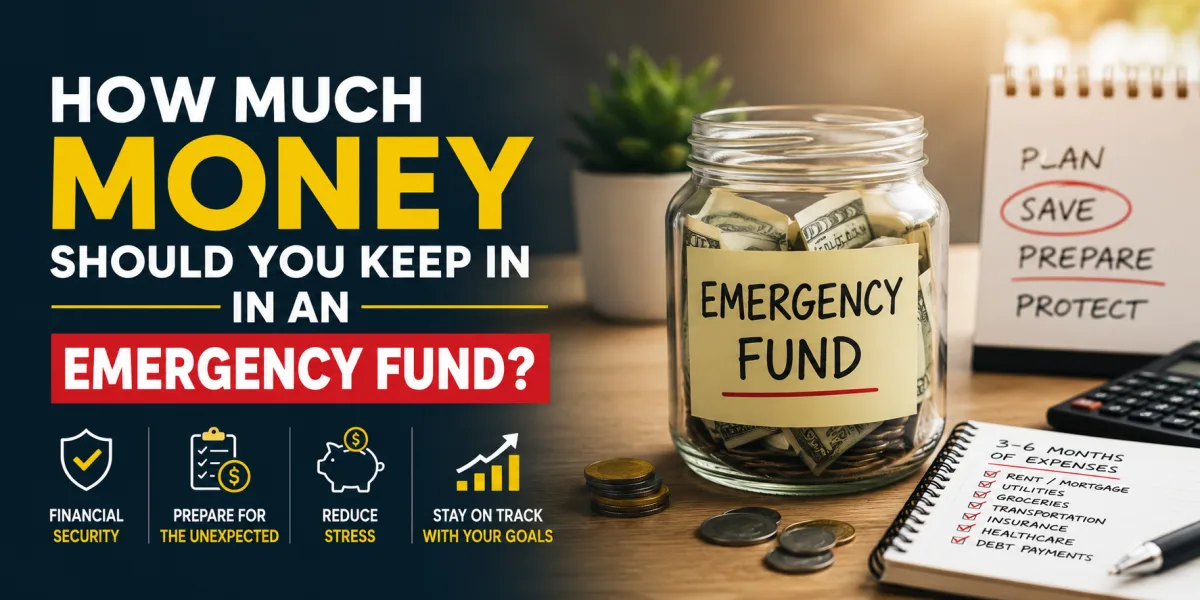
The Cash Cushion: How Much Money Should You Keep in an Emergency Fund?
An emergency fund is not exciting until the day it becomes essential. It does not promise high returns. It does not impress anyone at dinner. It does not look as productive as an investment account or as satisfying as paying off debt. Most of the time, it simply sits there, quiet and unused.
That quietness is the point.
An emergency fund is financial shock absorption. It is the money that stands between an unexpected expense and a credit card balance, between a job loss and missed rent, between a car repair and a payday loan, between a medical bill and panic. It is not designed to make you rich. It is designed to keep one bad month from becoming a financial spiral.
The Consumer Financial Protection Bureau defines an emergency fund as a cash reserve set aside for unplanned expenses or financial emergencies, including car repairs, home repairs, medical bills, or loss of income.
The traditional rule says to keep three to six months of expenses in an emergency fund. That rule is useful, but incomplete. A single adult with a stable government job, low fixed expenses, no dependents, and strong insurance may not need the same cash reserve as a self-employed parent with two children, an older car, a mortgage, medical needs, and variable income. A renter in a walkable city has different risks from a homeowner in a high-cost suburb. A two-income household has different risk from a single-income household. A person with high-interest debt has a different savings strategy from someone who is debt-free.
The right emergency fund is not a universal number. It is a risk-based number.
The question is not simply, “How much should I save?” The better question is, “How much cash would protect my household from the most likely financial shocks without unnecessarily holding too much money out of longer-term wealth-building opportunities?”
Why Emergency Funds Matter More Than They Seem
Most financial plans assume normal life. Income arrives. Bills are paid. Food is bought. Insurance renews. Debt payments are made. Savings transfers happen. But real life does not stay normal for long. Appliances break. Employers restructure. Children get sick. Pets need care. Cars fail inspections. Rent rises. Flights must be booked for family emergencies. Medical deductibles reset. A client pays late. A spouse loses work. A roof leaks.
Without cash, these events become debt events. The emergency itself may be temporary, but the financing can last for months or years. A $1,200 car repair placed on a high-interest credit card can cost far more if it is not paid quickly. A missed rent payment can create fees, stress, and housing risk. A delayed utility bill can trigger penalties. A small gap becomes larger because there is no buffer.
The Federal Reserve’s 2026 report on the economic well-being of U.S. households found that 63 percent of adults said they would cover a hypothetical $400 emergency expense using cash, savings, or a credit card paid off at the next statement. That means a large minority would need another method, such as carrying debt, borrowing, selling something, or being unable to pay.
That statistic matters because $400 is not a large emergency in modern household finance. Many car repairs, medical bills, home repairs, insurance deductibles, and travel emergencies exceed it quickly. If $400 is difficult, a larger shock can be destabilizing.
Emergency savings are not only about mathematics. They reduce fear. They give a person time to make better decisions. They prevent desperate borrowing. They help preserve credit. They reduce the chance that long-term investments must be sold during a downturn. They protect dignity.
The Three-to-Six-Month Rule
The common recommendation is to keep three to six months of essential expenses in cash. Essential expenses usually include housing, utilities, groceries, insurance, transportation, minimum debt payments, childcare, medicine, phone, internet, and other costs required to keep life functioning.
This rule became popular because it roughly matches the kind of disruption many households fear most: temporary unemployment or income loss. If you lose a job, a three-month emergency fund gives breathing room. A six-month fund gives more room to search carefully, avoid panic, and maintain basic obligations.
But the rule should be used as a range, not a commandment. Three months may be enough for someone with stable income, low expenses, strong insurance, and multiple backup options. Six months may be more appropriate for someone with dependents, variable income, health risks, or a specialized career where job searches take longer. Some households need nine to twelve months. Others can start with one month and build gradually.
The point is not to memorize the rule. The point is to understand what the rule is trying to protect: time, stability, and choice.
Start with Essential Expenses, Not Total Lifestyle Spending
Emergency fund targets should usually be based on essential expenses, not full lifestyle spending. If your normal monthly spending is $5,000 but $1,200 of that is travel, dining out, subscriptions, shopping, entertainment, and optional extras, your emergency budget may be closer to $3,800.
In a real emergency, spending should contract. You may pause travel, reduce restaurants, cancel optional subscriptions, delay upgrades, cut discretionary shopping, and redirect money toward survival expenses. The emergency fund should protect the core household, not necessarily preserve every normal habit.
To calculate essential monthly expenses, list the costs that must continue even during a crisis. Housing comes first. Then utilities, groceries, transportation, insurance, medical needs, childcare, minimum debt payments, communication, and any obligations that keep income possible. If a vehicle is required to work, transportation is essential. If internet is required to work remotely, internet is essential. If medication is required, it is essential.
Once you know the essential monthly number, multiply it by the number of months you want to protect. If essentials are $3,500 per month, three months equals $10,500. Six months equals $21,000. Nine months equals $31,500.
This calculation gives clarity. It turns vague anxiety into a concrete target.
The First Emergency Fund: $500 to $1,000
For someone starting from zero, a three-to-six-month emergency fund can feel impossible. That is why the first target should be smaller. A starter emergency fund of $500 to $1,000 can prevent many small emergencies from becoming debt.
A starter fund is not complete protection. It will not cover job loss or major medical costs. But it can cover a tire replacement, urgent prescription, small appliance repair, overdraft risk, minor car issue, or emergency trip deposit. It creates the habit of saving and provides immediate psychological relief.
Vanguard has argued that even $2,000 in savings can provide a meaningful buffer and reduce the likelihood of financial distress, especially for households vulnerable to unexpected expenses.
That is an important lesson. Emergency savings do not become useful only after they reach six months of expenses. The first few hundred dollars can already change behavior. A person with no savings may reach for credit immediately. A person with $800 can solve some problems in cash and avoid turning every surprise into debt.
The first milestone matters because it changes the household from fully exposed to partially protected.
The One-Month Emergency Fund
After the starter fund, the next meaningful goal is one month of essential expenses. This is where financial stress begins to shift. One month of expenses can protect against a delayed paycheck, temporary work interruption, small medical issue, car repair, or short-term family emergency.
A one-month fund is especially important for people living paycheck to paycheck. It creates room between income and bills. Instead of every bill depending on the next paycheck arriving exactly on time, the household has a buffer.
This is also the beginning of cash-flow freedom. When you have one month of expenses saved, you can gradually move toward using this month’s income to pay next month’s bills. That shift reduces timing stress dramatically. Bills stop feeling like ambushes because the money is already present.
For many households, the one-month fund is the most important psychological milestone. It proves that saving is possible. It reduces panic. It creates space to think.
The Three-Month Emergency Fund
A three-month emergency fund is a solid target for households with relatively stable financial lives. It may be appropriate for people with steady employment, strong job prospects, low debt, good health insurance, no dependents, and access to family or community support if needed.
Three months can also work for dual-income households where either income could cover most essential expenses. If one person loses work but the other income continues, the emergency fund stretches longer. A household with flexible spending and low fixed obligations may be able to reduce expenses quickly during a crisis.
A three-month fund is not small. If essential expenses are $4,000 per month, it requires $12,000. That amount takes time to build, especially while paying debt or supporting a family. The goal should be approached in stages rather than abandoned because it feels large.
Three months is often the first “fully functional” emergency fund. It can handle more than small inconveniences. It can absorb a short job loss, a major repair, or a cluster of smaller emergencies without immediately forcing borrowing.
The Six-Month Emergency Fund
A six-month emergency fund is the standard conservative target for many households. It may be appropriate for families with dependents, single-income households, homeowners, people with health risks, workers in volatile industries, and anyone whose job search could take time.
Six months provides more than money. It provides negotiating power. A person with six months of expenses saved can be more selective after a layoff. They may avoid taking the first poor job offer out of fear. They may manage a medical recovery without immediately falling behind. They may help a family member without destroying their own stability.
But six months also carries opportunity cost. Cash is safe and liquid, but it usually earns less over long periods than a diversified investment portfolio. Holding six months of expenses in cash may be wise for risk management, but holding several years of expenses in cash without a reason can slow wealth building.
The right amount is not the maximum possible. It is the amount that protects the household while still allowing long-term money to grow.
When You May Need Nine to Twelve Months
Some households should consider a larger emergency fund. A self-employed person with uneven income may need more cash than a salaried employee. A commission-based worker may need a buffer for slow sales cycles. A business owner may face client delays, tax obligations, and operating expenses. A single parent may need more protection because there is no second income in the household.
Specialized professionals may also need larger reserves. If your industry has long hiring cycles or requires relocation, three months may not be enough. If you work in a field vulnerable to recessions, layoffs, contract changes, or funding cuts, more cash can be rational.
Homeowners often need larger emergency funds than renters because they own the repair risk. A renter may call the landlord when the water heater fails. A homeowner receives the bill. Older homes, older cars, medical needs, pets, dependents, and family obligations all increase the case for more cash.
A larger emergency fund can also be appropriate before a major life transition: starting a business, moving countries, having a child, going back to school, leaving a job, or retiring early. In those cases, cash is not laziness. It is transition insurance.
When a Smaller Fund May Be Reasonable
Some people can maintain a smaller emergency fund, at least temporarily. A person with high-interest credit card debt may keep a starter emergency fund while aggressively paying down debt. This is because credit card interest can be financially destructive. Saving six months in cash while paying 25 percent interest on debt may not be optimal.
A smaller fund may also be reasonable for someone with very stable income, low fixed expenses, strong insurance, no dependents, and multiple backup resources. A tenured employee or government worker may face lower income disruption risk than a contractor in a volatile industry. A dual-income household with low expenses may need less cash than a single-income household with high fixed obligations.
However, “smaller” does not mean zero. Even people with stable jobs face car repairs, medical bills, travel emergencies, and family needs. A basic cash cushion is still essential.
The emergency fund should reflect risk, but it should never disappear entirely.
Emergency Fund Versus Debt Payoff
One of the hardest questions is whether to save or pay off debt. The answer depends on the type of debt and the size of the emergency fund.
If you have no emergency savings, build a starter fund first. Without it, the next surprise may go back onto the credit card, undoing debt progress. A small emergency fund protects the debt payoff plan.
After the starter fund, high-interest debt deserves urgency. Credit card debt, payday loans, and high-cost personal loans often charge rates that overwhelm what savings can earn. In that situation, a person may keep one month of essential expenses or a starter fund while directing extra cash toward debt.
Once high-interest debt is gone, building a larger emergency fund becomes easier and more important. Low-interest debt, such as some mortgages or student loans, does not always need to be eliminated before reaching a full emergency fund. The decision depends on interest rates, income stability, and risk tolerance.
The best sequence for many households is: save a starter emergency fund, pay down high-interest debt, build one month of expenses, continue debt payoff, and gradually grow toward three to six months.
Emergency Fund Versus Investing
Investing is essential for long-term wealth, but emergency money should not be treated like investment money. The purpose is different. Investment money seeks growth. Emergency money seeks availability and safety.
If the stock market falls at the same time you lose your job, an invested emergency fund can create a painful choice: sell at a loss or borrow. This is exactly what an emergency fund is supposed to prevent.
Recent financial-planning coverage continues to warn against investing the entire emergency fund because market volatility and liquidity risk can make money unavailable or reduced precisely when needed. High-yield savings accounts are often preferred for emergency funds because they combine safety, access, and some interest.
This does not mean every dollar beyond the emergency fund should sit in cash. Once your emergency fund target is met, additional long-term money can usually be invested according to your goals, time horizon, and risk tolerance. The emergency fund protects the investment plan by reducing the chance that you must sell investments during a crisis.
Cash and investments are not enemies. They have different jobs.
Where to Keep an Emergency Fund
An emergency fund should be safe, liquid, and separate from daily spending. The ideal location is usually a high-yield savings account, money market deposit account, insured bank savings account, or similar cash account. The money should be easy to access within a short time, but not so easy that it becomes ordinary spending money.
The Federal Deposit Insurance Corporation states that deposits are automatically insured to at least $250,000 at each FDIC-insured bank. Its standard insurance amount is $250,000 per depositor, per insured bank, for each account ownership category.
Deposit insurance matters because emergency funds are not supposed to be speculative. If the money is in a bank account, verify that the institution is insured and that your balances are within applicable coverage limits. For most households, this is straightforward. For higher-balance households, coverage limits should be reviewed carefully.
A separate account is helpful because it creates friction. If emergency money sits in the same checking account used for groceries, subscriptions, and dining out, it may slowly disappear. A separate savings account makes the boundary visible.
The account should still be accessible. A certificate of deposit may offer a higher rate, but penalties and delays can reduce flexibility. Some people use a tiered approach: one month in a high-yield savings account, additional reserves in money market funds or short-term Treasury bills. That can work for more advanced households, but the first priority is simple access.
What Counts as an Emergency?
A true emergency is unexpected, necessary, and urgent. Job loss is an emergency. A major medical bill is an emergency. Essential car repair can be an emergency if the car is needed for work. Urgent home repair can be an emergency. Emergency travel for a family crisis may be an emergency.
Not every irregular expense is an emergency. Holidays are not emergencies. Annual insurance premiums are not emergencies. Back-to-school costs are not emergencies. Routine car maintenance is not an emergency. Property taxes are not emergencies. These should be handled through sinking funds.
This distinction matters because emergency funds often get drained by predictable expenses. The household then has no cash left for true emergencies. A strong financial system includes both emergency savings and sinking funds.
If the expense is predictable, save for it separately. If it is unexpected and necessary, the emergency fund is there.
Emergency Funds for Renters
Renters may not face roof repairs or water heater replacements, but they still need emergency savings. Renters can face job loss, medical costs, moving expenses, security deposits, rent increases, car repairs, family emergencies, and lease disruptions.
A renter’s emergency fund should include enough to cover essential expenses and potential relocation costs. Moving can require first month’s rent, security deposit, application fees, utility deposits, movers, storage, and transportation. In high-cost cities, this can be substantial.
Renters with strong tenant protections and stable jobs may lean toward three months. Renters with uncertain employment, family dependents, or unstable housing markets may need more.
Housing insecurity is one of the most destabilizing financial risks. Emergency savings help protect against it.
Emergency Funds for Homeowners
Homeowners usually need larger emergency funds because they own maintenance and repair risk. A home can create sudden expenses: roof leaks, plumbing failures, electrical problems, HVAC replacement, appliance breakdowns, storm damage, pest treatment, foundation issues, or insurance deductibles.
Homeowners should maintain both an emergency fund and a home maintenance sinking fund. The emergency fund protects against sudden crises. The maintenance fund handles expected wear and tear. A homeowner who treats every repair as a surprise will constantly raid emergency savings.
Older homes generally need larger reserves. Homes in areas exposed to storms, floods, wildfire, freezing temperatures, or high insurance deductibles also require more cash planning.
A house can be an asset, but it is also a liability machine. Emergency savings help keep ownership from becoming financial stress.
Emergency Funds for Families
Families need larger emergency funds because more people create more possible emergencies. Children need medical care, school expenses, clothing, childcare, transportation, and sometimes urgent support. A family may also have less flexibility to cut spending quickly because many expenses are tied to dependents.
Childcare is especially important. If a parent loses a job, childcare may still be needed for job searching or maintaining another parent’s work schedule. If childcare is lost, income may be affected. Family budgets are interconnected.
Families should consider at least three to six months of essential expenses, and more if there is one income, a child with medical needs, unstable work, or limited family support. The emergency fund should reflect the cost of protecting the household, not just the adults.
For parents, emergency savings are not only a personal finance tool. They are a form of family stability.
Emergency Funds for Freelancers and Business Owners
Freelancers and business owners need special caution because income and expenses can both be irregular. A salaried worker may lose income in one large event. A freelancer may experience slow-paying clients, project gaps, seasonal demand, platform changes, contract cancellations, and tax obligations.
A self-employed person should often separate personal emergency savings from business reserves. The personal emergency fund covers household expenses. The business reserve covers taxes, software, equipment, contractors, professional insurance, slow client payments, and operating costs.
Six to twelve months of essential personal expenses may be reasonable for many freelancers, especially if income is volatile. Business owners may also need several months of operating expenses, depending on payroll, rent, inventory, and customer payment cycles.
The self-employed also need tax discipline. Money set aside for taxes is not emergency money. It already belongs to a future obligation.
Emergency Funds for Retirees
Retirees need emergency funds, but the purpose changes. Instead of protecting against job loss, cash protects against market downturns, medical expenses, home repairs, family support needs, and irregular spending.
A retiree drawing from investments may hold a larger cash buffer to avoid selling stocks during market declines. This is sometimes called a cash bucket. The amount varies, but many retirees keep one to three years of near-term spending in cash or conservative assets, depending on pension income, Social Security, portfolio size, health, and risk tolerance.
Retirees with stable pension income may need less cash than retirees relying heavily on investment withdrawals. Homeowners, people with health risks, and those supporting family members may need more.
For retirees, emergency savings protect both lifestyle and portfolio longevity.
How to Build an Emergency Fund Faster
Building an emergency fund requires a system, not leftover hope. The first step is automation. Set up an automatic transfer to savings on payday, even if it is small. Treat the transfer like a bill.
Next, direct windfalls into the fund. Tax refunds, bonuses, cash gifts, overtime, side income, rebates, and extra paychecks can accelerate progress. A single lump sum can move the fund from fragile to functional.
Then audit recurring expenses. Cancel unused subscriptions. Negotiate insurance. Review phone plans. Reduce delivery fees. Pause spending categories temporarily. The goal is not permanent deprivation. It is building the cash cushion that makes future life less stressful.
Sell unused items if it helps create the starter fund. Take on a short-term side project if realistic. Use savings challenges if they motivate you, but do not rely on gimmicks. The basic formula is simple: automatic transfers, reduced leaks, and intentional use of extra income.
The emergency fund should be built before lifestyle upgrades consume every raise.
How to Refill an Emergency Fund
Using an emergency fund is not failure. That is what it is for. The failure would be using it and never rebuilding it.
After an emergency, pause and reset. Ask how much was used, whether the expense was truly unexpected, and what category should handle similar expenses in the future. If the emergency was a car repair, you may need a car maintenance sinking fund. If it was a medical bill, you may need a medical reserve. If it was income loss, you may need a larger emergency target.
Then rebuild the fund with priority. Temporarily reduce discretionary spending. Redirect extra debt payments if necessary after minimums are covered. Use bonuses or windfalls. Automate transfers again.
An emergency fund is not a trophy to keep untouched forever. It is a working tool. When it does its job, rebuild it.
How Much Is Too Much?
It is possible to hold too much emergency cash. Cash provides safety, but long-term excess cash can lose purchasing power after inflation and miss investment growth. A person holding two years of expenses in cash while underfunding retirement may be overprotecting the present and underfunding the future.
There are exceptions. Someone preparing to leave a job, start a business, buy a home, care for family, move countries, or retire early may intentionally hold more cash. That is not necessarily excessive. It is planned liquidity.
The test is purpose. Every dollar in emergency savings should have a job. If the cash is protecting a known risk, it may be justified. If it is sitting there because investing feels scary, the issue may be risk tolerance and financial education.
Once the emergency fund is full, additional long-term savings should usually move toward investing, retirement contributions, debt reduction, business building, or other wealth-building goals.
A Practical Emergency Fund Formula
Start with monthly essential expenses. Then choose a risk multiplier.
Use one month if you are starting from zero and need the first meaningful milestone.
Use three months if you have stable income, low fixed expenses, no dependents, good insurance, and strong backup options.
Use six months if you have dependents, one primary income, moderate job uncertainty, a mortgage, health concerns, or higher fixed obligations.
Use nine to twelve months if you are self-employed, a business owner, a single parent, in a volatile industry, supporting extended family, dealing with health risks, or preparing for a major transition.
Then adjust. If debt is high-interest, keep a starter fund and focus on debt. If job security weakens, increase savings. If a child is born, increase savings. If you buy a home, increase savings. If you become debt-free and stable, you may not need to keep expanding cash indefinitely.
The emergency fund is not a static number. It should change when your risks change.
The Wealth Lesson
An emergency fund is the foundation of financial resilience. It does not replace investing. It protects investing. It does not eliminate emergencies. It prevents emergencies from controlling the entire financial plan.
The right amount depends on your life. Start with $500 to $1,000 if you have nothing. Build to one month of essential expenses. Then aim for three months if your situation is stable, six months if your responsibilities are greater, and nine to twelve months if your income or life risks are more complex.
Keep the money safe, liquid, and separate. Use insured accounts where appropriate. Do not invest the core emergency fund. Do not treat predictable expenses as emergencies. Build sinking funds for the bills you know are coming. Refill the fund after using it.
A strong emergency fund changes how money feels. Problems still happen, but they no longer become immediate crises. You can repair the car without wrecking the budget. You can handle a medical bill without panic. You can survive a job interruption without making desperate decisions. You can protect your credit, your household, and your long-term investments.
Cash may not be glamorous, but it is powerful. It buys time. It buys calm. It buys choices. And in an emergency, choices are often the most valuable asset you own.
 Article
 Article
 Article
 Article
 Article
 Article
 Article
 Article