
The Retirement Portfolio Starter: Best Investment Strategies for Beginners
Retirement investing can feel more complicated than it needs to be. A beginner opens an employer plan, brokerage app, or IRA website and is immediately confronted with unfamiliar language: index funds, target-date funds, expense ratios, Roth contributions, traditional contributions, asset allocation, diversification, bonds, ETFs, rebalancing, risk tolerance, contribution limits, glide paths, and market volatility.
The result is often delay. People wait until they understand everything. They wait until they earn more. They wait until the market looks calmer. They wait until they know which fund is best. They wait until they have paid off every debt, moved into a better job, or found a financial advisor. Years pass. The retirement account remains small or unopened.
That delay is costly because retirement investing is powered by time. The beginner does not need a perfect portfolio on day one. The beginner needs a sensible system that starts early, contributes regularly, keeps costs low, diversifies broadly, avoids panic, and improves gradually. Retirement investing is not a single brilliant decision. It is a long sequence of repeatable choices.
The Securities and Exchange Commission explains that asset allocation means dividing investments among categories such as stocks, bonds, and cash, and that the right allocation depends on time horizon and risk tolerance. That idea is the foundation of retirement strategy. Beginners do not need to guess which company will dominate the next decade. They need to decide how much growth, stability, and liquidity their retirement money should have.
The best retirement investment strategies for beginners are not exciting in the way financial media often suggests. They are not built around hot stocks, market predictions, day trading, or speculative assets. They are built around habits: capture employer matches, use tax-advantaged accounts, buy diversified funds, keep fees low, invest automatically, increase contributions over time, and stay invested through market cycles.
The beginner’s goal is not to beat every other investor. The goal is to build a portfolio that can survive their own uncertainty.
Start with the Right Goal
Retirement investing begins with purpose. The purpose is not simply to make money. The purpose is to convert working income into future income. During employment years, wages or business income fund daily life. In retirement, that income must be replaced by Social Security, pensions, annuities, rental income, investments, savings, or part-time work. Retirement investing builds the pool of assets that may eventually support withdrawals.
This matters because the retirement portfolio has a long job. It must grow during working years, endure market declines, protect against inflation, and eventually support spending. That is different from saving for a vacation, emergency fund, house down payment, or car purchase. Short-term money needs stability. Retirement money usually needs growth.
A beginner should therefore separate money by time horizon. Cash needed within the next few months belongs in checking or savings. Money needed within a few years should generally avoid heavy stock market risk. Money intended for retirement decades away can usually accept more volatility because it has time to recover from downturns.
The first retirement strategy is not choosing a fund. It is assigning the correct job to each dollar.
Strategy 1: Capture the Employer Match
For many beginners, the best retirement investment strategy is contributing enough to a workplace retirement plan to receive the full employer match. A match is additional money the employer contributes based on the employee’s contribution. If an employer matches 50 percent of contributions up to 6 percent of pay, the employee who does not contribute enough to receive the full match leaves compensation unused.
The employer match is powerful because it improves the contribution rate immediately. The market return is uncertain. The match is part of the plan formula. A beginner who contributes 6 percent of pay and receives a 3 percent employer match is effectively putting 9 percent of pay toward retirement before any investment growth.
This does not mean every worker can immediately contribute the maximum allowed. Many households are balancing rent, debt, childcare, insurance, groceries, and emergency savings. But the employer match deserves priority because it may be the highest-confidence retirement benefit available.
For 2026, the IRS announced that the employee contribution limit for 401(k), 403(b), most 457 plans, and the federal Thrift Savings Plan increased to $24,500, while the IRA contribution limit increased to $7,500. Beginners do not need to start at the maximum. They need to start with a contribution rate that captures available benefits and can grow over time.
If the full match is not affordable today, start lower and set a schedule. Increase contributions by one percentage point every few months, at every raise, or each January. The key is to make progress automatic rather than dependent on motivation.
Strategy 2: Use Tax-Advantaged Accounts Before Taxable Investing
Retirement accounts exist because governments want to encourage long-term saving. These accounts can provide tax advantages that help money compound more efficiently. The main beginner options are employer plans such as 401(k), 403(b), 457, and Thrift Savings Plan accounts, plus individual retirement accounts such as traditional IRAs and Roth IRAs.
A traditional 401(k) or traditional IRA may allow pre-tax contributions, meaning taxable income may be reduced today. Investments can grow tax-deferred, and withdrawals are generally taxed later. A Roth 401(k) or Roth IRA uses after-tax money today, but qualified withdrawals may be tax-free later. The better choice depends on current tax rate, expected future tax rate, eligibility, employer plan features, and need for flexibility.
Beginners often spend too much time trying to choose perfectly between traditional and Roth. The decision matters, but not as much as actually contributing. A person who delays for three years because they cannot decide on tax treatment has likely lost more than the tax decision would have saved.
A useful beginner approach is to prioritize the workplace plan match first, then consider an IRA if eligible and appropriate, then increase workplace contributions over time. Taxable brokerage accounts can be useful after tax-advantaged accounts are on track, especially for early retirement goals or additional investing. But for basic retirement planning, tax-advantaged accounts are usually the starting point.
Account choice is a container decision. Investments still need to be selected inside the container.
Strategy 3: Choose Asset Allocation Before Choosing Funds
Asset allocation is the mix of stocks, bonds, cash, and other investments in a portfolio. It is one of the most important decisions in retirement investing because it shapes both risk and potential return.
Stocks generally offer higher long-term growth potential but greater volatility. Bonds may provide income and stability but usually lower long-term growth potential. Cash is stable and liquid but may not keep up with inflation over long periods. The right mix depends on the investor’s age, retirement timeline, risk tolerance, income stability, other assets, and ability to stay invested during downturns.
Investor.gov emphasizes that the asset allocation that works best depends largely on time horizon and ability to tolerate risk. This is crucial for beginners. A 28-year-old saving for retirement may reasonably hold a stock-heavy portfolio because retirement is decades away. A 62-year-old retiring soon may need more stability because withdrawals are near.
Risk tolerance is not what you say during a rising market. It is what you can live with during a falling market. A beginner who chooses an aggressive portfolio but sells after a 25 percent decline may be taking more risk than they can handle. A slightly more conservative portfolio held through downturns may outperform an aggressive portfolio abandoned in panic.
Asset allocation should be chosen for the investor’s real behavior, not their imagined courage.
Strategy 4: Use Broad Index Funds as a Core
Index funds are one of the simplest retirement tools for beginners. An index fund seeks to track a market index, such as a broad U.S. stock market index, international stock index, or bond market index. Instead of trying to pick winning companies or hire a manager to beat the market, the investor owns a broad slice of the market.
The appeal is diversification, simplicity, and often low cost. A total U.S. stock market index fund may own shares in thousands of companies. An international index fund may provide exposure outside the United States. A bond index fund may add fixed-income exposure. With a few funds, a beginner can build a globally diversified retirement portfolio.
Index investing does not guarantee profit. Index funds can decline sharply when markets fall. A broad stock index fund may lose significant value during bear markets. But diversification reduces the risk that one company failure destroys the plan. The investor is not betting everything on one stock, one executive team, or one industry trend.
For beginners, index funds can remove the burden of stock selection. The question becomes not “Which stock will win?” but “What broad mix of assets should I own for my retirement timeline?”
This shift is powerful because most beginners do not have the time, training, or temperament to analyze individual securities. They need participation in long-term wealth creation, not a second job as a stock analyst.
Strategy 5: Consider a Target-Date Fund
A target-date fund is designed around an expected retirement year. A beginner chooses a fund with a date near the year they expect to retire, such as a 2055 or 2060 fund. The fund holds a diversified mix of investments and gradually becomes more conservative as the target date approaches.
FINRA explains that target-date funds are designed to help manage investment risk, with investors choosing a fund whose target year is closest to their anticipated retirement year. As the fund approaches its target date, it generally focuses more on lower-risk assets such as fixed income and cash equivalents. The Department of Labor similarly notes that target-date funds can be attractive for employees who do not want to actively manage retirement savings and that they automatically rebalance to become more conservative as retirement nears.
For beginners, a target-date fund can be a useful one-fund solution. It handles diversification, allocation, and rebalancing inside one package. This can prevent paralysis and reduce the chance that an investor builds a random portfolio from too many overlapping funds.
But not all target-date funds are identical. Funds with the same target year can hold different stock and bond allocations, follow different glide paths, charge different fees, and take different levels of risk near retirement. Beginners should compare expense ratios, underlying holdings, and whether the fund is designed to reach its most conservative allocation at retirement or through retirement.
A target-date fund is not automatically perfect, but it is often better than a poorly assembled portfolio built from confusion.
Strategy 6: Keep Fees Low
Investment fees reduce returns. The effect may look small in one year but can become large over decades. Retirement investors in their 20s, 30s, and 40s are especially affected because unnecessary fees can compound against them for many years.
Investor.gov explains that fees and expenses affect portfolio value and encourages investors to ask what total fees apply, what ongoing fees maintain the account, and how fees compare with other products that can meet the same objective. The SEC also warns that fees and expenses reduce investment returns and can have a major impact over time.
Beginners should learn the expense ratio. The expense ratio is the annual cost of owning a mutual fund or ETF, expressed as a percentage of assets. A fund charging 0.05 percent costs far less than one charging 1.00 percent. That difference can meaningfully affect the final account balance over a 30- or 40-year investing period.
Fees can also appear as advisory fees, sales loads, transaction fees, account fees, annuity charges, and plan administration costs. Some fees may be worth paying for valuable advice or service. But a fee should always be understood. Paying more is not proof of better investing.
Retirement investing is uncertain enough without allowing avoidable costs to quietly erode the outcome.
Strategy 7: Automate Contributions
Automation is one of the most effective beginner retirement strategies because it removes the monthly negotiation between present spending and future security. Payroll deductions into a 401(k) or 403(b) happen before the money reaches the checking account. Automatic IRA transfers can create the same effect outside a workplace plan.
This matters because saving what is left over rarely works. Life expands to consume available cash. Groceries, rent, subscriptions, dining, gifts, travel, car repairs, and small pleasures absorb money quietly. If retirement contributions wait until the end of the month, they often lose.
Automation pays the future first. It turns retirement investing into a bill paid to your future self. The beginner does not need to feel inspired every payday. The system acts before emotion enters.
Automatic escalation can be even more powerful. Many employer plans allow participants to increase contributions automatically each year. A one-percentage-point annual increase may feel small, but over time it can move a saver from 4 percent to 10 percent or 15 percent without one painful jump.
Beginners often underestimate the importance of contribution rate. Investment returns matter, but they are uncertain. Contributions are controllable. A brilliant portfolio with tiny contributions may not build enough wealth. A simple portfolio funded consistently can become powerful.
Strategy 8: Increase Contributions with Income
Retirement investing becomes easier when contribution increases are tied to income increases. Raises, bonuses, promotions, debt payoff, side income, and tax refunds can all become opportunities to raise the savings rate.
The danger is lifestyle inflation. Income rises, and spending rises just as quickly. A larger apartment, newer car, more travel, more dining out, and more subscriptions absorb the raise before retirement contributions change. The person earns more but does not become more financially secure.
A better strategy is to split every raise. Direct part to retirement contributions, part to savings or debt reduction, and part to lifestyle if desired. This allows life to improve while future security improves too.
For beginners, contribution momentum matters more than the starting number. Someone who begins at 5 percent and increases gradually may eventually save aggressively. Someone who waits until they can start at 15 percent may never start.
Retirement wealth is built by turning income growth into asset growth.
Strategy 9: Rebalance Periodically
Over time, investment portfolios drift. If stocks perform well, the portfolio may become more stock-heavy than intended. If bonds outperform or stocks fall, the portfolio may become more conservative than planned. Rebalancing brings the portfolio back toward its target allocation.
For example, a beginner may choose an 80 percent stock and 20 percent bond allocation. After a strong stock market run, the portfolio may become 88 percent stocks and 12 percent bonds. Rebalancing would involve shifting some money back toward bonds. After a sharp stock decline, the portfolio may become 70 percent stocks and 30 percent bonds. Rebalancing may require buying stocks when they feel uncomfortable.
This is not market timing. It is discipline. Rebalancing enforces the original risk plan rather than letting recent market movement dictate the portfolio.
Target-date funds and some managed accounts rebalance automatically. Investors using individual funds may rebalance once or twice a year, or when allocations drift beyond a chosen threshold. Rebalancing too often can create unnecessary activity, especially in taxable accounts. Retirement accounts usually make rebalancing easier because trades inside the account may not trigger current taxes, though account rules vary.
Beginners should not confuse constant tinkering with good management. A retirement portfolio needs maintenance, not obsession.
Strategy 10: Avoid Stock-Picking as the Foundation
Individual stocks can be part of some investors’ portfolios, but they should not usually be the foundation of a beginner’s retirement strategy. A stock represents ownership in one company. That company may thrive, stagnate, or fail. Even strong companies can become poor investments if bought at high prices or held through structural decline.
Beginners often become interested in investing through stories. A friend made money in a tech stock. A famous investor bought a company. A social media account promotes a trend. A stock has gone up sharply. The temptation is to believe retirement wealth can be accelerated by finding the next winner.
The problem is that concentration increases risk. A portfolio built around a few companies may outperform for a while and then collapse when one company disappoints. Retirement money should not depend on one earnings report, one regulatory decision, one product cycle, or one management team.
A better beginner structure is to use diversified funds as the core. If the investor wants to hold individual stocks, keep them as a limited satellite position that does not threaten the retirement plan. The core should be boring enough to survive excitement.
Retirement investing is not entertainment. It is future income construction.
Strategy 11: Treat Bonds as Stabilizers, Not Failures
Beginners sometimes view bonds as dull or unnecessary, especially during strong stock markets. But bonds can play an important role in retirement portfolios. They may provide income, reduce volatility, and create a source of funds during stock market downturns.
The right bond allocation depends on age, risk tolerance, retirement timeline, and other income sources. A young investor may hold a small bond allocation or none at all in some cases. An investor nearing retirement may need more bonds to reduce sequence-of-returns risk. A risk-averse beginner may need some bonds simply to stay invested during market declines.
Bonds are not risk-free. Bond prices can fall when interest rates rise. Credit risk matters. Inflation can reduce real returns. Long-duration bonds can be volatile. Bond funds can decline in value. But a diversified bond allocation can still help moderate portfolio swings.
The purpose of bonds is not to win a performance contest against stocks. Their purpose is to help the investor keep the overall plan intact.
Strategy 12: Keep Emergency Savings Outside Retirement Accounts
A retirement strategy fails if every emergency forces withdrawals from retirement accounts. Emergency savings protect retirement investments from short-term shocks. A job loss, car repair, medical bill, family emergency, or home repair should not automatically trigger a 401(k) loan, IRA withdrawal, or credit card balance.
Retirement accounts are designed for long-term growth. Early withdrawals can trigger taxes, penalties, lost compounding, and bad habits. Even retirement account loans can create risk if employment ends or repayment becomes difficult.
Beginners should build at least a starter emergency fund while beginning retirement contributions. The full emergency fund target depends on household stability, income variability, dependents, insurance deductibles, and housing situation. A single renter with stable income may need less than a single-income family with children and a mortgage.
Cash is not a high-return asset, but it is an essential protection asset. It keeps retirement money invested when life becomes inconvenient.
Strategy 13: Pay Down High-Interest Debt
High-interest debt competes directly with retirement investing. A credit card charging a high APR can compound against the borrower faster than a balanced retirement portfolio can reasonably be expected to compound for the borrower. Paying down expensive debt can therefore be one of the strongest financial moves available.
This does not mean all investing must stop until every debt is gone. A reasonable sequence may be to capture an employer match, build a small emergency fund, and attack high-interest debt aggressively. Low-interest debt, such as some mortgages or student loans, may be handled differently depending on rate, tax treatment, income stability, and personal goals.
The beginner should avoid pretending that investing and debt are unrelated. A household that contributes to retirement while carrying expensive revolving debt may be building wealth with one hand and leaking it with the other.
The goal is not debt perfection. It is reducing the debts that most threaten cash flow and compounding.
Strategy 14: Understand Risk Before Returns
Beginners often ask, “What return can I expect?” A better first question is, “What risk must I accept to pursue that return?”
Stocks can deliver long-term growth, but they can also lose value sharply over short periods. Bonds can stabilize, but they can decline too. International investments add diversification but carry currency and geopolitical risk. Real estate can generate income and appreciation but can be illiquid and concentrated. Speculative assets can rise dramatically and fall just as fast.
Retirement investing requires accepting uncertainty. The investor cannot demand high returns with no volatility. But they can design a portfolio with risk they understand and can endure.
Risk tolerance questionnaires can help, but experience teaches more. A beginner who checks their account during the first market decline may learn quickly whether their allocation is too aggressive. The key is to learn without abandoning the plan entirely.
A portfolio is only suitable if the investor can hold it when it is temporarily disappointing.
Strategy 15: Avoid Market Timing
Market timing is the attempt to move in and out of investments based on predictions about short-term market direction. Beginners often believe they will invest after the market drops or sell before the next crash. The problem is that successful timing requires being right twice: when to exit and when to re-enter.
Markets can rise during bad news and fall after good news. Recoveries often begin before investors feel confident. A person waiting for certainty may miss years of growth. A person selling during panic may miss the rebound.
For retirement beginners, regular contributions are usually more useful than prediction. Investing every paycheck or every month creates discipline. When prices are high, contributions buy fewer shares. When prices are lower, contributions buy more shares. This does not guarantee profit, but it reduces the emotional burden of choosing the perfect day.
The retirement investor’s edge is not perfect timing. It is persistent participation.
Strategy 16: Use Target-Date Funds Properly
A target-date fund works best when it is used as the main diversified retirement holding, not mixed randomly with many overlapping funds. A beginner might choose a 2060 target-date fund and then add several stock funds without realizing the target-date fund already owns stocks. This can make the portfolio more aggressive or duplicative than intended.
If using a target-date fund, understand that it is usually designed as an all-in-one solution. Review what it owns. Check the stock-bond mix. Look at the expense ratio. Compare it with other target-date options in the plan. Then decide whether it can serve as the core.
Some investors outgrow target-date funds and build custom allocations. That is fine. But beginners should not assume custom is better. A simple all-in-one fund held consistently can be more effective than a complicated portfolio that is poorly understood.
The best retirement fund is often the one you can explain and keep funding.
Strategy 17: Use Index Funds Properly
Index funds are simple, but using them well still requires structure. A beginner should avoid buying five funds that all track similar large U.S. companies and assuming the portfolio is diversified. Fund names can be misleading. A large-cap index fund, S&P 500 fund, total U.S. stock fund, and growth fund may overlap heavily.
A basic index portfolio may include broad U.S. stocks, international stocks, and bonds. The percentages depend on risk tolerance and time horizon. Some beginners use a three-fund portfolio: U.S. total stock market, international total stock market, and total bond market. Others use a target-date fund that holds similar building blocks automatically.
The point is not to own many funds. The point is to own the right exposures without unnecessary overlap and cost.
Index investing is not a guarantee of success. It is a method of broad participation. The investor still needs contribution discipline, asset allocation, and patience.
Strategy 18: Do Not Ignore Inflation
Retirement may be decades away for a beginner. Over decades, inflation can erode purchasing power. A retirement account balance that looks large today may buy less in the future. This is why long-term retirement money usually needs growth assets.
Cash and very conservative investments may feel safe because balances do not move much, but they may fail to outpace rising living costs. A beginner who keeps all retirement savings in cash for decades may avoid market volatility but accept inflation risk.
Stocks are volatile, but they represent ownership in businesses that may raise prices, grow earnings, and build long-term value. Bonds and cash play roles, but growth assets are often necessary for a retirement horizon measured in decades.
The beginner must understand that safety has more than one meaning. Stable dollar value today is not the same as future purchasing power.
Strategy 19: Review Beneficiaries and Account Details
Retirement investing is not only about funds and returns. Account structure matters. Beneficiary designations determine who receives retirement account assets if the account owner dies. These designations can override a will in many cases, so they should be reviewed after marriage, divorce, births, deaths, and major life changes.
Beginners should also keep track of old employer plans after job changes. Cashing out retirement accounts can trigger taxes, penalties, and lost compounding. Better options may include leaving money in the old plan if allowed, rolling it into a new employer plan, or rolling it into an IRA. The best choice depends on fees, investment options, creditor protection, simplicity, and tax strategy.
Retirement accounts should not become lost financial furniture. Keep records. Update logins. Track balances. Review investments. Make sure the money remains invested according to plan.
A retirement strategy includes administration. Neglected accounts can become costly.
Strategy 20: Get Advice When the Stakes Rise
Beginners can do a great deal on their own with a simple plan. But advice can be useful when circumstances become complex: high income, business ownership, stock compensation, inheritance, divorce, disability, special-needs planning, tax complexity, early retirement, pension choices, or large account balances.
The important point is to understand how advisors are paid. Some charge assets-under-management fees, some charge hourly or flat fees, some earn commissions, and some combine models. Each structure has incentives. A good advisor should explain costs, conflicts, fiduciary status, investment philosophy, and planning process clearly.
Investor.gov encourages investors to check the background and registration status of anyone recommending or selling investments through the SEC’s free professional search tools. This is basic due diligence. Beginners should not hand retirement money to someone simply because they sound confident.
Advice is valuable when it improves decisions, reduces mistakes, and clarifies trade-offs. It is not valuable when it sells complexity the investor does not need.
A Beginner Retirement Portfolio Example
Consider a 30-year-old worker with access to a 401(k), a 4 percent employer match, no high-interest debt, and a retirement timeline of more than 30 years. A reasonable starting strategy might be to contribute at least enough to receive the full match, invest in a low-cost target-date fund near the expected retirement year, build emergency savings, and increase contributions by one percentage point each year.
This is not glamorous. It is effective because it creates automation, diversification, low maintenance, and rising contributions. The worker does not need to pick stocks or forecast recessions. The main work is earning income, contributing consistently, and avoiding destructive behavior.
Now consider a 40-year-old beginner with no retirement savings, credit card debt, and no employer match. The strategy may be different. They may build a small emergency fund, attack high-interest debt, contribute what they can to an IRA or employer plan, use a diversified low-cost fund, and raise contributions aggressively after debt payoff. The late start requires urgency, but not speculation.
Now consider a self-employed beginner. They may explore an IRA, SEP IRA, Solo 401(k), or other retirement plan depending on income, business structure, and tax situation. Their main challenge may be irregular income, so automatic percentage-based contributions after each payment may work better than fixed monthly contributions.
The best strategy depends on the person, but the principles remain: use the right account, diversify, keep costs low, contribute consistently, and protect the plan.
Common Beginner Mistakes
The first mistake is waiting for the perfect time. The perfect time rarely arrives. Retirement investing benefits from starting and improving.
The second mistake is choosing investments before understanding risk. A fund’s recent return does not reveal whether it fits your time horizon and temperament.
The third mistake is missing the employer match. That is part of compensation.
The fourth mistake is holding too much cash in a retirement account for decades. Cash may feel safe but may not keep up with inflation.
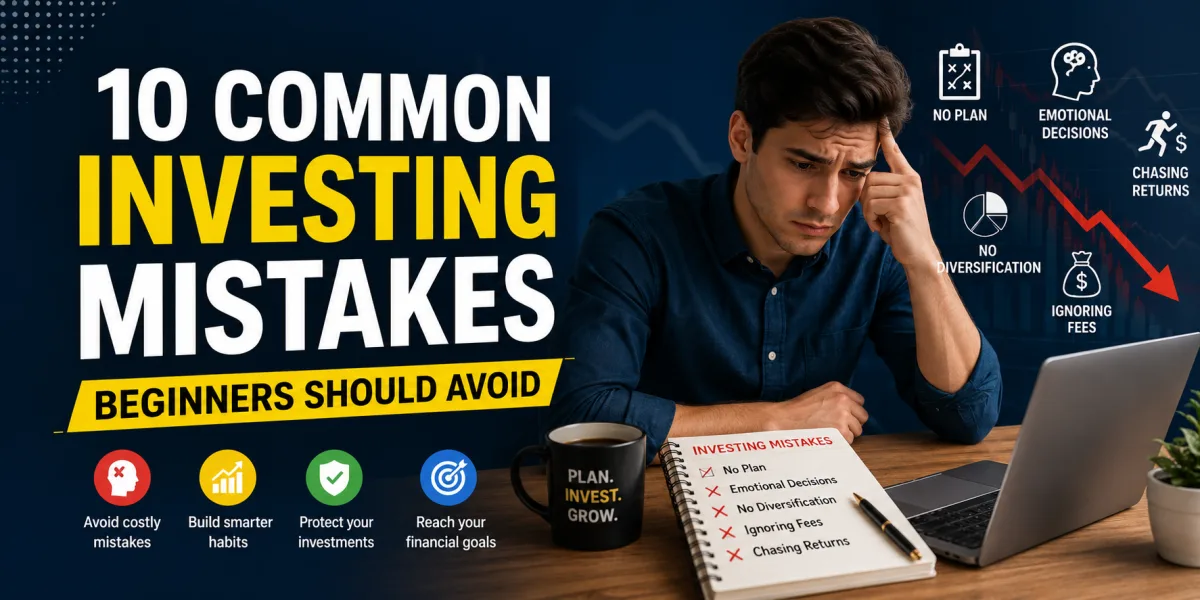
The fifth mistake is chasing hot stocks or sectors with retirement money. Speculation should not be the foundation.
The sixth mistake is ignoring fees. Small percentages can become large over decades.
The seventh mistake is stopping contributions during market declines. Lower prices may be uncomfortable, but long-term investors who keep contributing buy more shares when markets are down.
The eighth mistake is cashing out old retirement accounts after job changes. This can trigger taxes, penalties, and lost compounding.
The ninth mistake is using retirement accounts as emergency funds. Short-term shocks should be handled by cash reserves where possible.
The tenth mistake is confusing complexity with sophistication. A simple portfolio funded consistently can be more powerful than a complicated portfolio misunderstood by its owner.
The Beginner’s Retirement Checklist
Open the workplace retirement plan if available.
Contribute enough to receive the full employer match where possible.
Choose a diversified investment option, such as a low-cost target-date fund or a simple index-fund portfolio.
Build emergency savings outside retirement accounts.
Pay down high-interest debt aggressively.
Understand whether traditional or Roth contributions fit your tax situation.
Increase contributions automatically with raises.
Check expense ratios and avoid unnecessary fees.
Review allocation once or twice a year.
Keep investing through market volatility.
Update beneficiaries and track old retirement accounts.
Seek qualified advice when your situation becomes complex.
The Wealth Lesson
The best retirement investment strategy for beginners is not a secret portfolio. It is a disciplined system. Use tax-advantaged accounts. Capture the employer match. Choose an allocation that fits your timeline and risk tolerance. Invest in diversified, low-cost funds. Automate contributions. Increase the savings rate over time. Rebalance periodically. Avoid panic, speculation, high fees, and unnecessary complexity.
Beginners often believe retirement investing requires stock-picking skill. It usually requires something less exciting and more powerful: patience. A worker who contributes steadily to a diversified portfolio for 30 or 40 years gives compounding time to work. A worker who waits, trades emotionally, chases performance, or stops investing during downturns interrupts the very process that builds retirement wealth.
Retirement investing is not about knowing the future. It is about building a portfolio that does not depend on knowing the future. Broad diversification accepts that no one knows which company, country, or sector will lead next. Low fees preserve more of the return that markets provide. Asset allocation matches risk to time horizon. Automation protects the plan from forgetfulness and temptation.
The beginner’s advantage is time. But time only helps money that is actually invested. Start with the account available to you. Use simple, diversified investments. Raise contributions as your income grows. Keep emergency money separate. Let retirement money remain retirement money.
A strong retirement portfolio does not need to look impressive on day one. It needs to be funded, diversified, affordable, and durable. The earlier that system begins, the more years it has to turn ordinary contributions into future independence.
 Article
 Article
 Article
 Article
 Article
 Article
 Article
 Article