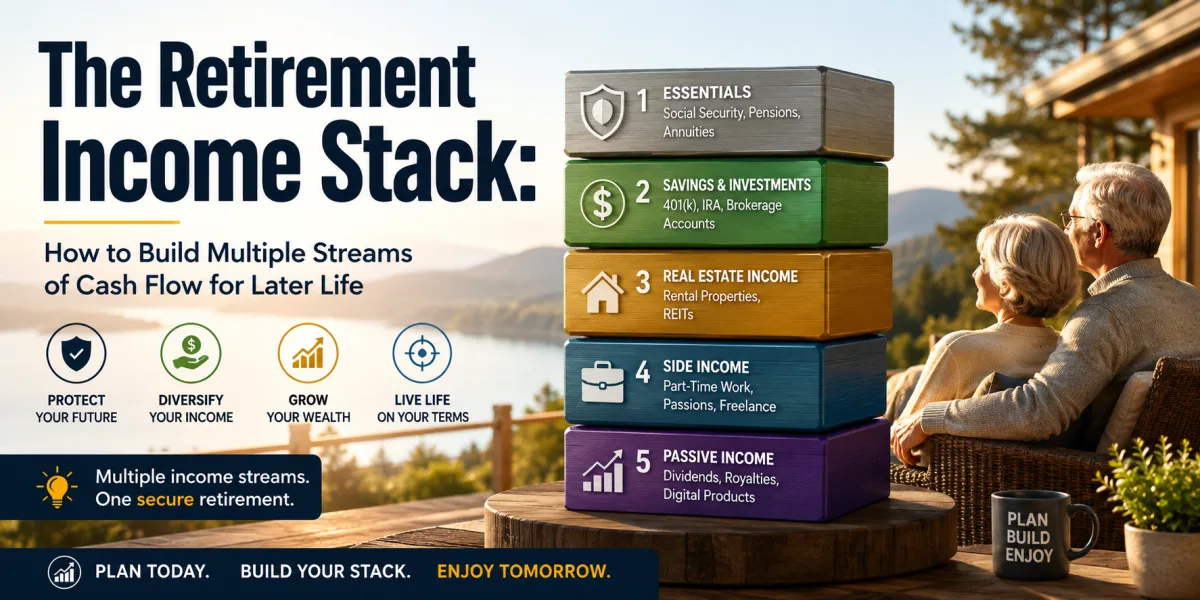
The Retirement Income Stack: How to Build Multiple Streams of Cash Flow for Later Life
Retirement planning is often presented as an account balance problem. Save a million dollars. Save two million. Reach a number, stop working, and live from the pile. That picture is simple, but it is incomplete.
Retirement is not only about how much money you have. It is about how money will arrive when paychecks stop.
A person with a large account balance but no income plan may feel anxious every time the market falls. A person with a smaller balance but reliable Social Security, a pension, rental income, cash reserves, and a disciplined withdrawal strategy may feel more secure. The difference is structure. One person has assets. The other has an income system.
Multiple income streams matter because retirement is long, uncertain, and expensive in different ways at different times. Markets rise and fall. Inflation changes purchasing power. Healthcare costs can surprise. Tax rules affect withdrawals. A spouse may die. A rental property may sit vacant. A business may slow. Interest rates can change. A retiree may live much longer than expected.
No single income source solves every risk. Social Security can provide inflation-adjusted lifetime income, but it may not cover the full lifestyle. Investment portfolios can grow, but they fluctuate. Pensions can provide stability, but fewer workers have them and survivor choices matter. Annuities can create guaranteed income, but they reduce liquidity and depend on contract terms. Rental property can produce cash flow, but it requires capital, management, and repairs. Part-time work can reduce portfolio withdrawals, but health and job availability are not guaranteed.
This is why the strongest retirement income plans are layered. They combine sources with different strengths. Some income is guaranteed. Some is growth-oriented. Some is flexible. Some is tax-efficient. Some is inflation-sensitive. Some is optional. The goal is not to collect income streams for the sake of complexity. The goal is resilience.
The Social Security Administration provides benefit calculators so workers can estimate retirement, disability, and survivor benefits based on their own records, which is essential because Social Security often becomes the foundation of retirement cash flow. The IRS also sets contribution limits for major retirement accounts; for 2026, the employee contribution limit for 401(k), 403(b), most 457 plans, and the federal Thrift Savings Plan is $24,500, while the IRA contribution limit is $7,500.
Building multiple income streams for retirement begins long before retirement. It begins with one question: when work income fades, what will replace it?
Retirement Income Is Different from Working Income
During working years, income usually arrives from one dominant source: a paycheck or business. The worker earns, spends, saves, pays taxes, and invests. The income is active. It depends on labor.
Retirement income is different. It may arrive from government benefits, employer plans, investment accounts, rental property, annuities, business assets, cash reserves, and part-time work. The retiree must coordinate timing, taxes, market conditions, healthcare costs, required withdrawals, and spending needs.
This shift can be emotionally difficult. A worker becomes used to income appearing every two weeks. A retiree may need to create that paycheck from assets. Without a plan, withdrawals can feel like loss. Selling investments can feel dangerous. Spending principal can feel like failure. In reality, retirement assets were built to become income. The challenge is turning them into income in a disciplined way.
A good retirement income system does three things. It covers essential expenses reliably. It funds lifestyle goals flexibly. It protects against shocks. Essential expenses should not depend entirely on selling stocks after a market crash. Lifestyle spending should be adjustable when conditions change. Emergency spending should not force a desperate sale of long-term assets.
Multiple streams help because they spread pressure. If one source weakens, another can support the plan. If markets decline, guaranteed income and cash reserves can carry more weight. If inflation rises, growth assets and inflation-adjusted benefits may help. If healthcare costs increase, flexible spending can be reduced. The system becomes more durable than any single source.
Start with the Retirement Income Gap
Before building income streams, estimate the gap they must fill. Retirement income planning begins with spending.
Estimate annual retirement expenses in three categories. First, essential expenses: housing, food, utilities, insurance, healthcare, taxes, transportation, and basic household needs. Second, lifestyle expenses: travel, hobbies, gifts, dining, entertainment, family visits, and home upgrades. Third, risk expenses: medical surprises, long-term care needs, major repairs, inflation, and family support.
Then list reliable income sources already expected. Social Security. Pensions. Existing annuity income. Rental income after expenses. Business income likely to continue. Part-time work if realistic. The difference between expected spending and reliable income is the retirement income gap.
For example, a household may expect to spend $85,000 per year. Social Security may provide $42,000. A small pension may provide $12,000. The remaining gap is $31,000. That gap must be filled by portfolio withdrawals, rental income, business income, annuities, part-time work, or a combination.
Another household may expect to spend $120,000 per year and receive $35,000 from Social Security. The gap is $85,000. That household needs a much larger or more diverse income system.
The retirement income gap is the central design problem. It tells you how hard your assets must work.
Stream 1: Social Security as the Foundation
Social Security is often the first layer of retirement income because it can provide monthly income for life. For many households, it is the closest thing to a guaranteed inflation-adjusted paycheck in retirement. But it should be planned, not guessed.
Benefit amounts depend on earnings history and claiming age. Claiming early can reduce monthly benefits. Delaying can increase monthly benefits up to age 70 for many retirees. The right claiming decision depends on health, life expectancy, income needs, marital status, survivor benefits, employment, taxes, and other assets.
The Social Security Administration’s tools allow people to create an account, review earnings history, and estimate benefits. The detailed calculator is updated for 2026 economic data, showing why workers should use current official tools rather than old estimates.
Married couples should think beyond the first check. Survivor benefits matter. When one spouse dies, the household may lose one Social Security payment, but many expenses remain. The higher earner’s claiming decision can affect the surviving spouse’s future income. A strategy that maximizes one person’s early cash flow may weaken survivor protection.
Social Security is not usually enough by itself. But it is powerful because it is lifetime income. It reduces the amount that must be withdrawn from investments. It can support essential expenses. It can make the portfolio last longer. It gives the retirement income stack a stable base.
Stream 2: Employer Pensions
A pension is a defined benefit plan that pays retirement income according to a formula, often based on years of service, salary history, and age. Pensions are less common for many private-sector workers than they once were, but they remain important for some government workers, union workers, educators, public safety employees, and long-tenured employees in certain industries.
A pension can reduce the portfolio burden because it provides predictable income. But pension decisions can be complex. Retirees may need to choose between single-life payments, joint-and-survivor payments, lump sums, period-certain options, or other structures. A single-life pension may pay more while the retiree is alive but stop at death. A joint-and-survivor option may pay less monthly but protect a spouse.
The pension’s inflation protection matters. A pension with cost-of-living adjustments is far more powerful over a long retirement than a fixed pension that loses purchasing power. The financial health of the pension sponsor also matters, as does any government or insurance protection that applies.
For workers with pensions, the planning question is how much essential spending the pension can cover. A retiree whose Social Security and pension cover housing, food, healthcare premiums, utilities, and taxes may be able to invest the rest of the portfolio more flexibly. A retiree whose pension covers only a small portion must rely more heavily on savings.
A pension is not only an income source. It is a risk reducer. It can protect against longevity risk, market risk, and spending anxiety. But the payout election should be made carefully because it may be irreversible.
Stream 3: Traditional Retirement Account Withdrawals
Traditional 401(k)s, traditional IRAs, 403(b)s, 457 plans, and similar retirement accounts are common sources of retirement income. Contributions may have been made pre-tax, investments may have grown tax-deferred, and withdrawals are generally taxed as ordinary income.
These accounts are powerful during accumulation because they encourage disciplined saving and may reduce taxes during working years. But in retirement they require a withdrawal strategy. Taking too much too early can deplete the portfolio. Taking too little from tax-deferred accounts may create larger required withdrawals later.
The IRS states that required minimum distributions generally begin for IRAs on April 1 of the year following the year the account owner reaches age 73, and for many defined contribution plans the required beginning date is generally April 1 following the later of reaching age 73 or retirement if the plan allows delay. The IRS also provides RMD worksheets for calculating required withdrawals.
RMDs matter because the government eventually requires withdrawals from many tax-deferred accounts. These withdrawals can affect taxes, Medicare premium calculations, Social Security taxation, and cash-flow planning. A retiree who ignores RMDs can face penalties and tax complications.
Traditional retirement accounts can create a strong income stream, but they are not a checking account. They require investment allocation, withdrawal planning, tax awareness, and discipline.
Stream 4: Roth Retirement Accounts
Roth IRAs and Roth 401(k)s can provide valuable retirement income because qualified withdrawals may be tax-free. This gives retirees flexibility. A household may use Roth withdrawals in years when taxable income is already high, during market downturns, or for large expenses that would otherwise push income into a higher tax bracket.
Roth accounts are also useful because they diversify tax risk. Future tax rates are uncertain. A retiree with only tax-deferred accounts may have less control over taxable income. A retiree with traditional, Roth, and taxable accounts can choose which bucket to tap depending on tax conditions and spending needs.
Roth contributions may be especially attractive during lower-income years, early career stages, career breaks, or years before income rises. Traditional contributions may be more attractive in high-income years when deductions are more valuable. Many households benefit from having both.
Roth income is not magic. Contributions require cash flow. Eligibility and plan rules matter. Conversion strategies can create current taxes. But as part of the retirement income stack, Roth accounts provide flexibility that can be extremely valuable later.
Stream 5: Taxable Brokerage Investments
A taxable brokerage account is often overlooked in retirement planning because it does not have the obvious tax benefits of a 401(k) or IRA. Yet it can become an important retirement income stream.
Taxable accounts provide flexibility. There are no retirement-age restrictions in the same way as many retirement accounts. Funds can be used for early retirement, bridge years before Social Security, large purchases, tax planning, or extra income. Taxable accounts can hold stocks, bonds, ETFs, mutual funds, and other assets.
They also allow tax management. Long-term capital gains and qualified dividends may receive different tax treatment from ordinary income, depending on the household’s situation and law. Investors may harvest losses, manage gains, donate appreciated assets, or choose tax-efficient funds.
A taxable account can be especially useful for people who max out retirement accounts, plan to retire early, receive bonuses or equity compensation, or want flexibility outside retirement account rules. It can also provide heirs with different planning options than tax-deferred accounts, depending on estate rules and tax law.
The danger is using taxable investing as a speculation account. Retirement-oriented taxable investments should still have an allocation plan, diversification, and cost discipline.
Stream 6: Dividend and Interest Income
Dividend-paying stocks, stock funds, bond funds, certificates of deposit, Treasury securities, money market funds, and high-yield savings can all produce cash flow. Many retirees like the idea of living from dividends and interest without selling shares.
Income-focused investing can be useful, but it must be understood clearly. A dividend is not free money. When a company pays a dividend, cash leaves the business. The stock price may adjust. A high dividend yield can signal value, but it can also signal risk. Dividends can be cut. Bond interest depends on rates, credit quality, and duration. Cash yields can fall when rates decline.
Interest income can support short-term spending and cash reserves. Bond income can stabilize the portfolio. Dividend income can contribute to withdrawals. But retirees should avoid chasing yield blindly. A portfolio built around the highest-yielding securities may take on hidden risk, including credit risk, concentration risk, sector risk, interest-rate risk, and dividend-cut risk.
A better approach is total return thinking. Income matters, but capital preservation and growth matter too. Sometimes selling a small portion of a diversified portfolio is more sensible than forcing the portfolio into risky high-yield assets.
Dividend and interest income should support the retirement income plan, not dominate it at the expense of safety.
Stream 7: Annuity Income
An annuity can convert part of savings into a stream of income, sometimes for life. This can help manage longevity risk, the risk of outliving assets. Annuities come in many forms: immediate annuities, deferred income annuities, fixed annuities, indexed annuities, variable annuities, and contracts with various riders.
The appeal is guaranteed income, depending on the insurer and contract. A retiree who worries about market withdrawals may value a predictable monthly payment. An annuity can cover part of essential expenses, allowing the investment portfolio to handle growth and discretionary spending.
But annuities are complex. Fees, surrender charges, inflation protection, liquidity limits, death benefits, rider costs, insurer financial strength, tax treatment, and payout options matter. Some annuities are simple. Others are difficult to understand and expensive. The word “guaranteed” should always be followed by the question: guaranteed by whom, under what terms, at what cost?
Annuities may fit retirees who want more guaranteed income, lack a pension, expect long life, or need help controlling withdrawal risk. They may not fit people who need liquidity, dislike complexity, have poor health, already have strong pension income, or are being sold a product they do not understand.
Used carefully, annuities can strengthen the income stack. Used poorly, they can lock up money in an expensive contract.
Stream 8: Rental Real Estate Income
Rental property can produce retirement income, inflation sensitivity, and long-term asset appreciation. A paid-off rental that generates reliable net income can be a valuable retirement stream. But real estate is not passive in the way many advertisements suggest.
Rental income must be measured after expenses. Mortgage payments, property taxes, insurance, repairs, vacancies, property management, utilities, legal costs, tenant turnover, capital improvements, and local regulation all affect cash flow. A property that appears profitable before repairs may produce little net income over a full cycle.
Real estate also concentrates risk. One property in one neighborhood with one tenant can expose a retiree to vacancy, damage, local economic weakness, weather, litigation, and major repairs. Diversification is harder than with mutual funds. Liquidity is lower. Selling can take time and involve taxes and transaction costs.
Still, rental property can be powerful for the right household. It may provide income that rises over time, mortgage amortization, tax benefits, and a tangible asset. Retirees who understand property management, maintain reserves, buy at reasonable prices, and avoid overleverage may benefit.
The retirement test is net reliability. A rental is not an income stream because rent is collected. It is an income stream if net cash flow remains after the property has been maintained properly.
Stream 9: Part-Time Work and Consulting
Part-time work is one of the most underrated retirement income streams. Even modest earnings can dramatically reduce pressure on a portfolio, especially in early retirement. A retiree who earns $15,000 or $25,000 per year may need to withdraw much less from investments, delaying portfolio depletion and creating flexibility.
Work can also provide structure, purpose, social connection, and health benefits. Some retirees consult in their former profession. Others teach, coach, drive, write, provide bookkeeping, care for children, manage projects, work seasonally, or build small service businesses.
The danger is assuming work will always be available. Health, caregiving, age discrimination, local labor markets, burnout, and family needs can limit the ability to work. Part-time income should be treated as a helpful layer, not the only retirement plan.
For people approaching retirement without enough savings, phased retirement may be powerful. Reducing hours rather than stopping completely can preserve income, delay withdrawals, maintain benefits, and ease the psychological transition.
Retirement does not have to mean an abrupt end to earning. For many people, the goal is not never working again. It is never being forced to work under financial pressure.
Stream 10: Business Income
Business income can become a retirement stream if the business can produce cash without full-time labor from the owner. This may include royalties, licensing, digital products, franchising, partnerships, professional practices with associates, agencies with management teams, software subscriptions, content businesses, or small operating businesses with staff.
But many businesses are really jobs. If income stops when the owner stops working, the business is not yet a retirement income stream. It is self-employment. That can still be valuable, but it should not be confused with passive income.
To turn a business into retirement income, the owner must build systems. Document processes. Hire or train operators. Diversify customers. Separate business and personal finances. Build recurring revenue. Reduce dependence on the owner’s personal labor. Maintain clean books. Protect intellectual property. Plan taxes. Consider succession.
A business can also become retirement capital through sale. But sale value depends on profitability, transferability, customer concentration, growth, margins, management depth, and market demand. A business that cannot run without the owner may be hard to sell.
Business income can be one of the most flexible retirement streams, but it requires planning years before retirement.
Stream 11: Royalties and Intellectual Property
Royalties can come from books, music, patents, courses, licensing, photography, software, designs, or other intellectual property. For some people, royalties create long-tail income that continues after the original work is done.
This stream is attractive because it can scale. A book, course, or license can generate income repeatedly. But royalty income is unpredictable. Many projects earn little. Platforms change rules. Audiences fade. Piracy, competition, and marketing costs can reduce returns. Intellectual property may require ongoing updates or promotion.
Royalties are best treated as supplemental retirement income, not a guaranteed foundation unless the income history is long and diversified. A retiree with several royalty streams from different assets may have a useful layer. A retiree relying on one viral product may be exposed to decline.
The best time to build intellectual property income is before it is needed. It can take years to create, distribute, and prove.
Stream 12: Cash Reserves and Short-Term Instruments
Cash is not usually thought of as an income stream, but in retirement it serves a vital cash-flow role. High-yield savings, money market funds, Treasury bills, certificates of deposit, and short-term bond funds can help cover near-term spending and reduce the need to sell long-term investments during market downturns.
Cash reserves create psychological and practical stability. If the stock market falls sharply, a retiree with one to three years of planned withdrawals in safer assets may feel less pressure to sell stocks at depressed prices. If a major expense appears, cash can absorb it.
The trade-off is inflation. Too much cash can lose purchasing power over long periods. The right cash amount depends on guaranteed income, withdrawal rate, risk tolerance, health, housing, and market exposure.
Cash is not the growth engine of retirement. It is the shock absorber. A good retirement income stack usually needs both.
Stream 13: Home Equity
Home equity is often one of the largest assets retirees have, but it is not income unless there is a plan to use it. Home equity can support retirement through downsizing, selling and relocating, renting part of the home, taking in a housemate, using a home equity line cautiously, or considering a reverse mortgage in specific circumstances.
Each option has trade-offs. Downsizing can release capital, but transaction costs, moving costs, taxes, emotional ties, and local housing prices matter. Renting space can produce income but reduces privacy and adds landlord responsibilities. Borrowing against the home creates debt and risk. Reverse mortgages are complex and require careful review.
The home can also reduce retirement income needs if it is paid off before retirement. But a paid-off home still has property taxes, insurance, repairs, utilities, and maintenance. It is not cost-free.
Home equity should not be ignored, but it should not be treated casually. Housing is both a financial asset and an emotional anchor. Using it for income requires sober planning.
Stream 14: Health Savings Accounts
A Health Savings Account, or HSA, can become a retirement healthcare income tool for eligible people enrolled in high-deductible health plans. Contributions may be tax-deductible or pre-tax, growth can be tax-free, and withdrawals for qualified medical expenses can be tax-free.
Because healthcare is a major retirement expense, an HSA can function as a dedicated medical reserve. Some people use HSAs for current medical expenses. Others invest HSA balances and save receipts for future reimbursement. The best strategy depends on cash flow, health needs, account fees, investment options, and eligibility.
An HSA should not be viewed only as a health account. For eligible savers, it can be part of the retirement income stack because it may help fund medical costs without increasing taxable income in retirement.
The limitation is that not everyone is eligible. High-deductible health plans are not right for every household. A lower premium plan with an HSA may be poor if the deductible is unaffordable or care needs are high. The insurance decision comes first. The HSA benefit comes second.
How to Layer Income Streams
The strongest retirement income systems assign jobs to different streams.
Social Security, pensions, and annuities can cover essential lifetime expenses. Portfolio withdrawals can fund both essentials and lifestyle spending. Roth accounts can provide tax flexibility. Taxable accounts can fund early retirement or bridge years. Rental income can supplement spending and provide inflation-sensitive cash flow. Part-time work can reduce withdrawals. Cash reserves can protect against market timing risk. Business income can add flexibility. Home equity can serve as a backup source if needed.
The goal is not to make every stream equal. Some streams will be primary. Others will be backup. Some will be reliable. Others will be opportunistic. Some will be taxable. Others may be tax-free or tax-deferred. Some will grow. Others will be stable.
A useful retirement income stack might look like this: Social Security for base expenses, pension or annuity for additional guaranteed income, investment withdrawals for the remaining spending gap, cash reserves for short-term needs, Roth withdrawals for tax flexibility, and part-time consulting for discretionary spending in early retirement.
Another household might use Social Security, rental income, taxable brokerage withdrawals, and later IRA withdrawals after required minimum distributions begin.
There is no universal stack. There is only a system that fits the household.
Tax Diversification Matters
Multiple income streams are not only about cash flow. They are also about tax control.
Traditional IRA and 401(k) withdrawals are generally taxable as ordinary income. Roth qualified withdrawals may be tax-free. Taxable brokerage accounts may produce dividends, interest, and capital gains. Rental income has its own tax treatment and expenses. Social Security can be partially taxable depending on income. Pensions and annuities may be taxable depending on structure.
A retiree with all assets in one tax category has fewer options. A retiree with traditional, Roth, taxable, and cash buckets can manage income more carefully. In some years, it may make sense to draw from taxable accounts. In others, Roth withdrawals may help avoid higher tax brackets. In low-income years before required minimum distributions, Roth conversions may be considered. In later years, RMDs may shape the withdrawal plan.
Tax planning should be revisited annually because income, law, markets, and life events change. A tax-efficient retirement income plan can extend the life of a portfolio by reducing unnecessary tax drag.
Inflation Protection
Retirement income must fight inflation. A fixed payment that feels comfortable at 65 may feel tight at 80 if prices rise significantly. Inflation affects groceries, utilities, insurance, property taxes, home repairs, travel, and healthcare.
Social Security includes cost-of-living adjustments, which can help. Some pensions include inflation adjustments, but many do not. Annuities may include inflation features, but they usually reduce initial payout or raise cost. Rental income may rise over time, but expenses may rise too. Stocks and real estate can offer long-term inflation protection, but they are volatile.
This is why retirement income should include both stability and growth. Too much fixed income can lose purchasing power. Too much market exposure can create volatility. The balance depends on age, risk tolerance, guaranteed income, and spending flexibility.
The retirement income stack should be built for a retirement that may last 25, 30, or 40 years, not just the first year after work ends.
Sequence Risk and the Need for Flexible Streams
Sequence-of-returns risk is the danger of poor market returns early in retirement. If a retiree withdraws heavily from a declining portfolio, the portfolio may struggle to recover even if long-term average returns later look acceptable.
Multiple income streams help reduce this risk. Social Security, pensions, annuities, rental income, part-time work, and cash reserves can reduce the amount that must be withdrawn from stocks during a downturn. Flexible lifestyle spending can be reduced temporarily. Roth or taxable accounts can be used strategically depending on tax and market conditions.
The retiree who has only one source, investment withdrawals, has fewer levers. The retiree with several streams can choose which lever to pull.
This is one of the main reasons to build income diversity before retirement begins. Income streams are harder to create under pressure.
Building Streams in Your 30s and 40s
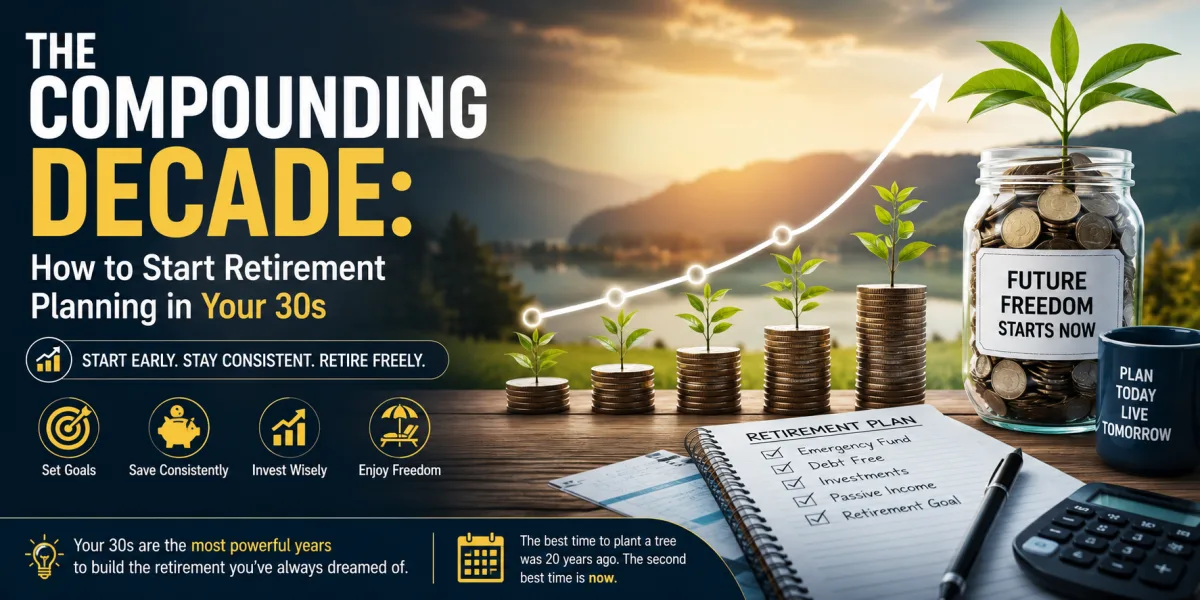
For younger workers, the priority is accumulation. Build the foundation first. Contribute to employer retirement plans. Capture the match. Use IRAs where appropriate. Build emergency savings. Pay down high-interest debt. Invest in diversified, low-cost funds. Increase contributions with raises.
The 30s and 40s are also a good time to build future optional streams. Develop career skills that can later become consulting income. Start a side business carefully. Learn about real estate before buying property. Build a taxable brokerage account after retirement accounts are on track. Create intellectual property if it fits your skills. Avoid lifestyle inflation that consumes every raise.
At this stage, the goal is not immediate retirement income. The goal is future income capacity. Every invested dollar, paid-down debt, acquired skill, and scalable asset can become part of the future stack.
Building Streams in Your 50s
The 50s are often the income-design decade. Retirement is closer, so assumptions become more real. Workers should estimate Social Security, review pensions, increase retirement contributions where possible, evaluate Roth opportunities, pay down high-interest debt, decide whether to retire with a mortgage, and test retirement spending.
For 2026, IRS retirement contribution limits allow substantial saving through workplace plans and IRAs, and older workers may have catch-up options depending on age and account type. These limits matter because the 50s may be the final high-earning decade for many households.
This is also the time to evaluate whether rental property, part-time work, consulting, annuities, or business income will realistically fit. A person who wants consulting income in retirement should begin building reputation and client relationships before leaving full-time work. A person who wants rental income should understand property management before depending on rent checks. A person considering annuities should compare products slowly, not under retirement pressure.
The 50s are not too late to build income streams, but they require focus.
Building Streams in the Final Years Before Retirement
In the final years before retirement, the emphasis shifts from accumulation to coordination. Estimate the first five years of retirement cash flow. Decide when Social Security might start. Review healthcare coverage. Build cash reserves. Adjust investment allocation. Understand tax brackets. Map withdrawals from taxable, traditional, and Roth accounts. Review pensions and survivor options. Consider whether part-time work will be needed or desired.
This is also the time to run stress tests. What if markets fall 25 percent in the first year? What if inflation stays high? What if one spouse dies? What if healthcare costs rise? What if rental income stops for six months? What if part-time work is unavailable?
A retirement income stack is only strong if it can handle bad scenarios, not only average scenarios.
How Much Should Come from Guaranteed Income?
There is no universal answer, but a useful framework is to cover essential expenses with reliable income where possible. Reliable income may include Social Security, pensions, annuities, and other stable sources. If essential spending is $60,000 per year and Social Security provides $42,000, the household has an $18,000 essential gap. That gap may be covered by portfolio withdrawals, a small annuity, part-time income, or reduced expenses.
Some retirees prefer more guaranteed income because they value security. Others prefer more investment flexibility because they want liquidity and growth potential. The right answer depends on personality, health, family, assets, risk tolerance, and bequest goals.
The key is to separate essential spending from discretionary spending. Essential spending deserves stronger income support. Discretionary spending can depend more on market-sensitive assets because it can be adjusted.
Common Mistakes
The first mistake is relying on one income source. A single source creates fragility.
The second mistake is treating Social Security as automatic without planning claiming age, survivor benefits, and taxes.
The third mistake is chasing high-yield investments without understanding risk. High yield can signal danger.
The fourth mistake is confusing gross rental income with net rental income. Repairs, vacancies, taxes, insurance, and management matter.
The fifth mistake is buying annuities without understanding fees, surrender charges, inflation protection, and liquidity limits.
The sixth mistake is ignoring taxes. Retirement income is not all taxed the same way.
The seventh mistake is holding too much cash for too long. Stability today can become purchasing-power loss tomorrow.
The eighth mistake is holding too little cash and being forced to sell investments during downturns.
The ninth mistake is depending on part-time work that may not be available due to health or labor-market realities.
The tenth mistake is waiting until retirement to design income. Income streams are easier to build before they are needed.
A Practical Retirement Income Blueprint
First, estimate annual retirement spending in essential, lifestyle, and risk categories.
Second, estimate Social Security using official tools and review claiming options.
Third, list all expected income sources: pensions, annuities, investment accounts, rental income, business income, part-time work, and cash reserves.
Fourth, calculate the retirement income gap after reliable income.
Fifth, decide which assets will fund the gap and in what order.
Sixth, build tax diversification across traditional, Roth, taxable, and cash buckets where possible.
Seventh, maintain an investment allocation that balances growth and stability. Investor.gov explains that asset allocation depends on time horizon and risk tolerance, which makes it central to retirement income design.
Eighth, create a cash reserve for near-term withdrawals and emergencies.
Ninth, stress-test the plan against market declines, inflation, healthcare costs, widowhood, rental vacancy, and lower-than-expected work income.
Tenth, review the income stack every year because retirement is dynamic.
The Wealth Lesson
Retirement security is not built from one paycheck replacement. It is built from an income stack. Social Security may provide the foundation. Pensions and annuities may add guaranteed income. Retirement accounts may fund the spending gap. Roth accounts may provide tax flexibility. Taxable investments may provide liquidity. Rental property may create cash flow. Part-time work may reduce withdrawals. Business income may extend earning power. Cash reserves may protect against bad timing. Home equity may provide a backup option.
The purpose of multiple income streams is not complexity. It is resilience. Each stream solves a different problem. Guaranteed income helps with longevity. Growth assets help with inflation. Cash helps with volatility. Tax-diverse accounts help with withdrawal planning. Real estate and business income can add flexibility but require management. Work income can help, but should not be the only safety net.
The best retirement income plan begins long before retirement. It starts with saving consistently, using tax-advantaged accounts, building taxable flexibility, controlling debt, developing skills, protecting income, and understanding what each future dollar is supposed to do.
A retirement account balance is a number. A retirement income system is a strategy. The number tells you what you own. The system tells you how you will live.
Build the streams before you need them. Make some reliable, some flexible, some growth-oriented, and some tax-efficient. Then retirement becomes less dependent on one market, one benefit, one property, one job, or one assumption. It becomes what financial independence is meant to be: a life supported by several sources of strength.
 Article
 Article
 Article
 Article
 Article
 Article
 Article
 Article