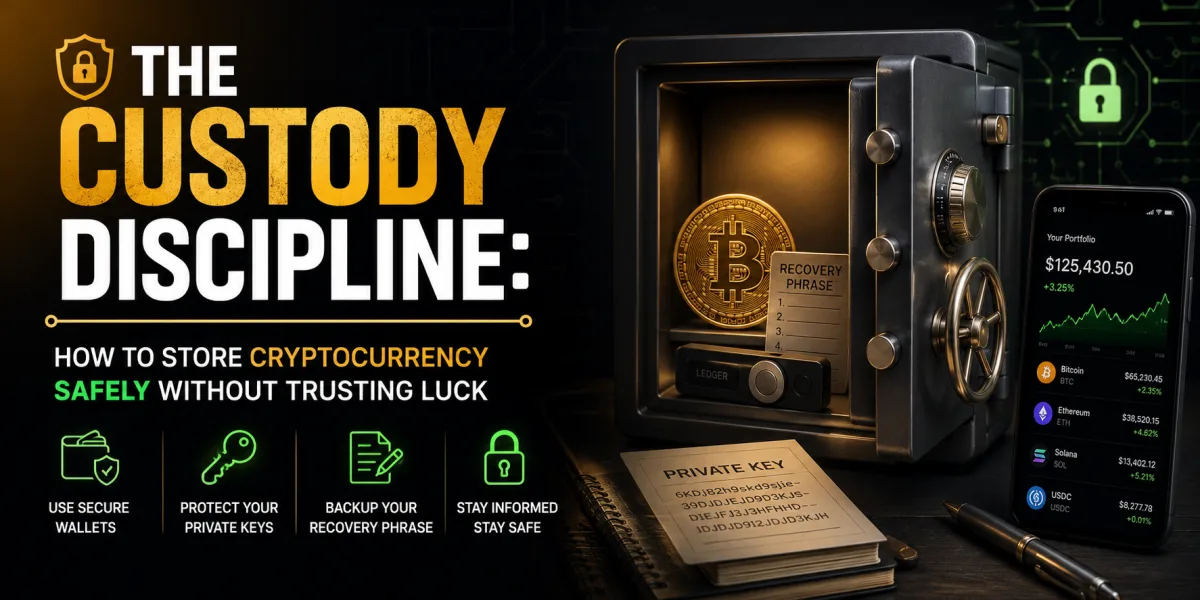
The Custody Discipline: How to Store Cryptocurrency Safely Without Trusting Luck
Cryptocurrency investing begins with buying. It survives through custody.
That is the part many beginners underestimate. They study Bitcoin, Ethereum, stablecoins, exchanges, price charts, market cycles, and long-term adoption. They compare coins and follow analysts. They learn how to buy. But they do not spend enough time learning how to store what they bought.
In traditional finance, custody is mostly invisible to the ordinary investor. A bank holds deposits. A brokerage holds securities. Password resets exist. Fraud departments investigate suspicious transactions. Regulators impose rules. Statements are issued. Accounts can often be recovered after a lost login.
Crypto is different.
Crypto assets are controlled through private keys. A wallet does not literally hold coins in the way a physical wallet holds cash. It holds or manages the cryptographic keys that allow assets on a blockchain to be moved. If someone gets access to those keys, they may be able to take the assets. If the owner loses the keys or seed phrase, they may lose access permanently.
This changes the investor’s job. Storing cryptocurrency safely is not only about choosing a good app. It is about designing a security system around ownership, access, backup, privacy, and human behavior.
The stakes are high. The SEC’s Investor.gov explains that crypto asset custody refers to how and where investors store and access crypto assets, and notes that wallets store private keys or passcodes rather than the crypto assets themselves. The SEC also warns retail investors to protect seed phrases, keep crypto holdings private, watch for phishing scams, and use strong passwords and multi-factor authentication.
Crypto security is not only a technical problem. It is a behavioral problem. Most losses do not happen because a blockchain itself fails. They happen because someone used a fake website, shared a seed phrase, stored backups carelessly, trusted the wrong exchange, clicked a malicious link, approved a dangerous wallet transaction, lost a device, forgot recovery details, or failed to plan for death or incapacity.
Safe storage requires humility. The investor must assume that mistakes are possible, scams are sophisticated, devices can fail, companies can collapse, and memory is unreliable. The goal is not perfect security. Perfect security does not exist. The goal is a practical system that reduces the most common and most damaging risks.
Understand the Two Main Custody Choices
Every crypto investor eventually faces the same custody choice: keep assets with a third party or control the keys personally.
Third-party custody means an exchange, broker, app, or custodian holds the assets on the investor’s behalf. The investor logs in with an account, password, and security settings. This is convenient because the platform manages much of the technical complexity. It may also provide customer support, transaction history, tax reports, and easier buying and selling.
Self-custody means the investor controls the private keys directly, usually through a software wallet or hardware wallet. This provides more control, but it also shifts responsibility onto the investor. If the seed phrase is lost, stolen, photographed, typed into a phishing site, or destroyed in a house fire, there may be no help desk that can restore the funds.
Neither choice is perfect. Custodial platforms introduce counterparty risk. Self-custody introduces personal operational risk.
FINRA warns that crypto assets carry traditional investing risks as well as unique risks, including technological, platform, liquidity, volatility, and fraud risks. Academic research on custodial and non-custodial wallets describes the basic trade-off clearly: non-custodial wallets give the owner full control over private keys, while custodial wallets are managed by third parties such as exchanges.
The safest decision depends on the investor’s amount, experience, technical ability, time horizon, and risk tolerance. A beginner holding a small amount may reasonably start with a reputable exchange while learning. A long-term investor holding a meaningful amount should usually learn self-custody or use a regulated professional custodian where available. A careless self-custody setup can be more dangerous than a strong custodial setup. A weak exchange can be more dangerous than a simple hardware wallet.
The right question is not, “Which method is always safest?” The better question is, “Which risks am I most capable of managing well?”
Exchange Storage: Convenient but Not Risk-Free
Most investors begin by leaving crypto on an exchange. This is understandable. Exchanges are easy to use. They allow buying, selling, swapping, deposits, withdrawals, and account statements. For small balances or frequent traders, exchange custody can be practical.
But exchange storage is not the same as holding cash in a bank account. Depending on the platform, jurisdiction, terms of service, and asset structure, investors may not have the same protections they expect from traditional financial institutions.
Exchange risks include hacking, insolvency, withdrawal freezes, regulatory action, poor internal controls, account takeover, phishing, service outages, and unclear ownership treatment if the company fails. A Reuters legal analysis of custodial crypto wallets noted that custodial wallets offer convenience but can complicate ownership questions during hacks or insolvencies, and that investors should scrutinize terms and storage options.
If using an exchange, choose carefully. Look for regulatory status where applicable, strong security history, proof-of-reserves disclosures where meaningful, clear fees, withdrawal reliability, transparent leadership, insurance information if available, and a track record of operating through market stress. Avoid obscure platforms promising unusually high yields or guaranteed returns.
Use exchange security properly. Create a unique password. Enable multi-factor authentication through an authenticator app or hardware security key rather than SMS where possible. Turn on withdrawal address allowlisting if available. Use anti-phishing codes if the exchange offers them. Keep email secure because email compromise can lead to exchange compromise. Do not reuse passwords from social media, shopping accounts, or old websites.
Exchange storage is best for small balances, active trading balances, or investors who are still learning. It is less appropriate for large long-term holdings unless the platform is a professional custodian and the investor understands the legal arrangement.
Hot Wallets: Useful for Activity, Risky for Savings
A hot wallet is connected to the internet. It may be a mobile app, browser extension, desktop wallet, or web wallet. Hot wallets are useful because they make transactions easy. They are common for decentralized finance, NFT activity, small transfers, stablecoin use, and interacting with blockchain applications.
The convenience comes with risk. Because hot wallets touch internet-connected devices, they are exposed to malware, phishing, malicious browser extensions, fake apps, clipboard hijacking, compromised websites, wallet-draining approvals, and user error.
A hot wallet should be treated like a spending wallet, not a vault. You might carry some cash in your pocket for daily use, but you would not carry your entire life savings there. The same logic applies to crypto.
Use hot wallets for limited amounts and specific purposes. Keep long-term holdings elsewhere. Do not connect your main wallet to unfamiliar decentralized applications. Do not approve transactions you do not understand. Review token approvals periodically. Avoid installing unnecessary browser extensions on the same browser used for crypto. Use a separate device or browser profile for crypto activity if the balance is meaningful.
Hot wallets are not bad. They are simply not designed to be the final security layer for serious long-term storage.
Cold Storage: Better for Long-Term Holdings
Cold storage means keeping private keys offline or isolated from internet-connected environments. Hardware wallets are the most common cold-storage method for ordinary investors. These devices sign transactions without exposing the private key directly to the computer or phone.
Cold storage is useful because it reduces exposure to online attacks. A hacker who compromises your laptop may still be unable to move assets if the transaction must be confirmed on a hardware device. But cold storage does not eliminate risk. The seed phrase can still be stolen. The user can still approve a malicious transaction. The device can be lost or damaged. A fake device or fake update can trick the owner.
Hardware wallet providers repeatedly warn users never to share recovery phrases. Ledger’s security guidance says a seed phrase must never be shared with anyone and must be kept out of anyone else’s reach. Ledger support also warns that Ledger will never ask for the 24 words of a recovery phrase.
Cold storage is best for long-term holdings and larger amounts. It is not ideal for frequent trading or constant decentralized application interaction. The more valuable the holdings, the more important it becomes to separate long-term storage from daily-use wallets.
A simple structure works well for many investors: keep a small amount on an exchange or hot wallet for active use, and keep long-term holdings in cold storage. The larger the balance, the more carefully backup and inheritance planning should be designed.
The Seed Phrase Is the Master Key
A seed phrase, also called a recovery phrase or mnemonic phrase, is usually a sequence of 12 to 24 words that can restore access to a wallet. It is the most important security item in self-custody.
If someone has your seed phrase, they can often restore your wallet and move your assets. If you lose your seed phrase and your device fails, you may lose access. This is why seed phrase storage matters more than the hardware device itself.
The SEC’s Investor.gov bulletin explains that a seed phrase allows investors to restore a crypto wallet if the private key, hardware, or software is lost, damaged, or corrupted, and it tells investors to store the seed phrase securely and not share it.
Never store the seed phrase in a cloud note, email draft, screenshot, photo gallery, password manager without understanding the risk, messaging app, or online document. Digital copies are vulnerable to hacking, sync errors, malware, account compromise, and accidental sharing.
Write the phrase down carefully on paper when setting up the wallet. Verify every word and order. Store it somewhere private, protected, and physically secure. For larger holdings, consider a metal backup designed to survive fire and water damage. Keep backups away from obvious places such as desk drawers, laptop bags, or photographed notebooks.
Do not tell people where the seed phrase is unless they are part of a deliberate inheritance or emergency plan. Do not show it on video calls. Do not type it into websites. Do not enter it into a device unless you are deliberately restoring a wallet through a legitimate, verified process.
The seed phrase is not a password. It cannot simply be reset. Treat it as the asset itself.
Private Keys, Public Addresses, and Transaction Safety
A public address is like a receiving address. You can share it to receive crypto. A private key or seed phrase is control. You do not share it.
Many beginners confuse these concepts. Sharing a public address is normal. Sharing a private key is catastrophic. The public address lets someone send funds to you. The private key lets someone spend funds from you.
Transaction safety also requires attention. Blockchain transactions are usually irreversible. If you send assets to the wrong address, wrong network, fake address, or malicious contract, recovery may be impossible.
Always send a small test transaction before moving a large amount. Check the first and last characters of the destination address. Confirm the network. For example, sending a token on the wrong network may cause loss or require complicated recovery. Be careful with copy-and-paste because some malware can replace copied addresses with attacker addresses. Use address books and withdrawal allowlists where available.
Do not rush transactions. Scammers often create urgency because urgency reduces verification.
Phishing Is the Everyday Threat
Phishing is one of the most common ways crypto holders lose funds. A phishing attack tricks the user into giving away credentials, seed phrases, wallet approvals, or private information. It may arrive through email, text, social media, fake support messages, fake wallet updates, QR codes, search ads, fake websites, or direct messages.
Crypto phishing has become more sophisticated. Chainalysis estimated that $17 billion was stolen in crypto scams and fraud in 2025, with impersonation scams growing 1,400% year over year and AI-enabled scams becoming 4.5 times more profitable than traditional scams.
A July 2026 Queensland police warning described a QR-code crypto scam where fraudulent letters pretending to come from Ledger directed victims to a fake security update site; police warned users not to scan unknown QR codes, not to share private keys or authentication credentials, and to enable two-factor authentication.
The phishing rule is simple: never trust the message; verify through an independent channel.
Do not click wallet links from emails. Do not scan unknown QR codes. Do not trust sponsored search results for wallet downloads. Do not respond to “support agents” in direct messages. Do not enter seed phrases into websites. Do not install wallet updates from links sent to you. Go directly to the official website by typing the address yourself or using a verified bookmark.
For high-value holdings, use a dedicated browser, dedicated device, or hardware wallet for crypto activity. Keep operating systems and wallet software updated through official channels. Remove unnecessary extensions. Avoid pirated software because malware is a major risk.
Phishing succeeds when investors act before thinking. Slow down.
Hardware Wallet Setup: A Careful Process
Setting up a hardware wallet should be done slowly and privately.
Buy the device from the official manufacturer or a highly trusted authorized seller. Avoid used devices. Avoid devices that arrive with a prewritten seed phrase. A legitimate setup should generate the recovery phrase during initialization, not provide it in advance.
Set up the device in a private location. Write the seed phrase by hand. Confirm it carefully. Create a strong PIN. Update firmware only through official software. Send a small test amount first. Then reset and restore the wallet with the seed phrase before moving larger amounts if you want to confirm that your backup works. This test can be valuable because a backup that cannot restore the wallet is not a backup.
Store the hardware device separately from the seed phrase. If a thief finds both together, the security benefit weakens. If a fire destroys both together, recovery may fail. The device and recovery phrase should not live in the same obvious location.
Do not use the hardware wallet casually with every website. A hardware wallet protects private keys, but it does not protect you from approving a bad transaction. Always read what the device is asking you to sign. Blind signing and malicious approvals can still be dangerous.
Multi-Signature Storage for Larger Holdings
Multi-signature, or multisig, storage requires more than one key to move funds. For example, a wallet might require two of three keys or three of five keys to authorize a transaction. This reduces the risk that one stolen or lost key destroys everything.
Multisig can be powerful for large holdings, families, businesses, investment groups, and serious long-term investors. It can protect against single-point failure. One key might be stored at home, one in a safe deposit box, and one with a trusted professional or secure backup location.
But multisig is not beginner-friendly. Poorly designed multisig can create new risks. If the investor forgets the setup, loses too many keys, fails to back up wallet configuration details, or relies on people who do not understand the process, funds can become inaccessible.
For most beginners, a simple hardware wallet with careful seed backup is easier. For larger balances, multisig may be worth learning or setting up with professional guidance. The more money involved, the more custody deserves planning.
Security should scale with asset value.
Separate Wallets by Purpose
One wallet should not do everything.
A good crypto storage system separates risk. Use one wallet for long-term cold storage. Use a smaller hot wallet for daily transactions, decentralized application activity, or experimentation. Use exchange balances only for trading or near-term liquidity. Use separate wallets for high-risk activity such as new protocols, NFTs, or token approvals.
This limits damage. If a hot wallet is compromised, the cold-storage wallet remains separate. If an exchange has a problem, long-term holdings are not entirely exposed. If a malicious application receives approval, it affects only the wallet used for that activity.
This is similar to traditional money management. People do not keep all wealth in a physical wallet. They use checking accounts, savings accounts, brokerage accounts, retirement accounts, business accounts, and cash reserves. Crypto investors need similar compartmentalization.
Convenience encourages consolidation. Security encourages separation. The right system balances both.
Backups Must Protect Against Theft and Loss
Crypto backup planning has two opposite risks: someone else finding the backup and no one being able to find it when needed.
If the seed phrase is too easy to access, theft risk rises. If it is too hidden, loss risk rises. A good backup plan balances secrecy with recoverability.
For small holdings, one well-protected backup may be enough. For larger holdings, consider multiple backups in separate secure locations. A metal backup can protect against fire and water. A safe deposit box may protect against home disasters but introduces access and legal considerations. A home safe may protect from casual discovery but may attract theft if known.
Do not label the backup obviously as “Bitcoin wallet seed phrase.” Do not store it next to the hardware wallet. Do not make digital copies casually. Do not split words randomly without understanding the recovery risk. Do not create a puzzle so complicated that you or your heirs cannot solve it.
Backup planning should be tested. Can you restore the wallet? Can you read the words? Are the words in the correct order? Is the backup still where you think it is? Has anyone unauthorized seen it? Has your household situation changed?
A backup is not something you create once and forget forever. It is part of the custody system.
Password Managers and Crypto
Password managers are valuable for exchange accounts, email accounts, and crypto-related logins because they help generate and store unique strong passwords. They reduce the risk of password reuse.
But a password manager should not automatically be treated as the best place for seed phrases. Storing a seed phrase digitally can expose it if the password manager account, device, or cloud environment is compromised. Some advanced users may use encrypted digital storage as part of a broader plan, but beginners should be cautious.
Use a password manager for exchange passwords, email passwords, two-factor recovery codes where appropriate, and records of which platforms you use. Use a strong master password and multi-factor authentication. Keep emergency access procedures in mind.
Your email account deserves special protection. If an attacker controls your email, they may reset exchange passwords, intercept messages, or impersonate you. Use strong email security, multi-factor authentication, recovery options, and account monitoring.
Phone Security Matters
Many crypto investors manage assets from a phone. That makes phone security important.
Use a strong device passcode, not a simple four-digit code. Keep the operating system updated. Avoid installing unknown apps. Be cautious with screen sharing. Do not store seed phrase photos in the gallery. Do not save exchange passwords in insecure notes. Be careful with SIM-swap risk if using SMS authentication.
SIM-swap attacks occur when criminals take control of a phone number by tricking or bribing mobile carriers. If exchange accounts use SMS for authentication, this can be dangerous. Use authenticator apps or hardware security keys where possible. Add carrier account protections if your provider offers them.
For larger holdings, do not rely on a phone as the only security layer. Mobile wallets are convenient, but convenience should not be confused with vault-level protection.
Safe Use of Decentralized Applications
Decentralized applications, or dApps, can require wallet connections and transaction approvals. This creates additional risk because users may approve permissions they do not understand.
Some malicious contracts can drain tokens after approval. Some fake sites imitate real applications. Some links in social media or Discord groups lead to wallet-draining pages. Some airdrop claims are traps.
Use separate wallets for dApp activity. Verify the website address. Use official links from trusted sources. Be cautious with urgent minting, claim, staking, or reward messages. Read transaction prompts carefully. Revoke unnecessary token approvals periodically using reputable tools. Do not connect your long-term cold-storage wallet to random applications.
The safer pattern is simple: vault wallet for long-term holdings, activity wallet for interacting with applications, and tiny test amounts for unfamiliar protocols.
Do Not Announce Your Holdings
Privacy is security.
Many crypto holders create risk by talking publicly about how much they own, where they store it, which wallet they use, which exchange they prefer, or when they are moving funds. This can attract scammers, hackers, physical threats, or social engineering attempts.
Keep holdings private. Avoid screenshots of balances. Avoid public bragging. Avoid telling casual acquaintances about exact amounts. Be cautious in online communities. Do not respond to direct messages offering help, investment access, recovery services, or special opportunities.
Crypto wealth can be more directly transferable than traditional wealth. That makes privacy important.
Plan for Death, Disability, and Emergencies
One of the most neglected parts of crypto storage is inheritance planning.
If only you know how to access the assets and something happens to you, your family may never recover them. If you share everything too freely, you increase theft risk. The challenge is to create a plan that allows trusted people to recover assets under defined circumstances without exposing them unnecessarily today.
At minimum, keep a private inventory of where assets are held: exchange names, wallet types, device locations, attorney or executor instructions, and general recovery procedures. Do not put seed phrases directly into a will that may become public through probate. Consider legal advice for meaningful holdings.
A spouse, executor, or trusted family member may need to know that crypto exists, where instructions are stored, and whom to contact. For large holdings, professional estate planning may be necessary.
Crypto self-custody gives control, but control without succession planning can become accidental destruction.
Business and Shared Holdings Need Stronger Controls
Business crypto holdings should not depend on one founder’s phone or one employee’s wallet. That creates key-person risk and internal theft risk.
A business should use formal custody policies: approved exchanges or custodians, access controls, multi-signature wallets, documented authorization procedures, transaction limits, accounting records, and separation of duties. The person who initiates a transaction should not always be the only person who approves it.
Businesses should also document tax treatment, accounting classification, valuation policies, and who can access wallets. Crypto assets should not sit outside the company’s financial controls.
For serious business holdings, professional custody may be more appropriate than informal self-custody. The storage method should match fiduciary responsibility.
Scam Recovery Services Can Be Scams Too
Victims of crypto theft are often targeted again. After someone loses funds, fake recovery agents may promise to retrieve the assets for an upfront fee. Some claim to be hackers, investigators, law enforcement contacts, exchange employees, or blockchain experts.
Be skeptical. Blockchain transactions may be traceable, but recovery is difficult and often depends on law enforcement, exchanges, courts, and whether funds reach identifiable services. No one can guarantee recovery from a private wallet drain.
If funds are stolen, act quickly. Document transaction hashes, wallet addresses, exchange accounts, messages, websites, emails, and timelines. Contact the exchange if funds moved through one. Report to local cybercrime authorities. Consider reputable legal or forensic professionals for large losses. Do not send more crypto to someone promising recovery.
A real recovery process begins with documentation and official reporting, not a stranger in your inbox.
A Practical Storage System for Beginners
A beginner can build a safer custody system in stages.
First, secure the basics. Use a reputable exchange, unique password, authenticator app, secure email, and withdrawal allowlisting if available. Hold only a small learning amount at first.
Second, learn wallet concepts. Understand the difference between public addresses, private keys, seed phrases, hot wallets, cold wallets, and custodial accounts.
Third, buy a hardware wallet from an official source if holdings become meaningful. Set it up privately. Write the seed phrase by hand. Test restoration. Send a small transaction first.
Fourth, separate funds by purpose. Keep spending or activity funds in a hot wallet. Keep long-term holdings in cold storage. Keep trading funds on an exchange only when needed.
Fifth, create backups. Store the seed phrase securely offline. Consider durable backup materials. Keep device and seed phrase separate. Review periodically.
Sixth, practice transaction hygiene. Test small transfers. Verify addresses. Confirm networks. Avoid unknown links. Do not connect vault wallets to unfamiliar applications.
Seventh, plan for emergencies. Write private instructions for trusted heirs or executors without exposing seed phrases carelessly.
This system does not require paranoia. It requires routine discipline.
Common Storage Mistakes
The first mistake is keeping all crypto on one exchange without understanding platform risk.
The second mistake is taking a screenshot of the seed phrase. Photos sync, leak, and get backed up online.
The third mistake is typing the seed phrase into a website or fake wallet update page.
The fourth mistake is buying a hardware wallet from an untrusted source or using a device with a prewritten recovery phrase.
The fifth mistake is storing the hardware wallet and seed phrase together.
The sixth mistake is using SMS authentication instead of a stronger multi-factor method where alternatives exist.
The seventh mistake is connecting the main wallet to random decentralized applications.
The eighth mistake is failing to send a test transaction before a large transfer.
The ninth mistake is telling too many people about holdings.
The tenth mistake is creating a custody plan so secret that heirs can never recover the assets.
The Bigger Lesson
Cryptocurrency storage is not a minor technical detail. It is the foundation of ownership.
In crypto, the investor must think like a bank, security officer, records manager, and estate planner. That does not mean every investor needs an elaborate system. It means every investor needs a deliberate system.
Exchange custody offers convenience but introduces third-party risk. Hot wallets offer flexibility but should not hold life-changing amounts. Hardware wallets improve long-term storage but require careful seed phrase protection. Multisig can protect larger holdings but requires more knowledge. Backups must protect against both theft and loss. Phishing must be treated as a constant threat. Inheritance planning must not be ignored.
The safest storage strategy is layered. Use reputable platforms. Protect accounts. Keep long-term holdings offline. Separate wallets by purpose. Store seed phrases securely. Verify every transaction. Avoid urgency. Keep holdings private. Plan for emergencies.
Crypto gives investors a form of financial control that traditional systems rarely provide. But control is not the same as safety. Safety comes from habits, systems, and respect for risk.
The investor who stores cryptocurrency safely is not the one who owns the most advanced device. It is the one who understands that in crypto, losing access and losing ownership can be the same event.
Custody is not the boring part of crypto. It is the part that determines whether the investment survives.
 Article
 Article
 Article
 Article
 Article
 Article
 Article
 Article