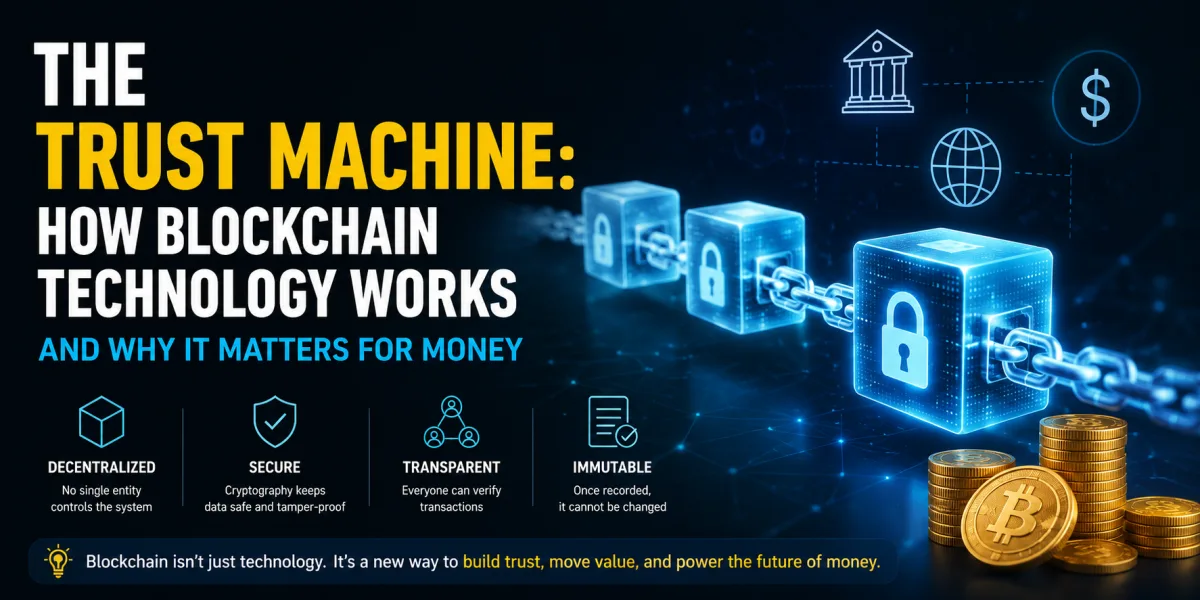
The Trust Machine: How Blockchain Technology Works and Why It Matters for Money
Blockchain technology is one of the most misunderstood financial innovations of the modern era. For many people, the word immediately brings to mind cryptocurrency prices, market speculation, dramatic gains, painful losses, online debates, and stories of early investors becoming wealthy. That public image is understandable, but it is incomplete. Blockchain is not simply a way to create digital coins. It is a method of recording information, verifying ownership, coordinating activity, and transferring value without relying entirely on a central authority.
At its core, blockchain technology asks a profound financial question: how can people who do not know or trust one another agree on who owns what?
That question may sound abstract, but it sits at the center of modern economic life. Money, banking, property, securities, contracts, identity, trade, insurance, and investment all depend on trusted records. If a bank says you have money in your account, that record matters. If a land registry says you own a house, that record matters. If a brokerage says you own shares, that record matters. If a lender says you owe a debt, that record matters. Wealth is not only physical possession. Much of wealth is a claim recorded somewhere.
Traditionally, society has relied on institutions to maintain those records. Banks maintain account balances. Governments maintain property registries. Exchanges and clearinghouses maintain securities records. Insurance companies maintain policies. Payment networks move funds between parties. These institutions provide order, but they also create dependency. They can make errors. They can be slow. They can exclude people. They can be expensive. They can fail. They can be corrupted. They can be hacked. They can be controlled by policy, politics, or corporate incentives.
Blockchain technology offers a different model. Instead of placing the master record in one institution’s database, a blockchain distributes the record across a network of computers. Instead of asking one central authority to verify every transaction, the network follows shared rules. Instead of trusting a person, company, or government alone, participants trust a combination of cryptography, incentives, transparency, and consensus.
This does not mean blockchains are magical, risk-free, or superior for every use case. They are not. Blockchains can be slow, expensive, complicated, vulnerable to poor design, and surrounded by speculation. Many blockchain projects have failed. Many tokens have little lasting value. Many promised use cases remain unproven. Yet the underlying concept is important because it changes how ownership and trust can be organized in a digital world.
To understand blockchain, investors must look beneath the price charts. They need to understand what a blockchain is, how transactions are recorded, why blocks are linked together, how cryptography protects records, how networks agree on truth, why some blockchains use mining, what smart contracts do, and why decentralization matters. Once those basics are clear, the financial implications become easier to evaluate.
The Simple Definition: A Blockchain Is a Shared Digital Ledger
A blockchain is a digital ledger that records transactions in a way that is shared, verifiable, and difficult to alter after the fact. The word “ledger” is important. Before blockchain was a technology term, a ledger was an accounting term. It referred to a record of transactions: money received, money paid, assets transferred, liabilities created, balances changed.
Every financial system needs ledgers. A bank account is a ledger entry. A credit card balance is a ledger entry. A stock brokerage account is a ledger entry. A mortgage is a ledger entry. Even cash, in a broader sense, relies on a social ledger of what people accept as money. Without reliable records, finance collapses into confusion. Ownership becomes disputed. Payments become uncertain. Fraud becomes easier. Credit becomes harder to extend.
A blockchain performs the ledger function digitally, but with an unusual structure. Instead of storing all records in one central database controlled by one organization, the blockchain is copied across many computers, often called nodes. Each node can maintain a version of the ledger. The network uses rules to decide which transactions are valid and which version of the ledger is accepted.
The ledger is called a blockchain because transactions are grouped into batches called blocks. Each block contains transaction data and a reference to the block before it. That reference creates a chain. If someone tries to change an old block, the change affects the relationship between that block and every later block. This makes tampering easier to detect and harder to execute.
A useful analogy is a public accounting book where every page contains a summary of the previous page. Once a page is filled, it is sealed and the next page begins. If someone changes a number on page ten, the summaries on pages eleven, twelve, and beyond no longer match. Everyone holding a copy of the book can see that something is wrong.
The word “public” does not always mean that personal identities are exposed. Many public blockchains show addresses and transactions, not necessarily legal names. But the transaction history itself can be visible to the network. This transparency is one reason blockchains can operate without a single central recordkeeper. Participants can verify the ledger for themselves.
Not all blockchains are the same. Some are public, open networks where anyone can participate. Bitcoin and Ethereum are examples of public blockchains. Others are private or permissioned networks, where only approved participants can access or validate records. A bank consortium, supply-chain network, or enterprise platform may use a permissioned blockchain. The basic concept of linked records may be similar, but the trust model is different.
The essential idea remains this: a blockchain is a record system designed to let multiple parties agree on a shared version of truth.
Why Blockchain Was Created
Blockchain technology became widely known through Bitcoin, introduced in 2008 and launched in 2009. Bitcoin’s purpose was not simply to create a speculative asset. It attempted to solve a long-standing problem in digital money: how to prevent double spending without relying on a central authority.
Double spending is the risk that a digital unit of money could be spent more than once. Physical cash avoids this problem because if you hand someone a paper note, you no longer possess that note. Digital files are different. A song, document, image, or spreadsheet can be copied endlessly. If digital money could be copied the same way, it would fail. A payment system must make sure that once a unit of value is spent, it cannot be spent again by the same owner.
Before blockchain, digital payments usually solved this problem through central intermediaries. Banks, card networks, and payment processors maintain account records and update balances. If Alice sends money to Daniel, the bank reduces Alice’s balance and increases Daniel’s balance. The bank prevents Alice from spending the same money twice. This works, but it requires trust in the intermediary.
Bitcoin proposed another route. Instead of one central party maintaining the ledger, a network of participants would maintain it collectively. Transactions would be broadcast to the network. Valid transactions would be grouped into blocks. Network participants would compete to add blocks through a process called proof of work. The longest valid chain would represent the accepted history. The result was a digital cash system without a traditional central operator.
This was significant because digital scarcity had always been difficult. The internet was excellent at copying information. Blockchain introduced a way to create and transfer scarce digital units. That scarcity could represent money, tokens, ownership claims, collectibles, governance rights, or other digital assets.
The timing also mattered. Bitcoin appeared shortly after the global financial crisis, when trust in banks and financial institutions had been damaged. Many people were open to the idea of money that did not depend on central banks, commercial banks, or government rescue packages. Bitcoin’s early supporters included technologists, libertarians, cryptographers, monetary thinkers, and people skeptical of traditional finance.
Over time, blockchain moved beyond Bitcoin. Developers began asking whether the same kind of decentralized ledger could support more complex applications. Ethereum popularized the idea of smart contracts: programs that run on a blockchain and execute according to code. This expanded blockchain from digital money into decentralized finance, token issuance, non-fungible tokens, decentralized organizations, gaming assets, identity experiments, and other applications.
Yet the original problem remains the foundation. Blockchain is a response to the question of how to coordinate digital ownership without placing total control in one central institution.
How a Blockchain Transaction Works
To understand blockchain, it helps to follow a transaction from beginning to end. Imagine that Maya wants to send one unit of a cryptocurrency to Joseph. She does not physically hand him anything. She creates a digital transaction that says, in effect, “Transfer one unit from my address to Joseph’s address.”
The transaction includes important information: the sending address, the receiving address, the amount, and a digital signature proving that Maya has authority to spend from her address. This digital signature is created using cryptography. Maya does not need to reveal her private key. The network can verify that the signature is valid without seeing the secret key itself.
Once created, the transaction is broadcast to the network. Nodes receive it and check whether it follows the rules. Does Maya have enough balance? Has she already spent those units? Is the digital signature valid? Is the transaction formatted correctly? If the transaction fails these tests, honest nodes reject it. If it passes, the transaction can wait in a pool of pending transactions until it is included in a block.
A block producer then selects transactions and proposes a new block. The specific method depends on the blockchain. In proof-of-work systems, miners compete to solve a computational puzzle. In proof-of-stake systems, validators are selected or weighted based on the amount of cryptocurrency they have staked. Other consensus designs exist as well, but the goal is similar: decide who gets to add the next block and make sure invalid blocks are rejected.
Once the block is added, the transaction becomes part of the blockchain’s history. Other nodes verify the block and update their copies of the ledger. Joseph can now see that the transaction has been recorded. As more blocks are added after it, the transaction becomes harder to reverse because changing it would require altering that block and the blocks that followed.
This process may sound complicated, but it mirrors familiar financial functions. A payment network verifies authorization. A bank checks balances. A ledger records the transfer. A settlement system finalizes the transaction. Blockchain combines these functions in a distributed structure.
One key difference is that blockchain transactions are often irreversible. In traditional finance, certain payments can be reversed, disputed, frozen, or corrected by intermediaries. On many blockchains, once a transaction is confirmed, it cannot easily be undone. This finality can be powerful for settlement, but it also creates responsibility. If a user sends funds to the wrong address, falls for a scam, or signs a malicious transaction, recovery may be difficult or impossible.
This is one of the central trade-offs of blockchain technology. It can reduce reliance on intermediaries, but it also reduces some protections those intermediaries provide.
The Role of Cryptography
Cryptography is the mathematical foundation that allows blockchains to secure transactions and ownership. It sounds intimidating, but the basic concepts can be understood without advanced mathematics.
Most blockchain users interact with two related pieces of information: a private key and a public address. The private key is a secret. It gives control over assets associated with the corresponding address. The public address is like a destination where assets can be received. You can share your public address with others, but you must protect your private key.
A common analogy is a mailbox. The public address is like the mailbox location where people can send mail. The private key is like the key that lets you open the mailbox and remove what is inside. The analogy is imperfect because blockchain keys do more than open a box, but it captures the basic idea: receiving can be public, spending requires secret authority.
When a user signs a transaction, cryptography allows the network to verify that the transaction was authorized by the holder of the private key. The network does not need to know the private key. It only needs to verify the signature. This is one of the elegant features of public-key cryptography: proof without disclosure.
Blockchains also use cryptographic hash functions. A hash function takes input data and produces a fixed-length output, often called a hash. If the input changes even slightly, the hash changes dramatically. This makes hashes useful for detecting tampering.
Each block contains a hash of the previous block. That is what links the chain. If an old transaction changes, the block’s hash changes. Then the next block’s reference no longer matches. The inconsistency spreads forward. This structure makes historical manipulation visible.
Cryptography does not make blockchains invincible. Users can lose private keys. Hackers can exploit weak software. Smart contracts can contain bugs. Exchanges can be compromised. Scammers can trick users into signing harmful transactions. But cryptography provides the basic tools that allow digital ownership to exist without a central password database or account administrator.
For investors, the practical lesson is clear: control of private keys is control of assets. A person who owns cryptocurrency but does not understand keys has not fully understood ownership. This is why phrases such as “not your keys, not your coins” became common in crypto communities. The phrase means that if another platform controls the keys, the user depends on that platform’s solvency, security, and honesty.
Self-custody, however, is not automatically safer for everyone. If a user loses a seed phrase or stores it poorly, the assets may be lost or stolen. The responsibility shifts from institution to individual. Blockchain gives users more direct control, but direct control demands direct competence.
What Blocks Contain
A block is a batch of data added to the blockchain. The exact contents vary by blockchain, but most blocks include transactions, a timestamp or ordering information, a reference to the previous block, and other data needed by the network’s consensus rules.
The transactions are the most visible part. They show transfers, contract interactions, or changes in state. On a simple payment blockchain, transactions may mostly show value moving from one address to another. On a smart contract platform, transactions may trigger code, trade tokens, borrow assets, mint digital collectibles, vote on governance proposals, or interact with decentralized applications.
The previous block reference is what creates continuity. Each block points backward. This produces a chain of history. The newest block depends on the one before it, which depends on the one before that, continuing back to the first block, often called the genesis block.
Blocks are not unlimited in size or capacity. This matters because block space can become scarce. When many people want to transact at the same time, fees can rise. Users may compete to have their transactions included sooner. This is one reason some blockchains become expensive during periods of heavy demand.
Block size, block time, fee markets, and throughput are central design issues. A blockchain that produces blocks quickly may confirm transactions faster but could create other technical burdens. A blockchain with larger blocks may handle more transactions but require more storage and bandwidth from nodes. These trade-offs affect decentralization, security, cost, and usability.
Investors often overlook these technical details, but they influence economic value. A blockchain’s ability to attract users depends partly on whether it is secure, affordable, reliable, and scalable. If fees become too high, some users leave. If the network becomes too centralized, trust assumptions change. If throughput is too low, applications may struggle. If security is weak, capital avoids the system.
Blocks may seem like technical containers, but they are also economic units. Block space can be valuable. In some networks, users pay transaction fees for block space. Validators or miners earn rewards for producing valid blocks. The economics of block production shape incentives and security.
Consensus: How the Network Agrees
Consensus is the process by which blockchain participants agree on the valid state of the ledger. Without consensus, a distributed ledger would fragment. Different nodes might accept different histories. Ownership would become uncertain. The system would fail.
Consensus is necessary because blockchains operate in an environment where participants may not trust one another. Some may be honest. Some may be careless. Some may be malicious. Some may go offline. Some may try to cheat. The network needs rules that allow honest participants to converge on one accepted history.
The two most widely discussed consensus mechanisms are proof of work and proof of stake.
Proof of Work
Proof of work is the mechanism used by Bitcoin. In proof of work, miners compete to solve a computational puzzle. This puzzle requires energy and computing power. The first miner to find a valid solution can propose the next block and receive rewards, usually in the form of newly issued coins and transaction fees.
The purpose of proof of work is not to perform useful computation in the ordinary sense. Its purpose is to make block production costly. Because producing blocks requires real resources, attacking the network becomes expensive. A malicious actor who wants to rewrite history would need enormous computing power and energy, especially on a large established network.
Proof of work has strengths and weaknesses. Its strength is that it ties security to external costs. Attackers cannot simply pretend to have influence; they must spend resources. Its weakness is that it consumes significant energy, can lead to mining concentration, and may be slower or less flexible than other designs.
Critics argue that proof-of-work energy use is wasteful. Supporters argue that the energy secures a neutral monetary network and that the relevant question is whether the social value justifies the cost. Investors do not need to settle that debate fully to understand the mechanism. They need to know that proof of work uses economic cost to defend ledger integrity.
Proof of Stake
Proof of stake uses a different model. Instead of miners spending energy to compete, validators lock up, or stake, the network’s native asset. Validators are selected to propose or attest to blocks. If they behave honestly, they can earn rewards. If they violate rules, they may lose part of their stake through a penalty known as slashing.
The logic is that validators have money at risk. If they attack the network or validate improper transactions, their own capital can be damaged. Security comes from financial bonding rather than computational energy.
Proof of stake can be more energy efficient and may support different performance characteristics. But it has its own trade-offs. Wealthier participants may have greater influence. Staking services can become concentrated. Governance and validator incentives must be carefully designed. The system depends on economic penalties, software reliability, and social coordination during extreme events.
Neither proof of work nor proof of stake is perfect. Both are attempts to solve a difficult problem: how to maintain a shared ledger among participants who do not fully trust one another. Different blockchains make different design choices, and those choices affect decentralization, security, speed, cost, and investment risk.
Decentralization: The Promise and the Trade-Off
Decentralization means that control is spread across many participants rather than concentrated in one authority. It is one of blockchain’s most important ideas, but also one of its most misused marketing terms.
A blockchain can be decentralized in several ways. Nodes may be widely distributed. Validators or miners may be numerous and independent. Development may be open source. Token ownership may be broad. Governance may be transparent. No single company may control access. No central operator may be able to rewrite balances or block users at will.
But decentralization exists on a spectrum. Some networks are more decentralized than others. A project may call itself decentralized while relying heavily on a small development team, a few validators, a concentrated token supply, a central foundation, or hosted infrastructure. Investors should not accept the word “decentralized” without asking how control actually works.
Decentralization provides several potential benefits. It can make a network more resistant to censorship. It can reduce single points of failure. It can allow users to verify records independently. It can create open access. It can make the rules more transparent. It can allow innovation without permission from a central gatekeeper.
Yet decentralization also creates trade-offs. It can make decision-making slower. It can make user support weaker. It can make errors harder to reverse. It can make regulation more complicated. It can make upgrades contentious. It can shift responsibility to users who may not be prepared for it.
Traditional finance often prioritizes efficiency, consumer protection, and centralized accountability. Blockchain often prioritizes openness, resistance to centralized control, and verifiability. Neither model is automatically superior in every context. The right model depends on the problem being solved.
For example, a centralized database may be better for a company tracking internal inventory. It is faster, cheaper, and easier to manage. A blockchain may be more useful when multiple parties need a shared record but do not want one party to control it entirely. The value of blockchain rises when trust is costly, coordination is difficult, or neutrality matters.
Investors should be cautious when companies use blockchain as a buzzword. If a problem does not require decentralization, public verification, or shared settlement, a blockchain may add complexity without adding value. Strong technology investment requires understanding not only what a tool can do, but where it is actually needed.
Smart Contracts: Code That Holds and Moves Value
Smart contracts are programs that run on a blockchain. They execute according to rules written in code. The phrase “smart contract” can be misleading because smart contracts are not always legally binding contracts in the traditional sense, and they are not smart in the human sense. They are automated instructions.
A simple smart contract might say: if a user sends this token, release that token. A more complex contract might manage lending pools, decentralized exchanges, insurance-like products, token distributions, digital collectibles, governance votes, or derivatives. Smart contracts allow blockchains to move beyond simple payments into programmable finance.
Decentralized finance, often called DeFi, depends heavily on smart contracts. Instead of borrowing from a bank, a user may borrow from a smart-contract-based lending protocol. Instead of trading through a centralized exchange, a user may trade through an automated market maker. Instead of relying on a company to distribute rewards, a smart contract may distribute tokens according to coded rules.
The appeal is automation and openness. Anyone with compatible assets and internet access may be able to interact with the contract. The rules can be visible on-chain. Settlement can happen without a traditional intermediary. This can reduce friction and create new financial structures.
The risk is that code can fail. Smart contracts may contain bugs. Hackers may exploit vulnerabilities. Economic design may break under stress. Oracles that provide external data may be manipulated. Governance may change contract parameters. Users may misunderstand what they are approving. Once funds are locked into a contract, the user depends on the contract behaving as expected.
In traditional finance, contracts are interpreted by legal systems, enforced by courts, and supported by institutions. Smart contracts replace some of that with code. Code is precise, but it is not forgiving. If the code permits an unintended outcome, the blockchain may execute it anyway.
This is why smart contract risk matters. A protocol can offer attractive yields, but if the contract is exploited, the yield becomes irrelevant. A decentralized exchange can operate smoothly for years, but a bug or governance attack can cause losses. A bridge connecting blockchains can be convenient, but bridges have historically been attractive targets because they may hold large pools of assets.
For investors, smart contracts expand what blockchains can do, but they also expand the risk surface. Understanding the difference between holding a major cryptocurrency directly and depositing assets into a complex protocol is essential. The risks are not the same.
Tokenization: Turning Claims Into Digital Units
One of blockchain’s most important financial ideas is tokenization. Tokenization means representing something as a digital token on a blockchain. The token may represent a cryptocurrency, a governance right, a claim on an asset, a digital collectible, access to a service, or a unit within a financial protocol.
Tokenization matters because financial markets are built around ownership claims. A share represents ownership in a company. A bond represents a lending claim. A property title represents ownership of real estate. A fund unit represents a claim on pooled assets. If blockchain can represent claims digitally and transfer them efficiently, it may affect how assets are issued, traded, settled, and managed.
The clearest existing example is cryptocurrency itself. Bitcoin is a token native to the Bitcoin network. Ether is the native asset of Ethereum. Stablecoins are tokens designed to track the value of traditional currencies. Many other tokens exist for specific networks, applications, or communities.
Tokenization could also apply to real-world assets. In theory, bonds, funds, invoices, real estate interests, carbon credits, commodities, or private-market assets could be represented on-chain. This could improve settlement speed, transparency, fractional ownership, and transferability. But real-world tokenization requires legal recognition, custody arrangements, compliance systems, reliable issuers, and enforceable rights. A token is only as meaningful as the claim behind it.
This distinction is crucial. A token representing ownership of an apartment building is not valuable merely because it is on a blockchain. It is valuable only if the legal structure gives token holders a real claim, the property exists, cash flows are managed honestly, and investors can enforce their rights. Blockchain can improve recordkeeping and transfer, but it does not magically create legal substance.
Beginners often confuse token creation with value creation. It is easy to create a token. It is hard to create a useful asset, credible network, durable community, legal claim, or profitable business. The ease of token creation is one reason crypto markets contain so many low-quality projects.
Tokenization is powerful, but it requires discipline. Investors should ask: What does this token represent? What rights does it provide? Who issued it? What backs it? Can holders enforce claims? How is supply controlled? Who benefits from issuance? Is demand organic or purely speculative?
Without clear answers, a token may be little more than a tradable story.
Public Blockchains, Private Blockchains, and Databases
Not every blockchain is open to the public. Understanding the difference between public and private blockchains helps separate genuine innovation from marketing language.
A public blockchain is open for anyone to read, transact on, or help validate, depending on the network’s rules. Bitcoin and Ethereum are public blockchains. Their openness is part of their value proposition. Users do not need permission from a company to create an address or verify the ledger.
A private or permissioned blockchain restricts participation. Only approved parties can validate transactions or access certain data. This may be useful for businesses, banks, supply chains, or institutions that want shared records but cannot expose everything publicly. A permissioned blockchain may improve coordination among known parties, but it does not provide the same trust model as a public blockchain.
Many enterprise blockchain projects are closer to shared databases than open decentralized networks. That is not necessarily bad. A shared database can be useful. But investors should understand the difference. The investment case for a public crypto asset may depend on open network effects, decentralization, and token economics. The business case for an enterprise blockchain may depend on efficiency, compliance, and industry coordination. These are different stories.
Sometimes a normal database is better. If one company controls the data and all users trust that company, a blockchain may be unnecessary. Databases are usually faster, cheaper, and easier to modify. Blockchain becomes more interesting when multiple parties need a shared record and no single party is fully trusted to control it.
This is one reason blockchain adoption has been uneven. The technology is not a universal replacement for databases. It is a specialized tool for certain trust and coordination problems. Serious analysis begins by asking whether the problem actually requires a blockchain.
Blockchain Security: Strong Design, Human Weakness
Blockchain security has several layers. The protocol may be secure, but users, applications, exchanges, wallets, and bridges may still fail. Beginners often hear that a blockchain has never been hacked and assume all related activity is safe. That assumption is dangerous.
A major blockchain can have a secure base layer while people lose money through phishing, exchange failures, fake wallets, malicious smart contracts, compromised devices, weak passwords, social engineering, or poor private-key storage. The chain may work exactly as designed while a user loses assets through an irreversible transaction.
This distinction is similar to the difference between a secure banking system and a customer being tricked into sending money to a fraudster. The bank’s internal ledger may be intact, but the customer still suffers. In crypto, the customer may have fewer reversal options.
Blockchain security also depends on economic incentives. Validators or miners must be rewarded enough to support the network. Attackers must find attacks too expensive or unprofitable. Users must trust that the network can survive stress. Developers must maintain software. Communities must respond to vulnerabilities. Security is not a one-time achievement. It is an ongoing process.
Smaller blockchains may be more vulnerable because attacking them can be cheaper. Thinly traded tokens may be easier to manipulate. New protocols may have unaudited code. Bridges may concentrate risk. Centralized exchanges may hold large pools of customer assets. Stablecoins may depend on reserves and redemption mechanisms. Each part of the ecosystem introduces different risks.
For investors, the lesson is to avoid broad statements. “Blockchain is secure” is too vague. Which blockchain? Which wallet? Which exchange? Which contract? Which bridge? Which custody model? Which governance process? Which security assumptions?
Financial safety comes from understanding the exact risk being taken.
Why Blockchain Transactions Can Be Transparent Yet Private
Public blockchains often display transaction histories openly. Anyone can inspect addresses, balances, transfers, and contract interactions. This transparency can be useful for verification. It allows users, analysts, researchers, and developers to observe activity directly.
At the same time, blockchain addresses are not always tied directly to real-world identities. This creates pseudonymity. A public address may be visible, but the person behind it may not be immediately known. If that address later connects to an exchange account, public identity, merchant, or repeated behavior pattern, privacy can weaken.
This creates a strange combination: blockchains can be more transparent than banks at the ledger level but less identity-based at the surface level. Traditional bank transactions are private from the public but visible to the bank and regulators. Public blockchain transactions may be visible to everyone but linked to addresses rather than names.
Privacy varies by blockchain and tool. Some networks and applications focus more heavily on privacy. Others are highly transparent. Regulatory authorities, analytics firms, exchanges, and investigators often use blockchain data to trace funds. The idea that all cryptocurrency is anonymous is misleading.
For ordinary users, transparency creates both benefits and risks. It can help verify supply, monitor large movements, and audit protocol activity. But it can also expose financial behavior if addresses are linked to identity. A person who shares a public address may unintentionally reveal balances and transaction history.
Privacy is therefore not automatic. It requires understanding how addresses, exchanges, wallets, and on-chain activity connect. Beginners should assume that public blockchain activity may be traceable.
Blockchain and Money
Blockchain’s relationship with money is the reason it became famous. Bitcoin introduced the possibility of a digital asset with a predetermined issuance schedule and no central bank. Stablecoins introduced blockchain-based tokens designed to track fiat currencies. Decentralized finance introduced lending, trading, and collateral systems built with smart contracts.
Money has several traditional functions. It can serve as a medium of exchange, a store of value, and a unit of account. Different cryptocurrencies attempt to serve different roles. Bitcoin is often discussed as a store of value or digital monetary asset. Stablecoins are used more often as transaction and settlement instruments because their value is designed to remain close to a traditional currency. Other tokens may be used to pay network fees, secure protocols, or access applications.
Blockchain-based money can be attractive where traditional systems are slow, expensive, unstable, restrictive, or inaccessible. Cross-border transfers, dollar access in countries with weak currencies, settlement between digital platforms, and programmable payments are common areas of interest.
But crypto money faces challenges. Price volatility makes many cryptocurrencies difficult to use as everyday money. Regulatory treatment varies. User experience can be complicated. Scams and hacks reduce trust. Tax rules may make frequent spending inconvenient. Stablecoins depend on issuer quality, reserve transparency, and redemption confidence.
The monetary question is therefore not simply whether blockchain can move value. It can. The deeper question is whether people want to hold, price, borrow, lend, save, and transact in blockchain-based assets at scale. That depends on stability, trust, regulation, usability, liquidity, and network effects.
Blockchain and Investing
For investors, blockchain creates several possible opportunity categories. The first is direct ownership of crypto assets, such as major native tokens. The second is equity ownership in companies building blockchain infrastructure, exchanges, custody platforms, payment systems, analytics tools, or mining operations. The third is investment in funds or vehicles that provide exposure to digital assets. The fourth is indirect exposure through companies using blockchain to improve operations.
Each category has different risks. Owning a token is not the same as owning stock in a company. A stock may represent a claim on corporate earnings and assets. A token may represent network usage, governance influence, collateral utility, fee payment ability, or something less clear. Investors must understand the economic link between blockchain adoption and token value.
This is a common analytical mistake. A person may believe a blockchain network will become widely used and assume the token price must rise. Sometimes that may be true. But it depends on token supply, demand, fee structures, value capture, competition, regulation, and incentives. Network usage does not automatically translate into investor return.
Another mistake is treating all blockchain exposure as the same. A profitable exchange, a mining company, a smart contract platform token, a stablecoin issuer, and a venture-backed infrastructure company have different business models. Some benefit from trading volume. Some benefit from asset prices. Some benefit from transaction fees. Some benefit from custody revenue. Some depend on energy costs. Some depend on regulatory approval.
Investors should ask the same hard questions they would ask in any market: What drives value? What are the risks? What is already priced in? Who are the competitors? What can go wrong? How liquid is the investment? What is the time horizon? How does this fit into the portfolio?
Blockchain may be innovative, but valuation discipline still matters. Paying any price for a promising technology is not investing wisdom. It is speculation wearing the clothing of innovation.
Blockchain’s Practical Uses Beyond Cryptocurrency
Blockchain may be useful wherever multiple parties need a shared, tamper-resistant record. Potential applications include payments, settlement, supply-chain tracking, digital identity, property records, trade finance, loyalty programs, asset tokenization, voting systems, intellectual property records, gaming assets, and audit trails.
In payments, blockchain can move value across borders without relying on every traditional correspondent banking step. In securities settlement, blockchain could reduce reconciliation delays between institutions. In supply chains, it may help track goods across multiple companies. In digital identity, it may allow users to control credentials without relying entirely on centralized databases. In gaming, blockchain can allow digital items to be owned and transferred outside one company’s closed system.
Yet every use case must be judged carefully. A supply-chain blockchain does not solve the problem of false data entered at the source. If someone records that a product is authentic when it is not, the blockchain may preserve bad information permanently. This is sometimes called the “garbage in, garbage out” problem. Blockchain can protect records after entry, but it cannot guarantee that every real-world input is truthful.
Property records raise similar issues. A blockchain registry is useful only if courts and governments recognize it. Tokenized assets require legal enforceability. Digital identity systems require privacy protection, usability, and institutional acceptance. Voting systems require security, secrecy, accessibility, and public trust.
Blockchain is not a cure-all. It is a tool. Its usefulness depends on whether it solves a real problem better than existing alternatives.
The Cost of Trust
The deepest way to understand blockchain is to think about the cost of trust. In traditional systems, trust is provided by institutions. Those institutions charge fees, set rules, maintain infrastructure, and manage disputes. This can be efficient when institutions are reliable and accountable. But when institutions are weak, slow, expensive, or exclusionary, trust becomes costly.
Blockchain tries to lower certain trust costs by allowing participants to verify records independently. A user does not need to trust a central party in the same way if the ledger is open, consensus rules are clear, and assets can be self-custodied. This can be valuable in environments where institutional trust is limited.
But blockchain introduces other costs. Users must manage keys. Networks must pay validators or miners. Transactions may require fees. Mistakes may be irreversible. Software risk becomes financial risk. Regulatory uncertainty may create friction. Education becomes essential.
So the question is not whether blockchain eliminates trust. It changes where trust is placed. Users may trust code, cryptography, economic incentives, open-source communities, hardware wallets, validators, developers, exchanges, or their own operational discipline. Trust does not disappear. It is redistributed.
This is why simplistic statements about blockchain can be misleading. It is not a world without trust. It is a world with different trust assumptions.
The Main Limits of Blockchain Technology
Blockchain’s limitations are as important as its strengths. The first limitation is scalability. Public blockchains must balance security, decentralization, and throughput. Increasing transaction capacity can create technical trade-offs. If running a node becomes too expensive, fewer people may verify the network independently, reducing decentralization.
The second limitation is user experience. Managing wallets, addresses, gas fees, network selections, seed phrases, and transaction approvals is still difficult for many people. Until blockchain tools become safer and easier, mainstream adoption will face friction.
The third limitation is legal integration. Financial assets exist within legal systems. Ownership, taxation, consumer protection, bankruptcy, compliance, and dispute resolution matter. Blockchain records may be technologically valid but legally insufficient if institutions do not recognize them.
The fourth limitation is security at the edges. Even if base-layer blockchains are secure, exchanges, bridges, wallets, and applications can fail. Many losses occur around the blockchain rather than inside its core protocol.
The fifth limitation is speculation. Excessive speculation can distort incentives. Developers may focus on token prices instead of useful products. Users may chase rewards instead of sustainable value. Fraudsters may exploit excitement. Investors may confuse market capitalization with adoption.
The sixth limitation is governance. Blockchains need upgrades, bug fixes, and community coordination. Decentralized governance can be resilient, but it can also be messy. Disagreements may lead to forks, delays, or uncertainty.
These limitations do not make blockchain irrelevant. They make it real. Every important technology has constraints. Wise investors study both the promise and the friction.
A Practical Example: Buying Coffee Versus Settling Wealth
People often ask whether blockchain will be used to buy everyday items like coffee. That question can be useful, but it may be too narrow. The value of blockchain may not be that every small purchase happens directly on a base-layer blockchain. The value may be in settlement, ownership, and financial infrastructure.
Consider the difference between payment experience and settlement. When you tap a card at a café, the payment feels instant. But behind the scenes, banks, processors, card networks, and settlement systems reconcile the transaction. The user sees convenience, while institutions handle complexity.
Blockchain may compete more directly with settlement layers than with the visible act of tapping a card. Stablecoins, tokenized deposits, central bank digital currency experiments, and blockchain settlement networks all explore ways to move value more directly. Whether public blockchains, private networks, or regulated digital money systems win specific roles remains uncertain.
This distinction matters for investors. A technology can be important even if consumers do not interact with it directly. Most people do not think about clearinghouses when buying stocks, yet clearing and settlement are essential. Most people do not understand payment rails, yet those rails shape commerce. Blockchain may become valuable in places where users see only faster, cheaper, or more programmable financial services.
How to Evaluate a Blockchain Project
Beginners and investors need a disciplined way to evaluate blockchain projects. The first question is purpose. What problem does the project solve? Is blockchain necessary, or would a normal database work better?
The second question is users. Who uses the network or application? Are they real users or mainly speculators? Is activity organic or driven by temporary rewards?
The third question is security. How long has the network operated? Has it been attacked? Who validates it? Is the code audited? Are there known vulnerabilities? How much value is secured?
The fourth question is decentralization. Who controls development, validation, governance, and token supply? Can insiders change rules? Are validators concentrated? Is infrastructure dependent on a few providers?
The fifth question is token economics. Why does the token need to exist? What creates demand? How is supply issued? Who owns large allocations? Do insiders have vesting schedules? Does network usage create value for token holders?
The sixth question is regulation. Could the project face legal restrictions? Does it involve securities, lending, payments, stablecoins, privacy tools, or other regulated activity? Are users exposed to compliance risk?
The seventh question is competition. What alternatives exist? Are traditional systems better? Are other blockchains faster, cheaper, more secure, or more adopted?
The eighth question is valuation. Even if the project is good, is the asset priced reasonably? Many investors lose money not because they identify bad technology, but because they overpay for good stories.
This framework does not guarantee success, but it reduces blind speculation. It pushes the investor to think like an owner rather than a spectator.
What Blockchain Means for Financial Education
Blockchain forces people to learn financial principles that traditional systems often hide. It teaches that ownership is a record. It teaches that custody matters. It teaches that settlement is different from payment experience. It teaches that incentives secure systems. It teaches that scarcity must be designed and defended. It teaches that trust has costs. It teaches that technology does not remove human behavior from markets.
For this reason, blockchain can be valuable to study even for people who never buy cryptocurrency. It reveals the architecture behind money and markets. It makes visible the ledgers, intermediaries, settlement systems, and trust assumptions that support financial life.
A person who understands blockchain may also become more thoughtful about traditional finance. They may ask how banks create and record deposits. They may ask how securities settle. They may ask who controls payment networks. They may ask how inflation affects money. They may ask what ownership really means when assets are held through layers of intermediaries.
That curiosity is healthy. Financial education improves when people stop treating money as magic and start seeing it as a system of records, incentives, claims, and rules.
The Investor’s Balanced View
A balanced view of blockchain avoids two extremes. The first extreme says blockchain will replace every institution and make traditional finance obsolete. That view underestimates regulation, legal systems, consumer needs, institutional trust, and the efficiency of existing databases. The second extreme says blockchain is nothing but speculation and fraud. That view underestimates the significance of decentralized digital ownership, programmable settlement, and open financial networks.
The more realistic view is that blockchain is a powerful but specialized technology. It will likely matter in some areas and disappoint in others. Some networks may endure. Many projects may fail. Some tokens may capture value. Many may not. Some institutions may adopt blockchain-like systems. Others may find no need. The future will probably be uneven rather than absolute.
Investors should not confuse technological importance with guaranteed investment return. The internet changed the world, but many internet stocks failed. Railroads transformed economies, but many railroad investors lost money. Innovation creates opportunity, but it also attracts overcapitalization, hype, fraud, and competition.
The right question is not “Is blockchain good or bad?” The better question is “Where does blockchain solve a real problem, and who captures the economic value?”
Final Thought
Blockchain technology works by combining shared ledgers, cryptography, linked blocks, network consensus, economic incentives, and transparent verification. It allows digital ownership to be recorded and transferred without relying entirely on a single central authority. That idea is technically complex, but financially simple: blockchain is a new way to organize trust.
Its promise is significant. It can make records more transparent, assets more programmable, settlement more direct, and financial networks more open. Its risks are equally real. It can be difficult to use, costly under stress, vulnerable at the edges, legally uncertain, and surrounded by speculation.
For Wealth Insights readers, the lesson is not to worship blockchain or dismiss it. The lesson is to understand it. A serious investor does not need to chase every token or believe every prediction. But a serious investor should understand why blockchain exists, how it works, what problems it may solve, and where its limits begin.
Technology changes. Markets cycle. Narratives rise and fall. But the central financial question remains timeless: who controls the ledger, who verifies ownership, and who bears the risk when trust fails?
Blockchain is one of the most important modern attempts to answer that question.
 Article
 Article
 Article
 Article
 Article
 Article
 Article
 Article