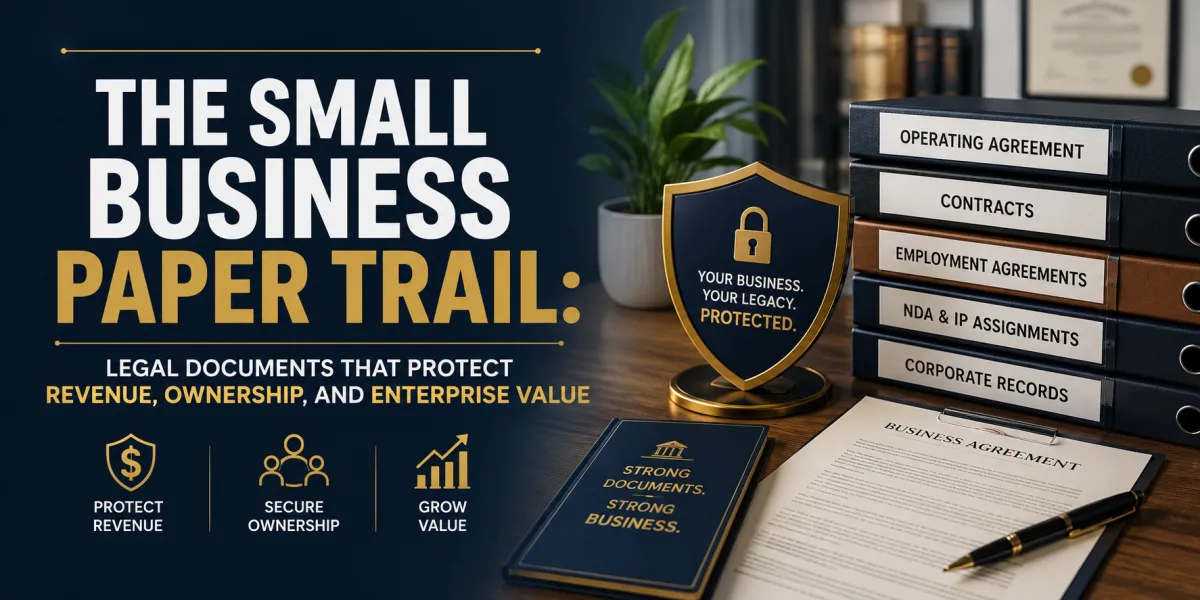
The Small Business Paper Trail: Legal Documents That Protect Revenue, Ownership, and Enterprise Value
A small business often begins with energy rather than paperwork. A founder sees an opportunity, serves the first customer, sends the first invoice, hires help, opens a bank account, creates a website, signs a lease, buys equipment, or starts selling online. At the beginning, speed feels more important than structure. The business owner wants momentum. Documentation can feel like something for larger companies with legal departments, board meetings, investors, and formal offices.
That belief is understandable, but it is dangerous. Small businesses may have less margin for legal mistakes than large companies. A large company can sometimes absorb a contract dispute, an unpaid invoice, a worker classification problem, or a supplier failure. A small business may not. One bad lease, one unclear partnership, one missing intellectual property assignment, one vague customer contract, or one personal guarantee can threaten years of work.
Legal documents are not merely administrative files. They are the written infrastructure of the business. They define who owns the company, who may make decisions, who gets paid, who bears risk, who owns intellectual property, who can access confidential information, who is responsible for taxes and compliance, and what happens when relationships end.
A business without documents may still operate, but it operates on memory, assumptions, goodwill, and hope. Those may be enough while everyone agrees and money is small. They become fragile when the business grows, customers delay payment, partners disagree, contractors leave, employees make claims, lenders ask questions, regulators review activity, or a buyer conducts due diligence.
The most important legal documents for a small business are not the same for every company. A one-person consulting practice does not need the same documents as a restaurant, software startup, construction firm, e-commerce brand, medical practice, family partnership, or rental property business. The right documents depend on structure, industry, employees, customers, suppliers, intellectual property, regulation, financing, and growth plans.
Still, certain categories appear again and again. Formation documents. Ownership agreements. Tax registrations. Licenses. Customer contracts. Supplier agreements. Employment and contractor documents. Intellectual property assignments. Confidentiality agreements. Commercial leases. Financing documents. Insurance records. Privacy policies. Terms and conditions. Corporate records. These are the documents that turn a commercial activity into a more durable enterprise.
This article is financial education, not legal advice. Business law varies by jurisdiction, industry, and transaction. Important documents should be reviewed by qualified legal and tax professionals. The purpose here is to help small business owners understand what each document does, why it matters, and how documentation protects long-term business value.
Why Legal Documents Matter Financially
Small business owners often think legal documents matter only if there is a lawsuit. That is too narrow. Legal documents matter every day because they govern money, ownership, responsibility, and risk.
A customer agreement affects whether revenue is collected. A supplier agreement affects whether goods arrive on time and meet standards. A lease affects fixed costs and location stability. An employment agreement affects worker expectations and intellectual property ownership. A founder agreement affects control and profit sharing. A loan agreement affects cash flow and personal exposure. A privacy policy affects data obligations. A trademark registration or assignment affects brand value. A corporate resolution affects whether a decision was properly authorized.
In that sense, legal documents are financial documents. They influence profit margins, cash conversion, liability, taxes, valuation, and exit options. A company with clean records is easier to finance, insure, partner with, and sell. A company with missing documents may still generate revenue, but it carries hidden risk that can reduce value.
Documentation also protects the owner from relying on informal memory. People remember promises differently when money is at stake. A customer may remember unlimited revisions. A contractor may remember retaining ownership of work. A partner may remember equal voting rights. A landlord may remember that the tenant agreed to pay repairs. A supplier may remember that delivery dates were estimates. Written documents reduce the space where these disputes can grow.
The small business owner should not ask, “What documents do I need to look official?” The better question is, “What documents protect the value I am creating?”
1. Business Formation Documents
Formation documents create or register the legal structure of the business. Depending on the jurisdiction and entity type, these may include articles of organization, articles of incorporation, certificates of formation, partnership registrations, business name registrations, or equivalent filings.
These documents matter because the business structure affects liability, taxation, administration, ownership, and growth options. Official small-business guidance from the SBA explains that structure affects daily operations, taxes, and how much of the owner’s personal assets may be at risk. The IRS also notes that the form of business entity determines which income tax return form must be filed, and that legal and tax considerations enter into selecting a structure.
A sole proprietor may begin with minimal formal filings, but the owner and business are often legally closer together. A limited liability company, corporation, partnership, or other entity may create clearer separation, though that separation must be maintained properly. The owner may need to keep business finances separate, follow filing requirements, avoid commingling funds, document major decisions, and comply with tax rules.
Formation documents should match the owner’s business plan. A freelancer with low risk and no employees may need a simpler structure than a company planning to raise investor capital. A family business may need different governance than a venture-backed startup. A professional practice may face special entity rules. A regulated business may need approvals beyond ordinary formation.
Business owners should also keep confirmation of registration, business name approvals, registered agent details, entity identification numbers, amendments, annual reports, and dissolution or conversion documents if the structure changes.
The formation file is the company’s birth certificate. If it is missing, incorrect, or inconsistent, future contracts, bank accounts, loans, tax filings, licenses, and ownership records can become harder to manage.
2. Operating Agreement, Shareholders’ Agreement, or Partnership Agreement
If formation documents create the entity, ownership agreements explain how the entity is governed. The document may be called an operating agreement, shareholders’ agreement, partnership agreement, founders’ agreement, bylaws, or members’ agreement depending on structure and jurisdiction.
This is one of the most important documents for any business with more than one owner. It answers questions that can become explosive later: who owns what percentage, who contributed capital, who makes decisions, how profits are distributed, what duties each owner has, how new owners may join, how ownership may be transferred, what happens if an owner wants out, and how disputes are resolved.
Many small businesses begin with informal ownership understandings. Two friends agree to split the business. A spouse helps without defining ownership. A family member contributes money. A co-founder builds the product while another brings customers. At the beginning, the arrangement feels obvious. Later, when the business has value, assumptions collide.
A strong ownership agreement should address capital contributions, voting rights, management roles, profit distributions, salaries, expense approvals, ownership vesting where relevant, buy-sell rights, restrictions on transfers, death or disability, divorce issues, deadlock procedures, confidentiality, non-solicitation, intellectual property assignment, and exit valuation.
This agreement is not a sign that owners distrust each other. It is the document that protects trust by clarifying expectations before conflict appears. In many small businesses, the ownership agreement is more important than the original formation document because it governs the human relationship behind the entity.
3. Employer Identification, Tax Registration, and Tax Records
Every business needs clear tax records. Depending on the country, these may include employer identification numbers, tax registration certificates, sales tax registrations, VAT or GST registrations, payroll tax accounts, excise registrations, withholding accounts, and local tax filings.
Tax documentation matters because a business does not only earn revenue. It collects, reports, withholds, remits, deducts, and files. The structure of the business affects which tax forms apply, how income is reported, and what obligations exist. The IRS notes that entity form determines which income tax return form a business must file.
Small businesses should keep organized records of revenue, expenses, invoices, receipts, payroll, contractor payments, tax returns, estimated tax payments, sales tax filings, asset purchases, depreciation schedules, mileage, home office records where applicable, and professional fees. Poor tax documentation can lead to missed deductions, penalties, audit stress, and inaccurate financial statements.
Tax records are also important for financing and sale. A lender may want tax returns to verify income. A buyer may review tax filings to confirm revenue and expenses. An investor may examine tax compliance as part of due diligence. A business with messy tax records may appear riskier, even if the underlying operation is strong.
The tax file should not be treated as an annual panic. It should be maintained throughout the year.
4. Business Licenses and Permits
Formation does not automatically give a business the right to operate. Many businesses need licenses, permits, registrations, inspections, zoning approvals, health permits, professional licenses, sales permits, alcohol licenses, childcare approvals, food handling permits, contractor licenses, transportation permits, data or financial services approvals, or local business operating certificates.
The SBA’s business registration guidance highlights that businesses may need federal and state tax ID numbers and licenses and permits depending on their activities.
Licensing matters because operating without required permission can lead to fines, forced closure, denied insurance claims, contract problems, refund obligations, reputational damage, or inability to enforce certain agreements. A restaurant, salon, medical clinic, construction business, food product company, financial service, daycare, logistics provider, or real estate business may face more requirements than a basic consulting firm.
Small businesses should keep copies of all licenses, renewal dates, inspection records, compliance certificates, permits, and correspondence with authorities. They should also track where the license applies. A permit for one location, product line, or service may not cover expansion into another.
A license file is not glamorous, but it protects the company’s right to operate.
5. Customer Agreements and Sales Contracts
A business survives by getting paid. Customer agreements protect the path from promise to payment. These documents may be called service agreements, client contracts, purchase agreements, sales terms, engagement letters, order forms, statements of work, subscription agreements, or terms and conditions.
A strong customer agreement defines what the business will provide, what the customer must pay, when payment is due, how changes are handled, what happens if payment is late, what warranties apply, what refunds are available, who owns work product, how liability is limited, how either side may terminate, and how disputes are resolved.
For service businesses, scope is critical. A vague scope invites unpaid extra work. The contract should define deliverables, timelines, revision limits, client responsibilities, approval process, and change-order procedures. For product businesses, sales terms should clarify specifications, shipping, delivery risk, returns, warranties, defective goods, and payment obligations.
Customer agreements are especially important when the business provides high-value work, customized services, recurring subscriptions, credit terms, digital products, professional advice, construction work, marketing services, software, or consulting. The more complex the sale, the more important the written terms.
Small businesses often begin work after a friendly conversation and send an invoice later. That may work for small, low-risk jobs. It becomes dangerous when the project is large, the customer is slow to pay, or expectations are unclear. A business should avoid becoming an unpaid lender to its customers.
The customer agreement is the revenue protection document.
6. Supplier and Vendor Agreements
Small businesses rely on suppliers, vendors, manufacturers, software providers, logistics companies, wholesalers, agencies, consultants, and service providers. Vendor agreements protect the company from disruption and clarify what happens if the supplier fails to perform.
A supplier agreement should define pricing, quantities, quality standards, delivery timelines, inspection rights, rejection rights, warranties, payment terms, confidentiality, intellectual property, data handling, insurance, liability, indemnity, termination rights, and remedies for breach.
This matters because supplier failure often becomes customer-facing. If a manufacturer sends defective goods, the customer blames the brand. If a logistics provider misses delivery, the customer blames the seller. If a software vendor fails, the business may lose access to systems. The vendor agreement determines whether the business has remedies when upstream problems cause downstream damage.
Businesses should be especially careful with exclusivity, minimum purchase commitments, automatic renewal, price escalation, service-level terms, and limitations of liability. A low price may not be attractive if the contract leaves the business with no remedy for failure.
Vendor agreements also reduce fraud and confusion. Written vendor onboarding procedures, approved payment instructions, and authorization rules can help prevent fake invoices and impersonation scams. The FTC warns that small businesses can be targeted by scams that harm the bottom line and reputation.
7. Independent Contractor Agreements
Many small businesses use independent contractors for design, writing, software development, marketing, accounting, photography, consulting, administrative support, sales, delivery, and specialized services. A contractor agreement protects the business by defining the relationship clearly.
The agreement should cover scope, deliverables, deadlines, fees, expenses, payment timing, confidentiality, intellectual property ownership, revision limits, acceptance standards, termination, dispute resolution, and independent contractor status.
Intellectual property is one of the most important issues. Business owners often assume that paying a contractor means the business owns the work. That assumption may be wrong without a written assignment or work-made-for-hire arrangement where legally applicable. If a contractor creates a logo, website, software code, product design, curriculum, sales copy, photographs, videos, or brand assets, ownership should be documented.
Contractor classification also matters. A written agreement saying someone is an independent contractor does not automatically make it true if the working relationship resembles employment under applicable law. Misclassification can create tax, wage, benefit, and penalty exposure.
A contractor agreement protects both sides. The contractor knows the assignment and payment terms. The business knows what it receives and what it owns.
8. Employment Agreements and Offer Letters
When a small business hires employees, documentation becomes more important. Employment agreements and offer letters define the basic terms of work: role, start date, compensation, benefits, work location, reporting line, hours or expectations, confidentiality, intellectual property, probationary periods where lawful, and termination provisions.
Not every employee needs a long contract, but every employee relationship should be documented clearly. The business should avoid relying on vague conversations about pay, commissions, bonuses, remote work, ownership promises, or future promotions.
Commission and bonus plans deserve special attention. Salespeople may interpret incentive plans differently from owners. The document should define when commissions are earned, when they are paid, what happens after termination, how returns or refunds affect commissions, and whether the plan can be changed.
Confidentiality and intellectual property terms matter for employees who access customer lists, pricing, software, product designs, trade secrets, processes, marketing strategies, or proprietary information. The company should clearly document ownership of work created within the scope of employment, subject to local law.
Employment law is highly jurisdiction-specific. Wage rules, leave, termination, restrictive covenants, discrimination laws, worker protections, and required notices vary widely. A small business should get legal guidance before using copied employment templates, especially if employees work across multiple regions.
9. Employee Handbook and Workplace Policies
An employee handbook is not only for large companies. Even a small business benefits from written workplace policies once it hires staff. A handbook can explain standards for conduct, attendance, compensation practices, anti-harassment rules, discrimination policies, safety procedures, leave, remote work, device use, data security, expense reimbursement, conflicts of interest, disciplinary procedures, and complaint reporting.
The handbook helps create consistency. Without written policies, managers may respond differently to similar situations, creating confusion and legal risk. Employees may not know how to report concerns, request leave, handle confidential information, or use company systems.
A handbook should be tailored to the business and jurisdiction. Some policies may be legally required. Others may create unintended obligations if written poorly. The business should avoid promising procedures it does not intend to follow or benefits it cannot afford.
A good handbook supports culture and compliance at the same time. It tells employees how the business operates when the owner is not in the room.
10. Non-Disclosure Agreements
A non-disclosure agreement, or NDA, protects confidential information shared with another party. Small businesses may use NDAs before discussing partnerships, investments, acquisitions, product ideas, supplier relationships, contractor work, customer data, pricing, software, formulas, strategies, or trade secrets.
An NDA should define what information is confidential, how the receiving party may use it, who may access it, what exclusions apply, how long confidentiality lasts, how information must be returned or destroyed, and what remedies may be available if confidentiality is breached.
An NDA is not a perfect shield. It cannot prevent every misuse of information, and enforcing it may require legal action. But it establishes expectations and can strengthen the business’s position if sensitive information is disclosed improperly.
Business owners should also know when an NDA is not enough. If a contractor creates work, the business needs intellectual property assignment. If two parties are developing a product together, they may need a development or joint venture agreement. If a partner will resell goods, a distribution agreement may be needed. Confidentiality is one layer of protection, not the whole contract.
11. Intellectual Property Assignments and Registrations
Intellectual property can be one of a small business’s most valuable assets. Brand names, logos, software, designs, written content, videos, product formulas, training materials, processes, customer lists, and trade secrets may become central to business value.
Important IP documents may include founder IP assignments, contractor IP assignments, employee invention agreements, trademark applications and registrations, copyright registrations where relevant, patent filings, licensing agreements, brand usage guidelines, and trade secret policies.
The USPTO’s trademark resources explain the basics of trademarks, including scope of protection, strong marks, registration, and whether an attorney may be needed. This matters because a business name, logo, or product brand may become valuable only if the company can protect and use it without conflict.
Small businesses often make IP mistakes early. A founder creates assets before forming the company and never assigns them. A designer creates a logo without transferring rights. A developer writes code but retains ownership. A business builds a brand name without checking whether another company already has rights. A contractor uses third-party material without permission.
These problems may not appear until the business grows, seeks investment, faces a competitor, or prepares for sale. Buyers and investors want to know that the company owns or controls the assets it depends on.
IP documents protect the invisible assets that may become the most valuable part of the business.
12. Commercial Lease or Property Agreement
A commercial lease can be one of the largest obligations a small business signs. It affects location, fixed costs, operating flexibility, buildout, personal liability, and exit options. A lease should never be treated as a simple rent document.
Important lease terms include rent, term length, renewal options, permitted use, exclusivity, signage, parking, buildout responsibilities, maintenance, repairs, utilities, taxes, insurance, common area charges, assignment, subleasing, default, personal guarantees, security deposits, restoration obligations, and early termination.
Maintenance obligations deserve special attention. A tenant may assume the landlord handles major repairs, but the lease may shift responsibility for heating, cooling, plumbing, glass, interior systems, compliance upgrades, or common area costs. A low rent may become expensive if the tenant accepts broad obligations.
Personal guarantees also matter. A business owner may sign through the company but personally guarantee the lease. If the business closes, the landlord may pursue the owner personally. Guarantees can sometimes be limited, capped, or reduced over time, but only if negotiated before signing.
A commercial lease should match the business plan. A restaurant, warehouse, clinic, salon, gym, retail store, or office may require specific permits, utilities, ventilation, accessibility, zoning, or signage. The lease should allow the intended use.
The lease is the legal foundation of a physical location.
13. Loan Agreements and Financing Documents
Business financing documents govern debt, collateral, repayment, and lender rights. These may include loan agreements, promissory notes, security agreements, personal guarantees, credit line agreements, equipment finance agreements, merchant cash advance documents, and investor debt instruments.
The business owner should understand interest rates, repayment schedules, fees, collateral, covenants, default events, acceleration rights, prepayment penalties, reporting requirements, and personal guarantees.
A monthly payment is only part of the financing story. The agreement may restrict additional borrowing, require minimum financial performance, give the lender rights over assets, or trigger default if reports are late. A personal guarantee may expose the owner’s personal wealth if the business cannot pay.
Some financing products are more expensive than they appear when expressed through fees rather than annual percentage rates. Others may take repayment directly from daily sales, creating cash flow pressure. The owner should compare financing not only by access, but by total cost, flexibility, and downside risk.
Financing documents can help a business grow. They can also transfer control to creditors if misunderstood.
14. Insurance Policies and Risk Records
Insurance policies are legal contracts that protect the business against defined risks. Common policies may include general liability, professional liability, property insurance, workers’ compensation, cyber insurance, commercial auto, product liability, directors and officers coverage, employment practices liability, business interruption, and key person insurance.
Small businesses should keep copies of policies, declarations pages, endorsements, exclusions, certificates of insurance, claims records, renewal dates, premium notices, and correspondence with brokers or insurers.
Insurance documents matter because coverage depends on details. A business may believe it is insured, only to discover that a claim is excluded, limits are too low, notice requirements were missed, or the policy does not cover the actual activity. Contracts with customers, landlords, lenders, or vendors may require specific insurance coverage.
Legal documents and insurance work together. A contract may require one party to indemnify another, but that obligation is more valuable if backed by insurance. A lease may require property and liability coverage. A customer contract may require professional liability or cyber coverage.
Insurance records should be reviewed regularly as the business grows. New products, employees, vehicles, locations, data practices, or professional services can change the risk profile.
15. Website Terms, Privacy Policy, and Data Documents
Any business operating online should consider website terms and privacy documentation. These documents may include terms of use, terms and conditions of sale, privacy policies, cookie notices, data processing agreements, subscription terms, refund policies, and acceptable use policies.
Website terms explain how visitors or customers may use the site, buy products, create accounts, access content, submit reviews, use software, cancel subscriptions, request refunds, and resolve disputes. Privacy policies explain what personal information the business collects, how it uses it, who it shares it with, how long it keeps it, and what rights users may have.
Data rules vary widely by jurisdiction. A small business can become subject to privacy obligations because of where its customers live, not only where the business is located. Businesses collecting email addresses, payment information, health information, location data, children’s data, or user behavior data should be especially careful.
Advertising and marketing claims also require care. The FTC states that advertising claims must be truthful, cannot be deceptive or unfair, and must be evidence-based. This affects website copy, testimonials, earnings claims, health claims, environmental claims, influencer marketing, affiliate promotions, and product descriptions.
An online business may appear simple, but digital scale creates legal exposure quickly. Website documents are not decorative. They help define the rules of digital commerce.
16. Marketing, Advertising, and Testimonial Records
Small businesses should keep records supporting marketing claims. If the business advertises performance, savings, health results, earnings potential, environmental benefits, customer outcomes, guarantees, or product superiority, it should have evidence before making the claim. The FTC’s advertising guidance emphasizes truthfulness, fairness, and evidence-based claims.
Important records may include substantiation files, customer consent for testimonials, influencer agreements, affiliate disclosures, before-and-after documentation, refund-policy records, product testing, clinical or technical evidence where relevant, and approvals for regulated claims.
This matters because marketing is often created quickly. A founder writes a landing page. A freelancer drafts ad copy. An influencer posts a testimonial. A sales team makes claims on calls. If those claims are inaccurate or unsupported, the business may face refunds, platform penalties, regulatory scrutiny, or reputational harm.
Marketing records protect the business by showing that claims were considered and supported, not invented casually. This is especially important for health, finance, coaching, beauty, supplements, sustainability, business opportunity, and investment-related products.
17. Corporate Records, Minutes, and Resolutions
Corporate records document important decisions. Depending on entity type, these may include bylaws, minutes, written consents, resolutions, ownership ledgers, share certificates, membership interest records, capitalization tables, annual reports, director and officer appointments, banking resolutions, and approval records for major transactions.
Small businesses often neglect governance records because there are only one or two owners. But records matter when the business opens bank accounts, takes loans, issues ownership, admits investors, sells assets, changes officers, approves compensation, signs major contracts, or prepares for sale.
Corporate records show that decisions were authorized properly. They help preserve the separation between the business and its owners. They reduce disputes about who approved what. They make due diligence easier if the company seeks financing or a buyer.
A single-owner company may not need elaborate minutes for every small decision, but major decisions should be documented. A multi-owner company should be even more disciplined.
Governance records are the memory of the company.
18. Buy-Sell Agreement and Succession Documents
A buy-sell agreement explains what happens to an owner’s interest if certain events occur: death, disability, retirement, divorce, bankruptcy, termination, dispute, voluntary exit, or sale attempt. It may be part of an operating agreement or a separate document.
This document is crucial for businesses with multiple owners. Without it, an owner’s shares or membership interest may pass to heirs, spouses, creditors, or outsiders in ways that disrupt the business. Surviving owners may find themselves operating with someone they never chose as a partner.
A buy-sell agreement should address triggering events, valuation methods, payment terms, funding mechanisms, restrictions on transfer, rights of first refusal, and required approvals. Some businesses use life insurance or disability insurance to fund buyouts, depending on circumstances and advice.
Succession documents also matter for single-owner businesses. What happens if the owner becomes incapacitated? Who can access accounts, pay employees, manage customers, fulfill contracts, or sell the business? A business that depends entirely on one person should have emergency authority and continuity plans.
Succession planning is not only for retirement. It protects the business from life’s interruptions.
19. Standard Operating Procedures and Compliance Records
Standard operating procedures, often called SOPs, are not always thought of as legal documents, but they can become part of the business’s legal and financial protection. SOPs document how work is performed, who approves decisions, how quality is controlled, how safety is maintained, how customer complaints are handled, and how data or money is protected.
Compliance records may include safety logs, training records, incident reports, inspection checklists, customer complaint records, refund logs, data access records, vendor approval records, quality control reports, and internal audit files.
These documents matter because they show that the business is not operating casually. If a dispute, insurance claim, employee issue, customer complaint, or regulatory inquiry arises, records can demonstrate process and diligence. They also help train employees and preserve knowledge as the business grows.
A business that relies only on the founder’s memory is difficult to scale and difficult to sell. SOPs turn knowledge into transferable business value.
20. Exit, Sale, and Due Diligence Documents
Even if a business owner does not plan to sell soon, they should keep documents as if a buyer might review them someday. A sale process exposes weak documentation quickly. Buyers often ask for formation documents, ownership records, tax returns, financial statements, contracts, leases, licenses, employee records, IP assignments, insurance policies, litigation history, customer lists, vendor agreements, debt documents, and compliance records.
If documents are missing, buyers may reduce the price, delay closing, demand indemnities, hold back part of the purchase price, or walk away. A business can be profitable and still appear risky if the paper trail is weak.
Exit readiness is not only about selling. It is also useful for refinancing, bringing in investors, transferring ownership to family, merging with another company, or preparing for the owner’s retirement.
Good documentation makes business value more credible.
How to Prioritize Documents When Resources Are Limited
Small businesses often cannot perfect every document immediately. The solution is to prioritize by risk. Start with documents that affect ownership, revenue, liability, people, intellectual property, and regulatory permission.
A business with multiple owners should prioritize an ownership agreement. A service business should prioritize customer agreements and payment terms. A company hiring workers should prioritize employment and contractor documents. A business built on brand or software should prioritize intellectual property assignments and trademark review. A physical-location business should prioritize the lease and licenses. An online business should prioritize website terms, privacy policy, and advertising compliance. A financed business should prioritize loan documents and guarantees.
The owner should also consider dollar value and duration. A one-time low-value purchase may not need extensive legal review. A five-year lease, major customer contract, investor agreement, or personal guarantee deserves attention.
The question is not whether every document must be perfect. The question is which missing document could cause the greatest damage.
How to Store and Manage Legal Documents
A legal document is only useful if the business can find it and follow it. Small businesses should create a central document system with clear folders, file names, dates, parties, renewal deadlines, and responsible owners.
Important contracts should be stored with all amendments, exhibits, statements of work, invoices, certificates, notices, and correspondence. Renewal dates should be tracked. Termination windows should be calendared. Insurance expiration dates should be monitored. License renewals should be scheduled before deadlines.
Document management should also include access control. Sensitive files such as payroll records, ownership agreements, tax returns, customer data, and trade secrets should not be available to everyone. The business should know who may view, edit, sign, and share documents.
Annual legal document reviews are useful. The business can ask: Have we added new products, employees, markets, vendors, locations, or risks? Do our contracts still match how we operate? Are old templates still being used? Are licenses current? Are insurance policies adequate? Are contractors assigning IP properly? Are marketing claims supported?
A small business does not need a large legal department to manage documents well. It needs discipline.
Common Legal Document Mistakes Small Businesses Make
The first mistake is operating with no ownership agreement. This is especially dangerous when there are partners, family members, or informal investors.
The second mistake is using customer contracts that do not define scope, payment timing, revisions, refunds, or liability.
The third mistake is hiring contractors without intellectual property assignment. This can leave the business without clear ownership of key assets.
The fourth mistake is signing commercial leases without understanding repair obligations, personal guarantees, renewal terms, and permitted use.
The fifth mistake is treating workers as contractors without analyzing classification rules.
The sixth mistake is copying online templates without legal review. A template can look professional and still be wrong for the business.
The seventh mistake is failing to keep licenses, permits, tax registrations, and insurance current.
The eighth mistake is making advertising claims without evidence.
The ninth mistake is signing financing documents without understanding guarantees, collateral, covenants, and default rights.
The tenth mistake is failing to store documents properly. A signed agreement lost in an email inbox may be practically useless when needed.
The Legal Document Checklist for a Small Business
A strong small business document file may include formation documents, ownership agreements, tax registrations, licenses and permits, customer agreements, supplier agreements, contractor agreements, employment documents, employee handbook, NDAs, IP assignments, trademark or copyright records, commercial leases, loan agreements, insurance policies, website terms, privacy policies, marketing substantiation files, corporate resolutions, buy-sell agreements, SOPs, compliance records, and due diligence files.
Not every business needs every document immediately. But every business should know which documents are relevant and which gaps create risk. A one-person business may begin with formation, tax, customer contract, website terms, and insurance. A growing company may need employment policies, IP assignments, vendor contracts, governance records, and financing documents. A company preparing for sale may need a complete due diligence file.
The checklist is not about bureaucracy. It is about protecting the income, assets, and relationships that make the business valuable.
Final Thought
The most important legal documents for small businesses are the documents that protect ownership, revenue, liability, people, intellectual property, compliance, financing, and continuity. They are not simply files for lawyers. They are business tools.
A small business becomes stronger when its promises are written clearly. Customers know what they are buying. Suppliers know what they must deliver. Employees know what is expected. Contractors know who owns the work. Partners know how decisions are made. Lenders know repayment terms. Owners know what happens if someone leaves, dies, defaults, or wants to sell.
Legal documents do not guarantee success. They do not replace good products, ethical behavior, strong operations, or financial discipline. But they protect the value those things create. They reduce ambiguity, preserve leverage, support compliance, and make the business easier to manage, finance, scale, and sell.
The best time to build the legal paper trail is before the business is under pressure. Before the customer refuses to pay. Before the partner dispute. Before the contractor claims ownership. Before the lease becomes a burden. Before the investor asks for due diligence. Before the buyer reviews the company.
A serious business does not wait until it is large to become organized. It becomes organized so it has a better chance of growing large without carrying avoidable risk. The paper trail is not separate from the business. In many ways, it is the record of the business becoming real.
 Article
 Article
 Article
 Article
 Article
 Article
 Article
 Article