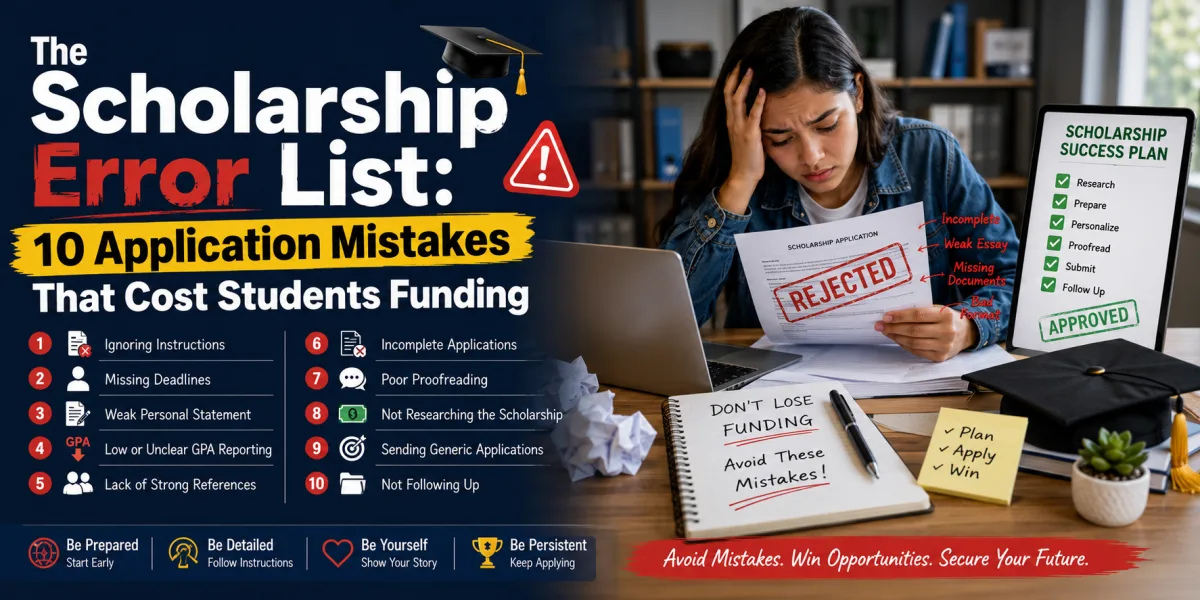
The Scholarship Error List: 10 Application Mistakes That Cost Students Funding
Scholarship applications are not lost only by weak students.
They are often lost by capable students who apply carelessly, write vaguely, misunderstand the scholarship, submit late documents, choose the wrong recommenders, or fail to explain why they are a strong investment. A student may have excellent grades, real financial need, meaningful leadership experience, and a powerful personal story, yet still lose because the application does not make those strengths clear.
This is what makes scholarship applications different from ordinary forms. They are not only administrative documents. They are arguments. Every essay, recommendation, transcript, CV, financial statement, portfolio, and interview should support one central message: this student is prepared, deserving, aligned with the scholarship’s purpose, and able to use the opportunity well.
Many applicants assume scholarship committees are simply looking for the “best” student. That is too simple. Committees are usually looking for the best fit. A leadership scholarship wants leadership evidence. A research scholarship wants intellectual seriousness. A need-based scholarship wants financial clarity and academic promise. A development scholarship wants public impact. An international exchange scholarship wants cultural maturity and future contribution.
The strongest applications understand this. The weakest ones treat every scholarship the same.
Major scholarship programs make their expectations visible. Chevening describes its scholarships as funding outstanding emerging leaders to pursue one-year master’s degrees in the United Kingdom, and its application criteria emphasize clear short-, mid-, and long-term career plans with measurable goals. ([chevening.org](https://www.chevening.org/scholarships/?utm_source=chatgpt.com)) ([chevening.org](https://www.chevening.org/resource-hub/guidance/application-criteria/?utm_source=chatgpt.com)) DAAD explains that a motivation letter should describe the applicant’s professional and personal reasons for a planned project in Germany. ([daad.de](https://www.daad.de/en/studying-in-germany/scholarships/information-for-scholarship-applicants/?utm_source=chatgpt.com)) Fulbright guidance commonly separates the study or research objective from the personal statement, asking applicants to explain both their academic plan and their personal trajectory. ([usefnepal.org](https://usefnepal.org/fulbright/ffsp/key-elements-of-a-successful-application/?utm_source=chatgpt.com))
The lesson is clear: scholarship applications are evaluated against purpose, evidence, and fit. Mistakes happen when applicants ignore that structure.
This article explains 10 scholarship application mistakes to avoid. Some are obvious, such as missing deadlines. Others are subtle, such as choosing a prestigious recommender who cannot write specifically about your work. Together, they explain why scholarship success depends on more than ambition. It depends on disciplined preparation.
Mistake 1: Applying Without Understanding the Scholarship
The first and most damaging mistake is applying before understanding why the scholarship exists.
Many students see the word “fully funded” and rush to apply. They read the benefits, but not the mission. They notice the stipend, tuition coverage, or university name, but ignore the selection criteria. This leads to applications that are technically complete but strategically weak.
A scholarship is not simply money waiting to be claimed. It is usually designed to support a particular kind of student, goal, field, community, country relationship, leadership pipeline, research agenda, or social purpose. If your application does not speak to that purpose, it will feel generic even if your achievements are strong.
For example, a leadership scholarship is not satisfied by high grades alone. It needs evidence that you can influence people, organize action, build networks, solve problems, and use education for broader impact. Chevening’s reading committee feedback has repeatedly stressed that applicants need to demonstrate leadership and networking with specific evidence rather than vague statements or superficial examples. ([chevening.org](https://www.chevening.org/news/reading-committee-feedback-for-applicants/?utm_source=chatgpt.com))
A research scholarship is different. It wants to know whether you have a focused academic question, preparation in the field, methodological awareness, and a reason for studying at a particular institution or with a particular supervisor. A need-based scholarship wants honest financial context, but also proof that removing the financial barrier will unlock serious potential.
Before writing anything, study the scholarship like a business case. Ask: Who funds it? Why does it exist? Who has won before? What qualities does the program repeatedly mention? What documents matter most? What obligations come with the award? What kind of future impact does the program want to create?
Then build the application around that answer.
A student applying for a development scholarship should not sound like they are applying only for personal escape. A student applying for a leadership scholarship should not submit an essay that only lists academic awards. A student applying for a research scholarship should not write mostly about general inspiration. Fit is not optional. It is the foundation.
Mistake 2: Writing One Generic Essay for Every Scholarship
The second mistake is recycling the same essay across multiple scholarships with only the name changed.
Reusing material is normal. Students do not need to rewrite their entire life story from scratch for every award. But recycling without adaptation is dangerous. Scholarship committees can recognize generic essays quickly. They read hundreds or thousands of applications. They know when an essay could have been sent to any university, any country, and any scholarship.
Generic essays usually rely on broad statements: “I am passionate about education,” “I want to make a difference,” “this scholarship will help me achieve my dreams,” “I have always wanted to study abroad,” or “your institution is world-class.” These phrases may be sincere, but they are not specific enough to persuade.
A strong essay answers the exact prompt. It names the specific program, explains the fit, connects the applicant’s past experience to the scholarship’s purpose, and shows why this opportunity is the right next step. If the scholarship asks about leadership, the essay should show leadership. If it asks about financial need, the essay should explain the financial barrier clearly. If it asks about career goals, the essay should offer a credible plan.
The best way to avoid generic writing is to create a scholarship-specific thesis. Before drafting, write one sentence: “This scholarship should fund me because…” The answer should be different for each major award.
For one scholarship, the answer may be: “This scholarship should fund me because my work on rural water access has reached the point where I need advanced training in environmental engineering and public financing to scale solutions beyond one district.”
For another, it may be: “This scholarship should fund me because I have already built a peer tutoring program for low-income students, and this education policy degree will help me design evidence-based support systems at a national level.”
These sentences guide the essay. They prevent the application from becoming a collection of achievements with no direction.
A generic essay asks the committee to admire you. A specific essay helps the committee understand why you fit.
Mistake 3: Listing Achievements Without Explaining Their Meaning
Many scholarship applicants turn their essays into expanded CVs. They list awards, clubs, volunteer roles, competitions, certificates, internships, grades, and leadership titles. The application becomes impressive on the surface but emotionally and intellectually flat.
The problem is not achievement. Achievement matters. The problem is that lists do not explain growth, judgment, or purpose.
Scholarship committees want to know what your experiences mean. What did you learn? What problem did you encounter? What responsibility did you take? What changed because of your work? How did the experience shape your academic or career direction?
For example, writing “I volunteered at a community health clinic” is less powerful than explaining what the clinic taught you: “At the clinic, I saw that mothers were not missing prenatal appointments because they ignored medical advice; they were missing them because transport costs were higher than a day’s income. That changed my understanding of public health from individual behavior to system design.”
The second version reveals insight. It shows that the applicant did not simply collect volunteer hours. They observed, reflected, and developed a clearer goal.
Scholarship essays should turn experience into evidence. A leadership role should prove initiative. A research project should prove intellectual curiosity. A family hardship should prove resilience and responsibility. A job should prove maturity. A community project should prove service and problem-solving.
Ask yourself after every example: “So what?” If you cannot explain why the example matters, it may not belong in the essay.
Committees fund future potential. Achievements are useful because they help predict that future. But they must be interpreted.
Mistake 4: Having Vague Career Goals
Unclear career goals weaken scholarship applications, especially for awards that see funding as an investment in future impact.
Many applicants write that they want to “help people,” “serve my community,” “become a leader,” “contribute to development,” “promote change,” or “build a better future.” These goals sound noble, but they are too broad. A committee cannot evaluate whether the scholarship fits the plan because the plan is not concrete.
Strong career goals are specific enough to be believable. They name a field, problem, role, sector, country, community, institution type, or pathway. They may include short-term, medium-term, and long-term plans. Chevening’s application criteria explicitly ask for short-, mid-, and long-term career plans with clear, measurable goals. ([chevening.org](https://www.chevening.org/resource-hub/guidance/application-criteria/?utm_source=chatgpt.com))
A vague goal says: “I want to improve education in my country.”
A stronger goal says: “After the master’s program, I plan to return to my role in a teacher-training nonprofit and focus on literacy assessment for rural primary schools. Within five years, I want to help design a district-level reading intervention that trains teachers to identify struggling readers by grade two rather than waiting until national exams expose the gap.”
The second goal is more credible because it shows context, pathway, and scale. It does not promise to fix the entire education system. It explains a role within the system.
This matters because scholarship committees are wary of inflated promises. A student who claims they will “eradicate poverty” may sound less convincing than a student who explains how they will improve agricultural credit access for smallholder farmers in two regions. Ambition is valuable when it is grounded.
If you are not sure about your long-term career, be honest but structured. You can explain a direction rather than a fixed job title. For example: “My long-term goal is to work at the intersection of climate finance and municipal infrastructure, either through a public agency or a development finance institution.” That is still clearer than “I want to help the environment.”
A scholarship application should make the future visible.
Mistake 5: Ignoring Financial Details Until Too Late
Some students treat scholarship applications as separate from financial planning. They apply first and calculate costs later. This can create painful surprises.
A scholarship may cover tuition but not housing. It may cover one year but not the full degree. It may provide a stipend that is insufficient for a high-cost city. It may require the student to pay visa fees, health insurance, flights, deposits, books, or personal expenses. It may be renewable only if the student maintains a certain GPA. It may be paid after arrival, leaving the student responsible for upfront costs.
Students should not assume that “scholarship” means “everything is handled.” EducationUSA maintains a database of special opportunities and financial aid options for international students, but awards vary widely by amount, deadline, renewability, and eligibility. ([educationusa.state.gov](https://educationusa.state.gov/find-financial-aid?utm_source=chatgpt.com)) A student must read each award carefully.
Financial need essays should also be handled with precision. Some applicants write emotionally but vaguely: “My family cannot afford this opportunity.” That may be true, but a stronger explanation gives context: family income, dependents, currency issues, education costs, what the student has already done to contribute, and what exact gap the scholarship would close.
The goal is not to expose every private detail unnecessarily. The goal is to help the committee understand the barrier clearly.
Financial planning also protects the student from accepting unaffordable offers. A partial scholarship at an expensive university may still require large loans. A full-tuition scholarship may still leave unaffordable living costs. A prestigious admission offer without funding can become a financial trap.
Before applying, build a cost table. Include tuition, fees, housing, meals, insurance, books, travel, visa, personal expenses, and emergency funds. Then identify which scholarships actually cover which costs.
A scholarship application is not only a writing task. It is a financial decision.
Mistake 6: Choosing the Wrong Recommenders
Recommendation letters can elevate an application or weaken it quietly.
Many students choose recommenders based on title rather than knowledge. They ask the most famous professor, senior official, politician, principal, CEO, or public figure they can access. The result is often a vague letter: “This student is hardworking, disciplined, and deserving.” The title may be impressive, but the evidence is thin.
A strong recommender knows your work closely. They can describe how you think, lead, write, research, solve problems, serve others, or respond to difficulty. They can provide specific examples. They can explain why you are ready for the scholarship.
For academic scholarships, a teacher, professor, thesis supervisor, or research mentor may be best. For leadership scholarships, a supervisor, community leader, program director, or organization founder who has seen you lead may be stronger. For professional scholarships, a manager or client may speak more credibly than a lecturer who only knows your exam grades.
The recommender should also match the scholarship. If the award emphasizes research, at least one recommender should discuss academic or research ability. If it emphasizes service, one should discuss community contribution. If it emphasizes professional leadership, one should discuss workplace responsibility.
Students should prepare recommenders well. Provide the scholarship criteria, your CV, essay draft, program information, deadline, submission instructions, and a short note explaining what you hope the letter can emphasize. Do this early. A rushed recommendation is rarely strong.
Do not ask someone who barely knows you unless the scholarship specifically requires their institutional role. A detailed letter from a teacher who supervised your project is usually better than a generic letter from a famous person.
Scholarship committees trust evidence. Choose recommenders who can provide it.
Mistake 7: Missing Deadlines and Administrative Instructions
This is the most preventable mistake, yet it happens constantly.
Students miss deadlines because they underestimate how long documents take. Transcripts need processing. Recommendations take time. Test scores may arrive late. Passports expire. Financial documents require signatures. Translations take days or weeks. Online portals crash. Time zones confuse applicants. Some scholarships require school nomination before the student can even apply.
Administrative mistakes are not small. They signal carelessness. A scholarship committee may receive thousands of applications. It does not need to chase missing documents or interpret incomplete forms. If the instructions say one PDF, submit one PDF. If the word limit is 500 words, do not submit 900. If the deadline is noon in a specific time zone, do not assume midnight in yours.
Deadlines can also change by year. Students should verify current dates on official scholarship websites rather than relying on old blog posts or social media screenshots. For example, EducationUSA’s funding database lists award-specific deadlines, and individual entries can vary by institution and cycle. ([educationusa.state.gov](https://educationusa.state.gov/find-financial-aid?utm_source=chatgpt.com))
The solution is a scholarship calendar. Include opening dates, internal school nomination dates, official deadlines, recommendation deadlines, test dates, transcript requests, financial aid forms, interview windows, and visa-related deadlines. Work backward from each deadline.
Submit early when possible. A strong application should not depend on perfect internet connection in the final hour.
Scholarship success rewards excellence, but it also rewards logistics.
Mistake 8: Writing About Hardship Without Showing Agency
Hardship can be an important part of a scholarship application. Many students face real financial, family, health, political, geographic, or educational barriers. Committees should understand those barriers when they affect opportunity.
But hardship alone is not a complete application.
A common mistake is writing an essay that focuses entirely on suffering without showing what the applicant did, learned, built, or hopes to change. The result can feel emotionally heavy but strategically incomplete. Scholarship committees may feel sympathy, but they still need confidence in the applicant’s readiness and future contribution.
The strongest hardship essays combine honesty with agency. They explain the obstacle, but they also show response.
For example: “When my father lost his job, I began tutoring younger students after school to cover my transport and exam fees. That experience helped me remain in school, but it also showed me how many students in my community lacked affordable academic support. I later organized a weekend peer tutoring group that served 32 students preparing for national exams.”
This paragraph does not hide hardship. It turns hardship into evidence of responsibility, initiative, and service.
Financial need should be explained with dignity. Avoid exaggeration. Avoid trauma written only for emotional impact. Avoid suggesting that the committee should fund you because life has been unfair. The stronger argument is: despite these barriers, I have prepared seriously; this scholarship removes the barrier that remains; and I will use the opportunity well.
Scholarships can be compassionate, but they are still investments. Show why the investment is sound.
Mistake 9: Failing to Explain Program Fit
Many applicants explain why they want a scholarship but not why they want the specific program, university, country, supervisor, or course. This creates a serious gap.
A scholarship committee may ask: Why this degree? Why this university? Why this country? Why now? Why not a cheaper or local option? Why are you prepared for this academic environment?
Weak fit sounds like admiration: “Your university is prestigious and has excellent professors.” Strong fit sounds like analysis: “The program’s focus on urban climate adaptation, combined with its policy lab and internship placement model, matches my work on flood-risk mapping for informal settlements.”
DAAD’s motivation letter guidance asks applicants to describe professional and personal reasons for their planned project in Germany, which shows how important destination and project fit can be. ([daad.de](https://www.daad.de/en/studying-in-germany/scholarships/information-for-scholarship-applicants/?utm_source=chatgpt.com)) Erasmus Mundus Joint Masters similarly require students to apply to specific consortia, making program fit central because each joint master’s has its own structure, universities, and mobility path. ([erasmus-plus.ec.europa.eu](https://erasmus-plus.ec.europa.eu/opportunities/individuals/students/erasmus-mundus-joint-masters?utm_source=chatgpt.com))
To explain fit, research beyond the homepage. Read course lists, faculty profiles, research centers, internship options, thesis requirements, laboratory facilities, alumni outcomes, fieldwork opportunities, language requirements, and partner institutions. Then connect those details to your goals.
Do not overdo it by listing every course. Select two or three precise features that matter. The reader should see that you chose the program thoughtfully, not because it was famous.
Program fit tells the committee that you are not just seeking funding. You are making a serious academic and career decision.
Mistake 10: Submitting Without Serious Revision
The final mistake is treating the first complete draft as the final application.
Scholarship writing improves through revision. The first draft usually contains repetition, vague claims, weak transitions, unnecessary background, and unclear goals. It may sound emotional but unfocused. It may answer only part of the prompt. It may include strong experiences in the wrong order. It may bury the best evidence near the end.
Revision is not proofreading. Proofreading catches spelling and grammar errors. Revision strengthens the argument.
Start with structure. Does the essay answer the prompt? Is the main point clear by the first or second paragraph? Does each section move the argument forward? Is there a logical connection between past experience, chosen program, scholarship fit, and future goals?
Then examine evidence. Have you supported every major claim with a specific example? If you say you are a leader, where is the leadership evidence? If you say you are committed to a field, where is the history of commitment? If you say the program fits, where are the program details?
Then refine language. Remove generic phrases. Cut inflated words. Simplify sentences. Replace “I am passionate about helping my community” with a concrete explanation of the community, problem, and work. Replace “this opportunity will change my life” with a clear explanation of what the funding enables.
Ask for feedback from people who can help in specific ways. One reviewer may check clarity. Another may check grammar. Another may check field accuracy. Another may know scholarship expectations. Do not accept every suggestion blindly. Protect your voice and argument.
A polished essay that says little is not enough. A strong essay that is poorly edited may also fail. The goal is substance and clarity together.
The Application Should Work as One System
Scholarship documents should not feel disconnected. The essays, CV, recommendations, transcripts, financial information, portfolio, and interview should reinforce one coherent case.
If your essay says your goal is public health, your CV should show health-related experience, research, volunteering, coursework, or work. If your recommendation praises your leadership, the essay should include leadership examples. If your financial need statement explains hardship, your academic record and activities should show persistence despite that barrier. If your study plan mentions a specific research area, your past preparation should make that area believable.
The strongest applications have alignment. Every document points in the same direction.
This does not mean repeating the same sentence everywhere. It means building a consistent profile. The committee should finish reading and feel that they understand who you are, what you have done, what you want to study, why the scholarship fits, and what you will do with the opportunity.
Weak applications feel scattered. Strong applications feel inevitable.
A Practical Pre-Submission Checklist
Before submitting any scholarship application, ask a series of hard questions.
Have I read the official eligibility criteria and selection criteria? Does my essay answer the exact prompt? Have I explained why this scholarship exists and how I fit it? Have I used specific examples rather than broad personality labels? Are my career goals clear enough to be believable? Have I explained program fit with real details? Have I chosen recommenders who know my work? Have I given them enough time and context? Have I calculated what the scholarship covers and what it does not cover? Have I followed formatting, word limits, file naming, and submission instructions? Have I revised the essay for structure before proofreading? Have I submitted before the deadline?
If the answer to any of these questions is weak, the application is not ready.
Scholarship applications are competitive. You do not control the applicant pool. You do control preparation.
How to Recover If You Have Already Made These Mistakes
Many strong scholarship winners were rejected before they succeeded. Rejection does not always mean the student was unqualified. It may mean the application was unclear, incomplete, poorly matched, or less competitive in that cycle.
If you are rejected, analyze the application calmly. Did you meet all eligibility rules? Did you answer the prompts? Were your goals specific? Did your recommenders write detailed letters? Did your application show fit? Were your documents submitted correctly? Did your examples prove leadership or only describe participation?
Some scholarship programs publish feedback. Chevening, for example, has shared reading committee feedback explaining common weaknesses, including the need for clearer examples and stronger evidence in areas such as networking, leadership, and career planning. ([chevening.org](https://www.chevening.org/news/where-did-i-go-wrong-on-my-chevening-application-feedback-from-this-years-reading-committees/?utm_source=chatgpt.com)) That kind of feedback is valuable even for applicants to other scholarships because the underlying principles are similar.
Use rejection as data. Strengthen your CV. Gain more relevant experience. Improve your essays. Choose better-fit scholarships. Build relationships with recommenders earlier. Clarify your career plan. Apply again when the application is stronger.
Scholarship success often belongs to the applicant who learns faster than they feel discouraged.
The Bigger Lesson
Scholarship applications fail for many reasons, but the most common mistakes are avoidable. Students apply without understanding the scholarship. They submit generic essays. They list achievements without meaning. They write vague career goals. They ignore financial details. They choose weak recommenders. They miss deadlines. They overfocus on hardship without agency. They fail to explain program fit. They submit without serious revision.
Each mistake weakens the same thing: trust.
A scholarship committee must trust that you understand the opportunity, that your achievements are real, that your goals are credible, that your financial need is clear, that your chosen program fits, and that funding you will produce meaningful value.
The best applications make that trust easy.
They are specific. They are aligned. They are honest. They are evidence-based. They answer the prompt. They respect instructions. They show preparation. They make the reader believe not only that the student needs funding, but that the student is ready for what the funding makes possible.
A scholarship is not won by sounding desperate. It is won by making a clear case for investment.
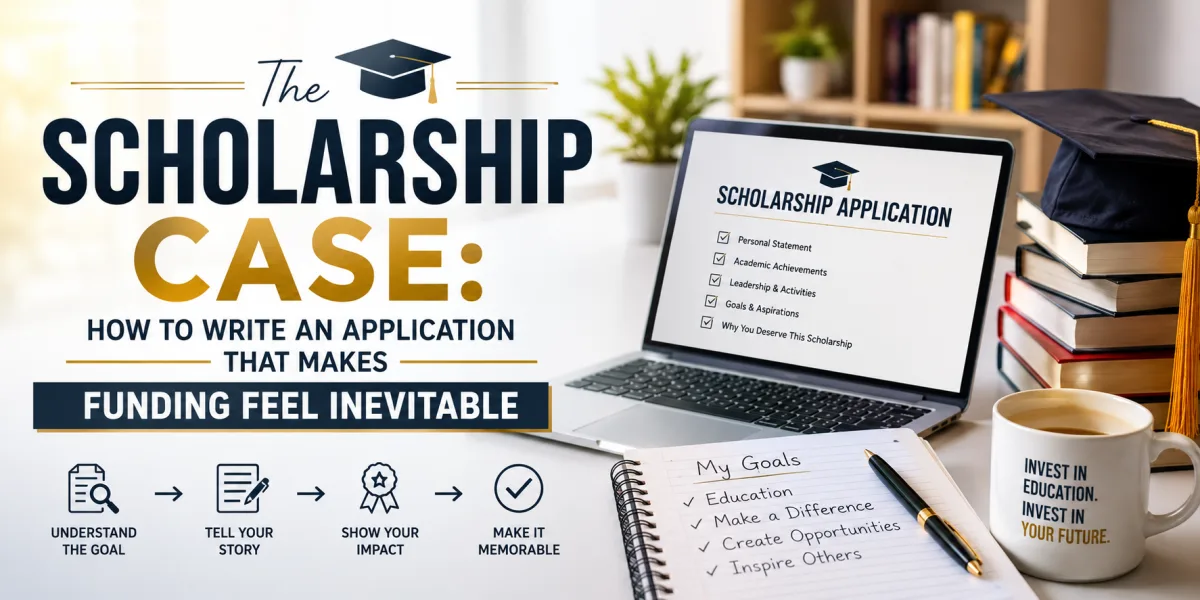
Avoid the mistakes. Build the case. Let every document tell the same story: I am prepared, I fit this opportunity, and I will use it well.
 Article
 Article
 Article
 Article
 Article
 Article
 Article
 Article