
The Scholarship Case: How to Write an Application That Makes Funding Feel Inevitable
A scholarship application is not a plea for money. It is a case for investment.
That distinction changes everything. Many students write scholarship applications as if the committee’s main question is, “Does this applicant need help?” Financial need may matter, especially for need-based awards, but most competitive scholarships ask a larger question: “If we fund this person, what becomes possible?”
The strongest application answers that question with evidence. It shows that the applicant has prepared seriously, chosen the right program or opportunity, developed a clear direction, demonstrated ability, overcome real constraints, and can use the award to create value beyond personal advancement.
A weak application describes dreams. A strong application explains a trajectory.
Scholarship committees are not only reading words. They are reading judgment. They want to know whether the applicant understands the scholarship, the field, the institution, the cost of the opportunity, and the responsibility attached to funding. They want proof that the applicant can succeed academically, contribute to a community, and use the opportunity well.
This is why generic scholarship essays fail. They say the applicant is hardworking, passionate, determined, ambitious, and grateful. Those qualities may be true, but they are too common to distinguish one candidate from another. A winning application does not rely on adjectives. It uses stories, results, choices, and future plans.
Major scholarship programs make this clear in different ways. Chevening describes its scholarships as funding outstanding emerging leaders to pursue one-year master’s degrees in the United Kingdom, and its applicant guidance emphasizes leadership, networking, study in the UK, and clear career plans. Fulbright application guidance commonly separates the study or research objective from the personal statement, requiring applicants to explain both what they propose to do and who they are as a candidate. DAAD guidance explains that a letter of motivation should describe professional and personal reasons for the planned project in Germany.
The pattern is consistent: strong scholarship applications connect purpose, preparation, fit, and future impact.
Understand the Scholarship Before Writing Anything
Many students begin with the essay. That is too late in the process. The first step is understanding the scholarship as an institution.
Every scholarship has a reason for existing. Some fund leadership. Some fund research. Some fund public service. Some fund financial need. Some support specific countries, fields, universities, communities, professions, or development priorities. Some are designed to build diplomatic relationships. Some are designed to increase access for underrepresented students. Some are designed to advance a particular industry or discipline.
Your application should be written to that purpose. A leadership scholarship needs leadership evidence. A research scholarship needs research clarity. A need-based scholarship needs financial context and academic promise. A community service scholarship needs credible service and future commitment. A professional scholarship needs career direction.
Do not treat all scholarships as the same. The same personal story may be framed differently depending on the award. For a leadership scholarship, you may emphasize initiative and influence. For a research scholarship, you may emphasize intellectual development and methodology. For a financial need scholarship, you may explain barriers and persistence. For a development-focused scholarship, you may connect your studies to public or community impact.
Before drafting, read the official website, eligibility criteria, selection criteria, frequently asked questions, application instructions, essay prompts, recommendation rules, and alumni profiles if available. Look for repeated language. Does the scholarship mention leadership, service, innovation, academic excellence, community impact, public purpose, professional experience, financial need, or return to home country? Those words are not decoration. They tell you what the committee values.
A winning application is not written in isolation. It is written in conversation with the scholarship’s mission.
Start with Fit, Not Flattery
Applicants often spend too much space praising the scholarship, university, or country. They write that the institution is prestigious, world-class, renowned, excellent, transformative, and globally respected. The committee already knows this. It does not need a brochure repeated back to it.
What the committee needs is fit.
Fit answers why this scholarship, why this program, why this moment, and why you. It is specific. It explains how the opportunity connects to your past preparation and future plans.
Weak fit sounds like this: “Your university is one of the best in the world, and studying there will help me achieve my dreams.”
Strong fit sounds like this: “The public health policy concentration matches my work on maternal health access in rural clinics, especially because the program combines health economics, implementation research, and policy evaluation. I need that combination because my current work has shown me that clinical outreach alone cannot solve access gaps without better financing and local health-system design.”
The second version does not flatter. It explains.
Fit is especially important for international scholarships. Erasmus Mundus Joint Masters, for example, require students to apply directly to the institution running the chosen program, and the structure often involves study at several universities in Europe and beyond. A strong Erasmus Mundus applicant must therefore explain why the specific joint program and mobility structure matter for their academic and professional goals, not merely why Europe sounds attractive.
Scholarship committees fund students who understand the opportunity precisely.
Build Your Application Around One Central Argument
A winning scholarship application should have a central argument. This is the core case for why you should be funded.
The argument does not need to be dramatic. It needs to be clear.
For example:
“I have spent three years improving access to affordable legal information for migrant workers, and this human rights law program will give me the legal research and policy tools to build a stronger worker-rights advocacy platform in my country.”
“My engineering background and community work on water systems have shown me that rural infrastructure problems require both technical design and public financing expertise; this master’s program is the bridge between those two needs.”
“As a first-generation student who built a peer tutoring initiative for low-income learners, I want to study education policy so I can design scalable academic support systems for underserved schools.”
Each argument contains past experience, current insight, future direction, and scholarship relevance. It gives the application a spine.
Without a central argument, the application becomes a collection of achievements. The student has good grades, volunteer work, leadership roles, hardship, ambition, and gratitude, but the committee does not know how these pieces fit together.
Your job is to connect the pieces.
Before writing the application, complete this sentence: “This scholarship should fund me because…” The answer should be specific enough that it could not belong to thousands of other students.
Show Evidence, Not Personality Labels
Many scholarship essays rely on labels: “I am passionate,” “I am determined,” “I am a leader,” “I am resilient,” “I am hardworking.” These statements are not wrong, but they are weak unless supported by evidence.
Committees believe actions more than adjectives.
Instead of writing, “I am passionate about education,” show what you did: “After noticing that many students in my district could not afford exam preparation, I organized weekend study sessions with four volunteers, created shared revision materials, and helped 38 students prepare for the national mathematics exam.”
Instead of writing, “I am resilient,” show the constraint and response: “When my family could no longer afford transport to school every day, I arranged to borrow textbooks weekly, studied from home two days a week, and still ranked in the top five of my class.”
Instead of writing, “I am a leader,” show influence: “As chair of the student health committee, I negotiated with the administration to install water stations in three lecture buildings, recruited 22 volunteers, and created a maintenance schedule that kept the program running after I left office.”
Specifics create credibility. Numbers help when they are real. Names of programs, roles, communities, tools, research topics, and outcomes make the essay concrete.
A winning application does not ask the committee to trust your self-description. It gives them reasons to believe it.
Tell a Story, But Do Not Turn the Essay into a Memoir
Personal stories can make scholarship applications memorable. They show motivation, context, struggle, and growth. But a scholarship essay is not a full autobiography. It is a focused argument supported by selected life evidence.
The best stories are chosen because they explain the applicant’s direction. A childhood story may work if it shaped a serious academic or professional path. A family hardship may work if it explains resilience, responsibility, or commitment. A failure may work if it led to maturity and better judgment. A community experience may work if it reveals the problem the applicant wants to solve.
The mistake is including dramatic stories that do not connect to the scholarship. Pain alone is not a strategy. A difficult background can help the committee understand barriers, but the application must still show preparation and future use of the award.
A strong story has three parts: context, action, and meaning.
Context explains what was happening. Action explains what you did. Meaning explains how it shaped your goals or skills.
For example: “During my second year of university, I volunteered at a legal aid clinic serving domestic workers. Many women arrived with unpaid wage claims but no written contracts. I began documenting patterns in their cases and realized the problem was not only lack of legal representation but lack of accessible employment information before abuse occurred. That experience shifted my goal from litigation alone to preventive legal education and policy reform.”
This story works because it does not stop at emotion. It shows observation, action, insight, and direction.
Write a Strong Opening Without Trying Too Hard
The opening paragraph should create interest and direction. It does not need to be theatrical. Scholarship essays often become weaker when applicants force dramatic openings: a quote from a famous leader, a childhood scene written like a novel, or a grand statement about changing the world.
A strong opening can be direct.
It can begin with a problem: “In my district, students often fail science not because they lack ability, but because their schools lack laboratories, trained teachers, and basic experiment materials.”
It can begin with a turning point: “The first time I helped a small business owner organize her financial records, I realized that bookkeeping was not just paperwork; it was the difference between survival and closure.”
It can begin with a question your work has pursued: “How can rural clinics improve maternal health when the nearest hospital is four hours away and transport costs more than a week’s income?”
It can begin with a concise statement of purpose: “I am applying for this scholarship because my work in community health has reached the limit of what field experience alone can teach me. I now need formal training in health policy and financing to scale the interventions I have helped implement locally.”
The opening should tell the reader what kind of application they are about to read. It should not delay the point for the sake of style.
Explain Academic Preparation Clearly
Scholarships fund potential, but they also need evidence of readiness. Academic preparation is part of that evidence.
Do not simply list grades. Explain what your academic path has prepared you to do. Mention relevant courses, research projects, thesis work, fieldwork, laboratory experience, publications, academic awards, or technical skills. Connect them to the program you want to pursue.
For example: “My undergraduate thesis examined the relationship between mobile money usage and savings behavior among informal traders. That project introduced me to survey design, regression analysis, and the difficulty of collecting reliable financial data in informal markets. It also convinced me that I need stronger training in development economics and data methods.”
This paragraph does more than say the applicant studied economics. It shows progression.
If your academic record has weaknesses, address them carefully if the application allows. Do not make excuses. Explain context briefly, show improvement, and redirect to evidence of current readiness.
For example: “My first-year grades were affected by illness and family financial instability. After returning to full health and securing part-time work, my grades improved steadily, and I earned distinction in my final-year research project.”
The goal is not to dwell on weakness. The goal is to help the committee interpret the record fairly.
Make Career Goals Specific and Credible
Scholarship committees often care deeply about what you will do after the award. This is especially true for leadership, development, public service, and international exchange scholarships.
A weak career goal is broad: “I want to help my country,” “I want to become a leader,” “I want to empower people,” or “I want to make a difference.” These statements may be sincere, but they do not show planning.
A strong career goal is specific enough to be believable.
It names a field, problem, role, sector, organization type, community, or pathway. It may include short-term and long-term goals. Chevening’s reading committee feedback, for example, says the program looks for applicants with a clear post-study career plan, including immediate plans after returning home and longer-term goals.
Strong goals sound like this:
“After the master’s program, I plan to return to my role in the Ministry of Agriculture’s climate adaptation unit and focus on financing models for smallholder irrigation. Within five years, I aim to lead a pilot program that combines farmer cooperatives, local banks, and public subsidies to expand drought-resilient irrigation in two counties.”
“My immediate goal is to work with a nonprofit legal aid organization that supports migrant domestic workers. In the longer term, I plan to build a policy and training center that helps workers understand contracts before migration and documents wage abuse patterns for legislative reform.”
These goals are not vague dreams. They are plausible next steps.
Credibility matters. Do not promise to solve a national crisis alone. Explain the role you can realistically play within a larger system.
Connect Financial Need to Investment Potential
If the scholarship considers financial need, explain it with dignity and clarity. Do not exaggerate. Do not write as if suffering alone entitles you to funding. Explain the barrier and then show what funding would make possible.
A strong financial need paragraph answers three questions: What is the financial constraint? What have you done despite it? How will the scholarship change the outcome?
For example: “My family’s income supports six people, and the cost of international tuition is beyond what we can finance through savings or loans. During university, I worked part-time as a tutor to cover transport and books, while maintaining a strong academic record. This scholarship would allow me to accept admission without taking on unsustainable debt and would let me focus fully on the research and field placement required by the program.”
This paragraph is clear, factual, and forward-looking.
Avoid language that suggests helplessness. Scholarship committees want to fund resilience and potential, not only hardship. The financial barrier matters because it blocks a candidate who is otherwise ready.
Choose Recommenders Strategically
Recommendations can strengthen or weaken a scholarship application. A famous recommender who barely knows you is often less useful than a professor, supervisor, mentor, or community leader who can describe your work in detail.
The best recommender can provide evidence. They can explain how you performed, how you think, how you lead, how you respond to difficulty, and why you are ready for the opportunity.
Choose recommenders based on the scholarship’s criteria. For an academic scholarship, at least one academic recommender may be essential. For a leadership scholarship, a supervisor or community leader who has observed your initiative may be powerful. For a research scholarship, a professor who supervised your thesis or project can speak to intellectual ability.
Give recommenders enough time. Provide your CV, scholarship information, program details, essay drafts, deadlines, submission instructions, and a short summary of what you hope they can emphasize. Do not write the letter for them unless the process requires a draft, but do help them remember specific examples.
A weak recommendation says the student is excellent, hardworking, and deserving. A strong recommendation says the student led a specific project, solved a particular problem, produced strong research, showed unusual maturity, or contributed meaningfully to a community.
Help your recommenders write with evidence by giving them the evidence.
Build a CV That Supports the Essay
Your scholarship CV should not be a generic job résumé. It should support the application’s central argument.
Include education, awards, research, publications, work experience, leadership, volunteer service, projects, skills, languages, conferences, and relevant training. Use clear bullet points that emphasize responsibility and impact.
Weak CV bullet: “Participated in community outreach.”
Strong CV bullet: “Coordinated weekly financial literacy workshops for 120 market traders, creating budgeting materials and tracking attendance over four months.”
The CV should help the committee see patterns. If your essay says you are committed to public health, the CV should show public health activities. If your essay says you are preparing for environmental policy, the CV should show relevant coursework, research, fieldwork, advocacy, or work experience.
A scholarship application is strongest when every document reinforces the same case.
Answer the Prompt Exactly
Many strong students lose marks because they answer the essay they wanted to write instead of the prompt they were given.
If the prompt asks about leadership, do not write only about hardship. If it asks why you chose the program, do not write only about your childhood. If it asks for career plans, do not spend most of the essay praising the university. If it asks for financial need, do not submit a general personal statement.
Underline the key words in each prompt. Identify what the committee is asking. Then answer directly.
For multi-part prompts, answer every part. If the prompt asks for your academic goals, professional goals, and how the scholarship will help, make sure all three appear clearly. Do not assume the reader will infer.
Scholarship readers may review hundreds or thousands of applications. They appreciate clarity. A beautifully written essay that avoids the prompt is not a winning essay.
Avoid Generic Scholarship Language
Certain phrases appear so often in scholarship essays that they lose power: “Since I was a child,” “I have always been passionate,” “I want to give back,” “education is the key to success,” “I want to change the world,” “this scholarship will help me achieve my dreams,” and “I am a hardworking and determined individual.”
These phrases are not forbidden, but they are usually too broad. Replace them with specific language.
Instead of “I want to give back,” write who you want to serve, what problem you want to address, and how your program prepares you.
Instead of “I have always been passionate about technology,” explain the first project, problem, or experience that made technology meaningful to you.
Instead of “I want to change the world,” describe the system you want to improve and the role you are preparing to play.
Specificity is the antidote to generic writing.
Use Numbers Carefully
Numbers can strengthen an application when they are accurate and relevant. They show scale, effort, and results.
For example, “I trained 45 volunteers,” “raised $3,200,” “reduced processing time from 10 days to four,” “surveyed 180 households,” “organized 12 workshops,” or “supported 60 first-year students” can make achievements more concrete.
Do not invent or inflate numbers. Committees may verify claims, and exaggeration damages trust. If you do not have exact numbers, use honest estimates: “approximately,” “more than,” or “about.”
Numbers should not replace meaning. “I led 20 volunteers” is useful, but the reader also needs to know what those volunteers accomplished and why it mattered.
Show Reflection, Not Only Achievement
Scholarship committees often read applications from high achievers. Grades, awards, leadership titles, and activities are common among strong candidates. Reflection can distinguish you.
Reflection explains what you learned from experience. It shows maturity. It reveals how you think.
For example, after describing a community project, do not stop with what you did. Explain what the experience taught you about the problem, your field, your limitations, or your future direction.
“This project taught me that distributing school supplies was helpful but insufficient. Students also needed academic mentoring, parent engagement, and teacher support. That realization pushed me toward education policy rather than short-term charity.”
This sentence shows growth. The applicant is not simply collecting volunteer experience. They are learning from it.
Winning applications often show a mind in motion.
Write for a Smart Reader Outside Your Field
Scholarship committees may include experts, administrators, alumni, diplomats, faculty, or professionals from different backgrounds. Do not assume every reader understands your technical field.
Explain specialized terms briefly. If your research involves machine learning, agricultural extension, hydrology, genomic sequencing, fintech regulation, or public procurement, write so an intelligent non-specialist can understand why it matters.
This does not mean oversimplifying. It means translating importance.
Weak technical writing says: “My research applies convolutional neural networks to improve classification accuracy in remote sensing datasets.”
Stronger scholarship writing says: “My research uses machine learning to analyze satellite images so that local authorities can identify crop stress earlier and respond before drought losses become severe.”
The second version explains value.
Committees fund people who can communicate across audiences, especially for leadership and public-impact scholarships.
Revise for Structure Before Style
Many applicants polish sentences before fixing structure. This wastes time. A beautifully written essay with weak organization remains weak.
First, check structure. Does the essay answer the prompt? Is the main argument clear? Does each paragraph serve a purpose? Is there a logical progression from past experience to current goals to future impact? Are there missing transitions? Is the ending strong?
Then check evidence. Have you supported claims with examples? Have you shown leadership rather than merely naming it? Have you explained fit? Have you included enough detail about the program or scholarship?
Only then polish style. Remove repetition. Cut vague phrases. Simplify long sentences. Replace inflated language with clear language. Make the opening stronger. Make the conclusion purposeful.
Revision is not proofreading. Revision is rethinking.
Ask for Feedback from the Right People
Feedback can improve an application, but too much unfocused feedback can damage it. Choose reviewers carefully.
Ask one person to review for clarity. Ask another to review for field accuracy. Ask another to review for grammar and flow. If possible, ask someone familiar with scholarships to evaluate whether the essay answers the criteria.
Do not accept every suggestion. Your essay should remain yours. Some reviewers may try to make the essay sound more formal, more dramatic, or more generic. Protect your voice and argument.
When asking for feedback, be specific. Instead of asking, “Is this good?” ask, “Is my career goal clear?” “Does the leadership example feel strong enough?” “Do I explain why this program fits?” “Are there any vague sections?”
Specific questions produce useful feedback.
Prepare for Scholarship Interviews Through the Application
If the scholarship includes an interview, your written application becomes the foundation. Interviewers may ask about your essays, goals, leadership examples, academic plans, weaknesses, and future commitments.
Do not write anything you cannot defend in conversation. If you claim a major goal, be ready to explain the steps. If you mention a research interest, be ready to discuss it. If you describe a leadership project, be ready to explain challenges, failures, and lessons.
Strong written applications make interviews easier because they give you a coherent story. Weak applications create interview risk because they contain vague claims that are hard to expand.
After submitting, reread your application and prepare short explanations for every major point. Practice answering: Why this scholarship? Why this program? Why now? What will you do after? What problem are you trying to solve? What have you already done? What will you contribute to the cohort?
The interview should feel like a continuation of the written case.
Submit Early and Professionally
A winning application can fail because of avoidable administrative errors. Missing documents, wrong file names, late recommendations, incomplete forms, unofficial transcripts, formatting problems, or ignored instructions can damage your chances.
Create a checklist for every scholarship. Include essays, CV, transcripts, test scores, admission documents, passport, recommendations, financial forms, portfolio, research proposal, writing sample, and certification documents if required.
Submit before the deadline. Online systems can crash, internet connections can fail, recommenders can delay, and time zones can cause confusion. Do not let a strong application depend on the final hour.
Professionalism is part of the evaluation. Following instructions shows seriousness.
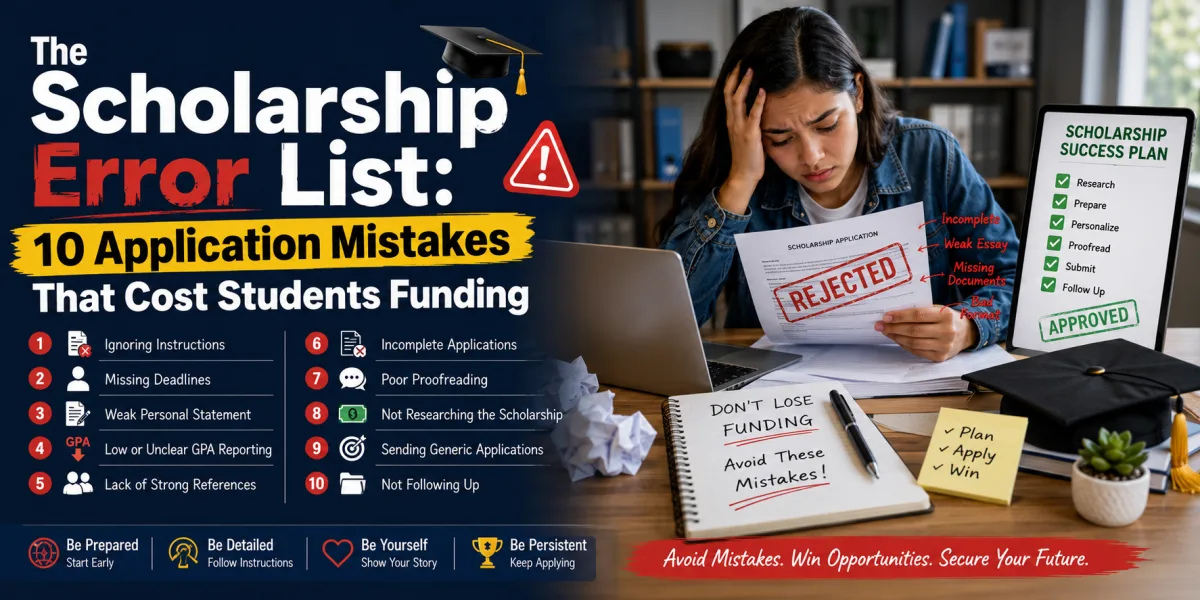
Common Mistakes That Weaken Scholarship Applications
The first mistake is writing one generic essay for every scholarship. Reusing material is fine, but each application must be adapted to the award’s mission and prompt.
The second mistake is focusing only on hardship. Hardship may matter, but the application must also show preparation, agency, and future potential.
The third mistake is listing achievements without reflection. Committees need to understand why the achievements matter.
The fourth mistake is vague career planning. A scholarship is an investment in future impact. The future plan must be credible.
The fifth mistake is weak program fit. Prestige is not enough. Explain why the specific course, institution, country, supervisor, or structure matters.
The sixth mistake is choosing recommenders by title rather than knowledge. A detailed letter from someone who knows your work is better than a generic letter from a famous person.
The seventh mistake is overclaiming. Do not exaggerate leadership, poverty, impact, research, or future outcomes. Credibility is fragile.
The eighth mistake is poor editing. Grammar errors alone may not destroy an application, but careless writing suggests careless preparation.
A Practical Application Timeline
Six to twelve months before the deadline, identify scholarships and confirm eligibility. Research programs, universities, funding coverage, required tests, and recommendation needs. Begin building a document list.
Four to six months before the deadline, contact potential recommenders, request transcripts, draft your CV, research your program fit, and write the first version of your essays.
Two to three months before the deadline, revise essays deeply. Add evidence, sharpen goals, remove generic language, and ask for targeted feedback. Confirm that recommenders have the correct instructions.
One month before the deadline, finalize documents, check formatting, proofread carefully, and prepare the online application. Do not wait for the last week to discover missing materials.
One week before the deadline, submit if possible. Save confirmation emails and copies of every document. If recommendations are submitted separately, confirm that they have arrived.
After submission, prepare for interviews. Review your application, research the scholarship again, and practice explaining your goals clearly.
The Bigger Lesson
A winning scholarship application is not the result of perfect writing alone. It is the result of clear thinking.
The committee must understand who you are, what you have done, what you want to study, why the opportunity fits, what barrier the scholarship removes, and what future value the investment can create. Every document should support that case.
Strong applications are specific. They use evidence. They answer the prompt. They connect past experience to future goals. They show fit. They explain financial need with dignity. They choose recommenders wisely. They revise carefully. They submit professionally.
Scholarships are competitive because they fund possibility. The question is whether your application makes that possibility credible.
Do not write to sound impressive. Write to be understood. Do not list every achievement. Select the experiences that support your argument. Do not beg for funding. Show why funding you is a wise investment.
A scholarship can change the economics of education. A strong application changes how the committee sees your potential.
That is the work: turn your story into evidence, your ambition into a plan, and your need into a case for investment.
 Article
 Article
 Article
 Article
 Article
 Article
 Article
 Article