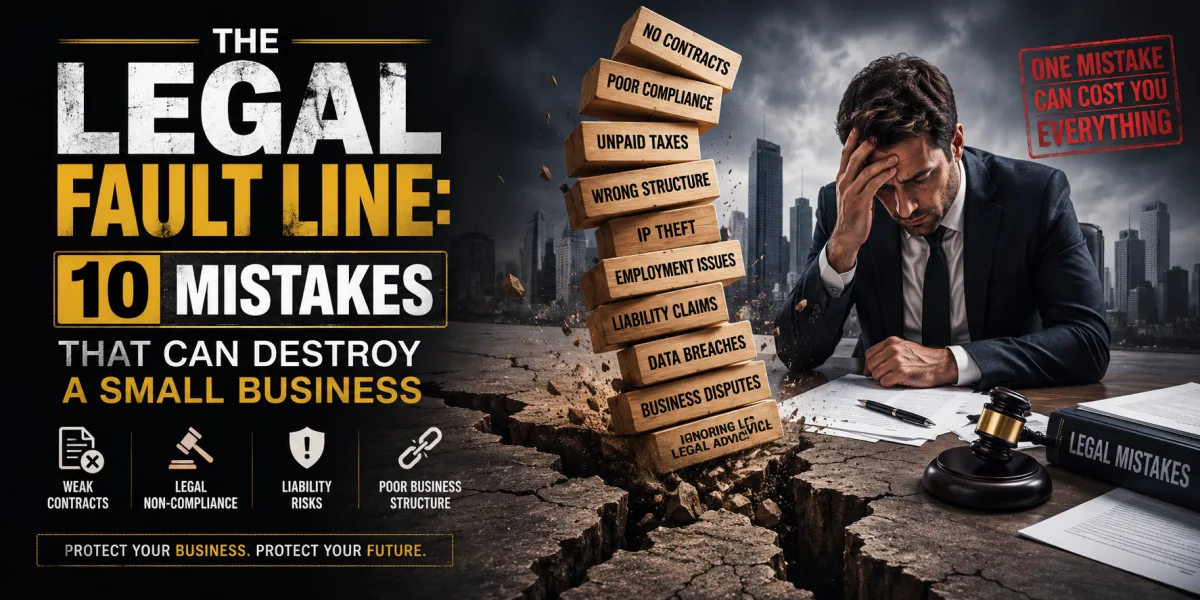
The Legal Fault Line: 10 Mistakes That Can Destroy a Small Business
A small business can survive many difficulties. It can survive a slow sales month, a disappointing product launch, a difficult customer, a delayed shipment, a bad hire, a pricing mistake, or a competitor entering the market. Entrepreneurs expect struggle. They know that building a business requires stamina.
What many business owners underestimate is legal fragility.
A legal mistake can reach deeper than an ordinary operating problem. It can threaten ownership, cash flow, personal assets, brand value, contracts, employees, data, reputation, and the right to operate. A business can be profitable and still be legally vulnerable. It can have customers and still be exposed. It can look successful on social media while carrying risks that no one sees until a dispute, audit, claim, lawsuit, investor review, or buyer due diligence process exposes them.
Legal problems often begin quietly. A founder starts selling before forming the right entity. Two partners split responsibilities without a written agreement. A service provider begins work without a signed contract. A designer creates the logo but never assigns ownership. A business hires workers as contractors because payroll feels expensive. A landlord inserts a personal guarantee in a lease. A customer database grows without privacy procedures. Taxes are postponed because cash is tight. Licenses are assumed rather than verified. A supplier sends invoices that nobody checks carefully. Each mistake may seem manageable at first. Together, they can create a fault line under the company.
Small businesses are especially vulnerable because they have less room for error. A large company may have legal reserves, compliance teams, insurance departments, outside counsel, and cash cushions. A small business may depend on one owner, one bank account, one lease, one customer contract, one product line, or one local reputation. When a legal problem hits, it can consume management attention, drain cash, interrupt operations, and frighten lenders, investors, customers, or employees.
This does not mean small business owners should operate in fear. Legal risk is not a reason to avoid entrepreneurship. It is a reason to build with discipline. The strongest businesses do not wait until something goes wrong to become organized. They treat legal structure as part of financial strategy.
The ten mistakes below are common because they feel harmless at the beginning. They become dangerous because business value grows on top of them. The earlier an owner recognizes and corrects these risks, the easier they are to manage.
1. Choosing the Wrong Business Structure or Ignoring Structure Entirely
The first legal mistake is treating business structure as a formality. Many owners begin as sole proprietors or informal partnerships because it is fast and inexpensive. That may be appropriate for some low-risk activities, but structure becomes more important as the business grows, signs contracts, hires workers, takes loans, leases space, sells products, or faces liability.
A business structure affects taxes, ownership, liability, administration, financing, and the owner’s personal exposure. The U.S. Small Business Administration explains that the chosen structure influences day-to-day operations, taxes, and how much of the owner’s personal assets may be at risk. The IRS also notes that the form of business entity determines which income tax return form must be filed.
The danger is not only choosing the wrong entity. It is believing that forming an entity automatically solves everything. A limited liability company or corporation may help separate business and personal obligations, but that protection can weaken if the owner mixes personal and business funds, signs personal guarantees, fails to keep records, ignores filings, undercapitalizes the business, commits fraud, or treats the entity as a personal wallet.
Structure should match risk. A part-time consultant with limited liability exposure may have different needs from a restaurant, construction firm, e-commerce brand, childcare provider, medical practice, software startup, trucking company, or real estate business. A company planning to raise investor capital may need a different structure from a family-owned local service business. A business with partners needs governance. A business with employees needs compliance. A business with physical premises needs insurance and lease discipline.
The destructive version of this mistake appears when a business owner discovers too late that personal assets are exposed, taxes were filed incorrectly, ownership is unclear, or a lender, investor, or buyer will not proceed because the company’s legal foundation is messy.
The disciplined alternative is to choose structure intentionally, document ownership clearly, maintain separation between business and personal finances, keep required filings current, and revisit the structure as the business grows.
2. Operating Without Clear Ownership Agreements
The second legal mistake is building a business with other people before documenting who owns what and how decisions are made. Partnership disputes can destroy small businesses because they strike at the center of control, money, effort, and trust.
Many businesses begin with goodwill. Friends launch a brand. Siblings open a shop. A spouse helps with operations. A technical founder builds the product while another founder sells. One person contributes money. Another contributes labor. The arrangement feels obvious because everyone is excited and the business has not yet accumulated enough value to fight over.
Then the business changes. Revenue grows. One partner works harder than another. One wants to reinvest profits. Another wants distributions. One wants to sell. Another wants to expand. One partner gets divorced, becomes ill, dies, loses interest, misuses funds, or starts another venture. Suddenly the original handshake becomes a liability.
A strong ownership agreement should address ownership percentages, capital contributions, roles, voting rights, decision thresholds, salaries, profit distributions, expense approvals, intellectual property ownership, admission of new owners, restrictions on transfers, buy-sell rights, death, disability, divorce, deadlock, dispute resolution, and exit valuation.
Without these terms, a business can become trapped. One owner may block decisions. A departing founder may retain a large stake. A family member may claim rights. Heirs may inherit an interest and disrupt operations. A lender or investor may hesitate because ownership is uncertain. A buyer may reduce valuation or walk away because the paper trail is weak.
This mistake is especially dangerous because it punishes success. When the business is worth little, nobody fights. When it becomes valuable, unclear ownership becomes expensive.
The disciplined alternative is to document ownership before value grows. A written agreement does not mean partners distrust each other. It means they respect the business enough to define the rules before pressure arrives.
3. Using Weak Contracts or No Contracts at All
The third legal mistake is relying on verbal agreements, vague proposals, email threads, copied templates, or invoices instead of clear contracts. Small businesses often avoid contracts because they do not want to slow down sales. They want to seem flexible. They trust the customer. They believe the job is simple. They assume everyone understands the deal.
That assumption fails when expectations differ.
A customer may expect unlimited revisions. The business may have priced two. A supplier may treat a delivery date as an estimate. The retailer may have promised customers a firm launch. A contractor may believe they own the design files. The business may believe payment transferred ownership. A client may delay payment because milestones were not defined. A vendor may disclaim responsibility for losses because limitation language was buried in its terms.
Contracts protect cash flow by defining scope, price, payment timing, deposits, late fees where lawful, deliverables, deadlines, change orders, refunds, warranties, liability, intellectual property, confidentiality, termination, and dispute resolution. The purpose is not to create paperwork for its own sake. The purpose is to convert business assumptions into enforceable expectations.
Weak contracts destroy businesses in several ways. They create unpaid work. They make collections harder. They expose the company to disproportionate liability. They allow customers to cancel after the business has incurred costs. They leave ownership unclear. They make disputes more expensive. They weaken the company during financing, investment, or sale.
A contract should match the transaction. A simple one-time sale may need straightforward terms. A major service engagement, commercial lease, software project, construction job, distributor relationship, financing agreement, or supplier commitment deserves more detailed review. The larger the commitment, the more dangerous casual documentation becomes.
The disciplined alternative is to use lawyer-reviewed templates for recurring transactions, require signed agreements before work begins, define scope precisely, document changes in writing, and review major contracts before signing them.
4. Misclassifying Workers and Ignoring Employment Law
The fourth legal mistake is treating workers casually. People are often the first major growth step for a small business, and also one of the first major legal risk areas. A business may hire freelancers, contractors, interns, part-time staff, commission-based salespeople, remote workers, family members, or full-time employees without understanding the legal implications.
Misclassifying workers as independent contractors when they function as employees can create tax, wage, benefit, insurance, and penalty exposure. The label in the contract is not always decisive. Authorities may look at the actual relationship: control, schedule, tools, independence, integration into the business, economic dependence, and other factors depending on jurisdiction.
Employment risk extends beyond classification. Businesses must understand wage and hour rules, overtime, leave, payroll taxes, workplace safety, discrimination, harassment, termination procedures, employee records, benefits, and required notices. Rules vary widely, and a small business may cross legal thresholds as it adds employees.
Commission plans are another danger. If a salesperson earns commissions, the agreement should explain when commissions are earned, when they are paid, what happens after termination, how refunds affect commissions, and whether the plan can be changed. Vague commission promises can create disputes that feel personal and become expensive.
Worker-created intellectual property also matters. If an employee or contractor creates software, designs, content, training materials, formulas, customer lists, or processes, the business should document ownership properly. Paying someone does not always mean the company owns every right automatically.
The destructive version of this mistake appears when a former worker files a claim, a tax authority reviews classification, unpaid wages are alleged, a contractor claims ownership of valuable work, or a buyer discovers that employment practices were informal.
The disciplined alternative is to classify workers carefully, use written agreements, document pay terms, comply with payroll and labor rules, protect confidential information, assign intellectual property properly, and consult employment counsel before difficult terminations or scaling staff.
5. Ignoring Taxes Until Cash Is Already Gone
The fifth legal mistake is treating taxes as a future problem. Taxes are easy to postpone mentally because the business has urgent needs today: inventory, rent, payroll, marketing, loan payments, software, repairs, and the owner’s personal bills. But tax obligations do not disappear because cash was used elsewhere.
Small businesses may face income tax, payroll tax, sales tax, VAT or GST, excise tax, franchise tax, property tax, estimated tax, withholding obligations, and local business taxes depending on jurisdiction and activity. The entity structure affects tax filings, and the IRS states that the form of business determines which income tax return form must be filed.
Payroll taxes are especially serious because employers may be responsible for withholding and remitting amounts connected to employees. Sales tax and VAT can also become dangerous because the business may collect money from customers that must later be remitted. Spending collected tax money as operating cash creates a future shortfall.
Poor tax records compound the problem. If the business does not track income, expenses, invoices, receipts, contractor payments, payroll, inventory, mileage, asset purchases, and bank statements, tax filing becomes guesswork. Guesswork can lead to underpayment, overpayment, penalties, missed deductions, and audit stress.
Tax problems can destroy a small business because they accumulate quietly and then arrive with authority. A tax bill can freeze expansion, block financing, trigger liens, damage credit, create personal exposure, or force payment plans that consume future cash flow.
The disciplined alternative is to separate tax money, use accounting systems early, reconcile accounts monthly, work with a qualified tax professional, understand filing deadlines, document deductions, classify payments properly, and treat taxes as a cost of doing business rather than a surprise.
6. Failing to Protect Intellectual Property
The sixth legal mistake is neglecting intellectual property until the business has already invested in a brand, product, software, content, or process. Intellectual property may include trademarks, copyrights, patents, trade secrets, logos, product names, brand names, software code, designs, formulas, training materials, customer lists, and proprietary systems.
Small businesses often make two opposite mistakes. Some assume intellectual property is irrelevant because they are small. Others assume they own intellectual property simply because they paid for it. Both assumptions can be wrong.
A business name, logo, or product name may conflict with someone else’s rights. The fact that a domain name or social media handle is available does not mean the brand is legally safe. The U.S. Patent and Trademark Office provides resources explaining trademark basics, including what trademarks are, the scope of protection, strong marks, and why registration may matter.
Ownership of creative work also requires care. If a designer creates a logo, a developer writes code, a photographer takes product images, a consultant builds training materials, or a contractor creates content, the business should confirm written assignment or licensing rights. Without proper documentation, the creator may retain rights that limit the company’s use, sale, or financing.
Trade secrets require protection as well. A customer list, pricing method, recipe, formula, supplier process, or proprietary workflow may lose protection if the business does not take reasonable steps to keep it confidential. Non-disclosure agreements, access controls, employee policies, and contractor agreements can help.
IP mistakes can destroy value during growth. A competitor may copy the brand. A trademark dispute may force rebranding. A contractor may demand more money. An investor may refuse funding because ownership is unclear. A buyer may reduce the purchase price because core assets were never assigned to the company.
The disciplined alternative is to clear important names before investing in them, register key marks where appropriate, use written IP assignments, protect confidential information, document ownership from founders and contractors, and treat intangible assets as real business property.
7. Signing Personal Guarantees Without Understanding the Risk
The seventh legal mistake is signing personal guarantees casually. A personal guarantee means an individual promises to pay or perform if the business does not. Guarantees often appear in commercial leases, loans, supplier credit applications, equipment financing, franchise agreements, merchant financing, and vendor arrangements.
Business owners sign them because they want access. They want the lease, loan, equipment, inventory, or supplier relationship. The guarantee may appear near the end of a document. It may feel standard. The owner may believe the business will succeed, so the guarantee will never matter.
Optimism is not a risk control.
A personal guarantee can move business risk into the owner’s personal financial life. If the company fails, defaults, closes, or cannot pay, the creditor may pursue the owner personally depending on the agreement and law. This can threaten savings, wages, property, credit, and family finances.
The scope of a guarantee matters. Is it unlimited or capped? Does it cover rent only or all obligations? Does it include legal fees, interest, penalties, damages, repairs, or future renewals? Are multiple owners jointly and severally liable? Does it continue after the owner sells the business? Can it be released after a period of good performance? Does it secure specific collateral?
A guarantee is not always avoidable. Many landlords and lenders require them from small businesses. But they may be negotiable. Owners may seek caps, time limits, burn-off provisions, limited guarantees, collateral substitutions, or release conditions.
The destructive version of this mistake appears when a business closure does not end the obligation. The owner loses the company and still owes the debt.
The disciplined alternative is to identify every personal guarantee, understand its scope, negotiate limits where possible, keep guaranteed obligations manageable, and never sign one without appreciating that it can outlive the business.
8. Operating Without Required Licenses, Permits, or Regulatory Compliance
The eighth legal mistake is assuming that forming a company gives permission to operate. Formation creates or registers the business entity. It does not necessarily provide industry licenses, location permits, professional approvals, health permits, zoning clearance, tax registrations, employment registrations, data compliance, or advertising compliance.
Regulated industries carry special risk. Food, healthcare, childcare, financial services, insurance, lending, construction, transportation, real estate, alcohol, education, professional services, environmental activities, beauty services, and online products may require specific approvals. Local zoning may restrict what can be done from a home, storefront, warehouse, or office.
Online businesses can also face regulatory exposure. A company selling across regions may encounter consumer protection rules, privacy laws, tax collection obligations, subscription cancellation rules, advertising restrictions, influencer disclosure requirements, or product safety standards.
The Federal Trade Commission states that advertising claims must be truthful, cannot be deceptive or unfair, and must be evidence-based. This matters for businesses making claims about health, income, performance, savings, environmental benefits, financial outcomes, beauty results, coaching success, or product superiority.
Compliance mistakes can destroy a business because they attack the right to operate. Authorities may impose fines, require refunds, suspend licenses, restrict sales, force product changes, or close operations. Platforms may shut down accounts. Payment processors may freeze funds. Customers may lose trust.
The disciplined alternative is to identify licensing and regulatory obligations before launch, track renewals, document compliance, review marketing claims, train staff, and seek specialized legal advice when entering regulated markets.
9. Ignoring Data Privacy, Cybersecurity, and Business Scams
The ninth legal mistake is treating data and fraud prevention as technical issues only. In modern small business, customer information, payment data, employee records, email accounts, cloud software, vendor portals, passwords, invoices, and digital marketing systems are legal and financial assets. If they are mishandled, the business may face breach obligations, customer claims, regulatory scrutiny, operational disruption, and reputational damage.
Small businesses often collect more data than they realize: names, phone numbers, addresses, emails, payment details, browsing behavior, health information, financial information, employee records, children’s information, location data, or customer preferences. Depending on jurisdiction and business model, privacy obligations may require disclosure, consent, security measures, data access rights, deletion rights, breach notification, vendor controls, and limits on sharing.
Cybersecurity weaknesses also create legal exposure. A hacked email account can lead to invoice fraud. A compromised payment system can affect customers. A stolen laptop can expose employee records. A weak password can give criminals access to business bank accounts or vendor systems.
Scams deserve equal attention. The FTC warns that small businesses are targeted through scams, including fake invoices, impersonation, and attempts to obtain money or sensitive information; it advises training employees not to send passwords or sensitive information by email, even if a message appears to come from a manager.
The destructive version of this mistake appears when a business loses funds to a fake invoice, exposes customer data, pays a fraudulent vendor, shares sensitive information, or discovers that no one knows what the company must do after a breach.
The disciplined alternative is to maintain privacy policies, limit data collection, secure passwords, use multi-factor authentication, train employees, verify payment changes by a trusted channel, restrict access to sensitive systems, review vendor data practices, and create an incident response plan.
10. Waiting Too Long to Get Legal Help
The tenth mistake is waiting until a legal problem becomes obvious. By the time a lawsuit is filed, a customer refuses payment, a partner locks the owner out, an employee makes a claim, a regulator sends a notice, a landlord threatens default, or a supplier dispute escalates, the business may already have lost leverage.
Legal advice is often most valuable before the signature, before the termination, before the angry email, before the public statement, before the missed deadline, before the dispute hardens, and before the business accepts obligations it does not understand.
Small business owners delay legal help for understandable reasons. They want to save money. They hope the issue resolves itself. They do not know which lawyer to call. They fear being told they made a mistake. They believe lawyers are only needed for lawsuits. They think the matter is too small.
But preventive legal help is usually cheaper than emergency legal repair. A lawyer reviewing a lease before signing may identify a personal guarantee, repair obligation, or renewal trap. A lawyer reviewing a customer contract may limit liability. A lawyer drafting a founder agreement may prevent a future ownership dispute. A lawyer advising before termination may reduce employment risk. A lawyer reviewing a brand name may prevent rebranding costs.
This does not mean every small decision requires a lawyer. It means that major decisions deserve legal attention: ownership, partners, employees, contractors, leases, financing, personal guarantees, intellectual property, regulated activity, customer data, large contracts, disputes, acquisitions, and sale of the business.
The disciplined alternative is to build relationships with qualified advisers before crisis, use counsel at legal inflection points, and treat legal review as risk management rather than a luxury.
The Pattern Behind Legal Failure
These ten mistakes have a common pattern: the business owner treats legal structure as something separate from business strategy. They focus on sales, product, marketing, and operations while assuming legal matters can be handled later. But legal structure is not separate. It is the frame that holds the business together when pressure arrives.
Revenue depends on enforceable payment terms. Ownership depends on written agreements. Brand value depends on intellectual property rights. Employee growth depends on compliance. Expansion depends on licenses. Financing depends on clean records. Sale value depends on due diligence. Personal wealth depends on liability boundaries.
A business can appear healthy while legal risk accumulates underneath. The danger is that legal mistakes rarely stay isolated. A weak contract can become a cash flow problem. A cash flow problem can become a tax problem. A tax problem can become a financing problem. A financing problem can trigger personal guarantees. Personal exposure can threaten household wealth. One gap can lead to another.
The goal is not perfection. No small business has perfect legal risk control. The goal is prioritization. Owners must identify which legal issues could cause the greatest damage and address them first.
A Practical Legal Risk Audit for Small Businesses
A small business owner can begin with a simple audit. Ask: Is the business structure still appropriate for the risks we take? Are ownership agreements written and current? Are business and personal finances separated? Are tax filings current? Are licenses and permits active? Are customer contracts signed before work begins? Are supplier agreements documented? Are workers classified correctly? Are employment terms written? Are contractor-created assets assigned to the company? Are key trademarks or brand assets protected? Are personal guarantees tracked? Are privacy and data practices documented? Are insurance policies current? Are major contracts stored and calendared?
The owner should also identify the five documents or risks that could hurt the business most. For a service firm, that may be client contracts, contractor agreements, insurance, tax records, and employment policies. For a restaurant, it may be licenses, lease obligations, employment compliance, supplier contracts, and insurance. For a software company, it may be founder agreements, IP assignments, privacy terms, customer contracts, and data security. For an e-commerce business, it may be supplier agreements, terms of sale, advertising claims, privacy policy, and sales tax compliance.
The audit should produce action, not anxiety. Correct the most dangerous gaps first. Use qualified legal and tax professionals where stakes are high. Create systems so the business stays organized as it grows.
Final Thought
Small businesses are not destroyed only by bad products or weak sales. They are also destroyed by legal mistakes that quietly undermine the company before the owner realizes what has happened.
The most dangerous mistakes are often ordinary: unclear ownership, weak contracts, unpaid taxes, worker misclassification, unprotected intellectual property, personal guarantees, missing licenses, poor data practices, ignored scams, and delayed legal advice. None of these may seem dramatic on the day they occur. Each can become serious when the business grows, money is at stake, or conflict appears.
Legal discipline is not bureaucracy. It is wealth protection. It protects the revenue the business earns, the assets it creates, the people it hires, the contracts it signs, the brand it builds, and the owner’s personal financial future.
A serious business does not wait until it is large to become legally organized. It becomes legally organized so it has a better chance of surviving long enough to become large.
The strongest small businesses are not the ones that avoid all risk. Business always involves risk. The strongest are the ones that know which risks they are taking, document their rights, protect their assets, comply with their obligations, and ask for help before a preventable legal problem becomes an existential threat.
 Article
 Article
 Article
 Article
 Article
 Article
 Article
 Article