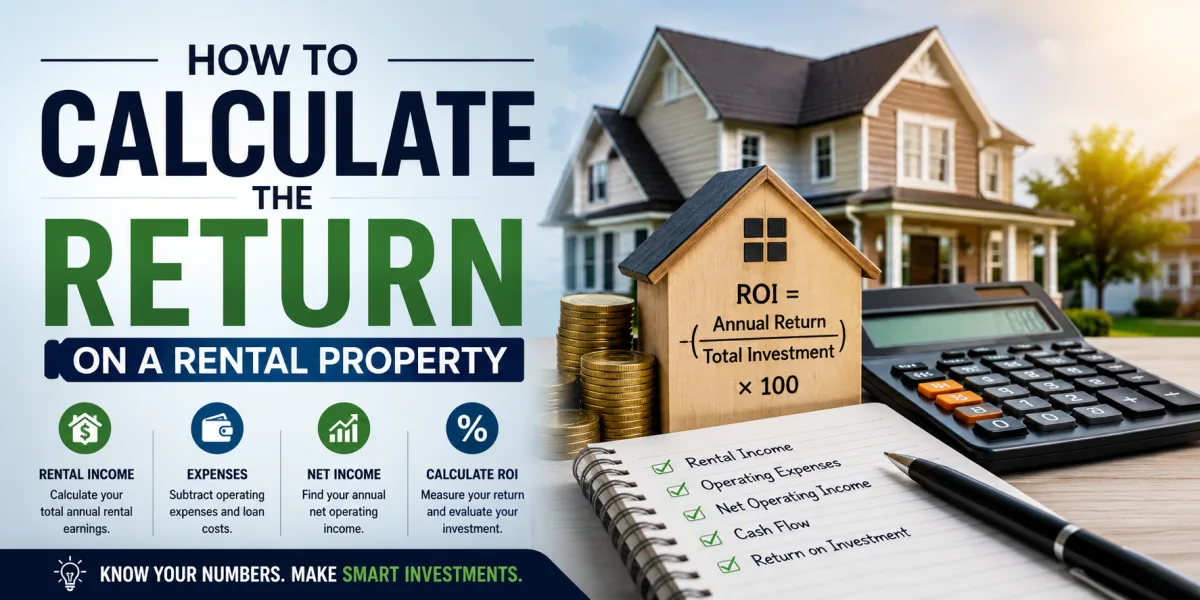
The Rental Return Equation: How to Know What a Property Is Really Earning
Rental property investing attracts people because the basic idea is easy to understand. Buy a property. Rent it to someone who needs a place to live or operate a business. Collect income. Pay the bills. Keep the difference. Over time, the property may rise in value while the loan balance falls. The investor builds wealth through rent, appreciation, and ownership.
That simple story is powerful, but it can also be misleading. Many rental properties look profitable before the numbers are examined carefully. A beginner may see a property renting for $1,500 per month and assume the investment is strong because the mortgage payment is only $1,100. On the surface, there appears to be $400 left over. But that quick calculation ignores vacancy, maintenance, insurance, property taxes, management, repairs, capital expenditures, legal costs, accounting, utilities, homeowner association fees, and the eventual replacement of major systems. It may also ignore the cash invested at purchase, the opportunity cost of that cash, and the risk that rent does not arrive on schedule.
Real rental property return is not measured by rent alone. It is measured by what remains after the property pays its true costs, carries its financing, survives uncertainty, and builds equity over time.
This matters because real estate has a way of making weak deals look strong. Unlike stocks, where market prices are visible every day, rental properties often feel stable because they are tangible. A building does not flash a red number on a screen when its value falls. A landlord may not notice underperformance immediately because rent arrives monthly and expenses arrive irregularly. A roof replacement, vacancy period, insurance increase, or major plumbing repair can reveal that the property was not as profitable as it seemed.
Calculating return properly protects the investor from illusion. It turns a property from a dream into a business. It separates gross income from net income, cash flow from profit, appreciation from speculation, and leverage from genuine value creation. It also allows investors to compare opportunities. A rental property can be compared with another rental property, a real estate investment trust, a bond, a stock portfolio, a business investment, or the choice to pay down debt.
The goal is not to make real estate feel complicated. The goal is to make it honest. A rental property can be a powerful wealth-building asset when bought well, financed prudently, and managed professionally. But the investor must know how to calculate what it is really earning.
The First Rule: Separate the Property From the Financing
The first principle in rental property analysis is to separate the property’s operating performance from the investor’s financing choice. This distinction is essential because a property can be strong but financed poorly, or weak but temporarily disguised by favorable financing.
The property itself produces rent and requires operating expenses. This gives us the property’s net operating income, often called NOI. Financing comes later. The mortgage, interest rate, down payment, loan term, and debt payments are choices attached to the property, but they are not part of the property’s operating income.
Why does this matter? Because two investors can buy the same property and experience different cash flow depending on financing. One may pay cash and have no mortgage payment. Another may use a 75 percent loan. A third may use short-term debt at a high interest rate. The property’s rent and operating expenses are the same, but the investors’ cash flow differs.
By separating operations from financing, the investor can answer two different questions. First: is this property economically attractive as a real estate asset? Second: does my financing structure make the investment attractive for me?
The first question is answered with measures such as net operating income and capitalization rate. The second question is answered with measures such as cash flow after debt service, cash-on-cash return, and total return on equity.
Beginners often blend these questions together and become confused. They may reject a good property because one loan quote produces weak cash flow, or they may accept a mediocre property because a low teaser rate makes the first-year payment look manageable. A disciplined investor evaluates the asset first and the financing second.
Start With Gross Rental Income
The calculation begins with gross rental income. This is the total rent the property could collect if fully occupied and paid on time. For a single-family rental, this may be one monthly rent multiplied by twelve. For a duplex, apartment building, or commercial property, it includes rent from all units or tenants.
For example, imagine a small rental property that can rent for $2,000 per month. The annual gross rental income is:
$2,000 × 12 = $24,000
This number is useful, but it is not the return. It is only the starting point. Gross rent is the most optimistic income figure because it assumes full occupancy and full payment. Real properties experience vacancy, turnover, late payments, concessions, and collection risk. A serious investor adjusts for those realities.
Some properties also produce other income. A multifamily building may charge for parking, laundry, storage, pet rent, utility reimbursements, application fees, or other services. These amounts can be included as additional income if they are realistic and recurring. However, beginners should avoid inflating income with uncertain fees or one-time charges. Conservative income assumptions protect the analysis.
The question to ask is not “What could this property earn under perfect conditions?” The better question is “What is this property likely to collect under normal conditions?”
Adjust for Vacancy and Credit Loss
Vacancy is the period when a property or unit is not rented. Credit loss refers to rent that is owed but not collected. These are real costs of owning rental property. Even strong rental markets experience turnover. Tenants move for jobs, family, affordability, or lifestyle changes. Units need cleaning, repairs, advertising, and time before a new tenant begins paying.
To account for vacancy, investors subtract a vacancy allowance from gross rental income. The appropriate allowance depends on the local market, property type, tenant quality, lease length, and historical experience. A common beginner mistake is assuming zero vacancy because the property is rented today. That is not analysis. That is optimism.
If the property has annual gross rent of $24,000 and the investor assumes 5 percent vacancy and credit loss, the calculation is:
$24,000 × 5% = $1,200
$24,000 - $1,200 = $22,800 effective rental income
Effective rental income is closer to reality than gross rent. It recognizes that ownership is not perfect. For some properties, 5 percent may be too low. Student rentals, short-term rentals, lower-quality properties, or weak markets may require higher vacancy assumptions. Long-term tenants in strong areas may experience lower vacancy, but the investor should still include a reserve.
Vacancy is especially important because it affects both income and expenses. During a vacancy, the owner may still pay utilities, cleaning, advertising, repairs, mortgage payments, insurance, property taxes, and management fees. A vacant property can turn from asset to expense quickly.
Subtract Operating Expenses
Operating expenses are the normal costs of running the property before mortgage payments. These costs include property taxes, insurance, repairs and maintenance, property management, utilities paid by the owner, landscaping, cleaning, pest control, legal and accounting fees, licensing, homeowner association fees, advertising, and supplies.
Operating expenses do not include mortgage principal and interest. They also usually exclude income taxes owed by the investor personally. The goal is to calculate how the property performs before financing.
Suppose the property has effective rental income of $22,800. Annual operating expenses might look like this:
Property taxes: $2,400
Insurance: $1,200
Repairs and maintenance: $1,800
Property management: $2,280
Owner-paid utilities: $600
Landscaping and cleaning: $500
Licensing, accounting, and miscellaneous: $400
Total operating expenses: $9,180
The exact numbers will differ by property and location. The principle is what matters: every recurring operating cost must be counted. If the owner plans to self-manage, it is still wise to include a management expense in the analysis. This keeps the numbers honest and recognizes that the owner’s time has value. It also protects the calculation if the owner later hires a manager.
Repairs and maintenance require special care. Beginners often use numbers that are too low because the property looks fine during the showing. But buildings age whether the investor budgets for it or not. Appliances fail. Plumbing leaks. Paint wears. Flooring damages. Doors, locks, gutters, drains, windows, heating systems, and cooling systems all need attention. A property with older systems needs a larger maintenance allowance than a newly renovated property, though new renovations can also hide poor workmanship.
Operating expenses should be based on evidence where possible: prior owner records, tax bills, insurance quotes, property manager estimates, inspection reports, local utility costs, and contractor input. When evidence is incomplete, the investor should use conservative estimates.
Calculate Net Operating Income
Net operating income, or NOI, is one of the most important rental property numbers. It measures income after vacancy and operating expenses, but before financing.
The formula is:
Net Operating Income = Effective Rental Income - Operating Expenses
Using the example:
Effective rental income: $22,800
Operating expenses: $9,180
NOI: $13,620
This means the property produces $13,620 per year before mortgage payments. NOI shows the earning power of the real estate itself. It is central to valuation because investors often value income-producing property based on the income it generates.
NOI is useful because it allows comparison between properties regardless of how they are financed. If two properties have the same price but one has higher NOI, the higher-NOI property may be more attractive, assuming similar risk and condition. If two properties have the same NOI but one is in a stronger location with better growth prospects, the investor may accept a lower initial yield. NOI begins the conversation but does not end it.
Beginners should be careful not to accept seller-provided NOI without checking the details. Sellers may understate expenses, exclude management, ignore vacancy, treat capital expenditures as unusual, or use future rent projections instead of current rent. A buyer should rebuild the NOI calculation independently.
Calculate the Capitalization Rate
The capitalization rate, or cap rate, measures the property’s net operating income as a percentage of its purchase price or market value. It shows the unleveraged income yield of the property before debt.
The formula is:
Cap Rate = Net Operating Income ÷ Property Value
If the property produces $13,620 in NOI and costs $200,000, the cap rate is:
$13,620 ÷ $200,000 = 6.81%
This means the property produces an unleveraged operating yield of 6.81 percent before financing. In simple terms, if an investor bought the property with cash and the numbers held true, the property would produce 6.81 percent before income taxes and before appreciation.
Cap rate is widely used because it helps compare income properties. A higher cap rate usually indicates higher income relative to price. But higher is not automatically better. A high cap rate may signal higher risk, weaker location, older property, lower tenant quality, limited growth, or difficult management. A low cap rate may reflect a prime location, stronger tenants, better growth expectations, lower risk, or investor overenthusiasm.
Cap rate should be interpreted in context. A 5 percent cap rate may be attractive in a growing, supply-constrained city with strong tenants and low financing costs. A 10 percent cap rate may be unattractive if the property is in a declining area, requires heavy repairs, or has unreliable rent. The number does not replace judgment.
Cap rate is also sensitive to NOI assumptions. If the investor underestimates expenses, the cap rate will look better than reality. This is why accurate NOI matters.
Calculate Debt Service
After evaluating the property’s operating performance, the investor must include financing. Debt service is the total mortgage payment required over a period, usually including principal and interest. Some mortgage payments also include taxes and insurance through escrow, but for analysis, taxes and insurance should already be counted as operating expenses. The investor must avoid double-counting.
Assume the investor buys the $200,000 property with a 25 percent down payment, or $50,000, and borrows $150,000. Suppose the annual principal and interest payments total $11,400.
Debt service: $11,400 per year
Debt service is not an operating expense in the NOI calculation, but it is essential for cash flow. A property can have positive NOI and still produce negative cash flow if the debt payment is too high. This is especially common when investors use high leverage, high interest rates, or short amortization periods.
Financing can change a deal dramatically. A property purchased with cash may produce steady income. The same property purchased with aggressive debt may produce little or no cash flow. This is why investors should test different financing scenarios before buying.
Calculate Cash Flow Before Tax
Cash flow before tax is the money left after operating expenses and debt service, before personal income taxes. It is one of the most practical numbers for a landlord because it shows whether the property puts cash in the owner’s pocket or requires support from other income.
The formula is:
Cash Flow Before Tax = Net Operating Income - Debt Service
Using the example:
NOI: $13,620
Debt service: $11,400
Cash flow before tax: $2,220
That equals $185 per month.
At first glance, positive cash flow is good. But the investor must ask whether $185 per month is enough compensation for the risks. A single repair can consume a year of cash flow. A one-month vacancy can erase profits. If the property has older systems or uncertain expenses, the margin may be too thin.
This is why cash flow should be viewed not only as a return measure but also as a safety measure. Strong cash flow gives the owner flexibility. Weak cash flow creates vulnerability. Negative cash flow may be acceptable for some investors if appreciation prospects are strong and reserves are deep, but beginners should be cautious. A property that requires monthly cash contributions can become stressful quickly.
Calculate Cash Invested
To calculate the return on the investor’s actual cash, the investor must know how much cash went into the deal. This is more than the down payment. Cash invested may include:
Down payment
Closing costs
Loan fees
Inspection fees
Appraisal fees
Legal fees
Initial repairs
Immediate renovations
Furnishing costs
Utility setup costs
Initial reserves dedicated to the property
Suppose the investor paid:
Down payment: $50,000
Closing costs: $5,000
Initial repairs: $7,000
Total cash invested: $62,000
Many beginners calculate return using only the down payment. That overstates performance. If closing costs and initial repairs were required to acquire and operate the property, they are part of the investment. Ignoring them makes the deal look better than it is.
Reserves require judgment. Some investors include initial reserves in cash invested because the money is tied to the property. Others track reserves separately because they remain cash. The important point is consistency. The investor should not pretend reserves are unnecessary.
Calculate Cash-on-Cash Return
Cash-on-cash return measures annual pre-tax cash flow divided by total cash invested. It tells the investor how much cash income the property generates relative to the cash put into the deal.
The formula is:
Cash-on-Cash Return = Annual Cash Flow Before Tax ÷ Total Cash Invested
Using the example:
Annual cash flow before tax: $2,220
Total cash invested: $62,000
Cash-on-cash return: $2,220 ÷ $62,000 = 3.58%
This is a more realistic return figure than simply comparing rent to mortgage payment. The property may have a 6.81 percent cap rate, but because of financing and cash invested, the cash-on-cash return is 3.58 percent before tax.
Is that good? It depends. A low cash-on-cash return may be acceptable if the property is in a strong growth market, has low risk, offers tax benefits, or is expected to appreciate. But if the property is management-intensive, older, risky, or unlikely to appreciate, 3.58 percent may not be enough.
Cash-on-cash return is useful because it focuses on actual cash invested and actual cash received. But it has limits. It does not include appreciation, debt paydown, tax effects, or changes in property value. It also uses one year of cash flow, which may not represent long-term performance. A property with low first-year cash flow may improve as rents rise. A property with strong first-year cash flow may weaken if repairs increase.
Cash-on-cash return is a practical measure, not a complete measure.
Calculate Debt Paydown
One of the hidden sources of rental property return is debt paydown. When a tenant’s rent helps cover the mortgage, part of each payment may reduce the loan principal. That principal reduction increases the owner’s equity.
Debt paydown is not the same as monthly cash flow. The owner does not receive it as spendable cash. It is wealth building inside the property. Over time, it can become significant.
Suppose the first year’s mortgage payments include $3,000 of principal repayment and $8,400 of interest. The $3,000 principal repayment increases the investor’s equity, assuming the property value does not fall. If rent funded the payment, the tenant effectively helped reduce the owner’s debt.
To include debt paydown in return, the investor can add principal reduction to annual cash flow as part of total return:
Cash flow before tax: $2,220
Principal paydown: $3,000
Cash flow plus paydown: $5,220
Return on cash invested before appreciation and tax:
$5,220 ÷ $62,000 = 8.42%
This gives a broader view than cash-on-cash return alone. However, the investor should remember that principal paydown is illiquid. It improves net worth, but it cannot be spent unless the property is sold, refinanced, or borrowed against.
Debt paydown grows over time on amortizing loans because a larger share of each payment goes toward principal in later years. This is one reason long-term property ownership can quietly build wealth even when early cash flow is modest.
Calculate Appreciation
Appreciation is the increase in property value over time. It can come from market growth, inflation, neighborhood improvement, rental growth, renovations, scarcity, or better management. Appreciation can be a major part of real estate returns, especially in strong markets.
Suppose the $200,000 property rises in value by 3 percent during the first year. The appreciation is:
$200,000 × 3% = $6,000
If the investor adds appreciation to cash flow and debt paydown, the total pre-tax return looks like this:
Cash flow: $2,220
Principal paydown: $3,000
Appreciation: $6,000
Total return before tax and selling costs: $11,220
Total return on cash invested:
$11,220 ÷ $62,000 = 18.10%
This looks much stronger than the cash-on-cash return. But appreciation requires caution. Unlike rent collected or principal paid down, appreciation is not certain. It is an estimate until the property is sold or refinanced. Property values can stagnate or decline. Selling also involves costs, such as agent commissions, transfer taxes, repairs, concessions, legal fees, and potential taxes.
Beginners should avoid making a deal work only because appreciation assumptions are aggressive. Appreciation is valuable upside, but relying on it too heavily turns the investment into speculation. A safer approach is to buy a property that makes sense based on current or conservatively projected income, with appreciation as an additional benefit.
Calculate Total Return
Total return combines the major sources of rental property wealth: cash flow, principal paydown, appreciation, and sometimes tax benefits. A simplified pre-tax total return formula is:
Total Return = Cash Flow + Principal Paydown + Appreciation
Total Return Percentage = Total Return ÷ Cash Invested
Using the example:
Cash flow: $2,220
Principal paydown: $3,000
Appreciation: $6,000
Total return: $11,220
Cash invested: $62,000
Total return percentage: 18.10%
This figure gives a fuller picture than cash flow alone. It shows why rental property can build wealth even when monthly cash flow is modest. But it also introduces estimates. Cash flow can be measured. Principal paydown can be measured. Appreciation is uncertain until realized. Tax benefits depend on the investor’s circumstances and local law.
A disciplined investor may calculate several versions of total return:
Current return excluding appreciation
Total return with conservative appreciation
Total return with no appreciation
Total return under stress conditions
This prevents the investor from relying on only one optimistic scenario.
Calculate Return on Equity
Return on equity measures how much return the property generates relative to the investor’s current equity, not just the original cash invested. This becomes important over time.
Suppose after several years the property is worth $260,000 and the loan balance has fallen to $130,000. The investor’s equity is roughly:
$260,000 - $130,000 = $130,000
If the property produces $5,000 in annual cash flow and $4,000 in principal paydown, excluding appreciation, it generates $9,000 in annual return before tax and appreciation.
Return on equity:
$9,000 ÷ $130,000 = 6.92%
This matters because a property can become less efficient as equity grows. Imagine the same property has appreciated significantly but rent has not kept pace. The investor may have a large amount of equity earning a modest return. In that case, the investor might consider refinancing, improving rents, selling, or holding for stability, depending on goals and taxes.
Return on equity helps investors avoid emotional attachment. A property that was an excellent investment at purchase may become a mediocre use of capital later. That does not mean it must be sold. It means the owner should understand what the equity is earning.
Calculate Break-Even Occupancy
Break-even occupancy shows how much of the property must be rented to cover operating expenses and debt service. This is especially useful for multifamily or commercial properties, but the concept also applies to single-family rentals.
The formula is:
Break-Even Occupancy = Operating Expenses + Debt Service ÷ Gross Potential Income
Using the example:
Operating expenses: $9,180
Debt service: $11,400
Total required: $20,580
Gross potential income: $24,000
Break-even occupancy: $20,580 ÷ $24,000 = 85.75%
This means the property needs to collect about 85.75 percent of its potential rent to break even before tax. If vacancy or nonpayment exceeds that cushion, the owner may need to contribute cash.
A lower break-even occupancy provides more safety. A property that breaks even at 65 percent occupancy can survive more stress than one that breaks even at 95 percent. Beginners should pay attention to this measure because it reveals fragility.
Calculate the Debt Service Coverage Ratio
The debt service coverage ratio, or DSCR, measures how well the property’s net operating income covers debt payments. Lenders often use it to assess income-producing property loans.
The formula is:
DSCR = Net Operating Income ÷ Debt Service
Using the example:
NOI: $13,620
Debt service: $11,400
DSCR: 1.19
A DSCR of 1.19 means the property produces 19 percent more NOI than needed to cover debt service. A DSCR below 1.0 means NOI is not enough to cover debt payments. The higher the DSCR, the more cushion the property has.
Different lenders and investors have different standards, but beginners should understand the concept. A thin DSCR means small changes in rent or expenses can create negative cash flow. A stronger DSCR provides protection.
Include Capital Expenditures
Capital expenditures, often called capex, are major costs that extend the useful life of the property or replace significant components. Examples include roofs, heating and cooling systems, plumbing lines, electrical upgrades, major appliances, exterior painting, flooring replacement, parking areas, windows, and structural repairs.
Capex is easy to ignore because it does not occur every month. But ignoring it is one of the most common ways investors overstate returns. A property may produce $3,000 per year in cash flow for five years, then require a $15,000 roof. If the owner did not reserve for that roof, the earlier cash flow was partly an illusion.
Investors should include a capex reserve in their analysis. The appropriate amount depends on property age, condition, climate, construction quality, tenant use, and inspection findings. A newer property may require less immediate capex, while an older property with aging systems requires more.
Some investors separate ordinary repairs from capex. Ordinary repairs maintain the property in current condition. Capex replaces major components or improves the property. For return analysis, both matter because both consume cash over time.
A conservative investor treats capex as inevitable, not exceptional.
Account for Taxes Carefully
Taxes can significantly affect rental property return. Rental income, deductible expenses, depreciation, mortgage interest, capital gains, and local property taxes all matter. Rules vary by jurisdiction, and investors should consult qualified tax professionals.
For analysis, it is useful to distinguish between pre-tax and after-tax return. Pre-tax return helps compare property economics before personal tax circumstances. After-tax return shows what the investor actually keeps.
Rental property may offer deductions for operating expenses. In some jurisdictions, depreciation allows the owner to deduct a portion of the building’s value over time, even if the property is not losing market value. This can reduce taxable income. However, depreciation may have consequences when the property is sold. Tax benefits are valuable, but they should not be treated as free money.
Beginners should avoid buying property solely for tax advantages. A property that loses money before tax is not automatically good because it creates deductions. The investment should make economic sense first.
Use a Conservative Example From Start to Finish
Consider a rental property purchased for $250,000. The investor puts down 25 percent, or $62,500. Closing costs are $6,000, and initial repairs are $8,500. Total cash invested is $77,000.
The property rents for $2,400 per month, or $28,800 per year. The investor assumes 6 percent vacancy and credit loss:
$28,800 × 6% = $1,728
Effective rental income:
$28,800 - $1,728 = $27,072
Annual operating expenses are estimated as:
Property taxes: $3,200
Insurance: $1,500
Repairs and maintenance: $2,000
Capex reserve: $2,000
Property management: $2,707
Owner-paid utilities and miscellaneous: $900
Total operating expenses: $12,307
NOI:
$27,072 - $12,307 = $14,765
Cap rate:
$14,765 ÷ $250,000 = 5.91%
The investor borrows $187,500. Annual principal and interest payments are $13,800.
Cash flow before tax:
$14,765 - $13,800 = $965
Monthly cash flow:
$965 ÷ 12 = $80.42
Cash-on-cash return:
$965 ÷ $77,000 = 1.25%
First-year principal paydown is $3,500.
Return including cash flow and debt paydown:
$965 + $3,500 = $4,465
$4,465 ÷ $77,000 = 5.80%
If the property appreciates 3 percent, appreciation is:
$250,000 × 3% = $7,500
Total return before tax and selling costs:
$965 + $3,500 + $7,500 = $11,965
Total return percentage:
$11,965 ÷ $77,000 = 15.54%
This example teaches an important lesson. The property’s cash-on-cash return is weak at 1.25 percent. But total return may look strong if appreciation occurs. The investor must decide whether the low cash flow provides enough safety. If appreciation does not happen, the return is far less exciting. If a major repair exceeds the reserve, cash flow may turn negative. If rents rise over time, returns may improve.
The calculation does not give a simple yes or no. It gives the investor the truth needed to make a judgment.
Stress-Test the Return
A rental property should be tested under unfavorable conditions before purchase. This is where many weak deals are exposed.
Ask what happens if rent is 5 percent lower than expected. What if vacancy is 10 percent instead of 5 percent? What if insurance rises 20 percent? What if property taxes increase after purchase? What if the first-year repair budget doubles? What if interest rates are higher when refinancing is needed? What if the property sits vacant for two months?
Using only the base case is dangerous because the base case often reflects what the investor hopes will happen. A stress test asks what could reasonably go wrong. The purpose is not to become pessimistic. It is to avoid fragility.
A strong deal can survive imperfect conditions. A weak deal requires everything to go right. Beginners should prefer deals with margin of safety, even if the headline return is less dramatic.
Compare Return With Risk
A rental property return is only meaningful when compared with risk. A 10 percent return from a stable property in a strong location with reliable tenants is not the same as a 10 percent return from an aging property in a declining area with high vacancy. The number may be identical, but the quality of return differs.
Investors should consider location risk, tenant risk, financing risk, repair risk, legal risk, liquidity risk, management intensity, and concentration risk. A property that consumes significant time should produce enough return to justify that time. A property that uses high leverage should offer enough reward and cushion to justify the debt.
Comparison also matters outside real estate. If a rental property produces a low return with high effort, the investor should compare it with REITs, diversified stock funds, bonds, debt repayment, or business investment. Real estate is not automatically superior because it is tangible. Tangibility does not guarantee return.
Common Mistakes That Make Returns Look Better Than They Are
The first mistake is using gross rent instead of net income. Rent is not profit. A property’s true earning power appears only after vacancy and expenses.
The second mistake is ignoring property management. Even if the owner self-manages, time has value. A return that depends on free labor is not fully honest.
The third mistake is underestimating repairs. Every building ages. Maintenance should be expected, not treated as a surprise.
The fourth mistake is excluding capital expenditures. Major replacements are part of ownership. A roof is not an unusual event in the life of a building. It is a scheduled reality with uncertain timing.
The fifth mistake is calculating return only on the down payment. Closing costs, repairs, and required reserves are part of the investment decision.
The sixth mistake is counting appreciation too confidently. Appreciation can create wealth, but it is not guaranteed. A deal that only works with strong appreciation is speculative.
The seventh mistake is ignoring selling costs. A property’s estimated value is not the same as net proceeds after sale costs and taxes.
The eighth mistake is forgetting taxes. Tax treatment can improve or reduce returns. Investors should understand after-tax results.
The ninth mistake is failing to update calculations. Property return changes over time as rents, expenses, values, debt balances, and equity change.
The tenth mistake is comparing leveraged real estate returns with unleveraged investments without adjusting for risk. Leverage can magnify returns, but it also magnifies loss and pressure.
When a Low Return May Still Make Sense
A low current return is not always a reason to reject a rental property. Some properties produce modest cash flow today but offer strong long-term prospects. A high-quality property in a supply-constrained area may appreciate steadily. A property near expanding infrastructure may benefit from future demand. A lightly rented property may have below-market rents that can be raised legally and ethically over time. A property with unused space may offer value-add potential.
But the investor must be clear about the reason. “The return is low, but I hope prices rise” is not enough. A stronger thesis would identify specific drivers: population growth, wage growth, limited supply, transport improvements, zoning constraints, renovation potential, or operational improvements.
The investor must also have enough financial strength to hold through the low-return period. A low cash-flow property can become dangerous if the owner lacks reserves. Long-term upside does not pay this month’s mortgage.
When a High Return May Be a Warning
A high projected return can be attractive, but it should trigger deeper due diligence. Why is the return high? Is the property in poor condition? Is the neighborhood risky? Are tenants unreliable? Are rents overstated? Are expenses understated? Is the seller hiding problems? Is the local economy weakening? Is financing unusually expensive? Are there legal restrictions?
In real estate, high yield often comes with high management intensity. A property may look excellent on a spreadsheet but require constant attention, difficult tenant situations, frequent repairs, or legal challenges. The investor must decide whether the higher return compensates for the added risk and work.
There is no universal “good” rental return. A good return is one that compensates fairly for the risk, effort, capital, illiquidity, and opportunity cost involved.
Build a Personal Rental Return Dashboard
Every rental property investor should track a few core metrics regularly. These include gross rent, effective rent after vacancy, operating expenses, NOI, cap rate based on current value, debt service, cash flow, cash-on-cash return, principal paydown, estimated equity, return on equity, repair reserves, and cash reserves.
This dashboard should be updated at least annually. Real estate is not a set-and-forget investment. Taxes rise. Insurance changes. Rents change. Property values change. Loan balances fall. Repairs occur. A property that was once excellent may become average. A property that began modestly may improve dramatically.
Tracking also helps with decision-making. Should the owner raise rent? Refinance? Sell? Renovate? Hire management? Pay down debt? Buy another property? Without current numbers, these decisions become emotional.
Professional investors measure performance. Beginners who adopt that habit early become more professional in their thinking.
Final Thought
Calculating the return on a rental property is not about finding one perfect number. It is about understanding the layers of return. Gross rent shows potential income. Effective income adjusts for vacancy. Net operating income shows property performance. Cap rate shows unleveraged yield. Cash flow shows monthly breathing room. Cash-on-cash return shows income on invested cash. Principal paydown shows equity growth. Appreciation shows potential market gain. Total return combines the major wealth drivers. Return on equity shows how efficiently capital is working over time.
Each metric tells part of the story. None tells the whole story alone.
The serious investor uses these numbers to avoid illusion. They do not buy because rent sounds high. They do not trust a seller’s optimistic spreadsheet. They do not ignore repairs because the paint looks fresh. They do not assume appreciation will rescue a weak deal. They calculate, stress-test, compare, and decide.
Rental property can be one of the most powerful wealth-building tools available to ordinary investors. It can turn disciplined saving into ownership, tenant rent into debt repayment, inflation into rising income, and time into equity. But it rewards those who respect the math.
The property does not care what the investor hopes to earn. It will produce what the numbers, market, management, financing, and condition allow. Learning to calculate return is learning to see the property clearly. And in real estate, clear vision is often the difference between owning an asset and buying a burden.
 Article
 Article
 Article
 Article
 Article
 Article
 Article
 Article