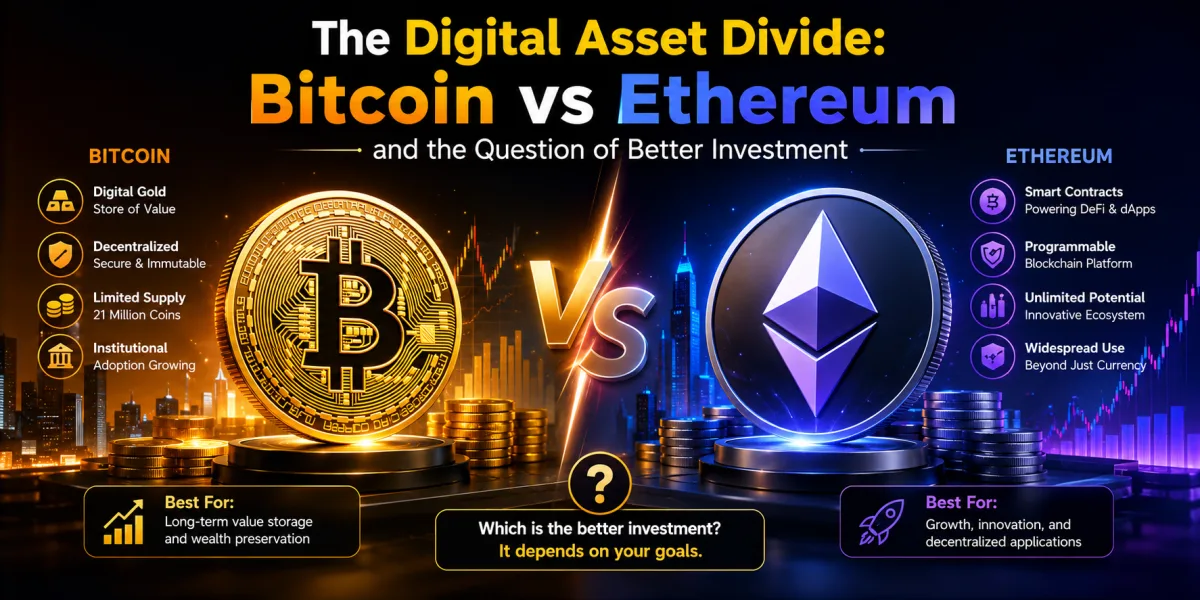
The Digital Asset Divide: Bitcoin vs Ethereum and the Question of Better Investment
Bitcoin and Ethereum are often mentioned together, but they are not the same investment.
They both belong to the crypto market. They both trade globally. They both move with digital asset sentiment. They both attract speculation, institutional attention, regulatory debate, developer interest, and sharp volatility. To a beginner, they can look like two versions of the same thing: large cryptocurrencies with famous names and unpredictable prices.
That is a dangerous oversimplification.
Bitcoin is primarily an investment in digital scarcity. Ethereum is primarily an investment in programmable blockchain infrastructure. Bitcoin asks whether the world will continue to value a decentralized, fixed-supply digital asset. Ethereum asks whether decentralized applications, tokenized assets, stablecoins, smart contracts, and blockchain-based financial systems will continue to use Ethereum as a core settlement and execution layer.
The difference matters because investment returns come from different beliefs. A Bitcoin investor is often betting on monetary credibility, scarcity, institutional adoption, and long-term store-of-value demand. An Ethereum investor is often betting on network activity, developer ecosystems, application growth, staking economics, scaling, and the usefulness of smart contracts.
One is simpler to understand. The other may have broader utility. One has a clearer supply story. The other has more moving parts. One is often treated as the reserve asset of crypto. The other is closer to a decentralized computing and financial infrastructure bet.
That does not make one automatically better. It means the answer depends on what kind of risk an investor wants to take.
As of mid-July 2026, Bitcoin remained the largest crypto asset by market value, with CoinMarketCap showing Bitcoin near $63,000 and a market capitalization of roughly $1.26 trillion, while Ethereum remained the second-largest asset, with recent market capitalization estimates around the low hundreds of billions. Those rankings confirm that Bitcoin and Ethereum dominate the digital asset market, but they do not answer the investment question. Size is not the same as superiority. A larger asset can be more mature and resilient. A smaller asset can have more upside but more risk.
The better question is not, “Which coin will rise more next month?” The better question is, “Which asset has the stronger investment case for my goals, risk tolerance, time horizon, and portfolio?”
Bitcoin’s Investment Case: Digital Scarcity
Bitcoin’s strongest investment argument begins with its supply.
Bitcoin has a maximum supply of 21 million coins. That hard cap is written into the protocol, and new bitcoin are issued through mining rewards that decline over time through scheduled halvings. Ethereum.org’s comparison of Bitcoin and Ethereum notes that Bitcoin’s supply will cap at 21 million coins and that this fixed limit is one reason Bitcoin is often compared to gold.
This scarcity narrative is powerful because most forms of money are not scarce in the same way. Governments can expand fiat currency supply. Companies can issue new shares. Gold supply can increase through mining, although slowly. Bitcoin’s issuance schedule is transparent and difficult to change because the network’s participants would need to accept such a change.
That does not mean Bitcoin must rise forever. Scarcity alone does not create value. A scarce asset still needs demand. But Bitcoin’s supply design gives investors a simple thesis: if more people, institutions, companies, funds, or governments want exposure to a fixed-supply digital asset, the price may rise because supply cannot expand to meet demand in the traditional way.
Bitcoin also benefits from simplicity. It does not try to be everything. Its core purpose is not to host thousands of applications or redesign corporate software. It is a decentralized digital asset with a long operating history, high liquidity, strong brand recognition, and a monetary narrative that is relatively easy to explain.
That simplicity is a strength for investors who want crypto exposure without betting on the success of specific applications, developers, decentralized finance platforms, or smart contract use cases. Bitcoin’s question is narrow: will the world continue to value Bitcoin as a scarce, censorship-resistant, non-sovereign digital asset?
The narrowness can also be a limitation. Bitcoin does not generate cash flow. It does not pay dividends. It does not represent ownership in a productive company. Its value depends on market demand, adoption, liquidity, trust, and the belief that its scarcity will remain economically meaningful.
For investors, Bitcoin is closer to a monetary asset than a technology platform equity. It is not a claim on a business. It is a claim on a digital asset with a fixed supply and a global market.
Ethereum’s Investment Case: Programmable Infrastructure
Ethereum’s investment case is broader and more complicated.
Ethereum is a blockchain platform that allows developers to build decentralized applications, issue tokens, create smart contracts, run decentralized finance protocols, support stablecoin transfers, experiment with digital ownership, and build blockchain-based systems. Ether, the network’s native asset, is used to pay transaction fees and participate in staking.
This gives Ethereum a different kind of investment logic. Its value depends not only on scarcity or brand, but on use. If Ethereum becomes a major settlement layer for digital finance, tokenized assets, stablecoins, decentralized applications, and institutional blockchain activity, demand for ETH could benefit. If users and developers migrate elsewhere, Ethereum’s investment case weakens.
Ethereum also changed its underlying consensus system. Ethereum switched to proof of stake in 2022, and Ethereum.org says the change was made because proof of stake is more secure, less energy-intensive, and better for implementing new scaling solutions than the prior proof-of-work design. Under proof of stake, validators secure the network by staking ETH rather than mining with energy-intensive hardware.
That shift created a major difference between Ethereum and Bitcoin. Bitcoin’s investment case is tied to proof-of-work mining and fixed issuance. Ethereum’s investment case includes staking, network fees, scaling upgrades, validator economics, and changing supply dynamics. Ethereum can be more adaptive, but that adaptability also introduces more complexity.
Ethereum’s strongest argument is utility. If Bitcoin is digital gold, Ethereum is closer to digital infrastructure. It is the platform on which many crypto experiments have been built. Stablecoins, decentralized exchanges, lending protocols, NFT markets, tokenized assets, and layer-two scaling networks have often centered around Ethereum or Ethereum-compatible environments.
The weakness is that infrastructure bets are competitive. Ethereum faces competition from other smart contract platforms, layer-two networks, alternative execution environments, centralized financial platforms, and future technologies. Ethereum can win a large share of blockchain activity and still disappoint investors if growth is slower than expected, fees decline, regulation limits activity, or competing systems capture value.
Ethereum is not merely “Bitcoin with more features.” It is a different bet.
The Supply Difference
Bitcoin’s supply policy is easier to explain. There will only ever be 21 million bitcoin. New supply declines over time. That fixed cap is central to the investment narrative.
Ethereum’s supply is more complex. ETH does not have the same hard 21 million cap. Its supply dynamics depend on issuance to validators, transaction fee burning, network activity, staking participation, and protocol design. At times, Ethereum can experience lower net issuance or even deflationary periods if enough fees are burned. At other times, net supply can increase.
This makes Bitcoin cleaner for investors seeking monetary scarcity. It also makes Ethereum more economically nuanced. Ethereum’s value may be influenced by how much the network is used and how fees flow through the system. In theory, more network activity can create more demand for ETH and affect supply through fee burning. In practice, the relationship is complicated by scaling, layer-two activity, transaction costs, and user behavior.
A beginner can understand Bitcoin’s supply story in one sentence. Ethereum’s supply story requires a discussion of staking, issuance, fee burning, network usage, and protocol upgrades.
That does not mean Ethereum is inferior. It means Ethereum asks more of the investor. A person buying ETH should understand that the investment case is not only “limited supply.” It is “network utility plus economic design plus adoption.”
The Utility Difference
Bitcoin’s utility is monetary. It is used as a store-of-value asset, settlement asset, collateral in some contexts, and transfer mechanism. Its strongest identity is not as an application platform but as a decentralized digital monetary network.
Ethereum’s utility is computational and financial. It supports smart contracts, decentralized applications, decentralized exchanges, stablecoins, token issuance, staking, and programmable financial activity. This gives Ethereum more visible network activity than Bitcoin in many application categories.
The investment trade-off is important. Bitcoin’s limited utility can make it easier to value narratively: it either succeeds as digital scarcity or it does not. Ethereum’s broader utility gives it more ways to grow, but also more ways to disappoint.
A simple analogy is land versus a city operating system. Bitcoin is like scarce land with a powerful cultural and monetary story. Ethereum is like an infrastructure network where many builders can create businesses, markets, and applications. Scarce land can be valuable even if it does not produce much activity. Infrastructure can be very valuable if many people use it, but it must keep attracting users and developers.
Bitcoin’s investment case is less dependent on daily application usage. Ethereum’s investment case is more dependent on whether meaningful activity continues to happen on or around the Ethereum ecosystem.
Institutional Adoption
Both Bitcoin and Ethereum have benefited from institutional acceptance, but Bitcoin has usually led.
Bitcoin’s narrative is easier for institutions to package. It is the largest crypto asset, has the longest track record, has a fixed supply, and is often framed as digital gold. The introduction of U.S. spot Bitcoin exchange-traded products strengthened the institutional access channel, making it easier for traditional investors to gain exposure without directly managing wallets or exchanges.
Ethereum also gained institutional access through spot Ethereum products, but its case is more complex. Investors must understand not only ETH price exposure but also staking, network activity, decentralized applications, regulatory treatment, and whether exchange-traded products fully capture Ethereum’s economics if they do not include staking yield.
Institutional momentum toward digital assets continues to expand. Reuters reported on July 16, 2026, that Citadel Securities invested $400 million in Crypto.com at a $20 billion valuation, describing it as part of a broader convergence between traditional finance and digital assets driven by institutional demand, regulatory clarity, and tokenized assets. Barron’s also reported that Morgan Stanley’s E*Trade launched crypto trading for eligible clients, including Bitcoin and Ethereum, through a partnership with zerohash.
This does not mean institutions guarantee higher prices. Institutions can buy, sell, hedge, arbitrage, and reduce exposure. But institutional access can improve liquidity, legitimacy, and market depth. Bitcoin has benefited most clearly from this trend because it is easier to present as the core crypto allocation. Ethereum may benefit as institutions grow more comfortable with tokenization, smart contracts, and on-chain settlement.
For investors, the institutional adoption question can be summarized this way: Bitcoin is the clearer institutional store-of-value asset; Ethereum is the broader institutional infrastructure bet.
Volatility and Risk
Both Bitcoin and Ethereum are volatile. Neither should be treated like a savings account, bond, or stable cash reserve.
Crypto markets can move sharply because they trade continuously, respond quickly to liquidity shifts, rely heavily on sentiment, and remain smaller than traditional asset markets. A change in interest-rate expectations, regulation, exchange risk, ETF flows, security concerns, or geopolitical stress can move prices quickly.
A 2025 study comparing Bitcoin and Ethereum return behavior found that both assets exhibit heavy-tailed returns, but Ethereum showed a greater frequency of extreme values than would be expected under its Bitcoin-modeled counterpart, indicating more pronounced tail risk. This aligns with a common market intuition: Ethereum can offer more upside tied to growth and utility, but it may also carry more extreme downside behavior.
This does not mean Bitcoin is safe. Bitcoin can lose large percentages of value. It can spend years below prior highs. It can fall during liquidity shocks. It can be affected by regulation, exchange failures, custody issues, macroeconomic conditions, and shifts in investor appetite.
Ethereum adds additional layers of risk: smart contract ecosystem risk, competition risk, protocol change risk, staking risk, layer-two value capture risk, regulatory interpretation, and application demand risk. Its flexibility is a strength, but flexibility creates complexity.
For risk-averse crypto investors, Bitcoin is often the cleaner starting point. For investors willing to accept more complexity in pursuit of potentially higher ecosystem-driven growth, Ethereum may be more attractive.
Bitcoin’s Strengths as an Investment
Bitcoin’s first strength is clarity. Investors understand the basic idea: a fixed-supply digital asset with a long track record and a global market.
The second strength is brand. Bitcoin is the name most people recognize first. In crypto, brand and trust matter because the market is crowded with thousands of assets, many of which will not survive.
The third strength is liquidity. Bitcoin usually has the deepest liquidity in the crypto market. That matters for large investors and for market resilience.
The fourth strength is institutional acceptance. Traditional finance has generally been more comfortable introducing Bitcoin exposure first because its investment thesis is simpler.
The fifth strength is monetary neutrality. Bitcoin is not controlled by one company, government, foundation, or development team in the way many crypto projects are. That decentralized identity is central to its appeal.
The sixth strength is supply discipline. The 21 million cap is one of the most powerful narratives in digital assets.
Bitcoin’s weakness is that its investment case depends heavily on belief in its monetary role. If the world loses interest in Bitcoin as digital scarcity, there is not a large application ecosystem to fall back on. Bitcoin is intentionally narrow. Investors must decide whether that narrowness is elegance or limitation.
Ethereum’s Strengths as an Investment
Ethereum’s first strength is utility. It is used as infrastructure for smart contracts, decentralized finance, stablecoins, token issuance, and blockchain applications.
The second strength is developer activity. Ethereum has historically attracted one of the strongest developer ecosystems in crypto. Developers matter because they build the applications and tools that create network value.
The third strength is adaptability. Ethereum has already undergone major upgrades, including the shift to proof of stake. This ability to evolve may help it respond to scaling, energy, and usability challenges.
The fourth strength is staking. ETH holders can participate in securing the network and may earn staking rewards, although staking comes with risks and may not be equally accessible through all investment vehicles.
The fifth strength is exposure to broader crypto activity. If tokenization, stablecoins, decentralized finance, and on-chain settlement grow, Ethereum may benefit from being a major platform for that activity.
Ethereum’s weakness is complexity. It has more competitors, more technical dependencies, more regulatory questions, and more uncertainty about where value ultimately accrues. Layer-two networks may increase Ethereum’s scale but can also complicate the relationship between network usage and ETH value. Lower transaction fees may help users but reduce certain fee-based economic effects. Competing blockchains can attract developers and users.
Ethereum is a bigger idea than Bitcoin in some ways. Bigger ideas often carry bigger execution risk.
Which Has the Better Risk-Adjusted Case?
Risk-adjusted return is not about which asset can rise more. It is about whether the expected return justifies the risk taken.
Bitcoin may have the stronger risk-adjusted case for investors who want crypto exposure with the clearest thesis, deepest liquidity, and least complexity. It is still highly risky, but its investment case is easier to monitor. Has institutional demand grown? Is Bitcoin still the dominant crypto store-of-value asset? Is the network secure? Is the fixed-supply thesis intact? Are more investors using Bitcoin as a long-term allocation?
Ethereum may have the stronger upside case for investors who believe blockchain infrastructure will become more widely used and that Ethereum will remain a leading platform. Its market value has often been smaller than Bitcoin’s, which can create more room for upside if adoption accelerates. But it also has more moving parts, more competition, and historically more pronounced extreme return behavior.
For conservative crypto investors, Bitcoin often deserves the larger allocation. For growth-oriented crypto investors, Ethereum can be a meaningful complement. For speculative investors, Ethereum’s ecosystem may offer more excitement, but excitement is not the same as safety.
The better investment depends on the investor’s thesis. If the thesis is digital scarcity, Bitcoin is the cleaner choice. If the thesis is programmable blockchain infrastructure, Ethereum is the more direct choice.
Should Investors Own Both?
Many investors do not need to choose only one.
Owning both Bitcoin and Ethereum can make sense because they express different crypto theses. Bitcoin provides exposure to digital scarcity and monetary adoption. Ethereum provides exposure to smart contract infrastructure and on-chain application growth.
A simple crypto allocation might place most crypto exposure in Bitcoin and a smaller portion in Ethereum. Some institutional-style frameworks have historically favored Bitcoin as the foundation and Ethereum as a growth complement, though exact allocations vary widely by investor. The logic is straightforward: Bitcoin may provide the core crypto store-of-value exposure, while Ethereum adds infrastructure upside.
For example, a cautious investor who chooses to allocate 5% of a portfolio to crypto might put 3.5% in Bitcoin and 1.5% in Ethereum. A more growth-oriented investor might split more evenly. A technology-focused investor might overweight Ethereum. A monetary-scarcity investor might own only Bitcoin.
The allocation should be intentional. Owning both is not automatically diversification if both assets fall during crypto sell-offs. Bitcoin and Ethereum can be highly correlated during market stress. But they are different enough in thesis that owning both can reduce dependence on one narrative.
The important rule is that crypto itself should usually remain a measured allocation within a broader financial plan. A diversified crypto basket is still crypto risk.
When Bitcoin May Be the Better Investment
Bitcoin may be the better investment for an investor who wants the simplest and most established crypto exposure.
It may fit someone who believes in fixed supply, digital scarcity, institutional adoption, and Bitcoin’s role as the reserve asset of crypto. It may also fit someone who does not want to evaluate smart contract competition, staking mechanics, decentralized finance protocols, or developer activity.
Bitcoin may be better for investors who value durability over complexity. Its core thesis has changed less than Ethereum’s. It is not trying to reinvent itself frequently. Its predictability is part of the appeal.
Bitcoin may also be better for investors who are new to crypto and want to learn slowly. It is easier to understand why Bitcoin exists than to evaluate the full Ethereum ecosystem. A beginner can build knowledge around Bitcoin before deciding whether Ethereum’s additional complexity is worth taking on.
Bitcoin is not low risk. It is simply the cleaner risk.
When Ethereum May Be the Better Investment
Ethereum may be the better investment for an investor who believes blockchain technology will be used for more than store-of-value speculation.
It may fit someone who believes decentralized finance, stablecoins, tokenized assets, smart contracts, gaming economies, digital identity, and on-chain settlement will grow over time. It may also fit someone who wants exposure to the developer ecosystem that has historically made Ethereum one of crypto’s most important platforms.
Ethereum may be better for investors willing to study technology and accept complexity. Understanding Ethereum requires attention to staking, scaling, fees, layer-two networks, competing chains, application activity, validator economics, and protocol upgrades.
Ethereum may also appeal to investors who want an asset with a broader utility story. If Bitcoin is mainly about what it is, Ethereum is about what can be built on it.
The risk is that broader utility does not automatically translate into better investment returns. A network can be useful while value accrues elsewhere. Applications, layer-two networks, competing chains, or centralized platforms can capture some of the economic benefit. Ethereum investors must watch not only adoption, but value capture.
The ETF and Custody Question
Investors can access Bitcoin and Ethereum in several ways: direct ownership through exchanges and wallets, exchange-traded products where available, funds, trusts, or companies with crypto exposure.
Direct ownership gives investors control over the asset but requires custody knowledge. A mistake with a private key, seed phrase, wallet address, or scam link can be costly. Exchange-traded products can simplify exposure inside brokerage accounts, but they introduce fund fees, tracking considerations, and sometimes do not provide the same economic features as direct ownership.
For Ethereum, staking is especially important. Direct ETH holders may be able to stake, depending on their method and jurisdiction. Some exchange-traded products may not include staking rewards, or staking features may depend on regulatory approvals and product structure. That can affect the investment comparison.
An investor comparing Bitcoin and Ethereum should compare access method as well as asset thesis. Direct BTC versus direct ETH is one comparison. Bitcoin ETF versus Ethereum ETF without staking may be another. Holding assets on an exchange versus using self-custody introduces different risks.
The best asset can become a poor investment if held through an unsuitable structure.
Regulatory Risk
Regulation affects both Bitcoin and Ethereum, but not always in the same way.
Bitcoin’s regulatory classification has generally been clearer in many markets because it is more commonly treated as a commodity-like digital asset. Ethereum has faced more complex questions because of staking, token issuance, decentralized applications, and its role in broader crypto infrastructure.
Regulation can affect exchanges, custody, stablecoins, decentralized finance, staking, taxation, reporting, anti-money-laundering rules, investor access, and institutional adoption. A favorable regulatory environment can improve confidence and capital flows. A restrictive environment can reduce liquidity and utility.
Investors should not assume regulation is only a threat. Clear rules can help institutions participate. But regulation can also change the economics of certain activities. For Ethereum, regulation of staking, decentralized finance, stablecoins, and tokenized assets may be especially relevant. For Bitcoin, regulation of custody, ETFs, mining, taxation, and exchange access matters.
The key is to avoid investing as if the legal environment is static. Crypto is still young enough that regulation remains part of the investment risk.
Energy and Environmental Considerations
Bitcoin uses proof-of-work mining. This requires energy. Supporters argue that Bitcoin mining can use stranded energy, support grid balancing in some contexts, or create demand for renewable energy. Critics argue that proof-of-work consumes too much electricity and creates environmental costs.
Ethereum moved away from proof of work and now uses proof of stake. Ethereum.org says Ethereum no longer relies on energy-intensive mining under proof of stake. For investors who care about environmental profile, this is a meaningful difference.
Environmental considerations can affect institutional adoption, regulation, public perception, and investor preference. Bitcoin’s proof-of-work model is part of its security and identity, but it also attracts criticism. Ethereum’s proof-of-stake model reduces energy criticism but introduces different debates around validator concentration, staking services, and governance.
Neither model is free from trade-offs. Bitcoin prioritizes proof-of-work security and monetary rigidity. Ethereum prioritizes proof-of-stake efficiency and adaptability. Investors should understand which trade-offs they are accepting.
Valuation Is Hard for Both
Traditional investors often ask how to value Bitcoin and Ethereum. The honest answer is that valuation remains difficult.
Bitcoin does not have earnings, dividends, or cash flow. Investors often use frameworks such as market capitalization compared with gold, adoption curves, scarcity models, realized value, network activity, liquidity, or macro demand. None is perfect.
Ethereum has more economic activity, but valuation is still difficult. Analysts may examine fees, staking yields, supply changes, application activity, stablecoin settlement, decentralized finance volume, developer activity, layer-two usage, and competing platforms. But ETH is not a stock. Holders do not own Ethereum Foundation equity or a legal claim on network revenue in the same way shareholders own claims on corporate cash flows.
This uncertainty means investors should be careful with confident price targets. Many crypto forecasts rely on heroic assumptions. A model can make Bitcoin or Ethereum appear cheap or expensive depending on adoption, discount rate, market share, monetary premium, or network activity assumptions.
The more uncertain the valuation, the more important position sizing becomes.
Portfolio Role
Bitcoin and Ethereum can play different roles in a portfolio.
Bitcoin’s role is usually high-risk store-of-value exposure. It may appeal to investors who want a hedge against currency debasement, financial system distrust, or long-term demand for digital scarcity. It is not a guaranteed inflation hedge, and it can fall during market stress, but its intended portfolio role is relatively clear.
Ethereum’s role is high-risk technology and infrastructure exposure. It may appeal to investors who want participation in blockchain-based financial systems, smart contract adoption, tokenization, and decentralized applications. Its return drivers may be more tied to network use and technological development.
Neither should usually replace emergency savings, diversified stock exposure, retirement contributions, insurance, or debt management. Crypto should come after financial foundations, not before them.
A disciplined investor decides the portfolio role before buying. Without a role, crypto becomes a price-watching habit.
Common Mistakes in Comparing Bitcoin and Ethereum
The first mistake is assuming Ethereum is better because it has more uses. Utility matters, but investment returns depend on value capture, competition, and price paid.
The second mistake is assuming Bitcoin is better because it is larger. Size can mean resilience, but it can also mean slower upside compared with smaller assets.
The third mistake is comparing only recent performance. Bitcoin and Ethereum move in cycles. A period of outperformance does not prove permanent superiority.
The fourth mistake is ignoring risk. Ethereum may offer more growth exposure but can carry more complexity and tail risk. Bitcoin may be simpler but remains highly volatile.
The fifth mistake is over-allocating to both. Owning Bitcoin and Ethereum does not eliminate crypto market risk.
The sixth mistake is forgetting custody. Direct ownership, exchange custody, and exchange-traded products have different risk profiles.
The seventh mistake is letting ideology replace analysis. Bitcoin and Ethereum communities can be passionate. Investors need judgment, not tribal loyalty.
A Practical Decision Framework
Choose Bitcoin first if your thesis is digital scarcity, fixed supply, institutional store-of-value adoption, and monetary simplicity.
Choose Ethereum first if your thesis is smart contract adoption, decentralized application growth, tokenized finance, staking, and programmable blockchain infrastructure.
Own both if you believe crypto has multiple durable investment themes and you want exposure to the two leading assets rather than making a single-thesis bet.
Avoid both if you cannot tolerate large drawdowns, do not have an emergency fund, carry high-interest debt, need the money soon, or do not want to learn custody and security basics.
Size the position based on risk, not excitement. A beginner might keep total crypto exposure small, perhaps in the low single digits as a percentage of investable assets. A sophisticated investor may choose more, but only with a clear plan and acceptance of volatility.
Rebalance periodically. If crypto rises sharply and becomes too large a share of the portfolio, reduce exposure back to target. If it falls sharply, decide in advance whether you will add, hold, or stop. Do not make these decisions only in moments of fear or greed.
So Which Is the Better Investment?
Bitcoin is the better investment for investors who want the clearest, most established, and most institutionally accepted crypto thesis. It is simpler, more liquid, more recognizable, and built around the powerful idea of fixed digital scarcity.
Ethereum is the better investment for investors who want exposure to blockchain utility, smart contracts, decentralized finance, tokenization, staking, and the broader application layer of crypto. It may offer more growth paths, but it also carries more execution and competition risk.
For many disciplined investors, the answer is not Bitcoin or Ethereum. It is Bitcoin as the core crypto holding and Ethereum as the growth complement.
The split depends on conviction. A conservative crypto investor may lean heavily toward Bitcoin. A technology-focused investor may hold a larger Ethereum allocation. A beginner may start with Bitcoin, study Ethereum, and add ETH only after understanding the thesis. A highly cautious investor may avoid crypto entirely.
The worst approach is buying either asset because of social media pressure, short-term price charts, or fear of missing out.
The Bigger Lesson
Bitcoin and Ethereum are the two most important crypto assets, but they represent different ideas.
Bitcoin is the scarcity asset. Ethereum is the programmable infrastructure asset. Bitcoin’s strength is simplicity, supply discipline, brand, liquidity, and monetary identity. Ethereum’s strength is utility, developer activity, staking, adaptability, and exposure to on-chain applications.
Bitcoin may be more suitable for investors who want a cleaner long-term store-of-value thesis. Ethereum may be more suitable for investors who believe blockchain networks will become important infrastructure and are willing to accept more complexity. Owning both can make sense when the investor wants exposure to both digital scarcity and decentralized computing.
Neither is safe. Neither is guaranteed. Neither should be bought without a plan. Both can fall sharply. Both can disappoint. Both require security awareness, tax planning, and position sizing.
The better investment is the one whose risks you understand and whose role in your portfolio you can explain without relying on hype.
Bitcoin asks whether scarce digital money will matter more over time. Ethereum asks whether programmable blockchain infrastructure will matter more over time. A serious investor does not need to predict the future perfectly. They need to know which question they are actually betting on.
 Article
 Article
 Article
 Article
 Article
 Article
 Article
 Article