The Protection Trade-Off: Term Life Insurance vs Whole Life Insurance
Life insurance is one of the few financial products people buy for someone else. The policy owner pays premiums. The insured person passes through life hoping the policy will not be needed soon. The beneficiaries are the ones protected if the worst happens. That emotional structure makes life insurance different from a savings account, investment account, credit card, or mortgage. It is not primarily about the buyer’s comfort today. It is about the financial survival of people who may be left behind tomorrow.
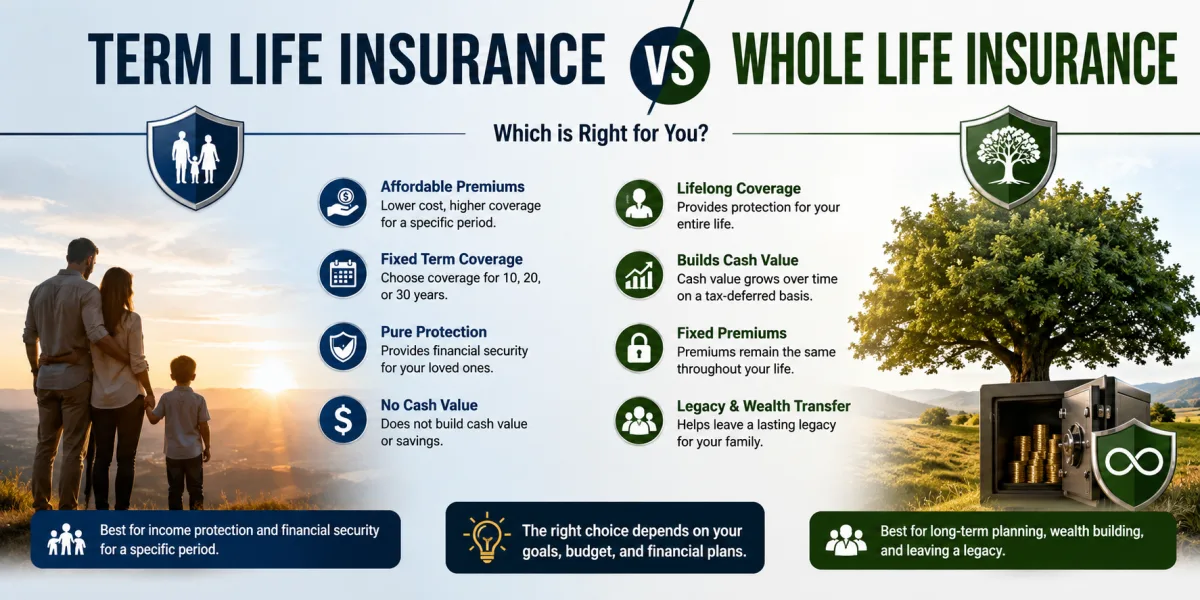
The challenge is that life insurance is often sold in language that blurs two separate goals: protection and accumulation. Protection means creating a death benefit large enough to replace income, pay debts, fund childcare, cover education, preserve housing, or support dependents if the insured dies. Accumulation means building cash value, savings features, guarantees, or tax-advantaged policy value over time. Term life insurance is mostly designed for protection. Whole life insurance combines permanent protection with a cash value feature.
That difference is simple on paper and complicated in real life.
The National Association of Insurance Commissioners explains that cash value life insurance can be kept as long as needed and may include savings or investment features that allow policy owners to access money while alive. It identifies whole life, universal life, and variable life as types of cash value policies. By contrast, the NAIC buyer’s guide notes that most term policies have no cash value.
The question is not which product sounds more sophisticated. The question is what problem you are trying to solve. A young family with a mortgage, children, and limited cash flow may need a large death benefit at an affordable cost for 20 or 30 years. Term life often fits that need. A high-net-worth household with estate planning goals, a lifelong dependent, business succession needs, or a desire for permanent guarantees may have reasons to consider whole life. Many households need the first kind of protection more than the second kind of structure.
Life insurance becomes expensive when people buy a policy that does not match the risk. It becomes dangerous when people buy too little coverage because the permanent policy they were sold is too costly. The first duty of life insurance is not to impress a spreadsheet. It is to make sure the right people receive enough money at the right time if the insured person dies.
What Term Life Insurance Is
Term life insurance provides coverage for a specific period, such as 10, 15, 20, 25, or 30 years. Some insurers may offer other term lengths. If the insured dies while the policy is active, the insurer pays the death benefit to the beneficiaries, assuming the policy is in force and the claim is valid. If the term ends and the insured is still alive, the policy usually expires unless it is renewed, converted, or extended under the contract’s rules.
Term life is designed around temporary risk. A parent may need coverage until children become financially independent. A homeowner may need coverage until a mortgage is paid. A spouse may need income replacement until retirement assets are large enough. A business owner may need coverage while a loan or buy-sell obligation exists.
Term policies generally do not build cash value. This is why they are usually much cheaper than permanent policies for the same initial death benefit. Life Happens describes term life as coverage that offers only a death benefit and does not include a savings benefit like permanent life insurance, which helps explain its affordability.
The simplicity is the appeal. You choose a death benefit, choose a term length, qualify through underwriting, pay premiums, and maintain the policy. If death occurs during the term, the beneficiaries receive the benefit. If not, the policy has served as protection during the years it was needed.
Some people dislike the idea that term insurance may expire without paying anything. But that is how many forms of insurance work. A person may pay for homeowners insurance for decades and never have a major fire. That does not mean the insurance was wasted. It means the risk was transferred during the period of exposure.
What Whole Life Insurance Is
Whole life insurance is a type of permanent life insurance. It is designed to last for the insured’s lifetime as long as required premiums are paid and policy conditions are met. It includes a death benefit and a cash value component. Premiums are typically much higher than comparable term coverage because the policy is built to provide lifelong protection and accumulate cash value.
The Insurance Information Institute explains that permanent life insurance, often called whole life or cash value insurance, provides coverage for the insured person’s lifetime as long as premium payments remain in good standing, and these policies may build cash value accessible under certain conditions.
Whole life policies are often described as guaranteed products. Depending on the policy, premiums may be level, the death benefit may be guaranteed, and cash value may grow according to the contract. Some whole life policies from mutual insurers may pay dividends, though dividends are generally not guaranteed. Policy owners may be able to borrow against cash value, use cash value to pay premiums, surrender the policy for cash surrender value, or use other policy features depending on the contract.
This makes whole life more complex than term life. The buyer is not only buying a death benefit. They are also buying a long-term policy structure with cash value mechanics, surrender rules, loan provisions, possible dividends, guarantees, expenses, and tax considerations.
Whole life can be useful in specific situations. It can also be oversold. The fact that a policy has cash value does not automatically make it a good investment. The fact that it lasts for life does not automatically mean every household needs it. Permanent coverage should solve a permanent or highly specific planning need, not merely sound more complete.
The Core Difference: Temporary Protection Versus Permanent Protection
The central difference between term and whole life is the duration of coverage.
Term life protects for a defined period. It matches temporary obligations: raising children, paying a mortgage, replacing income during working years, covering education costs, protecting a spouse until retirement, or securing a business loan. When the need ends, the coverage can end too.
Whole life is designed for permanent coverage. It may fit needs that do not disappear with time: providing for a lifelong dependent, supporting estate liquidity, leaving a guaranteed legacy, funding certain business-succession arrangements, covering final expenses for someone who wants lifelong certainty, or supporting advanced tax and estate strategies.
The mistake is assuming every person has a permanent life insurance need. Many people do not. A person may need a large death benefit while children are young and a much smaller need later after savings, home equity, retirement accounts, and adult children reduce the dependency risk.
Insurance should match the risk period. If the financial risk is temporary, term insurance often matches it cleanly. If the financial need is lifelong and the buyer can afford permanent premiums without underinsuring, whole life may deserve consideration.
The Cost Difference
Cost is usually the most visible difference. Term life is generally much cheaper upfront than whole life for the same death benefit. That is because term insurance covers a limited period and usually has no cash value. Whole life is built to last for life and accumulate cash value, so premiums are much higher.
Guardian’s 2026 comparison of term and whole life states that term is usually much cheaper upfront, while whole life costs more but adds lifelong protection and cash value. Fidelity’s 2026 explanation similarly notes that whole life covers the insured for life and builds cash value, while term life is temporary and typically less expensive.
This cost difference is not a minor detail. It can determine whether a household buys enough coverage. A family that needs $1 million of protection may be able to afford that amount through term life. The same family may only afford a much smaller whole life policy. If the insured dies early, the beneficiaries do not receive points for owning a more complex product. They receive the death benefit amount.
This is one of the strongest arguments for term insurance in income-replacement planning. The central question is not “Which product has more features?” The question is “How much money would my family need if I died, and which policy allows me to provide that protection affordably?”
Whole life premiums may be sustainable for high-income households, people with specific permanent needs, or buyers who value guarantees and can commit for the long term. But for households with limited monthly cash flow, the premium burden can crowd out emergency savings, retirement contributions, debt repayment, disability insurance, and adequate death benefit coverage.
The Cash Value Question
Cash value is the feature that makes whole life feel different. A portion of the premium supports the insurance cost and policy expenses, while part contributes to the policy’s cash value. Over time, the cash value may grow according to the policy’s guarantees and structure.
Policy owners may access cash value through withdrawals, loans, or surrender, depending on the contract. Loans usually accrue interest. Withdrawals may reduce the death benefit. Surrendering the policy may end the coverage and may trigger tax consequences if the amount received exceeds the policy owner’s basis. Policy mechanics vary, so the contract and illustration matter.
Cash value can be useful. It may provide liquidity, a conservative accumulation vehicle, or planning flexibility for certain households. But it should not be confused with a free savings account. Whole life cash value often grows slowly in early years because of policy costs, commissions, and surrender charges. The policy may take many years to become efficient.
FINRA describes whole life as permanent life insurance that provides lifetime coverage and can build cash value, which is part of why it is more complex than pure term coverage.
The buyer should ask hard questions. How much of the premium goes toward cash value in the first ten years? What are the guaranteed values? What are the non-guaranteed projections? What happens if dividends are lower than illustrated? What are the surrender charges? How do loans work? What happens if a loan is not repaid? How does accessing cash value affect the death benefit? What internal rate of return does the policy imply under guaranteed and current assumptions?
Cash value is a feature. It is not automatically a reason to buy.
The Investment Debate: Buy Term and Invest the Difference
One of the most common arguments in life insurance is “buy term and invest the difference.” The idea is straightforward. Because term life costs much less than whole life, the buyer purchases affordable term coverage and invests the premium difference in retirement accounts, brokerage accounts, index funds, or other assets.
This strategy can work very well if the person actually invests the difference. The term policy provides protection during the years of need, while invested assets grow separately. Over time, the household may become self-insured because investments, retirement savings, home equity, and lower obligations reduce the need for life insurance.
The weakness is behavioral. Many people buy term and spend the difference. If the premium savings disappear into lifestyle spending, the household may reach the end of the term with no policy and insufficient assets. The strategy works only if the difference is saved or invested consistently.
Whole life forces a form of premium discipline because the buyer must keep paying to maintain the policy. Some advocates view this as a benefit. The structure creates long-term accumulation for people who might not invest otherwise. Critics respond that forced discipline through an expensive insurance product may not be the best solution when automatic investing can create similar discipline at lower cost.
The right comparison should be honest. Whole life should not be compared against a person who buys term and wastes the difference. Term should not be compared against an unrealistic whole life illustration. The real question is what the household will actually do.
When Term Life Insurance Usually Makes Sense
Term life often makes sense when the primary need is income replacement. If a spouse, children, aging parent, business partner, or other dependent relies on your income, term life can provide a large death benefit during the years that dependency exists.
It also makes sense when debts or obligations are temporary. A mortgage may last 30 years. Children may need support until adulthood or college graduation. A business loan may have a defined repayment period. A spouse may need protection until retirement savings are large enough. A term policy can be matched to those timelines.
Term life is often attractive for young families because their need for coverage is high while their budget may be stretched. They may have childcare costs, housing costs, student loans, car payments, and limited savings. In that stage, buying enough death benefit can matter more than building cash value inside a policy.
Term life can also be useful for stay-at-home parents. Even without a paycheck, a stay-at-home parent provides economic value through childcare, household management, transportation, caregiving, and support work. If that parent died, the surviving household might need money for childcare, leave from work, household help, or debt management.
The strongest case for term life is simple: a temporary but large financial risk needs affordable protection.
When Whole Life Insurance May Make Sense
Whole life may make sense when there is a lifelong insurance need and the buyer can afford the premiums comfortably. One example is a family with a dependent who will need financial support for life. Another is estate planning for households that expect liquidity needs at death, such as estate taxes, equalization among heirs, or preserving a family business or property.
Whole life may also be considered by high-income households that already fund retirement accounts, maintain emergency savings, have adequate disability insurance, carry sufficient term coverage if needed, and want an additional conservative, tax-advantaged accumulation tool. In such cases, whole life may be part of a broader financial strategy rather than a substitute for basic investing.
Business owners may use permanent life insurance in certain buy-sell agreements, key-person planning, or succession strategies. The details are complex and should involve qualified legal, tax, and insurance advice.
Some people use whole life for final-expense planning or legacy goals. If the desire is to guarantee a death benefit regardless of age at death, term insurance may not satisfy that need because it expires. Whole life can provide lifelong coverage if maintained.
The important condition is affordability. A whole life policy that is surrendered after a few years because premiums are too high can be a poor outcome. Permanent insurance should be purchased only when the buyer understands the commitment and can sustain it without harming more urgent financial priorities.
The Risk of Underinsuring with Whole Life
One of the most common problems with whole life is underinsurance. A household may need $750,000 or $1 million of death benefit but buy $100,000 or $250,000 of whole life because that is what the budget allows. The policy has cash value and permanence, but the death benefit may be insufficient for the actual protection need.
This is especially dangerous for families with young children or large income-replacement needs. If the insured dies early, the beneficiaries need enough money to maintain housing, pay debts, replace income, cover childcare, and fund future obligations. A small permanent policy may not solve that problem.
Insurance planning should begin with the death benefit need, not the product type. Calculate the amount needed first. Then choose the most efficient way to provide it.
If whole life premiums prevent adequate coverage, term life may be the better tool. A policy that is permanent but too small may create a false sense of security.
The Risk of Outliving Term Coverage
Term life has its own risk: the policy may expire while the insured still wants or needs coverage. Renewal may be expensive. Buying new coverage later may be difficult if health has changed. Some term policies include conversion features that allow the policyholder to convert to permanent coverage without new medical underwriting, subject to contract rules and deadlines.
This is why term length matters. A 10-year term may be cheaper than a 30-year term but may not cover the full risk period. If children are young, a 20- or 30-year term may be more appropriate. If a mortgage has 25 years left, a short term may leave a gap. If retirement assets will likely take decades to build, the term should reflect that.
Some buyers ladder term policies. For example, they may buy multiple policies with different term lengths, matching the idea that insurance need declines over time. A large 20-year policy may protect children and mortgage needs, while a smaller 30-year policy provides longer income replacement. Laddering can reduce cost while matching changing needs, but it requires careful planning.
Term life should be long enough to cover the actual dependency period. Buying the cheapest short term can be a mistake if the risk lasts longer.
How Much Life Insurance Do You Need?
The right amount depends on who depends on you and what financial gap your death would create. A simple rule of thumb, such as 10 times income, can be a starting point, but it is not enough for serious planning.
Use a needs-based approach. Add income replacement, mortgage payoff or rent support, childcare, education goals, debts, final expenses, medical bills, support for a surviving spouse, and any special family obligations. Then subtract existing assets, savings, retirement accounts that beneficiaries could use, existing life insurance, and survivor benefits.
Consider time. A family with toddlers may need more years of income replacement than a family with teenagers. A spouse near retirement may need less income replacement than a spouse with decades of expenses ahead. A household with large savings may need less insurance than one with little savings.
Life insurance is not meant to make beneficiaries rich in a careless way. It is meant to replace the financial value lost when the insured dies. That value can include income, unpaid labor, caregiving, debt support, and future plans.
Once the death benefit need is clear, the product decision becomes easier.
Term Life for Income Replacement
Income replacement is one of the clearest uses of term life. If a household depends on a paycheck, the death of the earner creates a financial hole. The policy’s death benefit can help fill that hole.
The death benefit may allow a surviving spouse to remain in the home, pay off debts, cover childcare, take time away from work, fund education, and maintain stability during grief. Without insurance, the surviving household may be forced into immediate financial decisions during the worst moment of life.
Term life is effective here because income replacement is often temporary. The need may decline as children become independent, debts fall, savings grow, and retirement assets accumulate. The policy can be designed to cover the years when the gap would be largest.
The ideal outcome is not necessarily to keep life insurance forever. The ideal outcome is to reach a point where assets and reduced obligations make the insurance less necessary.
Whole Life for Permanent Needs
Whole life fits better when the need does not have a clear expiration date. A lifelong dependent may require funding regardless of whether the insured dies at 45, 75, or 95. Estate liquidity needs may arise whenever death occurs. A legacy goal may be permanent. Certain business obligations may call for permanent coverage.
Whole life can also appeal to people who value guarantees and do not want coverage to expire. For them, the higher premium buys certainty. The policy is not only protecting against premature death. It is designed to pay whenever death occurs, assuming the policy is kept in force.
But permanent need should be real, not assumed. Many people do not need lifelong life insurance because their financial obligations decline and their assets increase. If no one depends on your income, debts are manageable, retirement assets are strong, and estate liquidity is not a concern, permanent life insurance may be less necessary.
The permanent nature of whole life is valuable only if the permanent need exists and the premiums are sustainable.
Cash Value Loans and Withdrawals
Whole life policy owners may be able to access cash value through loans or withdrawals. This feature is often presented as flexibility, and it can be. But it must be understood carefully.
A policy loan uses the cash value as collateral. The insurer charges interest. The loan does not usually need to be repaid on a fixed schedule, but unpaid loans and interest can reduce the death benefit and may cause the policy to lapse if not managed. A lapse with outstanding loans can create tax consequences.
Withdrawals may reduce cash value and death benefit. Surrendering the policy may provide cash surrender value but ends coverage. Surrender charges may apply, especially in earlier years.
This means cash value is accessible but not frictionless. It is not the same as a checking account or emergency fund. A household should not buy whole life assuming policy cash value will replace ordinary savings. Emergency funds should still be liquid, simple, and separate.
Policy access features are useful only when the owner understands the trade-offs.
Tax Treatment: Useful, but Not a Reason by Itself
Life insurance has tax features that can be valuable. Death benefits are often received by beneficiaries income-tax-free under current U.S. federal tax rules, though estate, ownership, transfer, and other tax issues can complicate specific cases. Whole life cash value may grow tax-deferred. Policy loans may provide access to cash value without immediate income tax if structured and managed properly.
These tax features are part of why permanent life insurance appears in advanced planning. But tax treatment should not be the only reason to buy a policy. A tax-advantaged product can still be a poor fit if costs are high, coverage is wrong, surrender risk is high, or simpler alternatives would work better.
Tax rules can change, and individual circumstances vary. Anyone using whole life for tax, estate, or business planning should work with qualified professionals.
Insurance should first solve an insurance problem. Tax advantages are secondary benefits, not substitutes for suitability.
Comparing the Two Policies in Real Life
Imagine a 35-year-old parent with two young children, a mortgage, moderate retirement savings, and a spouse who depends partly on their income. The household may need a large death benefit for the next 25 or 30 years. Term life may provide the necessary coverage at a premium that fits the budget. The remaining cash flow can fund emergency savings, retirement accounts, disability insurance, college savings, and debt repayment.
Now imagine a 60-year-old business owner with substantial assets, estate liquidity concerns, and a child with lifelong support needs. The insurance need may not disappear after 20 years. Whole life or another permanent policy may deserve serious consideration as part of a broader estate and business plan.
Now imagine a single 28-year-old with no dependents, no major debts, and growing savings. The need for life insurance may be small or nonexistent, though future dependents could change that. Buying whole life simply because it is “good to start young” may not be the best use of limited cash flow if emergency savings, investing, and disability protection are underfunded.
Context decides the answer. Product labels do not.
Do Children Need Life Insurance?
Parents are sometimes offered whole life insurance for children. These policies may provide permanent coverage and cash value over time. The sales argument often emphasizes low premiums, future insurability, and savings.
There may be specific reasons a family considers coverage for a child, such as final expenses, medical history concerns, or guaranteed future insurability. But in most households, the larger insurance need is usually on the parents or caregivers whose income or labor supports the child.
Before buying life insurance for a child, parents should ask whether they have adequate coverage on themselves, an emergency fund, health insurance, disability insurance, retirement savings, and education savings. If those foundations are weak, a child whole life policy may not be the highest priority.
Insurance planning should protect the household’s biggest risks first.
Life Insurance and Stay-at-Home Parents
A stay-at-home parent may not earn a paycheck, but their work has economic value. Childcare, transportation, meal preparation, household management, caregiving, scheduling, and emotional support would be expensive to replace. If that parent died, the surviving household might need paid childcare, reduced work hours, household help, counseling, or time away from work.
Term life is often a practical tool for this need. The coverage can last until children are older or the household’s dependency on unpaid labor declines. The death benefit should reflect the replacement cost of the work performed, not only formal income.
Ignoring the insurance need of a non-earning caregiver is a common mistake. Life insurance is not only about replacing salary. It is about replacing financial support, whether paid or unpaid.
Life Insurance and Debt
Life insurance can protect survivors from debt burdens. A mortgage, business loan, private student loan, personal loan, or co-signed debt may create hardship if the borrower dies. Term life can be matched to the repayment period of the debt.
Mortgage protection is a common example. Instead of buying a specialized mortgage life policy that pays the lender directly, many households may prefer a standard term policy that pays beneficiaries. Beneficiaries can then decide whether to pay off the mortgage, invest the proceeds, cover living expenses, or make another choice.
Debt should not automatically determine the full insurance amount. The household may need income replacement beyond debt payoff. Paying off a mortgage may not be enough if the surviving spouse still lacks income for taxes, maintenance, food, healthcare, and childcare.
The question is not only “What do I owe?” It is “What would my people need?”
Life Insurance and Retirement Planning
Life insurance needs often decline as retirement assets grow. A person in their thirties may have young children, a mortgage, and limited savings. By their sixties, children may be independent, the mortgage may be lower or gone, and retirement accounts may be substantial. The death benefit need can shrink.
This is why term life often pairs naturally with retirement planning. The policy protects the accumulation years. If the insured survives the term, the household ideally has built enough assets to reduce or eliminate the need for life insurance.
Whole life may play a role in retirement planning for certain households, especially those seeking permanent death benefits, estate liquidity, or conservative cash value. But it should not be used as a substitute for adequate retirement saving unless the strategy has been carefully analyzed.
Retirement planning requires liquidity, investment growth, tax planning, income strategy, and risk management. Life insurance can support some of those goals, but it cannot replace a complete retirement plan.
Life Insurance and Disability Insurance
Life insurance protects dependents if you die. Disability insurance protects income if you become too sick or injured to work. For many working households, disability risk is just as important as death risk, sometimes more immediate.
A household may buy life insurance but ignore disability coverage. That leaves a major gap. If the earner survives but cannot work, the family may still lose income while expenses continue. Medical costs may rise. Retirement saving may stop. Debt may grow.
Before committing a large premium to whole life, a household should ask whether disability coverage is adequate. A permanent life policy may build cash value, but it does not replace the need to protect earning power during life.
A sound protection plan considers both premature death and loss of income due to disability.
Riders and Policy Features
Both term and whole life policies may offer riders. Riders add features or benefits, usually for extra cost. Common riders can include waiver of premium, accelerated death benefit, child term coverage, term conversion, guaranteed insurability, accidental death, or long-term care-related features depending on the insurer and policy.
The NAIC notes that life insurance riders add coverage not included in the base policy and that adding a rider increases the premium.
Riders can be useful, but they can also complicate the decision. A rider should solve a real problem. Do not buy riders simply because they sound comforting. Ask what the rider costs, when it applies, what exclusions exist, whether the benefit reduces the death benefit, and whether a separate policy would be better.
Term conversion riders deserve special attention. A conversion option may allow a term policyholder to convert to permanent insurance without new health underwriting during a specified period. This can be valuable if health changes and permanent coverage becomes desirable. But conversion rules vary, so they should be reviewed before purchase.
Policy Illustrations: Read the Guaranteed Column
Whole life insurance is often presented with an illustration showing future cash value and death benefit projections. These illustrations may include guaranteed values and non-guaranteed values based on current dividend scales or assumptions.
Buyers should focus first on the guaranteed column. The guaranteed values show what the insurer is contractually promising under the policy terms. Non-guaranteed values may be attractive, but they can change. Dividends, interest crediting, and policy performance can differ from projections.
Ask the agent or advisor to explain the policy under conservative assumptions. What happens if dividends are lower? How long before cash value exceeds cumulative premiums? What happens if premiums become unaffordable? What is the surrender value in years 1, 3, 5, 10, and 20? How do loans affect the policy?
A buyer should never purchase whole life based only on the most optimistic illustration. Permanent insurance is a long-term commitment. The downside scenario matters.
The Surrender Problem
Whole life policies can be costly to surrender in early years. If a policy owner cancels early, the cash surrender value may be much lower than premiums paid. This is one reason whole life is inappropriate for people who are uncertain about long-term affordability.
Surrender risk is not theoretical. Life changes. Income drops. Jobs are lost. Families grow. Housing costs rise. Medical expenses appear. If premiums become burdensome, the policy owner may reduce coverage, borrow, use dividends, or surrender, depending on options. Each choice has consequences.
Before buying whole life, stress-test the premium. Could you keep paying if income fell? If childcare costs rose? If a spouse stopped working? If you had a medical expense? If you needed to increase retirement contributions? If the answer is no, the policy may be too large or the wrong product.
A permanent policy is only permanent if it can be maintained.
How Agents Are Paid
Life insurance is often sold by agents who receive commissions. Commissions are not automatically bad. Professionals deserve compensation. But buyers should understand incentives. Permanent policies often pay higher commissions than term policies because premiums are higher and the products are more complex.
This does not mean every recommendation for whole life is inappropriate. It means buyers should ask questions. Is the agent captive or independent? What alternatives were considered? How much term coverage would meet the protection need? What are the policy costs? What happens if the policy is surrendered? Is the agent acting as a fiduciary in any part of the relationship?
A good insurance professional should welcome informed questions. Pressure, urgency, vague explanations, and dismissal of term insurance are warning signs.
The buyer should not need to become an actuary, but they should understand what they are buying and why.
Buy Term and Invest the Difference: When It Works
The buy-term-and-invest-the-difference approach works best for disciplined households. They buy enough term coverage, keep premiums affordable, and invest the savings in retirement accounts, brokerage accounts, or other assets. Over time, the invested difference may build enough wealth to reduce the future need for insurance.
This strategy is especially strong when the household has access to low-cost diversified investments, tax-advantaged retirement accounts, employer matches, and automatic contributions. The lower cost of term insurance can free cash flow for these priorities.
But the approach requires follow-through. If the difference is not invested, the strategy loses much of its power. A household should automate the difference if possible. The money saved by choosing term should not simply vanish into lifestyle spending.
The phrase should really be “buy term and actually invest the difference.” The second half is the discipline.
Whole Life: When It Works
Whole life works best when it is purchased for the right reason, funded properly, and maintained long enough for its structure to matter. It may serve households that want permanent death benefit guarantees, have estate liquidity needs, support lifelong dependents, or seek conservative policy cash value after other financial priorities are already strong.
It may also work for people who highly value certainty and can afford the premium without sacrificing adequate coverage or investment contributions. The psychological value of guarantees can be real. Not every decision is based only on maximum expected return.
But whole life works poorly when it is bought with vague expectations, unrealistic illustrations, insufficient cash flow, or as a substitute for emergency savings and retirement investing. It also works poorly when the death benefit is too small because the buyer could not afford adequate permanent coverage.
Whole life should be owned intentionally. It should not be bought because someone said wealthy people use it, banks supposedly do it, or it sounds like an investment that also has insurance. The actual policy matters.
Can You Have Both?
Yes. Some households use both term and whole life. This can make sense when there is a large temporary need and a smaller permanent need.
For example, a family may buy a large 30-year term policy for income replacement while also owning a smaller whole life policy for lifelong legacy or estate planning. The term policy covers the years of highest dependency. The whole life policy provides permanent coverage.
This blended approach can be more affordable than trying to meet the entire death benefit need with whole life. It can also be more flexible than using only term if a permanent need truly exists.
The key is designing coverage around actual needs. Do not buy both simply because indecision feels safer. Each policy should have a clear purpose.
How to Decide Between Term and Whole Life
Start with dependents. Who would suffer financially if you died? How much income or support would disappear? How long would they need help?
Next, calculate obligations. Include mortgage or rent support, childcare, education, debts, final expenses, medical bills, support for a spouse, business obligations, and special family needs.
Then review assets. Include savings, retirement accounts, existing life insurance, survivor benefits, home equity if relevant, and investments. The insurance need is the gap between obligations and available resources.
Then identify the duration of the need. If the gap is largest for the next 20 or 30 years and declines after that, term life likely deserves priority. If the gap exists for life, permanent coverage may be relevant.
Then test affordability. Can you buy enough death benefit? Can you maintain the premium during stress? Would the policy crowd out emergency savings, retirement contributions, disability insurance, or debt payoff?
Finally, compare alternatives. What would term coverage cost? What would whole life cost? What happens if you invest the difference? What guarantees does whole life provide? What risks does each option leave uncovered?
The right decision should be clear enough that you can explain it in plain English.
Questions to Ask Before Buying Term Life
How much death benefit do I need?
How long should the term last?
Are premiums level for the full term?
What happens when the term ends?
Can the policy be renewed?
Can it be converted to permanent insurance?
What is the conversion deadline?
Does the policy include an accelerated death benefit rider?
Are there exclusions or contestability rules I should understand?
How financially strong is the insurer?
Questions to Ask Before Buying Whole Life
What is the guaranteed premium?
What is the guaranteed death benefit?
What is the guaranteed cash value each year?
What values are non-guaranteed?
Are dividends assumed, and are they guaranteed?
How long before cash value becomes meaningful?
What are the surrender charges?
What happens if I miss premiums?
How do policy loans work?
What loan interest rate applies?
How do withdrawals or loans affect the death benefit?
Could the policy lapse if loans are not managed?
What is the internal rate of return under guaranteed assumptions?
How does this policy fit with my retirement, tax, estate, and insurance plan?
Common Mistakes to Avoid
The first mistake is buying life insurance without calculating the death benefit need. Product choice should follow need analysis, not replace it.
The second mistake is choosing whole life when the premium prevents adequate coverage. A small permanent policy may leave the family underprotected.
The third mistake is choosing term that is too short. A cheap 10-year policy may expire while the need still exists.
The fourth mistake is treating whole life cash value as equivalent to emergency savings. Policy access can involve loans, interest, surrender rules, and reduced death benefits.
The fifth mistake is buying insurance on children before protecting the adults whose income or unpaid labor supports the household.
The sixth mistake is ignoring disability insurance. Death is not the only risk to household income.
The seventh mistake is buying based on an optimistic illustration without understanding guaranteed values.
The eighth mistake is failing to name and update beneficiaries. Life changes such as marriage, divorce, births, deaths, and estate planning updates should trigger beneficiary review.
The ninth mistake is letting a policy lapse unintentionally. Premiums, grace periods, loans, and cash value should be monitored.
The tenth mistake is confusing insurance with investing. Some policies have accumulation features, but the first purpose of life insurance is protection.
Which Is Better?
For most families whose main need is affordable income replacement during working years, term life insurance is often the better first choice. It provides more death benefit per premium dollar, is easier to understand, and matches temporary needs such as raising children, paying a mortgage, and replacing income until assets grow.
Whole life insurance may be better for specific permanent needs, high-income planning situations, estate liquidity, lifelong dependent support, business planning, or buyers who value lifelong guarantees and can afford the premiums comfortably.
The best answer is not universal. Term life is not inferior because it expires. Whole life is not superior because it lasts forever. Each product is built for a different problem.
The practical rule is this: buy enough protection first. If the need is temporary, term life usually does that efficiently. If the need is permanent and cash flow supports the commitment, whole life may belong in the conversation.
The Wealth Lesson
Life insurance should protect people before it tries to build cash value. The death benefit is not an abstract number. It is rent, mortgage payments, groceries, childcare, education, debt relief, time to grieve, and the financial survival of people who depend on you.
Term life insurance is simple, affordable, and powerful when the risk is temporary. Whole life insurance is permanent, more expensive, and more complex, with cash value features that may fit certain long-term planning needs. Neither product is automatically right. Neither product is automatically wrong.
The wrong policy is the one that does not match the household’s real risk. A family that needs large protection but buys too little whole life may be underinsured. A person with a lifelong dependent who relies only on short-term coverage may create a future gap. A buyer who chooses term and spends the difference may fail to build assets. A buyer who chooses whole life without understanding costs may surrender early and lose money.
The decision should begin with people, not products. Who depends on you? How much would they need? How long would they need it? What can you afford? What other financial goals must also be funded? What risk is temporary, and what risk is permanent?
Answer those questions honestly, and the choice becomes clearer. Term life protects the years when your absence would create the largest financial hole. Whole life can protect needs that last beyond those years. A wise insurance plan may use one, the other, or both. But it should always begin with the same purpose: making sure the people you love are not left financially exposed when they are already facing loss.
 Article
 Article
 Article
 Article
 Article
 Article
 Article
 Article