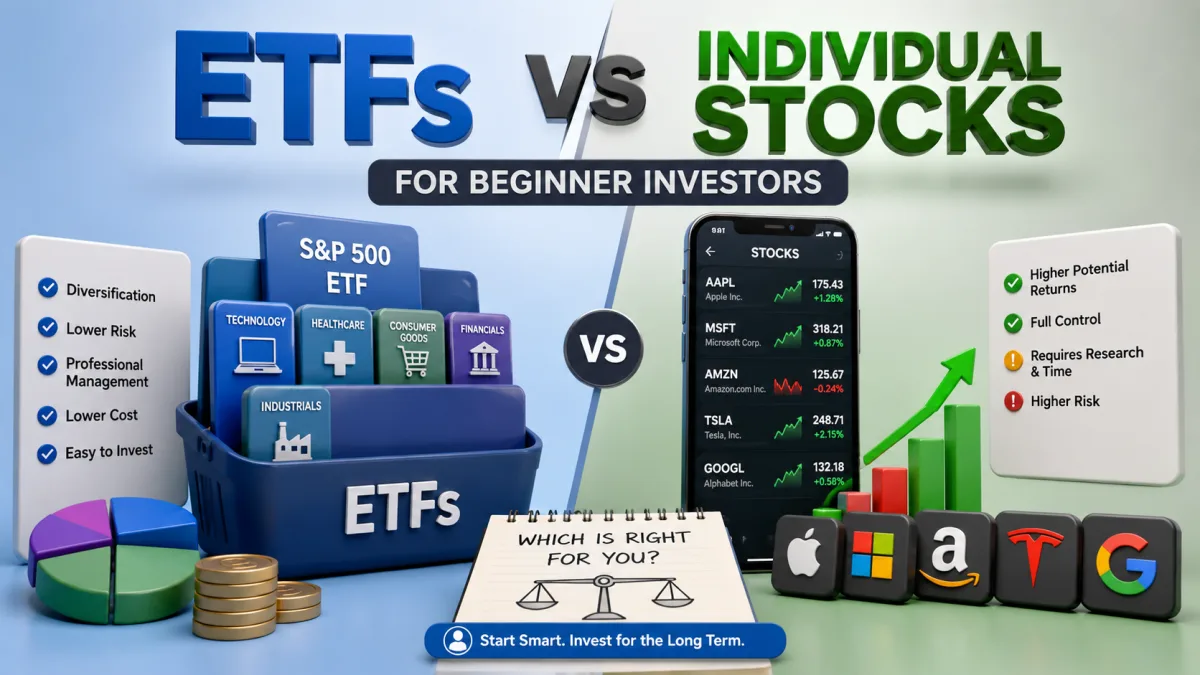
The Diversification Decision: ETFs, Individual Stocks, and the Beginner Investor
Every new investor eventually faces the same question.
Should I buy ETFs, or should I buy individual stocks?
At first, the question seems simple. ETFs appear safer and easier. Individual stocks appear more exciting and potentially more rewarding. One offers instant diversification. The other offers direct ownership in a company the investor may know, admire, or believe in. One feels like a system. The other feels like a choice.
Both can build wealth.
Both can lose money.
The difference is not only in what they own. The difference is in how much risk the investor is concentrating, how much research is required, how much emotional pressure the investor can tolerate, and how dependent the result becomes on a few decisions.
For beginners, this distinction matters deeply. Many new investors enter the market with enthusiasm but little experience. They hear stories about people who bought the right stock early and built life-changing wealth. They see headlines about companies that multiplied in value. They watch social media accounts discuss popular stocks as if wealth is only one clever pick away.
Those stories are not always false. Some investors do build substantial wealth through individual stocks. But the stories often leave out the difficult parts: the research, the patience, the volatility, the mistakes, the years of underperformance, the companies that never recovered, and the emotional discipline required to hold through uncertainty.
ETFs, by contrast, rarely create the same dramatic story. They are not usually built around one heroic decision. They do not offer the thrill of saying, “I found the next great company before everyone else.” Instead, they offer something quieter and often more useful for beginners: broad ownership, lower concentration risk, simplicity, and a better chance of staying invested.
The beginner’s goal should not be to look sophisticated. It should be to survive, learn, and compound.
That is why the ETF versus individual stock decision is not really about which investment is more impressive. It is about which structure gives a new investor the best chance to build wealth without being destroyed by avoidable mistakes.
What an ETF Really Is
An exchange-traded fund, usually called an ETF, is an investment fund that trades on an exchange like a stock.
When an investor buys one share of an ETF, they are usually buying exposure to a basket of assets. That basket may include hundreds or thousands of companies. It may include bonds. It may focus on a specific industry, country, investment style, or broad market index.
The simplest way to understand an ETF is this: instead of buying one company, the investor buys a collection.
A broad stock market ETF might hold companies from technology, healthcare, finance, consumer goods, energy, industrials, communication services, and other sectors. The investor does not need to choose which single business will win. They own a small part of many businesses at once.
This creates diversification.
Diversification means spreading money across different investments so that one poor result does not dominate the entire portfolio. If one company inside an ETF struggles, the effect on the investor may be limited because many other holdings remain. If one industry goes through a difficult period, other industries may help balance the damage.
ETFs can be broad or narrow. A broad ETF may track a large market index. A narrow ETF may focus on one theme, such as artificial intelligence, clean energy, cybersecurity, banking, or biotechnology. Beginners should understand this difference because not every ETF is automatically low risk. Some ETFs are diversified across the entire market, while others are concentrated in one sector or trend.
A broad ETF can be a foundation. A narrow ETF may behave more like a bet on a specific theme.
The power of ETFs for beginners is that they reduce the number of decisions required. Instead of asking, “Which company should I buy?” the investor can ask, “Which market or asset class do I want exposure to?” That shift often leads to better behavior because it reduces the pressure to identify winners.
What an Individual Stock Really Is
An individual stock represents ownership in one company.
When an investor buys a stock, they become a shareholder. Their investment is tied to that company’s future performance, market expectations, profitability, management decisions, competitive position, industry trends, and investor sentiment.
If the company performs well and the market values it highly, the stock may rise. If the company disappoints, faces disruption, loses customers, takes on too much debt, suffers from poor leadership, or becomes less profitable, the stock may fall.
Individual stocks can create extraordinary wealth. Many of the world’s largest fortunes were built through concentrated ownership in businesses. Founders, early employees, and early investors in exceptional companies have often benefited from the enormous upside that comes when a business grows for many years.
That upside is real.
But so is the risk.
A single company is vulnerable in ways a diversified fund is not. It can make a bad acquisition. It can lose a major customer. It can be disrupted by new technology. It can face lawsuits, regulation, fraud, product failure, debt pressure, supply chain problems, leadership changes, or declining demand.
Even good companies can become poor investments if the price paid is too high. A beginner may admire a company’s products and still overpay for the stock. Business quality and investment return are related, but they are not the same thing. The price matters.
This is one of the first serious lessons of stock investing: a great company is not always a great investment at any price.
The Main Difference: Diversified Ownership Versus Concentrated Ownership
The most important difference between ETFs and individual stocks is concentration.
An ETF usually spreads money across many holdings. An individual stock concentrates money in one holding.
That single difference changes almost everything.
With an ETF, the investor’s outcome is connected to a group of assets. With an individual stock, the investor’s outcome is connected to one company. The ETF investor is asking a broad question: will this market, asset class, or group of businesses create value over time? The stock investor is asking a narrower question: will this specific company perform well enough to justify my investment?
The narrow question can produce higher returns if the investor is right. It can also produce deeper losses if the investor is wrong.
This is why ETFs are often more suitable as a beginner’s foundation. They reduce the cost of being wrong about one company. They also reduce the research burden. A person who owns a broad ETF does not need to analyze every balance sheet, product cycle, competitor, and management decision inside the fund. The investor still needs to understand the fund, but the risk is spread.
Individual stocks place more responsibility on the investor. If the investor chooses poorly, diversification will not rescue them unless they own many other investments. If they buy based on hype, emotion, or brand recognition, they may learn an expensive lesson.
In investing, concentration is powerful. It can build wealth quickly when correct. It can destroy wealth quickly when wrong.
Why Beginners Often Prefer ETFs
Many beginners prefer ETFs because they simplify the starting point.
New investors already have much to learn. They need to understand accounts, fees, market volatility, risk tolerance, taxes, time horizons, compounding, and asset allocation. Adding the responsibility of analyzing individual companies can make the process overwhelming.
ETFs allow beginners to begin investing without needing to become stock analysts first.
This does not mean ETFs require no thought. A beginner still needs to know what the ETF owns, how much it costs, what index or strategy it follows, whether it is broad or narrow, and how it fits into the investor’s goals. But the level of research is usually more manageable than selecting individual companies.
ETFs also help beginners avoid a common emotional trap: falling in love with one company.
Many people buy individual stocks because they like a company’s products. They use the phone, shop at the store, watch the streaming service, drive the car, or admire the founder. Familiarity creates comfort. But familiarity is not analysis.
An ETF reduces the emotional attachment to one company. The investor owns a group. If one business disappoints, the portfolio does not depend entirely on that business. This can make it easier to stay disciplined during market swings.
For long-term investors, staying disciplined is not a small advantage. It is often the difference between building wealth and repeatedly interrupting the process.
The Research Burden of Individual Stocks
Individual stock investing requires more than recognizing a brand.
A serious stock investor needs to understand how the company makes money, what drives revenue, how profitable the business is, how much debt it carries, who its competitors are, whether its industry is growing or shrinking, how management allocates capital, and whether the current stock price leaves room for future returns.
That is a lot of work.
The investor must also monitor change. A company that looks strong today may weaken later. A business model that once seemed unbreakable may be disrupted. A leader who once inspired confidence may make poor decisions. A stock that once looked reasonably priced may become expensive after a rapid rise.
Beginners often underestimate this workload. They may believe stock investing means choosing companies they like and holding them. Sometimes that works. Often it does not.
Good stock research asks difficult questions.
Is the company growing because of durable advantages or temporary conditions?
Are profits supported by real cash flow?
Is debt manageable?
Does the company have pricing power?
Can competitors copy its products or services?
Is management honest and disciplined?
What assumptions are already reflected in the stock price?
What could cause the investment thesis to fail?
These questions are not meant to scare beginners away from individual stocks forever. They are meant to show that stock picking is a skill. Like any skill, it requires study, practice, and humility.
Volatility Feels Different When You Own One Company
Volatility is easier to discuss than to experience.
When a broad ETF declines, the investor may feel uncomfortable, but they can often remind themselves that they own many companies. The decline may reflect a market-wide issue rather than a permanent failure of one business.
When an individual stock falls sharply, the emotional pressure can be stronger. The investor may wonder whether something is wrong with the company. They may search for news, read opinions, panic over analyst commentary, or doubt their original decision. If the stock represents a large portion of their portfolio, the stress becomes even greater.
This emotional burden matters because investing behavior drives long-term results.
A portfolio that looks good on paper is useless if the investor cannot hold it through normal volatility. Some beginners say they can tolerate risk until they see real money falling in value. Then they discover that their emotional risk tolerance is lower than their theoretical risk tolerance.
ETFs can help reduce this pressure because they spread risk across many holdings. They do not eliminate volatility, but they may make it more manageable. Individual stocks require more emotional discipline because the investor must endure company-specific uncertainty.
The best investment is not only the one with the highest potential return. It is the one the investor can own responsibly for the required time period.
Company-Specific Risk: The Danger Beginners Underestimate
Company-specific risk is the risk that something goes wrong with one business.
This risk can appear in many forms. A company may miss earnings expectations. A new competitor may take market share. A product may fail. A major customer may leave. Costs may rise. Management may lose credibility. A scandal may damage the brand. A new regulation may reduce profits. A technology shift may make the business less relevant.
When an investor owns one stock, this risk matters enormously.
When an investor owns a broad ETF, company-specific risk is diluted. One company’s failure may hurt the fund slightly, but it is unlikely to destroy the entire investment unless the ETF is highly concentrated.
This is one of the strongest arguments for ETFs as a beginner’s starting point. They protect investors from the full damage of being wrong about one company.
Beginners often assume that large, famous companies are safe. But business history is filled with companies that once seemed dominant and later struggled. Size does not eliminate risk. Popularity does not guarantee future returns. A strong past does not guarantee a strong future.
Individual stock investors must accept that even well-known companies can disappoint.
The Upside of Individual Stocks
Individual stocks are not bad investments by nature.
They can be powerful wealth builders when chosen well, bought at reasonable prices, and held with discipline. Owning the right company through years of growth can produce returns that a broad ETF may not match.
This is the appeal of stock picking.
An investor who identifies a truly exceptional company early, understands it deeply, and remains patient through volatility may benefit from concentrated upside. Some companies create enormous shareholder value because they expand markets, build strong brands, produce high returns on capital, innovate successfully, or develop durable competitive advantages.
Individual stocks also give investors more control. They can choose companies that match their analysis, values, sector preferences, dividend goals, or growth expectations. They are not forced to own every company inside an index.
For people who enjoy business analysis, individual stocks can be intellectually rewarding. Studying companies teaches accounting, strategy, competition, management quality, industry structure, and economic history. It can make a person a better investor even if they still keep most of their money in ETFs.
The key is position sizing.
A beginner who wants to learn individual stock investing does not need to put their entire portfolio into a few companies. They can keep the core of the portfolio diversified and use a smaller portion for carefully researched individual stocks. This allows learning without making one decision too powerful.
The Problem With Hype Stocks
Many beginners first encounter individual stocks through hype.
A stock rises quickly. People start talking about it online. Screenshots of profits appear. Influencers describe the company as unstoppable. Friends discuss it. Financial media covers it constantly. The price movement becomes the advertisement.
This is dangerous because rising prices create social proof. The beginner may believe the stock is good simply because it has already gone up. They may buy without understanding the business, valuation, risks, or expectations embedded in the price.
Hype turns investing into crowd behavior.
The problem is that by the time a stock becomes widely hyped, much of the easy money may already have been made. The remaining buyers may be paying a price that assumes everything will go right. If reality disappoints even slightly, the stock can fall sharply.
Beginners should be especially cautious with any investment idea that creates urgency. Phrases such as “this will never be this cheap again,” “everyone is buying,” “do not miss out,” or “this is guaranteed” are warning signs.
Good investing does not require panic.
If an investment cannot survive careful analysis, it should not be bought because of excitement.
Costs and Fees
Fees matter because they reduce returns.
ETFs often have expense ratios, which are annual fees charged by the fund. Many broad index ETFs have low expense ratios, making them attractive for long-term investors. Specialized ETFs may cost more, so beginners should compare fees before buying.
Individual stocks do not have expense ratios, but that does not mean they are cost-free. Investors may face trading commissions, bid-ask spreads, taxes from frequent trading, and the hidden cost of poor decisions. A stock portfolio can also become expensive if the investor trades too often or uses platforms with high charges.
The lowest fee is not always the best choice, but every fee should be understood.
A beginner should ask: what am I paying, and what am I receiving in exchange?
If an ETF is broad, diversified, and low-cost, the fee may be easy to justify. If an expensive fund simply follows a narrow trend, the investor should be more cautious. If stock trading appears free but encourages constant buying and selling, the behavioral cost may be high even when the commission is zero.
Costs are not only financial. Complexity has a cost. Stress has a cost. Time has a cost. Mistakes have a cost.
Which Is Better for Long-Term Investors?
For most beginners, ETFs are usually the better starting point.
This does not mean ETFs are perfect. They can decline. They can be misunderstood. Narrow ETFs can be risky. Investors can still buy at bad times, sell in panic, or choose funds that do not match their goals.
But broad ETFs solve several beginner problems at once.
They provide diversification. They reduce company-specific risk. They require less research than individual stocks. They are often low-cost. They make it easier to invest consistently. They allow beginners to participate in market growth without needing to predict which company will win.
For a new investor, these advantages are significant.
Individual stocks may become appropriate later, especially for investors who enjoy research and can handle volatility. But they should usually be approached with humility. Stock picking is not easy simply because buying a stock is easy. The transaction is simple. The decision is difficult.
The beginner should separate access from skill. Modern platforms make it easy to buy almost anything. That does not mean every purchase is wise.
A Balanced Strategy: Core and Explore
Many investors do not need to choose between ETFs and individual stocks completely.
A balanced approach can use ETFs as the core and individual stocks as a smaller exploratory portion.
The core is the foundation. It may include broad, diversified ETFs or index funds that provide exposure to large parts of the market. This portion is designed for long-term compounding, stability, and simplicity.
The explore portion is smaller. It may include individual stocks the investor has researched and understands. This allows the investor to learn stock analysis and pursue selected opportunities without risking the entire portfolio on a few companies.
For example, an investor might place most of their long-term money in diversified ETFs and reserve a modest percentage for individual stocks. The exact percentage depends on risk tolerance, knowledge, goals, and financial stability. The principle is that the foundation should not be sacrificed for excitement.
This approach respects both realities.
ETFs are useful for broad wealth building. Individual stocks can offer learning and upside. The mistake is allowing the exciting part to overwhelm the stable part.
How Beginners Should Decide
The right choice depends on the investor.
A beginner who wants simplicity, diversification, and lower stress may be better served by ETFs. This investor does not want to spend hours reading financial statements, comparing competitors, or following company news. They want a practical way to build wealth over time.
A beginner who enjoys studying businesses may eventually include individual stocks. But enjoyment alone is not enough. The investor must also be willing to do research, accept volatility, size positions carefully, and admit mistakes.
The decision should begin with honest self-assessment.
Do you understand the business you want to buy?
Can you explain why the stock may perform well?
Can you explain what could go wrong?
Are you prepared for the stock to fall significantly without panicking?
Is the position small enough that being wrong will not damage your financial life?
Would a diversified ETF help you stay more consistent?
Do you want to invest, or do you want excitement?
These questions are not complicated, but they are revealing.
The Role of Time Horizon
Time horizon matters in every investment decision.
Money needed soon should not be placed in volatile investments, whether ETFs or individual stocks. A broad ETF can still fall in value over short periods. An individual stock can fall even more sharply. If the money is needed for rent, tuition, a home deposit, emergency expenses, or a near-term purchase, safety should come before growth.
Long-term money can usually accept more volatility because it has time to recover. This is why retirement investing often includes stocks or stock ETFs. The investor may not need the money for decades, giving compounding more room to work.
Individual stocks require even greater attention to time horizon because company-specific problems may take years to resolve, or may never resolve at all. A long time horizon helps, but it does not rescue every poor stock choice.
Time is powerful, but it is not magic. A bad business can remain a bad investment for a long time.
Why Simplicity Wins More Often Than Beginners Expect
Many beginners assume wealth requires complexity.
They believe successful investors must own dozens of stocks, follow every market update, use advanced charts, trade frequently, and understand complicated strategies. Complexity can create the appearance of intelligence, but it does not guarantee better results.
Simple strategies often work because they are easier to follow.
A diversified ETF portfolio with regular contributions may not sound exciting, but it can keep the investor focused on what matters: saving, investing, staying diversified, keeping fees low, and allowing time to work.
Complex strategies often fail because they create more opportunities for mistakes. More trades. More taxes. More fees. More emotional decisions. More chances to chase performance. More reasons to abandon the plan.
For beginners, simplicity is not a weakness. It is a form of protection.
The goal is not to build the most impressive portfolio. The goal is to build one that can survive real life.
Common Beginner Mistakes
Buying Stocks Because They Are Popular
Popularity is not an investment thesis.
A company can be widely admired and still be overpriced. A stock can be discussed constantly and still carry serious risk. Beginners should not confuse attention with quality.
Owning Too Few Companies
Owning one or two stocks can expose a beginner to unnecessary risk. If one company falls sharply, the damage can be significant. Diversification helps reduce the impact of a single mistake.
Using ETFs Without Understanding Them
Not every ETF is broad or conservative. Some ETFs are concentrated in one sector, use leverage, follow speculative themes, or hold volatile assets. Beginners should read what the ETF owns before investing.
Trading Too Often
Frequent trading can increase costs, taxes, and emotional mistakes. Long-term investing usually rewards patience more than constant activity.
Selling During Market Declines
Market declines are normal. Selling in panic can turn temporary losses into permanent ones. Investors should choose an allocation they can hold through difficult periods.
Ignoring Position Size
Even a good investment can become risky if it is too large relative to the portfolio. Position size determines how much damage one mistake can cause.
ETFs, Stocks, and the Wealth-Building Mindset
The ETF versus stock decision is partly technical, but it is also psychological.
ETFs represent humility. They accept that the investor may not know which company will outperform. They spread ownership widely. They prioritize participation over prediction.
Individual stocks represent conviction. They require the investor to believe that a specific company offers an attractive opportunity. Conviction can be rewarding, but it must be earned through research rather than borrowed from someone else’s opinion.
Beginners need both humility and curiosity.
Humility says, “I should not risk everything on one idea.”
Curiosity says, “I can keep learning how businesses and markets work.”
A strong investor does not need to reject individual stocks forever. But a strong investor also does not need to prove intelligence by picking stocks immediately. The foundation can be simple while the knowledge grows.
Final Thoughts
There is no perfect investment for every beginner.
ETFs and individual stocks both have a place in the investing world. ETFs offer diversification, simplicity, and lower company-specific risk. Individual stocks offer direct ownership, higher potential upside, and the opportunity to benefit from exceptional businesses.
The difference is responsibility.
An ETF allows a beginner to own a broad group of assets without needing to identify the winning company. An individual stock requires more research, more emotional discipline, and greater acceptance of company-specific risk.
For most beginners, broad ETFs are usually the smarter starting point. They make it easier to build the habit of investing, avoid concentration mistakes, and stay committed through market cycles. Complexity can come later, after the foundation is strong.
Individual stocks can still be part of the journey, but they should be approached carefully. Buy them because you understand the business, the risks, and the role they play in your portfolio. Do not buy them because of hype, boredom, fear of missing out, or the desire to get rich quickly.
The best investing strategy is not the one that sounds most exciting today.
It is the one you can follow consistently for years.
For many beginners, that means starting with diversified ownership, building confidence, learning patiently, and allowing time to do its quiet work.
Build the foundation first.
The market will always offer complexity. Wealth is built by learning when to ignore it.
 Article
 Article
 Article
 Article
 Article
 Article
 Article
 Article