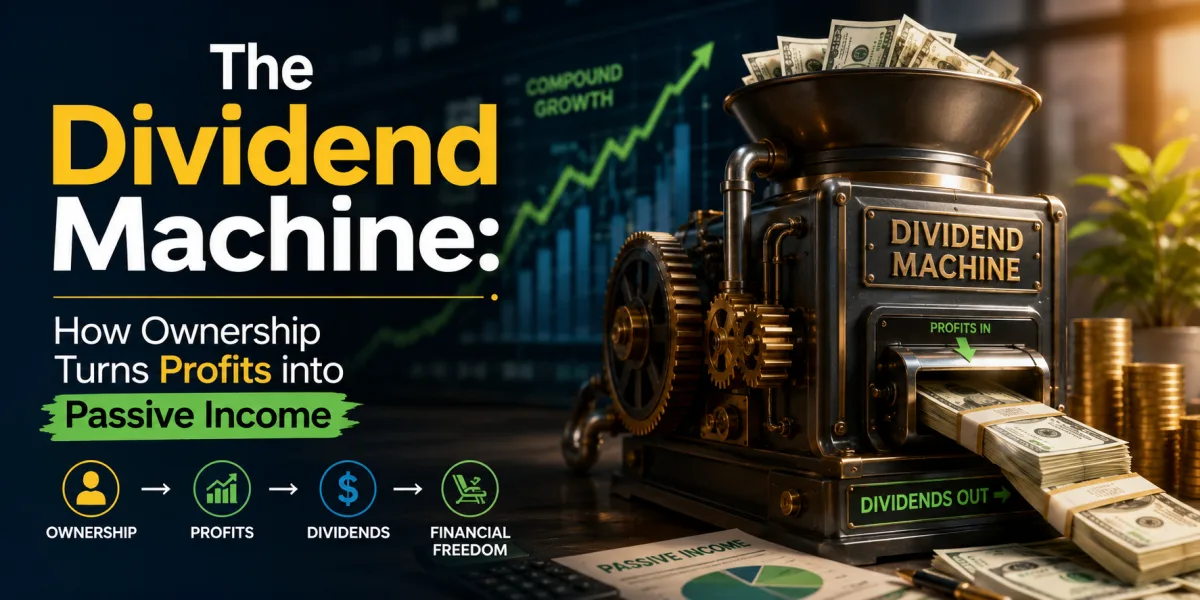
The Dividend Machine: How Ownership Turns Profits into Passive Income
Dividend investing is built on a simple idea: own pieces of profitable businesses and receive a portion of their cash flow. Instead of relying only on selling an asset later, the investor receives income while still owning the asset. That is why dividends have such enduring appeal. They make ownership visible.
A dividend payment is not magic money. It is not free money. It is a distribution from a company to its shareholders, usually paid from profits, retained earnings, or available cash. When a company pays a dividend, it is deciding that some cash should be returned to owners rather than reinvested in the business, used to repay debt, held on the balance sheet, or spent on acquisitions.
For investors, that decision can create passive income. A shareholder does not have to clock in, send an invoice, negotiate with customers, or manage employees to receive the dividend. The business does the operating work. The investor supplies capital and accepts risk. In exchange, the investor may receive periodic cash flow.
This is the ownership advantage. Workers earn from labor. Lenders earn from interest. Landlords earn from rent. Business owners earn from profits. Dividend investors participate in the profit stream of businesses they do not personally manage.
FINRA describes stocks as ownership interests in companies and notes that investors may receive dividends if the company distributes part of its earnings, though stock prices can be volatile and investing for short-term goals can be risky.
The appeal is easy to understand. A portfolio that produces $100 per month can help pay utilities. A portfolio producing $500 per month can cover groceries, insurance, or part of housing. A portfolio producing $2,000 per month can change retirement planning. A portfolio producing enough to cover all living expenses can make work more optional.
But dividend investing only creates durable passive income when it is built with discipline. Chasing the highest yield can be dangerous. Buying weak companies because the payout looks attractive can destroy capital. Ignoring taxes can reduce income. Concentrating in one sector can expose the portfolio to unnecessary risk. Treating dividends as guaranteed can lead to disappointment when companies cut payouts.
Dividend income is powerful precisely because it is tied to real businesses. That also means it must be evaluated like business ownership.
What a Dividend Really Is
A dividend is a payment made by a company to its shareholders. It is usually paid in cash, though some companies may pay stock dividends or special dividends. Most dividend investors focus on cash dividends because cash can be spent, saved, reinvested, or redirected to other goals.
Public companies are not required to pay dividends. Many growing companies retain earnings to fund expansion, research, hiring, acquisitions, marketing, factories, technology, or debt reduction. Other companies, especially mature and profitable ones, may generate more cash than they can reinvest at attractive rates. Those companies may return part of the surplus to shareholders.
A company’s board of directors generally decides whether to declare a dividend, how much to pay, and when it will be paid. Investors pay attention to several dates: declaration date, ex-dividend date, record date, and payment date. The ex-dividend date matters because investors must own shares before that date to receive the upcoming dividend under market rules. FINRA’s rules explain that securities transactions are handled “ex-dividend” on designated dates after a dividend is declared.
Dividends are commonly paid quarterly in the United States, though some companies pay monthly, semiannually, annually, or irregularly. Real estate investment trusts, business development companies, utilities, banks, consumer staples firms, energy companies, telecom companies, and mature industrial businesses are often associated with dividends, though each company must be evaluated individually.
A dividend is not a bonus added on top of a stock’s value without consequence. When a stock goes ex-dividend, the share price often adjusts downward by roughly the dividend amount, all else equal. The investor receives cash, but the company has less cash after paying it. The value comes from owning businesses that can keep producing profits and cash flow over time.
How Dividend Investing Creates Passive Income
Dividend investing creates passive income through recurring distributions. If an investor owns 100 shares of a company that pays $1 per share annually, the investor receives $100 per year before taxes. If the investor owns a diversified portfolio that pays $10,000 annually, that portfolio produces a meaningful income stream.
The income can be used in two ways. During the accumulation phase, the investor can reinvest dividends to buy more shares. This increases future dividend potential because more shares can produce more dividends. During the income phase, the investor can take dividends as cash to pay expenses.
This gives dividend investing a dual character. It can be a compounding strategy while the investor is building wealth and an income strategy when the investor needs cash flow.
For example, a 35-year-old investor may reinvest every dividend for decades. The cash payments buy additional shares, and those shares produce additional dividends. This creates a feedback loop: shares produce dividends, dividends buy shares, new shares produce more dividends. The process is slow at first, then more visible as the portfolio grows.
A 65-year-old retiree may use dividends differently. Instead of reinvesting all payouts, the retiree may use dividends to supplement Social Security, pensions, rental income, or portfolio withdrawals. The shares remain invested, but the cash flow helps fund daily life.
The passive nature of dividend income is real, but it should not be exaggerated. The investor does not work inside the company, but the investor must still choose investments, diversify, monitor risk, understand taxes, and avoid overconcentration. Dividend income is passive in operation, not passive in judgment.
The Difference Between Dividend Income and Capital Gains
Stock investors generally earn returns in two ways: income and appreciation. Income comes from dividends. Appreciation comes from the share price rising over time. A total-return investor cares about both.
Some companies pay little or no dividend because they reinvest heavily for growth. Investors in those companies may rely mostly on capital gains. Other companies pay significant dividends and may grow more slowly. Investors in those companies may receive more cash income along the way.
Neither approach is automatically superior. A company that pays no dividend may create enormous wealth if it reinvests profits at high returns. A company that pays a high dividend may be a poor investment if its business is declining. The best dividend investors understand that dividends are only one part of total return.
This is important because income can feel more real than appreciation. A dividend arrives as cash. A capital gain exists on paper until shares are sold. That psychological difference makes dividends attractive, especially for retirees or conservative investors. But the investor should still ask whether the underlying business is healthy and whether total return is competitive.
A 5 percent dividend yield paired with a 10 percent annual stock-price decline is not wealth creation. A 2 percent dividend yield paired with consistent earnings growth and rising dividends may be far better. Income without capital preservation is fragile.
Dividend Yield: Useful but Dangerous
Dividend yield is one of the most watched dividend metrics. It is calculated by dividing the annual dividend by the share price. If a stock pays $4 per year and trades at $100, the dividend yield is 4 percent.
Yield helps investors compare income potential, but it can mislead. A high yield can mean the company is generous and profitable. It can also mean the stock price has fallen because investors expect trouble. When the price falls and the dividend has not yet been cut, the yield can look unusually high. That high yield may be a warning, not an opportunity.
This is called a yield trap. Investors buy because the yield looks attractive, only to suffer a dividend cut and capital loss. A stock yielding 10 percent may look better than one yielding 3 percent, but if the 10 percent payout is unsustainable, the real outcome can be worse.
Dividend investors should ask why the yield is high. Is the company in a stable industry with strong cash flow? Or is the market pricing in declining earnings, debt pressure, regulatory risk, commodity weakness, or business disruption? The number alone does not answer the question.
Yield should be evaluated with payout ratio, free cash flow, debt, earnings stability, dividend history, industry conditions, and management’s capital allocation record. A moderate but sustainable dividend is often better than a high but fragile one.
The Payout Ratio: Can the Company Afford the Dividend?
The payout ratio measures how much of a company’s earnings are paid as dividends. If a company earns $5 per share and pays $2 per share in dividends, the payout ratio is 40 percent. This suggests the company retains 60 percent of earnings for reinvestment, debt reduction, cash reserves, or other uses.
A lower payout ratio can indicate room for dividend growth or resilience during downturns. A very high payout ratio can indicate vulnerability. If a company pays nearly all its earnings as dividends, even a modest earnings decline may pressure the payout.
But payout ratios must be interpreted by industry. Utilities and real estate investment trusts often have higher payout ratios because their business models and tax structures differ from technology firms or industrial companies. REITs, for example, are generally required to distribute a large portion of taxable income to shareholders to maintain favorable tax status. That makes their payout ratios look different from ordinary corporations.
Free cash flow can sometimes be more useful than accounting earnings. A company may report earnings but generate weak cash flow. Since dividends are paid in cash, the investor should care whether actual cash generation supports the payout.
A sustainable dividend is not measured by desire. It is measured by the business’s ability to keep producing cash after funding operations, capital expenditures, debt obligations, and strategic needs.
Dividend Growth: The Income That Raises Itself
Dividend growth is one of the most powerful parts of dividend investing. A company that increases its dividend over time can help investors fight inflation and increase income without buying more shares.
Imagine buying shares that pay $1,000 in annual dividends today. If the company raises its dividend by 6 percent annually, that income could grow meaningfully over time, even before reinvestment. If the investor reinvests dividends as well, the effect can compound further.
Dividend growth often signals business strength. A company that raises dividends consistently may have durable earnings, disciplined management, strong cash flow, and confidence in future operations. But dividend growth should still be evaluated. A company can raise payouts too aggressively, especially if management is trying to maintain a reputation while fundamentals weaken.
Investors often study dividend growth history. Companies that have raised dividends for many consecutive years are sometimes called dividend achievers, contenders, aristocrats, or kings depending on the index or classification used. These labels can be useful screening tools, but they should not replace analysis. A long history reduces uncertainty, but it does not eliminate risk.
The best dividend growth companies combine current income with the ability to increase that income over time. This is different from simply choosing the highest yield today.
Reinvesting Dividends: The Quiet Compounding Engine
Dividend reinvestment turns income into additional ownership. Instead of taking the dividend as cash, the investor uses it to buy more shares of the same investment or another investment. Many brokerages offer automatic dividend reinvestment plans, often called DRIPs.
The power of reinvestment is that it increases share count without requiring new money from the investor’s paycheck. More shares can produce more dividends, which can buy still more shares. Over long periods, reinvested dividends can represent a large portion of total stock-market returns.
The SEC’s Investor.gov compound interest calculator demonstrates how an initial investment, ongoing contributions, time, and return assumptions interact to grow wealth over time. While the calculator is not dividend-specific, it illustrates the compounding principle behind reinvested income.
Reinvestment is especially valuable during market downturns. When prices fall, dividends can buy more shares. This can feel uncomfortable because the portfolio value may be down, but long-term investors who continue reinvesting may accumulate more ownership at lower prices.
Reinvestment is not always the right choice. Retirees may need dividends for living expenses. Investors may choose to redirect dividends toward undervalued opportunities rather than automatically reinvest in the same stock. Taxable-account investors may owe taxes on dividends even if they reinvest them, which affects cash planning.
Still, for investors building wealth over decades, dividend reinvestment can be one of the simplest forms of automatic compounding.
Dividend Stocks Versus Dividend Funds
Investors can pursue dividend income by buying individual dividend-paying stocks or by buying dividend-focused funds. Each approach has advantages.
Individual stocks allow control. The investor can choose specific companies, evaluate balance sheets, monitor payout ratios, and build a customized income stream. This can be rewarding for investors who enjoy research and understand business analysis.
The risk is concentration. A portfolio of five dividend stocks may look diversified because it contains several names, but it may still be exposed to one sector, one economic cycle, or one type of risk. If one company cuts its dividend, the income stream can drop sharply.
Dividend exchange-traded funds and mutual funds provide instant diversification. A dividend ETF may own dozens or hundreds of dividend-paying companies. Some focus on high yield. Others focus on dividend growth. Others track indexes of companies with long dividend histories.
The advantage is simplicity and diversification. The drawback is less control. The investor receives the fund’s holdings, methodology, fees, sector exposures, and distribution pattern. A high-yield dividend ETF may hold companies the investor would not choose individually. A dividend-growth ETF may have a lower current yield than desired.
Funds also charge expense ratios. Fees matter because they reduce investor returns. The SEC’s Investor.gov has warned investors that fees and expenses can affect portfolio value over time.
For many investors, dividend funds are a practical starting point because they reduce single-company risk. More experienced investors may combine funds with individual holdings.
The Role of Dividend ETFs
Dividend ETFs have become popular because they make income investing easier. An investor can buy one fund and receive exposure to a basket of dividend-paying companies. Some ETFs distribute income monthly or quarterly, depending on the fund.
But dividend ETFs are not all the same. A high-dividend-yield ETF may select companies with the highest current yields. That can increase income but may also increase exposure to troubled companies. A dividend-growth ETF may select companies with records of increasing dividends. That may improve quality but reduce current yield. A low-volatility dividend ETF may focus on steadier companies. A sector-specific fund may concentrate in utilities, real estate, energy, or financials.
The investor should understand the index methodology. How are stocks selected? Are companies weighted by market value, dividend yield, dividend dollars, or equal weighting? Are there quality screens? Are there sector caps? How often is the fund rebalanced? What is the expense ratio? How has the distribution changed over time?
A dividend ETF should not be purchased only because the yield looks high. It should be evaluated as a portfolio.
Taxes on Dividend Income
Dividend income is not always taxed the same way. In the United States, qualified dividends may be taxed at long-term capital gains rates if they meet certain requirements. Nonqualified dividends are generally taxed as ordinary income. Investors may also owe state taxes and, for higher-income taxpayers, the net investment income tax.
The IRS explains that for tax year 2025, most net capital gains are taxed at no more than 15 percent for most individuals, with 0 percent and 20 percent rates applying depending on taxable income and filing status. Qualified dividends generally receive similar favorable rate treatment when requirements are met.
For 2026, Tax Foundation summarized IRS inflation-adjusted capital gains brackets from Revenue Procedure 2025-32, showing 0 percent, 15 percent, and 20 percent brackets based on taxable income and filing status.
Tax treatment matters because two investors can receive the same dividend and keep different after-tax amounts. A dividend received inside a tax-advantaged retirement account may not create current taxable income. A dividend received in a taxable brokerage account may generate a tax bill even if reinvested. A high-yield portfolio held in a taxable account may be less tax-efficient than expected.
Tax should not be the only factor in investment selection, but it should be part of the plan. Retirees, high earners, early retirees, and investors using taxable accounts should pay special attention to after-tax income.
Qualified Dividends Versus Ordinary Dividends
Qualified dividends are generally dividends from eligible U.S. corporations or qualified foreign corporations that meet holding-period and other requirements. They are taxed at preferential long-term capital gains rates. Ordinary dividends that do not qualify are taxed as ordinary income.
This distinction can significantly affect after-tax yield. A 4 percent qualified dividend may produce more after-tax income than a 4 percent ordinary dividend for a taxpayer in a higher ordinary income bracket. Investors should not compare yields without considering tax character.
REIT dividends, for example, often do not qualify for the same preferential treatment as qualified corporate dividends, though they may be eligible for other tax considerations such as the qualified business income deduction in certain circumstances. Business development company distributions, bond fund distributions, and certain covered-call fund distributions may also have different tax treatment.
Tax rules are detailed and can change. Investors should review Form 1099-DIV and consult a qualified tax professional for personal advice. The important principle is simple: passive income should be measured after taxes, not before them.
Dividend Investing in Retirement Accounts
Holding dividend investments inside retirement accounts can simplify taxes. Dividends paid inside a traditional IRA, Roth IRA, 401(k), or similar account generally do not create immediate taxable dividend income in the same way they would in a taxable brokerage account. The tax treatment depends on the account type.
In a traditional retirement account, dividends can compound tax-deferred, but withdrawals are generally taxed as ordinary income. In a Roth account, qualified withdrawals can be tax-free, making dividend growth especially attractive over long periods.
This is why dividend investors often consider asset location. High-yield investments that generate more taxable income may be better suited to tax-advantaged accounts, depending on the investor’s situation. Tax-efficient dividend growth stocks may be more acceptable in taxable accounts. The right answer depends on income, tax bracket, account balances, retirement timeline, and estate goals.
Asset location is not the same as asset allocation. Asset allocation decides what you own. Asset location decides where you hold it.
Dividend Investing and Inflation
Passive income is only useful if it maintains purchasing power. A portfolio paying $30,000 per year today may not feel sufficient twenty years from now if costs rise substantially. That is why dividend growth matters.
Fixed income can lose purchasing power when inflation rises. A dividend portfolio with companies that can raise prices, grow earnings, and increase payouts may help offset inflation over time. But not all dividend companies can do this. Businesses with weak pricing power may struggle when costs rise. Companies with heavy debt may face pressure when interest rates increase. Regulated industries may have limited flexibility.
Dividend growth is one defense against inflation, but it is not guaranteed. Investors should favor businesses with durable demand, reasonable debt, strong cash flow, and the ability to raise payouts from real earnings growth rather than financial engineering.
Dividend Cuts: The Risk Income Investors Must Respect
Dividends can be reduced, suspended, or eliminated. This is one of the most important truths in dividend investing. A company facing declining profits, debt pressure, recession, regulatory changes, commodity shocks, litigation, or strategic reinvestment needs may cut its dividend.
A dividend cut can hurt in two ways. First, the investor’s income falls. Second, the stock price may decline because the market reassesses the company’s strength. This double impact can be painful for investors who relied too heavily on one stock.
Dividend cuts are not always bad management. Sometimes cutting a dividend is necessary to preserve the business. But for income investors, the result still matters. A portfolio built around reliable cash flow must anticipate that some payouts may fail.
Diversification is the main defense. No single company should be responsible for too much portfolio income. Sector diversification also matters because dividend cuts can cluster in industries under stress. During energy downturns, energy dividends may be at risk. During banking crises, financial dividends may be pressured. During real estate stress, REIT payouts may be vulnerable.
A sustainable dividend portfolio is built to survive disappointment.
The Danger of High-Yield Obsession
Some investors begin dividend investing by searching for the highest yields. This is understandable but dangerous. A 12 percent yield looks attractive compared with a 3 percent yield, but the market rarely offers high income without risk.
High yields may appear in companies with declining share prices, unstable earnings, high leverage, commodity exposure, poor growth prospects, or market skepticism. Some closed-end funds and complex income products may advertise high distribution rates that include return of capital or rely on leverage. FINRA has cautioned that closed-end funds can appeal to investors because some offer high distribution rates, but investors need to understand how such funds work and the risks involved.
The yield investor should ask: Where is the cash coming from? Is the distribution funded by earnings, cash flow, borrowing, asset sales, leverage, option premiums, or returning the investor’s own capital? Is the payout covered? Is the business stable? Is the balance sheet healthy? Has the company cut dividends before? What would happen in a recession?
Yield is an output. Quality is the source. Chasing output while ignoring source is how income investors get hurt.
Building a Dividend Portfolio
A dividend portfolio should begin with purpose. Is the goal current income, dividend growth, retirement cash flow, lower volatility, reinvestment compounding, or financial independence? Different goals require different portfolios.
A young investor may prioritize dividend growth over high current yield. A retiree may need more current income but should still care about sustainability and inflation. An early retiree may need taxable-account income and tax planning. A conservative investor may prefer dividend ETFs for diversification. A research-oriented investor may build a stock portfolio.
The foundation should be diversified. This may include dividend growth stocks, broad equity index funds, dividend ETFs, bonds, cash reserves, and possibly REITs depending on risk tolerance. Dividend stocks should not be the entire financial plan unless the investor understands the concentration and sector risks.
A simple dividend portfolio might include a broad-market index fund for total return, a dividend growth ETF for income growth, a high-quality bond fund for stability, and a cash reserve for near-term needs. More advanced investors may add individual dividend stocks after research.
The investor should avoid building a portfolio that is secretly one bet. Many dividend portfolios become overweight in utilities, banks, energy, telecom, consumer staples, and REITs. These sectors can be useful, but concentration increases risk. A portfolio that looks diversified by company count may not be diversified by economic exposure.
How Much Money Is Needed to Create Passive Income?
The amount required depends on the portfolio yield and the income target. If a portfolio yields 3 percent, $100,000 produces about $3,000 per year before taxes. If it yields 4 percent, $100,000 produces about $4,000. If it yields 5 percent, $100,000 produces about $5,000.
To generate $1,000 per month, or $12,000 per year, a 3 percent yield requires about $400,000. A 4 percent yield requires about $300,000. A 5 percent yield requires about $240,000. These numbers are before taxes and assume dividends are maintained.
This math is useful because it brings realism. Dividend income can become meaningful, but it requires capital. A small portfolio can produce small income. The way to grow the income is to invest more, reinvest dividends, hold companies that raise payouts, and allow time for compounding.
Dividend investing is not a shortcut around the need to save. It is a method for turning savings into income-producing ownership.
Dividend Reinvestment Versus Living on Dividends
There are two major stages in dividend investing: accumulation and distribution.
During accumulation, the investor usually reinvests dividends. The goal is to increase ownership and future income. The investor may care less about current cash flow and more about long-term growth. Dividend growth stocks and broad-market funds may be suitable.
During distribution, the investor may use dividends to cover expenses. The goal becomes cash-flow reliability. The investor may care more about yield, payout stability, tax efficiency, and sequence risk. But growth still matters because expenses rise over time.
Some investors transition gradually. They reinvest dividends while working, then redirect part of the income to expenses in retirement. Others use dividends to fund specific goals: insurance premiums, travel, property taxes, education, or charitable giving.
The key is not to confuse the stages. A young investor taking every dividend as spending money may slow compounding. A retiree reinvesting all dividends while selling shares for living expenses may be unnecessarily complicated. The income strategy should match the life stage.
Dividend Investing and Financial Independence
Dividend investing appeals strongly to people pursuing financial independence because it creates visible cash flow. When dividends cover a bill, the investor can see ownership replacing labor. This can be motivating.
But financial independence should be based on total portfolio strength, not dividends alone. A company can cut its dividend. A dividend-focused portfolio can underperform. Taxes can reduce spendable income. Inflation can erode purchasing power. Overconcentration can create risk.
A financially independent household may use dividends as one income source alongside bond interest, cash reserves, rental income, business income, Social Security, pensions, part-time work, and strategic portfolio withdrawals. Dividends can reduce the need to sell shares, but they should not be treated as the only safe income.
The strongest financial independence plans are flexible. If dividends fall, spending can adjust. If markets decline, cash reserves can help. If taxes change, account location can be managed. If one sector weakens, diversification protects the plan.
Monthly Dividend Stocks and Funds
Some investors like monthly dividend stocks and funds because monthly payments feel like paychecks. Monthly income can help budgeting, especially for retirees. REITs, certain bond funds, closed-end funds, and some dividend ETFs may distribute monthly.
Monthly payment frequency is convenient, but it does not make an investment better. A weak company paying monthly is still weak. A fund with an unsustainable distribution is still risky. A quarterly dividend can be budgeted monthly by holding cash reserves.
Investors should evaluate quality first and payment frequency second. A reliable quarterly payer may be better than a fragile monthly payer. Income timing is an administrative issue. Income safety is an investment issue.
Dividend Aristocrats and Dividend Kings
Dividend aristocrats and dividend kings are companies with long records of raising dividends. The exact definitions depend on the index or source, but aristocrats are commonly associated with at least 25 consecutive years of dividend increases, while kings are often associated with at least 50.
These companies attract investors because a long dividend-growth record suggests durability. A company that raised dividends through recessions, inflation, interest-rate cycles, commodity shocks, and market crashes has demonstrated resilience.
But history is not a guarantee. A company can have a long record and still face disruption. Retailers can be disrupted by e-commerce. Consumer brands can lose relevance. Industrial firms can face margin pressure. Healthcare firms can face regulation. Even famous dividend companies require ongoing review.
Dividend-growth records are useful filters. They are not substitutes for analysis.
REITs and Dividend Income
Real estate investment trusts, or REITs, are popular with income investors because they often pay meaningful dividends. REITs own or finance income-producing real estate such as apartments, warehouses, data centers, cell towers, shopping centers, offices, hotels, healthcare facilities, or self-storage properties.
REITs can provide real estate exposure without directly owning property. They may generate income from rents, leases, or real estate financing. Because of their tax structure, REITs generally distribute a large portion of taxable income.
The risks vary by property type. Office REITs may face remote-work pressure. Retail REITs may face tenant weakness. Industrial REITs may depend on logistics demand. Data center REITs may depend on technology infrastructure growth. Mortgage REITs may be sensitive to interest rates and leverage.
REIT dividends can be attractive, but they are not bond payments. They are equity income tied to real estate businesses. Investors should understand sector exposure, debt maturity, occupancy, funds from operations, interest-rate sensitivity, and tax treatment.
Covered-Call Funds and Enhanced Income
Some investors use covered-call ETFs or funds to generate higher distributions. These funds typically hold stocks and sell call options to collect option premiums. The premiums can support income, but the strategy may limit upside when markets rise.
Covered-call funds can be useful for certain income needs, but they are often misunderstood. A high distribution rate does not necessarily mean high total return. Some distributions may include option premiums, capital gains, or return of capital. The fund may lag in strong bull markets because upside is capped.
Investors should read fund documents carefully. What index or stocks does the fund hold? How are options written? Are calls at the money or out of the money? What are fees? How tax-efficient are distributions? How did the fund perform in different market environments?
Enhanced income is not free. It is usually exchanged for something: upside, complexity, volatility, tax treatment, or strategy risk.
Dividend Investing Mistakes
The first mistake is chasing yield. High yield without sustainability can lead to dividend cuts and capital losses.
The second mistake is ignoring total return. A portfolio should create wealth, not only income. A high payout from a shrinking business is not success.
The third mistake is overconcentration. Owning many dividend stocks in the same sector does not create true diversification.
The fourth mistake is ignoring taxes. Dividend income in taxable accounts can create annual tax bills, even when reinvested.
The fifth mistake is assuming dividends are guaranteed. Companies can and do cut them.
The sixth mistake is neglecting valuation. A great dividend company can be a poor investment if bought at an excessive price.
The seventh mistake is failing to reinvest during accumulation. Spending every dividend too early can weaken compounding.
The eighth mistake is treating dividends as separate from business fundamentals. Dividends are outputs of businesses. If the business weakens, the dividend may follow.
A Practical Dividend Investing Framework
Start with financial foundation. Before building a dividend portfolio, maintain an emergency fund and eliminate destructive high-interest debt. Dividend income is less useful if credit card interest is draining wealth faster than investments can build it.
Next, choose the account type. Decide whether dividend investments belong in a taxable brokerage account, IRA, Roth IRA, employer retirement plan, or a mix. Consider taxes and access needs.
Then decide whether to use funds, individual stocks, or both. Beginners may favor low-cost dividend ETFs and broad index funds. Experienced investors may add individual companies after research.
Evaluate quality. Look at earnings stability, free cash flow, debt, payout ratio, dividend history, competitive advantage, industry outlook, and valuation. Do not buy only because the yield is high.
Diversify. Spread income across sectors, companies, and asset classes. Avoid relying on one company or industry for too much income.
Reinvest during accumulation. Let dividends buy more ownership while the portfolio is growing.
Review periodically. A dividend portfolio should not be traded constantly, but it should be monitored. Watch for deteriorating fundamentals, excessive payout ratios, debt pressure, and dividend cuts.
How Dividends Fit into a Wealth Plan
Dividend investing is most powerful when it is part of a broader wealth plan. The investor still needs income, savings discipline, tax planning, retirement accounts, insurance, estate planning, and risk management.
A dividend portfolio can support many goals. It can supplement retirement income. It can fund reinvestment. It can provide psychological comfort during market volatility. It can create cash flow for financial independence. It can help investors think like owners rather than speculators.
But dividends should not become an obsession that excludes better opportunities. Some of the world’s strongest companies have created wealth by reinvesting profits rather than paying high dividends. A broad total-return portfolio may include both dividend-paying and non-dividend-paying companies. The goal is wealth and income, not loyalty to one style.
Dividend investing is a tool. A powerful tool, but still a tool.
The Psychological Power of Dividends
Dividends change how investors experience ownership. A market decline can feel less frightening when cash still arrives. A dividend increase can feel like a raise. Reinvested dividends can make progress visible. This psychological benefit is one reason dividend investing remains popular.
Behavior matters. The best portfolio is not only the one with the highest theoretical return. It is the one the investor can hold through stress. If dividends help an investor stay disciplined, avoid panic selling, and think long term, they have value beyond the cash payment.
But psychology can cut both ways. Dividends can make investors complacent. A high yield can distract from deteriorating fundamentals. A long dividend history can create false confidence. Income can feel safe even when capital is at risk.
The disciplined dividend investor enjoys the cash flow but still studies the business.
The Real Meaning of Passive Income
Dividend investing creates passive income by converting savings into ownership. The investor works, saves, buys productive assets, and eventually those assets send cash back. This is the quiet machinery of wealth.
The first dividend may be small. A few dollars. Then a few more. At the beginning, the income can feel almost symbolic. But symbols matter. That first payment proves a new relationship with money. The investor is no longer only trading time for income. Capital has begun to work.
Over years, contributions, reinvestment, dividend growth, and market appreciation can turn small payments into meaningful cash flow. The process is not instant. It rewards patience. It rewards selectivity. It rewards avoiding large mistakes.
Dividend income is not guaranteed, and it is not risk-free. But when built on diversified ownership of healthy businesses, it can become one of the most understandable forms of passive income. The investor owns assets. The assets produce cash. The cash can buy more assets or support life.
That is the dividend machine. It begins with capital, runs on business profits, strengthens through reinvestment, and matures into income. Used wisely, it can help transform a portfolio from a number on a screen into a source of financial independence.
 Article
 Article
 Article
 Article
 Article
 Article
 Article
 Article