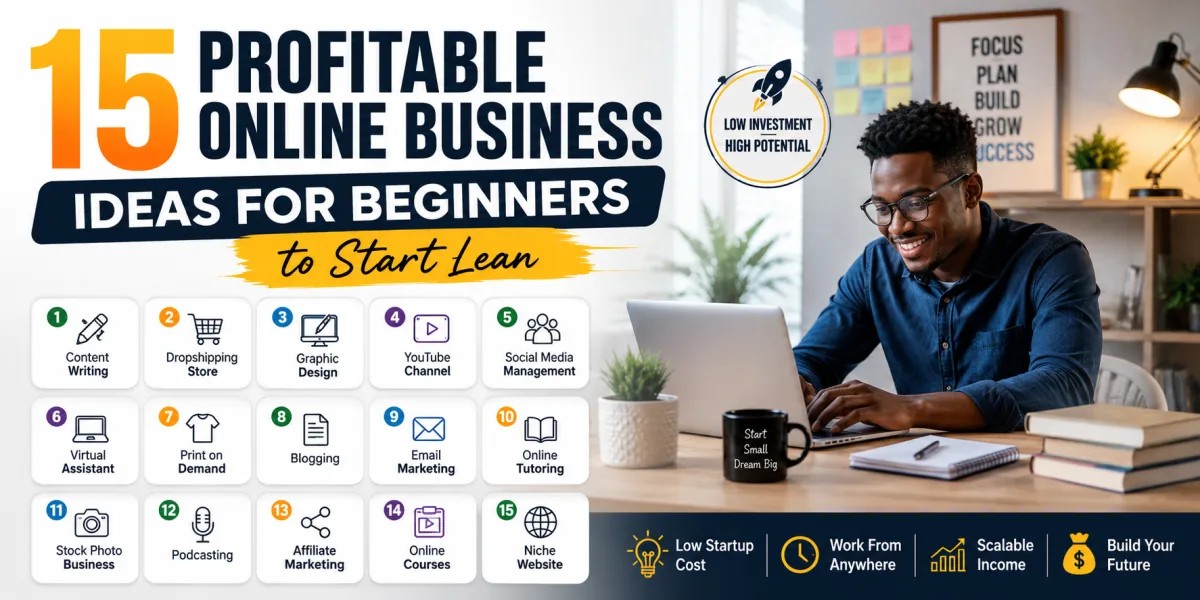
The First-Dollar Advantage: 15 Profitable Online Business Ideas for Beginners
The best online business for a beginner is not always the trendiest one. It is the one that can reach a real customer, solve a real problem, collect real payment, and improve with each transaction.
That distinction matters because the internet makes business look deceptively easy. Anyone can create a website, open a social media account, design a logo, publish a digital product, or list an item for sale. But an online presence is not the same as an online business. A business exists when someone pays for value and the economics make sense after time, costs, taxes, tools, refunds, and customer support.
Beginners often look for business ideas as if the idea itself creates profit. It does not. Profit comes from execution: selecting a customer, understanding demand, pricing correctly, delivering reliably, keeping costs low, and improving based on feedback. A simple idea executed well can outperform a sophisticated idea executed poorly.
The online economy is large enough to create opportunity across services, commerce, education, media, software, and digital products. Global retail ecommerce sales have continued to reach trillions of dollars, while the creator economy and freelance economy remain major parts of digital work and online income. That growth creates opportunity, but it also creates competition. Beginners need business models that are practical, focused, and close to cash.
This article examines 15 online business ideas that can be profitable for beginners. They are not get-rich-quick schemes. They are practical starting points. Some can produce income quickly through services. Others require audience building, product development, or marketplace testing. The right choice depends on your skills, time, budget, risk tolerance, and ability to reach customers.
The goal is not to pick the most exciting idea. The goal is to pick the idea you can execute with discipline.
1. Freelance Writing and Copywriting
Freelance writing remains one of the most accessible online businesses because it starts with a skill, not inventory. Businesses need website copy, email newsletters, blog articles, product descriptions, case studies, scripts, proposals, social media posts, landing pages, and sales materials. Many founders, consultants, agencies, and small companies have ideas but lack the time or ability to turn those ideas into clear written communication.
The beginner advantage is low startup cost. You need a computer, internet access, writing samples, a simple portfolio, and a way to contact potential clients. You do not need a large audience to begin. You need proof that you can write clearly for a specific customer.
The mistake beginners make is offering “writing” too broadly. A stronger approach is to specialize by customer or outcome. For example, you could write weekly newsletters for financial advisors, website copy for local service businesses, case studies for software companies, LinkedIn posts for consultants, or product descriptions for ecommerce brands. Specificity helps customers understand why they should hire you instead of a general writer.
Profit comes from packaging. Instead of charging low hourly rates, create defined offers: a five-email welcome sequence, a homepage rewrite, four monthly blog articles, a case study interview and write-up, or a LinkedIn profile and content refresh. Packages make pricing clearer and delivery easier.
To find early clients, create three strong samples in your niche, publish helpful posts showing how you think, and reach out directly to businesses with visible writing problems. A local contractor with a weak website, a consultant with no email newsletter, or a startup with confusing product pages may have an immediate need.
2. Virtual Assistant Services
Virtual assistance is a practical online business for organized beginners. Many small business owners, creators, coaches, consultants, and executives are overwhelmed by administrative work. They need help with email management, scheduling, customer service, data entry, research, travel planning, invoicing, CRM updates, file organization, and simple operations.
The business can begin with little money because it sells reliability and organization. The most important qualities are communication, attention to detail, confidentiality, and consistency. A beginner does not need to know every software platform immediately. They need to solve recurring administrative pain.
A general virtual assistant can earn income, but a specialized assistant can often charge more. Examples include inbox management for consultants, podcast administrative support, ecommerce customer service, real estate transaction coordination, calendar management for executives, or client onboarding support for coaches.
The path to profit is recurring revenue. A one-time project is useful, but a monthly retainer creates stability. A virtual assistant might offer 10 hours per month, 20 hours per month, or a defined package such as “weekly inbox cleanup and scheduling support.”
The main risk is underpricing. Administrative work can expand endlessly if scope is unclear. Set boundaries around response times, number of hours, tasks included, and communication channels. Use written agreements. Track time carefully. Raise prices as your systems improve.
3. Social Media Management for Small Businesses
Many small businesses know they should be visible online but do not have time to create consistent content. Restaurants, salons, gyms, therapists, real estate agents, dentists, accountants, coaches, local retailers, and service providers often need help planning posts, creating graphics, writing captions, responding to comments, and maintaining a professional presence.
Social media management can be profitable because it solves a recurring problem. Businesses do not need one post. They need ongoing visibility. That creates the possibility of monthly retainers.
Beginners should avoid promising viral growth. A better offer is consistency, clarity, and local trust. For example: “I create and schedule 16 posts per month for local service businesses, including customer education, offers, testimonials, and behind-the-scenes content.” This is concrete and easier to sell than vague growth promises.
The startup costs can be low. You may use free or inexpensive design tools, scheduling tools, and content calendars. What matters more is understanding the customer’s audience and business goals. A dentist does not need the same content strategy as a boutique clothing store. A real estate agent does not need the same tone as a tax preparer.
To find clients, start locally. Many local businesses have outdated pages, inconsistent posting, poor visuals, or unclear offers. Prepare a short audit showing three improvements. Do not criticize harshly. Show opportunity. The first sale often comes when a business owner sees that you understand their problem.
4. Online Tutoring
Online tutoring is one of the clearest beginner-friendly businesses because the customer need is direct. Students need help with math, science, writing, languages, test preparation, coding, music theory, college applications, professional certifications, and study skills. Adults also pay for tutoring in languages, software, finance, career skills, and technical subjects.
The business can start with a video call platform, a payment method, and subject expertise. You do not need a complex website at the beginning. A simple profile, testimonials, and clear explanation of your subjects may be enough.
Profitability depends on positioning. General homework help may be price-sensitive. Specialized tutoring can command more. Test preparation, advanced math, coding, essay coaching, professional exams, and language fluency may support higher rates if the tutor can demonstrate results.
The strongest tutors sell outcomes, not time. Instead of “one-hour tutoring sessions,” consider packages: “four-week algebra confidence program,” “SAT writing intensive,” “beginner Python tutoring for high school students,” or “college essay development package.” Packages help customers see progress and reduce constant reselling.
Trust is essential. Parents and students want reliability. Show credentials, experience, sample lesson plans, and testimonials. Offer a short consultation to diagnose needs. Keep clear notes after each session. Communicate progress. Tutoring grows through referrals when families feel supported.
5. Digital Products and Templates
Digital products are attractive because they can be created once and sold repeatedly. Examples include spreadsheets, budget templates, Notion dashboards, resume templates, meal planners, workout plans, business checklists, social media calendars, design assets, lesson plans, and printable worksheets.
The profit potential is real, but beginners often misunderstand the challenge. The hard part is not creating the product. The hard part is distribution. A template sitting online does not sell itself. Customers need to find it, trust it, understand it, and believe it solves a problem.
The best digital products often come from repeated service work. A bookkeeper who repeatedly helps freelancers organize expenses can create a tax-prep spreadsheet. A fitness coach who repeatedly designs beginner plans can create a training template. A virtual assistant who builds onboarding systems can sell a client onboarding kit.
This model has low marginal cost. Once created, each additional sale may require little extra delivery cost. But customer support, refunds, platform fees, updates, and marketing still matter. Profit comes from creating a useful asset and building reliable traffic.
Beginners can sell through marketplaces, their own websites, email lists, or social platforms. Marketplaces provide discovery but take fees and increase competition. Owned channels offer more control but require audience building. A smart path is to test on a marketplace, learn what sells, then build direct distribution over time.
6. Affiliate Content Website
Affiliate marketing means earning a commission when someone buys through your referral link. A beginner can build an affiliate content website around a niche such as home office gear, personal finance tools, software reviews, travel equipment, pet products, fitness gear, parenting products, or hobby supplies.
The model can be profitable because content can attract search traffic over time. A helpful comparison article, buying guide, tutorial, or product review may continue generating commissions after publication. But the model requires patience, trust, and quality. Thin articles written only to capture commissions rarely build durable value.
The strongest affiliate websites serve the reader first. They explain trade-offs, compare options honestly, disclose relationships, and help people make better decisions. A site that recommends everything loses credibility. A site that explains who should not buy a product builds trust.
Startup costs include a domain, hosting or website builder, basic SEO tools if needed, and time. The real investment is research and content quality. Beginners should choose niches where they can create genuinely useful material. Personal experience helps.
Affiliate marketing is slower than service businesses because traffic takes time. It may not be ideal for someone who needs immediate income. But for a patient beginner who enjoys writing, research, and niche education, it can become a scalable online asset.
7. Print-on-Demand Products
Print-on-demand allows entrepreneurs to sell physical products without holding inventory. Designs are printed on items such as T-shirts, mugs, notebooks, posters, tote bags, phone cases, and wall art after a customer orders. The supplier handles production and often shipping.
This model lowers inventory risk. You do not need to purchase hundreds of units upfront. That makes it beginner-friendly compared with traditional ecommerce. The challenge is differentiation. Generic designs are easy to copy and hard to sell. Profit usually comes from serving a specific audience with designs that feel personal, clever, beautiful, or identity-driven.
Examples include products for nurses, teachers, dog owners, runners, homeschool parents, local communities, hobby groups, faith communities, gamers, language learners, or niche professions. The more specific the audience, the easier it becomes to create designs that resonate.
Beginners should pay attention to margins. Product cost, platform fees, payment processing, shipping, returns, advertising, and discounts can reduce profit. A product that sells for $25 may produce only a small profit after all costs. Paid advertising can quickly erase margins if conversion rates are low.
A lean approach is to test designs organically through social media, niche communities, or marketplace search before spending heavily on ads. Focus on a narrow audience, create several designs, study what receives interest, and improve based on real buyer behavior.
8. Online Course or Workshop
Online education is a powerful business model when the teacher solves a painful learning problem. Courses and workshops can cover career skills, software, finance, fitness, language learning, creative skills, parenting systems, business operations, exam preparation, or technical training.
Beginners should not start by recording a massive course. That is the common mistake. The better path is to teach live first. A live workshop or small cohort allows you to test demand, answer questions, observe confusion, improve the material, and collect testimonials.
For example, instead of creating a 40-video course on freelancing, teach a two-hour workshop on “How to Create Your First Freelance Offer.” Instead of building a complete finance course, teach a live session on “How to Build a Simple Debt Payoff Plan.” If people pay for the workshop, you have evidence. If they ask the same questions repeatedly, you know what the full course should include.
Courses become profitable when they solve a specific transformation. “Learn marketing” is too broad. “Build a client-getting LinkedIn profile in one weekend” is clearer. “Learn Excel” is broad. “Excel for small business cash flow tracking” is more specific.
The business can scale because the same material can serve many people. But trust and distribution are required. A course without an audience or clear demand is just a file library. Sell the outcome before building the empire.
9. Niche Newsletter
A newsletter can become a profitable online business by serving a specific audience with useful, repeated insight. Revenue may come from sponsorships, paid subscriptions, affiliate links, digital products, consulting, courses, or community access.
The beginner advantage is simplicity. A newsletter does not require a complex website or expensive production. It requires a clear promise and consistent publishing. Examples include weekly job opportunities for nurses, local real estate investment insights, personal finance lessons for young professionals, AI tools for teachers, grant opportunities for nonprofits, or business tips for independent consultants.
The challenge is patience. Newsletters usually take time to grow. Early editions may have few readers. The founder must enjoy learning, curating, writing, and serving a niche consistently.
A strong newsletter is not random commentary. It saves the reader time, helps them make decisions, or gives them insight they would not easily find alone. Curation can be valuable if it is thoughtful. Original analysis is even better.
To monetize, start by building trust. Do not overload a small list with promotions. Once readers engage, you can test sponsorships, paid reports, workshops, templates, or consulting offers. The most profitable newsletters often become platforms for multiple revenue streams.
10. Website Design for Local Businesses
Many local businesses still have weak websites, outdated information, poor mobile design, missing calls to action, slow pages, or no website at all. A beginner with basic website-building skills can create simple, effective sites for service providers, restaurants, fitness studios, contractors, tutors, cleaners, salons, therapists, and local shops.
This business is attractive because the customer problem is visible. You can look at a business’s current online presence and identify gaps. Does the site load on mobile? Is the phone number clear? Are services explained? Are reviews visible? Is there a booking link? Does the site answer common questions?
Modern website builders make it easier for beginners to create professional sites without deep coding knowledge. In 2026 reviews, platforms such as Wix, Squarespace, Shopify, GoDaddy, Hostinger, and WordPress-based options remained common choices depending on budget, ecommerce needs, design preferences, and technical comfort.
The key is to sell business outcomes, not web design jargon. A plumber does not care about your favorite template. They care about phone calls. A therapist cares about appointment requests. A restaurant cares about reservations, menus, and location clarity. Your offer should connect the website to those outcomes.
A beginner can start with one-page websites, landing pages, or website refreshes. Later, you can add maintenance packages, SEO basics, monthly updates, hosting support, booking setup, and analytics reporting. Recurring maintenance turns one-time projects into steadier income.
11. Ecommerce Reselling
Ecommerce reselling involves buying products and selling them online at a profit. Products may come from thrift stores, clearance racks, estate sales, local marketplaces, auctions, wholesalers, or personal collections. Common categories include clothing, shoes, books, electronics, collectibles, toys, vintage items, sporting goods, and home goods.
This business can start with little money if you begin with items you already own. Selling unused possessions teaches photography, pricing, descriptions, shipping, platform rules, customer communication, and returns without requiring much capital.
The profit comes from information advantage. A reseller earns money by recognizing undervalued items, understanding demand, presenting products well, and managing logistics efficiently. The work is not passive. It involves sourcing, cleaning, photographing, listing, packing, shipping, and customer service.
Beginners should start narrow. Learn one category before buying widely. Shoes, vintage clothing, textbooks, camera lenses, trading cards, or small electronics each have different pricing patterns and risks. Knowledge protects margins.
Be careful with inventory. Unsold products tie up cash and space. Track cost of goods, shipping supplies, platform fees, returns, and time. A sale is not profitable simply because money arrives. Profit is what remains after all costs.
12. Bookkeeping Support for Small Businesses
Bookkeeping is one of the most practical online business ideas because businesses need accurate financial records. Many small business owners dislike bookkeeping, fall behind, mix personal and business expenses, misclassify transactions, or panic before tax season.
A beginner must be careful here. Bookkeeping requires accuracy, confidentiality, and competence. But it does not always require becoming a certified accountant, depending on the services offered and local rules. Basic bookkeeping support may include transaction categorization, reconciliation, invoice tracking, receipt organization, monthly reports, and preparing records for a tax professional.
The business can be profitable because bookkeeping is recurring. A client may need monthly support for years. That creates stable revenue if you deliver reliably.
Specialization helps. You might serve freelancers, coaches, ecommerce sellers, local contractors, therapists, creators, or landlords. Each group has different income patterns, expenses, software, and reporting needs.
Trust is critical. Use secure systems. Protect client data. Have written agreements. Stay within your expertise. Do not offer tax or legal advice unless qualified. Partnering with accountants or tax preparers can create referrals and improve service quality.
13. Video Editing and Short-Form Content Repurposing
Businesses, creators, coaches, podcasters, and educators need video content, but many do not enjoy editing. Short-form video has become a major discovery channel across social platforms, and long-form content can often be repurposed into clips, captions, quote graphics, and newsletters.
A beginner can start by offering simple editing packages: five short clips from one podcast episode, captions for weekly videos, YouTube shorts from webinars, or social clips for coaches. The value is not only editing. It is saving the client time and helping them publish consistently.
The startup cost can be modest if you already have a capable computer. Editing software ranges from free to professional-grade. Skill matters more than expensive tools. Learn pacing, captions, sound cleanup, hooks, framing, and platform requirements.
The market is competitive, especially as AI tools make basic editing easier. Beginners should compete through niche understanding and reliability. A video editor who understands fitness coaches, real estate agents, churches, financial educators, or SaaS founders can create better clips than a generic editor.
Recurring packages are the path to profit. A creator who publishes weekly may need ongoing support. Offer monthly clip packages, podcast repurposing packages, or launch campaign editing. Build a portfolio with before-and-after examples.
14. Career Services and Resume Writing
Career services can be profitable because job seekers have urgent, emotional, financially meaningful problems. They want better resumes, stronger LinkedIn profiles, interview preparation, career-change positioning, cover letters, portfolios, and job search strategies.
A beginner with strong writing, hiring, recruiting, HR, or industry experience can package those skills into services. The key is credibility. Customers need to believe you understand how hiring works and can help them present themselves more effectively.
Specialization improves results. Instead of serving all job seekers, focus on recent graduates, nurses, engineers, project managers, teachers changing careers, military veterans, executives, tech workers, or immigrants navigating a new job market. Each group has different challenges.
Offer clear packages: resume rewrite, resume plus LinkedIn, interview preparation session, career-change positioning package, or job search audit. Avoid vague hourly help. Customers want outcomes.
Be ethical. Do not guarantee a job. You cannot control hiring decisions, labor market conditions, or employer behavior. You can improve presentation, clarity, strategy, and confidence. Honest positioning builds long-term referrals.
15. Productized Consulting
Productized consulting turns expertise into a defined package instead of open-ended advice. This is powerful for beginners who have professional experience but do not want to sell vague consulting hours.
Examples include a website conversion audit, personal finance system setup, small business operations audit, marketing funnel review, pricing strategy session, customer onboarding review, productivity system setup, or local SEO audit. The customer pays for a clear deliverable, not indefinite consulting.
This model works because it reduces uncertainty. The client knows what they receive. The consultant knows what to deliver. The project has boundaries. The price can reflect value rather than hours.
For example, a productized offer might be: “I review your coaching business website, intake process, and follow-up emails, then deliver a 10-page action plan with the top fixes to increase consultation bookings.” Another might be: “I build a simple household money system with budget categories, bill calendar, debt tracker, and savings targets in one week.”
Productized consulting is profitable when the founder has a repeatable framework. The first few projects may be customized, but patterns should become clear. Over time, the framework can become a template, workshop, course, or software idea.
The beginner challenge is confidence. Many people underestimate expertise they already have. If you have solved a problem repeatedly in your job, industry, household, or community, someone else may pay to solve it faster.
How to Choose the Right Idea
The right online business idea sits at the intersection of skill, demand, access, and economics.
Skill means you can deliver the result or learn quickly enough to deliver responsibly. Demand means customers already want the outcome. Access means you can reach those customers without spending heavily. Economics means the price can exceed the cost of delivery.
If you need money quickly, choose a service business close to cash: freelance writing, virtual assistance, tutoring, bookkeeping support, web design, video editing, or career services. These models can generate revenue before you build a large audience.
If you have patience and enjoy content, consider newsletters, affiliate websites, digital products, or online courses. These can scale, but they usually require distribution and trust before meaningful income appears.
If you enjoy products and operations, consider print-on-demand or ecommerce reselling. These models teach customer demand, merchandising, pricing, and logistics, but margins must be watched carefully.
The best beginner idea is often the one with the shortest path to your first dollar. Your first dollar is not important because of the amount. It is important because it proves someone outside your imagination values what you offer.
Common Beginner Mistakes
The first mistake is building too much before selling. Beginners spend weeks on logos, websites, tools, and content calendars before speaking to customers. Selling early reveals what matters.
The second mistake is choosing a business only because it sounds passive. Passive income usually comes after active learning. Services often teach the problems that later become products.
The third mistake is copying successful businesses at the wrong stage. A mature creator with a large audience can sell a course immediately. A beginner may need to coach, tutor, consult, or write first.
The fourth mistake is ignoring margins. Revenue feels exciting, but fees, tools, taxes, refunds, shipping, and time can reduce profit. Track numbers from the beginning.
The fifth mistake is being too broad. “I help everyone with everything” is hard to market. A narrow customer and clear problem make selling easier.
The Bigger Lesson
Online business is not magic. It is leverage. The internet lets one person reach customers, deliver services, sell products, publish knowledge, and build assets with less capital than previous generations needed. But leverage rewards clarity and punishes confusion.
A beginner does not need the perfect idea. A beginner needs a practical idea, a real customer, a clear offer, and the discipline to keep costs low while learning from the market.
Profit does not come from calling something a business. It comes from solving a problem well enough that people pay, return, refer, or recommend. That is the foundation beneath every idea in this article.
Start with what you can deliver. Choose a customer you can understand. Sell a simple outcome. Track the money. Improve the process. Reinvest carefully. Over time, a modest online business can become a second income stream, a full-time company, or the first asset in a broader wealth-building strategy.
The first step is not to look established. The first step is to become useful.
 Article
 Article
 Article
 Article
 Article
 Article
 Article
 Article