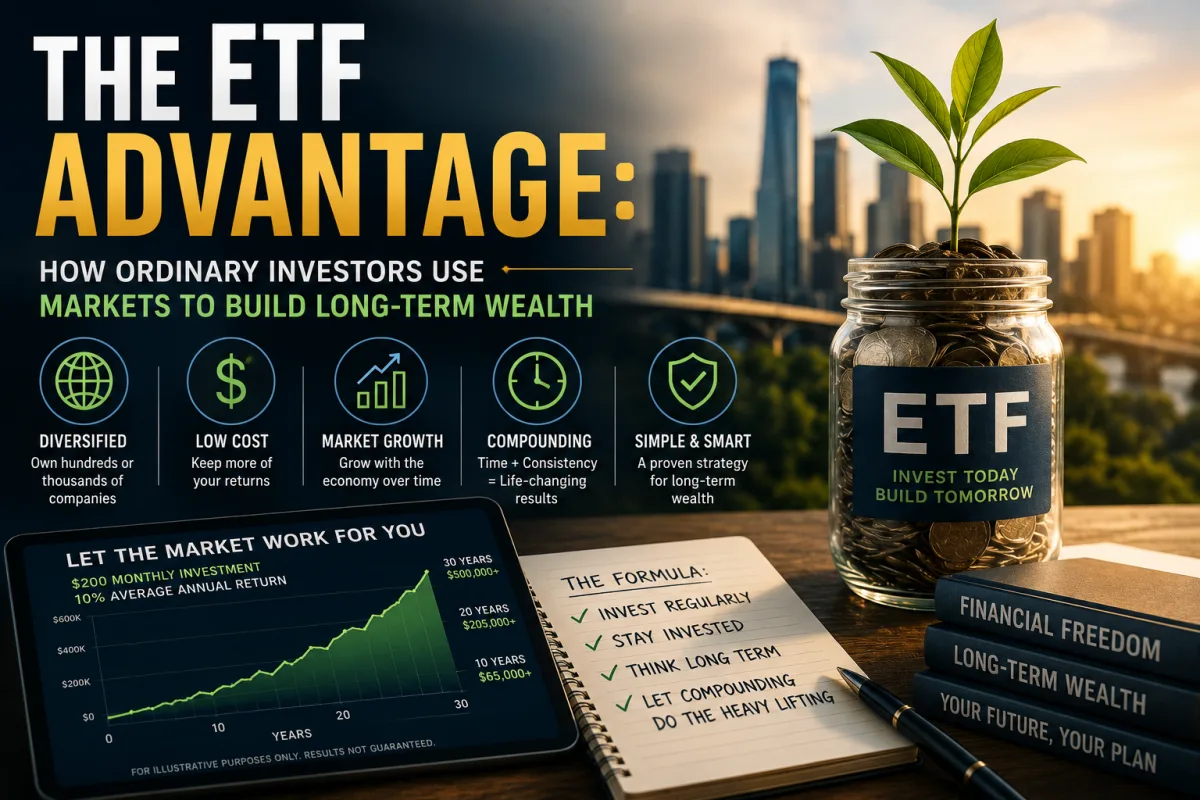
The ETF Advantage: How Ordinary Investors Use Markets to Build Long-Term Wealth
For most of financial history, ordinary investors faced a difficult choice.
They could buy individual stocks and accept the risk of being wrong about a company. They could give money to a professional fund manager and hope the manager would outperform after fees. They could keep savings in cash, fixed deposits, property, or government securities and miss much of the wealth created by listed companies. Or they could avoid investing altogether because the whole process seemed too technical, expensive, and intimidating.
Exchange-traded funds changed that equation.
An exchange-traded fund, or ETF, allows an investor to buy a basket of assets through a single security that trades on a stock exchange. Instead of selecting one company, the investor can own hundreds or thousands. Instead of trying to predict which stock will win, the investor can own an entire market. Instead of needing large amounts of capital to build a diversified portfolio, the investor can begin with much smaller amounts, especially where fractional investing is available.
This is the quiet power of ETFs. They do not promise excitement. They do not require the investor to predict the next market darling. They do not make investing risk-free. Their power is more practical: they make diversified ownership easier, cheaper, and more accessible.
For a Kenyan investor, this matters deeply. Local investors often face a narrow domestic market, currency pressure, inflation, limited access to some asset classes, and concentration in familiar investments such as land, bank deposits, government securities, and a few listed shares. ETFs can open a window to global markets. Through one fund, an investor can gain exposure to large American companies, global equities, bonds, real estate, commodities, or specific sectors.
But ETFs are not magic. They are tools. A good tool can build wealth when used with discipline. The same tool can cause damage when used carelessly. An investor who buys a low-cost broad-market ETF and holds it for decades may participate in the compounding power of global enterprise. An investor who jumps from one fashionable thematic ETF to another may simply replace stock-picking with theme-chasing.
The ETF advantage belongs to investors who understand what they own, why they own it, how much it costs, and how it fits into a long-term plan.
What an ETF Really Is
An ETF is an investment fund that trades on an exchange like a stock. Inside the ETF is a collection of assets. Those assets may be shares of companies, bonds, commodities, real estate investment trusts, or other securities. When an investor buys one share of an ETF, they gain exposure to the assets held by the fund.
The simplest way to think about an ETF is as a basket. Instead of buying one mango, one orange, and one banana separately, you buy a fruit basket. The basket gives you exposure to several items at once. In investing, the basket might contain 500 large American companies, thousands of global companies, a group of technology stocks, a collection of government bonds, or shares of gold-backed securities.
Most ETFs are designed to track an index. An index is a list of securities built according to certain rules. The S&P 500, for example, tracks large publicly traded companies in the United States. A total U.S. market index includes a broader range of American companies. A total world index may include companies across developed and emerging markets. A bond index may include government or corporate bonds of different maturities.
The ETF manager does not usually try to guess which company will outperform. Instead, the manager tries to replicate the performance of the index. This is called passive investing. The objective is not to beat the market through prediction. The objective is to capture the market return at low cost.
This idea sounds simple, but it is one of the most important developments in modern investing. It changed the investor’s task. Instead of asking, “Which stock will win?” the investor can ask, “Which market do I want to own, and at what cost?”
Why Diversification Matters
Diversification is one of the oldest principles in investing because the future is uncertain.
A company that looks strong today can disappoint tomorrow. A bank can suffer rising loan losses. A manufacturer can face higher input costs. A telecom company can face regulation or competition. A technology company can be disrupted. A mining company can be hurt by commodity prices. A retailer can misread consumer demand. Even good businesses can become poor investments if bought at excessive prices.
When an investor owns only one or two stocks, the outcome depends heavily on those few companies. If they perform well, the investor may do very well. If they fail, the investor may suffer permanent loss. Concentration can create wealth, but it can also destroy it.
Diversification spreads risk across many holdings. An ETF tracking a broad index may own hundreds or thousands of companies. Some will disappoint. Some will perform adequately. Some will grow dramatically. The investor does not need to know in advance which ones will become the biggest winners. The basket captures the collective result.
Diversification does not eliminate market risk. If the entire stock market falls, a stock ETF can fall with it. But diversification reduces company-specific risk. It lowers the danger that one management scandal, one product failure, one debt crisis, or one regulatory issue destroys the investor’s portfolio.
This is why ETFs are powerful for ordinary investors. Most people do not have the time, data, training, or temperament to analyze individual companies deeply. A broad ETF allows them to own capitalism itself rather than trying to identify the few companies that will lead it.
The Difference Between Diversification and Safety
One of the first mistakes investors make with ETFs is confusing diversification with safety.
A broad equity ETF may be diversified across many companies, but it can still decline sharply during a bear market. During global crises, investors often sell risky assets together. Correlations rise. Even diversified stock portfolios can fall 20%, 30%, or more. An ETF does not protect investors from market cycles.
Diversification reduces one kind of risk. It does not remove all risk.
An investor who buys an S&P 500 ETF owns many large American companies. That reduces the risk of being wrong about one company. But the investor remains exposed to U.S. equity valuations, corporate earnings, interest rates, inflation, investor sentiment, and the dollar. An investor who buys a technology ETF may own many companies, but still be concentrated in one sector. An investor who buys a global equity ETF may be geographically diversified, but still exposed to global stock market declines.
This distinction matters because investors sometimes become overconfident when they hear the word “diversified.” A diversified portfolio can still lose value. The purpose of diversification is not to make losses impossible. It is to make the portfolio less dependent on any single fragile outcome.
The Index Investing Revolution
The rise of ETFs is part of a larger revolution in index investing.
For decades, the investment industry was dominated by active management. Fund managers attempted to select securities that would outperform the market. Some succeeded for periods of time. Many did not. The challenge for investors was not merely finding a talented manager. It was identifying one in advance, paying the fees, staying invested through underperformance, and hoping the advantage would persist.
Index investing offered a different philosophy. Instead of trying to beat the market, own the market. Keep costs low. Diversify broadly. Minimize unnecessary trading. Let business growth, earnings reinvestment, dividends, and time do the heavy lifting.
This approach is not exciting in the short term. It does not offer the emotional satisfaction of saying you discovered the next great company. It does not make investors feel clever at dinner conversations. But it solves a real problem: most investors are not rewarded for complexity. They are rewarded for discipline, time, low costs, and sensible asset allocation.
The index investing revolution democratized access to professional-level diversification. A person with modest savings can now own exposure that once required significant capital, brokerage access, and portfolio construction knowledge.
Why Costs Matter So Much
ETF fees may look small, but they matter greatly over time.
The expense ratio is the annual cost charged by the ETF as a percentage of assets. A fund with a 0.03% expense ratio costs 30 cents per year for every $1,000 invested. A fund with a 0.75% expense ratio costs $7.50 per year for every $1,000 invested. The difference may look small in one year. Over decades, it compounds.
Every shilling or dollar paid in fees is money that does not remain invested. High fees create a hurdle the investment must overcome before the investor benefits. If two funds provide similar exposure, the lower-cost fund usually has a structural advantage.
This is one reason broad index ETFs became so popular. Many charge very low fees because they simply track an index rather than paying teams of analysts to select securities actively. The investor keeps more of the market return.
But cost should not be judged only by expense ratio. Investors should also consider brokerage commissions, foreign exchange spreads, platform fees, custody charges, withholding taxes, and bid-ask spreads. For Kenyan investors accessing offshore ETFs, the total cost of investing includes the cost of converting shillings into foreign currency and the cost of using the platform that provides access.
A low-cost ETF held on an expensive platform may not be as cheap as it appears. A disciplined investor studies the full cost chain.
The S&P 500 ETF: Simple, Powerful, and Not Perfect
The S&P 500 is one of the most famous indexes in the world. It tracks large publicly traded companies in the United States and includes many of the most influential businesses in global markets. An S&P 500 ETF gives investors exposure to companies across technology, healthcare, finance, consumer goods, industrials, energy, communication services, and other sectors.
The appeal is obvious. The United States has produced many of the world’s most profitable and innovative companies. The S&P 500 has historically delivered strong long-term returns, although those returns have never arrived smoothly. Investors who held through recessions, crashes, inflation scares, wars, rate cycles, and political uncertainty were compensated by the growth of corporate earnings and market value over long periods.
For Kenyan investors, an S&P 500 ETF can offer several benefits. It provides exposure to global companies beyond the domestic economy. It gives access to dollar-denominated assets. It reduces dependence on local market performance. It can serve as a simple core equity holding for investors seeking long-term growth.
But the S&P 500 is not the entire world. It is heavily linked to the United States. It can become concentrated in a few large companies when those companies dominate market capitalization. It may underperform other regions for long periods. Its valuation can rise to levels that reduce future expected returns. It is an excellent tool, but not a complete answer for every investor.
An investor who owns only the S&P 500 is making a choice: a strong preference for large U.S. companies. That may be reasonable. It should still be understood as a choice, not as neutral exposure to the whole global economy.
Total U.S. Market ETFs
A total U.S. stock market ETF provides broader exposure than the S&P 500. It may include large, mid-sized, small, and micro-cap companies across the American market. This gives investors exposure not only to established giants but also to smaller companies that may grow over time.
The advantage is broader diversification within one country. The investor is less limited to the largest companies. If smaller companies outperform over a period, the total market fund can capture some of that benefit. It is also a simple way to own the American equity market without deciding which segment will lead.
The difference between an S&P 500 ETF and a total U.S. market ETF may not always be dramatic because large companies often dominate the total market by size. But the philosophy is different. The S&P 500 focuses on large companies selected according to index rules. The total market approach aims to own nearly everything publicly traded in the U.S. market.
For long-term investors, either approach can be reasonable. The right choice depends on the investor’s goals, beliefs, desired simplicity, and broader portfolio.
Total World ETFs and Global Diversification
A total world ETF gives exposure to companies across many countries. It may include U.S. stocks, European stocks, Japanese stocks, Canadian stocks, emerging market stocks, and other regions. The purpose is to own global capitalism rather than one country’s market.
This approach appeals to investors who do not want to bet heavily on one economy. The United States has been dominant in recent decades, but leadership can change. Different regions perform well at different times. Currency cycles shift. Valuations diverge. Political and demographic forces affect markets in different ways.
A global ETF accepts uncertainty. It says, in effect: instead of deciding which country will win, own the world.
Some investors prefer the S&P 500 because American companies have global revenues and a long record of strong performance. Others prefer total world funds because they provide more balanced international exposure. Neither view is automatically correct. The important point is that investors understand the trade-off.
For Kenyan investors, global diversification can be especially valuable because it reduces dependence on the local economy and local currency. A portfolio concentrated only in Kenyan assets is exposed to Kenyan inflation, Kenyan interest rates, Kenyan politics, Kenyan corporate earnings, and the shilling. Global ETFs can introduce exposure to other economies and currencies.
But global exposure introduces its own risks. Foreign investments can fluctuate with exchange rates. Overseas tax rules may affect dividends. Some markets may underperform for long periods. Emerging markets can be volatile. International diversification is valuable, but it is not a guarantee of smooth returns.
Geographic and Country-Specific ETFs
Some ETFs focus on specific countries or regions. An investor can buy exposure to India, China, Japan, Europe, emerging markets, frontier markets, or specific regional blocs. These funds can be useful for investors who have a strong view about a country’s growth prospects.
The risk is concentration. A country-specific ETF may hold many companies, but those companies are often exposed to the same political system, currency, regulatory environment, economic cycle, and investor sentiment. If the country experiences a crisis, the whole fund may decline.
Country ETFs can be valuable satellite holdings, but they should be used carefully. They require more knowledge than broad global funds because the investor is making a specific geographic bet. A compelling economic story does not always translate into strong stock market returns. A country can grow quickly while listed companies underperform if valuations are high, governance is weak, currency depreciates, or profits do not flow to minority shareholders.
This is a crucial lesson for emerging and frontier market investors. Economic growth and investment returns are related, but they are not the same. The investor must ask who captures the growth, at what price, and under what governance conditions.
Sector and Thematic ETFs
Thematic ETFs are built around a story. Artificial intelligence. Clean energy. Cybersecurity. Robotics. Electric vehicles. Healthcare innovation. Digital payments. Semiconductors. Space exploration. Water scarcity. Climate transition.
These themes can be real. Many represent powerful economic forces. The problem is not that themes are imaginary. The problem is that good themes can still become bad investments if the price is too high, the fund is poorly constructed, or the investor buys after the excitement has already been priced in.
A thematic ETF may own companies that are only loosely connected to the theme. It may charge higher fees than broad index funds. It may be concentrated in a narrow set of stocks. It may be launched near the peak of investor enthusiasm, when demand for the theme is strongest and valuations are stretched.
This does not mean thematic ETFs should never be used. They can play a role for investors who understand the risks and keep allocations modest. But they are rarely suitable as the foundation of a portfolio. A portfolio built entirely around fashionable themes can become a collection of narratives rather than a disciplined wealth plan.
The correct question is not, “Is this theme important?” The correct question is, “Does this fund give me sensible exposure to the theme at a reasonable cost and valuation, and does it fit my overall plan?”
Bond ETFs
Equity ETFs receive most of the attention, but bond ETFs also matter.
A bond ETF holds a portfolio of bonds. These may be government bonds, corporate bonds, short-term bonds, long-term bonds, inflation-linked bonds, high-yield bonds, or international bonds. Bond ETFs can provide income, diversification, and lower volatility than equity funds, although they also carry risks.
Bond prices move when interest rates change. When rates rise, existing bond prices often fall. Long-duration bond funds are usually more sensitive to rate changes than short-duration funds. Corporate bond funds also carry credit risk. High-yield bond ETFs may offer higher income but can behave more like equities during stress periods.
For long-term investors, bonds can serve several purposes. They can reduce portfolio volatility. They can provide liquidity for rebalancing. They can support income needs. They can create psychological stability during stock market declines.
Kenyan investors often compare offshore bond ETFs with local government securities, fixed deposits, and money market funds. The right choice depends on currency needs, yield, risk, taxation, liquidity, and investment horizon. A dollar bond ETF may help diversify currency exposure, but it can also fluctuate in price. A local Treasury bond may offer attractive income, but it concentrates exposure in domestic currency and sovereign risk.
Gold ETFs
Gold has a long history as a store of value, a crisis hedge, and an asset that behaves differently from stocks and bonds. A gold ETF allows investors to gain exposure to gold without physically storing bullion.
Gold does not produce earnings, dividends, or interest. Its value depends on investor demand, inflation expectations, real interest rates, currency movements, central bank activity, and market fear. This makes it different from productive assets such as stocks or bonds.
A small allocation to gold may help diversify a portfolio, especially for investors worried about currency debasement, geopolitical risk, or inflation shocks. But gold should not be confused with a wealth-compounding machine. Over long periods, businesses that reinvest earnings and grow cash flow can create value in ways gold cannot.
Gold is insurance-like. It may protect purchasing power in certain environments, but it should not dominate a growth portfolio unless the investor has a very specific risk view.
Bitcoin and Cryptocurrency ETFs
Cryptocurrency-linked ETFs have opened another frontier for investors. Bitcoin ETFs, in particular, allow investors to gain exposure to bitcoin through regulated market structures rather than direct ownership on crypto exchanges.
This access has advantages. Investors may avoid some custody challenges associated with holding cryptocurrency directly. Traditional brokerage accounts may make allocation easier. Regulatory oversight may improve transparency compared with unregulated platforms.
But the underlying asset remains highly volatile. Bitcoin can rise dramatically and fall dramatically. It does not produce earnings or dividends. Its value depends on scarcity narratives, adoption, liquidity, regulation, investor sentiment, macro conditions, and speculation.
A small allocation may be acceptable for investors who understand the risk and can tolerate large drawdowns. But cryptocurrency ETFs should not be treated as substitutes for diversified equity or bond holdings. They are speculative satellite assets, not financial foundations.
The danger is not owning a small amount of a volatile asset. The danger is allowing excitement to override position sizing. In investing, the size of the bet often matters as much as the idea itself.
REIT ETFs and Real Estate Exposure
Real estate investment trust ETFs provide exposure to listed real estate companies that own or finance income-producing properties. These may include offices, apartments, warehouses, shopping centers, data centers, healthcare facilities, or other property types.
REIT ETFs can help investors access diversified real estate exposure without buying physical property. They may provide income through dividends and can be more liquid than direct real estate ownership.
But listed real estate is not the same as owning land or a rental property directly. REIT prices can fluctuate daily like stocks. They are sensitive to interest rates because property valuations and financing costs matter. They can be affected by tenant demand, occupancy rates, debt levels, and property-sector trends.
For Kenyan investors accustomed to thinking of land as the default wealth asset, REIT ETFs offer a different lesson. Real estate exposure can be financialized, diversified, and liquid. But liquidity comes with volatility, and income depends on the quality of the underlying property assets.
Why ETFs Are Especially Relevant for Kenyan Investors
Kenyan investors face a unique financial environment. The local stock market offers opportunities, but it is relatively small. Many households already have high exposure to the Kenyan economy through jobs, businesses, property, pensions, and local savings. The shilling can depreciate over long periods. Inflation can reduce purchasing power. Local investment options may be concentrated in familiar asset classes.
Offshore ETFs can help address some of these challenges.
First, they provide access to global companies. A Kenyan investor can own exposure to firms in technology, healthcare, consumer brands, industrial automation, financial services, and other sectors that may not be well represented locally.
Second, they diversify currency exposure. If an investor holds dollar-denominated assets, part of their wealth is no longer tied only to the shilling. This can matter for education abroad, international travel, imported goods, medical expenses, or long-term purchasing power.
Third, they reduce dependence on local market liquidity. Some domestic shares may have limited trading volumes. Large global ETFs often trade with deeper liquidity, although the investor’s access platform may still affect execution quality.
Fourth, ETFs can support disciplined long-term investing. Instead of waiting to buy land, trying to identify the best local stock, or holding too much idle cash, an investor can gradually allocate to diversified global funds.
But offshore investing also requires responsibility. Investors must understand tax implications, platform risk, foreign exchange costs, estate considerations, regulatory protections, and withdrawal processes. Offshore access is valuable, but it should not be treated casually.
Currency Risk: Protection and Exposure
Many Kenyan investors think of dollar assets as protection against shilling depreciation. This can be true, but the relationship is not always simple.
If the shilling weakens against the dollar, a dollar-denominated ETF may rise in shilling terms even if its dollar price is unchanged. That can protect local purchasing power. But if the shilling strengthens, the opposite can happen. A Kenyan investor may earn a positive dollar return but see a smaller return in shilling terms.
Currency exposure cuts both ways.
The right question is not whether currency movements can help or hurt. They can do both. The better question is what currency the investor’s future obligations are in. If future expenses are in Kenya, shilling liquidity remains important. If future expenses include foreign education, travel, imports, or global retirement plans, dollar exposure may be useful.
A balanced investor does not need to choose between local and foreign exposure as if one must replace the other entirely. The goal is to match assets with future needs while diversifying against avoidable concentration.
The Core and Satellite Approach
One useful way to build an ETF portfolio is the core and satellite approach.
The core is the foundation. It usually consists of broad, low-cost ETFs that provide diversified exposure to major asset classes. A core holding may be an S&P 500 ETF, a total U.S. market ETF, a total world ETF, a global equity ETF, or a balanced mix of stock and bond ETFs. The core should be simple, durable, low-cost, and aligned with long-term goals.
Satellites are smaller positions around the core. These may include sector ETFs, country funds, thematic ETFs, gold, REITs, or cryptocurrency exposure. Satellites allow the investor to express specific views without risking the entire portfolio.
This structure helps manage excitement. An investor who believes artificial intelligence will be important can allocate a modest satellite position to a technology or AI-related ETF. But the core remains diversified. If the theme disappoints, the portfolio survives. If the theme performs well, the investor participates.
The mistake many investors make is reversing the structure. They build the portfolio around satellites and neglect the core. The result is a collection of narrow bets rather than a wealth-building engine.
Asset Allocation Matters More Than ETF Selection
Investors often spend too much time asking which ETF is best and too little time asking what allocation is appropriate.
Asset allocation is the division of a portfolio among asset classes such as stocks, bonds, cash, real estate, commodities, and alternatives. It is one of the most important drivers of long-term portfolio behavior.
A young investor with stable income and a long horizon may hold a higher allocation to equity ETFs because they can tolerate volatility and benefit from growth. A retiree may need more bonds, cash, and income-producing assets because withdrawals are closer and capital preservation matters more. A business owner with irregular income may need a larger emergency fund before investing aggressively.
The right ETF inside the wrong allocation can still produce poor outcomes. A low-cost equity ETF is a good tool, but it may be unsuitable for money needed next year. A bond ETF may be sensible for stability, but too much conservatism can limit long-term growth for a young investor.
Investing begins with purpose. What is the money for? When will it be needed? What losses can the investor tolerate emotionally and financially? What currency will future expenses be in? What other assets does the investor already own?
Only after answering those questions should the investor select ETFs.
Time Horizon: The Investor’s Greatest Advantage
ETFs are most powerful when paired with time.
Stock markets can be unpredictable over one year. They can disappoint over three years. They can go through long periods of volatility, fear, and underperformance. But over long horizons, broad equity ownership has historically rewarded investors because companies innovate, sell products, increase productivity, earn profits, and reinvest capital.
Time allows compounding to work. Dividends can be reinvested. Earnings can grow. Market declines can become buying opportunities for investors who continue contributing. Costs remain low. Taxable selling can be minimized. The investor’s behavior becomes more important than short-term market noise.
This is why ETFs fit regular investing so well. An investor can contribute monthly or quarterly into a broad ETF, regardless of headlines. This approach, often called dollar-cost averaging, reduces the pressure to choose the perfect entry point. Sometimes contributions buy at high prices. Sometimes they buy at low prices. Over time, the habit matters more than the prediction.
The investor does not need to know where the market will be next month. The investor needs a plan strong enough to continue through uncertainty.
The Danger of Performance Chasing
ETF investors can still make the same behavioral mistakes as stock pickers.
One of the most common is performance chasing. An investor looks at the best-performing ETF of the past year and assumes it will continue. Money flows into last year’s winner. Then the cycle changes. The popular theme cools. Valuations compress. The investor sells in disappointment and moves to the next winner.
This behavior turns ETFs into trading vehicles rather than investment tools. The fund structure may be efficient, but the investor’s behavior destroys the benefit.
Performance chasing is especially dangerous with thematic ETFs because many are launched or marketed when a theme is already popular. By the time ordinary investors hear the story repeatedly, much of the optimism may already be priced in.
A disciplined investor does not buy an ETF because it recently performed well. They buy because it fits a long-term allocation at a reasonable cost and risk level.
Liquidity and Trading Discipline
Because ETFs trade throughout the day, investors can buy and sell them like stocks. This is convenient, but it can encourage unnecessary trading.
Traditional mutual funds trade once per day at net asset value. ETFs trade intraday, meaning their prices move during market hours. This gives flexibility, but flexibility can become temptation. Investors may check prices too often, react to short-term movements, or try to time entries and exits.
Long-term investors should not confuse tradability with the need to trade. The ability to sell an ETF instantly does not mean selling is wise. The same feature that makes ETFs convenient can make undisciplined behavior easier.
Investors should also understand bid-ask spreads. The bid is the price buyers are willing to pay. The ask is the price sellers are willing to accept. Highly liquid ETFs usually have narrow spreads. Less liquid ETFs may have wider spreads, making trading more expensive. For large purchases or less liquid funds, execution quality matters.
Taxes, Withholding, and Estate Considerations
Taxes can affect ETF returns, especially for investors buying offshore funds.
Dividends from foreign ETFs may be subject to withholding tax depending on the fund’s domicile, the investor’s country of residence, and applicable tax treaties. Capital gains treatment can vary. Estate tax exposure may apply in certain jurisdictions. Local reporting obligations may also exist.
Many investors ignore these issues because ETF investing feels simple. The product may be simple, but cross-border investing introduces legal and tax complexity. Investors with significant offshore holdings should seek qualified tax guidance.
Tax should not prevent investors from using ETFs, but it should be part of the decision. The goal is not just gross return. The goal is after-tax, after-cost, after-inflation wealth.
How to Compare ETFs
Before buying an ETF, investors should compare several features.
First, examine the index or strategy. What does the ETF actually track? Does it hold large companies, small companies, global stocks, bonds, commodities, or a narrow theme? The name of a fund can be misleading. The holdings reveal the truth.
Second, review the expense ratio. Lower is generally better when exposure is similar, but the cheapest fund is not automatically the best if it tracks the wrong index or has poor liquidity.
Third, study holdings and concentration. Does the fund hold thousands of companies or only 30? Are the top ten holdings a large percentage of the portfolio? Is the fund dominated by one sector?
Fourth, consider domicile and tax treatment. Funds listed in different jurisdictions may have different tax implications.
Fifth, assess trading liquidity. Large, established ETFs often trade efficiently. Smaller specialized ETFs may have wider spreads.
Sixth, evaluate tracking difference. An ETF should closely follow its index after fees. Persistent underperformance relative to the benchmark may indicate costs, structure, or replication issues.
Seventh, understand currency exposure. The trading currency of the ETF may not be the same as the currency exposure of the underlying assets. A global ETF trading in dollars may still hold companies earning revenues in euros, yen, pounds, rupees, or other currencies.
Finally, ask whether the ETF fits your plan. A good ETF can still be wrong for your goals.
Common ETF Mistakes
The first mistake is buying what you do not understand. An ETF can sound diversified while hiding concentration, leverage, derivatives, or sector exposure. Always read the fund objective and holdings.
The second mistake is owning too many ETFs. Some investors buy several funds that all hold similar companies. They believe they are diversifying, but they are duplicating exposure. Owning an S&P 500 ETF, a large-cap growth ETF, a technology ETF, and a Nasdaq-focused ETF may create heavy overlap in the same mega-cap companies.
The third mistake is ignoring fees. High expense ratios, platform costs, and currency conversion charges reduce returns.
The fourth mistake is using long-term funds for short-term money. Equity ETFs are not suitable for rent, school fees due soon, emergency funds, or money needed within months.
The fifth mistake is overusing thematic ETFs. Themes are attractive because they tell compelling stories. But stories are not the same as diversified wealth plans.
The sixth mistake is panic selling. ETFs make it easy to exit, but market declines are part of equity investing. Selling during fear can turn temporary volatility into permanent loss.
The seventh mistake is failing to rebalance. Over time, some assets grow faster than others. A portfolio can become riskier than intended. Rebalancing restores discipline by trimming overweight assets and adding to underweight ones.
ETFs Are Not a Substitute for Financial Planning
ETFs are investment products. They are not complete financial plans.
A person still needs an emergency fund, insurance where appropriate, debt management, retirement planning, estate planning, tax awareness, and clear goals. Buying an ETF does not solve overspending. It does not eliminate high-interest debt. It does not protect against medical emergencies. It does not replace income planning.
The proper order matters. Build a cash buffer. Control expensive debt. Understand monthly expenses. Protect against major risks. Then invest consistently according to a plan.
Investing before building a foundation can create stress. A person with no emergency fund may be forced to sell ETF holdings during a market downturn to handle a crisis. That is not investment failure. It is planning failure.
The Long-Term Wealth Lesson
The genius of ETFs is not that they make investors rich quickly. It is that they make sensible investing easier.
They allow ordinary people to own diversified portfolios. They reduce the need for constant prediction. They lower costs. They make global markets accessible. They support regular investing. They allow investors to focus less on stock selection and more on behavior, savings rate, asset allocation, and time.
For Kenyan investors, ETFs can open doors that were once difficult to access. They can provide exposure to the U.S. market, global equities, bonds, real estate, gold, and other assets. They can help diversify beyond the domestic economy and local currency. They can become part of a serious wealth-building plan.
But ETFs reward discipline, not excitement. The investor must avoid the temptation to chase every new fund, every hot theme, every recent winner, and every market prediction. The most powerful ETF strategy is often the least dramatic: choose broad, low-cost funds, invest consistently, diversify sensibly, keep costs low, rebalance periodically, and give compounding time to work.
The Investor’s Final Test
Before buying any ETF, an investor should be able to answer a few questions clearly.
What does this ETF own? What index or strategy does it follow? How much does it cost? Is it broad or narrow? What risks does it carry? What currency exposure does it create? How does it fit with my other investments? Is this money meant for long-term growth, income, preservation, or speculation? Can I hold this fund through a market decline without panicking?
If those questions cannot be answered, the investor is not ready to buy. Simplicity should not become carelessness.
ETFs are among the most useful financial inventions available to ordinary investors. They can turn small contributions into global ownership. They can help disciplined savers participate in the growth of companies around the world. They can reduce dependence on prediction and increase dependence on process.
But the ETF is only the vehicle. The investor still needs the map.
That map is built from patience, diversification, low costs, realistic goals, risk awareness, and the humility to admit that no one knows the future with certainty.
Used well, ETFs are not hidden treasures because they are mysterious. They are treasures because they make one of the most reliable principles of wealth accessible to almost everyone: own productive assets, diversify broadly, keep costs low, and let time do its work.
 Article
 Article
 Article
 Article
 Article
 Article
 Article
 Article