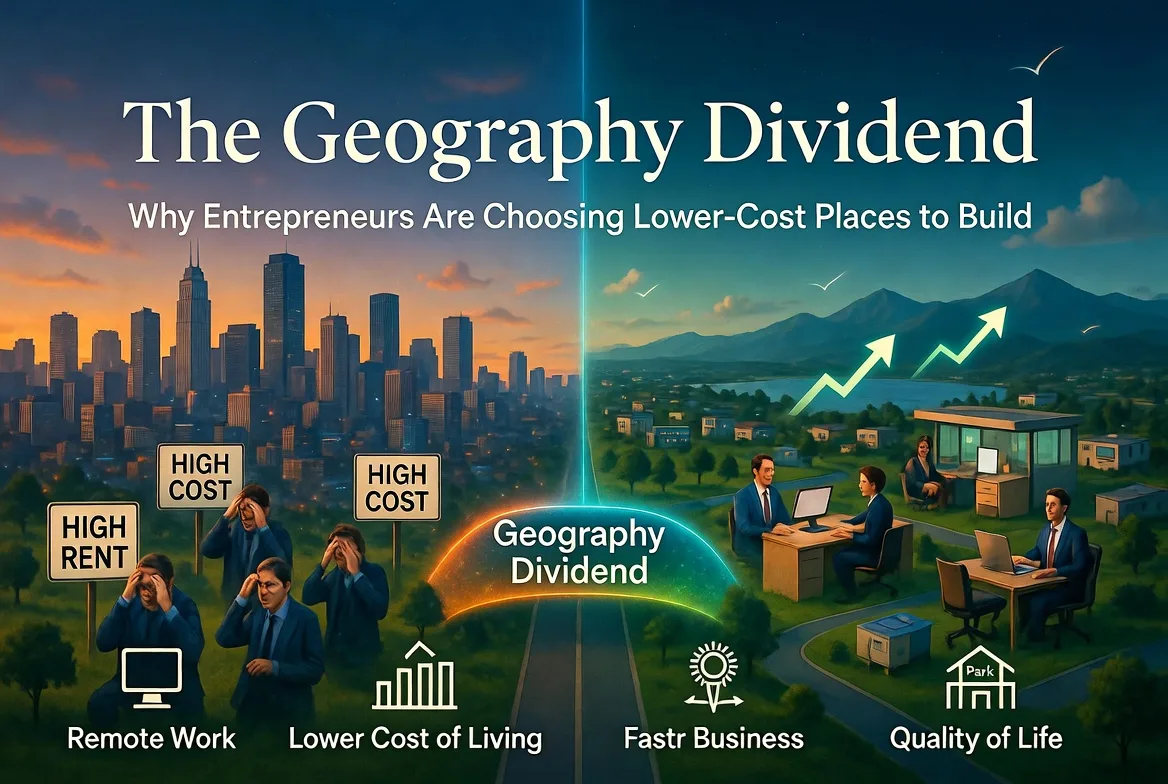
The Geography Dividend: Why Entrepreneurs Are Choosing Lower-Cost Places to Build
For much of modern startup culture, geography carried a simple message: serious ambition belonged in serious hubs. If you wanted technology, you looked to Silicon Valley. If you wanted finance, you looked to New York. If you wanted entertainment, you looked to Los Angeles. If you wanted scale, capital, status, talent, and visibility, you moved toward density. The advice was often implicit but powerful: go where the action is.
That assumption is weakening. Entrepreneurs are still ambitious, but many are becoming more financially precise about where they build. They are asking a different set of questions. How much runway does this city consume? How expensive is talent? How heavy is the tax burden? How difficult is compliance? How much does office space cost? How much personal income must the founder withdraw just to survive? How long can the company operate before needing outside capital? How much of every dollar earned remains available for reinvestment?
These questions matter because business location is not only a map decision. It is a financial decision. A company’s geography can shape its cost structure, hiring model, capital needs, tax exposure, regulatory friction, customer access, quality of life, and founder psychology. In a world of remote work, AI-enabled operations, digital marketing, cloud infrastructure, virtual teams, and online payments, many entrepreneurs no longer need to pay the full price of being physically close to traditional centres of power.
This does not mean major hubs are dead. They remain valuable. Dense cities still offer talent, capital, networks, universities, customers, media, suppliers, and cultural energy. Some businesses benefit enormously from being close to these ecosystems. A founder raising venture capital, recruiting specialized engineers, selling to enterprise clients, building in biotech, working in media, or relying on dense customer footfall may still find a major hub worth the cost.
But the old idea that bigger is always better has become financially lazy. The better question is not whether a location is prestigious. The better question is whether it improves the economics of the business being built.
Location Has Become Part of the Business Model
Every business has a model, even when the founder does not describe it formally. A business model explains how the company creates value, delivers value, and captures value. Geography influences all three.
A restaurant depends heavily on foot traffic, rent, local wages, utilities, licences, suppliers, and neighbourhood demand. A software company may depend more on talent, internet infrastructure, taxes, hiring laws, and access to capital. A consulting firm may need proximity to clients or may operate almost entirely through video calls. A manufacturing business must think about logistics, power, labour, land, regulation, and supply chains. A creator-led business may need affordable living, good internet, airports, and a supportive creative community more than a downtown office.
Because business models differ, the best location differs. The mistake is copying someone else’s geography without copying their economics. A venture-backed startup may tolerate high burn because its growth model depends on speed, talent density, and investor proximity. A bootstrapped founder cannot casually imitate that cost structure. A lifestyle business may prioritize owner quality of life and profitability. A logistics company may need transport corridors. A professional services firm may need credibility in a certain city. A digital product company may gain little from paying premium rent in a famous market.
Location should therefore be evaluated as part of strategy. The founder should ask: Does this place increase revenue, reduce cost, improve talent access, strengthen customer trust, lower risk, or extend runway? If the answer is unclear, the business may be paying for symbolism rather than advantage.
The Runway Effect
Runway is the amount of time a business can survive before it runs out of cash. For early-stage entrepreneurs, runway is life. It determines how many experiments can be run, how many customers can be acquired, how many mistakes can be survived, and how much pressure the founder feels when making decisions.
Location directly affects runway. A founder living in an expensive city may need a higher personal draw from the business. Office space may cost more. Contractors may charge more. Local services may be expensive. Taxes and compliance costs may be heavier. Even social expectations can raise costs: meetings in expensive venues, networking events, professional image spending, and lifestyle pressure.
A lower-cost location can extend runway without requiring more revenue or more investment. That is a powerful advantage. If two founders each begin with the same amount of capital, the one with lower living and operating costs can often survive longer. Survival time creates learning time. Learning time creates strategic optionality. The founder can test pricing, refine the product, build distribution, and develop customer trust without constantly facing the panic of a shrinking bank balance.
This is the geography dividend: the extra financial breathing room created by building in a place where the cost of ambition is lower.
The dividend is not automatic. A cheaper location that limits customers, talent, infrastructure, or logistics may harm the business. But where the business can operate effectively, lower fixed costs become a quiet source of competitive strength.
Why Remote Work Changed the Calculation
Remote work did not remove geography. It changed what geography means. In the past, many businesses had to locate near employees, customers, suppliers, or investors because communication and coordination required physical proximity. Today, many forms of work can be done across distance. Documents move instantly. Meetings happen online. Teams collaborate through cloud software. Payments cross borders. Customers can be reached through search, social media, email, marketplaces, and digital advertising.
This has weakened the monopoly of high-cost hubs. A founder can live in a smaller city, hire a designer in another country, use a developer in a different state, sell to customers nationally, and meet investors through video calls. A consultant can advise clients from anywhere. A software company can support users globally. A digital education company can sell courses without owning classrooms. A professional firm can operate with a distributed team.
Remote work also changes personal finance. If the founder can maintain revenue while reducing living costs, the household balance sheet improves. Lower rent or mortgage payments, lower transport costs, lower childcare costs, and lower daily expenses can reduce the pressure to extract cash from the company. That allows more profit to remain inside the business for hiring, marketing, product development, inventory, or reserves.
But remote work also creates new disciplines. Distributed businesses need documentation, communication norms, cybersecurity, performance management, and culture. A company can save money on office space and lose money through confusion if remote operations are poorly managed. Remote work rewards founders who build systems. It punishes those who confuse distance with simplicity.
AI Makes Geography More Flexible, But Not Irrelevant
Artificial intelligence has added another layer to the location decision. A small team can now produce more with fewer people. AI can assist with drafting, research, customer support, coding, design, analysis, documentation, translation, lead generation, and administrative work. This reduces the need to hire large local teams early.
For entrepreneurs in lower-cost locations, this can be especially important. A founder no longer needs every specialist nearby. They can use AI for first drafts, routine tasks, operational support, and productivity leverage, then hire humans for judgement, strategy, relationships, technical oversight, and execution. This allows a lean company to operate with capabilities that once required a larger payroll.
Yet AI does not make place meaningless. Internet reliability matters. Time zones matter. Legal jurisdiction matters. Customer expectations matter. Tax residency matters. Data protection rules matter. Access to airports, clients, manufacturing, healthcare, schools, and housing still matters. AI may reduce dependence on local labour for certain tasks, but it does not eliminate the practical realities of living and operating somewhere.
The more useful conclusion is that AI increases the number of viable places where entrepreneurs can build. It gives founders more location options. It does not make all locations equal.
The Tax Climate Question
Taxes are one of the clearest financial reasons entrepreneurs consider relocation. Income taxes, corporate taxes, sales taxes, franchise taxes, property taxes, payroll taxes, and filing fees can affect both the business and the founder’s personal finances. A business-friendly tax environment may improve cash retention, especially for profitable companies.
But tax decisions must be handled carefully. Entrepreneurs sometimes hear that a state or country has no income tax, low corporate tax, or favourable filing rules and assume relocation is automatically beneficial. The truth is more complex. Tax obligations depend on where the business is formed, where it operates, where customers are located, where employees work, where inventory is stored, where the founder resides, and how revenue is earned.
A company formed in one jurisdiction may still owe taxes or registration fees in another if it has sufficient activity there. A remote employee in a different state or country may create compliance obligations. Selling across borders can raise sales tax, VAT, or data compliance issues. Moving personally may not immediately erase prior tax obligations. Some low-tax places compensate through other costs, such as higher property taxes, insurance, fees, or limited services.
Tax efficiency is valuable, but it should be designed with professional advice. The goal is not to chase the lowest visible tax rate. The goal is to build a legal, sustainable structure that reduces unnecessary leakage without creating compliance risk.
Regulation as a Cost of Doing Business
Regulation is another part of the geography equation. Some locations make it easier to register a business, hire employees, obtain licences, access permits, file annual reports, manage compliance, and operate without excessive delays. Others may impose more complex procedures.
Regulation is not inherently bad. Good regulation protects workers, customers, investors, health, safety, and fair competition. But regulatory complexity can be costly for small businesses because they lack large legal and administrative teams. A multinational corporation can absorb compliance departments. A three-person startup cannot.
Founders should evaluate regulatory fit. A food business must understand health permits. A childcare business must understand licensing. A financial business must understand strict compliance. A construction business must understand zoning, insurance, and safety rules. A digital business must understand privacy, consumer protection, and tax obligations. A healthcare, education, transport, or insurance-related company may face sector-specific rules that geography can greatly affect.
A business-friendly location is not simply one with fewer rules. It is one where rules are clear, processes are predictable, agencies are responsive, and compliance costs are proportionate to the company’s stage and risk.
Talent Is No Longer Only Local, But It Is Still Local
One argument for major hubs has always been talent. Skilled people cluster where opportunity, universities, investors, and ambitious companies cluster. That remains true. But talent markets have become more layered.
A company can hire remote employees. It can use contractors. It can outsource specialized tasks. It can use AI for some support work. It can build a hybrid model where leadership is in one place, technical staff are distributed, customer support is elsewhere, and salespeople are near key markets. This flexibility allows companies outside traditional hubs to access skill without relocating the entire business.
Still, local talent matters for many firms. Manufacturing, hospitality, healthcare, construction, logistics, retail, personal services, and local sales all depend heavily on nearby workers. Even digital companies benefit from local communities of builders, advisers, accountants, lawyers, marketers, and operators. The founder’s city can influence who they meet, what they learn, and how quickly they can build trust.
Entrepreneurs should therefore ask not only, “Can I hire remotely?” but “Which roles must be local, which can be remote, and which can be outsourced?” A location that is excellent for remote software work may be poor for a business requiring warehouse labour. A city with low costs but limited professional services may slow a regulated company. A place with a strong university or technical school may offer talent advantages even if it is not a famous startup hub.
Capital Access Still Matters
Traditional hubs remain powerful partly because capital is social. Investors often fund people they know, people introduced by trusted networks, and companies close enough to observe. Even with remote pitching, proximity can still help. Casual meetings, founder communities, accelerators, industry events, and repeated exposure can influence fundraising.
But not every business should be built around venture capital. Many entrepreneurs are bootstrapping, using revenue, customer deposits, small-business loans, grants, crowdfunding, angel investors, or strategic partnerships. For these founders, lower costs can be more valuable than investor proximity. A company that needs less money has more control. It can grow at a pace aligned with profitability. It can avoid dilution. It can make decisions for customers and owners rather than for the next funding round.
This is one of the deeper wealth implications of the location shift. Lower-cost geography can support ownership retention. If a founder can build with less external capital, they may keep a larger share of the company. Ownership is the asset that creates wealth. Revenue pays bills, but ownership captures upside. A founder who gives away too much equity early may build a large company and still retain less wealth than expected.
Location can therefore affect dilution. A high-cost location may force earlier fundraising. Earlier fundraising may require giving up equity before the business has strong valuation. A lower-cost location may give the founder time to prove traction and raise later on better terms, or avoid raising at all.
The Personal Balance Sheet of the Founder
Entrepreneurship is often discussed as if the founder and the business are separate. Legally, they should be. Financially, they are deeply connected, especially in the early years. A founder’s personal expenses influence the company’s cash needs. A founder with heavy rent, debt, lifestyle costs, or family obligations may need to withdraw more from the business or raise more capital. A founder with lower personal costs can often reinvest more.
Relocation can strengthen the founder’s personal balance sheet. Moving to a lower-cost area may reduce housing expenses, commute costs, childcare costs, taxes, and daily spending. It may allow the founder to buy a home, build savings, or reduce debt. These improvements can make the founder more patient and less reactive.
Founder stress is not merely emotional. It affects decision-making. A founder under personal financial pressure may accept poor deals, underprice services, overpromise to customers, borrow unwisely, or sell equity too early. A founder with personal financial stability can negotiate better, choose customers more carefully, and build for the long term.
This is why geography can be a form of risk management. A lower-cost life can create the mental and financial space needed to make better business decisions.
Quality of Life Is Not a Soft Metric
Entrepreneurs sometimes treat quality of life as secondary to ambition. They imagine that serious founders should tolerate stress, high costs, long commutes, cramped housing, and constant pressure because success demands sacrifice. Sacrifice is real, but unnecessary friction is not a badge of honour.
Quality of life affects founder stamina. Access to affordable housing, safe neighbourhoods, good schools, healthcare, outdoor space, community, and manageable commuting can influence how long a founder can perform at a high level. A business may require years of sustained effort. The environment around the founder can either support that effort or drain it.
This does not mean every entrepreneur should move to a quiet town. Some people draw energy from dense cities. They need movement, networks, cultural intensity, and proximity to opportunity. Others think better with space, lower costs, and fewer distractions. The point is not to romanticize either. The point is to recognize that founder productivity is affected by place.
A location that allows the founder to live well on less may become a strategic advantage. It reduces burnout risk. It supports family stability. It lowers financial anxiety. It may increase the founder’s ability to persist through slow growth periods.
The Myth of the Prestigious Address
Prestige can be expensive. A downtown office, famous zip code, or presence in a recognized startup hub can signal seriousness. For some businesses, that signal matters. A law firm, financial firm, luxury brand, media company, or venture-backed startup may benefit from being associated with a certain place.
But prestige should be purchased only when it produces a return. Too many founders pay for status before they have built substance. They rent offices they do not need, move to cities they cannot afford, and attend events that create social proof but not customers. The business begins to carry the cost of being seen rather than the cost of being effective.
A disciplined entrepreneur asks whether the prestigious address changes customer acquisition, pricing power, investor access, hiring quality, or partnership opportunities. If it does, the cost may be justified. If it does not, the company may be better served by a lower-cost base and targeted travel to key markets.
In a digital economy, credibility can also be built through product quality, customer results, thought leadership, reviews, referrals, certifications, partnerships, and consistent communication. Physical location is one signal among many. It is no longer the only proof of seriousness.
Why Smaller Markets Can Offer Bigger Visibility
Large markets offer scale, but they also create anonymity. In a major hub, a new company may be one of thousands competing for attention. In a smaller market, the same company may become visible more quickly. Local media may care. Chambers of commerce may be accessible. Government programs may be more responsive. Business leaders may be easier to meet. Customers may value local presence.
This can create a network advantage. A founder in a smaller city may build relationships faster because the ecosystem is less crowded. They may become known as a serious operator within a niche. They may access local incentives, mentorship, or partnerships that would be harder to secure in a saturated hub.
However, smaller markets can also be limiting. The customer base may be smaller. Talent pools may be thinner. Specialized investors may be absent. Some industries may lack peer communities. The founder must decide whether the benefits of visibility outweigh the limits of scale. In many cases, the answer is a hybrid strategy: base the company in a lower-cost location while selling into larger markets.
The Hybrid Geography Strategy
The most sophisticated entrepreneurs are not choosing between one place and another in a simplistic way. They are designing hybrid geography strategies. The headquarters may be in a low-cost, business-friendly jurisdiction. The team may be distributed. Sales may target high-value markets. The founder may travel for key meetings. Customer support may operate remotely. Manufacturing may be located near logistics advantages. Legal formation may be structured for compliance and investor familiarity.
This approach treats geography as modular. Different functions can live in different places. The company does not need every activity in the same city. A product business may design in one country, manufacture in another, warehouse near customers, and manage administration from a lower-cost base. A consulting firm may have partners in several regions while maintaining a lean headquarters. A digital company may hire globally but maintain legal and tax clarity in one primary jurisdiction.
Hybrid geography requires management discipline. The business must avoid creating complexity that overwhelms savings. Time zones, taxes, employment laws, data protection, communication, and culture must be managed carefully. But when done well, hybrid geography allows entrepreneurs to capture the advantages of several locations without paying the full cost of any single one.
Real Estate as Both Cost and Asset
For many entrepreneurs, relocation is also a real estate decision. Housing costs influence personal finances. Office, retail, warehouse, or production space influences business costs. In some cases, a move to a lower-cost area allows the founder or business to acquire property rather than rent indefinitely.
This can have wealth-building implications. A business owner who buys a small warehouse, office, or mixed-use property may build equity over time. A founder who moves to a more affordable housing market may reduce personal rent and begin building home equity. These outcomes are not guaranteed, and property ownership carries risk, maintenance, debt, and illiquidity. But location can influence whether ownership is possible.
Entrepreneurs must be careful not to overbuy. Real estate can strengthen a business, but it can also trap capital. A young company may need flexibility more than ownership. Buying property too early can reduce liquidity and increase fixed obligations. The right choice depends on business stability, financing terms, growth plans, and local market conditions.
The key is to evaluate real estate strategically. Does owning reduce long-term cost? Does it provide operational control? Does it create an asset? Or does it simply satisfy the desire to look established?
Customer Geography Still Rules
Even in a remote economy, customers matter most. A founder can live anywhere only if customers can be reached from there. For some businesses, customer geography is flexible. A software product, online course, digital media company, consulting firm, or e-commerce brand may sell across regions. For others, geography is central. Restaurants, clinics, gyms, repair shops, logistics providers, construction firms, schools, and personal services depend heavily on local demand.
Before relocating or forming a business in a new place, entrepreneurs should map customer access. Where are the customers? How do they buy? Do they require face-to-face trust? Is delivery practical? Are there local competitors? Are there cultural differences? Are there regulations affecting sales? Is the founder moving closer to or farther from demand?
A lower-cost location is not valuable if it separates the business from its market. But if the company can sell into expensive markets while operating from a cheaper base, it may gain margin advantage. This is one of the most attractive models: earn revenue priced by high-income markets while maintaining costs in lower-cost regions.
Margins Are Built in the Gap Between Revenue and Cost
Business wealth is built in margins. Revenue gets attention, but margin creates durability. A company with high revenue and high costs may be fragile. A company with moderate revenue and strong margins may be healthier. Geography affects the cost side of this equation.
Lower rent, lower wages for comparable roles, lower taxes, lower insurance costs, lower utilities, and lower founder living expenses can improve margins. Improved margins can fund better customer service, stronger reserves, product development, marketing, and owner distributions. Margins also make a company more resilient during downturns.
But founders should avoid simplistic cost-cutting. The lowest-cost location is not always the best location. Poor infrastructure, weak talent pools, unreliable services, limited logistics, or low customer access can raise hidden costs. A cheap location that causes delays, quality issues, or missed opportunities may be expensive in disguise.
The goal is not minimum cost. The goal is optimal cost for the company’s strategy.
Why Formation Data Can Mislead
Business formation numbers are useful signals, but they should be interpreted carefully. A rise in new business filings does not automatically mean all those businesses are operating actively, hiring employees, generating revenue, or creating durable value. Some filings are holding companies. Some are side ventures. Some are formed for tax, legal, or asset-protection reasons. Some may never trade meaningfully. Others may close quickly.
Entrepreneurs should not move simply because formation data shows momentum in a state or region. They should ask what types of businesses are forming, why they are forming there, what incentives exist, what industries are growing, and whether the local ecosystem supports their specific model. A place that is attractive for LLC formation may not be ideal for operating a physical business. A place with favourable taxes may not provide the labour or customers a company needs.
Data should begin the investigation, not end it.
The Risk of Chasing Incentives
Governments often use incentives to attract entrepreneurs and companies. These may include tax breaks, grants, relocation programs, startup credits, training support, affordable land, or simplified registration. Incentives can be useful, but they should not be the main reason to choose a location.
An incentive is temporary. The business model must be durable. A founder who moves for a grant but lacks customers will still struggle. A tax break cannot compensate for poor market access forever. A low filing fee does not build a sales pipeline. A relocation bonus does not create product-market fit.
Incentives should be treated as sweeteners, not foundations. The foundational questions remain: Can the business acquire customers? Can it hire or access talent? Can it operate legally and efficiently? Can it maintain margins? Can the founder live sustainably? Can the company grow from this base?
The Family Dimension of Entrepreneurial Geography
Many relocation discussions focus on business costs, but founders are also spouses, parents, children, caregivers, and community members. A move affects family life. Schools, healthcare, safety, housing, childcare, eldercare, social support, and career opportunities for partners all matter. A location that looks financially ideal for the business may fail if it destabilizes the household.
This matters because household instability returns to the business. If the founder’s family is unhappy, unsupported, or financially strained, the founder’s focus suffers. If a partner cannot find work or children struggle with the move, pressure rises. If healthcare access is poor, risk increases. If the founder becomes isolated, decision quality may decline.
The best relocation decisions evaluate the household and the company together. Entrepreneurship is already uncertain. A move should reduce unnecessary stress, not create new forms of fragility.
International Lessons for Entrepreneurs Everywhere
Although the recent discussion focuses heavily on U.S. states, the broader principle applies globally. Entrepreneurs in Africa, Europe, Asia, Latin America, and the Middle East face similar geography decisions. Should a founder build in the capital city or a secondary city? Should a digital entrepreneur serve global clients from a lower-cost country? Should a manufacturer locate near ports, labour, power, or customers? Should a consultant move closer to corporate headquarters or operate remotely from a more affordable base?
In many countries, capital cities dominate opportunity. They may offer investors, government offices, large clients, airports, universities, professional services, and media. But they also often carry high rent, traffic, wage pressure, and competition. Secondary cities may offer lower costs, emerging talent, improved quality of life, and less crowded markets. The right answer depends on business model.
The global lesson is that entrepreneurs should stop treating location as destiny. A founder can sometimes build from outside the obvious centre if they design distribution, credibility, talent, and operations carefully. Digital tools have expanded the possible map.
The Founder’s Location Audit
Any entrepreneur considering relocation or formation in a new jurisdiction should conduct a location audit. The audit should begin with cost: housing, office space, wages, taxes, utilities, insurance, transport, childcare, and professional services. It should then examine revenue: customer proximity, market size, pricing power, sales channels, and access to high-value buyers.
The third area is talent. Which roles must be local? Which can be remote? Is there a university, technical school, industry cluster, or professional community nearby? Are wages sustainable? The fourth is regulation. What licences, filings, taxes, employment rules, data laws, zoning rules, and sector-specific requirements apply?
The fifth is infrastructure. Internet, power, roads, airports, shipping, banking, healthcare, coworking spaces, and logistics all matter. The sixth is capital. Are there local investors, lenders, grants, accelerators, or business networks? The seventh is personal sustainability. Can the founder and household live well, build savings, and remain mentally healthy?
The final question is strategic fit: Does this location make the business more durable, more profitable, or more investable? If not, the move may be lifestyle-driven rather than business-driven. That may still be acceptable, but it should be recognized honestly.
When Moving Is a Mistake
Relocation is not always wise. Moving can distract the founder during a critical stage. It can disrupt networks, family life, customer relationships, and team operations. It can create legal and tax complexity. It can lead to overconfidence about savings while hidden costs rise. It can isolate the founder from important industry conversations.
Moving is especially risky when the business depends on a local customer base in the original city, when the founder has not validated remote sales, when family support is essential, when the new location lacks required talent, or when the move is motivated mainly by frustration rather than strategy.
A founder should not move to escape business problems that are not caused by geography. Poor pricing, weak sales, unclear product positioning, bad cash management, and lack of customer understanding will follow the entrepreneur to any city. Geography can improve economics. It cannot fix a weak business model by itself.
When Moving Can Be Transformative
Relocation can be transformative when it directly improves the company’s economics or the founder’s ability to build. A founder may reduce monthly expenses enough to extend runway by a year. A business may move closer to suppliers and reduce logistics costs. A company may relocate to a jurisdiction with clearer regulation. A founder may gain access to a growing regional market. A family may find a more stable lifestyle, reducing pressure on the business. A remote-first company may choose a lower-cost base and hire talent globally.
The transformation comes from alignment. The new location must support the company’s model, not merely offer lower costs. When alignment exists, geography becomes a strategic asset.
The Ownership Advantage of Lower Burn
One of the most important wealth lessons in the location shift is the connection between lower burn and ownership. Burn is the rate at which a business spends cash. Lower burn gives a founder more time and more choices. More choices can mean less desperate fundraising, better negotiation, slower dilution, and more control.
For founders, control is not only emotional. It is financial. The more equity the founder retains in a valuable company, the greater the long-term wealth potential. A company that grows efficiently may produce life-changing ownership outcomes without requiring the founder to raise large amounts of capital. A company that raises heavily too early may create impressive headlines but leave the founder with reduced upside and increased pressure.
Lower-cost geography can help founders build with less burn. It can reduce the amount of capital required to reach profitability. It can allow revenue to fund growth. It can help the business survive periods when funding markets tighten. It can give founders time to prove value before negotiating with investors.
This is why location should be part of wealth strategy. The place where a business is built can influence how much of the business the founder keeps.
Building a Company That Travels Well
The future may favour companies that travel well. These are businesses whose value does not depend entirely on one expensive location. They have documented processes, remote-capable teams, digital distribution, strong financial controls, flexible customer acquisition, and legal structures that support growth. They can access talent from multiple markets. They can serve customers beyond their immediate neighbourhood. They can move functions when costs or opportunities change.
A company that travels well is not rootless. It may have a home base and local identity. But it is not trapped. It can adapt its geography as strategy evolves. This adaptability is valuable in a world of changing taxes, housing costs, labour markets, climate risks, political shifts, and technology.
Founders should think about geographic resilience the way they think about supplier resilience or revenue diversification. If one place becomes too expensive, too risky, or too limiting, can the business adjust? If not, geography has become a concentration risk.
Climate, Insurance, and Infrastructure Risk
Modern location decisions must also consider climate and infrastructure. Areas with lower taxes or attractive housing may carry higher exposure to wildfires, floods, hurricanes, drought, heat, water stress, or insurance cost increases. A location that looks affordable today may become expensive if property insurance rises, utilities become unreliable, or climate disruptions affect operations.
Entrepreneurs should examine not only current costs but future risks. Does the business rely on physical premises? Are supply routes vulnerable? Is insurance available and affordable? Does the area have reliable power and water? Are extreme weather events likely to interrupt operations? Will employees want to live there long term?
Infrastructure also matters for digital businesses. Reliable internet, power stability, transport links, airports, and healthcare can affect productivity and talent attraction. A low-cost location with weak infrastructure may impose hidden costs through downtime, delays, and employee dissatisfaction.
The Social Capital of Place
Money is not the only capital a location provides. Place also offers social capital: relationships, trust networks, mentors, peers, suppliers, civic institutions, and informal knowledge. In entrepreneurship, social capital can be decisive. A founder may learn about customers through local networks. They may find early employees through community ties. They may secure referrals, partnerships, and advice because people know them.
Large hubs have dense social capital, but they can also be transactional. Smaller markets may offer deeper relationship-based trust, though access can depend on integration into the community. A founder moving to a new region must invest in relationships, not merely registration paperwork. Joining local business groups, meeting suppliers, understanding community norms, and contributing to the ecosystem can create long-term advantages.
Digital businesses should not ignore local social capital. Even if customers are global, the founder lives somewhere. The local environment can provide emotional support, operational help, and unexpected opportunities.
Geography and the Future of Small Business Wealth
The decentralization of entrepreneurship may reshape wealth creation. If more founders can build from lower-cost regions, opportunity may spread beyond traditional centres. Secondary cities and smaller states may attract talent, capital, and innovation. Local economies may benefit from new businesses, remote workers, and founder spending. Families may build wealth in places where ownership is still attainable.
But there are risks. Popular lower-cost regions can become more expensive as newcomers arrive. Housing prices can rise. Local wages can shift. Infrastructure can strain. Tax advantages can change. Communities can experience tension between long-term residents and new arrivals. Entrepreneurs should be aware that their location choices affect local economies, not only personal finances.
Responsible founders build with respect for place. They hire locally where possible, support community institutions, understand local needs, and avoid treating lower-cost regions merely as extraction zones for personal advantage. A healthy entrepreneurial migration should create shared value, not just private savings.
The Practical Rule: Move for Economics, Stay for Strategy
A useful rule for entrepreneurs is this: move for economics, stay for strategy. Lower costs may justify considering a move, but long-term success requires more than savings. The location must support the company’s strategic direction. It must help the founder build customers, talent, systems, resilience, and wealth.
If a move only reduces rent but weakens sales, it may not be wise. If it reduces taxes but creates compliance confusion, the benefit may disappear. If it improves quality of life but isolates the founder from necessary industry networks, the business may suffer. If it extends runway and improves focus while remote distribution remains strong, it may be one of the best financial decisions the founder makes.
The New Entrepreneurial Map
The entrepreneurial map is becoming more flexible. It is no longer drawn only around famous hubs, expensive offices, and investor neighbourhoods. It now includes smaller cities, lower-cost states, remote-first teams, digital infrastructure, AI-supported operations, and founders who measure success by ownership, profitability, resilience, and life design.
This shift does not reject ambition. It redefines the cost of ambition. The question is no longer simply, “Where do successful founders go?” The question is, “Where can this specific business become strongest?”
For some, the answer will still be a major hub. For others, it will be a lower-cost state, a secondary city, a smaller town, or a hybrid structure that combines a lean base with access to national or global markets. The best entrepreneurs will not choose location by fashion. They will choose it by fit.
The Wealth Lesson Beneath the Move
At its core, the shift toward lower-cost, business-friendly places is about capital allocation. Every dollar not consumed by unnecessary overhead can become runway, inventory, marketing, product development, savings, hiring, debt reduction, or owner equity. Every month of extra runway gives the founder more time to learn. Every point of margin improves resilience. Every avoided dilution preserves ownership.
Location is therefore not a side issue. It is part of the wealth equation. The founder who chooses geography wisely may gain a quiet advantage that compounds for years. They may build longer before raising money. They may negotiate from strength. They may keep more equity. They may protect personal finances. They may create a business that serves customers without exhausting the owner.
The geography dividend is not about running away from big cities. It is about refusing to pay high costs without clear returns. It is about understanding that the place where a company is built can either drain capital or preserve it. It is about choosing a base that supports both the business model and the human being behind it.
Entrepreneurs have always searched for opportunity. What is changing is where they believe opportunity can live. The modern founder can build from more places than before. That freedom is valuable, but only if used with discipline. A lower-cost location is not a shortcut to success. It is a financial tool. Like any tool, it creates wealth only when placed in the hands of an owner who understands strategy, numbers, customers, and time.
The smartest entrepreneurs will not ask whether a place is fashionable. They will ask whether it gives their business a better chance to survive, compound, and remain theirs. That is the real geography dividend.
 Article
 Article
 Article
 Article
 Article
 Article
 Article
 Article