The Growth Discipline: How Businesses Move From Validation to Lasting Scale
Every business wants growth, but not every business is ready for the same kind of growth.
A new company needs proof that customers care. A struggling company needs cash. A stable company needs systems. A growing company needs operating leverage. A mature company needs renewal before the market moves on. These are not small differences. They are the difference between building a durable enterprise and exhausting the business with the wrong ambition at the wrong time.
Many founders and executives talk about growth as though it were one thing. More revenue. More customers. More staff. More markets. More locations. More products. More attention. But growth changes character as a company develops. The first sale is not the same as the thousandth sale. Hiring the first employee is not the same as building a management team. Opening a second location is not the same as franchising. Adding a new product is not the same as reinventing a mature business.
A company often fails not because growth was impossible, but because leadership misunderstood the stage it was in.
A validation-stage business that spends like a scaling company burns money before demand is proven. A survival-stage business that chases prestige instead of cash runs out of runway. A stability-stage business that depends entirely on the founder becomes a trap rather than an asset. A scaling-stage business that expands before unit economics work grows losses faster than revenue. A mature business that protects the past too aggressively becomes vulnerable to disruption.
Growth is not merely expansion. Growth is the disciplined movement from one stage to the next.
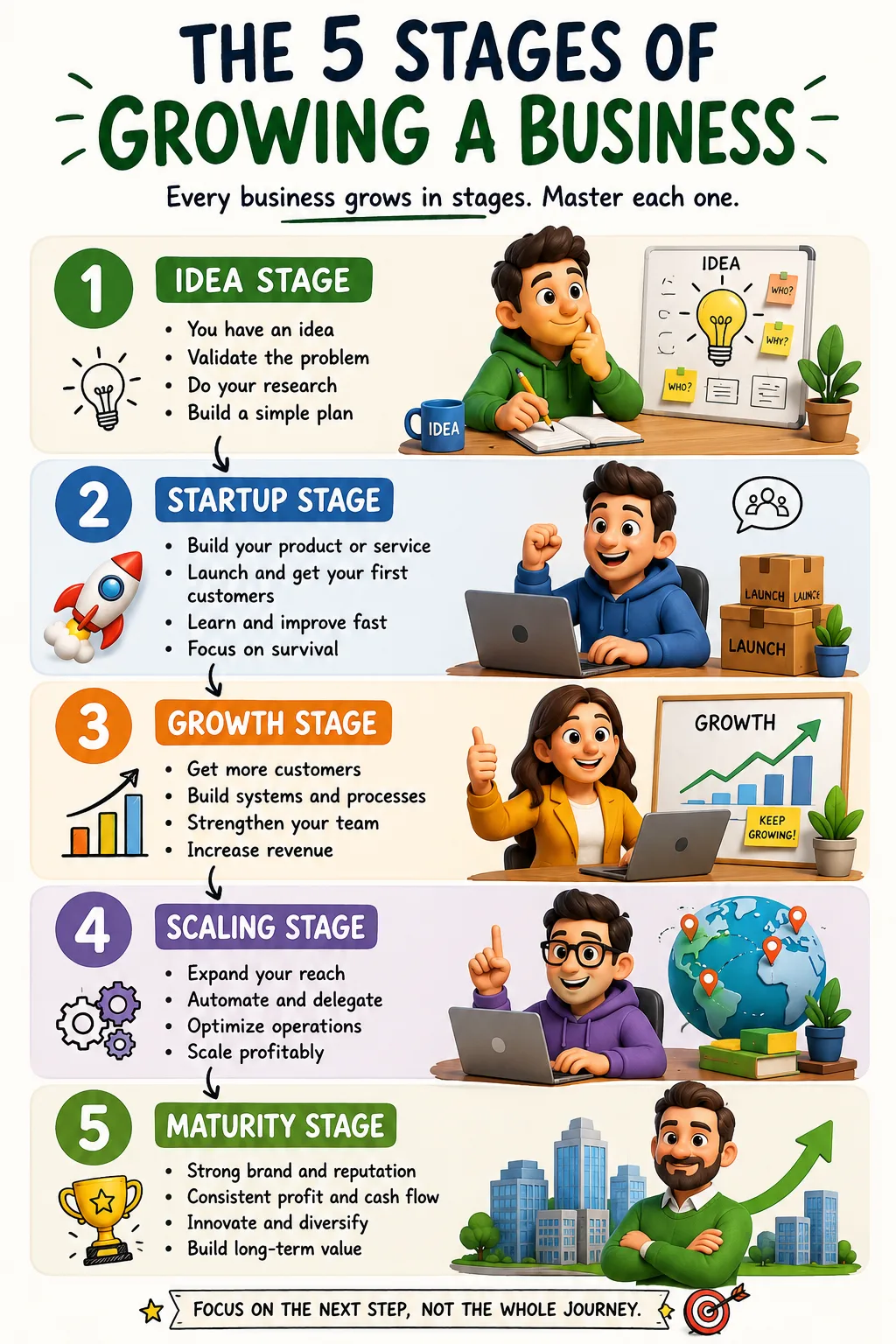
The five broad stages of business growth are validation, survival, stability, scaling, and maturity or renewal. Each stage has its own central question. Validation asks, “Will customers pay?” Survival asks, “Can the company stay alive?” Stability asks, “Can the business operate predictably?” Scaling asks, “Can revenue grow faster than costs?” Maturity or renewal asks, “Can the company defend its core while creating the next engine of growth?”
When leaders answer the wrong question, they waste time and capital.
A founder in validation may obsess over logos, offices, legal complexity, and brand polish before knowing whether anyone wants the product. A survival-stage owner may chase every customer, even unprofitable ones, because revenue feels like progress. A stable business may avoid delegation because the founder is still addicted to control. A scaling company may assume that what worked with ten customers will work with ten thousand. A mature company may mistake past success for permanent relevance.
The discipline of growth is knowing which problem deserves priority now.
Stage One: Validation
Validation is the stage where a business proves that a real market exists.
This is the beginning of commercial truth. The founder may have an idea, a product, a service, a skill, a prototype, a menu, an app, a consulting offer, a retail concept, a course, a technology, or a professional practice. But none of these becomes a business until customers demonstrate willingness to pay.
Interest is not validation. Compliments are not validation. Social media likes are not validation. Friends saying “that sounds amazing” is not validation. A waitlist can be useful, but even that is not final proof. The strongest evidence is a paying customer who buys without excessive discounting, persuasion, customization, or personal loyalty to the founder.
The validation-stage business must identify a specific customer problem. Broad markets are seductive but dangerous. “Everyone can use this” often means no one urgently needs it. A stronger validation question is narrower: Who has this problem? How painful is it? What do they currently do instead? How much does the problem cost them? Why would they switch? Who controls the budget? How often does the need occur?
A restaurant founder may test a menu through a food stall, catering events, or delivery service before signing a long lease. A software founder may build a basic version of the product and sell it to a small group of users before building a full platform. A consultant may sell a clearly defined service package before creating a large agency. A retailer may test demand online before opening a physical store. A manufacturer may secure purchase commitments before investing heavily in equipment.
The goal is not perfection. It is evidence.
Validation requires feedback, but feedback must be interpreted carefully. Customers may request features they will not pay for. Prospects may praise a product because they want to be polite. Early adopters may behave differently from the broader market. A founder can easily confuse activity with proof.
The most useful validation metrics include number of paying customers, conversion rate, revenue per customer, customer acquisition cost, repeat purchases, retention, and qualitative feedback. The business should ask whether customers are buying again, referring others, using the product meaningfully, and accepting the price. A one-time purchase is useful. Repeatable demand is stronger.
The greatest risk in validation is building something customers do not need. The second greatest risk is spending heavily before demand is proven. Founders often want to look legitimate. They buy equipment, hire staff, lease offices, build complex technology, print materials, attend conferences, or develop elaborate branding before the market has spoken. These costs make the business less flexible. They also create emotional pressure to defend the original idea even when evidence suggests it should change.
Validation rewards humility. The market is not obligated to appreciate the founder’s effort. Customers do not pay because something was difficult to build. They pay because it solves a problem, creates value, saves time, reduces risk, improves status, increases income, provides pleasure, or satisfies a need better than alternatives.
A business has made progress in validation when customers buy the product without extraordinary effort from the founder. They understand the value proposition. They accept the price. They use the offering. Some return. Some refer others. The sales process begins to show patterns rather than one-off exceptions.
At this stage, the founder should remain light, curious, and financially cautious. The work is to learn quickly and cheaply. Validation is not the time to build the company the founder dreams of running someday. It is the time to discover whether the market wants the thing being offered today.
The Validation Trap: Mistaking Motion for Demand
Early entrepreneurship can feel productive even when the business is not being validated.
A founder can spend weeks designing a logo, choosing brand colors, refining a website, registering social media handles, studying competitors, attending networking events, buying software, forming entities, and writing elaborate plans. Some of this may eventually matter. But none of it proves demand.
The validation trap is the belief that preparation equals progress.
Real progress at this stage is uncomfortable because it involves asking people to pay. Pricing reveals truth. Sales conversations reveal objections. Customer behavior reveals whether the problem is urgent. Delivery reveals whether the business can create value. Refunds, churn, silence, and hesitation provide information that branding exercises cannot.
This is why validation-stage founders should design small commercial experiments. Sell before scaling. Test before hiring. Measure before building. Offer before assuming. The early business should remain flexible enough to change its product, target customer, pricing, packaging, or distribution channel based on what the market reveals.
Some founders avoid this because validation can bruise the ego. It is easier to perfect the idea in private than expose it to customers. But private confidence is not a business model. A company exists in the market, not in the founder’s imagination.
The sooner a business discovers the truth, the cheaper the lesson.
Stage Two: Survival
Survival begins when the business has customers but is not yet financially secure.
This is one of the most demanding stages because it combines hope with danger. The company may be generating revenue. People may be buying. The product may work. The founder may feel that the business is real. Yet the bank balance may remain fragile. Bills arrive faster than cash. Sales fluctuate. Customers pay late. Expenses rise. The founder works constantly but cannot yet rely on stable profit.
The main objective in survival is simple: generate enough cash to remain in operation.
This is not the stage for vanity. Revenue headlines matter less than cash flow. A company can report sales and still fail because money is tied up in receivables, inventory, payroll, rent, debt service, or unprofitable delivery. Profit on paper does not guarantee cash in the bank. Growth can even make the cash problem worse if the business must pay suppliers, staff, or production costs before customers pay.
Survival-stage leaders must watch monthly revenue, gross profit, operating expenses, cash balance, burn rate, break-even point, accounts receivable, inventory turnover, and working-capital needs. These metrics are not administrative details. They are the vital signs of the company.
The survival-stage business must focus on the most profitable customers and products. Not all revenue is equal. Some customers are expensive to serve. Some products have poor margins. Some sales require heavy customization. Some contracts look impressive but create cash strain. The founder must learn which work strengthens the business and which work merely keeps everyone busy.
This stage often requires hard choices. Expenses must be controlled. Hiring may need to wait. The company may need to renegotiate supplier terms, shorten collection cycles, raise prices, reduce unprofitable offerings, or stop serving customers who drain resources. The founder may need to delay personal compensation, but only with clear limits. A business that survives by permanently underpaying the owner may not be healthy; it may be hiding its true cost structure.
Survival also reveals the danger of customer concentration. A young business may depend heavily on one major client. That client can provide essential revenue, but it can also create vulnerability. If the client leaves, delays payment, negotiates aggressively, or changes strategy, the company may be exposed. The founder should appreciate major customers without allowing one relationship to become the entire business.
Debt is another survival-stage risk. Borrowing can extend runway, purchase inventory, fund equipment, or bridge receivables. But debt taken on before the model is stable can accelerate failure. Fixed repayment obligations reduce flexibility. If the business has not proven reliable margins and cash flow, debt may turn a difficult period into a crisis.
The sign of progress in survival is not merely higher sales. It is the ability to cover operating costs reliably and maintain an adequate cash reserve. The business begins to breathe. The founder can see beyond the next invoice. Decisions become less desperate. The company develops financial rhythm.
Survival is not glamorous, but it is where many real entrepreneurs are formed. It teaches cash discipline, pricing realism, customer quality, operational focus, and emotional resilience. A founder who survives this stage without learning those lessons may carry dangerous habits into later growth.
Why Cash Flow Matters More Than Reported Profit
One of the most important lessons in business is that profit and cash are not the same.
A company can sell a product today, record revenue, show profit, and still not have cash because the customer has not paid. A company can buy inventory, pay suppliers, and wait months before converting that inventory into cash. A service firm can complete work and wait for invoices to be collected. A growing company can be profitable on each sale but still run short because growth requires working capital.
Survival-stage companies fail when they do not understand this timing gap.
Consider a business that earns a 30 percent gross margin but must pay suppliers within 15 days while customers pay after 60 days. Every new sale creates a cash need before it creates cash inflow. If sales grow quickly, the cash gap grows too. The founder may celebrate revenue growth while the company moves closer to insolvency.
This is why collections matter. Payment terms matter. Deposits matter. Inventory discipline matters. Supplier negotiations matter. Pricing matters. A business model is not truly proven until the cash cycle works.
Cash is oxygen. Profit is important, but a business can survive short periods of low profit if it has cash. It cannot survive without liquidity. The survival-stage founder must understand the bank account as well as the income statement.
Stage Three: Stability
Stability begins when the company is no longer merely trying to survive. It has customers, revenue, and the ability to cover operating costs. But it is not yet scalable. It depends too heavily on the founder, informal processes, personal relationships, and heroic effort.
The main objective in stability is to create a predictable, repeatable business.
This is the stage where the founder must begin turning activity into systems. Processes need documentation. Roles need clarity. Customer service needs consistency. Financial controls need strengthening. Delivery quality needs standardization. Employees need training. Recurring or repeat revenue should be developed where possible. The business must become less dependent on memory, improvisation, and the founder’s personal intervention.
Stability is where many small businesses get stuck. They are successful enough to continue but not structured enough to grow. The founder is busy, customers are served, bills are paid, and revenue may be respectable. Yet the business cannot operate for long without the owner. Every decision flows through one person. Staff ask the founder for answers. Customers expect the founder personally. Quality varies. Financial reporting is delayed. Hiring is reactive. The company is alive, but fragile.
A stable business must measure profit margin, customer retention, recurring revenue, employee productivity, delivery quality, customer satisfaction, revenue predictability, and operational errors. These metrics reveal whether the business is becoming repeatable or merely busy.
Documentation is a major stability-stage activity. How is a customer onboarded? How are orders processed? How are complaints handled? How is inventory counted? How is work reviewed? How are invoices issued? How are employees trained? How are leads followed up? How are refunds approved? How are financial reports produced?
Some founders resist documentation because they believe it slows them down. In reality, undocumented knowledge traps the business inside the founder’s head. A process that cannot be explained cannot be delegated. A task that cannot be delegated cannot scale.
Hiring becomes more important in stability, but hiring alone does not solve the founder-dependence problem. A poor hire can create more work than no hire. A good hire without clear processes may still struggle. The business needs dependable employees, but it also needs roles, expectations, training, accountability, and management rhythm.
Financial controls also matter. As cash flow improves, waste can hide. Inventory may be mismanaged. Discounts may be given inconsistently. Expenses may creep upward. Employees may lack spending limits. Fraud risk may increase. Tax obligations may be missed. The stable company needs stronger accounting, reporting, approvals, and review processes.
The sign of progress in stability is that the business can operate for extended periods without the founder managing every daily decision. The founder may still be essential strategically, but the company no longer collapses when the founder steps away for a week. Staff understand their responsibilities. Customers receive consistent service. Financial information is available. Workflows are repeatable.
Stability may feel less exciting than launching or scaling, but it is the stage that turns a founder’s effort into an enterprise. Without stability, growth magnifies chaos.
The Founder’s Changing Role
In the beginning, the founder does everything.
They sell, deliver, invoice, handle complaints, design the product, answer emails, manage suppliers, create marketing, pay bills, and make decisions. This is normal in validation and often necessary in survival. But the habits that help a founder survive can later prevent the company from growing.
The founder must move from doer to designer.
At first, the founder proves the business. Then the founder protects cash. Then the founder builds systems. Later, the founder builds leaders. Eventually, the founder allocates capital, shapes culture, and decides where the company should go next.
This transition is emotionally difficult. Founders often trust themselves more than anyone else. They may believe no one can serve customers as well, sell as effectively, or make decisions with the same care. Sometimes they are right in the short term. But if the company cannot learn to operate through others, the founder has not built a business. They have built a job with employees.
Delegation is not abandonment. It is controlled transfer of responsibility. The founder must define standards, train people, measure outcomes, and create feedback loops. The goal is not to disappear. The goal is to make the organization capable.
A business becomes more valuable when knowledge moves from one person into systems and teams.
Stage Four: Scaling
Scaling is often confused with growth, but they are not the same.
A company is growing when revenue increases. A company is scaling when revenue increases faster than costs. This distinction is crucial. A business can grow and become weaker if every new customer requires proportional increases in labor, overhead, discounts, support, mistakes, or capital. Scaling means the company can serve substantially more demand while preserving or improving unit economics.
The main objective in scaling is to increase revenue faster than costs.
Scaling requires a proven model. Demand must be validated. Cash flow must be understood. Operations must be stable enough to handle volume. Unit economics must be healthy. Leadership capacity must exist. Without these foundations, scaling accelerates dysfunction.
Key activities in scaling include expanding successful sales channels, automating repeatable work, strengthening management, entering new markets, investing in technology, increasing marketing efficiently, securing growth capital where necessary, and improving operational leverage.
The scaling-stage business should track revenue growth rate, contribution margin, customer acquisition cost, customer lifetime value, sales productivity, operating leverage, market share, churn, capacity utilization, and quality metrics. These numbers show whether expansion is profitable or merely impressive.
Unit economics are especially important. If the business loses money on each customer, more customers deepen the problem. If acquisition costs rise faster than customer value, marketing scale becomes dangerous. If delivery quality declines as volume rises, growth damages the brand. If staff must increase at the same rate as revenue, the business may be growing but not scaling.
Technology can support scaling, but it is not a cure for a weak model. Automation works best when processes are already understood. Software cannot fix unclear strategy, poor pricing, weak demand, or bad management. A company should not automate chaos; it should simplify first, then automate.
Scaling often requires stronger leadership. The founder can no longer manage everything directly. Managers must manage. Teams must coordinate. Data must guide decisions. Culture must be clear enough to survive hiring. Communication must become more formal. The company may need executives, finance leadership, sales leadership, operations leadership, and human-resources capacity.
Capital decisions become more consequential. Some companies can scale through reinvested profits. Others need loans, investor capital, strategic partnerships, or supplier financing. Each source of capital has a cost. Debt requires repayment. Equity dilutes ownership. Outside investors may change governance. Growth capital should be tied to a clear plan, not raised simply because expansion feels exciting.
The main risks in scaling are scaling an unprofitable model, losing quality, overhiring, expanding too quickly, weakening culture, underestimating working capital, and allowing customer acquisition costs to rise unnoticed. The company may look successful from the outside while becoming internally strained.
The sign of progress is healthy expansion: revenue grows, unit economics remain strong, operational quality stays consistent, and the business becomes more profitable or strategically stronger as it gets larger.
Scaling is the stage where ambition must be matched by discipline. Growth that cannot be absorbed becomes damage.
The Difference Between Scaling and Simply Getting Bigger
Size alone is not success.
A restaurant can open a second location and double its headaches. A software company can acquire users who do not renew. A service firm can hire staff faster than it can train them. A retailer can add stores while margins shrink. A manufacturer can increase orders while quality failures rise. A company can become larger and less valuable.
Scaling requires a repeatable economic engine.
The business must know how it acquires customers, what those customers are worth, what it costs to serve them, how long they stay, what capacity is required, and how profit behaves as volume increases. If these questions are unclear, expansion is speculation.
Operating leverage is the prize of scaling. It appears when fixed costs are spread across more revenue, allowing profit to grow faster than sales. A software company with a strong product may add customers without equivalent increases in cost. A standardized service firm may train teams to deliver repeatable packages. A manufacturer may improve margins as production volume rises. A franchisable restaurant concept may expand through replicated systems.
But operating leverage can work in reverse. Fixed costs become burdens when revenue disappoints. New hires, leases, systems, debt, and management layers create obligations. If growth slows, the company may be trapped in a cost structure built for a future that has not arrived.
The scaling question is not “Can we sell more?” It is “Can we sell more while the business becomes stronger?”
Stage Five: Maturity or Renewal
Maturity begins when the business has established customers, systems, teams, market recognition, and reliable economics. It may produce strong cash flow. It may have a known brand, loyal customer base, experienced employees, and operational rhythm. The urgent chaos of earlier stages has faded.
But maturity brings a new danger: comfort.
The main objective in maturity or renewal is to protect the core business while finding new sources of growth.
Mature companies face a different kind of risk from startups. They may not fail suddenly because no one wants the product. Instead, they may decline gradually because the market changes and the company responds too slowly. Customer preferences shift. Technology improves. Competitors innovate. Costs rise. Talent leaves. Channels become less effective. Regulations change. Younger companies attack profitable niches. The mature company continues doing what once worked, but the world no longer rewards it the same way.
Mature businesses must defend profitable market positions, improve efficiency, develop new products, enter adjacent markets, acquire complementary businesses, strengthen succession planning, and replace declining products or channels. The work is both defensive and creative.
Important metrics include market share, return on invested capital, free cash flow, profitability by division, innovation revenue, customer retention, capital allocation effectiveness, and management depth. These metrics reveal whether the company is merely harvesting the past or building the future.
Free cash flow becomes especially important in maturity. A mature business that generates reliable cash has strategic options. It can reinvest, acquire, pay down debt, distribute profits, buy back shares where relevant, fund innovation, upgrade systems, or expand internationally. But capital allocation discipline matters. Mature companies can waste money on acquisitions that do not fit, prestige projects, excessive bureaucracy, or diversification into areas they do not understand.
Succession planning is another maturity-stage priority. The founder or early leadership team may not be the right group to lead the next chapter. A company that cannot develop future leaders becomes vulnerable when key people leave. Family businesses face this sharply, but the issue applies to all mature companies. Leadership continuity is part of enterprise value.
Renewal requires listening to the market again. In a sense, a mature company must return to validation for new ideas. It must test emerging customer needs, experiment with products, study technology, and question assumptions. The company must protect the profitable core without allowing the core to become a prison.
The sign of progress in maturity is that the company continues producing strong cash flow while successfully creating new growth engines. It does not merely defend what exists. It adapts.
Maturity does not have to mean decline. Some companies renew themselves repeatedly. They enter new categories, acquire capabilities, improve productivity, and evolve with customers. Others become monuments to their own history. The difference is leadership discipline.
The Mature Business and the Risk of Complacency
Complacency is dangerous because it often arrives disguised as confidence.
A mature company may have survived recessions, competitors, operational problems, and leadership transitions. Its success can create a belief that current methods are proven beyond challenge. Employees learn the old way. Customers remain loyal for a time. Cash flow continues. The company becomes less curious.
Then the decline begins quietly.
A new competitor offers faster service. A digital platform changes distribution. A cheaper substitute appears. Younger customers prefer a different experience. A key supplier raises prices. A regulatory change increases costs. A technology reduces demand for the old product. The company notices but responds slowly because the existing business still produces cash.
Renewal requires discomfort. Mature companies must be willing to question profitable habits before those habits become obsolete. They must fund experiments that may threaten the old model. They must attract talent that thinks differently. They must measure emerging risks, not just current performance.
The mature business must remember the lesson of validation: the market decides.
How Leadership Requirements Change at Each Stage
Business growth changes the job of leadership.
In validation, leadership requires curiosity, speed, humility, and customer obsession. The founder must test, listen, adjust, and sell. The central skill is learning.
In survival, leadership requires cash discipline, resilience, focus, and negotiation. The founder must protect runway, choose profitable work, control costs, and avoid panic. The central skill is financial endurance.
In stability, leadership requires process design, delegation, hiring, and control. The founder must turn personal knowledge into organizational capability. The central skill is system building.
In scaling, leadership requires management depth, data discipline, capital allocation, and strategic focus. The company must grow without breaking. The central skill is controlled expansion.
In maturity or renewal, leadership requires reinvention, governance, succession, efficiency, and long-term capital allocation. The company must defend the core while creating the future. The central skill is renewal.
Many leaders struggle because they continue using the style that made them successful in the previous stage. The scrappy founder may resist process. The survival-focused owner may underinvest in growth. The systems builder may become too cautious. The scaling executive may pursue expansion after the market has changed. The mature-company leader may protect legacy businesses too long.
Leadership growth must match business growth.
The Metrics That Matter Most
No single metric defines a successful business across all industries.
A software company, restaurant, construction firm, professional-service practice, retailer, manufacturer, and marketplace all have different economics. But several metrics appear repeatedly across the growth lifecycle.
Gross margin shows how much money remains after direct costs. Operating margin shows profitability after overhead. Cash runway shows how long the company can operate before needing more cash. Customer acquisition cost reveals how expensive growth is. Customer lifetime value estimates what customers are worth over time. Revenue growth shows expansion. Customer retention shows whether the business keeps demand. Working-capital requirements show how much cash is needed to fund operations.
Metrics should be interpreted by stage.
In validation, paying customers and repeat behavior may matter more than polished financial statements. In survival, cash balance and break-even point may matter more than brand awareness. In stability, retention, quality, and process reliability become more important. In scaling, unit economics and operating leverage become central. In maturity, free cash flow, return on invested capital, and innovation revenue become critical.
A fast-growing company with weak margins and negative cash flow may be less healthy than a slower-growing company with strong retention and reliable free cash flow. Growth rate without economic quality is not enough.
The best leaders use metrics to reveal constraints. What is preventing the company from moving to the next stage? Is it demand? Cash? Systems? Leadership? Scalability? The answer determines the next strategic priority.
The Biggest Mistake at Each Stage
Each stage has a signature mistake.
In validation, the biggest mistake is building before proving demand. The founder falls in love with the idea and avoids the market’s verdict.
In survival, the biggest mistake is mistaking revenue for health. The company sells more but lacks cash, margin, and discipline.
In stability, the biggest mistake is allowing founder dependence to continue. The business becomes successful but not transferable, scalable, or resilient.
In scaling, the biggest mistake is expanding an unprofitable or unstable model. Growth amplifies weaknesses that were manageable at a smaller size.
In maturity, the biggest mistake is complacency. The company protects the old model while the future develops elsewhere.
These mistakes are predictable because they come from success itself. A good idea creates overconfidence. Early sales create spending temptation. Founder competence creates dependence. Growth creates ambition. Maturity creates comfort.
The discipline of business growth is to recognize when yesterday’s strength is becoming tomorrow’s constraint.
How a Business Can Move Backward
Business growth is not always linear.
A company may move from stability back into survival during a recession, customer loss, supply shock, legal dispute, product failure, or cash crunch. A scaling company may need to return to stability after quality declines. A mature company may need to validate new products because the old market is shrinking. A founder may regain direct involvement when systems fail.
This is not automatically failure. It is reality.
The danger is denial. Leaders may continue acting as though the company is scaling when it has slipped back into survival. They may keep hiring, expanding, and spending while cash deteriorates. Or they may treat a mature business as safe while customer relevance declines.
Companies should periodically reassess their stage. The question is not what stage the business reached last year. The question is what stage the business is in now. Demand, cash flow, systems, leadership, and scalability can change.
Reassessment allows leaders to reset priorities before problems become existential.
A Practical Stage Assessment
A useful business-growth assessment can be built around five categories: demand, cash flow, systems, leadership, and scalability.
Demand asks whether customers clearly want the product or service. Are they paying? Are they returning? Are referrals happening? Is the market specific and reachable? Does the value proposition work without heroic selling?
Cash flow asks whether the company can fund operations. Does revenue convert into cash? Are margins healthy? Are expenses controlled? How many months of runway exist? Are collections reliable? Does growth require more cash than the company can access?
Systems ask whether the business can repeat its work predictably. Are processes documented? Is service consistent? Are financial controls reliable? Can new employees be trained? Are errors tracked and reduced?
Leadership asks whether responsibility is distributed appropriately. Does every decision depend on the founder? Are managers capable? Are roles clear? Is the company developing future leaders? Can the business operate if the founder is absent?
Scalability asks whether revenue can grow faster than costs. Are unit economics healthy? Can customer acquisition expand efficiently? Can operations handle more volume? Does technology or process create leverage? What would break if demand doubled?
Score each category honestly. A company may have strong demand but weak systems. It may have stable operations but poor scalability. It may have good revenue but dangerous cash flow. The lowest score often reveals the constraint preventing the business from moving forward.
The next strategy should address the constraint, not the founder’s favorite project.
The Restaurant Example
Consider a small restaurant concept.
In validation, the founder might test the menu through pop-ups, food stalls, delivery platforms, or catering. The question is whether customers like the food enough to pay at profitable prices and return. The founder should avoid signing an expensive lease before demand is clear.
In survival, the restaurant must generate enough daily sales to cover ingredients, wages, rent, utilities, and other expenses. Cash flow matters intensely because food inventory spoils, staff must be paid, and margins can be thin. The owner must identify profitable menu items, control waste, and manage working capital.
In stability, the restaurant documents recipes, purchasing procedures, cleaning routines, service standards, supplier relationships, and staff roles. The food must taste the same when the founder is not cooking. Customers must receive consistent service. Financial controls must prevent leakage.
In scaling, the restaurant may open additional branches, create a franchise model, centralize purchasing, use technology for ordering, or expand delivery. But expansion only works if unit economics are strong and quality can be maintained. A second location should not merely double fixed costs and operational headaches.
In maturity, the restaurant brand may develop new formats, packaged products, catering lines, geographic markets, or franchising systems. It must defend quality while adapting to changing customer tastes, delivery economics, labor costs, and competition.
The same restaurant can fail at any stage by using the wrong logic. It can overspend before validation, run out of cash during survival, depend too heavily on the founder during stability, open too many branches during scaling, or become stale during maturity.
The Software Company Example
A software company follows the same lifecycle in a different form.
In validation, the company builds a basic product and seeks initial paying users. The key question is whether the software solves a problem important enough for customers to adopt and pay for. Usage, conversion, feedback, and retention matter more than feature quantity.
In survival, the company must retain customers, manage development costs, and extend runway. Subscription revenue may look promising, but churn can expose weak value. The company must watch burn rate, cash balance, customer acquisition cost, and support burden.
In stability, the company builds recurring revenue, improves onboarding, documents support processes, strengthens product reliability, and creates a repeatable sales motion. The founder cannot be the only person who understands product, customers, sales, and code.
In scaling, the software company automates onboarding, expands sales channels, improves customer success, invests in infrastructure, and grows efficiently. Customer lifetime value must exceed acquisition cost. Support costs must not rise as fast as users. The product must remain reliable under heavier usage.
In maturity, the company may add products, acquire competitors, enter new markets, or defend against technological disruption. It must avoid becoming a legacy tool while customer needs evolve.
Software can scale powerfully because the cost of serving additional customers may be low. But software companies can also burn enormous capital when they acquire customers inefficiently, overbuild features, or ignore retention.
The Professional-Service Firm Example
A professional-service firm grows through the same stages with a different constraint: people.
In validation, a consultant, accountant, designer, lawyer, engineer, marketer, coach, or adviser wins initial client engagements. The question is whether clients will pay for a defined service and whether the founder can deliver value.
In survival, the firm must maintain enough billable work to cover expenses. Cash flow depends on utilization, pricing, collections, and project timing. The founder may accept too much customized work just to keep revenue moving.
In stability, the firm develops repeatable service packages, templates, quality standards, client onboarding, and delivery processes. It hires staff and begins transferring work from the founder to trained professionals. The firm must maintain quality while reducing dependence on one person.
In scaling, the firm expands through teams, specialized practices, new regions, partnerships, or productized services. The challenge is that professional services often scale less easily than software because delivery depends on skilled labor. Strong training, pricing, and management are essential.
In maturity, the firm may build a recognized brand, deepen specialization, acquire smaller firms, develop technology-enabled services, or transition leadership to partners. Succession is critical because client relationships can be personal.
The professional-service firm becomes more valuable when it moves from individual expertise to institutional capability.
AI, Automation, and the Changing Growth Curve
Modern business growth is being reshaped by automation, artificial intelligence, digital distribution, and remote work.
Digital platforms make market testing cheaper. A founder can launch ads, build landing pages, test offers, sell through marketplaces, survey customers, and measure demand faster than previous generations could. This improves validation, but it also increases competition. Low barriers to testing mean many others can test similar ideas.
Artificial intelligence is increasing automation potential in customer service, software development, sales support, content creation, research, administration, analytics, and internal operations. This can improve scaling by allowing companies to serve more customers without proportional increases in staff. But AI does not eliminate the need for strategy, judgment, product quality, data discipline, or customer trust.
Subscription and recurring-revenue models remain attractive because they improve revenue predictability. A business with recurring revenue may plan more confidently than one dependent entirely on one-time sales. But recurring revenue is only valuable when retention is strong. A subscription business with high churn is not stable; it is constantly refilling a leaking bucket.
Remote and distributed teams can reduce office costs and expand access to talent. They can also create communication, culture, and accountability challenges. Scaling remote teams requires clear processes, tools, documentation, and management discipline.
Data dashboards are becoming more common for tracking customer acquisition, retention, margins, cash flow, and operational performance. This is valuable when the data is accurate and tied to decisions. Dashboards do not help if leaders ignore what the numbers say.
The modern growth environment rewards companies that can test cheaply, learn quickly, automate intelligently, and remain financially disciplined. It punishes companies that confuse digital activity with economic strength.
Profitable Growth Over Vanity Growth
For many years, parts of the business world celebrated growth above all else. Revenue growth, user growth, geographic expansion, fundraising, headcount, and market share were often treated as signs of inevitable success.
But growth without economics eventually meets reality.
A company must understand how it will produce profit or durable strategic value. This does not mean every company must be profitable immediately. Some businesses rationally invest ahead of profit to capture a market, build infrastructure, or develop technology. But even then, the logic must be clear. The company must know why losses today create stronger economics tomorrow.
Vanity growth is growth that looks impressive but weakens the business. It may include acquiring unprofitable customers, discounting heavily to show revenue, expanding to markets with poor retention, hiring ahead of need, building features customers do not value, or opening locations to appear successful.
Profitable growth is different. It improves the company’s financial strength. Customers are valuable. Margins are healthy. Retention is strong. Costs are controlled. Systems improve. The business becomes more resilient as it grows.
The mature leader learns to ask not “How fast are we growing?” but “What is the quality of this growth?”
Growth Financing: Organic, Debt, or Equity
As businesses move from survival to scaling, financing choices become more important.
Organic growth uses profits generated by the business. It preserves ownership and avoids repayment obligations, but it may be slower. Debt allows the company to fund expansion without giving up equity, but it requires repayment and can create pressure if cash flow weakens. Equity capital provides funding without fixed repayment, but it dilutes ownership and may change control, governance, and expectations.
The right choice depends on the business model, cash flow reliability, asset base, growth opportunity, risk tolerance, and founder goals.
A company with predictable cash flow and tangible assets may use debt responsibly. A high-growth technology company with uncertain cash flow may be better suited to equity if the opportunity is large enough. A stable service business may prefer organic growth to preserve independence. A family business may avoid outside equity to maintain control. A company pursuing acquisitions may use a combination.
Financing should match stage. Validation-stage companies should be cautious about taking on obligations before demand is proven. Survival-stage companies should avoid debt that merely postpones difficult decisions. Stability-stage companies may use modest financing to strengthen systems. Scaling-stage companies may justify larger investment if unit economics are proven. Mature companies should allocate capital based on return, risk, and strategic fit.
Capital is not a strategy. It is fuel. Fuel helps only if the engine works.
Turning a Business Into an Asset
A business becomes a true wealth-building asset when it can produce value beyond the founder’s direct labor.
This does not mean the founder is unimportant. It means the company has customers, systems, people, processes, financial controls, brand strength, intellectual property, and management depth that make it transferable. A buyer, heir, partner, or professional manager can understand and operate it.
Many owners discover too late that their business is hard to sell because it depends entirely on them. Customers are loyal to the founder personally. Employees wait for the founder’s decisions. Financials are unclear. Processes are informal. Revenue is concentrated. Contracts are weak. The brand is underdeveloped. The company may generate income, but its enterprise value is limited.
To turn a business into an asset, the owner must build beyond themselves. Document key processes. Strengthen recurring revenue. Diversify customers. Professionalize accounting. Develop managers. Protect intellectual property. Standardize delivery. Build a brand independent of the founder. Reduce key-person risk. Create succession options.
This work often begins in the stability stage and becomes essential in maturity. It is also central to generational wealth. A family business that cannot operate without the founder may not transfer well. A business that has systems and leadership can become a legacy asset.
The ultimate test is simple: can the business create value while the founder is not in the room?
The Discipline of Moving Stage by Stage
Business growth is not a race to become large. It is a sequence of capabilities.
Validation builds market truth. Survival builds financial endurance. Stability builds repeatability. Scaling builds operating leverage. Maturity builds renewal. Each stage earns the right to attempt the next.
A founder who respects the sequence avoids many avoidable failures. They do not overbuild before demand. They do not chase revenue without cash. They do not scale chaos. They do not confuse size with strength. They do not let maturity become stagnation.
This does not mean progress is slow. Some companies move quickly because they validate demand early, manage cash well, build systems aggressively, and scale with strong economics. But even fast companies must solve the same problems. Speed does not remove the stages; it compresses them.
The leader’s task is to identify the current constraint. If demand is uncertain, validate. If cash is tight, survive. If operations are inconsistent, stabilize. If the model is repeatable and profitable, scale. If the core is mature, renew.
Growth becomes safer when the business stops imitating companies at other stages and starts solving the problem in front of it.
From Founder Energy to Enterprise Strength
Every business begins with some form of energy: an idea, frustration, opportunity, skill, product, customer relationship, or founder conviction.
But founder energy is not enough to build a lasting company. Energy must become evidence. Evidence must become cash flow. Cash flow must become systems. Systems must become scale. Scale must become renewal.
That is the real business growth journey.
Validation asks for humility. Survival asks for discipline. Stability asks for delegation. Scaling asks for precision. Maturity asks for reinvention.
A company that learns these lessons can become more than a source of income. It can become an asset, an employer, a platform for innovation, a family wealth engine, a community institution, or a business capable of outliving its founder.
The goal is not merely to grow bigger. The goal is to grow stronger at every stage.
The businesses that endure are not the ones that chase every opportunity. They are the ones that understand which opportunity belongs to the stage they are in, which weakness must be fixed before the next stage, and which disciplines must be protected even when success makes carelessness tempting.
Growth is exciting. Discipline makes it valuable.
 Article
 Article
 Article
 Article
 Article
 Article
 Article
 Article