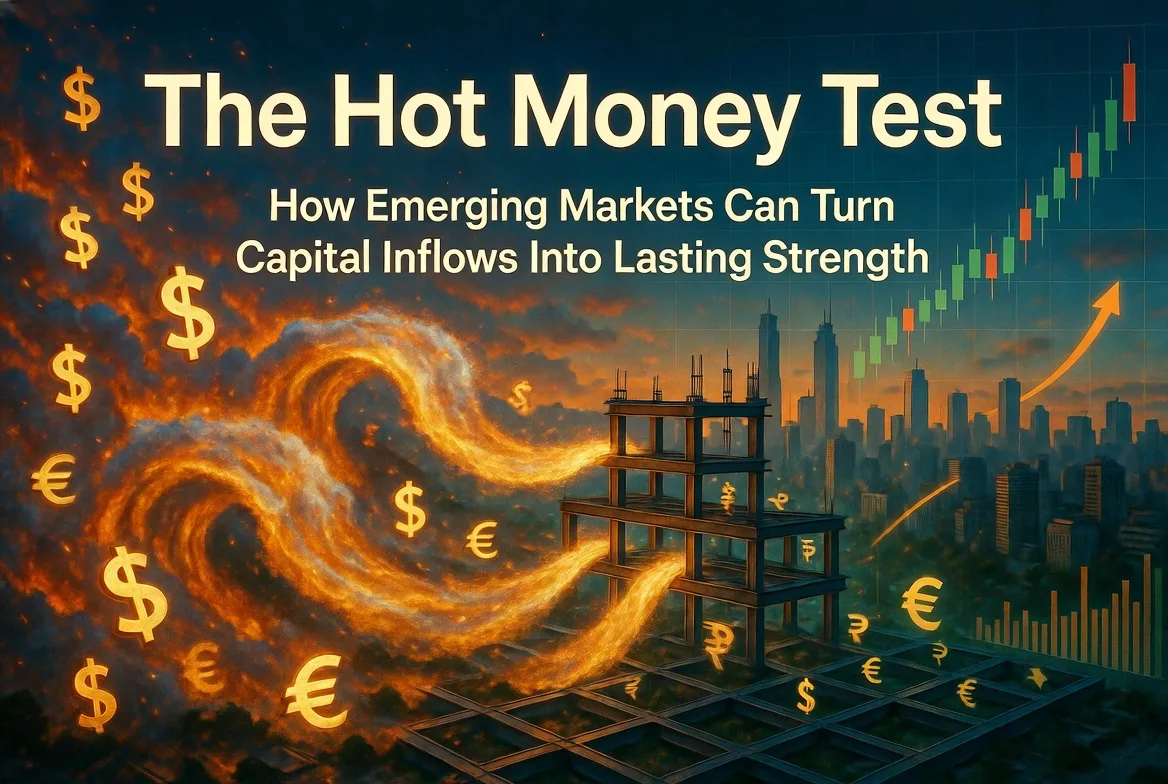
The Hot Money Test: How Emerging Markets Can Turn Capital Inflows Into Lasting Strength
Capital rarely arrives quietly.
When global investors rediscover emerging markets, the first signs are often visible in financial prices before they appear in factories, wages, or household balance sheets. Currencies strengthen. Government bond yields fall. Equity markets rise. Foreign exchange reserves increase. Investment bankers become more optimistic. Local politicians begin to speak about confidence, reform, resilience, and international recognition.
At first, it feels like validation. A country that had been ignored by global investors suddenly becomes fashionable. Fund managers who once worried about inflation, debt, elections, currency weakness, or external deficits begin to see opportunity. A weaker dollar, lower interest rates in advanced economies, improved domestic policy, and stronger commodity earnings can all combine to make emerging markets attractive again.
But the central question is not whether capital inflows are good or bad. The better question is what kind of capital is arriving, what it is financing, and how easily it can leave.
That distinction matters because emerging markets do not become wealthy merely by attracting money. They become wealthier when capital is transformed into productive capacity: roads, power systems, ports, factories, technology, skills, local businesses, deep financial markets, and institutions that support long-term investment. Capital that finances a new logistics network, a manufacturing plant, or a renewable power grid can strengthen an economy for decades. Capital that rushes into short-term bonds for yield can support markets for a season and disappear when conditions change.
This is the hot money test.
Every emerging market capital boom asks the same question in a new form: can a country use temporary investor enthusiasm to build permanent economic strength, or will it allow easy money to become the seed of the next crisis?
Why Capital Flows Toward Emerging Markets
Emerging markets attract foreign capital for a simple reason: they often offer what mature economies lack. Faster growth. Younger populations. Higher yields. Undervalued assets. Expanding consumer markets. Infrastructure needs. Commodity exposure. Financial systems that still have room to deepen.
For global investors, emerging markets can provide return, diversification, and exposure to economic growth that may not be available in slower-growing advanced economies. For emerging markets, foreign capital can help finance development faster than domestic savings alone would allow.
This is the optimistic case. A country with limited domestic capital can borrow from abroad, attract foreign direct investment, develop its bond market, expand credit to businesses, and raise its long-term growth rate. A pension fund in Europe can finance a toll road in Latin America. A sovereign wealth fund in the Gulf can invest in ports in Africa. A global asset manager can buy local-currency government bonds in Asia. A multinational company can build a factory in a country where labor, logistics, and market access make long-term sense.
In theory, this is one of the great benefits of global finance. Capital moves from where it is abundant to where it is scarce. Investors earn returns. Recipient countries build capacity. Households benefit from jobs, infrastructure, and financial inclusion.
The problem is that global capital does not always behave like patient development finance. Much of it moves through liquid markets, guided by interest rate differentials, currency expectations, index weights, benchmark pressure, and changes in global risk appetite. When the mood is favorable, money can arrive quickly. When the mood turns, it can leave just as quickly.
The International Monetary Fund has warned that cross-border portfolio flows into emerging markets have risen sharply since the global financial crisis, with nonbank financial investors playing a larger role and cumulative inflows approaching several trillion dollars by 2025. These flows expand financing options, but they also increase sensitivity to global risk sentiment.
That is the defining tension. The same capital that lowers borrowing costs can increase fragility. The same inflows that strengthen a currency can later amplify depreciation. The same foreign demand that helps governments borrow cheaply can make them vulnerable to sudden stops.
The Difference Between Patient Capital and Hot Money
Not all foreign capital is created equal.
Foreign direct investment is usually the most patient form. When a company builds a factory, develops a mine, acquires a business, or constructs energy infrastructure, it cannot exit overnight. The investment is embedded in the real economy. It tends to bring jobs, technology, management knowledge, supply chain development, and tax revenue. It can still create problems, especially if contracts are poorly designed or profits are extracted without local benefits, but it is generally more stable than short-term portfolio money.
Portfolio investment is different. It includes foreign purchases of stocks, bonds, and other financial securities. Portfolio flows can be useful because they deepen capital markets, lower financing costs, and broaden the investor base. But they are also more mobile. A fund manager can sell a bond or stock with a few keystrokes. If many investors do the same thing at once, a manageable adjustment can become a destabilizing reversal.
Bank lending sits somewhere in between. Cross-border loans can support trade, infrastructure, and business expansion, but they can also create maturity mismatches and foreign-currency exposure. When local borrowers earn revenue in domestic currency but owe debt in dollars or euros, a depreciation can quickly turn a manageable loan into a balance sheet problem.
Hot money usually refers to short-term, yield-seeking capital that enters a market because the return looks attractive relative to perceived risk. It is not committed to the country’s long-term development. It is committed to the trade.
That does not make hot money immoral. Investors are not charities. They allocate capital according to incentives. If a country offers high real interest rates, a stable or appreciating currency, improving credit metrics, and access to liquid markets, foreign investors may buy its bonds. If the same country later faces inflation, political stress, currency pressure, or a shift in global interest rates, those investors may sell.
The danger appears when policymakers confuse market appetite with structural strength.
A bond rally is not the same as development. A stronger currency is not the same as productivity growth. A rising equity market is not the same as broad prosperity. Lower borrowing costs are helpful, but they do not guarantee that borrowed money will be used well.
The Old Pattern: Boom, Confidence, Excess, Reversal
Emerging market crises rarely begin with pessimism. They often begin with optimism.
The classic capital flow cycle has four stages.
First comes neglect. Investors avoid the country because of inflation, debt, weak institutions, political instability, low reserves, or a recent crisis. Asset prices are depressed. Borrowing costs are high. The currency may be weak. Domestic policymakers are forced to adjust because external financing is scarce.
Second comes rediscovery. Conditions improve. Inflation falls. A reformist government takes office. Commodity prices rise. The central bank gains credibility. The fiscal deficit narrows. Global interest rates decline. Investors begin to return. At this stage, capital inflows can be healthy. They reward better policy and reduce pressure on the economy.
Third comes enthusiasm. The early investors make money. Index providers increase weights. Rating agencies become more positive. Local banks expand lending. Companies borrow abroad. Households feel wealthier. Property prices rise. The currency strengthens. Policymakers begin to believe that the world has permanently re-rated the country.
Fourth comes the test. A global shock occurs. The dollar rises. Oil prices move. The Federal Reserve changes course. A domestic election introduces uncertainty. Inflation returns. A current account deficit widens. Investors who once saw opportunity now see crowding, leverage, and exit risk. The same liquidity that carried prices up now pulls them down.
The reversal does not need to be caused by a domestic failure. Sometimes the trigger comes from outside. Emerging markets can suffer not because they did everything wrong, but because global portfolios were positioned as if nothing could go wrong.
This is why capital flow management is not a narrow technical issue. It is a wealth preservation issue at the national level.
Why Foreign Exchange Reserves Became the First Line of Defense
After the emerging market crises of the 1990s and early 2000s, many countries learned a brutal lesson: when foreign capital leaves, reserves matter.
Foreign exchange reserves allow a central bank to provide dollar liquidity, smooth currency volatility, reassure creditors, and reduce the risk that external obligations become impossible to meet. A country with large reserves is harder to push into crisis because investors know the central bank has ammunition.
This is why many emerging markets spent years accumulating reserves. The strategy made sense. If global finance can suddenly turn hostile, self-insurance becomes attractive. A reserve buffer can reduce dependence on emergency support from international institutions. It can also give policymakers time to adjust rather than being forced into panic decisions.
But reserves are not free.
When a central bank accumulates reserves, it often buys low-yielding foreign assets, such as US Treasury securities, while the domestic government or central bank may pay higher interest rates at home. The difference can become a fiscal or quasi-fiscal cost. If reserves are built by absorbing short-term inflows, the country may be exchanging one vulnerability for another: holding safe foreign assets while owing expensive liabilities to mobile investors.
There is also a political economy problem. Large reserves can create the illusion of safety even when private balance sheets are becoming fragile. A country may have impressive reserves, but if corporations have borrowed heavily in foreign currency, banks have maturity mismatches, and the government relies on short-term external financing, reserves may only delay the reckoning.
Reserves are valuable. They are not a substitute for sound balance sheets.
The Case for a Broader Policy Toolkit
The modern debate is no longer whether emerging markets should welcome all capital without question. That view has weakened considerably.
For many years, the dominant policy message from global finance was that countries should liberalize capital accounts, open markets, attract foreign investors, and avoid restrictions. The assumption was that free capital movement would discipline governments, allocate resources efficiently, and support growth.
Experience complicated that view. Capital account openness can bring benefits, but it can also expose countries to destabilizing flows that have little to do with domestic fundamentals. The IMF’s institutional view on capital flows, adopted in 2012, recognized that capital flow management measures can be appropriate under certain conditions, especially when inflows create macroeconomic or financial stability risks.
That shift matters because it legitimized a more pragmatic approach. Instead of treating capital controls as a sign of failure, policymakers could view them as part of a broader macro-financial toolkit.
The tools vary. Some countries use taxes on short-term inflows. Others impose unremunerated reserve requirements, forcing foreign investors to hold a portion of their inflow at the central bank without earning interest. Some set minimum holding periods to discourage rapid entry and exit. Others limit foreign-currency borrowing by banks or companies. Macroprudential tools can include loan-to-value limits, countercyclical capital buffers, liquidity coverage rules, and restrictions on currency mismatches.
The purpose is not to stop investment. The purpose is to change its composition.
A well-designed policy framework should welcome long-term, productive capital while discouraging fragile, leveraged, short-term flows that can destabilize the economy. The goal is not isolation. It is resilience.
What Emerging Markets Should Do When the Money Arrives
The most dangerous moment in finance is often the moment when financing becomes easy.
When capital is scarce, discipline is imposed from outside. Governments cannot borrow endlessly because markets will not lend. Companies cannot overexpand because credit is expensive. Households cannot speculate aggressively because lending standards remain tight.
When capital becomes abundant, discipline must come from within.
That is why the management of inflows matters as much as the management of outflows. Waiting until money leaves is too late. The architecture of resilience must be built while investors are still eager to enter.
First, lengthen the maturity of national balance sheets.
Short-term debt is seductive because it is often cheaper. But it creates rollover risk. If a government or company must constantly refinance, it becomes dependent on market mood. Longer maturities may cost more, but they buy time. Time is one of the most valuable assets in a crisis.
Emerging markets should use favorable conditions to replace short-term debt with longer-term financing. Governments should extend bond maturities. Banks should reduce reliance on short-term external wholesale funding. Companies should avoid borrowing structures that look cheap only because they ignore currency and refinancing risk.
Second, reduce foreign-currency mismatches.
A country can survive currency depreciation. It struggles when depreciation destroys balance sheets.
If borrowers earn in local currency but owe in dollars, a weaker exchange rate increases the real burden of debt. This can force companies to cut investment, banks to tighten credit, and governments to provide support. The damage spreads from currency markets into the real economy.
Local-currency borrowing is therefore a form of sovereignty. It does not eliminate risk, but it reduces the chance that exchange rate movement becomes a debt crisis. Developing deep local-currency bond markets should be a priority for emerging economies that want to benefit from global capital without becoming hostage to it.
Third, distinguish between asset-price growth and productive investment.
Foreign capital can lift stock markets and real estate prices without increasing productivity. This creates a wealth effect for asset owners, but it may not produce broad economic gains.
Policymakers should ask a simple question: what is the inflow financing?
If capital is financing infrastructure, export capacity, energy security, technology adoption, and business formation, the country may be building durable wealth. If it is financing luxury property speculation, consumer imports, fiscal complacency, or leveraged financial trades, the country may simply be borrowing against future stability.
Fourth, build fiscal buffers during good times.
Capital inflows can flatter public finances. Lower yields reduce interest costs. Stronger currencies reduce the local-currency burden of external debt. Asset booms increase tax receipts. Commodity inflows can raise government revenue.
But temporary revenue should not fund permanent spending. This is one of the oldest mistakes in public finance. Governments often treat cyclical windfalls as structural improvement. When the cycle turns, the spending remains while the revenue disappears.
Emerging markets should use inflow booms to improve fiscal resilience: reduce deficits, refinance expensive debt, build stabilization funds, and prioritize public investment with measurable long-term returns.
Fifth, improve data transparency.
Crises grow in the shadows. Policymakers need to know who is borrowing, in what currency, at what maturity, and from whom. Investors need reliable data on reserves, external debt, contingent liabilities, bank exposures, and corporate leverage.
Opacity may seem convenient during a boom because it allows weaknesses to remain hidden. But hidden risks do not disappear. They compound.
Transparent data can reduce panic because it allows markets to distinguish between solvent and vulnerable borrowers. It also gives regulators the information needed to act before pressure becomes systemic.
The Investor’s Lesson: Emerging Market Returns Are Never Just About Growth
For individual investors, emerging markets are often marketed through the language of growth. Young populations. Rising middle classes. Urbanization. Digital adoption. Commodity demand. Infrastructure expansion.
These themes are real. But they are not enough.
High economic growth does not automatically produce high investment returns. A country can grow quickly while shareholders earn poor returns because of dilution, weak governance, currency depreciation, inflation, capital controls, or political risk. A bond can offer a high yield but still disappoint if the currency falls or inflation erodes real returns.
Emerging market investing requires a balance between opportunity and structure.
The key questions are practical. Is the country borrowing in its own currency or someone else’s? Is inflation falling because policy is credible or because demand is weak? Are inflows going into productive investment or short-term carry trades? Are reserves adequate relative to external financing needs? Is the current account stable? Are banks exposed to foreign-currency liabilities? Does the legal system protect minority investors? Are policymakers using the boom to strengthen the economy or to postpone reform?
These questions matter because emerging market returns are shaped by both growth and fragility.
A fast-growing country with weak institutions may be a poor investment. A slower-growing country with credible policy, disciplined companies, and reasonable valuations may produce better risk-adjusted returns. The difference is not always visible in headline GDP.
Why the Dollar Still Matters
No discussion of emerging market capital flows can ignore the US dollar.
The dollar is not merely another currency. It is the central funding currency of the global financial system. Many commodities are priced in dollars. Many sovereign and corporate debts are issued in dollars. Many global investors measure performance against dollar benchmarks. When the dollar strengthens, financial conditions often tighten for emerging markets. When it weakens, they often ease.
A weaker dollar can attract capital into emerging markets by making local-currency returns more appealing and reducing pressure on dollar borrowers. A stronger dollar can do the opposite. It can raise debt burdens, encourage outflows, weaken currencies, and force central banks to defend stability even when domestic conditions would otherwise justify easier policy.
This creates a difficult reality. Emerging markets can improve domestic policy, but they cannot fully control the global financial cycle. They can make themselves more resilient, but they cannot make themselves immune.
The Bank for International Settlements has continued to examine how capital flows, exchange rates, local and foreign investors, and global shocks shape financial conditions in emerging market economies. Its work reflects a central point: domestic financial conditions in emerging markets are influenced by both local policy and international monetary dynamics.
That is why the strongest emerging markets do not rely on favorable global conditions lasting forever. They design policy for the day conditions change.
The Household Parallel: Personal Finance Has Its Own Hot Money Problem
The logic of capital flow management is not limited to governments.
Households face a smaller version of the same problem. When income rises, credit becomes available, asset prices increase, or bonuses arrive, the temptation is to treat improved cash flow as permanent wealth. People upgrade homes, cars, lifestyles, and obligations. They assume the good period will continue.
Then conditions change. A job is lost. Interest rates rise. A business slows. A currency weakens. A market falls. Suddenly, the household discovers that what looked like prosperity was partly leverage, partly optimism, and partly timing.
The personal finance lesson is the same as the national one: inflows should build resilience before they fund expansion.
A household receiving a financial windfall should reduce high-interest debt, build emergency reserves, invest in productive skills or assets, and avoid converting temporary income into permanent expenses. A country receiving foreign capital should reduce vulnerabilities, strengthen institutions, invest productively, and avoid confusing liquidity with wealth.
In both cases, the question is not how much money arrives. It is what remains after the money stops arriving.
Capital Controls: A Tool, Not a Philosophy
Capital controls provoke strong reactions because they sit at the intersection of economics, politics, and ideology.
Supporters see them as necessary defenses against destabilizing speculation. Critics see them as distortions that discourage investment, protect bad policy, and reduce market discipline. Both sides have evidence.
Poorly designed controls can do real damage. They can scare away long-term investors, create corruption opportunities, encourage evasion, and signal that policymakers are unwilling to address underlying problems. Controls cannot fix fiscal irresponsibility, chronic inflation, weak institutions, or unsustainable debt.
But refusing to use any capital flow management tool can also be costly. If short-term inflows are creating excessive credit growth, currency overvaluation, or asset bubbles, policymakers may need targeted measures before the boom becomes dangerous.
The best way to think about capital controls is not as a permanent wall, but as a set of circuit breakers. They should be transparent, targeted, temporary where possible, and integrated with macroeconomic policy. They work best when they lean against specific risks rather than trying to hide broad policy failure.
A tax on very short-term inflows, for example, may encourage longer holding periods. Limits on foreign-currency lending to unhedged borrowers may reduce balance sheet risk. Reserve requirements on certain inflows may reduce leverage. These measures do not reject foreign capital. They ask it to arrive in a safer form.
The Real Goal: Convert Liquidity Into Capacity
The deepest challenge for emerging markets is not attracting capital. It is converting capital into capacity.
Capacity means the country becomes stronger after the inflow than it was before. It has better infrastructure, deeper local markets, stronger institutions, more competitive companies, improved human capital, and more resilient public finances.
That transformation requires intentional policy.
Infrastructure investment must be selected carefully, not politically. Public-private partnerships must allocate risk honestly. Debt must be measured not only by its size, but by the quality of the assets it finances. Education and skills policy must connect to industries where the country can compete. Capital markets must serve domestic enterprise, not merely foreign trading strategies.
Financial openness is useful when it supports this agenda. It is dangerous when it substitutes for it.
A country can look successful during a capital boom while failing to build the foundations of wealth. Its currency can be strong, its stock market can rise, and its government can borrow cheaply. But if productivity is stagnant, institutions are weak, and debt is financing consumption rather than capacity, the boom is fragile.
The countries that benefit most from capital inflows are those that remain skeptical during the celebration. They ask hard questions while markets are friendly. They prepare for stress while financing is available. They understand that investor confidence is useful, but national strength must rest on more than foreign appetite.
What a Better Emerging Market Boom Would Look Like
A healthier capital flow boom would have several visible features.
More inflows would go into long-term investment rather than short-term securities. More borrowing would be in local currency. More public debt would finance productive assets rather than recurring expenses. Banks would hold stronger liquidity buffers. Regulators would monitor foreign-currency mismatches. Governments would resist the temptation to overpromise. Central banks would preserve credibility rather than chasing temporary growth. Data would be transparent. Fiscal policy would become more disciplined, not less.
For investors, a healthier boom would mean lower probability of crisis, even if it also meant lower speculative upside. For households, it would mean more stable inflation, fewer abrupt currency collapses, and better employment prospects. For governments, it would mean more freedom to make long-term choices because they are less exposed to sudden shifts in global sentiment.
This is the quiet promise of good capital flow management. It does not eliminate cycles. It makes cycles less destructive.
The Next Boom Will Reward Discipline
Emerging markets do not need to fear foreign capital. They need to respect it.
Capital is a tool. It can build or destabilize. It can finance productivity or speculation. It can deepen markets or inflate bubbles. It can reward reform or disguise weakness. Its effect depends on the structure into which it flows.
The next emerging markets capital boom will likely be praised while it is happening. Rising currencies, falling yields, and stronger markets will be interpreted as signs of confidence. Some of that confidence may be deserved. Many emerging markets have improved monetary frameworks, built reserves, developed local markets, and learned from past crises.
But the old dangers have not disappeared. They have changed form. Nonbank investors can move quickly. Exchange-traded funds can transmit global sentiment rapidly. Dollar funding remains powerful. Geopolitical shocks can alter risk appetite. Domestic politics can still undermine credibility. Debt can still accumulate faster than productive capacity.
The lesson is not to close the door. It is to install better hinges, stronger locks, and clearer rules for entry.
For policymakers, the task is to use inflows to lengthen maturities, reduce currency mismatches, strengthen reserves without relying on them alone, apply targeted macroprudential tools, and channel capital toward productive investment.
For investors, the task is to look beyond yield and growth narratives. The quality of institutions, balance sheets, currencies, and policy frameworks matters as much as the headline return.
For households, the lesson is timeless: easy money is not the same as durable wealth. Whether the inflow is foreign capital into a country or extra income into a family account, the wisest move is to build strength before increasing exposure.
The countries that pass the hot money test will not be those that attract the most capital during the boom. They will be those that have the most to show after the boom has passed.
 Article
 Article
 Article
 Article
 Article
 Article
 Article
 Article