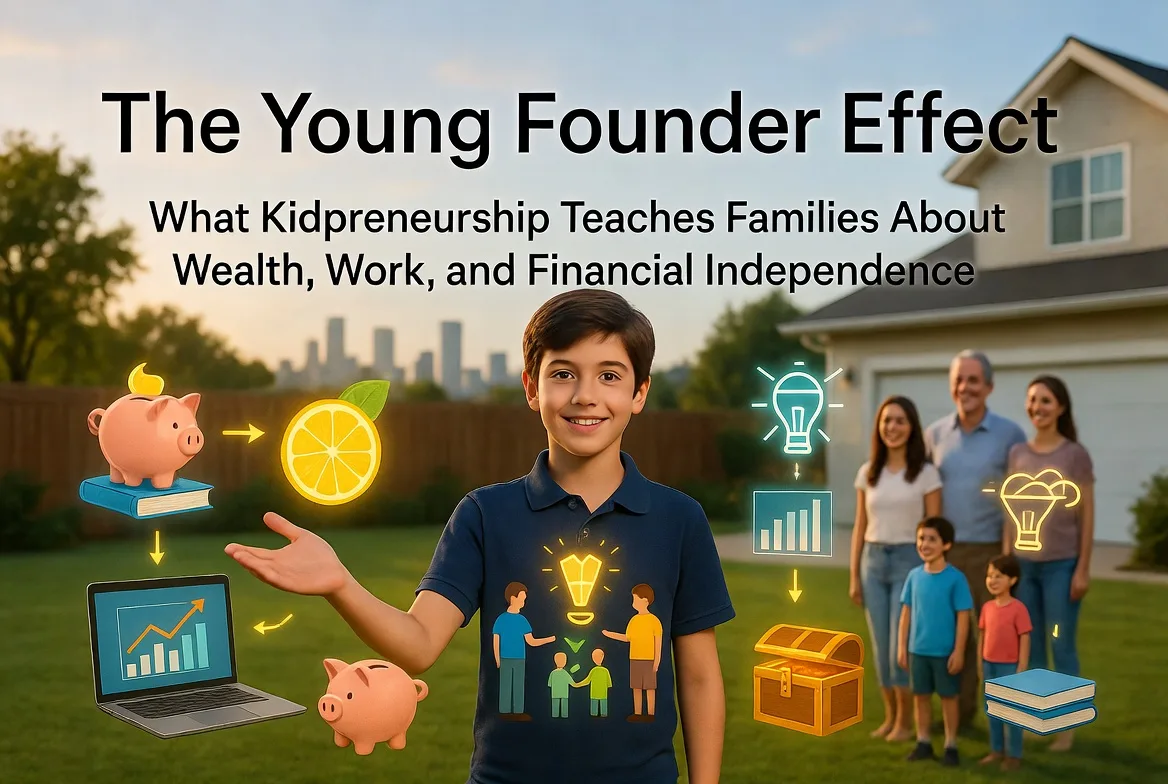
The Young Founder Effect: What Kidpreneurship Teaches Families About Wealth, Work, and Financial Independence
Every generation has its childhood economy.
For some, it was the lemonade stand on a hot afternoon. For others, it was mowing lawns, babysitting, washing cars, selling candy at school, delivering newspapers, tutoring younger students, or helping in a family shop after class. These small money-making activities were rarely described with formal business language. A child was not a founder. A Saturday project was not a venture. A handmade bracelet table was not a brand. Yet the underlying lessons were real: effort can create value, value can be exchanged, money must be handled, customers have choices, and profit is not the same as sales.
What has changed is the scale, visibility, and vocabulary.
Today, a child’s small business may have a logo, a payment link, a social media page, a video strategy, a parent-managed online store, a holiday pop-up, or a pitch competition. A young person can sell digital art, slime kits, baked goods, tutoring sessions, pet treats, handmade jewelry, gaming lessons, coding help, secondhand clothing, or custom crafts. They can watch business tutorials before they understand compound interest. They can see children on YouTube earning more than adults. They can hear adults celebrate founders as cultural heroes.
This is the age of the young founder effect.
Kidpreneurship is not simply about children starting tiny businesses. It is a sign of a much larger shift in how families, schools, technology, and culture think about work. Children are growing up in a world where entrepreneurship is no longer presented as a rare path for adults with capital and credentials. It is presented as a mindset, an identity, a side hustle, a content strategy, a path to independence, and sometimes a route around traditional employment.
For Generation Alpha, the first cohort born fully into a smartphone, platform, and artificial intelligence economy, business may feel less like a distant adult institution and more like a set of tools available on a screen. Their parents can open an online shop in an evening. A teenager can design a product with software, promote it through short-form video, and accept payments digitally. A child can observe entrepreneurship not as an abstract concept, but as something happening inside the home, on the kitchen table, in a spare bedroom, or through a parent’s laptop.
This creates opportunity. It also creates risk.
Used wisely, kidpreneurship can become one of the most practical forms of financial education a family can offer. It can teach children how money is earned, not merely spent. It can show the difference between revenue and profit. It can build confidence, creativity, negotiation skills, patience, numeracy, communication, and resilience. It can help children understand ownership before they ever buy a stock or start a retirement account. It can turn money from a mysterious adult subject into something observable and discussable.
Used poorly, it can turn childhood into a productivity contest. It can teach children that every hobby must be monetized, every talent must become content, and every moment of attention has commercial value. It can expose children to online pressure, adult expectations, privacy concerns, comparison, burnout, and the emotional confusion of being praised more for earning than for becoming.
The question for families is not whether children should ever earn money. Children have always found ways to earn money. The real question is what kind of financial worldview is being built underneath the activity.
A child selling cookies is not only learning about cookies. They are learning about labor, pricing, confidence, rejection, planning, promises, responsibility, and the emotional meaning of money. A child posting product videos is not only learning marketing. They are learning about attention, approval, public identity, and the marketplace’s appetite for personality. A child watching adults celebrate entrepreneurship is not only learning ambition. They may also be learning that stable work is inferior, that rest is wasted time, or that financial success should happen quickly.
That is why kidpreneurship needs adult wisdom. Not adult control. Wisdom.
Why Kidpreneurship Is Rising
There is no single reason children are becoming more interested in business. Several forces are converging at once.
The first is visibility. Previous generations knew local business owners: the shopkeeper, the mechanic, the baker, the tailor, the farmer, the contractor, the market trader, the family friend who ran an office, or the relative who owned rental property. Today’s children also see entrepreneurs at mass scale. They see founders interviewed online, creators selling products, influencers launching brands, athletes becoming investors, and ordinary people turning hobbies into income streams.
The second force is technology. The tools required to start a small venture have become cheaper and easier to access. A child does not need to lease a storefront to sell handmade goods. A teenager does not need a printing press to design a flyer. A family does not need a merchant account from a bank to accept digital payments. Design tools, e-commerce platforms, social media, delivery services, and digital wallets have lowered the barrier between idea and marketplace.
The third force is parental anxiety. Many parents are looking at a changing economy and wondering whether traditional education alone will prepare their children. They see automation, artificial intelligence, expensive housing, student debt, unstable career paths, and a labor market that rewards adaptability. Teaching a child how to create value feels like a form of protection. A small business becomes more than a weekend activity. It becomes practice for uncertainty.
The fourth force is cultural admiration for independence. Modern wealth culture often celebrates ownership over employment. It praises the founder, the investor, the creator, the freelancer, the side hustler, and the person who “built something.” Children absorb this language. They hear adults talk about passive income, financial freedom, business models, personal brands, and escaping the nine-to-five. Even when they do not understand these ideas fully, they understand the emotional direction: ownership is admired.
The fifth force is schools and youth programs. Many educational institutions now recognize entrepreneurship as a skill set. Pitch competitions, innovation labs, business fairs, coding clubs, student markets, financial literacy programs, and project-based learning expose children to enterprise earlier. This can be valuable when done thoughtfully. It gives children practical experience with problem-solving, teamwork, budgeting, and presentation.
The sixth force is the creator economy. Children do not only see businesses selling products. They see people monetizing attention. This is a major distinction. A lemonade stand teaches a child that customers buy a drink. A content channel may teach a child that viewers buy access to personality, lifestyle, humor, beauty, talent, or family life. That world can be lucrative, but it is also emotionally complex. The line between business and self can blur early.
Parents need to understand these forces because children are not encountering entrepreneurship in a neutral environment. They are encountering it in a culture that often compresses wealth, fame, identity, and self-worth into the same image.
The Best Lesson: Ownership Comes Before Wealth
The deepest financial lesson kidpreneurship can teach is ownership.
Most children first encounter money as consumption. They want a toy, snack, game, outfit, trip, device, or experience. Money appears as the thing standing between desire and purchase. If money exists, the item can be bought. If money does not exist, the item must wait. This is an important lesson, but it is incomplete.
Entrepreneurship introduces a different idea: money can also be produced by creating value for someone else.
A child who sells homemade bookmarks learns that money does not come from wishing. It comes from solving a small problem or offering a small pleasure. A child who washes neighbors’ cars learns that convenience has value. A child who tutors younger students learns that knowledge can become income. A child who sells vegetables from a family garden learns that land, labor, and timing affect earnings. A child who creates digital designs learns that creativity can be packaged and exchanged.
This is ownership thinking. The child begins to understand that wealth is not only about receiving income. It is about owning a productive process, however small.
That distinction matters because many adults reach adulthood without it. They know how to work for wages and spend for consumption, but they have little experience thinking like owners. They may earn well and still struggle to build wealth because every dollar passes through their hands into lifestyle. They may see investing as mysterious because they have not internalized the idea that assets produce income or appreciate over time. They may think profit is something corporations earn, not something households can intentionally create through ownership.
Kidpreneurship can make ownership tangible.
A simple example is a child selling muffins at a local event. If the child sells twenty muffins for two dollars each, they collect forty dollars. To a young child, that may look like forty dollars earned. But the parent can help them count ingredients, packaging, table fees, transport, and unsold inventory. Perhaps the true profit is fifteen dollars. Suddenly the child learns one of the most important lessons in finance: revenue is not profit.
This lesson alone can prevent years of adult confusion.
Many people see large numbers and mistake them for wealth. A business with high sales may have low margins. A person with high income may have high expenses. A property with rent may have repairs, taxes, insurance, vacancies, and debt service. An influencer with sponsorship income may have production costs, management fees, taxes, and unstable demand. The child who learns early to ask, “What did it cost to make this money?” is developing financial judgment.
Ownership also teaches accountability. If the muffins are late, customers notice. If the product breaks, someone complains. If the child forgets change, sales slow down. If they price too low, they work hard for little profit. If they price too high, customers may walk away. These are not abstract lectures. They are lived consequences.
That is why a small business can teach more than a worksheet. A worksheet can explain profit. A business makes profit felt.
Work Ethic Without Work Worship
One of the benefits of youth entrepreneurship is that it can build work ethic. Children learn to prepare, follow through, speak to people, solve problems, and handle disappointment. They learn that effort matters. They learn that quality matters. They learn that money is connected to service, not magic.
But families must be careful not to turn work ethic into work worship.
Work ethic says, “I can commit effort toward something meaningful.” Work worship says, “My value depends on productivity.” Work ethic builds confidence. Work worship breeds anxiety. Work ethic allows rest after responsibility. Work worship treats rest as weakness.
This distinction is especially important in a culture that celebrates hustle. Adults often praise children for being “little CEOs,” “future billionaires,” or “natural bosses.” These comments may sound harmless, but children listen closely. If praise is always tied to earning, selling, achieving, or performing, a child may begin to believe that being impressive matters more than being whole.
A child should not need a business to be valued. A child should not need profit to be praised. A child should not feel that every craft, song, drawing, recipe, joke, or idea must become a product.
The healthiest form of kidpreneurship keeps business in its proper place. It is a learning experience, not an identity prison. The child can enjoy it, pause it, change it, or outgrow it. They can have hobbies that are not monetized. They can play without a brand strategy. They can fail without public embarrassment. They can learn discipline without being turned into a miniature adult.
Parents can communicate this clearly. “This business is something you are trying. It is not who you are.” “You can be proud of earning money, but we are proud of your honesty, effort, kindness, and courage too.” “Not everything you enjoy needs to make money.” “Rest is part of doing good work.”
Those sentences protect the child’s inner life.
Wealth education should expand a child’s freedom, not narrow their sense of self.
The Family Business Classroom
A child’s first business does not need to be impressive to be educational. In fact, the simpler it is, the better the lessons often are.
Parents can think of a small venture as a family business classroom. The objective is not maximum profit. The objective is financial understanding. The business becomes a living textbook.
The first lesson is identifying value. What does someone need or want? What problem can be solved? What would make someone’s life easier, happier, cleaner, faster, more organized, more beautiful, or more enjoyable? A child who begins here learns that business is not begging people to buy. It is noticing where value can be created.
The second lesson is cost. What materials are needed? How much do they cost? How much time is required? Are there tools, packaging, platform fees, transport costs, or parent contributions? A child should learn that money received is not the same as money kept.
The third lesson is pricing. Pricing is one of the most powerful financial lessons because it combines math and psychology. Price too low, and the child may sell out while earning little. Price too high, and demand may fall. The parent can ask, “How much did each item cost to make? How much do you want to earn for your time? What are similar items selling for? What price feels fair to the customer and fair to you?”
The fourth lesson is quality. A product or service creates trust. If the child promises five dog-walking sessions, they must show up. If they sell bracelets, the bracelets should not fall apart immediately. If they offer tutoring, they should prepare. Quality teaches respect for the customer and respect for one’s own name.
The fifth lesson is sales communication. Children can learn to explain what they offer without pressure. They can practice eye contact, clarity, gratitude, and resilience. If someone says no, the child learns that rejection is not humiliation. It is information.
The sixth lesson is recordkeeping. Even a notebook can be enough. Sales, costs, profit, savings, giving, reinvestment, and spending should be tracked. This develops the habit of looking at numbers instead of guessing.
The seventh lesson is allocation. What happens to the profit? This is where entrepreneurship becomes personal finance. A child can divide money into categories: spend, save, give, invest, and reinvest. Reinvestment may mean buying more materials. Saving may mean a future goal. Giving may teach generosity. Investing may begin with a custodial account or a parent-guided explanation of ownership in companies.
The eighth lesson is reflection. What worked? What did not? What would you do differently? Did you enjoy it? Was the profit worth the effort? Would you rather change the product, raise the price, improve quality, or try something else?
This reflection is what turns activity into education.
Why Failure May Be the Most Valuable Profit
Adults often want children to succeed quickly because success feels encouraging. But the most valuable lessons in entrepreneurship often come from small failures.
A child makes too many products and sells only a few. A customer complains. A friend copies the idea. Rain ruins the event. A video receives little attention. A price is too low. A supply cost rises. The child forgets an order. The business is boring after two weeks.
These moments can feel discouraging, but they are financially rich.
Failure teaches that the marketplace is not obligated to reward effort. That lesson may sound harsh, but it is better learned gently in childhood than painfully in adulthood. Effort matters, but effort must be connected to value, timing, quality, demand, communication, and persistence.
Failure also teaches emotional regulation. A child learns to experience disappointment without collapsing. They learn that a poor result is not the same as a permanent identity. They learn to ask better questions. Did people understand the offer? Was the product useful? Was the location wrong? Was the price wrong? Was the timing wrong? Was the idea more fun to make than to sell?
These are the beginnings of business judgment.
Parents should resist the urge to rescue every venture. If a child prices poorly, let the result teach them. If they forget to promote the sale, let them see the consequence. If they spend all revenue before buying supplies for the next batch, let them experience the constraint. The stakes should be low enough to be safe, but real enough to be meaningful.
This is very different from shaming. The parent’s role is not to say, “I told you so.” The role is to help interpret the lesson: “What did we learn?” “What would you change?” “Was there a better way to plan?” “Do you want to try again?”
Children who are allowed to fail safely may become adults who can take intelligent risks. Children who are shielded from all failure may become adults who fear any uncertainty or hide mistakes until they become expensive.
Small losses can build large wisdom.
Teaching the Difference Between Income and Wealth
Kidpreneurship naturally focuses on earning. That is useful, but earning is only the first layer of financial education.
The deeper lesson is the difference between income and wealth.
Income is money coming in. Wealth is what remains, grows, and produces future choices. A child can earn money and spend it immediately. That is income without wealth. A child can earn money, save part of it, reinvest part of it, and eventually own assets. That is the beginning of wealth thinking.
Many adults never fully internalize this distinction. They pursue higher income but do not build assets. They increase lifestyle at the same pace as earnings. They confuse busyness with progress. They look successful but remain financially fragile. A child who learns early that income is only useful when directed wisely has an advantage.
Parents can demonstrate this with simple categories.
Spending money is for present enjoyment. Saving money is for planned future use. Giving money is for generosity and community. Reinvestment money is for improving the business. Investment money is for buying assets that can grow or produce returns over time.
Even if the amounts are small, the categories matter. A child who earns twenty dollars and divides it intentionally is practicing the same mental habit an adult needs with two thousand or twenty thousand dollars. The numbers change. The discipline is similar.
The parent can also introduce the concept of capital. Capital is money or resources used to create more value. If a child uses profit to buy better baking trays, more beads, a lawn tool, packaging, or a simple website, they are learning that some spending is productive. Not all money going out is consumption. Some money going out is investment in capacity.
This becomes a foundation for understanding larger wealth concepts later: business equity, rental property, dividend stocks, index funds, intellectual property, tools, education, and systems.
The child begins to see that money can be a seed, not only a ticket.
When Children Meet the Digital Marketplace
The digital world makes kidpreneurship easier, but it also makes it more complicated.
A child selling to neighbors faces a small, visible marketplace. A child selling online can reach strangers, receive public comments, be judged by algorithms, and become part of a commercial environment designed for attention. This requires stronger boundaries.
Parents should be especially careful with children’s images, names, locations, school information, daily routines, and personal details. A child may be excited to appear in videos, but they cannot fully understand the long-term implications of a digital footprint. The parent must think beyond sales.
There is also a difference between a child having a business and a child becoming the product. If the business sells candles, cookies, art, tutoring, or crafts, the child is the creator or seller. If the business depends primarily on the child’s face, personality, private life, reactions, or cuteness, the ethical stakes are higher. Attention can become income, but it can also become pressure.
The creator economy has created real opportunities, but children need protection from adult incentives. Views, likes, sponsorships, and affiliate revenue can tempt families to share more than is wise. A parent may begin with pride and slowly drift into performance. The child may learn to measure worth through engagement. The business may reward exposure over craftsmanship.
A healthy rule is to build the business around the value offered, not around the child’s loss of privacy.
Parents can also use digital tools without public exposure. A child can design products privately, track sales in a spreadsheet, learn digital payments, create mock marketing campaigns, or sell through parent-managed channels with limited personal information. Digital literacy does not require digital overexposure.
The modern marketplace is powerful. Children should enter it through gates, not open highways.
Parents as Investors, Not Employers
When a child starts a small venture, parents often become funders, drivers, suppliers, coaches, photographers, accountants, and emotional support. This can be wonderful. It can also distort the lesson if the parent quietly does all the real work.
A child who receives unlimited parent labor may think the business is profitable when it is actually subsidized. A child whose parent buys all supplies, handles every customer, creates all marketing, and absorbs every mistake is not learning entrepreneurship. They are watching a parent operate a project in their name.
Parents should be honest about subsidies. If the parent provides startup money, call it startup capital. If the child must repay it, define the terms. If it is a gift, explain that many real businesses do not have free supplies. If the parent drives to a market, discuss transport costs. If the family kitchen is used, talk about shared resources.
This does not mean charging a child for every household contribution. The goal is not to make childhood severe. The goal is to teach economic reality.
Parents can act like patient investors. They provide support, ask questions, help the child think, and protect them from serious harm. But they do not remove all responsibility. They do not demand adult-level performance. They do not take over the business because the table display is imperfect or the sales pitch is shy.
The investor mindset asks: What is the child learning? Are they developing judgment? Are they gaining confidence? Are they understanding the numbers? Are they treating customers respectfully? Are they balancing business with school, rest, friendships, and play?
The employer mindset asks: Are they producing enough? Are they representing the brand correctly? Are they hitting targets?
Children need the first far more than the second.
Business as Character Education
One of the underrated benefits of kidpreneurship is that it can teach character in concrete ways.
Honesty matters when giving change. Reliability matters when delivering an order. Humility matters when receiving feedback. Courage matters when speaking to customers. Patience matters when sales are slow. Gratitude matters when someone buys. Discipline matters when preparation is tedious. Generosity matters when profit is shared or used to help others.
Money reveals habits. It reveals whether a child wants immediate pleasure or can wait. It reveals whether they keep promises. It reveals whether they blame customers or improve the offer. It reveals whether they can handle comparison. It reveals whether they become careless when praised.
Parents should treat these moments as teaching opportunities. The goal is not only to raise a child who can make money. The goal is to raise a person who can handle money without losing integrity.
This is crucial because wealth without character can become destructive. A child who learns only how to sell may become an adult who manipulates. A child who learns only how to win may become an adult who cuts corners. A child who learns only that money brings admiration may become an adult who confuses net worth with human worth.
Financial education must include ethics.
Children should learn that customers are people, not targets. They should learn not to exaggerate claims. They should learn to admit mistakes. They should learn that copying others has limits. They should learn that business can serve a community, not merely extract from it.
These lessons are not sentimental. Trust is an economic asset. Reputation compounds. Integrity reduces hidden costs. In the long run, character and wealth are more connected than many people admit.
The Danger of Turning Every Child Into a Brand
One of the most troubling features of the modern economy is the pressure to become visible. Adults feel it. Teenagers feel it. Increasingly, children feel it too.
A child with a small business may be encouraged to create a brand, post regularly, build an audience, tell their story, appear on camera, share behind-the-scenes content, and develop a public identity. Some children enjoy this. Some are naturally expressive. Some families manage it carefully. But the pressure can become unhealthy.
A brand is not the same as a person. A brand must be consistent, legible, marketable, and audience-aware. A child is meant to be inconsistent, developing, private, experimental, and free to change. When childhood becomes branding too early, the child may feel trapped inside an image that was profitable or praised.
Parents should be cautious with language. Calling a child “the CEO” may be fun, but it can also attach adult identity to childhood exploration. Celebrating the project is different from making the child perform ambition as a personality.
The family should ask: Would this still be worthwhile if nobody online saw it? Would the child still enjoy this if it made little money? Are we protecting private life? Are we allowing the child to quit without shame? Are we praising qualities beyond sales?
A child can learn entrepreneurship without becoming content. A child can learn confidence without becoming public property. A child can learn marketing without surrendering privacy.
What Schools Can Teach That Markets Cannot
Entrepreneurship education can be valuable in schools, but it should not replace broader education. Markets teach useful lessons, but they do not teach everything children need.
A market rewards what sells. It does not always reward what is true, beautiful, just, patient, or deeply meaningful. Some of the most important parts of education do not have immediate commercial value. Literature, history, science, art, civics, philosophy, mathematics, music, and physical education shape citizens and human beings, not only workers and founders.
Families should resist the idea that every subject must be justified by earning potential. A child studying history is not wasting time because they are not monetizing it. A child reading fiction is developing imagination and empathy. A child learning science is developing curiosity and reasoning. A child playing music is developing discipline, expression, and pattern recognition. A child playing sports is learning teamwork, resilience, and bodily confidence.
Entrepreneurship should sit inside a broad education, not swallow it.
The strongest future founders may be those who understand people, culture, ethics, technology, numbers, communication, and history. Business does not happen in a vacuum. It happens inside society. A narrow child trained only to sell may become a shallow entrepreneur. A broadly educated child can create with more depth.
From Kidpreneurship to Investing
Once a child understands earning and profit, the next natural step is investing.
Investing can be introduced as ownership beyond one’s own labor. When a child runs a small business, income depends on their effort. If they stop baking, mowing, tutoring, or crafting, the income stops. Investing introduces a different concept: money can be used to buy ownership in assets that may grow even when the person is not actively working.
This does not require complex explanations. A parent can say, “When you own a tiny piece of a company, you are not just buying a product from that company. You are sharing in the company’s future results.” Or, “When you invest in a broad fund, you own small pieces of many companies instead of betting everything on one.”
The connection between entrepreneurship and investing is powerful. A child who understands profit in their own small venture can better understand why companies are valuable. They can grasp that businesses have customers, costs, competition, and margins. They can understand why not every popular company is a good investment and why patience matters.
Parents can also teach the difference between speculation and investing. Speculation asks, “Can I sell this to someone else for more soon?” Investing asks, “Do I own something valuable that can grow or produce cash over time?” Children growing up around online hype need this distinction early. They will encounter cryptocurrencies, meme stocks, trading apps, influencer picks, gaming assets, and digital collectibles. Without a foundation, they may confuse excitement with wealth building.
Entrepreneurship can make investing less abstract, but it must be paired with patience. A child should learn that real wealth often grows slowly, then suddenly appears impressive because of time. The early years may look boring. The compounding years are where the power emerges.
Generational Wealth Begins With Language
Families often think of generational wealth as money passed down. That is one form. But language is another.
What words are spoken around money? Is money always described as scarce, stressful, corrupting, impossible, confusing, or shameful? Or is it described as a tool, responsibility, resource, seed, protection, and opportunity?
Children inherit money language before they inherit money. They learn whether rich people are admirable, suspicious, lucky, greedy, disciplined, or free. They learn whether business is noble or exploitative. They learn whether investing is gambling or ownership. They learn whether debt is normal, dangerous, useful, or humiliating. They learn whether asking prices is rude. They learn whether negotiation is confidence or conflict.
Kidpreneurship gives families a chance to improve this language.
Instead of saying, “We cannot afford anything,” a parent can say, “We are choosing to use our money for a bigger goal.” Instead of saying, “You made forty dollars,” a parent can ask, “How much profit did you keep after costs?” Instead of saying, “You are a business genius,” a parent can say, “You listened to customers and improved your product.” Instead of saying, “Money is not important,” a parent can say, “Money matters, but it is not the only thing that matters.”
These small phrases build a financial worldview.
How Families Can Start Without Pressure
Not every child wants to start a business, and that is fine. Entrepreneurship should be offered, not forced. Some children prefer art, reading, sports, animals, building, coding, cooking, helping, collecting, performing, or exploring without selling anything. The goal is not to manufacture a founder. The goal is to develop financial capability.
For a child who is interested, start small. Choose a simple product or service. Keep costs low. Avoid public exposure at the beginning. Sell to a small circle or at a supervised event. Track the numbers. Discuss what happened. Let the child make age-appropriate decisions.
For younger children, the business might last one afternoon. For older children, it might become a summer project. For teenagers, it might develop into a real income stream. The structure should match maturity.
Parents should set boundaries around school, sleep, friendships, chores, and family life. A business should not excuse poor character or unhealthy imbalance. If a child becomes anxious, obsessive, entitled, or exhausted, slow down. The lesson is not worth the cost.
It is also wise to avoid comparing siblings or peers. One child may be commercially minded. Another may not. One may love selling. Another may find it stressful. One may earn more. Another may learn quietly. Financial education should not become a competition for parental admiration.
The best approach is curiosity: “What would you like to try?” “What problem do you notice?” “What do you think people would pay for?” “What would you do with the money?” “What did you enjoy?” “What felt hard?”
Curiosity keeps the experience human.
The Parent’s Checklist for Healthy Kidpreneurship
Before encouraging a child’s venture, parents should ask several questions.
Is the child interested, or are the adults more excited than the child? A business driven mainly by parental ambition can become a burden.
Are the stakes low enough for safe failure? Children need room to make mistakes without serious financial or emotional consequences.
Is privacy protected? The child’s personal information, image, location, and daily life should not be casually exposed for sales.
Is the child learning the numbers? Revenue, costs, profit, taxes when relevant, savings, and reinvestment should be explained in age-appropriate ways.
Is the business ethically sound? The child should not make false claims, pressure buyers, copy unfairly, or treat customers carelessly.
Is rest protected? The business should not consume childhood, school, health, friendships, or family connection.
Is money being allocated wisely? Spending all earnings immediately teaches a different lesson than dividing money intentionally.
Is the child praised for character as much as earnings? Courage, honesty, patience, creativity, kindness, and responsibility deserve attention.
Can the child stop? A healthy learning experience includes the freedom to pause, change direction, or decide entrepreneurship is not enjoyable right now.
This checklist keeps the venture in perspective. The child matters more than the business.
What Kidpreneurship Can Teach Adults
Children are not the only ones who can learn from small ventures. Adults can learn too.
A child’s business reveals the fundamentals that adults often overcomplicate. What value is being created? Who is the customer? What does it cost to deliver? What price makes sense? What is the profit? What should be saved, spent, reinvested, or given? What happens when demand changes? What happens when quality slips? What happens when enthusiasm fades?
These are the same questions adults face in careers, households, side businesses, and investing. The numbers may be larger, but the principles remain.
Many adults would improve their finances by returning to the clarity of a child’s business notebook. Money in. Money out. Cost of materials. Profit kept. Goal for next time. Lesson learned.
Personal finance often becomes confusing because households mix too many categories. Income arrives. Debt payments leave. Lifestyle expands. Subscriptions renew. Taxes surprise. Business expenses blend with personal spending. Investments are made inconsistently. The household feels busy but not necessarily wealthier.
A child’s small business can remind a family that wealth building begins with visibility. You cannot manage what you refuse to measure. You cannot improve what you do not understand. You cannot build wealth if every dollar is consumed before it is assigned a job.
The Future Worker May Need an Owner’s Mind
Not every child will become an entrepreneur. Most should not be pressured to. Society needs excellent employees, teachers, nurses, engineers, artists, public servants, scientists, builders, caregivers, managers, and professionals. Entrepreneurship is not morally superior to employment.
But even children who never start adult businesses may benefit from an owner’s mind.
An owner’s mind understands value creation. It asks how systems work. It notices incentives. It thinks about customers, costs, assets, risk, reputation, and long-term consequences. It does not wait passively for instructions. It looks for problems worth solving. It understands that financial security often comes from owning assets, not only earning wages.
This mindset can help an employee negotiate better, manage income wisely, invest consistently, understand their employer’s business model, build career resilience, and avoid lifestyle traps. It can help a professional think independently. It can help a household build multiple income streams over time. It can help a person see money as a tool for freedom rather than a source of constant fear.
The future economy may reward this mindset even for those who remain in traditional jobs. Artificial intelligence, automation, remote work, platform labor, global competition, and changing industries will require adaptability. Children who learn to create, test, communicate, and manage resources may be better prepared than children who only learn to follow instructions.
That does not mean every child needs a startup. It means every child needs financial agency.
Childhood First, Business Second
The central principle of healthy kidpreneurship is simple: childhood first, business second.
A child is not a revenue channel. A child is not a brand asset. A child is not a family business strategy. A child is a developing human being who may benefit from learning how money works through real experience.
When that order is respected, kidpreneurship can be beautiful. A shy child learns to speak confidently. A creative child sees that their ideas can bring joy to others. A mathematically curious child discovers pricing. A generous child donates part of the profit. A restless child channels energy into responsibility. A teenager begins saving for university, a car, tools, or investments. A family has richer conversations about money than any lecture could provide.
When the order is reversed, the same activity can become harmful. The child becomes anxious about sales. The parent becomes overly invested. The online audience becomes too important. The business becomes a measure of worth. The family praises income more than integrity. The child loses the right to be ordinary.
The difference is not always the business itself. It is the adult framework around it.
The Real Wealth Lesson
The rise of kidpreneurship should not be treated as a cute trend or a guarantee that Generation Alpha will become a generation of business owners. Some will. Many will not. Some childhood ventures will become serious companies. Most will become memories, lessons, and stories told years later.
That is enough.
The purpose of a child’s first business is not to predict their career. It is to teach them that money has movement, work has dignity, value can be created, numbers tell a story, customers deserve respect, mistakes can be studied, and profit should be directed with intention.
Those lessons matter whether the child becomes a founder, employee, investor, artist, teacher, doctor, engineer, parent, or public servant.
The deeper promise of kidpreneurship is not that every child will build a company. It is that more children may grow up understanding the connection between ownership, effort, value, patience, and choice. They may enter adulthood less intimidated by money. They may be less likely to confuse income with wealth. They may understand that assets matter. They may know that business is not magic. They may learn that ambition needs ethics, and that financial freedom requires discipline.
Families do not need to turn children into miniature executives to teach these truths. They need to create small, safe encounters with real financial life. A table at a community fair. A dog-walking flyer. A handmade product. A tutoring offer. A garden harvest. A simple spreadsheet. A conversation after a failed sale. A decision to save instead of spend. A first investment explained patiently.
These moments may look small. So does the first coin in a jar. So does the first dollar invested. So does the first sentence in a notebook. Wealth education often begins quietly.
The child who learns that money can be earned, managed, shared, saved, reinvested, and grown has received something more valuable than a weekend profit. They have received a framework.
That framework can last long after the lemonade stand closes.
And if Generation Alpha does become more entrepreneurial than the generations before it, the families that serve them best will not be the ones that simply push them to sell earlier, brand faster, and earn more publicly. They will be the families that teach them to build wisely, protect their dignity, understand ownership, respect people, and use money in service of a meaningful life.
That is the real young founder effect.
 Article
 Article
 Article
 Article
 Article
 Article
 Article
 Article