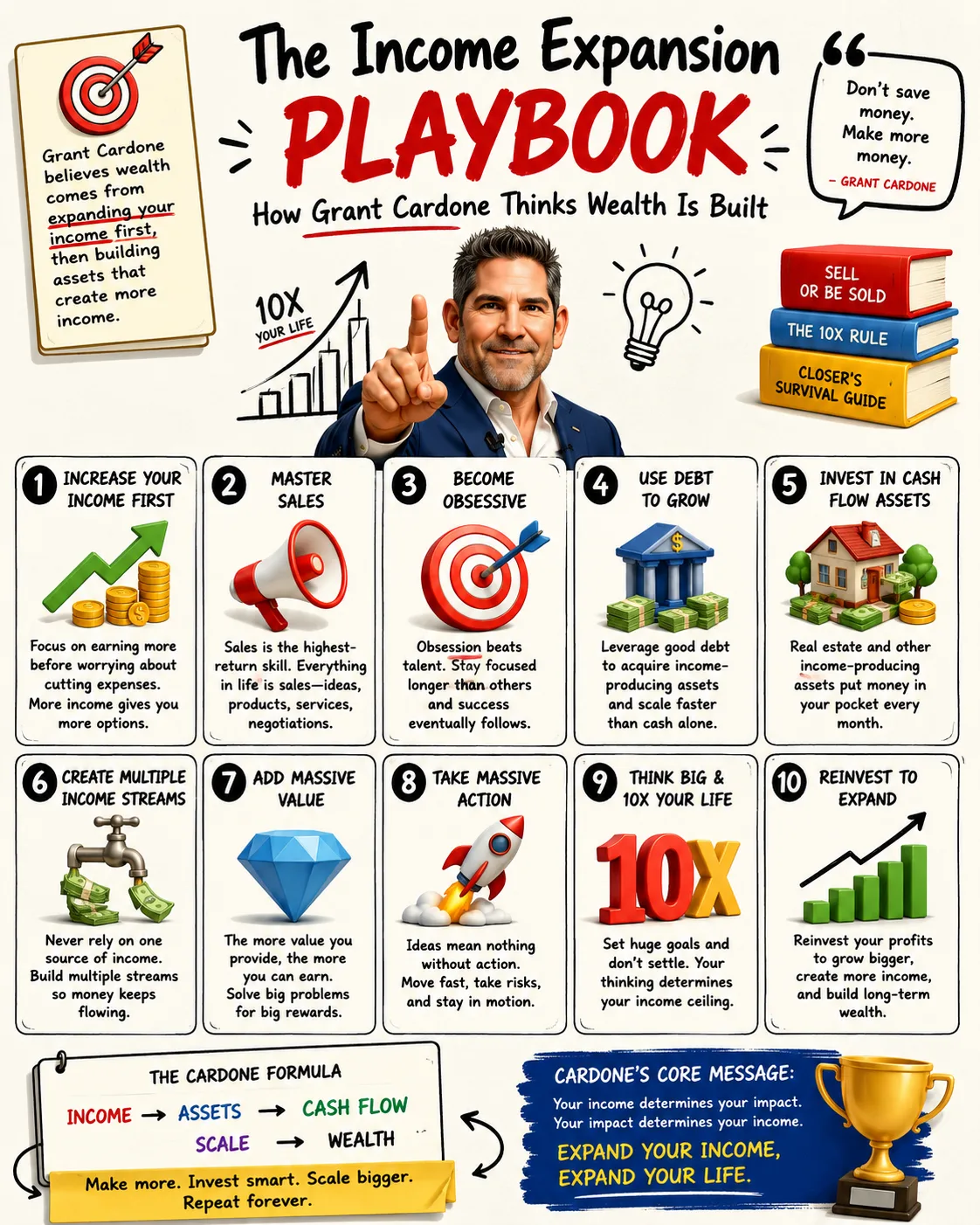
The Income Expansion Playbook: How Grant Cardone Thinks Wealth Is Built
Grant Cardone’s philosophy of wealth begins with a direct challenge to conventional financial comfort: most people are not earning enough.
Where traditional personal finance often begins with cutting expenses, tracking spending, and living below one’s means, Cardone begins with expansion. Increase your income. Learn how to sell. Build a business. Acquire assets. Reinvest aggressively. Think bigger than your current environment allows. Do not organize your financial life around scarcity if your real problem is insufficient earning power.
This is the foundation of Cardone’s message across his books, sales training, real estate content, seminars, and public business philosophy. He argues that wealth is not built by playing defense forever. It is built by raising income, converting income into ownership, and using that ownership to acquire cash-flow-producing assets at scale.
His philosophy is energetic, entrepreneurial, and often polarizing. Some of its principles are broadly useful. Sales skills can increase earning power. Avoiding lifestyle inflation can accelerate wealth building. Reinvesting profits can compound capital. Owning income-producing assets can create financial independence. Building multiple income streams can reduce reliance on a single paycheck.
Other parts of Cardone’s approach require more caution. His emphasis on aggressive growth, large goals, real estate concentration, and strategic debt can expose investors to serious risk if applied without discipline. Leverage can magnify gains, but it can also magnify losses. Multifamily real estate can generate cash flow, but it is not automatically safe. A motivational framework such as the “10X Rule” can increase ambition, but it is not a substitute for underwriting, liquidity, diversification, or risk management.
To understand how to get rich according to Grant Cardone, the key is to understand his operating system: increase income first, master sales, avoid settling for financial security as the final goal, reinvest profits, buy cash-flowing assets, use debt carefully when the numbers justify it, build multiple income streams, persist through rejection, and place yourself in environments that expand your expectations.
Cardone’s message is not subtle. But beneath the intensity is a coherent wealth-building model: money must be produced before it can be invested, income must be scaled before assets can be acquired meaningfully, and assets must generate cash flow before they can support financial freedom.
Increase Income Before Obsessing Over Expenses
Cardone’s first major departure from traditional personal finance is his emphasis on income expansion. He argues that many people spend too much energy trying to save small amounts of money while ignoring the larger opportunity: earning substantially more.
Expense control matters. A person who spends every dollar they earn will struggle to build wealth no matter how high their income becomes. But Cardone’s point is that expense cutting has a natural limit. A person can only reduce spending so far. Income, at least in theory, has more room to grow.
This distinction changes the financial question. Instead of asking only, “How can I spend less?” Cardone asks, “How can I earn more?”
That question pushes a person toward higher-value activities. Can they ask for a raise? Move into a better-paying role? Learn a sales skill? Build a service business? Sell a product? Acquire customers? Negotiate better compensation? Develop a side income? Create a recurring revenue stream? Improve their professional network? Enter an industry with greater upside?
For Cardone, income is the engine that funds asset acquisition. Without surplus income, investment remains slow. A person earning barely enough to cover expenses may understand wealth principles intellectually but lack the capital to act. Increasing income creates the fuel.
This does not mean everyone can instantly multiply earnings. Income growth depends on skills, opportunity, labor markets, geography, industry, health, education, and personal circumstances. But Cardone’s framework is useful because it shifts attention from passive budgeting to active value creation.
A worker who wants to increase income must become more valuable to the market. That may require sales ability, technical skill, leadership, communication, problem-solving, entrepreneurship, or specialization. Income expansion is not wishful thinking; it is the result of increasing economic usefulness.
The danger is ignoring expenses entirely. High earners can still be broke if they inflate lifestyle as income rises. Cardone himself often warns against spending too early on status. The strongest version of his philosophy combines income growth with delayed gratification. Earn more, but do not immediately consume more. Use the difference to buy assets.
Income is the offense. Expense control is the defense. Wealth requires both, but Cardone believes too many people try to win the game with defense alone.
Sales as a Wealth Skill
Cardone places sales at the center of his wealth philosophy. To him, sales is not merely a profession. It is a core economic skill that affects income, entrepreneurship, investing, leadership, and personal opportunity.
Every business depends on selling. A company must sell products to customers, ideas to employees, vision to investors, strategy to partners, and value to the market. A professional must sell their competence in interviews, negotiations, presentations, and internal discussions. An entrepreneur must persuade customers to trust a new offer before the business has a long track record.
Cardone’s argument is that people who cannot sell are financially limited. They may have talent, but they struggle to convert that talent into income. They may have ideas, but they cannot persuade others to act. They may have products, but no customers. They may have ambition, but no pipeline.
Sales skill includes much more than closing. It includes listening, asking questions, identifying needs, handling objections, following up, communicating value, negotiating, building relationships, and maintaining confidence through rejection. These abilities transfer across industries.
A salesperson who learns to prospect can create opportunities instead of waiting for them. A founder who understands sales can test demand quickly. A consultant who can communicate value can charge appropriately. An employee who can present results clearly may be promoted faster. An investor who can build relationships may gain access to better deals.
Cardone’s emphasis on sales also reflects his belief that rejection is part of success. Many people avoid selling because they fear being told no. Cardone treats rejection as data and repetition as training. Follow-up, persistence, and volume matter because a single refusal does not define the market.
There is a risk in applying sales philosophy poorly. Aggressive selling without ethics can damage trust. Pressure tactics may produce short-term transactions but harm long-term reputation. The strongest salespeople do not merely push; they diagnose, educate, and solve. Sustainable sales depend on value delivered, not only persuasion.
For wealth building, the lesson is practical. A person who improves sales ability increases their capacity to generate income. Income then becomes capital. Capital can be reinvested. Reinvestment creates ownership. Ownership creates wealth.
In Cardone’s framework, sales is the bridge between ambition and cash flow.
The 10X Mindset: Ambition as a Financial Force
Cardone’s most famous motivational framework is the “10X Rule.” The idea is to set goals much larger than conventional targets and take levels of action far beyond what most people consider normal.
The financial value of this mindset is not that every person will literally achieve ten times their goal. The value is that larger thinking can expose the smallness of many plans. A person aiming only to survive may make different decisions than a person aiming to build substantial wealth. A business targeting modest growth may ignore opportunities that a more ambitious company would pursue. A salesperson aiming for one deal may stop after a few rejections; one aiming for ten deals may build a stronger pipeline.
Ambition changes behavior. It can push people to increase activity, learn faster, seek better environments, improve skills, and reject self-imposed ceilings. Cardone believes many people underestimate what is required to achieve financial independence because they set targets based on comfort rather than opportunity.
The 10X mindset also encourages responsibility. Instead of blaming the market, economy, employer, or competition immediately, the person asks whether their level of action is sufficient. Have they made enough calls? Created enough offers? Followed up enough times? Studied enough? Built enough relationships? Solved a valuable enough problem?
Used well, this mindset can break complacency. Used poorly, it can encourage reckless risk-taking, burnout, or unrealistic expectations. Not every goal becomes better simply because it is larger. A goal must be paired with strategy, resources, health, time, and risk controls.
There is also a difference between thinking bigger and ignoring reality. A real estate investor cannot wish a property into profitability. A business owner cannot motivate bad unit economics into success. A salesperson cannot close customers who do not need the product. Ambition must be disciplined by numbers.
The best interpretation of Cardone’s 10X philosophy is this: most people underestimate both the size of the opportunity and the amount of action required. Therefore, expand the goal and expand the effort, but keep the underwriting honest.
Ambition can be a financial force when it leads to better behavior. It becomes dangerous when it replaces judgment.
Cash Flow as the Target
Cardone’s wealth philosophy places heavy emphasis on cash flow. He is not primarily interested in assets that look valuable on paper but produce no income. He wants assets that send money to the owner regularly.
Cash flow is the income left after operating expenses and financing costs. In real estate, this means rental income minus expenses such as debt service, taxes, insurance, repairs, management, vacancy, utilities, reserves, and other property costs. In business, cash flow means the company generates money after paying the costs required to operate.
Cardone’s focus on cash flow reflects a practical view of financial freedom. A person does not pay living expenses with theoretical net worth. They pay with cash. An asset that produces recurring income can reduce dependence on employment. A portfolio of cash-flowing assets can support lifestyle, reinvestment, and resilience.
This is why Cardone favors income-producing real estate, particularly multifamily apartments and commercial properties. The objective is not merely to buy and hope the property appreciates. The objective is to own assets that generate rent month after month.
Cash flow also creates optionality. It can be reinvested into more assets. It can service debt. It can support business expansion. It can provide liquidity during downturns. It can create psychological confidence because the investor is not relying only on future resale value.
But cash flow must be real, not imagined. Investors often make mistakes by underestimating expenses, overestimating rent, ignoring vacancy, failing to reserve for repairs, or assuming financing terms will remain favorable. A property that appears to cash flow in a sales presentation may not cash flow under stress.
Cardone’s emphasis on cash flow is one of the strongest parts of his philosophy when paired with conservative analysis. The question is simple: does the asset produce income after all costs, and can it continue doing so under less-than-perfect conditions?
An asset is not attractive merely because it is real estate. It is attractive because the income, expenses, financing, management, location, tenant demand, and purchase price work together. Cash flow is not a slogan. It is a calculation.
Why Cardone Favors Multifamily Real Estate
Real estate is central to Cardone’s wealth strategy, and he is especially associated with multifamily apartment investing. His preference reflects several features of the asset class.
Multifamily properties can generate recurring rental income from many tenants. Unlike a single-family rental, where one vacancy can mean zero rental income for that property, a larger apartment building may still produce income even if some units are vacant. This can create more diversified property-level cash flow.
Multifamily housing also serves a basic need. People need places to live. Demand can be influenced by employment, income, demographics, migration, affordability, and local supply, but housing itself is not optional. This gives residential rental property an economic foundation that some discretionary businesses lack.
Large properties may also provide operational efficiencies. Professional management, maintenance systems, financing structures, and value-add improvements can be applied across many units. If an investor improves operations, raises occupancy, renovates units, or reduces waste, the property’s income may increase.
Cardone’s strategy generally favors scale. He argues that larger deals can produce more meaningful income and justify professional management. A small rental property may require owner involvement while generating modest cash flow. A large apartment building, if properly financed and managed, can operate more like a business.
The appeal is clear, but the risks are significant. Multifamily properties require substantial capital, careful underwriting, strong management, legal compliance, maintenance reserves, insurance, financing expertise, and market knowledge. Small mistakes become large when multiplied across many units. Debt can create pressure if income declines or interest costs rise. Property values can fall when capitalization rates rise or market sentiment weakens.
Real estate is also local. National enthusiasm does not guarantee local performance. A property’s success depends on neighborhood quality, job growth, rent levels, competition, crime, schools, transportation, taxes, regulation, and operating execution. Two apartment buildings with similar unit counts can have very different economics.
For individual investors, the lesson is not to buy multifamily blindly. The lesson is to understand why income-producing real estate can build wealth when purchased correctly. The numbers must support the story.
A disciplined investor studies rent rolls, expenses, debt terms, occupancy, capital expenditures, local rent comparables, tenant quality, property condition, insurance, taxes, management fees, and exit assumptions. They stress-test the deal. What happens if rents stagnate? What happens if vacancies rise? What happens if refinancing is expensive? What happens if repairs exceed expectations?
Cardone’s real estate philosophy can create wealth only when ambition is matched by underwriting discipline.
Strategic Debt and the Discipline of Leverage
Cardone often distinguishes between debt used for consumption and debt used to acquire productive assets. In his framework, bad debt finances lifestyle. Strategic debt finances income-producing assets.
This distinction is important. Borrowing to buy depreciating luxury goods can weaken a person’s finances because it creates payments without creating income. Borrowing to buy a property that generates income above all costs may increase returns because the investor controls a larger asset than they could purchase with cash alone.
Leverage is one of the reasons real estate attracts wealth builders. A buyer may use debt to acquire an asset, tenants may help service the debt through rent, and equity may grow over time through amortization and appreciation. If the property performs well, leverage can amplify returns on the investor’s equity.
But leverage is never free. It introduces fixed obligations. The lender must be paid whether the property is fully occupied or not. Debt service continues whether repairs are high or low. Refinancing risk matters. Interest rates matter. Loan covenants matter. Personal guarantees may matter. A leveraged investment can become fragile if cash flow is thinner than expected.
This is one of the most controversial parts of Cardone’s philosophy because aggressive real estate strategies can look brilliant in favorable markets and dangerous in stressed markets. When rents rise, financing is available, and property values increase, leverage can accelerate wealth. When income falls, credit tightens, or valuations decline, leverage can expose weakness quickly.
Strategic debt requires discipline. The investor should know the break-even occupancy, debt service coverage, maturity schedule, interest rate structure, reserve needs, and downside case. They should understand whether the asset can survive a period of stress without forced sale or capital distress.
The phrase “good debt” should never replace analysis. Debt is not good because the asset sounds productive. Debt is useful only when the asset produces enough durable cash flow to justify the obligation and when the borrower has the financial strength to survive adverse conditions.
Cardone’s approach rewards confidence, but leverage punishes overconfidence. The wise investor respects both sides.
Reinvest Profits Instead of Displaying Success
Although Cardone is known for bold messaging, his wealth framework includes a disciplined idea: delay excessive consumption and reinvest profits into assets.
This principle matters because income alone does not create wealth. Many high earners remain financially weak because every increase in income becomes a lifestyle upgrade. Bigger houses, cars, travel, restaurants, clothing, entertainment, and status purchases absorb cash that could have been invested.
Cardone’s philosophy encourages people to use surplus income to acquire more income. Business profits should support expansion. Real estate cash flow should help buy more real estate. Sales income should become investment capital. The goal is to build an asset base large enough that income no longer depends solely on active work.
This is compounding in entrepreneurial form. Earn more. Save the surplus. Reinvest in assets. Use asset income to acquire more assets. Repeat.
Reinvestment also builds patience. The early years of wealth building may not look glamorous because capital is being redirected into growth rather than consumption. The person may be earning more but spending less than peers expect. That gap becomes the wealth engine.
Lifestyle inflation is one of the greatest enemies of Cardone’s model. If a person increases income from $80,000 to $200,000 but also increases spending by the same amount, their wealth position may not improve. They may look richer while remaining dependent on active income.
Cardone’s strongest lesson here is that status can be expensive. Luxury consumption before asset ownership can trap people in a cycle of high income and high obligation. Assets should come before lifestyle expansion.
That does not mean life should be joyless. It means consumption should be sequenced. Build the financial machine first. Let the machine support the lifestyle later.
Multiple Income Streams
Cardone encourages building multiple income streams because dependence on one source of income creates vulnerability. A single paycheck can disappear. A single business can decline. A single investment can underperform. Multiple income streams can improve resilience when they are thoughtfully constructed.
In Cardone’s framework, income streams may include sales income, business income, real estate cash flow, investment distributions, royalties, partnerships, consulting, digital products, or recurring revenue models. The goal is not merely to stay busy. The goal is to create independent sources of cash flow.
This distinction matters. Many people confuse multiple income streams with multiple jobs. Working constantly for several employers may increase income temporarily, but it does not necessarily create wealth if each source still depends entirely on personal labor. Cardone’s preferred model is to increase active income first, then convert it into assets and businesses that produce recurring income.
A strong income stream has several characteristics. It is understandable. It has a reliable source of demand. It produces positive cash flow. It can be tracked. It is not overly dependent on one fragile customer, platform, or market condition. It either scales or supports the acquisition of assets that scale.
For a beginner, the first additional stream may come from commission income, freelancing, a small service business, or a higher-paying role. For an intermediate wealth builder, it may come from business profits, rental property, or partnerships. For an advanced investor, it may come from larger real estate holdings, private investments, royalties, or operating companies.
Multiple income streams require management. Every stream carries complexity. Real estate requires oversight. Businesses require customers. Partnerships require trust and legal clarity. Royalties require distribution. Investments require monitoring. A person who adds income streams without systems may create chaos instead of freedom.
The principle remains valuable: financial resilience improves when income does not depend entirely on one source. But quality matters more than quantity. Three strong income streams are better than ten distractions.
Persistence, Follow-Up, and Rejection
Persistence is a recurring theme in Cardone’s work. In sales and entrepreneurship, rejection is unavoidable. Prospects decline. Customers delay. Investors say no. Employees leave. Deals fall apart. Markets change. Competitors respond. A person who interprets every rejection as final may never build momentum.
Cardone treats follow-up as a wealth skill. Many sales are lost not because the product is bad, but because the seller stops too early. Many opportunities require repeated contact, better timing, stronger trust, or clearer value. Persistence keeps the conversation alive.
In business, follow-up signals professionalism. A company that responds quickly, checks in, solves problems, and remains present can outperform competitors that disappear after the first contact. In investing, persistence can create deal flow. In careers, it can create relationships. In entrepreneurship, it can turn early indifference into eventual demand.
However, persistence must be paired with respect and intelligence. There is a difference between professional follow-up and harassment. A skilled salesperson reads signals, adds value, and improves the offer. An unskilled one merely repeats pressure.
Persistence also applies internally. Wealth-building plans often fail because people stop when results are not immediate. They launch a business and quit after a slow month. They try sales and retreat after rejection. They begin saving but stop when progress feels small. They study real estate but never analyze enough deals to find one that works.
Cardone’s message is that volume and consistency matter. Success often requires more attempts than people expect. The person who stays in motion learns faster and creates more chances for luck.
The practical lesson is not to be stubborn about bad strategies. It is to be persistent about the mission while improving the method. If the market gives feedback, adjust. If the offer is weak, strengthen it. If the skill is lacking, train. If the numbers do not work, find a better deal. Persistence should produce learning, not blind repetition.
Control Your Financial Environment
Cardone often argues that people are shaped by their environment. The expectations, habits, conversations, and ambitions of those around them influence what they believe is possible.
This idea is not unique to Cardone, but he applies it aggressively to wealth. If a person spends most of their time around people who fear money, avoid risk, dismiss ambition, or normalize financial mediocrity, their own expectations may shrink. If they spend time around entrepreneurs, investors, high performers, and skilled operators, they may see larger possibilities and learn faster.
Environment affects standards. A salesperson surrounded by top producers may raise activity levels. A founder around serious operators may improve execution. An investor around disciplined underwriters may avoid emotional deals. A professional around ambitious peers may pursue better opportunities.
Networks also create access. People hear about deals, jobs, partnerships, customers, mentors, and capital through relationships. A strong network does not guarantee success, but it can increase the surface area for opportunity.
There is a risk in confusing proximity with progress. Attending events, joining groups, or following wealthy people online does not automatically build wealth. Environment helps only when it changes behavior, knowledge, standards, and access. A person must still execute.
There is also a risk of entering environments that encourage excessive risk or status competition. Not every ambitious room is wise. Some groups promote speculation, pressure, or unrealistic promises. A good financial environment should increase ambition and improve judgment.
Cardone’s principle is useful when applied carefully: choose influences that expand your expectations while strengthening your discipline.
Where Cardone Aligns With Timeless Wealth Principles
Several parts of Cardone’s philosophy align with established wealth-building principles.
The first is skill development. Sales, communication, negotiation, and business development can increase earning power. A person who can create revenue has valuable leverage in almost any industry.
The second is ownership. Cardone’s emphasis on real estate and business ownership reflects the broader truth that wealth usually comes from owning productive assets, not only earning wages.
The third is reinvestment. Wealth compounds when profits are used to acquire more assets rather than consumed immediately. This principle applies across businesses, real estate, public equities, and intellectual property.
The fourth is cash flow. Assets that generate recurring income can support financial independence. Cash flow creates flexibility and reduces dependence on active income.
The fifth is persistence. Business success often requires repeated effort, follow-up, and resilience through setbacks.
The sixth is avoiding lifestyle inflation. Increasing income matters most when the surplus is preserved and invested.
These principles are durable. They can benefit employees, entrepreneurs, investors, and professionals even if they never adopt Cardone’s more aggressive tactics.
Where Cardone’s Approach Requires Caution
Cardone’s philosophy can also be misapplied in ways that create financial danger.
The first caution is leverage. Borrowed money can increase returns, but it can also create losses and liquidity pressure. Investors should never assume that debt is safe simply because it is attached to real estate. Cash flow must be stress-tested.
The second caution is concentration. Cardone strongly favors real estate, particularly multifamily assets. Concentration can build wealth when the asset class performs well and the investor has expertise. It can also create vulnerability if the market turns, financing tightens, expenses rise, or regulatory conditions change. Diversification remains important for many households.
The third caution is aggressive goal-setting without risk management. Large goals can inspire action, but they should not justify reckless commitments. A person should not take on obligations they cannot survive simply because they want to think bigger.
The fourth caution is confusing sales confidence with investment skill. Being persuasive can help raise capital, close deals, and grow businesses, but investing requires analysis. A confident presentation does not make a property profitable. Numbers must be independently examined.
The fifth caution is underestimating cycles. Real estate and business markets move through expansions and contractions. Rents, occupancy, interest rates, valuations, lending standards, and investor sentiment can change. A strategy that works in one environment may need adjustment in another.
The sixth caution is burnout. Constant expansion can become psychologically and physically costly if a person never defines enough. Ambition should build freedom, not permanent exhaustion.
The strongest version of Cardone’s philosophy pairs intensity with discipline. Sell more, but serve honestly. Earn more, but avoid waste. Invest aggressively, but underwrite conservatively. Use leverage, but protect liquidity. Think bigger, but respect risk.
A Practical Cardone-Inspired Wealth Strategy
A practical strategy inspired by Grant Cardone begins with income. Review your current earning power honestly. Are you in a role or business where income can grow meaningfully? Do you have sales ability? Can you negotiate better compensation? Can you move closer to revenue-generating work? Can you develop a higher-value skill?
Next, build a sales skill set. Learn how to communicate value, ask better questions, follow up, negotiate, and close. Even if you are not in a formal sales role, these skills improve career and business outcomes.
Then control lifestyle inflation. As income rises, do not allow expenses to rise automatically. Create a gap between what you earn and what you spend. That gap is investment capital.
After that, study cash-flowing assets. Real estate may be one option, but it is not the only one. Businesses, public equities, private investments, royalties, and digital products can also produce income. If choosing real estate, learn underwriting before investing. Understand rent, expenses, debt, taxes, insurance, repairs, reserves, vacancy, and market risk.
Use leverage carefully. Debt should be tied to durable income, not optimism. Maintain reserves. Stress-test assumptions. Avoid deals that work only under perfect conditions.
Reinvest profits. Early cash flow should strengthen the asset base rather than fund premature luxury. Let assets multiply before lifestyle expands dramatically.
Build multiple income streams gradually. Do not chase every opportunity. Add streams that fit your skills, capital, and goals. Systems matter. Complexity should be managed.
Upgrade your environment. Seek mentors, peers, and professionals who understand the level you want to reach. Avoid environments that normalize either fear or recklessness.
Finally, define the purpose of expansion. More income and larger assets should create freedom, security, impact, and options. Growth without purpose can become endless pressure.
The Real Meaning of Getting Rich According to Grant Cardone
Grant Cardone’s philosophy of getting rich is built around expansion. Expand income. Expand skill. Expand action. Expand ownership. Expand cash flow. Expand the size of the problems you are willing to solve.
He rejects a passive financial life organized only around saving what remains. He wants people to produce more, sell more, invest more, and think beyond survival. In his worldview, financial security is not the destination; it is the starting point from which larger wealth can be built.
The most valuable part of his philosophy is the insistence that income matters. Many people cannot budget their way to wealth if their earning power is too low. They need better skills, stronger sales ability, higher-value opportunities, and ownership of productive assets.
The most dangerous part of his philosophy is the temptation to confuse aggression with intelligence. Bigger goals, bigger deals, and bigger debt do not automatically create wealth. They create larger consequences. Without underwriting, reserves, diversification, and patience, expansion can become fragility.
Cardone’s wealth formula can be summarized this way: become highly valuable to the market, master sales, generate surplus income, avoid wasting it on lifestyle, buy cash-flowing assets, use leverage only when the numbers are strong, reinvest profits, and persist long enough for the system to compound.
For the disciplined wealth builder, this philosophy offers a useful challenge. Do not think too small. Do not rely on one income source forever. Do not spend everything you earn. Do not avoid sales because it feels uncomfortable. Do not let fear of action become a financial strategy.
But also do not ignore risk. Do not buy assets you do not understand. Do not borrow beyond your ability to withstand stress. Do not assume motivation can repair weak economics.
According to Grant Cardone, getting rich is not about shrinking your life to fit your income. It is about expanding your income, converting that income into assets, and building enough cash flow that money begins working at a larger scale than your personal labor alone.
That is the income expansion playbook: earn aggressively, invest deliberately, manage risk seriously, and let cash-flowing ownership become the foundation of long-term wealth.
 Article
 Article
 Article
 Article
 Article
 Article
 Article
 Article