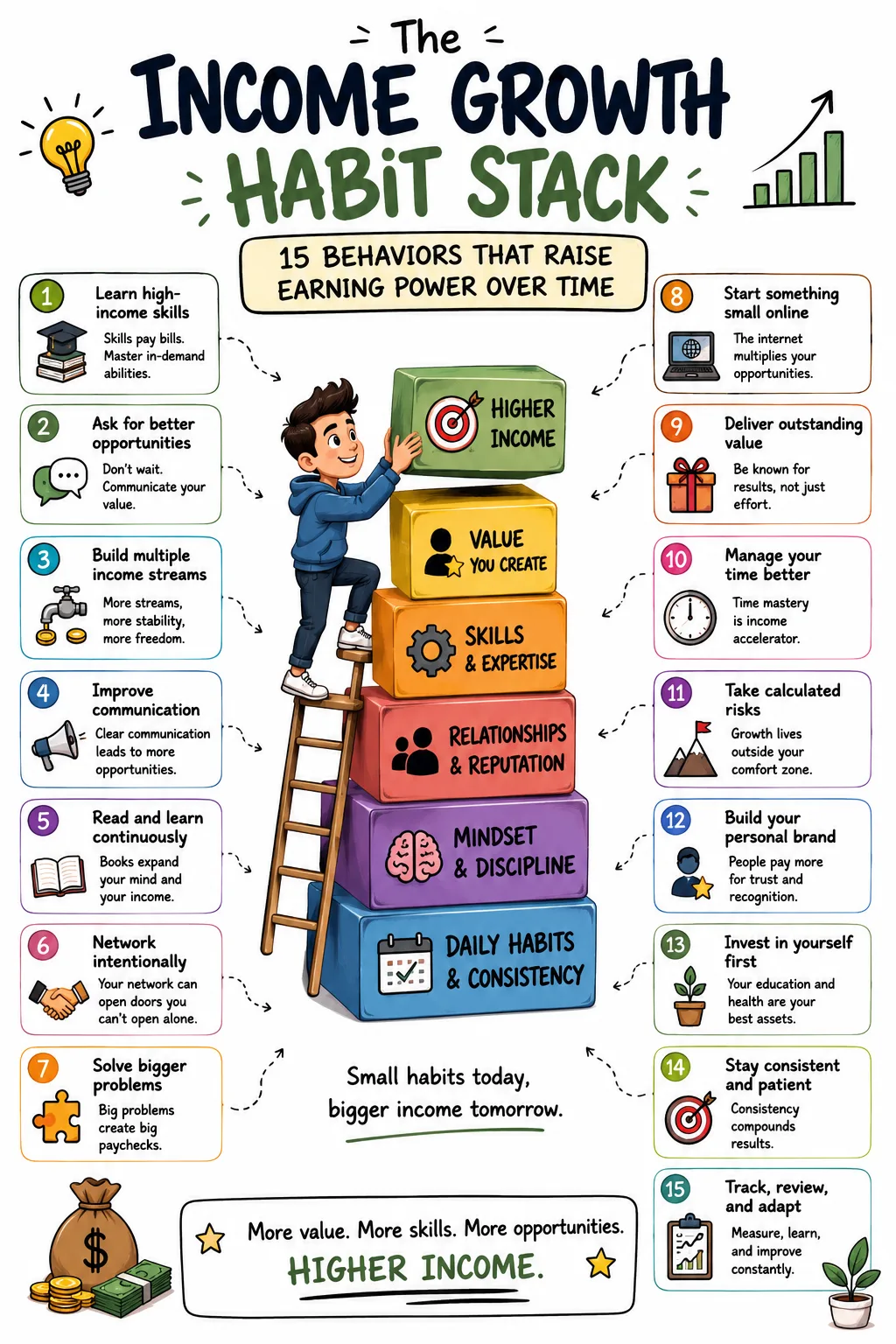
The Income Growth Habit Stack: 15 Behaviors That Raise Earning Power Over Time
Most people think about wealth from the investment side first. They ask which stock to buy, which fund to choose, which property market is rising, or which asset class might compound fastest over the next decade. Those questions matter. Ownership is central to wealth building. Assets create leverage that labor alone cannot always provide.
But before most people can invest meaningfully, they face a simpler and more immediate challenge: they need more income.
Not because income automatically creates wealth. It does not. Many high earners remain financially fragile because their spending rises at the same pace as their pay. Some professionals earn excellent salaries and still live one missed bonus away from stress. Income is powerful, but only when it is converted into savings, investments, ownership, and financial flexibility.
Still, income matters deeply. It is the engine that funds debt repayment, emergency savings, retirement contributions, business experiments, education, insurance, housing stability, and investment capital. A household earning too little has fewer options. A worker stuck in a stagnant wage path often has less room for error. A young professional who never learns how income grows may spend years trying to budget their way out of a problem that also requires earning power.
The most useful way to think about income growth is not as a single tactic, but as a stack of habits. One habit rarely changes a financial life by itself. Learning a valuable skill helps, but only if people know you have it. Networking helps, but only if you can communicate clearly. Productivity helps, but only if it is aimed at work that matters. Building a side income helps, but not if it distracts from the primary career that pays the bills. Long-term thinking helps, but only if it produces consistent action in the present.
Income growth is built through compounding behaviors.
The habits in this article are not magic rules. They do not guarantee higher earnings. Income is shaped by forces larger than individual effort: education access, industry demand, geography, family obligations, discrimination, economic cycles, health, technology change, and luck. Any serious discussion of earning power must admit that the labor market is not a perfectly fair scoreboard.
But the fact that income is not fully controllable does not mean it is random. Certain behaviors consistently improve the probability of higher earnings. People who build marketable skills, communicate well, negotiate, create value, cultivate relationships, learn continuously, and think in years rather than weeks tend to give themselves more chances. They become easier to promote, easier to hire, easier to trust, easier to recommend, and harder to replace.
The goal is not to hustle endlessly. It is to become more valuable in ways the market recognizes.
1. Learn High-Income Skills
The most durable income growth habit is skill acquisition. In every economy, certain abilities command higher compensation because they solve urgent, difficult, or scarce problems. These skills change over time, but the principle remains constant: the more valuable and less replaceable your contribution, the stronger your earning power tends to become.
This is the foundation of human capital. Human capital refers to the knowledge, skills, experience, and judgment that make a person more productive. A person who can write software, analyze financial statements, repair complex machinery, manage a clinical team, sell enterprise services, design infrastructure, run paid advertising profitably, or lead a high-performing department has a form of capital inside them. It is not visible on a balance sheet, but it affects income every year.
High-income skills are not limited to white-collar professions. Skilled trades can produce excellent earnings when demand is high and supply is limited. Healthcare roles can command strong compensation because the work is essential and often requires certification. Technical salespeople can earn more than many analysts because they directly influence revenue. Managers who can lead teams through complexity may earn more than individual contributors because their decisions affect many people at once.
The key is not simply learning what sounds impressive. It is learning what the market values.
A skill becomes economically powerful when it sits at the intersection of demand, scarcity, usefulness, and transferability. Demand means employers or customers actively need it. Scarcity means not enough people can do it well. Usefulness means it produces measurable outcomes. Transferability means it can be used across companies, clients, industries, or business models.
For example, data analysis can be valuable because organizations need people who can turn raw information into decisions. Cybersecurity can be valuable because digital risk keeps rising. Project management can be valuable because companies lose money when complex work is disorganized. Sales can be valuable because revenue is the bloodstream of business. Writing can be valuable when it persuades customers, clarifies strategy, or builds trust.
Not every skill produces the same return. Some are personally enriching but not highly monetizable. Others are monetizable only in specific markets. A person who learns video editing may earn little if they treat it as a hobby, more if they serve businesses, and far more if they combine editing with direct-response marketing, storytelling, distribution, and client acquisition. The income is not in the tool alone. It is in the business problem the tool solves.
A useful question is: who pays for this skill, and why?
When choosing what to learn, study job postings, freelance marketplaces, industry reports, professional communities, and compensation data. Look for repeated patterns. Which roles keep appearing? Which certifications are requested? Which problems do companies describe again and again? Which skills appear in higher-paying versions of your current field?
Then go one level deeper. Do not only ask what skill is popular. Ask what combination is rare. A software developer who understands finance may have an advantage in fintech. A nurse with management training may move into leadership. A designer who understands conversion rates may become more valuable to e-commerce companies. A financial advisor who communicates clearly through content may build a larger client base.
Income often grows when skills are stacked.
The habit is simple but demanding: choose one economically useful skill, learn it seriously, apply it repeatedly, and keep raising the difficulty. Watching tutorials is not enough. Skill turns into earning power through practice, feedback, proof, and results.
2. Ask for Better Opportunities
Many people wait to be noticed. They assume that if they work hard, someone will eventually reward them. Sometimes that happens. Often it does not.
Organizations are busy. Managers are distracted. Compensation systems are imperfect. Promotions do not always go to the most capable person. They often go to the person whose value is visible, whose ambitions are known, whose work connects to business priorities, and whose timing aligns with opportunity.
Asking for better opportunities is not arrogance. It is career stewardship.
This habit includes asking for a raise, applying for a promotion, volunteering for a high-impact project, requesting leadership exposure, seeking mentorship, moving to a stronger team, changing employers, or entering a higher-paying industry. It requires a shift from passive employment to active career management.
Annual raises alone may not transform earning power. In many fields, the largest income jumps come from role changes. A person who stays in the same position for years may receive small percentage increases, while someone who develops skills and moves into a higher-value role may reset their entire income base. The difference compounds. A $10,000 salary increase does not affect only one year. It can influence future raises, retirement contributions, borrowing capacity, savings rate, and negotiation anchors for the next job.
But asking effectively requires preparation.
The weakest version of asking is emotional: “I work hard, so I deserve more.” The stronger version is evidence-based: “Here is the value I have created, here is how my responsibilities have expanded, here is the market range for this role, and here is the compensation or opportunity I would like to discuss.”
Before a compensation conversation, document outcomes. Revenue generated. Costs reduced. Processes improved. Clients retained. Risks avoided. Projects delivered. People trained. Systems built. If possible, translate your contribution into business language. Employers do not pay more simply because an employee feels ready. They pay more when they believe the employee’s contribution, retention, or potential justifies the cost.
There is also a psychological barrier. Many workers fear that asking will make them seem demanding. But professional asking can be respectful, calm, and strategic. You do not need to threaten. You do not need to exaggerate. You do need to communicate your aspirations clearly.
A practical approach is to ask earlier than the formal review. Instead of waiting until compensation decisions are already made, ask your manager what would make you a strong candidate for advancement in the next cycle. Ask what skills, metrics, or responsibilities matter most. Ask where the team needs someone to step up. Then use the answer as a roadmap.
Opportunity often favors people who make their direction known.
3. Build Multiple Income Streams
A single paycheck can be efficient, but it can also be fragile. When all income depends on one employer, one industry, or one client, financial life becomes vulnerable to decisions you do not control. A layoff, recession, health issue, management change, automation wave, or business closure can disrupt everything.
Multiple income streams can improve resilience. They can also accelerate wealth building when the extra income is invested rather than absorbed by lifestyle inflation.
There are many forms of income diversification: employment income, freelance work, consulting, rental income, dividends, interest, royalties, digital products, small business profits, affiliate revenue, licensing, and equity ownership. Some are active. Some are passive only after years of effort. Some require capital. Others require skill, time, reputation, or distribution.
The mistake is treating all income streams as equal.
A second income stream that drains energy, distracts from a promising career, and produces little profit may be more burden than benefit. A side business that earns a few hundred dollars but prevents someone from performing well in a role with promotion potential may reduce long-term income. Diversification is useful only when it is sustainable and strategically chosen.
For many people, the best first income stream is not a complicated business. It is maximizing the primary income engine. If your main career has significant upside, skill development and role advancement may produce a better return than chasing several small side hustles. The first question should be: where is my highest-probability income growth?
Once the primary income path is stable, additional streams can make sense. A teacher might create educational materials. A designer might freelance selectively. A software engineer might build a small tool. A professional with deep expertise might consult. An investor might use surplus cash to buy income-producing assets. A writer might develop paid newsletters, books, or licensing opportunities.
The best secondary income streams often grow from existing capabilities. They use skills, knowledge, networks, or assets you already have. This lowers the learning curve and increases credibility.
It is also important to separate revenue from profit. Many side businesses look attractive from the outside but produce thin margins after software, advertising, shipping, taxes, time, refunds, contractors, and customer service. An online store doing $5,000 a month in sales may produce far less income than a consulting project doing $2,000 a month with minimal overhead.
Multiple income streams should reduce financial stress, not multiply chaos.
The habit is to build carefully: protect your main income, test small, track real profitability, avoid debt-heavy experiments, and invest the surplus. Done well, income diversification creates options. Done poorly, it becomes a scattered attempt to escape financial pressure without a strategy.
4. Improve Communication Skills
Communication is one of the highest-leverage income skills because it affects almost every professional interaction. People who communicate well can explain ideas, persuade decision-makers, lead teams, negotiate compensation, win clients, manage conflict, and build trust.
In many careers, technical ability gets someone into the room. Communication helps them rise in the room.
A brilliant analyst who cannot explain findings clearly may be overlooked. A skilled engineer who cannot communicate trade-offs may struggle to influence product decisions. A founder who cannot tell a compelling story may fail to raise capital or win customers. A manager who cannot give clear direction may weaken an entire team. A salesperson who cannot listen may lose deals that a more thoughtful competitor wins.
Communication is not just speaking well. It includes writing, listening, asking questions, structuring arguments, reading the room, simplifying complexity, and adapting to the audience. The most valuable communicators are not necessarily the most polished speakers. They are the clearest thinkers.
Clarity creates confidence.
When someone can explain a problem simply, people assume they understand it deeply. When someone can write a concise memo, decision-makers can act faster. When someone can present a recommendation with evidence, risks, and next steps, they become more useful to leadership. When someone can communicate bad news honestly without panic, they become trusted.
Improving communication starts with observation. Notice which colleagues get listened to. What do they do differently? Often they organize their thoughts before speaking. They lead with the point. They avoid unnecessary jargon. They connect details to business outcomes. They anticipate objections. They make it easy for others to say yes.
One practical habit is to use the “answer first” method. Instead of beginning with every detail, start with the conclusion, then provide supporting reasoning. For example: “We should delay the launch by two weeks because the payment flow is still producing errors that could affect revenue and customer trust. Here are the three issues and the proposed fix.”
This style respects attention. It also signals judgment.
Writing is equally important. In modern work, many opportunities are shaped through emails, proposals, reports, messages, profiles, posts, and documentation. Clear writing travels when you are not in the room. It can influence hiring managers, clients, executives, partners, and customers.
Listening may be the most underappreciated communication skill. People who listen well identify needs more accurately. They sell better because they understand the buyer’s real problem. They manage better because they hear friction before it becomes failure. They negotiate better because they discover what the other side values.
Communication improves through deliberate practice. Record presentations. Rewrite emails for clarity. Ask for feedback. Read strong business writing. Join discussions. Practice explaining complex ideas to non-experts. Replace vague statements with specific ones.
Over time, better communication turns invisible value into visible value.
5. Read Financial Books Regularly
Financial education does not automatically create wealth, but financial ignorance can quietly destroy it.
Reading financial books is valuable because it exposes people to principles they may not learn at home, in school, or at work. Budgeting, compounding, risk, taxes, debt, inflation, diversification, insurance, asset allocation, business ownership, behavioral bias, and retirement planning all shape financial outcomes. A person who understands these concepts has a better chance of making informed decisions.
But reading alone is not transformation. A shelf full of finance books cannot compensate for uncontrolled spending, chronic avoidance, speculative behavior, or failure to act. The purpose of financial reading is not to feel productive. It is to improve decisions.
The best financial books teach frameworks. They help readers understand trade-offs. Why does compound interest reward patience? Why can high-interest debt overpower income? Why do investors panic during downturns? Why does lifestyle inflation consume raises? Why does insurance matter before disaster? Why does ownership change the wealth equation?
Good financial education also reduces susceptibility to hype. People who understand basic investing are less likely to chase every trend. People who understand debt are less likely to confuse monthly payments with affordability. People who understand risk are less likely to put emergency savings into volatile assets. People who understand taxes are more likely to plan before decisions become expensive.
For income growth specifically, financial reading helps in two ways. First, it teaches how to use income wisely. More earnings should not simply fund a more expensive lifestyle. They should strengthen the balance sheet. Second, it can reveal new income possibilities: entrepreneurship, freelancing, asset ownership, negotiation, career capital, and business models.
A useful reading habit is to pair each book with one action. After reading about budgeting, automate savings. After reading about investing, review retirement contributions. After reading about negotiation, prepare a compensation file. After reading about business, test a small offer. After reading about behavioral finance, identify your own financial triggers.
Financial books are not instruction manuals for copying someone else’s life. They are tools for sharpening judgment.
6. Network Intentionally
Many opportunities move through relationships before they ever become public. Jobs are referred. Clients are introduced. Mentors make suggestions. Partners compare notes. Investors hear about founders. Managers recommend people they trust. A strong network does not replace competence, but it can help competence travel further.
This is social capital: the value created through relationships, trust, reputation, and access to information.
Intentional networking is not collecting contacts or sending shallow messages to strangers. It is building genuine professional relationships before you urgently need them. The most effective networkers are often generous, curious, and consistent. They share useful information. They make thoughtful introductions. They follow up. They remember what people care about. They contribute before asking.
Networks matter because information is unevenly distributed. Someone in your field may know which company is hiring, which manager is excellent, which certification has value, which client needs help, which trend is growing, or which role is underpaid. Without relationships, you may never hear these things.
Strong networks also create trust shortcuts. A hiring manager who receives a referral from someone they respect may view a candidate differently. A business owner introduced by a mutual contact may face less skepticism. A professional recommended by a credible colleague may win a conversation that cold outreach could not secure.
Networking should not be limited to people above you. Peer networks can be just as powerful. The colleague at your level today may become a founder, executive, investor, client, or specialist tomorrow. Many careers are built through cohorts that rise together.
The habit begins with clarity. Who should know what you do? Which communities matter in your profession? Where do serious people in your field exchange ideas? Which former colleagues do you respect? Which mentors could help you see blind spots? Which events, associations, online groups, or alumni networks create useful proximity?
Then make relationship-building routine. Reach out after reading someone’s work. Congratulate people on meaningful milestones. Ask thoughtful questions. Offer help when you can. Share relevant resources. Schedule occasional conversations. Keep notes on important details. Follow up without making every interaction transactional.
Networking has a compounding effect. One conversation can lead to another. One introduction can open a door. One reputation-building contribution can circulate beyond the original audience.
The goal is not popularity. It is trust at scale.
7. Solve Bigger Problems
Income often follows problem size. The larger, more urgent, more complex, or more profitable the problem you can solve, the more economic value you can command.
This does not mean every high earner is morally superior or every low earner solves small problems. The labor market does not perfectly measure social value. Some essential work is underpaid. Some highly compensated work may be financially valuable without being socially noble. But within many careers and businesses, compensation tends to rise when responsibility, complexity, and measurable impact increase.
An entry-level employee may be paid to complete tasks. A manager may be paid to coordinate people. A director may be paid to allocate resources and make trade-offs. An executive may be paid to guide strategy under uncertainty. A consultant may be paid to solve a specialized problem a client cannot solve internally. A business owner may be rewarded for building a system that solves a recurring customer need at scale.
To grow income, ask: what bigger problem can I become capable of solving?
For a customer service representative, the bigger problem may be reducing complaint volume by identifying root causes. For a bookkeeper, it may be helping owners understand cash flow before crises occur. For a teacher, it may be designing a program that improves outcomes across many classrooms. For a software developer, it may be building infrastructure that reduces downtime. For a salesperson, it may be opening a new market segment.
Bigger problems usually require broader thinking. You must understand not only your task, but the system around it. Why does the problem exist? Who is affected? What does it cost? What has already been tried? What constraints matter? What would a successful solution change?
This is how people move from task execution to value creation.
One practical method is to follow the money, risk, and friction. Where does the organization lose revenue? Where do customers leave? Where do delays occur? Where do errors repeat? Where do managers worry? Where do costs rise? Where is the business exposed? Problems in these areas often matter because they affect performance.
Then build the skill to help. Do not simply point out problems. Become someone who can frame them, analyze them, and contribute to solutions. People who only criticize are rarely promoted for long. People who reduce uncertainty become valuable.
Solving bigger problems also requires judgment. Bigger problems are often ambiguous. There may be no perfect answer. Trade-offs are unavoidable. The ability to make progress without full certainty is a mark of professional maturity.
Income growth often begins when you stop asking only, “What am I assigned?” and start asking, “What outcome matters most?”
8. Start Something Small Online
The internet has lowered the cost of testing income ideas. A person can publish expertise, sell services, create digital products, launch a small store, teach, consult, build software, freelance, distribute content, or reach customers without renting a storefront or raising large amounts of capital.
This creates real opportunity. It also creates unrealistic expectations.
Many online businesses fail. Many produce modest income. Many take years to become meaningful. Some are profitable only because owners do not honestly count their time. Others depend on platforms that can change algorithms, fees, policies, or reach overnight. The internet makes starting easier, not succeeding easy.
The healthiest way to approach online income is as experimentation.
Start small. Test one offer. Serve one audience. Solve one problem. Keep costs low. Learn from real feedback. Do not confuse branding with business. A beautiful logo, website, and social profile mean little if nobody pays for the product or service.
Good online income ideas usually begin with a clear customer pain. A consultant helps small businesses improve operations. A designer creates templates for a specific profession. A tutor teaches a high-demand subject. A writer creates research for a niche audience. A developer builds a simple tool that saves time. A fitness coach serves busy professionals with a defined program.
The more specific the problem, the easier it is to communicate value.
Online work also rewards trust. Because buyers cannot always meet you in person, they look for signals: testimonials, samples, clear explanations, useful content, credentials, case studies, guarantees, professional presentation, and consistent behavior. This is where communication, skill, and personal brand intersect.
Starting something small online can teach lessons that employment may not. You learn pricing, customer psychology, marketing, delivery, operations, taxes, time management, and resilience. Even a modest project can improve business judgment. It can also reveal whether entrepreneurship energizes or exhausts you.
But not every person needs an online business. Some will earn more by becoming excellent employees, professionals, tradespeople, or executives. Online income should be treated as one possible path, not a moral requirement.
The best test is simple: can you create value for a defined group of people and capture some of that value profitably?
If the answer is yes, start with a low-risk experiment. If the answer is unclear, learn before spending. Avoid large upfront investments, expensive courses promising fast riches, inventory you cannot afford to hold, or advertising campaigns you do not understand.
Small online projects can grow into meaningful income streams. But the habit is not “get rich online.” The habit is learning to create, test, sell, and improve in public markets.
9. Increase Productivity Daily
Productivity is not about being busy. It is about directing attention toward work that matters and completing it with less waste.
Many people are exhausted not because they are doing high-value work, but because their days are fragmented. Messages, meetings, notifications, unclear priorities, multitasking, procrastination, and low-value tasks consume the hours. At the end of the day, they feel tired but cannot point to meaningful progress.
Income growth often requires deliberate output. Skills must be practiced. Projects must be finished. Applications must be sent. Proposals must be written. Clients must be followed up with. Content must be published. Systems must be built. Learning must be scheduled. Without productivity, good intentions remain theoretical.
The first productivity habit is prioritization. Not every task deserves equal energy. A useful question is: which activity, if completed well, would most improve my future earning power?
That answer might be studying for a certification, preparing for a salary negotiation, improving a portfolio, reaching out to five potential clients, finishing a high-visibility project, practicing a technical skill, or documenting achievements for a promotion conversation.
Productivity improves when important work receives protected time. This may mean doing deep work before checking messages, blocking study hours, batching administrative tasks, preparing tomorrow’s top priorities the night before, or using a weekly review to prevent drift.
It also requires energy management. The advice to increase productivity is often misunderstood as a call to remove rest. That is a mistake. Recovery is not the enemy of performance. Burnout reduces judgment, creativity, emotional control, and consistency. A person who sacrifices sleep for months may appear disciplined while quietly damaging the very capacity that income growth depends on.
Effective productivity balances intensity with sustainability.
One useful framework is to divide work into maintenance, growth, and leverage. Maintenance tasks keep life functioning: bills, email, errands, routine reporting. Growth tasks build future earning power: learning, portfolio work, networking, sales, negotiation, strategic projects. Leverage tasks create systems or assets that keep producing value: templates, processes, products, documentation, automation, training materials, or investments.
Many people spend too much time on maintenance and too little on growth and leverage. Income changes when the calendar changes.
Daily productivity does not require perfect routines. It requires honest attention. What did you do today that could make next year better? What did you avoid that keeps you in the same place? What can be simplified, delegated, automated, or eliminated?
Productivity is valuable when it serves a meaningful direction.
10. Learn Sales Skills
Sales is often misunderstood. Some people hear the word and imagine pressure, manipulation, or rejection. Poor sales can be all of those things. Good sales is different. It is the ability to understand a need, communicate value, build trust, address concerns, and guide a decision.
That skill is valuable far beyond traditional sales jobs.
Employees sell ideas to managers. Founders sell visions to investors. Freelancers sell services to clients. Executives sell strategy to boards. Job candidates sell their value to employers. Managers sell change to teams. Professionals sell recommendations, budgets, timelines, and priorities.
If you cannot sell, your value may remain hidden.
Sales begins with listening. The best salespeople do not rush to pitch. They diagnose. They ask what the buyer is trying to accomplish, what problems they face, what they have tried, what failure costs, what success looks like, and what constraints matter. Then they connect the solution to the buyer’s world.
This is why sales is closely tied to income. Revenue is one of the most measurable forms of business value. People who can bring in customers, retain clients, expand accounts, negotiate deals, or influence purchasing decisions are often close to the money. Companies tend to notice people who help revenue grow.
Sales skills also strengthen negotiation. A salary negotiation is not begging for more pay. It is a value conversation. You must understand the employer’s needs, present evidence, handle objections, and propose terms. A promotion conversation works similarly. So does a client proposal.
Learning sales does not mean becoming aggressive. It means becoming clear, confident, and useful.
Start by studying how decisions are made. Why do people buy? Why do they delay? Why do they trust one provider over another? Why do they object to price? Often price resistance is not only about money. It may reflect uncertainty, lack of urgency, poor fit, unclear value, or fear of making the wrong decision.
Practice explaining value in terms of outcomes. Do not say only, “I provide marketing services.” Say, “I help local clinics turn website visitors into booked appointments by improving their landing pages and follow-up systems.” Do not say only, “I am good with data.” Say, “I help teams identify which customer segments are driving profit and where retention is weakening.”
Good sales makes value concrete.
For professionals who dislike selling, the goal is not to become someone else. The goal is to become comfortable advocating for useful work. If you believe your skill, product, service, or idea can help, then explaining it well is not manipulation. It is part of creating value.
11. Build a Personal Brand Carefully
A personal brand is simply a professional reputation made visible. It is what people come to associate with your name: reliable, insightful, technical, creative, strategic, generous, disciplined, careless, inconsistent, or difficult.
Everyone has a reputation. The question is whether it is intentional.
In knowledge-based industries, personal brand can create opportunity. It can help employers discover you, clients trust you, peers recommend you, and audiences follow your work. A strong professional presence can turn private competence into public credibility.
But personal branding should be handled carefully. Visibility without substance is fragile. A person who posts constantly but cannot deliver results may attract attention briefly and lose trust permanently. The strongest brands are built on demonstrated competence, not noise.
A useful personal brand answers three questions. What do you understand? Who do you help? What can people trust you for?
For example, a cybersecurity professional might become known for explaining risk to non-technical executives. A financial planner might become known for helping young families make practical money decisions. A software developer might become known for writing clear technical breakdowns. A real estate professional might become known for data-driven local market analysis. A consultant might become known for improving operations in a specific industry.
Specificity creates memorability.
Building a personal brand does not require becoming an influencer. It can be as simple as maintaining a strong professional profile, sharing thoughtful insights, publishing case studies, speaking at industry events, contributing to professional communities, writing useful articles, or consistently doing excellent work that people talk about.
The danger is confusing attention with trust. Attention can come from controversy, exaggeration, or performance. Trust comes from usefulness, consistency, honesty, and results. For long-term income growth, trust is more valuable.
A careful personal brand also respects employer policies, client confidentiality, professional ethics, and personal boundaries. Not every achievement should be public. Not every opinion should be posted. Not every trend deserves commentary. Reputation is an asset, and assets require risk management.
Think of your personal brand as a bridge. It connects your ability to the people who need it. The stronger and more credible the bridge, the more opportunities can cross it.
12. Stop Wasting Free Time
Free time is one of the most emotionally charged topics in income growth. Some advice treats every leisure hour as a missed business opportunity. That view is too simplistic. Rest, recreation, family, friendship, exercise, sleep, and unstructured time are not waste. They are part of a healthy life and often essential for sustained performance.
But it is also true that discretionary time can shape financial outcomes.
The issue is not whether every evening should be monetized. The issue is whether a person’s time use matches their stated goals. Someone who says they want a better career but spends years avoiding learning, networking, applications, and skill-building may need to confront the gap. A few hours a week, used consistently, can change a life over time.
Consider the arithmetic. Five focused hours per week is 260 hours per year. Over three years, that is 780 hours. That is enough time to build a portfolio, learn a technical skill, study a language, prepare for a credential, start a small business, write extensively, improve fitness, or develop sales ability. The transformation does not come from one heroic weekend. It comes from repeated allocation.
Free time becomes powerful when it is directed toward growth.
This does not require eliminating pleasure. It requires reducing unconscious consumption. Endless scrolling, low-quality entertainment, impulsive shopping, gossip, and digital distraction can consume hours without providing real recovery. People often feel neither rested nor improved afterward.
A better approach is intentional leisure and intentional growth. Watch the film you truly enjoy. Spend time with people you love. Rest without guilt. Then protect time for the future you claim to want.
One practical method is to create a weekly learning block. It might be Tuesday and Thursday evenings, Saturday morning, or one hour before work. During that block, the task is predetermined: study, practice, build, apply, write, or reach out. The decision is made before motivation fluctuates.
Another method is replacing low-value time with high-value time gradually. Do not attempt to rebuild your entire schedule overnight. Start with three hours per week. Then five. Then more if it is sustainable.
The goal is not to become a machine. It is to stop letting the most flexible hours of your life disappear without serving either joy or progress.
13. Focus on Value Creation
Value creation is the central economic principle behind income growth. People earn more when they help employers, clients, customers, or markets achieve outcomes they care about.
This sounds obvious, but many people focus on effort instead of value. They track how busy they are, how many hours they work, how tired they feel, or how much they know. Those things may matter, but compensation is usually tied more closely to perceived value than personal exertion.
A worker who spends ten hours on a low-impact task may be less valuable than someone who spends two hours solving a costly problem. A business with a beautiful product that customers do not need may fail, while a simple service that removes a painful bottleneck may thrive. The market does not reward effort equally. It rewards outcomes that others recognize and are willing or required to pay for.
Value can take many forms. It can increase revenue, reduce costs, save time, lower risk, improve quality, enhance customer satisfaction, protect assets, simplify complexity, create status, provide comfort, or reduce uncertainty. In personal finance, value creation is the bridge between ability and income.
To focus on value, learn to see through the eyes of the payer. What does your employer need? What does your client fear? What does your customer want? What problem is expensive, urgent, recurring, or emotionally important? What result would make someone grateful to pay?
This mindset changes how you work.
Instead of saying, “I need to make more money,” you ask, “What valuable problem can I solve better than before?” Instead of saying, “I deserve more because I am loyal,” you ask, “How can I make my contribution more visible and economically meaningful?” Instead of starting a business around what you want to sell, you ask, “What does a specific group already want solved?”
Value creation also encourages ownership thinking. Employees with ownership thinking do not limit themselves to tasks. They care about outcomes. They notice inefficiencies. They understand customers. They think about profit, risk, quality, and reputation. This does not mean allowing an employer to exploit them. It means developing the mindset that later supports leadership, entrepreneurship, investing, and negotiation.
One exercise is to write a value statement for your work: “I help [person or organization] achieve [outcome] by doing [specific contribution].” If the statement is vague, your market value may be hard to communicate. Make it sharper.
Income growth becomes more rational when value is clear.
14. Invest in Knowledge Constantly
Careers used to change more slowly. A person could often learn a trade, profession, or corporate function and rely on that knowledge for many years. Today, many fields evolve faster. Technology changes workflows. Regulations shift. Customer behavior changes. New tools enter the market. Old skills lose value. Industries expand, consolidate, automate, or disappear.
Continuous learning is no longer optional for people who want durable earning power.
Investing in knowledge includes formal education, certifications, books, courses, mentors, conferences, apprenticeships, podcasts, technical documentation, industry reports, professional communities, and deliberate practice. But the best learning is not random consumption. It is strategic.
Ask what knowledge would improve your income prospects most. Technical expertise? Leadership? Financial literacy? Sales? Data? Writing? Industry specialization? AI tools? Compliance? Operations? Language skills? Management? The answer depends on your field, career stage, and goals.
Knowledge investment should be evaluated like capital allocation. Some learning has a high return. Some is interesting but not urgent. Some credentials are respected. Others are expensive signals with little market value. Some courses teach skills. Others mainly sell motivation.
Before paying for education, ask: who recognizes this? What outcome does it support? Can I learn it cheaper elsewhere? Will it produce a portfolio, credential, network, or capability? How will I apply it within 30 days?
The application question matters most. Knowledge decays when unused. A person who completes a course but never practices may gain confidence without competence. A person who learns one concept and applies it immediately may gain more.
Investing in knowledge also protects against economic shocks. Workers who keep learning can adapt faster when industries change. They can move into adjacent roles, use new tools, understand emerging markets, and avoid being trapped by outdated expertise.
This habit is not about chasing every trend. It is about staying professionally alive.
A good learning system has three layers. The first is core knowledge: the durable principles of your field. The second is current knowledge: what is changing now. The third is adjacent knowledge: skills outside your role that increase your versatility. For a marketer, that might mean consumer psychology, analytics, and AI-assisted creative testing. For an accountant, it might mean tax rules, automation tools, and advisory communication. For a tradesperson, it might mean technical mastery, estimating, and small business management.
Continuous learning compounds because each new layer makes the next layer easier. You develop pattern recognition. You understand context. You ask better questions. You become harder to fool.
Income growth belongs to people who keep becoming more useful.
15. Think Long Term Always
The most meaningful financial changes usually take longer than people want. Skills take time. Promotions take time. Businesses take time. Networks take time. Investments take time. Reputation takes time. Debt reduction takes time. Wealth building is rarely a straight line.
Long-term thinking is the habit that protects people from quitting too early or chasing shortcuts that damage them.
Short-term thinking asks, “What can I get now?” Long-term thinking asks, “What will this decision make possible later?”
This distinction affects careers. A slightly lower-paying role that builds rare skills may be better than a stagnant role with a small immediate premium. A difficult project may be worth taking if it creates proof of leadership. A season of focused learning may pay off more than extra overtime in a dead-end position. A professional relationship may not produce value today but may matter years from now.
Long-term thinking also affects lifestyle. When income rises, the temptation is to upgrade everything quickly: housing, car, travel, dining, clothing, subscriptions, and social spending. Some lifestyle improvement is reasonable. Money should support life. But if every raise is consumed, income growth fails to become wealth.
The long-term thinker captures part of each increase. They raise savings rates. They invest. They pay down expensive debt. They build emergency reserves. They buy insurance where appropriate. They use higher income to purchase freedom, not only status.
Long-term thinking is especially important in entrepreneurship and side income. Early results are often slow. Many people quit before learning enough to improve. Others persist in bad ideas for too long because they confuse patience with denial. The skill is knowing the difference. Long-term thinking requires both persistence and feedback.
A useful question is: what would make this effort worth continuing for three years?
If the answer is unclear, refine the path. If the answer is strong, commit to the process. Long-term thinking turns scattered effort into strategy.
It also creates emotional stability. People who think only in weeks are easily discouraged. They compare themselves constantly. They chase trends. They panic during setbacks. People who think in years can absorb slower progress. They understand that compounding looks unimpressive at first.
The long term is not an excuse to delay action. It is the reason to act consistently now.
The Habits Work Best as a System
Each habit is useful by itself, but the real power comes from combining them.
Imagine a professional who learns data analytics. That skill has value. But if they also communicate clearly, they can explain insights to leadership. If they network intentionally, more people learn what they can do. If they ask for better opportunities, they move toward roles that use the skill. If they understand sales, they can position their value. If they build a careful personal brand, opportunities may come from outside their employer. If they think long term, they keep improving rather than stopping after the first raise.
This is the income growth habit stack.
Another example: a tradesperson develops advanced technical expertise. They improve communication with customers. They learn basic sales and estimating. They build a reputation for reliability. They use free time to study business operations. They start a small online presence showing their work. They build relationships with contractors and property managers. Over time, they may move from employee to independent contractor to business owner. The transformation is not one habit. It is the stack.
A teacher might use the same principles differently. They build expertise in a high-demand subject, improve public speaking, create educational resources, network with administrators and other educators, pursue leadership roles, start tutoring or digital products carefully, and invest in long-term credentials. Income growth does not require abandoning the profession. It may require expanding how value is delivered.
The best system is personal. Not everyone should pursue the same path. A parent with limited time may focus first on a certification that raises salary. A young professional may prioritize networking and communication. A mid-career worker may need to negotiate or change industries. A high earner may need to convert income into assets. A burned-out entrepreneur may need productivity boundaries and rest.
The habits are tools, not commandments.
Income Growth Is Not the Same as Wealth
It is possible to earn more and still feel broke. This is the income illusion: the belief that a higher paycheck automatically creates financial security.
Income growth creates potential. Wealth building requires conversion.
Every increase in income should be given a job. Some can improve quality of life. Some should strengthen emergency savings. Some should reduce high-interest debt. Some should be invested. Some should fund insurance and protection. Some can support education, business experiments, or career mobility.
Without a plan, lifestyle inflation quietly absorbs progress. A raise becomes a car payment. A bonus becomes a vacation. A promotion becomes a more expensive apartment. None of these choices is automatically wrong. The danger is unconscious escalation.
A practical rule is to save or invest a meaningful portion of every income increase before expanding spending. This preserves the emotional reward of earning more while ensuring that higher income changes the balance sheet.
For example, if monthly take-home pay rises by $800, someone might allocate $300 to improved lifestyle, $300 to investing, $100 to emergency savings, and $100 to debt reduction or education. The exact numbers depend on circumstances, but the principle is powerful: do not let income growth disappear without leaving evidence.
Wealth is what remains after income flows through decisions.
The External Forces Still Matter
A mature view of income growth must avoid pretending that habits alone determine outcomes. They do not.
Two people can practice the same habits and receive different results because they operate in different environments. One may live in a region with abundant high-paying jobs. Another may face limited local opportunities. One may have family support. Another may carry caregiving responsibilities. One may work in a growing industry. Another may be in a shrinking one. One may face discrimination that affects hiring, pay, promotion, or access to capital.
Economic cycles matter too. During recessions, even skilled workers can lose jobs. During booms, opportunities may expand quickly. Technology can raise demand for some skills while reducing demand for others. Public policy, education systems, transportation, healthcare access, and housing costs all influence earning power.
Recognizing these realities is not pessimism. It is accuracy.
The purpose of income growth habits is not to deny external barriers. It is to identify what remains within a person’s influence. Skills, communication, networks, learning, negotiation, value creation, and time allocation do not remove every obstacle. But they can improve the odds.
Financial education becomes more honest when it balances agency with context.
How to Begin Without Becoming Overwhelmed
Fifteen habits can feel like too many. The solution is not to overhaul your entire life in a week. The solution is to sequence.
Start with your income bottleneck.
If you lack a marketable skill, begin with skill development. If you have skill but no visibility, improve communication and networking. If you are underpaid relative to your contribution, prepare to ask for better opportunities. If you are financially dependent on one fragile source, explore sustainable diversification. If you are scattered, improve productivity. If you consume financial information but do not act, choose one practical step.
A simple 90-day plan can work well.
For the first 30 days, assess. Document your current income, skills, role, industry, network, time use, and financial habits. Identify the highest-value improvement area.
For the next 30 days, build. Choose one skill, one relationship habit, and one communication improvement. Practice consistently. Track output.
For the final 30 days, convert. Apply for opportunities, ask for feedback, update your profile, publish a portfolio piece, speak with a manager, pitch a client, or automate savings from any additional income.
The point is to move from inspiration to evidence.
Income growth becomes real when behavior changes in a measurable way. Hours studied. Projects completed. People contacted. Applications sent. Offers tested. Negotiations prepared. Money saved. Debt reduced. Investments funded.
What gets measured has a better chance of improving.
The Deeper Lesson
The strongest income growth habits all point toward the same truth: earners are rewarded not only for working, but for becoming more capable of creating value in changing environments.
Learning high-income skills increases capability. Asking for better opportunities increases access. Multiple income streams increase resilience. Communication increases influence. Financial reading improves judgment. Networking increases reach. Solving bigger problems increases impact. Online experiments increase optionality. Productivity increases execution. Sales increases conversion. Personal brand increases trust. Better use of free time increases capacity. Value creation increases relevance. Knowledge investment increases adaptability. Long-term thinking increases compounding.
Together, these habits form a practical philosophy of earning power.
They do not promise overnight wealth. They do not remove unfairness from the economy. They do not make every side hustle succeed or every negotiation successful. But they move a person away from passivity. They shift attention from wishing income would rise to building the conditions that make higher income more likely.
The financial life changes gradually at first. A sharper skill. A clearer conversation. A useful contact. A better project. A small raise. A first client. A stronger reputation. A smarter decision. A habit of saving the increase instead of spending it all.
Then the effects begin to connect.
Higher skill leads to better opportunities. Better opportunities lead to more income. More income, managed wisely, leads to more savings and investment. More financial stability creates more room to take strategic risks. Better networks create more options. Stronger judgment prevents costly mistakes. Long-term thinking keeps the system moving.
Income growth is not a single door. It is a corridor of doors, and habits determine how many you are prepared to open.
The best time to begin is not when conditions are perfect. It is when the next controllable step is clear.
 Article
 Article
 Article
 Article
 Article
 Article
 Article
 Article