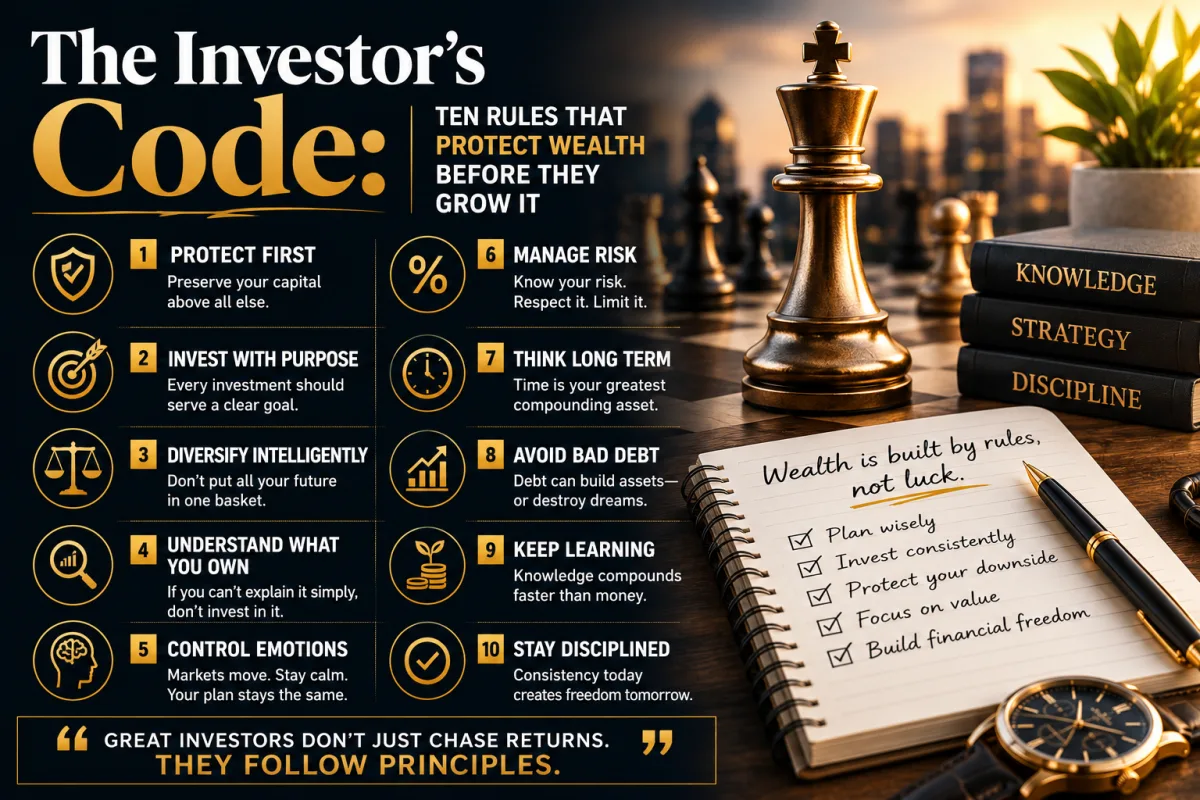
The Investor’s Code: Ten Rules That Protect Wealth Before They Grow It
Every generation of investors believes it is facing a market unlike any that came before. The names change. The technology changes. The headlines change. One era is dominated by railroads, another by oil, another by banks, another by internet companies, another by artificial intelligence, digital assets, or whatever new promise captures the public imagination. Yet beneath the surface, the central challenge of investing remains remarkably consistent: how to make sound decisions under uncertainty.
Markets are not machines that reward intelligence alone. They are emotional arenas where patience, discipline, humility, and risk control matter as much as analysis. Many investors fail not because they lack access to information, but because they misuse it. They chase what has already risen, abandon what has temporarily fallen, confuse excitement with opportunity, and mistake activity for progress.
The best investment principles are not complicated. They are simple enough to state in a sentence and difficult enough to practice for a lifetime. They do not depend on predicting next month’s market direction. They do not require secret access to privileged information. They do not promise quick riches. Their power comes from repetition, restraint, and time.
The ten commandments of investing are not rigid religious laws. They are practical disciplines. They help investors protect capital before seeking return. They separate investing from speculation. They convert financial ambition into a structured process. Most of all, they remind investors that wealth is rarely built by one brilliant decision. It is built by avoiding enough foolish ones.
Commandment One: Know What You Own
The first rule of intelligent investing is also the most neglected: never invest in what you do not understand.
This sounds obvious until the market becomes exciting. When prices rise quickly, people become more willing to buy assets they cannot explain. A friend mentions a fund. A colleague shares a stock tip. A relative introduces a private deal. A social media personality praises a new asset. The investor hears stories of fast gains and begins to fear being left behind. Soon, the question changes from “Do I understand this?” to “How much could I make?”
That shift is dangerous. An investor who does not understand an asset cannot properly judge its risk. They cannot distinguish a temporary decline from a permanent impairment. They cannot evaluate fees, liquidity, leverage, regulation, valuation, or the economic logic behind returns. They may not even know what would cause the investment to succeed or fail.
Knowing what you own does not mean knowing every technical detail. A person investing in a diversified fund does not need to memorize every security in the portfolio. But they should understand the broad asset class, the investment objective, the main risks, the fee structure, the liquidity terms, and the reason the investment belongs in their plan. A person buying shares should understand the company’s business model, financial health, competitive position, and valuation logic. A person buying property should understand location risk, rental demand, maintenance costs, taxes, financing, and exit options.
Understanding also requires knowing what you do not know. This is where humility becomes a financial asset. Many investors lose money because they confuse familiarity with knowledge. A business may be famous, but that does not make its stock attractive at any price. A property may be visible, but that does not make it liquid or fairly valued. A fund may be popular, but that does not make it suitable. A new technology may be transformative, but that does not mean every company attached to it will reward shareholders.
The investor’s basic questions should be direct. What am I buying? How does it generate value? What return do I reasonably expect? What risks could damage that return? What fees will I pay? How easily can I exit? What role does this investment play in my portfolio? What would have to happen for this decision to be wrong?
If the answers are unclear, the proper response is not embarrassment. It is patience. There is no shame in passing on an investment that cannot be understood. There is far more danger in pretending to understand it because others seem confident.
Many costly financial mistakes begin with a sentence that sounds harmless: “I do not really understand it, but everyone says it is good.” That is not investing. That is outsourcing judgment to the crowd. The crowd can be right for a while. It can also become dangerously wrong at exactly the moment confidence is highest.
Knowing what you own protects you in two ways. First, it reduces the chance of buying unsuitable investments. Second, it helps you behave rationally when conditions change. If you understand why you own an asset, you are less likely to panic during normal volatility. You can evaluate whether the original reason still holds. If it does, you may stay the course. If it does not, you can exit for a reason rather than from fear.
The investor who understands their holdings has an advantage that is not visible on a statement. They have conviction rooted in knowledge. Without that, even a good investment can become a bad experience.
Commandment Two: Invest Regularly
The second commandment is to invest regularly. Consistency is less glamorous than timing, but it is far more reliable for most people.
Many beginners believe successful investing depends on finding the perfect moment to enter the market. They wait for prices to fall, for the economy to stabilize, for interest rates to become clearer, for elections to pass, for experts to agree, or for fear to disappear. The problem is that perfect clarity rarely arrives. By the time uncertainty feels resolved, prices may already reflect the improvement.
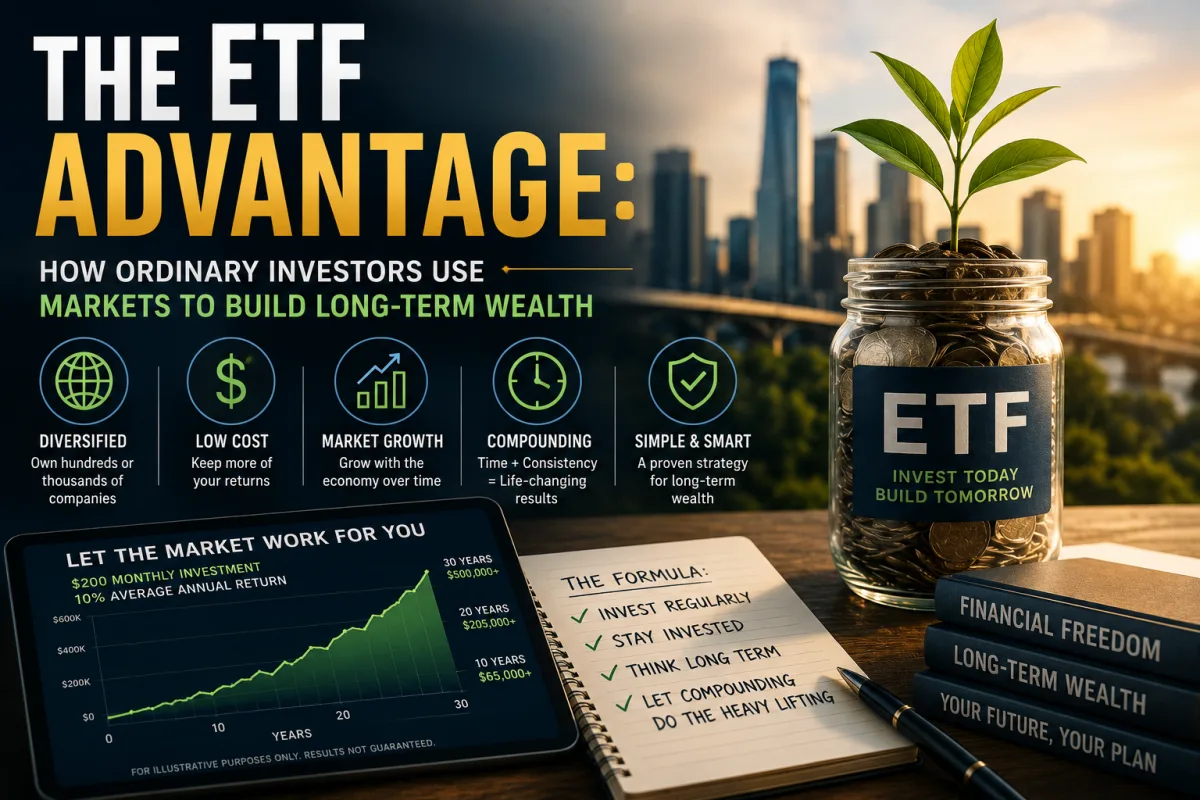
Regular investing solves part of this problem by shifting the focus from prediction to participation. Instead of trying to guess the best day to invest, the investor commits money on a schedule. This may be monthly, quarterly, or tied to income. The method is sometimes associated with dollar-cost averaging: investing fixed amounts over time so that more units are purchased when prices are lower and fewer when prices are higher.
The deeper value is behavioral. A regular investment plan removes the need to make a fresh emotional decision every month. The investor does not have to ask whether the market feels safe. The system acts before fear or excitement can interfere. Over long periods, this discipline can be more valuable than occasional cleverness.
Regular investing also connects wealth building to income. Most people do not begin with a large lump sum. They build capital gradually from salaries, business profits, commissions, bonuses, or side income. Consistent contributions allow ordinary income to become extraordinary ownership over time. The investor is not waiting to become wealthy before investing. They are using investing to convert surplus income into wealth.
This discipline is especially important during market declines. When prices fall, many investors stop investing because the environment feels dangerous. Yet lower prices can improve future expected returns if the underlying assets remain sound. A regular plan helps the investor continue buying when emotions might otherwise push them away. It turns volatility from a reason for paralysis into a feature of accumulation.
Regular investing does not guarantee profit. It does not remove market risk. It does not mean every asset should be bought regardless of valuation or quality. The commandment assumes the investor is contributing to a suitable, diversified, long-term plan. Consistency should support judgment, not replace it.
The investor should also increase contributions when income rises. One of the most powerful wealth-building habits is directing part of every raise, bonus, or profit increase toward investments before lifestyle absorbs it. This prevents income growth from becoming only consumption growth. It allows the investment plan to scale with earning power.
The great enemy of regular investing is inconsistency disguised as flexibility. People tell themselves they will invest when they have extra money. Extra money rarely appears by accident. It is usually created by intention. If investing happens only after all spending desires are satisfied, it will happen irregularly or not at all.
A strong investment plan treats investing as a priority, not a leftover. The amount can begin modestly. The habit matters first. Over time, the combination of rising contributions, reinvested returns, and patience can produce results that feel surprising only to those who did not notice the quiet accumulation happening month after month.
Commandment Three: Diversify Your Investments
Diversification is the investor’s admission that the future cannot be known with certainty. It is not a sign of weakness. It is a form of wisdom.
Every investment contains specific risks. A company can lose market share. A sector can fall out of favor. A currency can weaken. A property market can stagnate. A borrower can default. A government can change tax rules. A fund manager can underperform. A business model can be disrupted. Concentration magnifies the impact of being wrong about any one of these outcomes.
Diversification reduces dependence on a single decision. By spreading capital across different assets, sectors, geographies, currencies, or investment styles, the investor makes the portfolio less vulnerable to one failure. This does not eliminate losses. A diversified portfolio can still decline, especially during broad market stress. But diversification can reduce the chance that one bad investment permanently damages the entire financial plan.
For beginners, diversification often starts with collective investment vehicles such as diversified funds, retirement schemes, index funds, balanced funds, or professionally managed portfolios. These allow investors to own small pieces of many securities rather than relying on a single company or asset. As wealth grows, diversification can extend to fixed income, equities, real estate, cash reserves, retirement accounts, business ownership, and other suitable assets.
Good diversification is not simply owning many things. It is owning things that do not all fail for the same reason. An investor who owns ten shares in the same sector may still be highly concentrated. A property owner with several units in the same neighborhood may still depend on one local economy. A person who owns multiple funds holding similar companies may have duplication rather than true diversification.
The key question is: what risks am I actually spreading? If all investments rise and fall together, the portfolio may look diversified on paper but behave like one large bet in reality. Real diversification considers the forces that affect each asset: interest rates, inflation, economic growth, currency movements, consumer demand, regulation, credit conditions, and market sentiment.
Diversification also protects against overconfidence. Early success can make investors believe they have unusual skill. They may concentrate more money in whatever worked recently. This can be rewarding for a time, but it increases vulnerability. The market has a way of humbling concentrated confidence.
There are investors who build great wealth through concentration. Entrepreneurs often do this by owning large stakes in their own companies. Some professional investors concentrate in a small number of carefully researched positions. But concentration requires deep knowledge, emotional strength, liquidity planning, and the ability to withstand severe losses. It is not a default strategy for beginners.
Diversification is not designed to produce the highest possible return in every period. In fact, a diversified investor will almost always own something that is disappointing compared with the best-performing asset of the moment. That is the price of resilience. The goal is not to win every short-term comparison. The goal is to survive enough cycles for compounding to work.
An investor who diversifies properly gives up the fantasy of perfect prediction in exchange for the reality of durable progress. That is usually a wise trade.
Commandment Four: Be Patient
Patience is the least exciting investment advantage and one of the most powerful. It requires no special technology, no privileged access, and no exceptional IQ. Yet it is rare because it demands emotional control in a world designed to reward reaction.
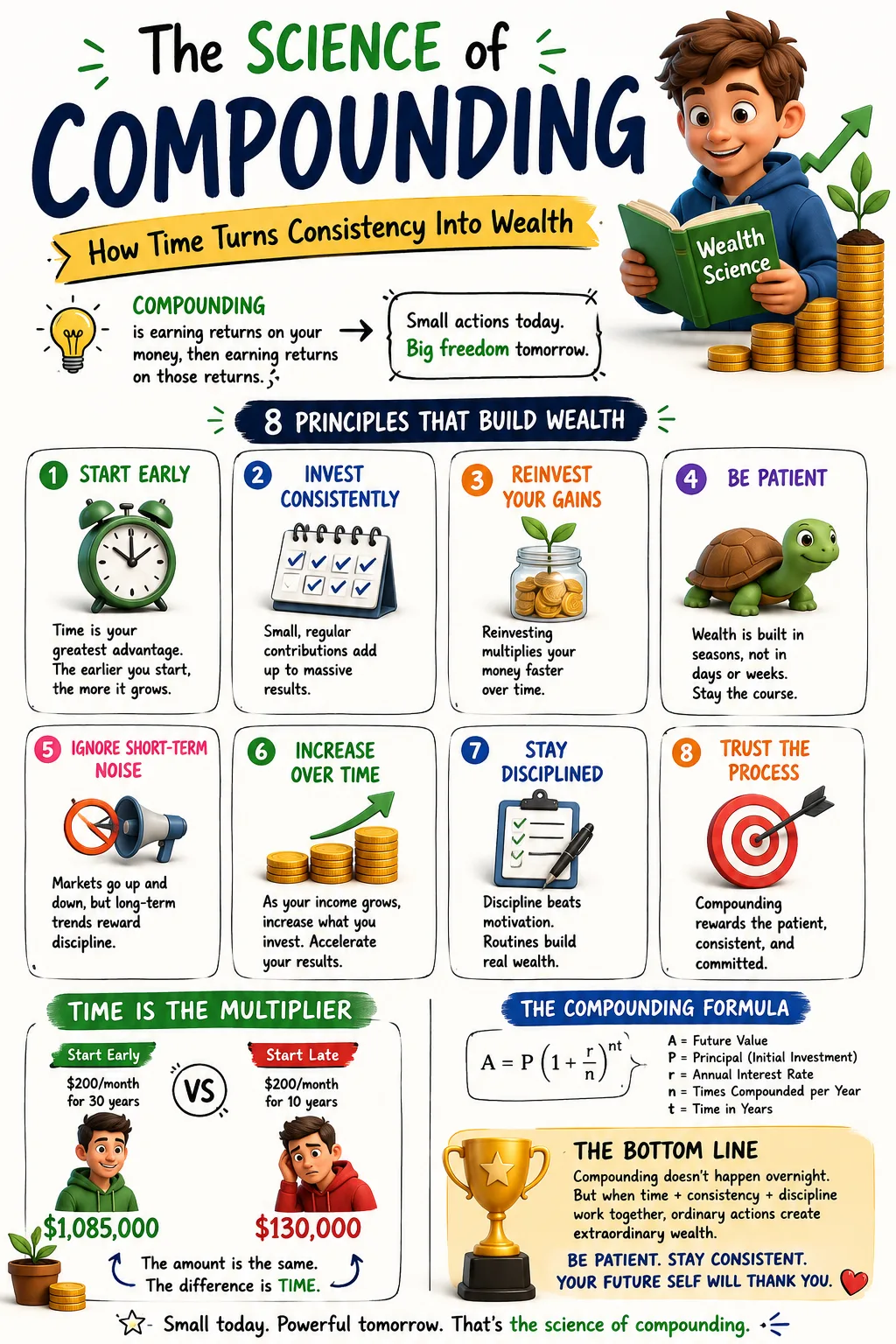
Compounding needs time. The early years of investing can feel slow because returns are being earned on a small base. A 10 percent gain on a modest portfolio may not feel life-changing. The investor may wonder whether the process is worth it. But compounding is not linear. As the base grows, the same percentage return produces larger absolute gains. Eventually, investment returns can exceed annual contributions. At that point, the portfolio begins to feel like an engine rather than a storage container.
The challenge is that many investors interrupt compounding before it has time to become impressive. They sell too early, switch strategies too often, chase recent winners, abandon temporarily weak assets, or withdraw gains for consumption. Each interruption may feel reasonable in the moment. Together, they prevent the long-term mathematics from working.
Patience does not mean doing nothing forever. It means giving a sound investment thesis enough time to unfold. It means distinguishing between volatility and deterioration. It means understanding that markets move faster than businesses in the short term but often reconnect with fundamentals over the long term. It means resisting the urge to demand immediate confirmation from every investment decision.
There is a difference between patient investing and stubborn investing. Patience is grounded in analysis. Stubbornness refuses to update when facts change. A patient investor can hold through temporary market declines if the underlying reason for ownership remains valid. A stubborn investor holds a failing asset simply because selling would admit a mistake. The distinction matters.
The investor should develop review points rather than emotional reaction points. For example, a long-term portfolio may be reviewed quarterly or annually to assess allocation, contributions, costs, and goal alignment. This is different from checking prices obsessively every day and interpreting every movement as meaningful. Frequent monitoring can create the illusion of control while increasing anxiety.
Patience also applies to wealth expectations. Many people underestimate how long it takes to build meaningful capital. They want investment returns to compensate for low savings, poor income growth, excessive spending, or late starts. Markets can help, but they cannot repeal arithmetic. Wealth usually requires steady contributions, reinvestment, and years of disciplined ownership.
Investors should be wary of strategies that appeal to impatience. Promises of quick doubling, guaranteed high returns, urgent entry windows, and effortless wealth often exploit the desire to avoid time. But time is not the enemy of investing. Time is one of its main ingredients.
The patient investor allows good assets to mature, allows income to be reinvested, allows market cycles to pass, and allows behavior to remain aligned with the plan. In a culture of speed, patience becomes a competitive advantage.
Commandment Five: Ignore Market Noise
Markets produce endless noise. Prices move every day. Commentators explain each movement with confidence. Headlines convert uncertainty into drama. Forecasts change. Analysts disagree. Social media magnifies fear and greed in real time. For the investor, the challenge is not lack of information. It is too much information with too little wisdom.
Market noise is any information that feels urgent but does not meaningfully change the long-term investment plan. It may include daily price swings, short-term predictions, sensational headlines, political drama, rumors, or confident opinions from people who bear no responsibility for the investor’s outcome.
Ignoring noise does not mean ignoring facts. Serious developments matter. A company’s earnings quality may deteriorate. A fund’s strategy may change. A government may alter tax rules. A borrower’s credit risk may increase. An investor should pay attention to information that affects fundamentals, costs, risk, liquidity, or goals. The discipline is learning to separate signal from noise.
Noise is dangerous because it provokes action. It makes investors feel that doing something is safer than doing nothing. A market decline makes them want to sell. A rally makes them want to buy. A popular story makes them want exposure. A frightening headline makes them want cash. Over time, these reactions can turn a long-term plan into a series of emotional trades.
One of the simplest ways to reduce noise is to define the plan before the noise arrives. An investor should know their target allocation, contribution schedule, time horizon, liquidity needs, and reasons for owning each investment. Then, when headlines become loud, the question is not “How do I feel today?” but “Has anything changed that affects my plan?”
Another way to reduce noise is to control information consumption. Checking markets constantly does not make most investors better. It often makes them more anxious. Long-term investors do not need minute-by-minute updates on assets they intend to hold for years. The frequency of information should match the time horizon of the decision.
Noise also creates the illusion that experts know more about the future than they do. Forecasts can be useful as scenarios, but dangerous as certainties. The economy is complex. Markets incorporate expectations quickly. Even intelligent analysts can be wrong. Investors should not build fragile plans that require one forecast to be precisely correct.
The ability to ignore noise is closely tied to humility. The investor admits they cannot respond wisely to every piece of information. They choose process over reaction. They accept that markets will move for reasons they cannot control and sometimes cannot understand.
Noise will never disappear. The financial world benefits from attention, and attention is easiest to capture through urgency. The disciplined investor learns to hear the noise without obeying it.
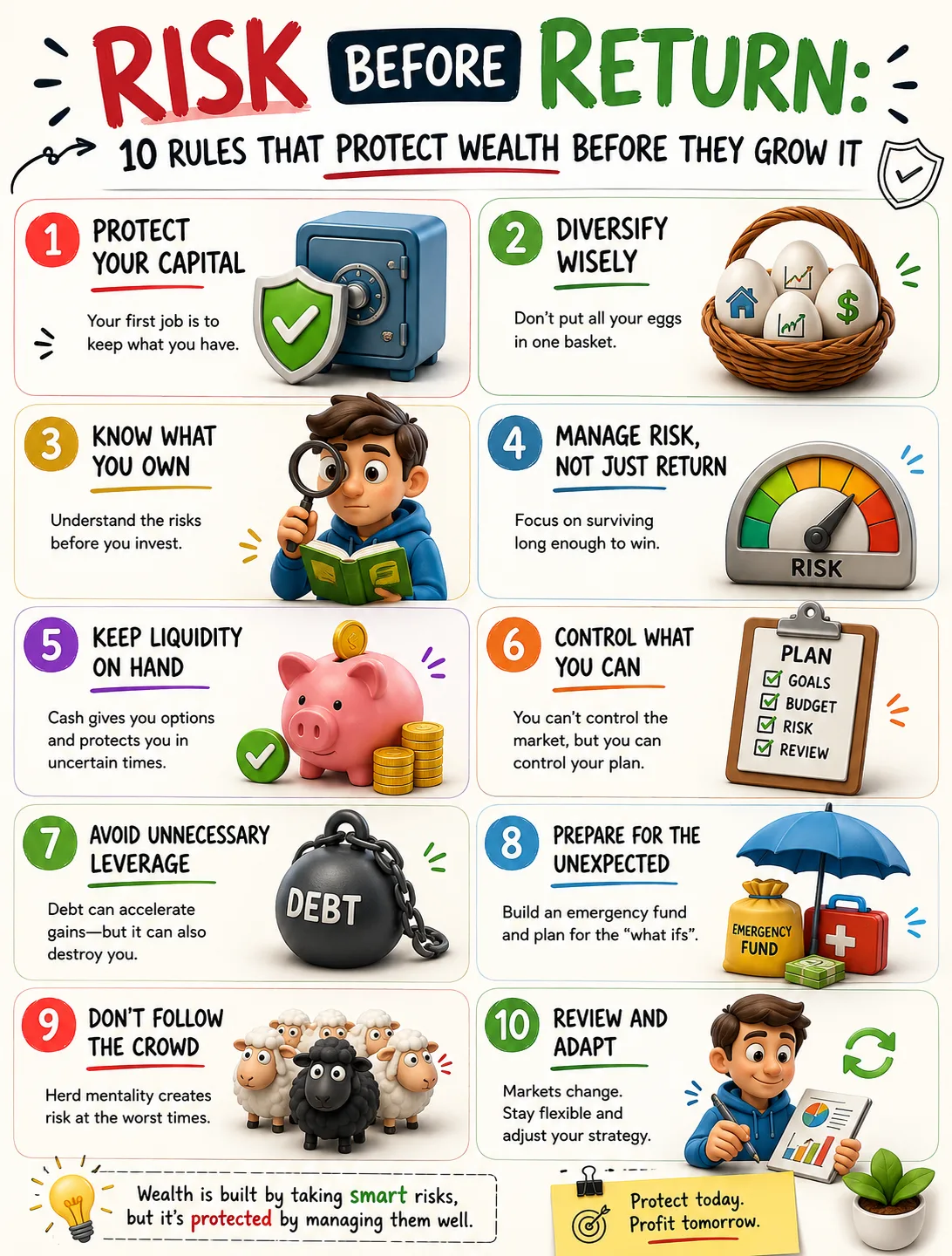
Commandment Six: Manage Risk Before Seeking Returns
Many investors begin with the question, “How much can I make?” Professionals often begin with a better question: “How much can I lose, and can I survive it?”
Return attracts attention. Risk determines survival. A portfolio that produces excellent gains for several years but suffers a catastrophic loss at the wrong time may fail the investor. Wealth building is not only about maximizing upside. It is about staying in the game long enough for upside to matter.
Risk management begins with understanding the types of risk present in a portfolio. Market risk is the possibility that asset prices decline. Credit risk is the possibility that a borrower fails to pay. Liquidity risk is the possibility that an asset cannot be sold quickly without a large discount. Inflation risk is the possibility that purchasing power erodes. Currency risk affects investors exposed to foreign exchange movements. Concentration risk arises when too much depends on one asset, sector, or income source. Behavioral risk comes from the investor’s own decisions under stress.
No investment is free of risk. Even cash has inflation risk. Government securities may have interest-rate risk. Property has liquidity and maintenance risk. Shares have market and business risk. Private investments may have transparency and exit risk. The task is not to eliminate risk, but to choose risks deliberately and be compensated for taking them.
Risk management also depends on personal circumstances. An asset that is risky for one investor may be reasonable for another. A young professional with stable income and a long time horizon may tolerate more volatility than someone nearing retirement. A household with uncertain income needs more liquidity than a household with strong cash flow. A person supporting dependents needs a different safety margin from someone with few obligations.
Preserving capital does not mean avoiding all losses. Temporary declines are part of investing. But permanent loss of capital is different. It occurs when an investment fails, is sold under pressure, is bought at an absurd price, or was unsuitable from the start. The investor’s job is to reduce the chance of permanent damage.
This is why diversification, liquidity, due diligence, valuation discipline, and position sizing matter. They may seem defensive, but defense is part of wealth creation. Losing 50 percent requires a 100 percent gain just to return to the starting point. Avoiding severe losses can be more valuable than chasing spectacular gains.
Risk management also includes resisting leverage unless it is well understood and responsibly used. Borrowed money can magnify returns, but it also magnifies losses and reduces flexibility. Many investors discover the danger of leverage only when asset prices fall and lenders still demand payment.
The disciplined investor does not worship safety at the expense of growth. Too little risk can leave wealth vulnerable to inflation and missed opportunity. But risk should be taken intentionally, with awareness of downside, time horizon, and financial capacity. The best investors are not fearless. They are risk-aware.
Commandment Seven: Continue Learning
Investing is not a subject one masters once and then forgets. Markets evolve, products change, tax rules shift, economic conditions move, and personal circumstances develop. The investor who stops learning becomes increasingly vulnerable to outdated assumptions.
Continuous learning does not require becoming a professional analyst. It requires curiosity, skepticism, and a willingness to improve judgment. Investors should understand basic financial statements, asset classes, inflation, interest rates, diversification, compounding, fees, taxes, behavioral biases, and portfolio construction. Over time, this knowledge compounds just as capital does.
Financial education is protective. It helps investors recognize unsuitable products, unrealistic promises, excessive fees, weak logic, and emotional traps. It also helps them ask better questions of advisers, fund managers, brokers, and product providers. An educated investor does not need to know everything, but they are harder to mislead.
Learning should come from high-quality sources. Not all financial content is education. Some of it is marketing. Some is entertainment. Some is speculation dressed as expertise. Investors should distinguish between people who teach principles and people who sell urgency. A person explaining risk, trade-offs, and uncertainty is often more valuable than one promising certainty and speed.
Reading history is especially useful. Financial history shows that bubbles, crashes, manias, frauds, recoveries, and cycles are not new. The assets may change, but human behavior repeats. Investors who study history are less likely to believe that current enthusiasm has abolished risk.
Learning also includes reviewing one’s own mistakes. Every investor will make errors. Some will buy too early, sell too late, hold too much cash, chase performance, underestimate risk, or ignore fees. The goal is not perfection. The goal is to pay tuition once. A mistake becomes expensive when it is repeated without reflection.
Continuous learning should lead to better simplicity, not unnecessary complexity. Some investors learn just enough to become dangerous. They discover technical terms, advanced products, or trading strategies and assume complexity equals sophistication. Often, the more an investor learns, the more they appreciate the value of clear goals, broad diversification, reasonable costs, patience, and discipline.
The market is a lifelong teacher, but its lessons can be costly. Formal learning, careful reading, and thoughtful reflection help reduce the price of education.
Commandment Eight: Avoid Speculation and Gambling
Investing and speculation are often confused because both involve putting money at risk. The difference lies in the basis of the decision.
Investing is the allocation of capital to an asset with a reasonable expectation of return based on underlying value, income, productivity, or long-term economic logic. Speculation relies primarily on the hope that someone else will pay a higher price in the near future. Gambling depends heavily on chance and often has unfavorable odds.
The boundary is not always perfectly clear. A growth company may have uncertain future cash flows but still be a legitimate investment if analysis supports the price. A property development may involve risk but still be an investment if the economics are sound. The issue is not uncertainty itself. All investing involves uncertainty. The issue is whether the decision is grounded in analysis or excitement.
Speculation becomes dangerous when it is disguised as investing. A person buys because prices are rising. They do not understand the asset. They do not know how it is valued. They do not have an exit plan. They are motivated by stories of other people’s profits. They use money they cannot afford to lose. They call it investing because that word feels respectable.
Speculation also becomes addictive because it offers emotional rewards. Fast price movements create excitement. Gains create overconfidence. Losses create the urge to recover quickly. The investor begins to seek stimulation rather than long-term wealth. This is how portfolios become casinos.
There is a place for calculated risk in wealth building. Entrepreneurs take risk. Equity investors take risk. Real estate developers take risk. But productive risk differs from reckless betting. Productive risk is researched, sized appropriately, aligned with goals, and understood in relation to downside. Reckless risk is driven by emotion, social pressure, or the fantasy of effortless wealth.
A useful test is whether the investor can explain the investment without referring mainly to recent price increases. If the main argument is “it has been going up,” caution is warranted. Price momentum may continue for a time, but it is not a complete investment thesis.
Another test is whether the investor would still want to own the asset if the market price were not quoted for several years. This question forces attention back to income, utility, ownership, and underlying value. Assets bought only for quick resale may be speculative by nature.
A disciplined investor may allocate a small portion of wealth to higher-risk opportunities if they fully understand the possibility of loss. But speculative capital should never be confused with core wealth. Retirement money, emergency reserves, education funds, and essential savings should not be placed on financial roulette tables.
The commandment is not “never take risk.” It is “do not gamble with money that should be building your future.”
Commandment Nine: Maintain Discipline
Discipline is the bridge between a good plan and a good outcome. Many investors know what they should do. Fewer do it consistently.
Investment discipline means following a thoughtful strategy even when emotions tempt you away from it. It means continuing contributions during uncertainty, rebalancing when allocation drifts, refusing unsuitable opportunities, controlling costs, and staying aligned with goals. It also means admitting when a plan needs adjustment because life or facts have changed.
Discipline is difficult because markets constantly test it. During bull markets, discipline requires resisting greed. Investors may want to increase risk because everything seems to be working. They may abandon diversification because one asset is outperforming. They may believe recent gains prove permanent skill. During bear markets, discipline requires resisting fear. Investors may want to sell, stop contributions, or move entirely to cash after losses have already occurred.
The disciplined investor prepares for both emotional extremes before they arrive. They decide in advance how much risk they can take, how much liquidity they need, how often they will review, and what would justify a change. This reduces dependence on mood.
Written investment plans can be powerful. A simple plan may state the investor’s goals, time horizon, target allocation, contribution schedule, emergency reserve level, rebalancing approach, and rules for evaluating new opportunities. The act of writing clarifies thinking. It also provides a reference point during stress.
Discipline also requires controlling lifestyle pressure. Investment plans often fail not because markets perform poorly, but because the investor repeatedly raids the portfolio. Every withdrawal for non-essential consumption interrupts compounding. There are legitimate reasons to use investments, especially when goals are reached. But casual withdrawals can turn a wealth plan into a temporary savings account.
Discipline is not rigidity. A person who refuses to change under any circumstance is not disciplined; they may simply be stubborn. True discipline is loyalty to the objective, not blind loyalty to every old decision. If a fund becomes too expensive, if a goal changes, if income becomes unstable, if risk tolerance shifts, or if an investment thesis breaks, adjustment may be appropriate.
The key is that changes should be made through reflection, not panic. A disciplined investor can adapt without becoming reactive.
Discipline is also easier when the system is well designed. Automatic contributions, separate accounts, diversified portfolios, periodic reviews, and clear rules reduce the burden on willpower. People often overestimate their ability to make calm decisions repeatedly. Systems help carry the weight.
In investing, discipline is not dramatic. It is quiet. It looks like another contribution, another refusal to chase hype, another year of patience, another review of risk, another decision not to panic. Over time, those quiet acts become financial power.
Commandment Ten: Invest With Clear Goals
The final commandment is to invest with clear goals. Money without a purpose is easily distracted.
Different goals require different strategies. Retirement investing may have a multi-decade horizon and can often tolerate more market volatility in the early years. Education funding may have a fixed date and requires more caution as the date approaches. A house deposit may need stability and liquidity. Financial independence requires assets that can eventually support living expenses. Wealth accumulation for future generations may involve long horizons, estate planning, and tax considerations.
Without goals, investors often choose assets by popularity rather than suitability. They ask what is performing best instead of what matches their needs. They compare themselves with others whose objectives, timelines, and resources are completely different. They may take too much risk with short-term money or too little risk with long-term money.
Clear goals help determine time horizon. Time horizon influences risk capacity. Risk capacity influences asset allocation. Asset allocation influences expected return and volatility. In other words, the goal is not a motivational accessory. It is the starting point of portfolio design.
Goals also improve behavior. An investor saving for a child’s education, retirement security, home ownership, or financial freedom has a reason to stay disciplined. The investment is no longer an abstract number on a statement. It represents a future outcome. That meaning can help resist short-term temptation.
Good goals are specific enough to guide decisions but flexible enough to adapt to life. “I want to be rich” is too vague. “I want to build enough retirement capital to support my living expenses from age sixty” is more useful. “I want to invest for my child’s university costs in twelve years” gives direction. “I want to build a portfolio that eventually produces passive income equal to half my current salary” creates a measurable target.
Goal-based investing also clarifies the role of risk. A long-term goal may justify exposure to growth assets because time can absorb volatility. A short-term goal may require cash or lower-risk instruments because capital preservation matters more than high return. The same investor may have multiple portfolios for multiple goals, each with different risk levels.
Investing with goals prevents the portfolio from becoming a collection of random products. Each holding should have a job. Some provide growth. Some provide income. Some provide stability. Some provide liquidity. Some hedge against inflation or currency weakness. A portfolio becomes stronger when every asset has a reason to exist.
The investor should revisit goals periodically. Life changes. Income changes. Family responsibilities change. Health changes. Career plans change. Markets change. Goals should not be rewritten every month, but they should not be ignored for years. A portfolio designed for a past life may not serve the present one.
Clear goals turn investing from a game of comparison into a process of alignment. The question becomes not “Am I beating everyone else?” but “Am I moving intelligently toward what matters?” That is a healthier and more durable standard.
The Commandments Work Together
Each commandment is useful on its own, but their real strength comes from combination. Knowing what you own reduces confusion. Investing regularly builds momentum. Diversification spreads risk. Patience allows compounding. Ignoring noise protects behavior. Risk management preserves capital. Continuous learning improves judgment. Avoiding speculation prevents major mistakes. Discipline keeps the plan alive. Clear goals give the whole process direction.
Remove one principle, and the structure weakens. A patient investor who is not diversified may still suffer from concentration risk. A consistent investor who buys what they do not understand may consistently make poor decisions. A knowledgeable investor without discipline may know the right action and fail to take it. A goal-driven investor who ignores risk may reach for returns that endanger the goal itself.
The commandments also protect against the most common investment failure: self-sabotage. Markets can be volatile, but investor behavior often causes deeper damage. Selling in panic, buying in euphoria, concentrating in trends, borrowing recklessly, chasing performance, and abandoning plans are all human errors. The commandments are designed to restrain these impulses.
They also shift the investor’s identity. Instead of being a trader of opinions, the investor becomes a steward of capital. Instead of seeking excitement, they seek progress. Instead of asking what will happen next week, they ask what habits will serve them over decades.
How to Apply the Ten Commandments in Real Life
Principles become valuable only when converted into practice. A beginner can start by reviewing every current financial holding and asking whether it is understood. If the answer is no, the next step is not necessarily to sell immediately, but to investigate. What is the product? What are the risks? What are the costs? Why was it purchased? Does it still fit?
Next, the investor can establish a regular contribution schedule. The amount should be realistic enough to sustain. A plan that depends on heroic sacrifice may collapse. A plan that begins modestly but grows with income can last for years. Automation helps because it removes negotiation from the process.
The investor should then evaluate diversification. Is too much wealth tied to one company, one property, one sector, one currency, one employer, or one business? Are investments spread across different sources of return? Is the emergency fund separate from long-term investments? Is there enough liquidity?
Patience can be supported by reducing unnecessary monitoring. The investor can choose review dates rather than reacting daily. Long-term investments do not need short-term emotional supervision. Reviewing too often may create anxiety without improving decisions.
Risk management should be practical. The investor should ask how much loss the portfolio could suffer under difficult conditions and whether that loss would threaten essential goals. They should consider debt levels, income stability, dependents, insurance, and cash reserves. Risk is not only a number on a chart. It is the impact of financial loss on real life.
Continuous learning can be built into routine. The investor might read one serious finance book per quarter, review educational materials from reputable institutions, study financial history, or learn basic accounting and economics. The goal is not to become overwhelmed, but to become progressively harder to fool.
A speculation boundary should also be defined. If the investor wants to participate in high-risk opportunities, they should decide in advance what portion of capital can be exposed without damaging core goals. This prevents excitement from invading retirement funds, emergency savings, or education money.
Finally, goals should be written down. A goal that lives only in the mind can change with mood. A written goal creates accountability. It allows the investor to measure progress and judge whether investments are serving a purpose.
The Real Measure of Investment Success
Investment success is often measured by return. Return matters, but it is not the only measure. A portfolio that earns a high return while exposing the investor to unbearable risk may not be successful. A portfolio that performs well but fails to meet the investor’s actual goals may not be successful. A portfolio that causes constant anxiety may be financially efficient but personally unsuitable.
The real measure of success is whether the investment plan helps convert income and capital into durable financial freedom. Does it preserve the investor’s ability to continue? Does it grow purchasing power over time? Does it support life goals? Does it avoid catastrophic mistakes? Does it allow the investor to sleep at night? Does it remain understandable?
This broader definition is important because comparison can distort judgment. Investors often compare their returns with friends, market indexes, headlines, or stories of exceptional gains. Some comparisons are useful for evaluating performance and cost. But constant comparison can push investors into unsuitable risk. The objective is not to own whatever performed best last year. The objective is to build a portfolio that serves a specific life.
A retiree, a young professional, a business owner, a parent saving for education, and a high-income executive may all need different portfolios. Success cannot be judged without context. The commandments provide common principles, but their application must fit the investor’s situation.
Good investing is therefore both universal and personal. The principles endure, but the portfolio must be tailored.
Why Timeless Rules Matter More During Exciting Markets
The commandments are easiest to respect during calm markets. They become most important during exciting ones.
When prices rise quickly, people begin to question old rules. Diversification feels unnecessary. Risk management feels cautious. Patience is replaced by urgency. Learning is replaced by imitation. Speculation is renamed opportunity. Clear goals are pushed aside by the desire for fast gains.
This is precisely when discipline matters most. Markets can reward bad behavior temporarily. An investor may make money despite poor reasoning. That can be dangerous because profit feels like validation. The investor becomes more confident, takes larger risks, and may eventually suffer losses that erase earlier gains.
During falling markets, the commandments matter in a different way. Understanding what you own helps resist panic. Diversification reduces the pain of concentrated loss. Cash reserves and liquidity prevent forced selling. Clear goals remind the investor why the portfolio exists. Regular investing turns lower prices into accumulation opportunities. Discipline keeps fear from rewriting the plan.
The value of timeless rules is that they do not depend on mood. They are useful in optimism and pessimism. They do not predict the weather; they build the shelter.
The Investor’s Code in One Sentence
If the ten commandments had to be reduced to one sentence, it would be this: invest only in what you understand, for goals that matter, with money you can commit, in a diversified plan you can follow through uncertainty.
This sentence contains the heart of sound investing. Understanding prevents blind risk. Goals create direction. Committed capital protects against forced selling. Diversification reduces dependence on one outcome. A plan creates discipline. The willingness to endure uncertainty allows compounding to work.
The investor who follows this code may not always achieve the highest return in any given year. They may watch speculative assets rise faster. They may feel boring during market manias. They may miss some dramatic opportunities. But they are also less likely to destroy capital through confusion, panic, concentration, or greed.
Over a lifetime, avoiding major mistakes can be as important as finding major winners. Wealth does not require perfection. It requires enough good decisions, repeated long enough, without one or two catastrophic errors undoing the work.
The Quiet Discipline of Wealth
Investing is often presented as a search for brilliance. The more durable truth is that investing is a practice of discipline. It rewards those who can control behavior, manage risk, and think in years while others react in days.
The ten commandments are not fashionable. They will not satisfy those looking for shortcuts. They do not promise that every investment will succeed or that every loss can be avoided. What they offer is a framework for making better decisions under uncertainty.
Know what you own. Invest regularly. Diversify. Be patient. Ignore noise. Manage risk. Keep learning. Avoid speculation. Maintain discipline. Invest with clear goals.
These principles sound simple because the deepest financial truths often do. Their difficulty lies in practice. The market will tempt investors to abandon them. So will fear, greed, pride, boredom, envy, and impatience. But the investor who returns to them again and again builds more than a portfolio. They build judgment.
And judgment, compounded over time, is one of the most valuable assets an investor can own.
 Article
 Article
 Article
 Article
 Article
 Article
 Article
 Article