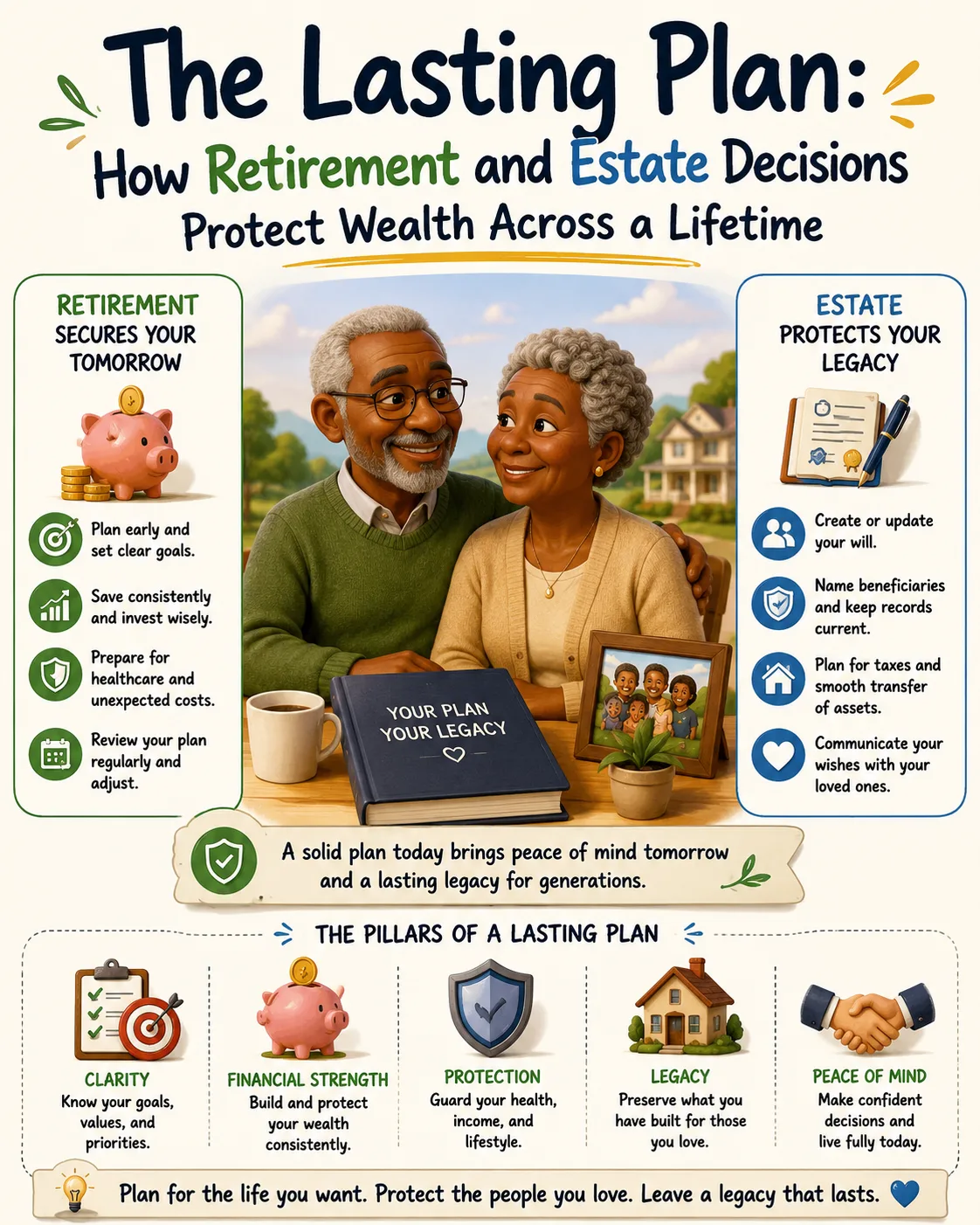
The Lasting Plan: How Retirement and Estate Decisions Protect Wealth Across a Lifetime
Most people think of retirement planning as a question of income. How much will I need? How much should I save? When can I stop working? Those questions matter, but they are only the beginning. Retirement is not simply the end of a career. It is the beginning of a long financial phase in which a household must turn accumulated assets into dependable income, protect purchasing power, prepare for healthcare costs, reduce unnecessary taxes, and preserve flexibility for an uncertain future.
Estate planning is often pushed even further into the background. Many people treat it as something for the wealthy, the elderly, or the seriously ill. That misunderstanding is expensive. Estate planning is not only about who receives property after death. It is also about who can make decisions during incapacity, how quickly assets can be accessed, whether family members understand your intentions, and whether the wealth you spent decades building is transferred smoothly or caught in confusion, conflict, court processes, tax friction, and avoidable delay.
Retirement planning and estate planning belong together because they answer one larger question: how should wealth serve a life, a family, and a legacy?
A retirement plan without an estate plan can protect income while leaving loved ones exposed to legal uncertainty. An estate plan without a retirement strategy can distribute assets elegantly after death while failing to support the owner during life. The strongest financial plans do both. They prepare for longevity and mortality, independence and incapacity, personal spending and family transfer, market risk and family risk.
The work is not glamorous. It involves documents, beneficiaries, projections, taxes, insurance, investment policy, family conversations, and periodic reviews. Yet few areas of personal finance create as much peace of mind. A good plan does not remove uncertainty. It makes uncertainty manageable.
The Core Mistake: Treating Retirement and Estate Planning as Separate Worlds
Retirement planning usually begins with accumulation. A person saves in workplace plans, personal accounts, pensions, investment portfolios, annuities, property, or business assets. The focus is growth. The question is whether today’s income can be turned into tomorrow’s independence.
Estate planning begins with control. Who receives assets? Who manages affairs? Who speaks for you if you cannot speak? Who protects minor children? Who handles accounts, property, debts, taxes, business interests, and digital assets?
Because these questions feel different, people often handle them separately. That is where many problems begin. Retirement accounts may pass by beneficiary designation rather than by will. Jointly owned property may move outside the estate. Life insurance may go directly to named beneficiaries. Trusts may change how assets are controlled. Tax rules may affect withdrawal decisions and inheritance strategies. Healthcare costs may force asset sales that change the eventual estate. Long-term care needs may reshape the entire plan.
A person may write a will leaving “everything equally to my children,” yet forget that a retirement account still names a former spouse. Another may create a trust but never retitle assets into it. A couple may save diligently for retirement but enter their seventies with no healthcare directive, no durable power of attorney, and no documented plan for incapacity. A business owner may build wealth but fail to create a succession plan. A parent may intend fairness but leave instructions so unclear that siblings spend years in conflict.
The lesson is simple: money does not follow intentions. Money follows legal ownership, account titling, beneficiary forms, tax rules, contracts, and documents. A financial plan must translate wishes into enforceable structure.
What Retirement Planning Is Really For
Retirement planning is not merely about reaching a number. A number can be useful, but it can also be misleading. A household with a large portfolio and no income strategy may be more fragile than a household with fewer assets, lower fixed expenses, stable income sources, and strong risk controls.
The purpose of retirement planning is to create durable financial independence after regular employment income stops or declines. That requires five disciplines.
First, retirement planning must estimate future spending. This includes housing, food, utilities, travel, transportation, taxes, insurance, healthcare, family support, charitable giving, hobbies, and emergency needs. Spending often changes through retirement. Early retirees may travel more. Later retirees may spend less on leisure but more on healthcare, support services, or assisted living.
Second, retirement planning must identify income sources. These may include personal savings, employer pensions, government retirement benefits, rental income, investment dividends, business distributions, annuities, part-time work, or proceeds from selling assets. Relying on one source creates vulnerability. Multiple sources can provide resilience.
Third, retirement planning must manage investment risk. A person saving at age thirty has time to recover from market downturns. A person retiring next year may not. Yet becoming too conservative too early can create another danger: the portfolio may fail to outpace inflation. The right balance changes with age, income needs, risk tolerance, health, family obligations, and total wealth.
Fourth, retirement planning must address longevity. Many people underestimate how long retirement can last. A retirement beginning in the mid-sixties can easily last twenty to thirty years or more. That means the portfolio must survive not only the first years of retirement, but the second and third decades, when inflation and healthcare costs can become more visible.
Fifth, retirement planning must create a withdrawal strategy. Saving is only half the challenge. The other half is turning assets into income without selling too much too soon, triggering unnecessary taxes, taking excessive risk, or leaving too much money idle. Withdrawal strategy is where retirement planning becomes a form of capital management.
The Retirement Mistakes That Quietly Destroy Wealth
Delaying the Start
The most common retirement mistake is waiting. Delay feels harmless when retirement is decades away, but time is the most powerful asset most investors ever receive. Early saving gives compounding room to work. Later saving must work harder because each dollar has fewer years to grow.
Consider two workers. One begins investing modestly in their twenties and continues for ten years before pausing. The other waits until their forties and invests larger amounts for decades. Depending on returns, the early saver may still end up with more because the first dollars had the longest runway. This is not magic. It is mathematics. Investment growth builds on prior growth. The earlier the base is created, the more time it has to multiply.
The danger of delay is not only financial. It also creates behavioral pressure. A person who starts late may feel forced to chase high returns, concentrate investments, or ignore risk. Delay can turn a manageable goal into a stressful race.
Relying Solely on Government Benefits
Government retirement benefits can be valuable, but they are rarely designed to fund every aspect of retirement for every household. They may provide a foundation, not a complete lifestyle. Rules can change. Benefit amounts may not match desired spending. Eligibility may depend on work history, age, contributions, residency, or other local requirements.
A strong retirement plan treats public benefits as one layer among many. Personal savings, employer plans, pensions, investment accounts, annuities, property income, and flexible spending habits can all support the structure. The greater the dependence on one source, the greater the vulnerability if that source falls short.
Ignoring Inflation
Inflation is one of retirement’s most underestimated risks because it works slowly. A household may feel secure at the beginning of retirement, only to discover years later that the same income buys less food, less energy, less healthcare, less travel, and less comfort.
Even moderate inflation can erode purchasing power over a long retirement. A retirement plan that covers expenses at age sixty-five may be inadequate at age eighty-five if income does not adjust. This is why some exposure to growth assets may remain necessary even after retirement begins. Safety is not only the avoidance of market volatility. Safety is also the ability to maintain real purchasing power.
Taking Too Much Risk Near Retirement
Risk feels different near retirement because losses have less time to recover. A severe market decline early in retirement can be damaging if the retiree must sell assets at depressed prices to fund living expenses. This is often called sequence-of-returns risk. The average return over thirty years may look acceptable, but the order of returns matters when withdrawals are being made.
A retiree who suffers large losses in the first years of withdrawals may permanently reduce the portfolio’s ability to recover. This does not mean retirees should avoid all risk. It means they need liquidity, diversification, and a withdrawal plan that reduces forced selling during downturns.
Becoming Too Conservative Too Soon
The opposite mistake is also common. Some people reach retirement and move nearly everything into cash or very low-return assets. The intention is protection. The result may be long-term erosion.
A person retiring at sixty-five may still need assets to support spending at eighty-five, ninety, or beyond. A portfolio that does not grow may struggle against inflation, taxes, and healthcare expenses. Conservatism has a cost. The challenge is not to choose between risk and safety. The challenge is to choose the right risks and avoid the wrong ones.
Withdrawing Retirement Funds Early
Early withdrawals can damage a retirement plan in several ways. They may trigger taxes, penalties, lost investment growth, and a weaker future income base. The most expensive cost is often invisible: the withdrawn money no longer compounds.
There are times when accessing retirement funds may be unavoidable. A true emergency, job loss, illness, or family crisis can force difficult choices. Yet retirement accounts should not become a casual source of spending money. Using long-term capital for short-term consumption is one of the fastest ways to weaken future security.
Entering Retirement With High-Interest Debt
Debt is not always bad. A manageable mortgage, business loan, or strategic borrowing arrangement may fit within a broader plan. High-interest consumer debt is different. Credit cards, payday-style loans, and other expensive obligations can drain retirement cash flow.
Retirement income is usually less flexible than employment income. A worker may earn overtime, change jobs, or increase income. A retiree may have fewer options. Carrying high-interest debt into retirement turns fixed income into a servant of past consumption. Reducing expensive debt before retirement can be as important as increasing savings.
Failing to Rebalance
Investment portfolios drift. Strong stock markets can leave a portfolio more aggressive than intended. Weak markets can leave an investor too defensive if fear prevents reinvestment. Rebalancing is the discipline of returning the portfolio to a chosen risk level.
Rebalancing does not guarantee higher returns. Its purpose is risk control. It prevents yesterday’s winners from quietly becoming an oversized bet. It also encourages investors to sell some assets after strong performance and add to others when they are cheaper. For retirement planning, rebalancing is less about prediction and more about staying aligned with the plan.
What a Strong Retirement Plan Should Do
Start With the Life, Not the Account Balance
A retirement plan should begin with the life a person expects to live. Where will they live? Will they support children, grandchildren, parents, or charities? Will they travel? Will they work part-time? Do they want to leave a large inheritance, spend most of their wealth, or balance both goals?
Money has no meaning without purpose. Two households with the same net worth can need very different strategies. One may have a paid-off home, low expenses, and strong family support. Another may rent, support relatives, and face high medical risk. One may value legacy. Another may value lifestyle. A useful retirement plan respects the owner’s actual priorities.
Build a Retirement Income Map
A retirement income map shows where income will come from and when. It might include government benefits starting at one age, pension income at another, investment withdrawals immediately, rental income throughout, and annuity income later. It also shows which accounts are taxable, tax-deferred, tax-free, or governed by special rules.
This map helps answer practical questions. Which assets should be used first? Which should continue growing? How much cash should be held for near-term spending? Which accounts create taxable income? Which assets are better suited for heirs? Which income sources adjust for inflation?
Without an income map, retirees often withdraw randomly. Random withdrawals can produce unnecessary taxes, excessive risk, and poor coordination. A planned sequence can make the same wealth last longer.
Maintain an Emergency Reserve
Retirement does not eliminate emergencies. It changes them. A retiree may face home repairs, medical expenses, family needs, market declines, or sudden relocation costs. An emergency fund separate from long-term investments can reduce the need to sell assets at the wrong time.
The right reserve depends on spending needs, income stability, insurance coverage, and risk tolerance. Some retirees prefer one year of essential expenses in safe liquid assets. Others hold more. The goal is not to maximize return on every dollar. The goal is to protect the plan from disruption.
Plan for Healthcare Before Healthcare Becomes the Plan
Healthcare is one of the largest uncertainties in retirement. Some retirees remain healthy for decades. Others face chronic illness, prescription costs, surgery, home care, assisted living, or nursing care. Even in countries with public healthcare systems, retirees may face premiums, deductibles, uncovered services, private care costs, dental care, vision care, mobility support, or long-term care needs.
Fidelity’s 2025 retiree healthcare estimate projected that a 65-year-old retiring that year could spend $172,500 on healthcare in retirement, underscoring how easily medical costs can be underestimated.
Healthcare planning should include insurance review, emergency reserves, long-term care conversations, housing decisions, and family expectations. It should also include incapacity planning. A person who becomes unable to manage finances or make medical decisions needs documents and trusted decision-makers in place before the crisis.
Use Diversification as a Survival Tool
Diversification is often explained as a way to improve investment results. Its deeper purpose is survival. No one knows which asset class, country, sector, currency, or strategy will perform best over the next thirty years. Concentration can create wealth, but it can also destroy it.
A diversified retirement portfolio may include cash reserves, bonds, equities, property, inflation-sensitive assets, annuities, or other income sources. The mix should reflect personal circumstances. The principle is that no single market event should be able to ruin the plan.
Review the Plan Annually
A retirement plan is not a document to create once and ignore. Markets change. Health changes. Family needs change. Tax rules change. Spending changes. Inflation changes. A plan that was sensible five years ago may no longer fit.
An annual review should update spending, account balances, income sources, investment allocation, insurance coverage, tax expectations, beneficiary designations, estate documents, and major life assumptions. The review does not need to be complicated. It needs to be consistent.
Estate Planning Is Not Only for the Wealthy
Estate planning has an image problem. It sounds like something reserved for dynastic families, large estates, private banks, and tax lawyers. In reality, estate planning is for anyone who owns assets, has dependents, uses financial accounts, has healthcare preferences, holds digital property, wants to reduce family confusion, or wants control over personal decisions during incapacity.
A young parent may need estate planning more urgently than a wealthy retiree because minor children require guardianship decisions. A single adult may need estate planning because no spouse is automatically available to manage affairs. A blended family may need careful planning because assumptions about inheritance can create conflict. A business owner may need succession documents. A person with online financial assets may need digital access instructions. A retiree may need healthcare directives and powers of attorney as much as a will.
Estate planning is not a prediction of death. It is a system for continuity.
The Estate Planning Documents That Matter
A Legally Valid Will
A will states how certain assets should be distributed and who should administer the estate. It may also name guardians for minor children, subject to local law and court approval. Without a will, a person dies intestate, meaning local law determines who receives assets. That legal formula may not match personal wishes.
A will is foundational, but it is not all-powerful. Many assets pass outside a will. Retirement accounts, life insurance, transfer-on-death accounts, payable-on-death accounts, and jointly owned property may follow beneficiary designations or ownership rules. This is why a will must be coordinated with account records.
Trusts Where Appropriate
A trust is a legal arrangement in which a trustee manages assets for beneficiaries according to specified terms. Trusts can serve many purposes: privacy, probate avoidance, control over distributions, planning for minor children, support for vulnerable beneficiaries, charitable giving, tax planning, business succession, or multi-generational wealth management.
Not everyone needs a trust. A simple estate may be handled with a will, beneficiary designations, and incapacity documents. A more complex estate may benefit from trust planning. The danger lies in assuming either extreme: that trusts are only for the ultra-wealthy, or that everyone needs one. The right answer depends on family structure, asset type, jurisdiction, tax exposure, privacy goals, and administrative needs.
Durable Power of Attorney
A durable power of attorney allows a trusted person to make financial decisions if the individual becomes incapacitated. This may include paying bills, managing investments, handling property, dealing with banks, filing taxes, or coordinating insurance.
Without this authority, family members may need court involvement to manage affairs. That can be slow, expensive, and emotionally difficult during a crisis. The person named should be responsible, organized, trustworthy, and capable of handling financial matters. Choosing someone merely because they are the oldest child or closest relative can be a mistake.
Healthcare Directive or Living Will
A healthcare directive records medical preferences if a person cannot communicate. It may address life-sustaining treatment, pain management, organ donation, end-of-life care, and who can speak with medical professionals.
This document is not only for the elderly. Accidents and illness can happen at any age. A healthcare directive reduces the burden on family members who might otherwise be forced to guess. It also reduces the risk of conflict among relatives who disagree about what should happen.
Beneficiary Designations
Beneficiary designations are among the most overlooked estate planning tools. They determine who receives certain accounts or policies at death. They are commonly used for retirement accounts, life insurance, annuities, and some bank or investment accounts.
The problem is that beneficiary forms are easy to forget. A person may name a parent as beneficiary when young, marry later, have children, divorce, remarry, and never update the form. The account may still go to the old beneficiary. In many cases, the beneficiary designation controls regardless of what the will says.
This is why beneficiary reviews should be part of every annual financial checkup. They should also be reviewed after marriage, divorce, birth, adoption, death of a beneficiary, major asset purchase, business sale, relocation, or any major family change.
Asset Inventory
An estate plan is only useful if the people responsible can find the assets. A clear inventory should list bank accounts, retirement accounts, brokerage accounts, insurance policies, real estate, business interests, vehicles, valuable personal property, debts, loans, digital assets, tax records, professional advisers, and document locations.
The inventory does not need to reveal every password in an unsafe way. It should tell trusted people what exists and how to begin. Without an inventory, families may miss accounts, overlook debts, fail to claim insurance, or spend months reconstructing a financial life.
The Estate Planning Mistakes That Create Family Conflict
Dying Without a Will
Dying intestate can turn private wishes into a public legal formula. The outcome depends on local law, family structure, and asset ownership. In some cases, assets may go to people the deceased would not have chosen. In others, loved ones may face delays, court costs, administrative burden, and disputes.
Gallup reported in 2021 that only 46% of U.S. adults said they had a will describing how they wanted money and estate matters handled, showing how common this gap remains.
The lesson is not country-specific. Across jurisdictions, failing to document wishes often leaves families with uncertainty at the worst possible time.
Assuming the Will Controls Everything
A will is powerful but limited. If an account has a named beneficiary, that designation may control. If property is jointly owned with rights of survivorship, it may pass to the surviving owner. If assets are held in a trust, the trust terms may govern. If an insurance policy names a beneficiary, the proceeds may bypass the will.
This is one of the most common estate planning traps. People update a will and assume the estate plan is complete. Then they leave old beneficiary forms untouched. The result can be a plan that contradicts itself.
Forgetting Digital Assets
Modern estates include more than houses, bank accounts, and paper records. They include email accounts, cloud storage, online businesses, social media profiles, digital subscriptions, cryptocurrency, domain names, loyalty points, payment apps, digital wallets, photo libraries, and intellectual property stored online.
Digital assets can create practical and emotional problems. A family may need access to bills, tax records, business accounts, or photographs. Crypto assets may be lost forever if private keys are unavailable. Online accounts may be locked by platform rules. A person’s digital life can remain active long after death if no instructions exist.
Digital estate planning should identify important accounts, explain access procedures, document where credentials or recovery instructions are stored, and name a trusted person to handle digital affairs where local law allows. Security matters. Passwords should not be left casually in a drawer. A secure password manager, encrypted storage, or professional guidance may be appropriate.
Failing to Plan for Incapacity
Many estate plans focus on death and ignore incapacity. That is a serious gap. Incapacity can last weeks, months, or years. During that time, bills still arrive, investments still need attention, taxes still need filing, property still needs maintenance, and medical decisions still need to be made.
A will does not solve incapacity because a will generally operates after death. Powers of attorney and healthcare directives are the key tools for life-stage emergencies. They should be created before they are needed, while the person has legal capacity.
Naming the Wrong Executor or Trustee
The executor, trustee, or personal representative has a serious job. This person may collect assets, pay debts, file tax documents, communicate with beneficiaries, manage property, distribute assets, and follow legal procedures. The best choice is not always the person who is closest emotionally.
A poor choice can create delays, resentment, mismanagement, or litigation. The role requires integrity, patience, organization, financial judgment, and emotional steadiness. In some cases, a professional or corporate trustee may be appropriate, especially for complex estates, blended families, special needs planning, or large trusts.
Leaving Unclear Instructions
Ambiguity is costly. Vague phrases such as “divide things fairly” can cause conflict because fairness means different things to different people. Does fair mean equal? Does it account for lifetime gifts? Does it consider who provided care? Does it distinguish sentimental property from financial property?
Clear instructions reduce room for interpretation. They do not guarantee family harmony, but they reduce avoidable confusion. Personal property can be especially emotional. Jewelry, photographs, heirlooms, tools, art, furniture, and family keepsakes may carry meaning far beyond market value.
Keeping Plans Secret Until It Is Too Late
Privacy matters, but secrecy can create problems. Family members do not necessarily need to know every financial detail, but key people should know that documents exist, where they are stored, who has authority, and what roles they may be asked to play.
Some families benefit from a structured conversation. The goal is not to negotiate the plan with beneficiaries. The goal is to explain intentions, reduce surprises, identify practical issues, and prepare responsible people. A difficult conversation during life is often better than a bitter dispute after death.
The Tax Question: Important, But Not the Whole Plan
Taxes matter in both retirement and estate planning. Retirement withdrawals may create taxable income. Pension payments may be taxed. Investment gains may be treated differently depending on account type and jurisdiction. Estate, inheritance, gift, or transfer taxes may apply in some places and not others.
In the United States, the IRS notes that the federal basic estate and gift tax exclusion amount is $15,000,000 for calendar year 2026 after legislative changes signed in 2025.
That figure is jurisdiction-specific and does not apply everywhere. Many countries, states, provinces, or regions have their own rules. Some impose estate taxes. Some impose inheritance taxes. Some tax capital gains at death. Some provide spousal exemptions. Some treat retirement accounts differently from other assets.
The main principle is universal: tax planning should support the family’s goals, not replace them. A plan designed only to reduce taxes may create complexity, inflexibility, or unfair outcomes. A plan that ignores taxes may waste wealth. The right balance depends on the owner’s assets, family, location, and objectives.
How Retirement Decisions Shape the Estate
Every retirement decision affects the eventual estate. Spending more leaves less for heirs. Spending less may preserve wealth but reduce quality of life. Buying an annuity may increase lifetime income but reduce liquid inheritance. Keeping a large home may preserve family property but increase maintenance costs. Gifting during life may help children when they need it most but reduce the donor’s flexibility.
This is why retirement and estate planning should be coordinated. The owner should decide how much wealth is for lifetime security, how much is for family transfer, how much is for charity, and how much flexibility is required for uncertainty.
A retired couple with three adult children may intend to leave equal shares. But one child may already have received help buying a home. Another may have special medical needs. A third may be financially secure. Equal division may feel fair to one family and unfair to another. The plan should reflect intention, not habit.
A business owner may expect children to inherit the company. But if only one child works in the business, equal ownership can create conflict. The operating child may want control. The non-operating children may want income. Without planning, the business can become a battlefield. Succession planning, buy-sell agreements, insurance, trusts, and clear governance can prevent wealth from becoming a source of division.
A retiree with significant charitable goals may use lifetime giving, donor-advised funds, charitable trusts, beneficiary designations, or bequests. The best structure depends on tax rules and personal priorities. The planning question is not merely “Who gets what?” It is “What should this wealth accomplish?”
The Family Meeting: A Wealth Tool Hiding in Plain Sight
Families often avoid conversations about retirement and inheritance because money feels private and death feels uncomfortable. Silence may feel peaceful, but it can store conflict for later.
A family meeting does not need to disclose every number. It can focus on roles, values, and expectations. Parents may explain who has been named executor and why. They may clarify whether inheritances are intended to be equal. They may discuss healthcare preferences. They may tell children where documents are stored. They may explain plans for a family home, business, or sentimental assets.
These conversations can reveal problems early. A named executor may not want the role. Siblings may disagree about caring for a parent. A child may expect to inherit a property the parents plan to sell. A family may discover that no one knows how to access digital accounts. Better to learn this during life than during grief.
The strongest family wealth plans combine documents with communication. Legal clarity matters. Emotional clarity matters too.
Retirement Planning by Life Stage
Early Career: Build the Base
In the early career years, the most valuable asset is time. The priority is to establish saving habits, capture employer benefits where available, avoid destructive debt, build emergency reserves, and begin investing. Contributions may be small, but consistency matters more than perfection.
Estate planning in this stage may be simple but should not be ignored. Young adults should consider basic beneficiary designations, healthcare directives, and powers of attorney. Parents of minor children should address guardianship and life insurance. The goal is not complexity. The goal is protection.
Mid-Career: Increase Discipline
Mid-career is often the most financially demanding stage. Housing, children, education costs, aging parents, business goals, and lifestyle pressure compete for income. Retirement can be squeezed unless saving is automated and treated as a priority.
This is also when estate plans often need updating. Marriage, divorce, children, property purchases, business formation, and investment growth can make old documents obsolete. Beneficiary designations should be reviewed carefully. Insurance coverage should be matched to family responsibilities. Tax planning may become more meaningful.
Pre-Retirement: Test the Plan
The decade before retirement is critical. The household should estimate spending, review income sources, reduce high-interest debt, assess healthcare coverage, evaluate investment risk, and create a withdrawal strategy. This is also the time to consider whether work will stop fully or gradually.
Estate planning should become more detailed. Wills, trusts, powers of attorney, healthcare directives, beneficiary forms, property titles, and asset inventories should be reviewed together. If the plan includes unequal inheritances, business succession, charitable giving, or support for vulnerable beneficiaries, professional guidance becomes especially valuable.
Retirement: Manage the Transition
The first years of retirement are a test. Actual spending replaces estimates. Market movements feel different because withdrawals have begun. Some retirees discover they spend more than expected. Others spend less because they fear running out.
A good retirement plan creates feedback. If markets decline, withdrawals may need adjustment. If spending is lower than expected, charitable or family giving may increase. If healthcare needs rise, reserves may need strengthening. Estate plans should be reviewed as relationships, health, and asset values change.
Later Retirement: Simplify and Protect
Later retirement often calls for simplification. Too many accounts, complex investments, scattered documents, and unclear instructions can burden both the retiree and future decision-makers. Consolidating accounts where appropriate, updating document storage, reviewing trusted contacts, and reducing administrative complexity can be valuable.
This stage also requires serious incapacity planning. Cognitive decline, mobility limitations, widowhood, and increased reliance on others can expose retirees to fraud, mistakes, and family pressure. Clear authority, trusted advisers, account monitoring, and family communication can protect dignity as well as wealth.
The Role of Insurance in the Plan
Insurance is often misunderstood. It is not a substitute for saving, investing, or legal planning. It is a risk-transfer tool. The purpose is to protect against losses too large for the household to absorb comfortably.
Life insurance may protect dependents, provide liquidity for estate costs, equalize inheritances, fund business succession, or support charitable goals. Disability insurance may protect income during working years. Health insurance and supplemental coverage may reduce medical risk. Long-term care insurance may help protect assets from care costs, though pricing, coverage, eligibility, and suitability vary widely.
The mistake is buying insurance without a clear purpose. Another mistake is avoiding insurance because the subject is uncomfortable. Insurance should be reviewed as part of both retirement and estate planning. The right question is not “Do I need this product?” It is “Which risks could seriously damage the plan, and what is the best way to handle them?”
Digital Assets and the Modern Estate
Digital estate planning has moved from a niche concern to a mainstream planning issue. Financial life is increasingly online. A family may need access to banking records, tax documents, investment accounts, automatic payments, subscription services, cloud storage, digital photos, online stores, intellectual property, cryptocurrency, and business platforms.
The first step is an inventory. List important accounts, platforms, devices, and digital assets. The second step is access planning. Identify where passwords, recovery codes, private keys, or instructions are stored. The third step is authority. Make sure estate documents address digital assets where local law permits. The fourth step is security. Access information should be protected from theft, not casually distributed.
Digital assets require special care because some cannot be recovered if access is lost. Cryptocurrency is the clearest example. If private keys are gone, the asset may be gone. Online businesses can also lose value quickly if no one can access payment systems, customer records, advertising accounts, or domain registration.
A modern estate plan should not leave the digital life invisible.
A Practical Checklist for Retirement and Estate Planning
Retirement Planning Actions
Start saving as early as possible, even if the first amounts are modest. Increase contributions as income rises. Capture employer-sponsored benefits where available. Diversify investments across appropriate asset classes. Review risk levels as retirement approaches. Maintain emergency savings outside long-term retirement accounts. Estimate retirement spending realistically. Include healthcare and long-term care possibilities. Plan for inflation. Reduce high-interest debt before retirement. Develop a withdrawal strategy before leaving full-time work. Review the plan every year.
Estate Planning Actions
Create a legally valid will. Consider whether a trust fits your family, assets, privacy goals, or tax situation. Name beneficiaries on retirement accounts, insurance policies, annuities, and transfer-on-death accounts. Review those designations after major life events. Create durable financial powers of attorney. Prepare healthcare directives or living wills. Name appropriate executors, trustees, guardians, and agents. Maintain an asset inventory. Include digital assets. Store documents securely. Tell trusted people where documents are located. Discuss intentions with family members where appropriate. Review the plan every few years or after major changes.
Events That Should Trigger a Review
A plan should be reviewed after marriage, divorce, separation, birth, adoption, death of a spouse, death of a beneficiary, disability, serious illness, relocation, major tax law change, business sale, home purchase, inheritance, major investment gain or loss, retirement, family conflict, or a meaningful change in charitable goals.
Reviews are not signs that the original plan failed. They are signs that the plan is alive.
When Professional Guidance Matters
Many people can understand the principles of retirement and estate planning on their own. That does not mean they should handle every technical detail alone. Professional guidance can be valuable when mistakes are costly, rules are complex, or family dynamics are sensitive.
A financial planner can help estimate retirement needs, coordinate investment strategy, model withdrawals, plan for taxes, and integrate insurance. An estate attorney can draft legally valid documents, structure trusts, address guardianship, advise on probate, and ensure local law is followed. A tax professional can help evaluate income tax, estate tax, gift tax, capital gains, and charitable strategies. Insurance specialists can help assess risk-transfer options. Business advisers can assist with succession planning.
The key is coordination. A retirement plan built by one professional and an estate plan built by another may conflict if no one sees the full picture. The owner should insist that advisers understand the same goals.
The Mindset Shift: From Accumulation to Stewardship
During working years, wealth building often feels like accumulation. Earn more. Save more. Invest more. Reduce debt. Buy assets. Increase net worth. That mindset is useful, but it is incomplete.
Retirement and estate planning require a shift from accumulation to stewardship. Stewardship asks how wealth should be protected, used, transferred, and explained. It recognizes that money is not only a personal resource. It becomes a family system. It affects spouses, children, business partners, charities, caregivers, and future generations.
A steward does not merely ask, “How much do I have?” A steward asks, “What could go wrong? Who depends on this? What happens if I cannot decide? What happens if I live longer than expected? What happens if I die sooner than expected? What values should this money express?”
This mindset turns planning from a chore into an act of responsibility.
What to Avoid
Avoid waiting until retirement is close before saving seriously. Avoid assuming government benefits will be enough. Avoid ignoring inflation. Avoid entering retirement with expensive debt. Avoid taking excessive investment risk near retirement. Avoid becoming so conservative that the plan cannot keep up with rising costs. Avoid withdrawing long-term retirement funds for short-term wants. Avoid failing to rebalance. Avoid planning for average life expectancy when your money may need to last much longer.
Avoid dying without a will. Avoid assuming a will controls every asset. Avoid leaving old beneficiary designations in place. Avoid ignoring digital assets. Avoid naming decision-makers who are unprepared, unreliable, or conflicted. Avoid unclear instructions. Avoid hiding every detail from the people who must eventually carry out the plan. Avoid treating estate planning as a one-time task. Avoid copying documents without understanding whether they fit your jurisdiction and family.
Most of all, avoid the illusion that good intentions are enough. Financial systems do not execute intentions. They execute instructions.
What to Do
Build a retirement plan around realistic spending, diversified income, inflation protection, healthcare preparation, and disciplined withdrawals. Keep enough liquidity to avoid forced selling. Review investment risk regularly. Protect against the largest risks before they become emergencies. Align retirement income with tax strategy where possible. Make the plan flexible because life will not follow a straight line.
Create an estate plan that covers death and incapacity. Use a valid will. Consider trusts when appropriate. Keep beneficiary forms current. Prepare powers of attorney and healthcare directives. Maintain an asset inventory. Include digital property. Choose responsible decision-makers. Communicate enough to reduce confusion. Review the plan after major life events.
Bring the two plans together. Retirement planning determines how wealth supports the owner during life. Estate planning determines how wealth is managed when the owner cannot act and how it transfers after death. The strongest households treat both as one system.
The Quiet Reward of Planning Well
The reward of retirement and estate planning is not only financial. It is emotional. A well-built plan reduces fear. It gives retirees permission to spend responsibly because they understand their income system. It gives families clarity because roles and wishes are documented. It gives heirs direction. It gives spouses confidence. It gives aging parents dignity. It gives wealth a purpose beyond accumulation.
No plan can remove every risk. Markets will still fluctuate. Tax rules may change. Health may surprise us. Families may remain complicated. But planning turns uncertainty into a set of prepared responses.
The people who benefit most are not always those with the largest estates. They are often the people whose plans are clearest. They know what they own. They know what they need. They know who will act. They know where documents are stored. They know how income will be created. They know which risks they have accepted and which they have protected against. They know the difference between a wish and an instruction.
Retirement planning protects the life you are still here to live. Estate planning protects the people and purposes that continue after you. Together, they form one of the most important acts of financial adulthood: deciding, while you can, how your wealth should serve the future.
 Article
 Article
 Article
 Article
 Article
 Article
 Article
 Article