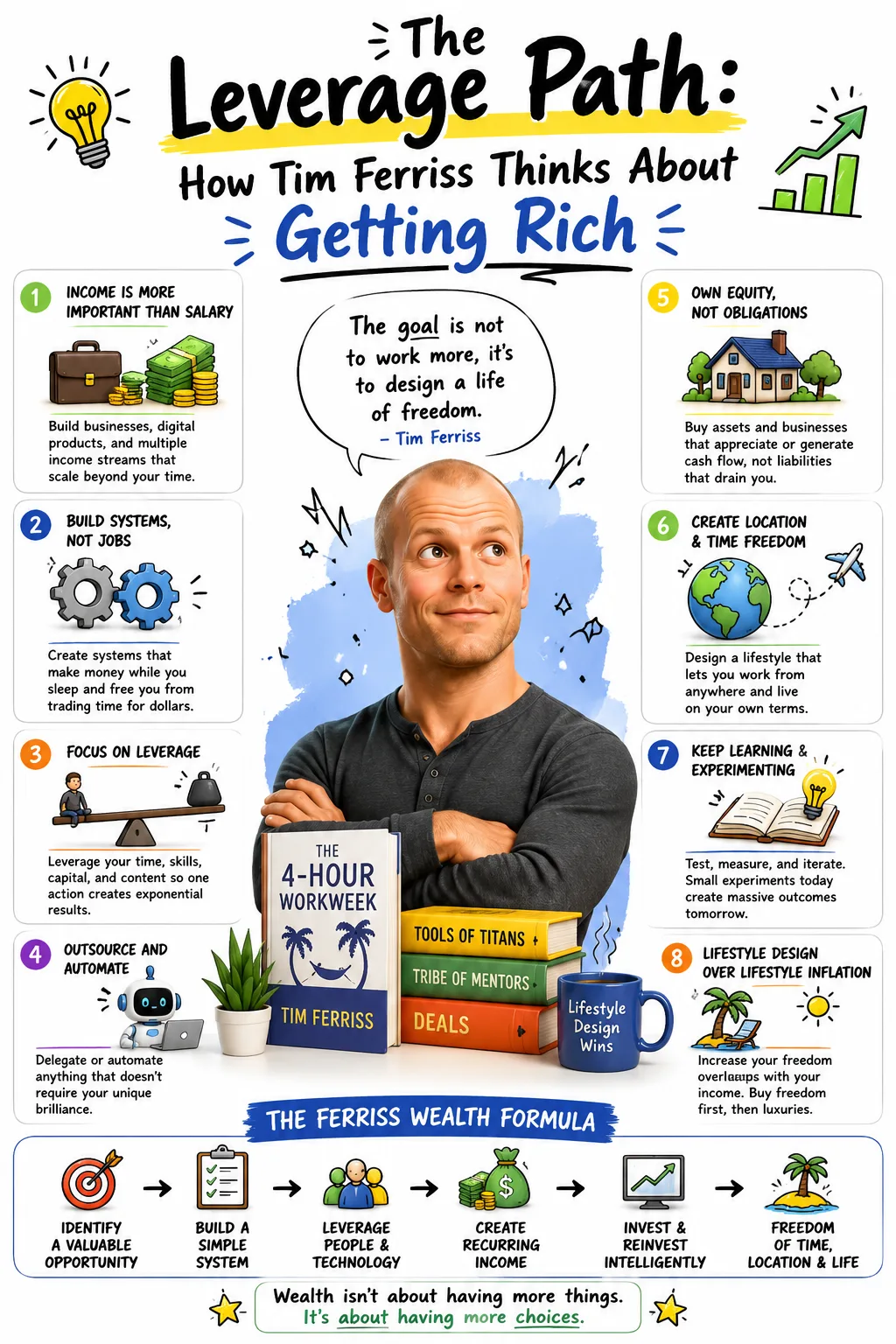
The Leverage Path: How Tim Ferriss Thinks About Getting Rich
Tim Ferriss did not become influential by telling people to work harder, save every spare dollar, and wait patiently for permission to enjoy life. His message was more disruptive than that. He asked a different question: what if wealth is not simply the accumulation of money, but the ability to control your time, choose your work, and design a life that is not permanently deferred?
That question explains why Ferriss’ ideas have lasted far longer than many productivity trends. The title of his best-known book, The 4-Hour Workweek, can be misleading if read literally. The deeper argument is not that serious wealth can be built with almost no effort. It is that most people confuse effort with progress, busyness with value, and income with freedom. Ferriss’ work challenges those assumptions. He argues that the goal is not to become idle. The goal is to escape the low-leverage exchange of time for money and replace it with systems, assets, skills, and decisions that produce a much larger return on each hour invested.
Ferriss’ own career gives the philosophy credibility and invites scrutiny. He is an entrepreneur, author, podcaster, and early-stage technology investor. His official biography describes him as an early-stage investor or advisor in companies including Uber, Facebook, Shopify, Duolingo, Alibaba, and others, and as the author of multiple major bestsellers, including The 4-Hour Workweek and Tools of Titans. His official investing portfolio lists Shopify as “first advisor,” Uber as “pre-seed round advisor,” and Duolingo as a Series A investment, among many others.
The Ferriss approach to wealth is not a conventional financial plan. It is not primarily about budgeting apps, coupon discipline, or maximizing a retirement account contribution. Those can matter, but they are not the center of his system. Ferriss is more interested in the architecture of a life: how income is produced, how decisions are made, how fear is handled, how work is eliminated or delegated, and how assets are created so that money no longer depends entirely on personal labor.
At its best, his philosophy is a powerful framework for increasing earning power, escaping unnecessary work, and converting specialized knowledge into durable assets. At its worst, it can tempt people to underestimate how hard “automated income” really is. The serious reader needs both sides. Ferriss’ ideas are most useful when treated not as shortcuts, but as principles of leverage.
The First Principle: Wealth Is Not the Same as Salary
The traditional career path is built around salary. Get qualified. Get hired. Get promoted. Increase pay. Repeat until retirement. This path can produce stability, and for many households it is still the foundation of financial security. But Ferriss argues that salary alone is a narrow form of wealth because it usually depends on a direct trade: time, attention, and obedience in exchange for income.
The problem is not employment itself. Many people build meaningful careers inside organizations. The problem is dependence. If every dollar requires another hour of personal effort, the person may earn a high income and still have little freedom. A lawyer billing eighty hours a week, a consultant flying constantly, or an executive chained to meetings may appear wealthy from the outside while living with very little control over time.
Ferriss’ philosophy asks a more precise question than “How much do you make?” It asks, “How is the money made?” A salary is active income. It stops or weakens when work stops. An asset can keep producing after the original work is finished. That difference is central to nearly every serious wealth-building philosophy, but Ferriss makes it unusually personal. He is not only interested in net worth. He is interested in how net worth affects daily life.
Consider two people earning the same $200,000 a year. One earns it through a demanding job that requires constant availability, a long commute, and a workplace culture that treats exhaustion as a badge of honor. The other earns it from a mix of a niche software product, royalties, investments, and a small advisory practice with strict boundaries. Their tax returns may look similar. Their lives do not.
Ferriss would likely view the second person as wealthier, even if the first person has higher social status. The second person has more control. More optionality. More ability to say no. More capacity to travel, experiment, recover, think, and build. In Ferriss’ world, wealth is partly measured by what money removes: the need to accept every demand, chase every promotion, or remain in a life that no longer fits.
This is why Ferriss’ work often resonates with high earners who feel trapped. They do not need another lecture on ambition. They need a new definition of success. A higher salary can improve life, but only if it comes with a better structure. Otherwise, income can become a more expensive cage.
The Second Principle: Build Systems Instead of Just Working Harder
Ferriss’ wealth philosophy depends on systems. A system is a repeatable process that produces a result without requiring constant personal intervention. In business, a system might be an automated sales funnel, a subscription product, a fulfillment process, a licensing agreement, or a software platform. In investing, it might be a disciplined portfolio strategy. In personal productivity, it might be a decision rule that prevents low-value commitments from consuming the week.
The central idea is simple: a person has limited hours, but a system can operate beyond those hours. A person can write one email at a time; a system can nurture thousands of leads. A person can teach one student at a time; a digital course can teach many. A person can sell consulting hours; a productized service can deliver a defined outcome through a repeatable process. A person can manually track every task; software can route, remind, record, and report.
Ferriss popularized this way of thinking for a generation of entrepreneurs. In the mid-2000s, when The 4-Hour Workweek first appeared, the internet was already changing the economics of small business. Ferriss’ official blog describes the book as having been published in 2007, a timing that matters because it arrived before remote work, creator businesses, ecommerce platforms, and online education became as mainstream as they are now.
The book’s deeper relevance is not the fantasy of working four hours. It is the idea that personal effort should be used to design productive machinery, not simply to push the same rock uphill forever. The wealth question becomes: “What can I build once that can sell, serve, or compound many times?”
A simple example is a niche information product. A consultant might spend years answering the same questions from clients. At first, the consultant earns only when present. But over time, patterns emerge. The same onboarding problem. The same pricing confusion. The same mistakes in hiring, marketing, or operations. A low-leverage consultant keeps repeating answers. A high-leverage consultant turns the repeatable part of the knowledge into a paid workshop, template library, course, book, or subscription. The personal expertise becomes intellectual property.
This is not passive income in the lazy sense. The work can be intense. The product may fail. Customers may require support. Marketing may be harder than expected. But the economic structure changes. Instead of selling the same hour repeatedly, the creator sells a packaged solution many times. Ferriss’ philosophy is not anti-work. It is anti-waste.
The Third Principle: Eliminate Before You Optimize
Many people respond to overload by searching for better tools. A faster app. A new calendar system. A more elegant task manager. Ferriss is known for asking a harsher question: should the task exist at all?
This is where the 80/20 principle enters his framework. The idea, often called the Pareto Principle, suggests that a large share of results frequently comes from a small share of causes. In business, a minority of customers may produce most profits. A minority of products may produce most revenue. A minority of activities may create most career advancement. The exact numbers vary, but the principle is useful because it forces a person to identify concentration.
Ferriss applies this to work and wealth. Which customers generate most of the profit and least stress? Which activities create most of the sales? Which relationships open the most valuable doors? Which habits create the most energy? Which meetings produce almost nothing? Which obligations exist only because nobody had the courage to remove them?
This matters because wealth creation is not only about adding more. It is often about removing what blocks the valuable work. A person who works twelve hours a day but spends eight of them reacting to messages, attending low-value meetings, and maintaining unprofitable clients may feel productive while starving the activities that actually create wealth.
Elimination is emotionally difficult because low-value work often disguises itself as responsibility. Email feels responsible. Meetings feel collaborative. Custom requests feel customer-focused. Endless research feels prudent. But many of these activities are forms of avoidance. They consume attention while delaying the harder task: building something valuable, selling it, negotiating better terms, or making a decision.
Ferriss’ elimination mindset can be applied to personal finance with surprising force. Many households try to optimize minor expenses while ignoring the few decisions that dominate their financial lives: housing, transportation, career path, business ownership, investment behavior, debt structure, and partner choice. A family may debate small purchases while carrying high-interest debt, underinvesting in career skills, or buying more house than their income can comfortably support.
The Ferriss lens asks: “Which few choices are driving most of the outcome?” That question is more valuable than another hour spent perfecting a spreadsheet. A household that reduces a major recurring expense, negotiates compensation, refinances expensive debt when appropriate, or builds a side asset may change its trajectory more than one that merely trims small pleasures without addressing structural issues.
The Fourth Principle: Leverage Is the Real Wealth Accelerator
Leverage is the ability to produce more output without a proportional increase in personal effort. Ferriss’ entire philosophy can be understood as a search for leverage.
There are several forms. Labor leverage uses other people’s time. Capital leverage uses money to acquire assets or fund growth. Technology leverage uses software, automation, and platforms. Media leverage uses audience, reputation, and distribution. Intellectual property leverage uses ideas that can be packaged, licensed, or sold repeatedly. Network leverage uses relationships to access opportunities that would otherwise be invisible.
The wealthy often differ from the merely hardworking because they possess leverage. A restaurant owner with one location may work constantly. A restaurant group with systems, managers, brand recognition, and financing has more leverage. A freelance designer earns by the project. A designer who creates a widely used template marketplace has more leverage. A teacher earns a salary. A teacher who builds a curriculum company, publishes books, or owns educational software has more leverage.
Ferriss’ contribution was to bring the language of leverage into personal lifestyle design. He showed that leverage is not reserved for billionaires or corporate executives. A solo operator can use digital platforms. A writer can build an audience. A specialist can productize expertise. A small business owner can automate fulfillment. A professional can negotiate remote work and convert commuting time into learning, health, or a side venture.
The modern economy has made this both easier and more competitive. Artificial intelligence, no-code software, global freelance markets, payment platforms, and digital distribution have reduced the cost of experimentation. A single person can now build a small media property, launch an online store, sell a digital product, test advertising, manage customer relationships, and automate operations with tools that once required a team.
Yet leverage cuts both ways. Because the tools are widely available, execution quality matters more. A mediocre course, generic newsletter, or copycat ecommerce store rarely becomes a durable asset. Leverage amplifies value, but it also amplifies weakness. If the offer is unclear, the audience is weak, the economics are poor, or the product does not solve a real problem, automation merely helps failure arrive efficiently.
The Ferriss lesson is not “use tools and get rich.” It is “build or acquire leverage around something valuable.” Technology is not the asset by itself. The asset is the combination of problem insight, distribution, trust, process, and ownership.
The Fifth Principle: Own Assets, Not Just Income Streams
Ferriss’ philosophy aligns with a timeless financial truth: ownership is the foundation of serious wealth. Labor can produce income. Ownership can produce compounding.
The difference is visible across history. Workers may earn wages. Owners possess claims on profits, intellectual property, land, equity, royalties, or interest. The investor who owns a share of a productive company participates in its future earnings. The author who owns royalties can be paid long after writing. The entrepreneur who owns a business can sell it, borrow against it, distribute cash from it, or let it grow. The landlord who owns productive real estate may receive rent and appreciation, while also carrying risk, maintenance, and financing obligations.
Ferriss’ preferred examples often involve businesses that can run with limited owner involvement: niche ecommerce, licensing, digital products, software, publishing, subscriptions, and investments. These are attractive because they can separate output from hours. The owner may still work, but the work is increasingly managerial, strategic, or creative rather than purely transactional.
For a Wealth Insights reader, the practical distinction is crucial. An income stream is not automatically an asset. A side hustle that requires constant labor is another job. A consulting practice with no repeatable process, no brand, no team, and no transferable client relationships may generate income but have little resale value. A social media account with attention but no trust or monetization system may be fragile. A rental property with negative cash flow and poor maintenance reserves may be a liability wearing the costume of an asset.
An asset has durable economic value. It can produce cash, appreciate, reduce future costs, or be sold. It does not need to be perfectly passive, but it should become less dependent on the owner’s direct hours over time. That is the standard Ferriss pushes people toward.
This standard changes how a person evaluates opportunities. Instead of asking only, “How much can I earn this month?” the better question is, “Will this create something I can own?” A freelancer might accept lower short-term income to develop a product. An employee might take equity in a high-quality company, while understanding the risk. A creator might spend years building a trusted audience before monetizing aggressively. An investor might choose broad, low-cost exposure to productive businesses rather than constantly trading.
Ownership requires patience because assets are often built before they are fully valued. The early stage can feel unrewarding. A new product has no buyers. A young portfolio compounds slowly. A brand has little authority. A newsletter has few subscribers. A software tool has bugs. A property has repairs. The visible income may lag the invisible asset creation.
Ferriss’ approach is useful because it encourages people to tolerate this early discomfort. The goal is not immediate applause. The goal is to build something that can eventually work harder than you do.
The Sixth Principle: Learn Skills That Compound
Ferriss has long emphasized skill acquisition. His broader work often explores how high performers learn faster, break down complex abilities, and identify the small set of actions that produce disproportionate improvement. In wealth building, this matters because certain skills compound across nearly every domain.
Sales is one. A person who can sell ethically can raise capital, close clients, negotiate salary, recruit talent, form partnerships, and persuade customers. Marketing is another. A person who understands positioning, attention, trust, and distribution can make good products visible. Writing compounds because clear thinking expressed clearly travels. Negotiation compounds because better terms affect every future cash flow. Basic financial literacy compounds because it improves decisions around debt, investing, taxes, risk, and opportunity cost.
Programming and technical literacy can also be powerful, especially in a world where software increasingly shapes business models. Not everyone needs to become a full-time engineer, but understanding what technology can automate, measure, and scale helps a person see opportunities others miss. Communication, management, and hiring matter because leverage often involves people. Investing skill matters because surplus income must eventually be allocated.
The key is that these skills are portable. A professional who learns negotiation can use it in compensation, vendor agreements, real estate, business acquisition, and family financial planning. A creator who learns copywriting can use it in landing pages, emails, product launches, investor updates, and speeches. An entrepreneur who learns financial modeling can use it to avoid attractive-looking but economically weak ventures.
Ferriss’ anti-credential bias should not be misunderstood. He is not arguing that formal education has no value. Doctors, engineers, accountants, pilots, lawyers, and many other professionals need rigorous training. The more useful point is that credentials are not the same as economically valuable skills. A person can accumulate degrees without learning how to create value in a market. Another person can develop rare, practical skills that create enormous opportunity without following a conventional academic path.
The wealth-building question is: “Which skill, if improved, would raise the ceiling on everything else?” For some people, the answer is sales. For others, it is writing, public speaking, financial analysis, leadership, coding, design, or negotiation. Ferriss’ method is to identify the constraint and attack it directly.
The Seventh Principle: Negotiation Is a Wealth Skill, Not a Personality Trait
Ferriss treats negotiation as one of the highest-return skills because it changes the terms under which money is earned, spent, invested, and protected. Many people avoid negotiation because they see it as confrontation. Ferriss’ philosophy reframes it as structured problem-solving.
A small improvement in terms can compound. A higher starting salary affects future raises, bonuses, retirement contributions, and confidence. A lower vendor cost improves business margins. Better payment terms improve cash flow. A higher royalty rate can matter for years. A negotiated equity stake can become life-changing if the underlying business succeeds. A reduced interest rate can save thousands. A better lease can protect a company during a downturn.
Negotiation also builds psychological freedom. The person who knows how to ask is less trapped by the first offer. This does not mean every negotiation succeeds. It means the person develops a habit of testing assumptions. Is the price fixed? Is the salary band real? Is there flexibility in timing, scope, equity, remote work, severance, or responsibilities? Can the deal be reframed so both sides win?
Ferriss’ broader work often encourages people to make uncomfortable asks. The hidden lesson is that many constraints are social rather than structural. People assume rejection will be catastrophic. Usually, it is not. A respectful ask may produce a yes, a counteroffer, useful information, or simply a no. The downside is often smaller than imagined.
For personal finance, negotiation should be viewed as an income strategy. Expense reduction has limits. Negotiated income and terms can expand. A person can cut subscriptions only so far, but a strong negotiation can permanently alter earning power. That does not make frugality irrelevant. It means the wealth builder must learn to improve both sides of the equation: what leaves and what comes in.
The Eighth Principle: Fear-Setting Turns Risk Into a Calculation
One of Ferriss’ most valuable ideas is fear-setting. Goal setting asks what you want. Fear-setting asks what you are afraid of, what could go wrong, how damage could be prevented, and how recovery might happen. His official blog describes fear-setting as an exercise he does regularly, and his public talks have framed it as a way to overcome paralysis by defining fears rather than leaving them vague.
The brilliance of fear-setting is that it turns anxiety into a written decision model. Vague fear is powerful because it has no edges. “What if I fail?” can stop a person for years. But when the fear is written down, it becomes more manageable. What exactly is failure? Losing money? Looking foolish? Disappointing family? Needing to find another job? Damaging health? Burning a relationship? Once the risk is named, it can be prevented, reduced, insured against, or accepted.
Ferriss also emphasizes the cost of inaction. In a transcript of a conversation with Ryan Holiday, Ferriss describes thinking carefully about the cost of inaction and projecting the effects of continuing the status quo across six, twelve, or eighteen months in financial, emotional, and physical terms. That idea is central to wealth building because many people treat action as risky and inaction as safe. In reality, inaction has its own compounding cost.
Staying in a low-growth career is risky. Remaining financially illiterate is risky. Avoiding investing for decades is risky. Carrying high-interest debt without a plan is risky. Refusing to build modern skills is risky. Keeping all income dependent on one employer is risky. Waiting for perfect confidence is risky.
Fear-setting does not mean reckless action. It means honest comparison. A person considering a business should define the worst plausible loss, not the imagined apocalypse. How much capital is truly at risk? How long would recovery take? What skills would be gained even if the venture failed? What relationships must be protected? What experiments could test demand before a full launch? What would make the risk unacceptable?
This is where Ferriss’ approach is more sophisticated than get-rich-quick thinking. He does not merely celebrate boldness. He encourages risk decomposition. The goal is not to eliminate fear. The goal is to prevent undefined fear from controlling the decision.
The Ninth Principle: Focus on the One Project That Could Change Everything
Ferriss is skeptical of scattered ambition. Many capable people dilute themselves across too many projects: a job, a side hustle, a podcast, a course, a newsletter, a real estate idea, a trading strategy, a social media brand, and a half-built app. Activity rises. Progress fragments.
The high-leverage question is: “Which project, if successful, would make many other things easier or unnecessary?”
This question is ruthless because it forces prioritization. Not all opportunities deserve equal attention. Some are distractions with attractive branding. Others are genuine turning points. A promotion into a more strategic role might matter more than a small side hustle. A product that can scale might matter more than another freelance client. A book that builds authority might matter more than scattered social posts. A debt payoff plan might matter more than chasing speculative investments. A health intervention might matter more than any business idea because energy is the base layer of all wealth creation.
Ferriss’ philosophy favors concentrated experiments. Choose a meaningful opportunity. Define the test. Limit the downside. Execute intensely. Measure results. Adjust or quit. This is different from drifting among possibilities. It is also different from blind persistence.
The ability to quit low-value pursuits is underrated. Many people continue projects because of sunk cost, public identity, or fear of admitting a mistake. Ferriss’ elimination mindset gives permission to stop. If a project is not producing learning, cash flow, strategic positioning, or joy, it may be consuming the attention needed for the project that matters.
Wealth often comes from a small number of unusually important decisions. The career pivot. The business model change. The first scalable product. The right partnership. The disciplined investment habit. The decision to leave a toxic environment. The choice to own rather than rent your attention to low-value work. Ferriss’ framework helps people search for these inflection points.
The Tenth Principle: Lifestyle Design Is a Financial Strategy
Lifestyle design is often misunderstood as a desire for beaches, laptops, and permanent travel. That image is too narrow. At its core, lifestyle design means intentionally structuring income, work, location, relationships, and obligations around a chosen life rather than inheriting a default one.
This is a financial strategy because lifestyle determines the amount of money required for freedom. Someone who needs luxury signals, constant upgrades, and approval from expensive social circles may require enormous income to feel secure. Someone who wants autonomy, meaningful work, health, family time, and periodic travel may need far less than society suggests. Ferriss’ philosophy makes the reader separate status from actual desire.
Many people pursue wealth without asking what it is supposed to buy. They chase more because more is measurable. More income. More square footage. More titles. More followers. More possessions. Yet the deeper forms of wealth are often qualitative: control over mornings, the ability to work from a chosen place, the freedom to decline bad clients, the margin to care for family, the time to exercise, the capacity to read, the ability to take a month away without financial panic.
Ferriss’ concept of “mini-retirements” challenged the traditional deferred-life plan. His official blog has described this as distributing recovery and adventure throughout life rather than saving all leisure for retirement. The point is not that everyone can or should take long breaks at will. The point is that the standard life script deserves examination. Why should all freedom be postponed until old age? Why should the healthiest decades be spent entirely in accumulation mode?
This does not mean abandoning responsibility. A parent with young children, a caregiver, or a person rebuilding after debt may have fewer options than a single entrepreneur with savings. Ferriss’ best ideas must be adapted to reality. But the question remains valuable: “What am I deferring, and is the deferral necessary?”
Sometimes the answer is yes. Sacrifice can be noble and strategic. But sometimes deferral is simply inertia. People postpone travel, creativity, health, relationships, and rest because they have never designed an alternative. They assume wealth means enduring decades of dissatisfaction in exchange for a future that may not arrive in the imagined form.
Ferriss’ contribution is to make freedom a design requirement, not an afterthought.
Why Ferriss’ Ideas Still Matter in the AI Era
Ferriss’ early work anticipated several trends that are now mainstream: remote work, creator businesses, niche ecommerce, digital education, automation, outsourcing, and personal brands. The modern AI era extends that logic. Many tasks that once required teams can now be accelerated by software. Research, drafting, coding assistance, customer support, analytics, design iteration, and workflow automation are increasingly accessible to small operators.
This makes Ferriss’ leverage philosophy more relevant, not less. A one-person company can now look larger than it is. A specialist can create content, test offers, automate scheduling, deliver digital products, and serve customers globally. A small business can use AI to reduce administrative drag. An investor can access better data and educational tools. A professional can learn faster and produce more.
But AI also raises the standard. If everyone can produce generic content, generic content loses value. If everyone can launch a basic product, trust and differentiation matter more. If automation floods markets with average work, human judgment, taste, credibility, and relationships become more important. Ferriss’ 80/20 thinking applies again: the tools are not the advantage; the rare insight is.
The wealth builder in the AI era should ask Ferriss-style questions. Which part of my work can be automated? Which part should never be automated because it creates trust? Which skill becomes more valuable when routine work gets cheaper? Which business model gains leverage from AI without becoming a commodity? Which assets can I build faster now? Which old assumptions about team size, location, and startup cost are no longer true?
The opportunity is real. So is the risk. Low barriers attract crowded markets. The person who wins is not the one who uses the most tools, but the one who uses tools to solve a painful problem with clarity, speed, and trust.
The Practical Ferriss Wealth Framework
To apply Ferriss’ philosophy, begin with income architecture. List every source of income and classify it. Is it active labor, recurring revenue, investment income, royalties, equity appreciation, business profit, or something else? Then ask how dependent each source is on your direct hours. This exercise quickly reveals whether you are building wealth or simply earning under pressure.
Next, identify your highest-leverage skill constraint. Do you need to sell better, write better, negotiate better, manage better, understand finance, learn technology, or build an audience? Avoid vague self-improvement. Choose the skill that would unlock the most economic opportunity over the next twelve months.
Then conduct an 80/20 audit. Look at customers, tasks, expenses, relationships, products, meetings, habits, and commitments. Which few produce most value? Which few create most stress? Which can be eliminated, delegated, automated, or redesigned? The goal is not to become cold or transactional. The goal is to stop allowing low-value noise to consume your most valuable attention.
After that, search for an asset you can build. This could be a portfolio of productive investments, a small business, a digital product, a book, a licensing agreement, a piece of software, a rental property, or equity in a company. The right asset depends on skills, capital, risk tolerance, time, and temperament. Ferriss’ framework does not require everyone to become a startup investor or internet entrepreneur. It requires movement from pure labor toward ownership.
Run fear-setting before major decisions. Write down the worst plausible outcomes, prevention steps, repair steps, and the cost of doing nothing. This is especially useful before quitting a job, starting a company, negotiating compensation, investing meaningful capital, ending a draining commitment, or changing location. The exercise converts emotion into analysis.
Finally, define freedom in specific terms. How much monthly income would cover your real life? Which expenses are status-driven rather than value-driven? How many hours do you want control over? Where do you want to live? What work would you keep doing even if you did not need every dollar? Which relationships deserve more time? What would enough look like?
This last step matters because wealth without a definition becomes endless. Ferriss’ philosophy is not simply about getting rich. It is about preventing wealth from becoming another form of captivity.
Where Ferriss’ Philosophy Can Mislead People
Ferriss’ ideas are powerful, but they can be misread. The most common mistake is underestimating execution. Automated businesses do not begin automated. They usually require product development, customer research, fulfillment design, marketing, support, quality control, and constant refinement. Passive income often begins as very active work.
A second mistake is confusing lifestyle design with avoidance. Some people use the language of freedom to avoid mastery, discipline, or difficult commitments. Ferriss’ own career does not support that interpretation. Writing bestselling books, building a major podcast, investing in startups, and developing a global audience require enormous effort. The point is not to avoid work. The point is to choose and structure work intelligently.
A third mistake is ignoring risk. Startup investing can produce extraordinary winners, but it is risky, illiquid, and often inaccessible to ordinary investors. Ferriss’ portfolio includes famous successes, but early-stage investing is not a simple template for the average household. Most people should be cautious about extrapolating from exceptional outcomes. Broad diversification, emergency reserves, prudent debt management, and long-term investing remain essential for financial resilience.
A fourth mistake is chasing novelty. Ferriss’ audience often includes ambitious experimenters, and experimenters can become addicted to new tactics. But wealth usually requires staying with a sound strategy long enough for compounding to matter. The 80/20 principle should not become an excuse to abandon every project when it becomes hard. Some assets require years of quiet work before the payoff becomes visible.
A fifth mistake is treating personal freedom as purely individual. Wealth decisions affect spouses, children, employees, customers, partners, and communities. Outsourcing, automation, relocation, and aggressive elimination can create real benefits, but they should be handled with ethics and care. A well-designed life should not depend on carelessly transferring burdens to others.
The mature version of Ferriss’ philosophy is not a fantasy of consequence-free independence. It is a disciplined pursuit of leverage, ownership, and autonomy within the constraints of real life.
Ferriss Compared With Other Wealth Thinkers
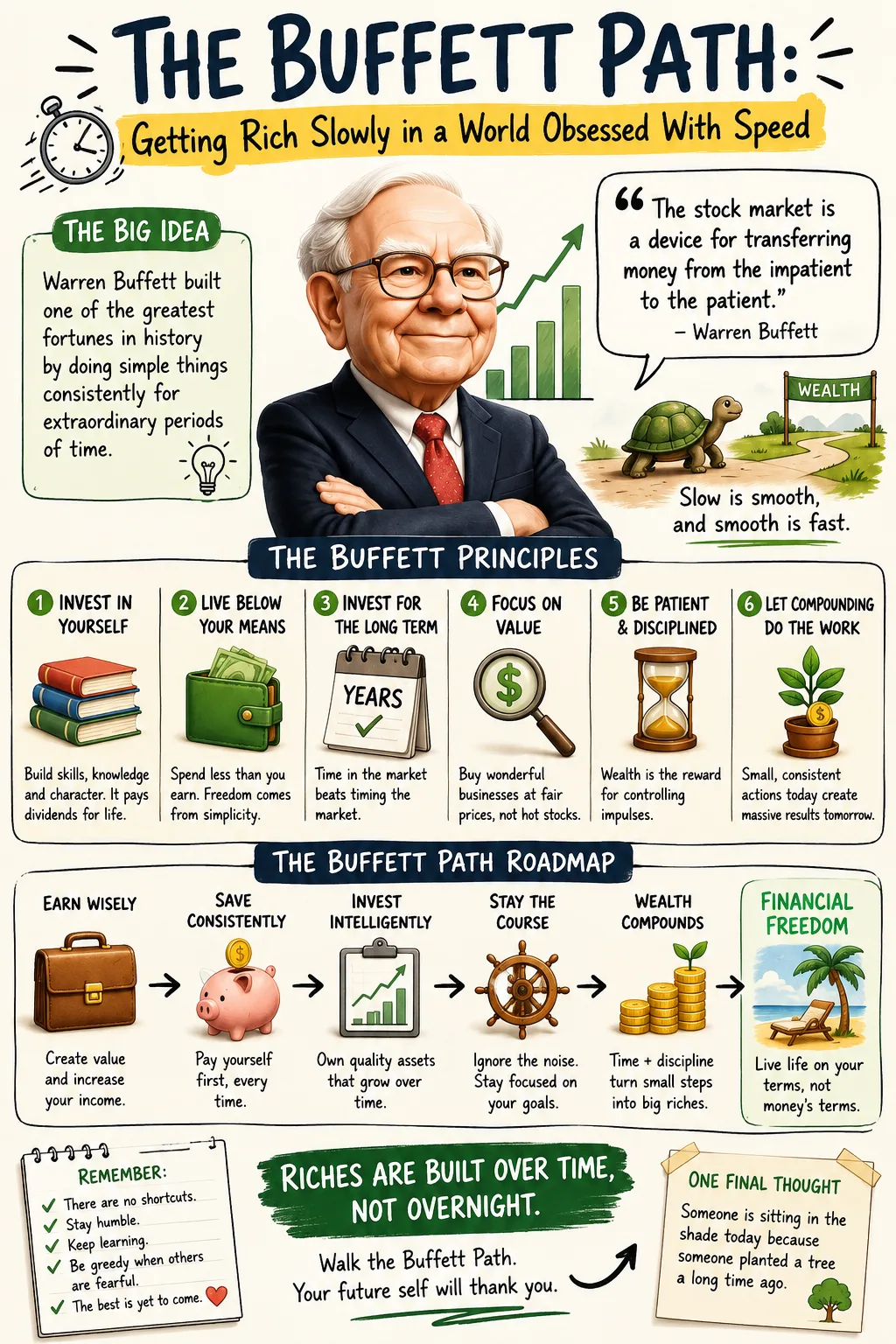
Ferriss overlaps with several influential wealth philosophies, but his emphasis is distinct. Warren Buffett focuses on business quality, patience, compounding, rationality, and buying productive assets at sensible prices. Naval Ravikant emphasizes specific knowledge, leverage, accountability, and ownership. Morgan Housel emphasizes behavior, humility, time, and the psychology of money. Ferriss sits at the intersection of entrepreneurship, productivity, lifestyle design, and experimentation.
Where Buffett asks whether an asset can compound over decades, Ferriss asks whether the structure of life is worth the income it produces. Where Naval emphasizes permissionless leverage through code and media, Ferriss gives practical attention to elimination, outsourcing, and lifestyle choices. Where Housel warns that financial success depends heavily on behavior, Ferriss offers tools for changing behavior by redesigning environments and decisions.
The strongest wealth builders can learn from all of them. Buffett adds patience. Naval adds leverage and ownership. Housel adds humility. Ferriss adds design. Taken together, they suggest that wealth is not created by one tactic. It is created by a system of earning, owning, deciding, waiting, and living.
A Realistic Path for the Ordinary Reader
Most readers are not going to become bestselling authors, famous podcasters, or early investors in world-changing companies. That does not make Ferriss’ ideas irrelevant. It makes adaptation necessary.
An employee can apply Ferriss by negotiating compensation, eliminating low-value work, building rare skills, and creating a side asset before leaving a stable job. A freelancer can apply Ferriss by productizing services, raising prices, building templates, hiring support, and moving from custom labor toward repeatable offers. A small business owner can apply Ferriss by documenting processes, focusing on profitable customers, automating administration, and building a management layer. A household can apply Ferriss by reducing status-driven expenses, investing consistently, and designing a life that requires less financial pressure to feel rich.
A young professional might use the framework to choose a career path with learning potential rather than immediate comfort. A mid-career manager might use it to negotiate remote work and reclaim ten hours a week for health and a business experiment. A parent might use it to build a flexible consulting practice around deep expertise. A retiree might use it to turn decades of knowledge into teaching, mentoring, or writing.
The common thread is leverage. What can be learned once and used repeatedly? What can be built once and sold repeatedly? What can be negotiated once and benefit you for years? What can be invested in steadily and allowed to compound? What can be removed permanently so that attention returns to what matters?
Ferriss’ wealth philosophy becomes practical when it moves from fantasy to calendar, bank account, and behavior. It is not enough to admire leverage. You must schedule the work that creates it. It is not enough to praise ownership. You must acquire or build assets. It is not enough to dislike busyness. You must cancel, delegate, or redesign the obligations that produce it. It is not enough to want freedom. You must define the price of freedom and build toward it.
The Deeper Lesson: Money Is a Tool for Optionality
Ferriss’ most enduring insight is that money should be judged by the options it creates. More money is useful when it buys time, health, learning, relationships, mobility, safety, generosity, and meaningful work. More money is less useful when it only buys comparison, complexity, and obligations.
This is a hard lesson because modern culture trains people to display wealth rather than experience freedom. The visible signs of wealth are easy to market: houses, cars, watches, vacations, restaurants, upgrades. The invisible signs are harder to photograph: a clear calendar, low anxiety, a strong marriage, a healthy body, a resilient portfolio, the ability to walk away, the ability to help family, the ability to spend a Tuesday afternoon with a child, the ability to recover after loss.
Ferriss’ philosophy asks readers to take those invisible forms seriously. If the purpose of wealth is freedom, then financial decisions must be evaluated by whether they increase or decrease freedom. A larger house with a suffocating mortgage may reduce freedom. A prestigious job that destroys health may reduce freedom. A business that cannot run without the owner may reduce freedom, even if it produces high income. An investment strategy that creates constant anxiety may reduce freedom.
By contrast, a modest but profitable asset, a flexible skill set, a strong emergency fund, a trusted audience, a disciplined investment plan, or a well-negotiated work arrangement may create more genuine wealth than a status purchase. Ferriss’ worldview rewards the quiet architecture of autonomy.
The Final Measure of Getting Rich According to Tim Ferriss
To get rich according to Tim Ferriss is not to chase money blindly. It is to build a life where money, systems, and assets serve freedom. The path begins by rejecting the idea that income alone is the score. It continues by creating leverage: through technology, ownership, skills, negotiation, media, systems, and intelligent risk-taking. It matures when the wealth builder learns to eliminate low-value work, focus on high-impact opportunities, and define enough with unusual honesty.
This philosophy is demanding. It requires more responsibility, not less. The person who wants Ferriss-style freedom must become a designer of systems, a student of markets, a manager of attention, and an owner of assets. They must learn to sell, negotiate, focus, invest, and decide under uncertainty. They must resist both conventional status games and shallow shortcut culture.
The reward is not merely a larger bank balance. The reward is optionality. The ability to choose work because it matters, not because panic requires it. The ability to take risks because the downside has been studied. The ability to rest before life forces a breakdown. The ability to own assets that keep working after the laptop closes. The ability to treat time as the scarce resource it has always been.
Ferriss’ wealth philosophy is best understood as a challenge: stop asking only how to earn more, and start asking how to build a life where each dollar, hour, skill, and asset increases freedom. For readers willing to do the harder work behind the appealing language, that challenge can change not only their finances, but the shape of their days.
 Article
 Article
 Article
 Article
 Article
 Article
 Article
 Article