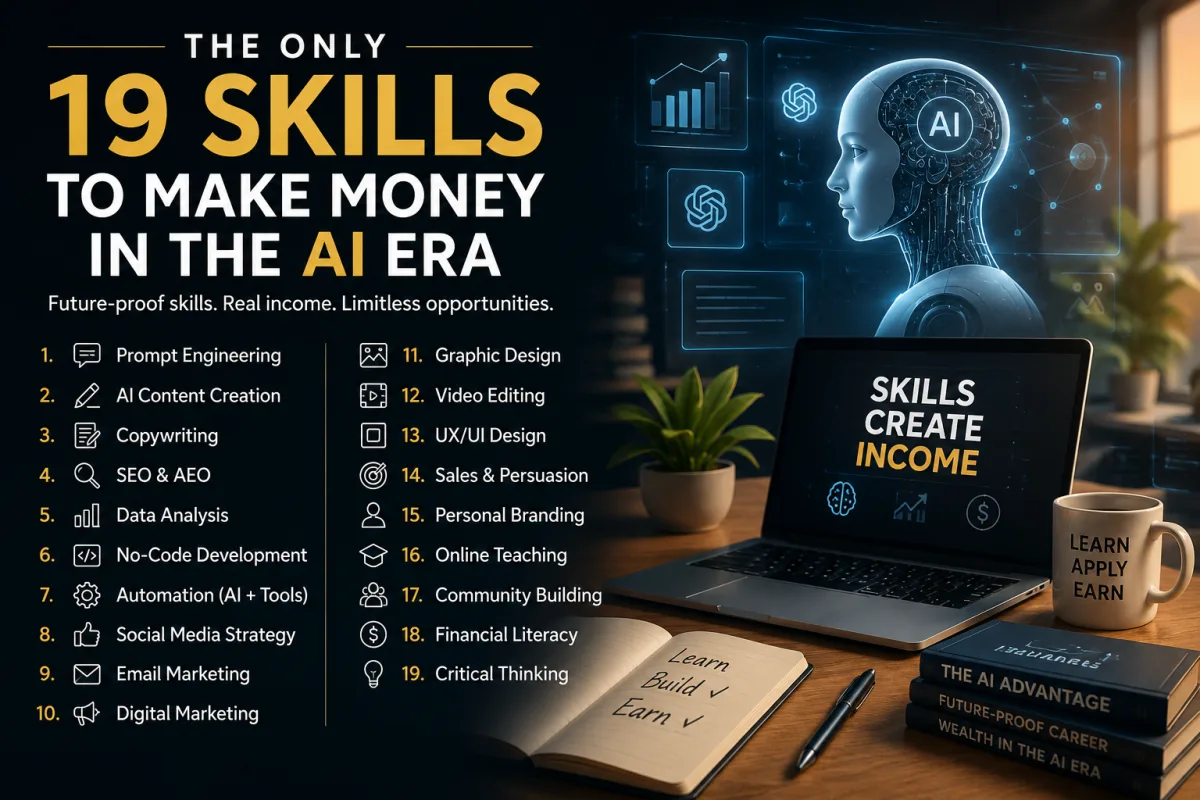
The Only 19 Skills to Make Money in the AI Era
Every major technological shift creates two groups of people.
The first group waits for certainty. They ask whether the change is real, whether the tools are safe, whether the economy will return to normal, whether their current job will remain untouched, and whether someone else will tell them exactly what to do. By the time certainty arrives, the best opportunities have often moved.
The second group studies the shift early. They do not worship new technology, but they do not ignore it either. They ask sharper questions. What work is becoming cheaper? What work is becoming more valuable? What can machines now produce quickly? What still requires human judgment? Where are businesses confused? Where are consumers overwhelmed? What new problems are being created by the very tools that promise to solve old ones?
The AI era rewards the second group.
Artificial intelligence is not just another app category. It is becoming a general-purpose productivity layer across writing, coding, research, customer service, finance, design, marketing, data analysis, operations, education, healthcare, legal work, administration, and business strategy. The World Economic Forum’s Future of Jobs Report 2025 identified AI and big data, technological literacy, creative thinking, resilience, flexibility, and analytical thinking among the skills expected to matter heavily as work changes through 2030.
That does not mean everyone must become a machine learning engineer. It means nearly everyone who wants to stay economically relevant must understand how value is created when intelligent tools become widely available.
For decades, people were paid for information access, routine execution, basic coordination, manual content production, administrative processing, and repetitive technical work. Those activities will not disappear overnight, but their economic value is changing. When a task becomes faster, cheaper, and more available through software, the person doing the task must either move up the value chain or watch their pricing power weaken.
The opportunity is that AI also gives individuals leverage that once required teams, capital, or institutional backing. A skilled person can now research faster, draft faster, test ideas faster, build prototypes faster, analyze data faster, create media faster, automate workflows faster, and serve more customers with fewer resources. Microsoft’s 2025 Work Trend Index described the rise of “frontier firms” built around human-agent teams, while OpenAI’s enterprise reporting shows workplace adoption expanding across industries and repeatable workflows.
Leverage is not the same as wealth. Tools do not make people rich by themselves. A person can have access to the best AI systems in the world and still produce shallow work, chase trends, copy others, or use automation to create noise. The money goes to people who combine AI fluency with judgment, commercial sense, trust, and ownership.
The question is not, “Will AI replace me?”
The better question is, “What skills make me more valuable when AI becomes normal?”
This article answers that question through 19 skills. Not 19 hobbies. Not 19 buzzwords. Not 19 vague personality traits. These are practical economic capabilities that help people make money, protect income, create assets, and build resilience in an AI-shaped economy.
Why Skills Matter More Than Job Titles Now
For much of the modern career era, job titles gave people identity and security. Accountant. Designer. Analyst. Writer. Customer support representative. Developer. Marketer. Consultant. Teacher. Operations manager. Financial advisor. Recruiter. Administrator.
Titles still matter, but they are becoming weaker as predictors of income security. A person’s title may remain the same while the tasks inside that role change dramatically. A marketer who only writes basic social media captions faces a different future from a marketer who understands customer psychology, offer design, analytics, positioning, paid acquisition, automation, and sales funnels. Both may carry the same title, but the market will not value them equally.
The AI era separates workers by task quality, not just job category.
If most of your work is routine, predictable, text-based, rules-based, or easily checked by software, then part of your role is exposed to automation. If your work requires complex judgment, human trust, ethical responsibility, emotional intelligence, domain expertise, strategic prioritization, negotiation, original taste, or accountability under uncertainty, your value can rise.
Anthropic’s Economic Index has shown heavy AI usage in areas such as writing, education, workplace tasks, coding, and business creation, which suggests that people are already using AI for knowledge work rather than waiting for some distant future.
This creates a new income principle: do not define yourself by the task AI can perform. Define yourself by the outcome you can deliver with AI as leverage.
A basic writer produces words. A valuable communicator creates trust, demand, clarity, persuasion, authority, and conversion. A basic analyst produces charts. A valuable analyst explains what the numbers mean, what decision should be made, what risk is hidden, and what action should follow. A basic designer creates visuals. A valuable designer shapes perception, improves usability, increases sales, and strengthens brand equity.
AI compresses execution. The market rewards interpretation.
That is why the strongest money-making skills in the AI era are not just technical. Some are technological, but many are human, strategic, financial, and commercial. The future belongs to people who can connect machine output to human value.
Skill 1: AI Literacy
AI literacy is the ability to understand what artificial intelligence can do, what it cannot do, where it is useful, where it is risky, and how to apply it responsibly to real work.
This is the foundation skill. Without AI literacy, every other skill becomes weaker because the person either overtrusts the technology or underuses it. Both mistakes are expensive.
Overtrust creates sloppy work. A person asks an AI tool for an answer, accepts it without checking, sends it to a client, publishes it, uses it in a financial decision, or builds a business process around it. The output may sound confident, but confidence is not accuracy. AI systems can misread context, invent details, miss nuance, misunderstand instructions, or produce generic conclusions. A professional who cannot detect those weaknesses becomes dangerous.
Underuse creates lost leverage. A person refuses to learn the tools and spends hours on tasks that could be accelerated. They may believe this protects their authenticity, but the market does not pay extra for unnecessary slowness. The market pays for value. When two people can deliver similar quality and one can do it faster, cheaper, and with better research support, the slower person must have a very strong reason to justify the difference.
AI literacy includes knowing the major categories of tools: large language models, image generators, coding assistants, data analysis tools, workflow automation platforms, voice tools, video tools, search-augmented systems, agentic systems, and specialized industry software. It also includes understanding privacy, data security, copyright concerns, bias, hallucination risk, and human oversight.
This skill makes money because businesses are full of people who are confused by AI. They do not need someone who only repeats hype. They need someone who can translate the technology into practical use cases: reduce support ticket time, improve sales follow-up, draft internal documentation, analyze customer feedback, automate reports, improve training, create knowledge bases, generate prototypes, and speed up research.
The person with AI literacy becomes the bridge between technology and productivity.
To develop this skill, pick three recurring tasks in your work and test how AI can improve them. Compare outputs. Check errors. Build templates. Create a repeatable process. Track saved time and improved quality. AI literacy is not proven by saying you use tools. It is proven by better results.
Skill 2: Prompt Judgment
Prompting is often described as the ability to write good instructions for AI. That definition is too small. The real skill is prompt judgment.
Prompt judgment means knowing how to frame a problem, provide context, define the desired output, test assumptions, challenge weak answers, request alternatives, impose constraints, and evaluate the result. The prompt is only the visible part. The judgment behind the prompt is where the money is.
Many people use AI as if they are asking a casual question. Professionals use AI as if they are managing a junior analyst, research assistant, editor, strategist, or technical collaborator. They give context. They specify the audience. They define success. They ask for reasoning. They request comparison. They test edge cases. They push for examples. They verify claims. They refine.
A weak prompt says, “Write me a sales email.”
A stronger prompt explains the product, buyer, pain point, price range, tone, offer, objection, previous customer behavior, desired action, length, and channel. It may ask for three versions: one consultative, one urgent, and one founder-led. Then the human reviews, edits, and chooses based on strategy.
This skill makes money because prompt judgment multiplies the output of other skills. A marketer with prompt judgment can test more angles. A consultant can produce sharper client deliverables. A recruiter can screen and summarize faster. A lawyer can organize documents more efficiently while still applying legal judgment. A student can learn faster. A founder can build systems that would once have required a larger team.
Prompt judgment also protects reputation. People who cannot evaluate AI output often publish polished mediocrity. They create content that sounds professional but says little. They generate strategies that appear sophisticated but ignore the real market. They automate customer interactions that feel lifeless. The market eventually punishes this.
The money is not in prompting alone. The money is in knowing what to ask, why to ask it, and when the answer is not good enough.
Skill 3: Learning Velocity
Learning velocity is the ability to acquire useful knowledge quickly and convert it into action.
The AI era punishes people who wait to be trained. Formal education still has value, especially in regulated fields and deep technical disciplines, but the pace of change is faster than many institutions can update. New tools, workflows, business models, and risks emerge constantly. The person who learns only when someone schedules a course will move slowly.
Learning velocity does not mean collecting random information. It means building a personal learning system.
A person with this skill can identify what they need to learn, find credible sources, use AI to explain unfamiliar concepts, test the knowledge through small projects, get feedback, revise, and apply the skill in commercial settings. They know how to move from confusion to competence without waiting for permission.
This skill makes money because new markets are inefficient. When technology changes quickly, many organizations have problems before they have job descriptions. They need people who can figure things out. A company may not know it needs an AI workflow designer, customer data interpreter, automation consultant, content systems manager, or internal AI trainer. It simply knows that work is messy and expensive. The fast learner can step in, understand the problem, and create value.
Learning velocity also compounds. The first new skill is hard. The fifth becomes easier. You learn how you learn. You build mental models. You develop confidence in unfamiliar territory. You become less afraid of change because you have evidence that you can adapt.
The practical method is simple. Choose one skill every quarter. Define the commercial use. Study the fundamentals. Build one visible project. Get feedback from someone serious. Improve it. Use it to earn, negotiate, or create an asset.
Knowledge alone does not pay. Applied learning pays.
Skill 4: Critical Thinking
Critical thinking is the ability to examine claims, compare evidence, detect weak logic, question assumptions, and make better decisions under uncertainty.
This skill becomes more valuable as AI-generated content multiplies. The internet already had misinformation, exaggeration, bias, and shallow advice. AI makes it easier to produce all of that at scale. More content does not mean more truth. More answers do not mean more wisdom.
In the AI era, many people will confuse fluency with expertise. A machine can generate a polished explanation of a market, investment, medical issue, legal topic, business strategy, or historical event. The writing may be smooth. The structure may be impressive. The confidence may be persuasive. But the output can still be incomplete, outdated, biased, or wrong.
Critical thinking makes money because decision quality is valuable. Businesses do not only pay for information. They pay for judgment that reduces risk and improves outcomes. Investors pay for analysis that separates durable value from hype. Executives pay for advisors who can identify hidden trade-offs. Consumers pay for experts who can simplify complexity without distorting truth.
A critical thinker asks: What is the source? What is missing? What incentive does this person have? What data supports the claim? What would disprove it? What alternative explanation exists? What happens if we are wrong? Who benefits from this belief? What time horizon are we discussing?
This skill is especially important in finance. AI can summarize investment concepts, but it cannot remove the need for human responsibility. A person who invests based on automated confidence without understanding risk is not an investor. They are outsourcing their future to a sentence generator.
Critical thinking is not cynicism. Cynicism rejects too much. Naivety accepts too much. Critical thinking evaluates carefully and acts with proportion.
Skill 5: Data Interpretation
Data interpretation is the ability to turn numbers into decisions.
Many people can now use AI tools to create charts, summaries, dashboards, and reports. That makes raw reporting less scarce. What remains scarce is the ability to understand what the data means and what should be done next.
A business may have website analytics, sales data, customer reviews, expense records, inventory numbers, employee performance metrics, email open rates, subscription churn, and advertising reports. The problem is not always lack of data. The problem is lack of interpretation.
Data interpretation asks: What pattern matters? What is noise? What changed? Why did it change? Which customer segment is profitable? Which product is draining resources? Which campaign produces buyers rather than attention? Which expense is rising faster than revenue? Which metric looks good but hides weakness?
This skill makes money because every business needs better decisions. A small retailer wants to know what stock to reorder. A coach wants to know which content brings paying clients. A software company wants to reduce churn. A property investor wants to compare yields. A freelancer wants to know which clients are profitable. A nonprofit wants to measure program impact.
AI can help analyze spreadsheets, summarize patterns, and generate hypotheses. But the human must understand the business context. A rise in revenue may not be good if margins collapsed. A viral post may not matter if it produced no customers. A low-cost supplier may be expensive if quality failures increase refunds. A high-performing employee may be burning out. The numbers require interpretation.
People who combine AI tools with data judgment can sell reporting packages, analytics consulting, business audits, marketing optimization, financial dashboards, operations improvement, and investment research support.
The practical path is to learn spreadsheet fundamentals, basic statistics, data visualization principles, and one or two analytics tools relevant to your field. Then practice translating every chart into a business sentence: “This means we should…”
Data becomes valuable when it changes behavior.
Skill 6: Writing That Builds Trust
Writing is not dead because AI can produce text. Weak writing is dead. Generic writing is dying. Trust-building writing is becoming more valuable.
In an economy full of automated content, readers become more selective. They do not want more words. They want clarity, perspective, credibility, and usefulness. They want someone who understands their problem deeply enough to explain it better than they can. They want writing that helps them decide, buy, invest, learn, trust, or act.
AI can generate drafts, outlines, summaries, and variations. But it does not have lived expertise, business accountability, moral courage, personal taste, original reporting, customer intimacy, or a reputation to protect. Those belong to the writer.
Trust-building writing makes money in many forms: newsletters, sales pages, investor letters, educational content, executive ghostwriting, brand storytelling, grant proposals, white papers, scripts, course material, product documentation, email campaigns, thought leadership, and internal communication.
The best commercial writing does more than sound good. It reduces uncertainty. It explains value. It handles objections. It shows evidence. It respects the reader’s intelligence. It moves people toward a decision without manipulation.
This skill is especially powerful for professionals who are not “writers” by title. A financial advisor who writes clearly can attract better clients. A founder who explains the company’s mission can raise capital and recruit talent. A consultant who writes strong reports can justify higher fees. A real estate expert who educates buyers can build authority. A technical expert who explains complex issues simply can become the person decision-makers call.
To build this skill, study persuasion, storytelling, structure, editing, and audience psychology. Use AI for drafting and variation, but never surrender your voice. The market does not need another machine-written paragraph. It needs human clarity strengthened by machine leverage.
Skill 7: Sales
Sales is the skill of helping people make decisions about value.
Many people dislike sales because they associate it with pressure, manipulation, or desperation. That version of sales deserves its bad reputation. But ethical sales is not manipulation. It is diagnosis, communication, trust, timing, and value exchange.
In the AI era, sales becomes more important because production becomes easier. More people can create products, courses, apps, services, designs, content, and offers. When supply rises, attention becomes scarce. The person who can communicate value and close business has an advantage.
Sales makes money directly. It brings revenue into a business. It turns skill into income. It turns knowledge into clients. It turns products into cash flow. A brilliant service provider who cannot sell may remain invisible. A decent provider who can sell ethically and deliver well may build a thriving business.
AI can support sales through lead research, email drafting, call summaries, objection analysis, customer segmentation, proposal creation, and follow-up automation. But the human must still understand pain, trust, timing, emotional resistance, and buyer psychology.
Strong salespeople know how to listen. They ask better questions. They do not rush to pitch before understanding the problem. They can explain outcomes in the buyer’s language. They can distinguish a real objection from a polite delay. They can follow up without begging. They can walk away when the fit is wrong.
Sales is also an internal career skill. Employees sell ideas to managers. Founders sell vision to investors. Leaders sell change to teams. Freelancers sell trust to clients. Parents even sell values to children. The ability to persuade ethically affects income far beyond formal sales roles.
To develop this skill, practice discovery conversations, offer design, objection handling, negotiation, and follow-up systems. Record sales calls where appropriate. Study lost deals. Build scripts, but do not become robotic. The goal is not to talk more. The goal is to understand better and communicate value more clearly.
Skill 8: Offer Design
Offer design is the ability to package value in a way that people understand, want, and are willing to pay for.
This is one of the most overlooked money skills. Many talented people struggle not because their work lacks value, but because their offer is unclear. They sell hours instead of outcomes. They describe features instead of transformation. They give customers too many choices. They price without strategy. They make buying feel risky, confusing, or inconvenient.
An offer answers the buyer’s hidden questions: What exactly do I get? What problem does it solve? Why should I trust you? How long will it take? What result can I expect? What makes this different? What happens after I pay? What risk am I taking? Why now?
AI can help brainstorm packages, compare competitor offers, draft landing pages, and identify objections. But offer design requires human empathy and market understanding. You must know what customers actually value, not just what you want to sell.
A weak offer says, “I provide social media management.”
A stronger offer says, “I help local clinics turn patient education content into weekly appointment inquiries through a 90-day content and follow-up system.”
The second offer is more specific. It speaks to a buyer. It connects service to outcome. It suggests a process. It is easier to price.
This skill makes money because the same capability can earn very different amounts depending on packaging. A designer can sell a logo cheaply or sell a full brand identity system for a serious business. A writer can sell articles or sell authority-building content for executives. A data analyst can sell spreadsheets or sell decision dashboards that reduce waste. A fitness coach can sell sessions or sell a transformation program with assessment, training, nutrition support, accountability, and progress tracking.
Offer design turns skill into a productized promise.
To develop it, study your customer’s pain, desired outcome, current alternatives, objections, and buying triggers. Then package your work around a clear result, defined process, strong proof, and simple next step.
Skill 9: Automation Thinking
Automation thinking is the ability to identify repeatable work and design systems that reduce manual effort.
This is not only a technical skill. It begins as a way of seeing.
Some people look at a messy process and accept it as normal. Others ask: Why are we doing this manually? What happens every week? What information moves from one place to another? Where do errors happen? Which tasks require judgment and which are just transfer, formatting, notification, routing, or recordkeeping?
Automation thinking makes money because businesses waste enormous time on repeated administrative work. Customer inquiries need routing. Invoices need tracking. Leads need follow-up. Reports need compiling. Documents need filing. Meetings need summaries. Employees need onboarding. Clients need reminders. Inventory needs updates. Payments need reconciliation.
AI combined with workflow tools can reduce this burden. A skilled automation thinker can design systems using no-code platforms, spreadsheets, customer relationship management tools, forms, email sequences, chatbots, internal knowledge bases, and AI assistants.
The danger is automating chaos. A bad process automated becomes faster confusion. That is why the skill requires process understanding before tools. You first map the workflow. Then remove unnecessary steps. Then automate the stable parts. Then monitor quality.
This skill creates income through consulting, internal promotion, operations roles, agency services, software implementation, and business ownership. A person who can save a company hundreds of hours per month can justify strong compensation.
To develop automation thinking, choose one recurring process in your life or work. Map every step. Identify what can be eliminated, delegated, templated, or automated. Build a simple version. Measure the time saved. Then repeat.
Automation is not about replacing humans. It is about protecting human attention for work that deserves it.
Skill 10: Product Thinking
Product thinking is the ability to turn a problem into a repeatable solution that can be used, sold, improved, and scaled.
Many people earn only through custom labor. Custom labor can be profitable, but it depends heavily on time. Product thinking asks how knowledge, service, process, software, media, or intellectual property can become an asset.
A consultant who answers the same questions for every client may create a diagnostic tool. A teacher may create a course. A designer may create templates. A lawyer may create educational resources for common legal questions while reserving custom advice for paid clients. A fitness expert may create a program. A finance educator may create calculators, guides, or membership content. A software developer may turn an internal tool into a product.
AI makes product thinking more accessible because it lowers the cost of prototyping. You can test copy, create mockups, draft curriculum, generate documentation, analyze feedback, and build early versions faster. But the product still needs market demand. A product nobody wants is not an asset. It is a file.
Product thinking makes money because it separates income from one-to-one time. A service provider sells hours. A product builder sells a system. The best businesses often combine both: premium services for high-value clients and scalable products for broader audiences.
This skill requires obsession with the user. What problem occurs repeatedly? How painful is it? What are people already paying for? What current solution disappoints them? What simpler, faster, cheaper, or more trusted solution could exist?
Product thinking also requires iteration. The first version may be imperfect. Feedback improves it. Usage reveals what customers actually value. Pricing changes. Features are removed. Positioning sharpens. The product becomes stronger through contact with the market.
To develop this skill, start by productizing something you already know. Create a checklist, template, calculator, workshop, mini-course, diagnostic, or repeatable service package. Sell it to a small audience. Learn from real buyers. Improve it.
Wealth grows when expertise becomes an asset.
Skill 11: Personal Branding
Personal branding is not pretending to be famous. It is building a reputation that makes opportunity travel toward you.
In the AI era, reputation becomes more valuable because content becomes cheaper. When anyone can publish polished material, people look for signals of trust. Who consistently teaches well? Who has evidence? Who has taste? Who has values? Who understands the field? Who can be relied upon?
A strong personal brand answers those questions before a sales conversation begins.
This skill makes money through better clients, higher fees, partnerships, speaking invitations, job offers, investor interest, media opportunities, course sales, consulting demand, and community trust. People pay a premium when they believe they know your judgment before they meet you.
Personal branding does not require sharing every detail of your private life. It requires consistent public evidence of competence. That evidence may come through articles, videos, talks, case studies, commentary, research, frameworks, client results, portfolio work, interviews, or thoughtful social media posts.
AI can help with drafting, editing, repurposing, and content planning. But it cannot replace substance. A brand built on generic AI content becomes forgettable. A brand built on real perspective becomes durable.
The strongest personal brands are clear about three things: the audience they serve, the problem they address, and the point of view they bring. A vague expert is hard to remember. A specific expert becomes easier to recommend.
To build this skill, choose a domain where you want economic authority. Publish consistently around real problems. Share examples. Explain your thinking. Avoid empty motivational content. Build proof. Protect credibility. Over time, your name can become a financial asset.
Skill 12: Niche Expertise
Niche expertise is deep knowledge of a specific market, audience, tool, regulation, industry, or problem.
General knowledge is becoming easier to access. Specific judgment remains valuable. AI can explain broad concepts, but it may not understand the hidden realities of a local market, a specialized profession, a regulatory environment, a customer subculture, or a company’s internal politics.
The money is often in specificity.
A general marketer competes with many people. A marketer who specializes in helping dental clinics, fintech startups, property developers, private schools, or B2B software companies has a clearer buyer. A general automation consultant may be useful. An automation consultant who understands insurance agencies, medical practices, law firms, construction companies, or online education businesses can command more trust.
Niche expertise makes AI more powerful because you can guide the tool with better context. You know what matters, what is unrealistic, what language customers use, what objections arise, what regulations apply, and what mistakes outsiders make. AI gives speed. Niche expertise gives direction.
This skill makes money through consulting, premium services, industry-specific products, training, advisory roles, research, investing, and business building. The expert who understands a niche can spot opportunities before generalists notice them.
To build niche expertise, choose a field with money, complexity, recurring problems, and a reachable audience. Study the industry deeply. Interview practitioners. Read trade publications. Analyze customer complaints. Learn the economics. Understand regulations. Build small solutions. Publish insights. Become known for understanding that world.
Broad curiosity is useful, but wealth often rewards focused depth.
Skill 13: Cybersecurity Awareness
Cybersecurity awareness is the ability to protect data, accounts, systems, customers, and business processes from digital threats.
As AI tools enter more workflows, the risks increase. More data moves through more platforms. More employees use third-party tools. More content is generated and shared. More attackers can use automation for phishing, impersonation, and social engineering. A company’s productivity gain can become a liability if security is ignored.
This does not mean everyone must become a cybersecurity engineer. It means every serious professional should understand basic digital risk: strong passwords, multi-factor authentication, phishing detection, access control, secure file sharing, data classification, device security, backup practices, vendor risk, and privacy rules.
Cybersecurity awareness makes money because trust is economic. Clients want to know their information is safe. Employers value people who do not create unnecessary risk. Consultants who handle sensitive data must show professionalism. Small businesses need guidance. Families and individuals need protection from scams.
A person with deeper cybersecurity skill can build a career in security audits, awareness training, compliance support, incident response, secure AI implementation, privacy consulting, or managed services. But even basic awareness can protect income by preventing costly mistakes.
The AI era will likely increase the value of people who can combine productivity with protection. Businesses do not only need faster workflows. They need safe workflows.
To develop this skill, start with your own digital life. Secure your accounts. Learn phishing patterns. Understand what data should never be pasted into public tools. Study your industry’s privacy obligations. Create simple security checklists. Good security begins with habits before it becomes infrastructure.
Skill 14: Financial Intelligence
Financial intelligence is the ability to understand how money is earned, managed, invested, protected, and multiplied.
This skill belongs in every AI-era income plan because higher earning potential does not automatically create wealth. A person can use AI to become more productive, get promoted, start a business, or win clients and still remain financially fragile if the money is poorly managed.
The AI era may create sudden income opportunities for freelancers, consultants, creators, developers, trainers, and entrepreneurs. Sudden income can be dangerous when it meets weak money habits. Lifestyle inflation rises. Taxes are ignored. Debt expands. Risky investments look attractive. Business revenue is mistaken for personal wealth.
Financial intelligence brings order.
It includes budgeting, saving, debt management, emergency funds, pricing, tax planning, investing, insurance, cash flow, retirement planning, and asset allocation. It also includes understanding the difference between income and wealth. Income is money coming in. Wealth is money retained and converted into assets that can preserve or produce value.
This skill makes money in two ways. First, it helps you keep and multiply what you earn. Second, it can become a profession or business. Financial educators, advisors, analysts, bookkeepers, tax professionals, investment researchers, CFO consultants, and money coaches all serve the need for financial clarity.
AI can help create budgets, categorize expenses, model scenarios, summarize financial documents, and explain concepts. But money decisions require human judgment, risk tolerance, ethics, and accountability. A tool can calculate. It cannot define your values.
To develop financial intelligence, track your income, expenses, debts, and assets. Learn basic investing principles. Understand taxes in your jurisdiction. Build an emergency fund. Avoid consumer debt traps. Study cash flow. Convert part of every income increase into ownership.
The goal is not only to make more money in the AI era. The goal is to keep more, grow more, and depend less on one source of income.
Skill 15: Negotiation
Negotiation is the skill of improving terms.
Many people focus on earning more but ignore the fact that terms shape wealth. Salary, equity, payment schedules, retainers, royalties, interest rates, rent, supplier contracts, partnership agreements, licensing deals, severance packages, client scope, and business exits are all negotiated.
A person who cannot negotiate may work hard and still leave money on the table for decades.
AI can help prepare for negotiation by researching market rates, drafting talking points, identifying possible objections, comparing contract language, and role-playing scenarios. But the human must still manage emotion, timing, confidence, relationship dynamics, and trade-offs.
Negotiation makes money because small improvements compound. A higher starting salary affects future raises. A better client contract reduces unpaid work. A royalty clause can create long-term income. A clear scope prevents project creep. A better supplier term improves margins. Equity in a growing company can become far more valuable than a short-term bonus.
Strong negotiators do not simply demand more. They understand interests. They prepare alternatives. They know their value. They listen carefully. They identify what the other side needs. They trade intelligently. They document agreements clearly.
This skill is especially important for AI-era workers because new roles and services may not have standard pricing. When the market does not know how to price your value, you must help define it.
To develop negotiation skill, start with preparation. Know your numbers. Know the other side’s likely concerns. Define your walk-away point. Practice the conversation. Ask for terms that reflect value, not ego. The person who negotiates well does not always win everything, but they consistently improve their economic position.
Skill 16: Relationship Capital
Relationship capital is the economic value of trust, reputation, goodwill, and useful connections.
AI can produce information, but opportunity still moves through people. Referrals, partnerships, promotions, investments, collaborations, introductions, and private deals often depend on trust. The more digital the economy becomes, the more valuable reliable human relationships can become.
Relationship capital is not networking in the shallow sense. It is not collecting contacts, flattering strangers, or sending empty messages. It is building a reputation for competence, generosity, reliability, and good judgment.
This skill makes money because people prefer to work with those they trust. A referred client closes faster. A trusted employee gets considered for hidden opportunities. A respected founder raises capital more easily. A reliable freelancer receives repeat business. A well-connected professional hears about roles before they are public.
AI can help manage relationships through reminders, research, personalized follow-ups, and summaries. But the relationship itself must be real. People can sense when they are being treated as entries in a database.
To build relationship capital, help people before you need them. Keep promises. Share useful information. Make thoughtful introductions. Follow up. Do good work. Avoid gossip. Respect confidentiality. Celebrate others. Become someone whose name creates confidence rather than concern.
In the AI era, trust may become one of the rarest currencies.
Skill 17: Strategic Thinking
Strategic thinking is the ability to choose where to focus resources for the greatest long-term advantage.
AI increases options. That can be helpful, but it can also create distraction. A person can start a newsletter, launch a course, build a chatbot, create videos, automate emails, sell templates, invest in tools, publish daily, build apps, and chase every trend. Activity rises. Results may not.
Strategic thinking asks: What game am I playing? What advantage do I have? Who am I serving? What problem is worth solving? What should I ignore? What compounds? What creates ownership? What risks matter? What sequence makes sense?
This skill makes money because resources are limited. Time, attention, capital, energy, and reputation cannot be spent everywhere. The person who chooses better opportunities often outperforms the person who works harder on scattered ones.
Businesses pay for strategy because execution without direction is waste. A company may have content, ads, staff, software, and data but no coherent plan. An individual may have skills but no positioning. A creator may have audience but no monetization system. A founder may have a product but no distribution strategy.
AI can help generate options, analyze scenarios, summarize competitors, and model plans. But strategy requires judgment about trade-offs. Machines can suggest paths. Humans must choose.
To develop strategic thinking, practice writing one-page strategy documents. Define the goal, audience, problem, advantage, constraints, risks, and next actions. Review decisions after outcomes appear. Study business history. Learn from failed strategies, not only successful ones.
In a noisy era, the ability to choose wisely is a money skill.
Skill 18: Ethical Judgment
Ethical judgment is the ability to make money without destroying trust, dignity, safety, or long-term reputation.
This skill may sound less commercial than sales, automation, or data analysis, but it is deeply financial. The AI era creates many temptations: fake testimonials, copied content, misleading images, spam automation, deepfake impersonation, privacy violations, biased decision systems, deceptive marketing, and low-quality products sold through polished persuasion.
Some people will make quick money through deception. Many will eventually pay for it through legal problems, platform bans, damaged reputation, customer anger, or personal shame.
Ethical judgment makes money by protecting durable trust. Serious clients, employers, investors, and partners want people who can be trusted with sensitive tools. As AI becomes more powerful, responsibility becomes more valuable.
This skill includes transparency, consent, privacy respect, fair representation, bias awareness, fact-checking, crediting sources, protecting confidential information, and refusing uses that harm people. It also includes knowing when human review is necessary. Not every decision should be delegated to automation.
Ethics is not only about avoiding scandal. It is about building a name that can survive scrutiny. A reputation for integrity becomes an asset. People recommend you. Clients stay longer. Partners trust your word. Employees follow your leadership. Customers believe your claims.
To develop ethical judgment, create personal rules before pressure arrives. What data will you not use? What claims will you not make? What work will you refuse? What needs disclosure? What must be checked by a human expert? What would embarrass you if made public?
The AI era will reward speed, but lasting wealth still requires trust.
Skill 19: Ownership Building
Ownership building is the skill of turning income, expertise, relationships, and systems into assets.
This is the highest money skill because it changes the direction of your financial life. Without ownership, you must keep selling time. With ownership, your past work can continue producing value.
Ownership can take many forms: stocks, real estate, businesses, intellectual property, software, data assets, media brands, courses, licensing rights, partnerships, equity compensation, royalties, and automated systems. The form matters less than the principle. You want part of your money and effort to become something that can grow or produce income beyond the original labor.
The AI era expands ownership possibilities. A small team can build software. A solo expert can create educational products. A consultant can develop proprietary frameworks. A writer can build a media asset. A designer can sell templates. A professional can negotiate equity. An employee can use increased productivity to earn more and invest more.
But ownership requires discipline. Many people use higher productivity to consume more instead of build more. They earn more and upgrade everything. They buy tools, subscriptions, gadgets, and status symbols while neglecting savings, investments, and assets. The result is modern financial fragility with better software.
Ownership building asks a different question after every income increase: What asset will this fund?
That asset may be an emergency fund first. Then debt reduction. Then investments. Then a business system. Then intellectual property. Then real estate. Then a diversified portfolio. The sequence depends on your situation, but the habit remains: income must be converted into ownership.
This skill also changes how you look at work. You stop asking only, “How much will I be paid for this task?” You begin asking, “Will this build a reusable asset? Will it create a relationship? Will it improve a system? Will it produce equity? Will it generate knowledge I can package? Will it strengthen my reputation?”
Ownership is not only for the rich. It is how people become rich over time. Small assets become larger assets when funded consistently and managed wisely.
How the 19 Skills Work Together
These 19 skills are powerful individually, but their real strength comes from combination.
AI literacy gives you access to leverage. Prompt judgment helps you use that leverage well. Learning velocity keeps you adaptable. Critical thinking protects you from bad information. Data interpretation turns numbers into decisions. Writing builds trust. Sales converts value into revenue. Offer design packages that value. Automation thinking creates efficiency. Product thinking turns service into assets.
Personal branding attracts opportunity. Niche expertise gives you pricing power. Cybersecurity awareness protects trust. Financial intelligence helps you keep and multiply earnings. Negotiation improves terms. Relationship capital opens doors. Strategic thinking focuses effort. Ethical judgment protects reputation. Ownership building turns income into wealth.
Someone who has only one of these skills may still earn. Someone who combines several can become difficult to replace.
Consider a freelance consultant. With AI literacy and prompt judgment, she works faster. With niche expertise, she serves a specific industry. With writing, she publishes useful insights. With personal branding, clients find her. With sales and offer design, she closes better deals. With automation thinking, she improves client operations. With negotiation, she raises fees. With financial intelligence, she invests profits. With ownership building, she turns her frameworks into a course, templates, or software tool.
That is not just a job. That is a wealth system.
Or consider an employee. With learning velocity, he adapts before colleagues. With data interpretation, he improves decision-making. With automation thinking, he saves the company time. With relationship capital, leaders trust him. With strategic thinking, he works on high-impact problems. With negotiation, he improves compensation. With financial intelligence, he avoids lifestyle inflation. With ownership building, he invests consistently and perhaps negotiates equity or builds assets outside work.
That is not passive career survival. That is active economic positioning.
The Skills That Will Lose Value
To understand what to build, it helps to understand what is weakening.
Routine output without judgment is losing value. Basic summaries, generic articles, simple designs, ordinary data entry, repetitive administrative processing, shallow research, and template-level analysis are becoming easier to produce. People can still be paid for these tasks, but pricing pressure will increase when clients believe software can do much of the work.
Blind tool operation is also weak. Knowing where to click is not enough. Tools change. Interfaces change. Models change. The durable skill is understanding the problem and producing the outcome.
Credential-only confidence is weakening. Degrees, certificates, and job titles still matter in many fields, but they do not guarantee adaptability. The market increasingly asks for proof: Can you produce? Can you think? Can you use tools? Can you communicate? Can you solve the problem?
Content volume without trust is weakening. Publishing more does not automatically create authority. Many people will use AI to flood the internet with average material. The audience will reward those who offer genuine insight, evidence, taste, and usefulness.
Isolated technical skill without communication may also face limits. A person may know how to build, analyze, or automate, but if they cannot explain value to decision-makers, they may be underpaid. Technical competence plus communication becomes a stronger combination.
How to Choose Which Skills to Learn First
You do not need to master all 19 skills at once. That would be unrealistic and unnecessary. The right sequence depends on your current income source, career stage, personality, capital, and goals.
If your income is low, begin with skills that raise earning power quickly: AI literacy, prompt judgment, learning velocity, writing, sales, offer design, and one niche skill tied to market demand.
If you are employed, focus on skills that increase internal value: AI literacy, data interpretation, automation thinking, strategic thinking, relationship capital, negotiation, and financial intelligence.
If you are a freelancer or consultant, prioritize sales, offer design, personal branding, niche expertise, automation thinking, product thinking, and ownership building.
If you are a business owner, focus on data interpretation, automation thinking, strategic thinking, cybersecurity awareness, ethical judgment, financial intelligence, and product thinking.
If you are already earning well, the highest return may come from financial intelligence, negotiation, ownership building, product thinking, and strategic focus. At that stage, the danger is not only earning too little. It is wasting high income, scattering attention, or failing to convert cash flow into assets.
The best first skill is often the one closest to money. Ask yourself: Which skill would help me earn more within 90 days? Which would help me save time this month? Which would help me sell something? Which would help me get promoted? Which would help me avoid a costly mistake? Which would help me build an asset?
Start there.
A 12-Month Skill Plan for the AI Era
A serious person can make significant progress in one year without quitting their job or abandoning responsibilities.
In the first quarter, build AI literacy and prompt judgment. Learn the major tools in your field. Use them for research, drafting, analysis, and workflow support. Build personal prompt templates. Study the risks. Practice checking output.
In the second quarter, improve one commercial communication skill. Choose writing or sales. If you choose writing, publish useful work weekly and study response. If you choose sales, practice discovery calls, follow-ups, and offer explanation. The goal is to communicate value more clearly.
In the third quarter, build automation or data interpretation skill. Map a recurring workflow and improve it. Learn spreadsheet analysis, dashboards, or no-code automation. Create a case study showing time saved, money saved, or decisions improved.
In the fourth quarter, work on ownership. Productize one piece of your knowledge. Create a template, guide, workshop, diagnostic, small software tool, paid newsletter, course, or repeatable service package. Sell it, test it, and refine it.
Throughout the year, practice financial intelligence. Track your money. Build savings. Reduce destructive debt. Invest consistently if appropriate. Avoid spending every income increase. The purpose of skill-building is not only to look capable. It is to create financial progress.
One year of focused skill acquisition can change how the market sees you. More importantly, it can change how you see yourself. You stop waiting for the economy to become predictable. You become more capable inside uncertainty.
The Human Advantage
The strange truth about the AI era is that it may make human qualities more valuable, not less.
When machines can produce endless content, human taste matters. When answers are abundant, judgment matters. When automation is cheap, trust matters. When tools are powerful, ethics matter. When execution accelerates, strategy matters. When information is everywhere, wisdom matters.
The people who make money in this era will not be those who merely use AI. Many will use AI. The advantage will belong to those who use it to become more valuable to other humans.
Customers are still human. Employers are still human. Investors are still human. Patients, students, clients, readers, buyers, partners, and communities are still human. They want problems solved, risks reduced, goals achieved, and dignity respected. Technology changes the method. Value remains human-centered.
This is why the 19 skills are not only technical. They are a blend of machine leverage and human intelligence. AI literacy without ethics can become dangerous. Automation without strategy can create waste. Writing without trust becomes noise. Sales without empathy becomes pressure. Data without interpretation becomes decoration. Income without financial intelligence becomes lifestyle inflation. Work without ownership becomes dependency.
The AI era is not asking people to become machines. It is asking people to stop competing with machines at machine-like tasks.
Do not build your future on being the fastest at routine output. Build it on being the person who can define the problem, use the tools, interpret the result, earn trust, sell the value, protect the relationship, and convert income into assets.
The New Money Rule
The old money rule was simple: learn a profession, get a job, work hard, and climb steadily.
That path can still work, but it is no longer enough by itself. The new money rule is broader: learn valuable skills, use intelligent tools, solve expensive problems, build trust, negotiate better terms, and turn income into ownership.
This rule applies whether you are an employee, entrepreneur, freelancer, investor, creator, or professional. The details differ, but the principle holds.
The AI era will create fear because change always threatens familiar income patterns. Some roles will shrink. Some tasks will be repriced. Some businesses will fail to adapt. Some workers will wait too long. But the same era will create opportunity for people who learn faster, think better, communicate clearly, and build assets.
The only 19 skills are not magic. They are a practical map.
Learn AI literacy so you understand the tools.
Develop prompt judgment so you can guide them.
Increase learning velocity so change does not paralyze you.
Practice critical thinking so polished errors do not mislead you.
Interpret data so numbers become decisions.
Write to build trust.
Sell ethically.
Design offers people understand.
Automate repeated work.
Think in products.
Build a reputation.
Develop niche expertise.
Protect digital trust.
Manage money intelligently.
Negotiate terms.
Build relationship capital.
Think strategically.
Use ethical judgment.
Convert income into ownership.
That is the difference between using AI as a novelty and using it as leverage. That is the difference between earning more and building wealth. That is the difference between being surprised by the future and preparing for it with discipline.
The AI era will not reward everyone equally.
It will reward the people who understand that tools reduce the price of execution, but they increase the value of judgment. It will reward those who can combine speed with trust, automation with strategy, and productivity with ownership.
Money will still flow toward value.
The question is whether your skills will make you easier to replace or harder to ignore.
 Article
 Article
 Article
 Article
 Article
 Article
 Article
 Article