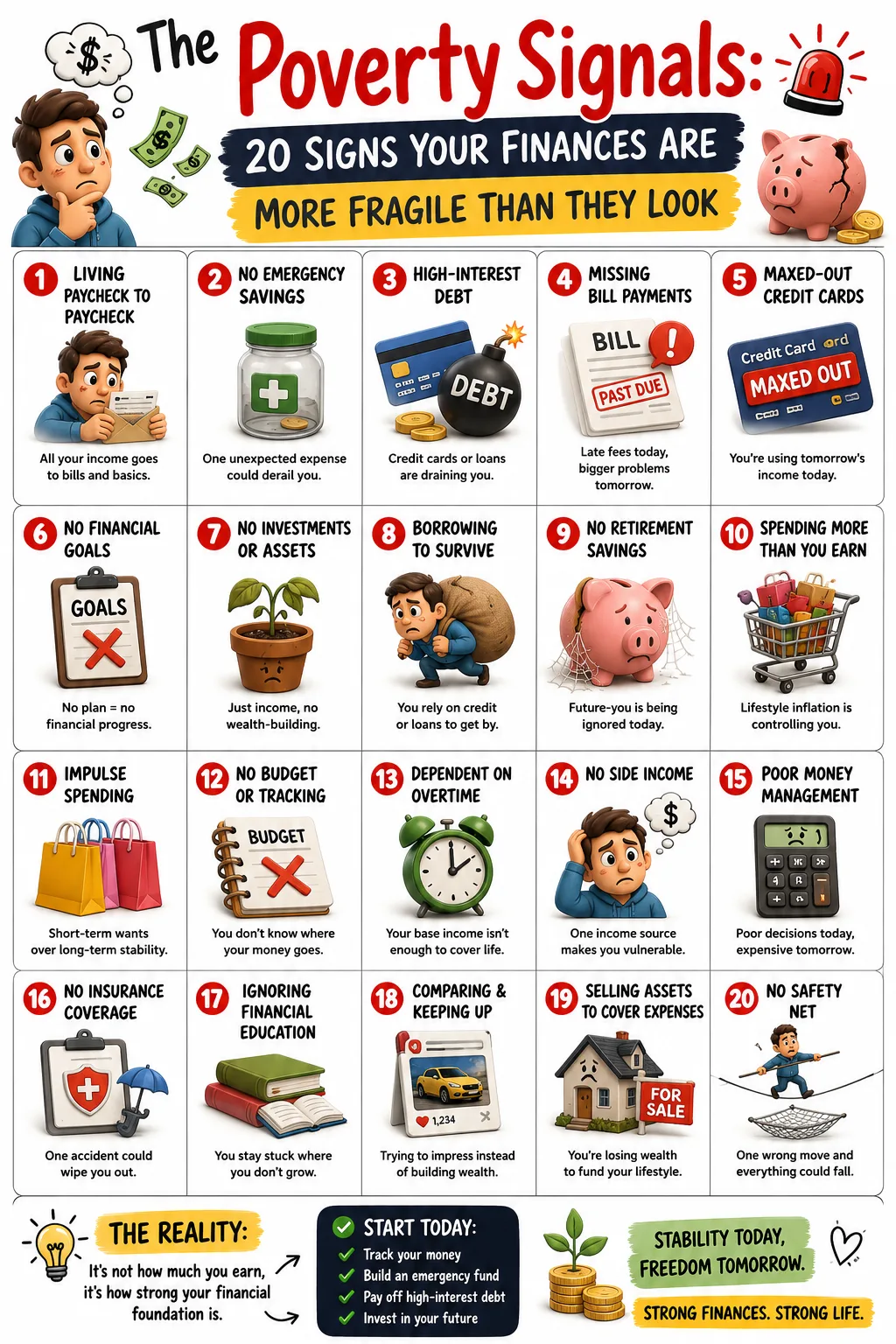
The Poverty Signals: 20 Signs Your Finances Are More Fragile Than They Look
Poverty is often misunderstood because people try to identify it by appearance. They look at clothes, cars, phones, restaurants, neighborhoods, holidays, and social media posts. These signals can be deeply misleading. A person driving an older car may own a paid-off home, hold a strong investment portfolio, and sleep well at night. Another person may appear prosperous while living one missed paycheck away from financial crisis.
Financial hardship is not a personality type. It is not a moral flaw. It is not always visible. It can affect a new graduate earning an entry-level salary, a parent stretched by rent and childcare, a business owner with unstable cash flow, a retiree with rising medical costs, or a high earner trapped by lifestyle inflation. Poverty can be temporary, persistent, structural, or hidden behind an income that looks impressive from the outside.
The clearest way to understand poverty is not to ask how someone looks. It is to ask how resilient their financial life is. Can they pay for necessities? Can they absorb a surprise expense? Can they handle a temporary loss of income? Are they building assets, or only servicing obligations? Is their income stable? Are debts manageable? Does money give them choices, or does the lack of money remove choices before they can even be considered?
That distinction matters because income and wealth are not the same. Income is money flowing in. Wealth is what remains after assets and liabilities are measured. A household can earn a high salary and still have little wealth if every dollar is consumed by housing, debt, taxes, transportation, subscriptions, school fees, medical costs, or lifestyle spending. Another household can earn modestly but build durable security through savings, low debt, insurance, and ownership of productive assets.
The Federal Reserve’s Survey of Consumer Finances tracks household balance sheets, including assets, debt, pensions, income, and demographic characteristics, which is why it is one of the most useful tools for separating income from wealth. The same distinction shows up in emergency savings data. In the Federal Reserve’s 2024 household well-being report, 63 percent of adults said they would cover a hypothetical $400 emergency expense entirely with cash or its equivalent, which means a large minority would need another option such as borrowing, selling something, or carrying a balance.
This article examines 20 signs that a person may be financially poor, asset poor, or financially vulnerable. The purpose is not shame. Shame rarely improves financial behavior. The purpose is diagnosis. Once the warning signs are visible, they can be measured. Once they can be measured, they can be improved.
What “Poor” Really Means Financially
There is more than one kind of poverty. Income poverty means a household does not earn enough to meet basic needs under the standards of its country, region, or household size. Asset poverty means a household lacks enough savings or liquid assets to survive for a period if income stops. Financial vulnerability means the household may be meeting current obligations but has little protection against disruption.
These categories overlap, but they are not identical. Someone may have low income but strong family support, paid-off housing, and no debt. Someone else may have a strong income but no savings, high-interest debt, and fragile employment. The second person may not be income-poor, but they are financially vulnerable. If their income stopped, the illusion of security would collapse quickly.
That is why financial well-being is broader than income. The Consumer Financial Protection Bureau describes financial well-being as something that can be measured through a person’s ability to manage current and ongoing obligations, feel secure about the future, and make choices that allow life satisfaction. The CFPB maintains a Financial Well-Being Scale for measuring these conditions rather than relying only on income.
A financially secure person has room to maneuver. A financially vulnerable person does not. The difference may appear small during normal months, but it becomes enormous during a crisis. A car repair, medical bill, delayed paycheck, rent increase, job loss, or family emergency exposes the real condition of the household balance sheet.
1. You Live Paycheck to Paycheck
The most common sign of financial fragility is needing nearly every dollar of income to cover ordinary monthly expenses. Paycheck-to-paycheck living does not always mean someone is irresponsible. It can be caused by low wages, high housing costs, medical bills, family obligations, inflation, unstable work, or a sudden life change. But whatever the cause, the effect is the same: there is no margin.
When every paycheck is already assigned before it arrives, money becomes a timing problem. Rent is due before wages clear. A bill arrives before a deposit posts. A child needs something before the monthly budget resets. The household is not only short of money; it is short of flexibility.
This condition is especially dangerous because it turns small disturbances into major events. A delayed payment from an employer, a higher utility bill, or a small emergency can force the household into borrowing. Borrowing then creates future payments, which makes the next month tighter. Over time, the paycheck does not merely fund life. It services the consequences of previous shortfalls.
The practical test is simple: after covering essential expenses, debt payments, and basic obligations, is there money left to save, invest, or absorb a surprise? If the answer is consistently no, the household is financially fragile even if income appears respectable.
2. You Have No Emergency Savings
An emergency fund is not a luxury account. It is a financial shock absorber. Its purpose is not to generate impressive returns but to prevent ordinary disruptions from becoming debt. A household without emergency savings lives closer to the edge because every unexpected cost requires an outside solution.
Financial experts often recommend building enough emergency savings to cover three to six months of essential expenses. That target is not magic. It is a practical range. A single person with stable employment, low fixed costs, and strong family support may need less. A household with children, variable income, medical risks, or one primary earner may need more. The principle matters more than the exact number: the household needs accessible cash that is not already committed.
The absence of emergency savings is one reason a $400 expense is such a revealing benchmark. The Federal Reserve’s data show that a large share of adults cannot cover even a modest emergency solely with cash or its equivalent. That does not mean every person in that group is permanently poor. It does mean many households have limited immediate resilience.
The first emergency fund goal should be small enough to reach. For many people, that means starting with one week of essential expenses, then one month, then three months. Financial stability often begins with the first amount that prevents a crisis from becoming a loan.
3. You Carry High-Interest Debt
Not all debt has the same meaning. A mortgage on an affordable home can help a household build equity. A student loan may support future earning power if the cost is reasonable relative to income. A business loan can fund productive expansion. High-interest consumer debt is different. It often extracts future income without creating a lasting asset.
Credit card balances, payday loans, high-cost personal loans, overdraft lines, and certain forms of buy-now-pay-later borrowing can become poverty accelerators. They make the present feel manageable by making the future more expensive. Interest charges reduce the amount available for savings, insurance, education, investment, and basic needs. The household becomes busy paying for yesterday.
The danger is not only the interest rate. It is the structure. Minimum payments can create the illusion of control while the balance remains stubbornly high. A person may feel responsible because they are paying every month, yet the debt barely falls. The lender receives cash flow; the borrower loses time.
A useful warning sign is when debt payments require sacrifice but do not produce progress. If balances remain flat or rise despite regular payments, the debt is not simply a bill. It is a claim on the household’s future.
4. You Miss Bill Payments
Missed payments are often treated as isolated mistakes, but repeated missed payments usually reveal a deeper cash-flow problem. Rent, mortgage payments, utilities, insurance premiums, school fees, taxes, and loan payments compete for limited funds. When income cannot cover all obligations on time, the household is forced to prioritize damage.
The most urgent bill is not always the most important long-term bill. A family may pay rent first because housing is immediate, delay insurance because the consequence feels distant, and carry a credit card balance because the minimum payment is smaller. These decisions may be rational under pressure, but they create hidden risk. Insurance can lapse. Credit scores can fall. Late fees can accumulate. A manageable shortage can become a broader financial decline.
Missing a payment once after a disruption does not define a person’s financial identity. Patterns matter. If late payments become routine, the household budget is not aligned with income. Either income must rise, expenses must fall, obligations must be renegotiated, or some combination is needed.
5. You Regularly Overdraw Your Bank Account
Overdrafts are expensive symptoms. They indicate that expenses are arriving before cash is available or that the household has lost track of its real balance. A single overdraft may be an administrative mistake. Frequent overdrafts suggest a fragile cash-management system.
The damage goes beyond the fee. Overdrafts create a cycle because the next deposit arrives already reduced by penalties. The account starts the next period weaker. If this continues, the household pays significant money for the privilege of being short of money. That is one of the cruelest features of financial hardship: poverty often carries its own surcharge.
The antidote is not only discipline. It is structure. A small checking-account buffer, bill calendar, low-balance alerts, automatic transfers, and separating bill money from spending money can reduce overdrafts. The deeper goal is to create enough cash margin that timing no longer controls the household.
6. You Own Few or No Assets
Income pays bills, but assets create staying power. Assets are resources that can store value, generate income, appreciate, or reduce future costs. Examples include cash savings, retirement accounts, diversified investments, home equity, business ownership, productive equipment, and education that increases earning power.
A household with no assets is exposed. It may survive while income is steady, but it has little accumulated strength. When a crisis arrives, there is nothing to draw on except future income, family support, public assistance, or debt. That is why asset poverty can exist even when monthly income seems adequate.
Asset ownership is also central to long-term wealth accumulation. Wages are often consumed by living costs, but assets can compound. A retirement account can grow while the owner sleeps. A home can build equity as the mortgage is paid down. A business can produce income beyond the owner’s direct labor. A diversified portfolio can participate in broad economic growth.
The absence of assets means the household is financially stationary. It may be working hard, paying bills, and appearing stable, yet nothing durable is accumulating. Over years, that difference becomes enormous.
7. Housing Costs Consume Too Much of Your Income
Housing is often the largest household expense. When rent or mortgage payments take an excessive share of income, almost every other financial goal becomes harder. Savings shrink. Debt repayment slows. Insurance feels unaffordable. Investments are postponed. Small emergencies become serious because the budget has already been absorbed by shelter.
Housing burden is especially difficult because it is not easy to adjust quickly. A household can cancel subscriptions or reduce restaurant spending, but it cannot always move to cheaper housing without transaction costs, deposits, school disruption, commuting changes, or safety concerns. Housing decisions lock in financial pressure.
The Bureau of Labor Statistics’ Consumer Expenditure Surveys show how spending differs by income group and how large ordinary expenses can be relative to household resources. In 2024, average annual expenditures ranged from $35,046 for consumer units in the lowest income quintile to $150,342 for those in the highest income quintile, illustrating how dramatically budgets differ across income levels.
A household is financially vulnerable when housing leaves too little room for food, transport, utilities, insurance, debt repayment, and savings. The question is not whether the home is beautiful. The question is whether the home allows the rest of the financial life to function.
8. You Experience Food Insecurity
Food insecurity is one of the clearest signs of financial hardship because it affects a basic human need. It may appear as skipped meals, smaller portions, reliance on cheap low-nutrition food, anxiety about groceries, dependence on food assistance, or choosing between food and another essential bill.
This kind of hardship is not only financial. It affects health, concentration, work performance, child development, and emotional stability. A person who is worried about food cannot easily focus on long-term investing strategy. Survival needs come first.
Food insecurity also reveals the limits of budget advice. Telling a household to “cut unnecessary spending” may be irrelevant when the real issue is that income does not reliably cover essentials. In that situation, financial improvement may require income support, better employment, community resources, debt relief, lower housing costs, or public benefits, not merely more careful shopping.
Still, practical steps can help reduce pressure. Meal planning, bulk staples, local food programs, school meal support, and avoiding high-cost convenience purchases can provide some relief. But the larger point remains: when food is uncertain, the household is experiencing serious financial vulnerability.
9. You Have No Retirement Savings
Retirement savings are not only about old age. They are evidence that a household has enough present capacity to protect its future self. When no money is being set aside for later life, one of two things is usually true: current income is insufficient, or current spending leaves no room for long-term planning.
The risk compounds over time. A person who cannot save in their twenties loses years of potential investment growth. A person who delays in their thirties and forties must contribute more later to reach the same outcome. A person who reaches their fifties or sixties with little retirement savings may face a difficult trade-off between working longer, reducing living standards, relying on family, or depending heavily on public pension systems.
The Federal Reserve reported that in 2024, 35 percent of non-retirees thought their retirement savings plan was on track. That figure improved slightly from 2022 and 2023 but remained below the 2021 level. The statistic matters because retirement readiness is not simply a future problem. It reflects present financial capacity.
The first retirement contribution does not need to be large. The critical habit is beginning. Even small automatic contributions can build identity, discipline, and momentum. Over time, raises, debt payoff, and expense reductions can increase the contribution rate.
10. You Borrow for Everyday Expenses
Borrowing for groceries, fuel, utilities, rent, or routine household supplies is a major warning sign. These are recurring expenses. If recurring expenses require borrowing, the household is not facing a one-time emergency. It has a structural deficit.
This deficit can be caused by income that is too low, expenses that are too high, debt payments that crowd out necessities, or irregular earnings that do not match the timing of bills. Whatever the cause, borrowing for everyday expenses means future income is being used to pay for current survival. The next paycheck arrives with less freedom because part of it belongs to lenders.
The danger is especially severe when borrowing carries high interest. A family that uses a credit card for groceries and cannot pay the balance in full is effectively making food more expensive. A worker who uses payday loans to cover fuel for commuting is paying a premium to get to work. These choices may be unavoidable in the moment, but they reveal a financial system under strain.
The long-term solution requires identifying whether the problem is temporary or recurring. A temporary gap may call for emergency support and a repayment plan. A recurring gap requires a redesigned budget, higher income, lower fixed costs, debt restructuring, or outside assistance.
11. Small Emergencies Create Major Hardship
Financial resilience is tested by small emergencies before large disasters. A broken phone, school expense, medical co-payment, car repair, appliance failure, or temporary income delay can reveal whether a household has margin. If small events create panic, the household is financially exposed.
This is one reason emergency savings matter so much. A $300 repair is annoying for a stable household. For a fragile household, it can trigger debt, missed bills, overdrafts, or lost income if the repair affects transportation or work. The same event has different consequences depending on the household’s financial buffer.
Small emergencies are also emotionally powerful. They create the feeling that life is always attacking. In reality, many such expenses are not unusual. Cars need repairs. Children need supplies. Homes require maintenance. Medical needs arise. The issue is not that life is unfair because expenses happen. The issue is that the household lacks a system to absorb predictable unpredictability.
A practical approach is to create sinking funds for irregular expenses. Instead of treating car repairs, annual insurance premiums, school costs, or medical co-pays as surprises, the household sets aside small amounts monthly. This turns future shocks into planned expenses.
12. You Live With Constant Financial Stress
Financial poverty is not only measured in spreadsheets. It is also measured in mental load. Constant worry about bills, avoidance of bank balances, fear of phone calls, shame around money conversations, and anxiety before payment dates are all signs of financial strain.
Stress can become self-reinforcing. A person avoids opening bills because they feel overwhelmed. The delay leads to late fees. Late fees increase the problem. The bigger problem creates more avoidance. What looks like irresponsibility from the outside may be a nervous system trying to escape constant threat.
Financial stress also reduces decision quality. Scarcity narrows attention. When the mind is focused on immediate survival, it is harder to compare loan terms, negotiate bills, apply for better jobs, study investing, or plan strategically. Poverty taxes attention as well as income.
The first step is to make the invisible visible. List every bill, debt, due date, balance, interest rate, and income source. This may be uncomfortable, but clarity reduces fear. A known problem can be managed. An avoided problem controls the household from the shadows.
13. You Lack Adequate Insurance
Insurance is often misunderstood as an expense that pays nothing back unless something goes wrong. That is precisely the point. Insurance protects the household from losses too large to absorb alone. Without adequate coverage, one event can erase years of progress.
The relevant coverage depends on the household. Health insurance, renters insurance, homeowners insurance, auto insurance, disability coverage, life insurance, liability protection, and business insurance all serve different purposes. Not every person needs every policy. But every household needs to understand which risks could financially destroy it.
A renter without renters insurance may lose everything in a fire or theft. A family dependent on one earner may be devastated by death or disability. A driver without adequate coverage may face legal and financial consequences after an accident. A business owner without liability protection may expose personal assets.
Being underinsured is a poverty risk because it converts bad luck into financial ruin. The goal is not to buy the most expensive coverage. The goal is to protect against losses that the household cannot afford to self-insure.
14. You Have Negative Net Worth
Net worth is the simplest measure of wealth: assets minus liabilities. If total debts exceed total assets, net worth is negative. This does not automatically mean someone is doomed. Young professionals with student loans may have negative net worth early in their careers. Entrepreneurs may borrow to build businesses. Households may recover after medical debt, divorce, or job loss. But negative net worth is still a major financial signal.
Negative net worth means the household owes more than it owns. If everything were sold and every account emptied, obligations would remain. This reduces flexibility and can limit access to credit, housing options, business opportunities, and retirement progress.
The key is trajectory. A person with negative net worth but rising income, controlled spending, and a debt payoff plan may be moving toward stability. A person with negative net worth and growing consumer debt is moving deeper into fragility. The number matters, but the direction matters too.
Tracking net worth monthly or quarterly can be transformative. It shifts attention from “Can I afford the payment?” to “Is my financial position improving?” That question is the foundation of wealth building.
15. You Have No Long-Term Investments
Savings protect the short term. Investments build the long term. A household with no investments may have cash stability but limited wealth creation. Over time, inflation reduces the purchasing power of idle money, while ownership of productive assets can help wealth grow.
Long-term investments may include retirement accounts, index funds, diversified portfolios, pension assets, rental property, business equity, or other productive assets. The common feature is ownership. The investor owns something that may grow, produce income, or participate in economic value creation.
Many people delay investing because they believe they need a large amount to begin. That belief can be costly. The habit of investing is often more important at the beginning than the size of the investment. Small consistent contributions create familiarity, discipline, and exposure to compounding.
Investing should not come before survival. A household with no food security, no emergency buffer, and high-interest debt may need to stabilize first. But once the basics are under control, avoiding investment entirely can keep a household permanently dependent on labor income alone.
16. You Cannot Access Affordable Credit
Credit access is not wealth, but affordable credit can be a tool. A household with strong credit may refinance debt, qualify for lower interest rates, rent housing more easily, or manage temporary liquidity needs at reasonable cost. A household with poor or limited credit may be forced toward expensive alternatives.
This creates a two-tier financial system. People with strong balance sheets often receive the cheapest money. People with fragile balance sheets often pay the highest rates. The result is that financial hardship becomes more expensive precisely for those least able to afford it.
Limited credit access can result from missed payments, high utilization, thin credit history, collections, unstable income, or past financial shocks. Rebuilding credit takes time, but it is possible. Paying bills on time, reducing revolving balances, disputing errors, using secured credit carefully, and avoiding unnecessary applications can gradually improve access.
The goal is not to borrow more. The goal is to avoid being trapped by predatory or high-cost borrowing when credit is needed.
17. You Pay Frequent Late Fees and Penalties
Late fees are small leaks that can become serious drains. A household paying repeated penalties for credit cards, rent, utilities, taxes, subscriptions, overdrafts, or loans is losing money without receiving value. These charges do not buy food, shelter, education, transportation, or ownership. They are friction costs.
Repeated fees often indicate a system problem rather than a character problem. Bills may be due at bad times of the month. Income may be irregular. The household may have too many accounts to track. Automatic payments may be pulling from an account without enough cash. The budget may be too tight to support punctuality.
Fixing late fees starts with timing and visibility. Align due dates where possible. Use a calendar. Create a bill account. Keep a small buffer. Cancel unused subscriptions. Contact creditors before missing payments. Many companies are more flexible before an account becomes delinquent than after.
Every avoided fee is a risk-free return. If a household avoids $40 in monthly penalties, that is $480 per year redirected toward savings, debt repayment, or essentials.
18. You Have No Financial Buffer
A financial buffer is broader than an emergency fund. It is the space between income and disaster. It includes cash savings, unused budget capacity, flexible expenses, supportive relationships, available credit, insurance, marketable skills, and assets that can be liquidated without destroying the household’s future.
Without a buffer, any income interruption becomes urgent. A sick day, delayed invoice, reduced work hours, lost client, or job transition immediately threatens basic expenses. This is common among gig workers, commission-based earners, small business owners, caregivers, and households with unstable employment.
The buffer is what turns a crisis into an inconvenience. It buys time to search for work, negotiate bills, recover from illness, repair a vehicle, or make a thoughtful decision instead of a desperate one.
Building a buffer often starts with reducing fixed obligations. A household with lower fixed costs needs a smaller emergency fund and can adapt faster. Flexibility is a form of wealth because it gives the household choices under pressure.
19. You Depend on One Income Source With No Backup
A single income source can be enough if it is stable, protected, and supported by savings. But dependence on one fragile source of income creates risk. If that income stops, the entire household suffers.
Income diversification does not always mean building a large business or managing multiple side hustles. It can mean maintaining employable skills, building a professional network, having a spouse or partner who can re-enter the workforce if needed, developing freelance capacity, earning investment income, renting out unused assets, or creating a small emergency income plan.
The purpose is not exhaustion. A household should not glorify working every hour of the day. The purpose is resilience. Multiple income possibilities reduce dependence on a single employer, client, industry, or economic cycle.
For wealth building, income diversification becomes even more powerful when surplus income is converted into assets. A side income that disappears into consumption may reduce stress temporarily. A side income used to repay debt, build savings, or invest can change the household’s financial trajectory.
20. You Cannot Save Consistently
The inability to save consistently is one of the most revealing signs of financial vulnerability. Saving is not only about willpower. It is the result of a budget with surplus. If there is no surplus, saving becomes a battle against arithmetic.
Some households cannot save because income is too low for the cost of basic needs. Others cannot save because fixed expenses are too high. Others earn enough but lose money through lifestyle inflation, debt payments, impulse spending, family pressure, or lack of a system. The cause matters because the solution differs.
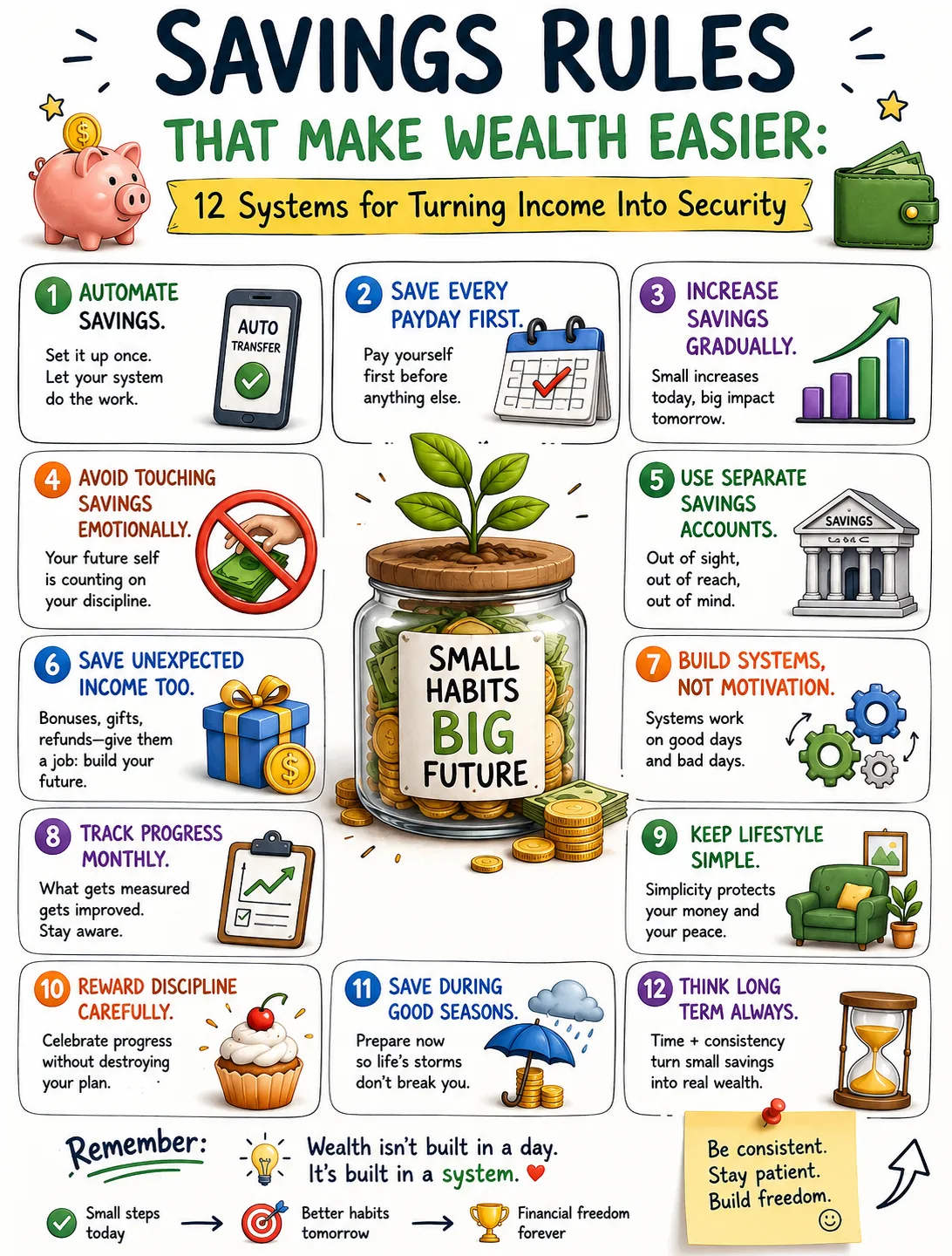
Consistent saving usually requires automation and separation. Money that remains in a checking account is easy to spend because it appears available. Money automatically moved to a savings or investment account becomes less visible and less negotiable. This is not a trick. It is an acknowledgment that systems are stronger than intentions.
A household that saves $20 every week is doing more than accumulating $1,040 per year. It is building financial identity. It is proving that money can remain unspent. That belief is the beginning of wealth.
The Difference Between Being Cash-Poor and Wealth-Poor
Not every person with tight cash flow is poor in the same way. A farmer may be cash-poor between harvests but own valuable land. A business owner may have little personal liquidity while holding equity in a growing company. A homeowner may have significant equity but limited monthly income. A retiree may have assets that are not easily converted into cash without tax consequences or lifestyle disruption.
Cash poverty means there is not enough liquid money available now. Wealth poverty means there are not enough assets overall. A person can be cash-poor but not wealth-poor, or wealth-poor despite appearing comfortable month to month.
This distinction matters for solutions. A cash-poor but asset-rich household may need liquidity planning, refinancing, expense timing, or income smoothing. A wealth-poor household needs asset building, debt reduction, and long-term accumulation. A high-income but asset-poor household needs to convert income into ownership before lifestyle claims consume it.
Many financial mistakes happen because people confuse cash flow with wealth. A high monthly income can create confidence, but if nothing accumulates, the household is only renting a lifestyle from its next paycheck.
Why Appearances Mislead
Modern consumer culture makes financial judgment difficult. Many visible signs of success are liabilities or expenses. Cars require payments, insurance, maintenance, fuel, and depreciation. Large homes require taxes, utilities, repairs, furnishing, and time. Luxury goods may hold some resale value, but most are consumption. Travel can enrich life, but it can also be debt-funded escape.
Meanwhile, many signs of wealth are invisible. A paid-off debt is invisible. An emergency fund is invisible. A retirement account is invisible. A low fixed-cost life is invisible. Good insurance is invisible until disaster. A diversified portfolio is invisible unless someone chooses to reveal it.
This is why comparing lifestyles is dangerous. You rarely know whether someone bought something with surplus income, inherited wealth, business cash flow, consumer debt, or money that should have gone to savings. The same purchase can mean different things depending on the balance sheet behind it.
Financial maturity begins when you stop asking, “What does this make me look like?” and start asking, “What does this do to my resilience?”
How to Start Rebuilding Financial Stability
The first step is diagnosis. List income, essential expenses, debts, interest rates, minimum payments, savings, assets, insurance policies, and upcoming irregular costs. This creates a financial map. Without a map, improvement is guesswork.
The second step is triage. Food, housing, utilities, transport to work, essential medical care, and basic insurance come before lifestyle spending. High-interest debt should be treated as a financial emergency because it grows against the household. Missed payments should be addressed quickly because fees and credit damage can compound.
The third step is margin creation. This may require cutting expenses, but expense cutting has limits. A household cannot budget its way out of every income problem. Sometimes the larger opportunity is earning more through a better job, additional hours, negotiation, training, freelancing, business activity, or relocating to a more affordable area.
The fourth step is automation. Automatic savings, automatic bill payments, automatic debt repayment, and automatic investing reduce the need for constant willpower. A good system makes the right action easier than the wrong one.
The fifth step is asset conversion. Surplus income should not remain permanently vulnerable to spending. It should be converted into cash reserves, debt reduction, retirement contributions, diversified investments, education, business equity, or other assets that strengthen the household.
A Practical Order of Operations
Financial recovery is harder when every goal competes at once. A practical order can reduce confusion. Start by stabilizing essentials: food, shelter, utilities, transportation, and basic health needs. Then prevent immediate damage by contacting creditors, avoiding unnecessary fees, and keeping critical insurance from lapsing.
Next, build a starter emergency fund. The first target might be $250, $500, or one week of expenses. The amount depends on the household, but the purpose is the same: create distance between life and debt.
After that, attack high-interest debt. The debt avalanche method prioritizes the highest interest rate first, which is mathematically efficient. The debt snowball method prioritizes the smallest balance first, which can build motivation. The best method is the one the household can sustain, though high-cost debt deserves urgent attention.
Once toxic debt is declining, expand emergency savings toward one month of expenses, then three months, then more if income is unstable. At the same time, take advantage of any employer retirement match if available, because an employer match is part of compensation.
From there, increase long-term investing, strengthen insurance, improve skills, and develop income resilience. Wealth is rarely built through one dramatic decision. It is built when many small decisions begin pointing in the same direction.
When Poverty Is Not a Personal Budgeting Problem
Some financial hardship cannot be solved by personal discipline alone. Low wages, unaffordable housing, medical costs, disability, caregiving responsibilities, discrimination, weak labor markets, war, inflation, economic shocks, and lack of social safety nets can all create poverty even among careful people.
Recognizing structural forces does not remove personal responsibility. It makes the analysis more accurate. A household facing high rent and low wages needs different advice from a high earner overspending on status goods. A disabled worker needs different support from a young professional with lifestyle inflation. A single parent paying childcare costs faces different constraints from a dual-income household without dependents.
Good financial education should not pretend every household starts from the same place. It should help people identify the levers they can control while being honest about the forces they cannot control alone.
The Quiet Signs of Recovery
Financial recovery often looks boring from the outside. It may look like saying no to purchases, driving the same car longer, cooking at home, applying for better jobs, taking a course, negotiating bills, using a budget, selling unused items, or making small weekly transfers to savings.
The first signs of progress may be modest. One bill is paid on time. One overdraft is avoided. One credit card balance falls. One emergency is paid with cash. One retirement contribution posts. One month ends with money left over. These moments matter because they prove the household is no longer only reacting.
Over time, the signs become stronger. Net worth turns positive. Debt payments fall. Savings cover several months. Investments begin to grow. Insurance protects major risks. Income comes from more than one source. The household starts making decisions from opportunity rather than panic.
That is the real movement from poverty toward wealth: not merely earning more, but gaining room to choose.
The Deeper Lesson Behind the 20 Signs
The 20 signs in this article are not separate problems. They are connected symptoms of financial fragility. No emergency savings leads to borrowing. Borrowing creates payments. Payments reduce cash flow. Tight cash flow causes missed bills. Missed bills create fees and credit damage. Poor credit raises borrowing costs. Higher costs make saving harder. The cycle feeds itself.
The reverse is also true. A small emergency fund reduces borrowing. Less borrowing improves cash flow. Better cash flow allows on-time payments. On-time payments protect credit. Better credit lowers costs. Lower costs increase savings capacity. Savings become investments. Investments become assets. Assets create resilience.
Poverty often feels like a trap because every problem reinforces another. Wealth building works the same way in the opposite direction. Every improvement strengthens the next.
The goal is not to judge yourself harshly if several signs apply to your life. The goal is to choose the first link in the chain you can change. For one person, that may be tracking spending. For another, calling creditors. For another, building a starter emergency fund. For another, seeking higher income. For another, finally calculating net worth and facing the numbers.
Financial stability is built by turning vague anxiety into specific actions. The signs are useful because they show where to begin.
Final Thought: Poverty Is a Condition, Not an Identity
To be poor, asset-poor, cash-poor, or financially vulnerable is not to be less intelligent, less worthy, or less capable. It means the current financial structure does not provide enough security, choice, or resilience. That structure may have been shaped by personal decisions, family circumstances, economic conditions, health, geography, policy, luck, or all of them together.
The most powerful response is neither denial nor shame. It is honest measurement. Do you have savings? Are debts manageable? Can you cover emergencies? Are you building assets? Is housing affordable? Is income stable? Are you protected against major risks? Is your net worth improving?
These questions reveal more than appearances ever will. They show whether money is merely passing through your life or beginning to work for you.
Poverty is not always visible, but neither is progress. A person quietly building savings, reducing debt, protecting their family, and buying assets may not look wealthy yet. But beneath the surface, the direction has changed. And in personal finance, direction is often the beginning of destiny.
 Article
 Article
 Article
 Article
 Article
 Article
 Article
 Article