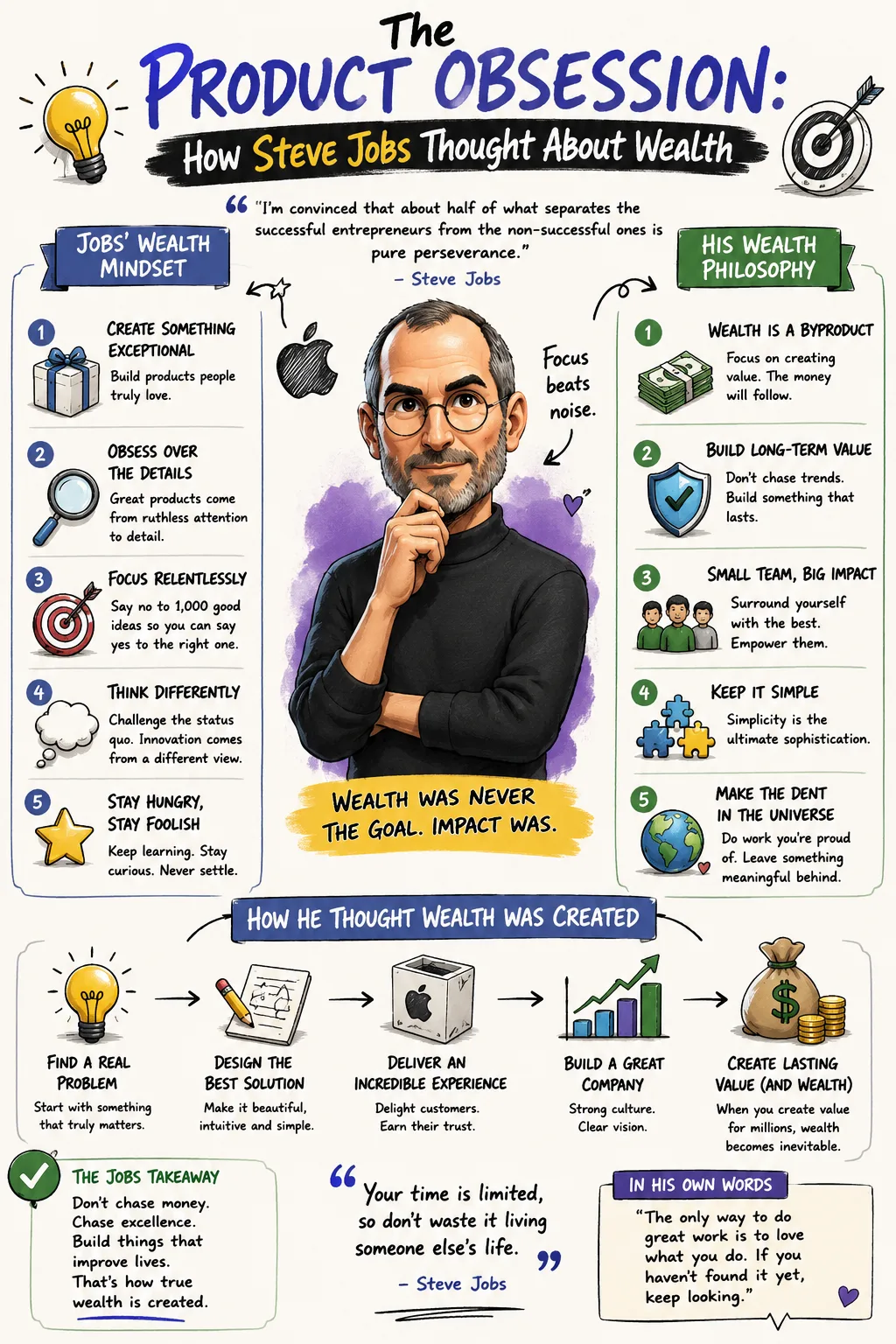
The Product Obsession: How Steve Jobs Thought About Wealth
Steve Jobs rarely spoke about getting rich as if it were the highest ambition. That alone makes his wealth philosophy unusual. In a culture that often treats money as the scoreboard, Jobs spoke more often about products, taste, craft, focus, creativity, mortality, and building things that mattered. Wealth, in his worldview, was not the starting point. It was the consequence of creating extraordinary value.
This does not mean Jobs was indifferent to business. He was one of the most commercially consequential founders in modern history. Apple, Pixar, NeXT, the Macintosh, the iPod, the iPhone, the iPad, iTunes, the App Store, and the broader Apple ecosystem all sit inside his legacy. He understood markets, margins, brand, distribution, product launches, and competitive advantage. But his deepest lesson for wealth builders is not “chase money.” It is “build something so good that the market has to respond.”
Jobs co-founded Apple Computer Company in 1976 with Steve Wozniak and Ronald Wayne, later founded NeXT after leaving Apple, and bought what became Pixar before Disney acquired Pixar in a $7.4 billion all-stock transaction in 2006. Disney’s own announcement said Steve Jobs, then Pixar’s Chairman and CEO, would join Disney’s board after the acquisition. Jobs’ career shows several paths to wealth at once: founding, product innovation, equity ownership, brand building, strategic selling, and long-term company creation.
Yet the most important thing about Jobs’ wealth philosophy is that money was not the creative engine. In his 2005 Stanford commencement address, Jobs urged graduates to “stay hungry, stay foolish,” and he framed life through curiosity, loss, love, death, and the courage to follow work that felt meaningful. Stanford’s published version of the speech records his emphasis on connecting the dots backward, finding work one loves, and remembering mortality as a tool for clarity.
For Wealth Insights readers, Jobs offers a powerful counterweight to purely financial thinking. He teaches that wealth can be built not only by allocating capital, but by creating products, companies, and experiences that reshape customer expectations. He teaches that focus is an economic weapon. He teaches that brand is accumulated trust. He teaches that excellence can create pricing power. He teaches that a small number of extraordinary decisions can matter more than years of scattered effort.
To get rich according to Steve Jobs is not to obsess over getting rich. It is to become obsessed with value, craft, and impact until wealth becomes the byproduct of work that is difficult to ignore.
Wealth Follows Value Creation
Jobs’ philosophy begins with value creation. He did not build Apple by asking how to extract the maximum amount of money from customers in the shortest possible time. He built Apple around a belief that technology should be personal, elegant, intuitive, and emotionally meaningful. That belief changed the way millions of people related to computers, music, phones, tablets, and digital services.
This is a different way to think about wealth. Many people begin with the income they want and then search for a tactic that might produce it. Jobs’ path suggests the reverse. Begin with the problem, the user, the experience, the product, and the standard. If the work creates exceptional value, the economics may follow.
This does not mean value creation always produces wealth. Many excellent products fail. Timing can be wrong. Distribution can be weak. Costs can be too high. Competitors can respond. Customers can misunderstand the product. But durable wealth rarely emerges without value creation somewhere in the chain. Someone must build, improve, simplify, entertain, protect, organize, teach, transport, connect, or empower.
Jobs’ genius was not merely technical. Steve Wozniak was the deeper engineer in Apple’s earliest days. Jobs’ genius was seeing how technology, design, usability, narrative, and business could become one integrated experience. He cared about the box, the interface, the store, the advertisement, the launch, the typography, the feel of the device, and the emotional promise behind the product.
That is why his wealth philosophy cannot be reduced to “start a technology company.” The deeper principle is to create something customers value at a level that changes their expectations. A restaurant can do this. A financial education company can do this. A software startup can do this. A consumer brand can do this. A healthcare company can do this. A local service business can do this. The form changes, but the principle remains: wealth follows the creation of value that customers recognize and trust.
Build Products People Love, Not Merely Products People Use
Jobs believed products should inspire affection, not merely tolerance. This distinction matters because many businesses survive by being necessary, but the greatest consumer companies often win by becoming loved. Customers return not only because the product functions, but because it feels better, simpler, more beautiful, more reliable, or more aligned with their identity.
The Macintosh was not just a computer. It was a statement about human-friendly computing. The iPod was not just a music player. It made carrying a music library feel simple and personal. The iPhone was not just a phone. It combined communication, internet access, media, applications, design, and touch interaction into a new daily object. The iPad did not invent portable computing, but it made a different kind of computing feel natural for millions of people.
In business terms, love can become an economic moat. Products people love can command premium pricing, generate repeat purchases, create word-of-mouth marketing, reduce customer acquisition burden, and strengthen brand loyalty. A company with beloved products does not compete only on price. It competes on trust, identity, experience, and ecosystem.
This is one reason Apple became so commercially powerful. Its best products did not merely solve functional problems. They created emotional attachment. Customers lined up for launches. They argued about design decisions. They integrated products into daily routines. They bought multiple devices because the experience improved when products worked together.
For entrepreneurs, the lesson is not that every product must be beautiful in the same way Apple products are beautiful. The lesson is that customers feel quality. They feel whether a company respects their time. They feel whether instructions are clear, support is responsive, pricing is honest, design is thoughtful, and the product does what it promises. Love is built through thousands of details.
A small business can apply this immediately. The invoice can be clearer. The onboarding can be simpler. The package can arrive faster. The interface can require fewer clicks. The service can include one thoughtful follow-up. The guarantee can remove anxiety. The product can solve the problem without making the customer feel foolish. Jobs’ standard was extreme, but the principle is universal: every point of contact either builds trust or drains it.
Focus Is an Economic Advantage
One of Jobs’ most famous business beliefs was that focus requires saying no. Not only to bad ideas, but to good ideas. This is a hard discipline because ambitious people usually want to do more. More products, more features, more markets, more partnerships, more campaigns, more meetings, more experiments. Jobs understood that excessive breadth can become weakness.
When he returned to Apple in 1997 after Apple acquired NeXT, the company was struggling. Jobs simplified the product lineup and forced attention onto fewer priorities. That focus became part of Apple’s revival. The broader historical record is clear that Jobs returned to Apple after the NeXT acquisition and played a central role in reviving the company through products such as the iMac, iPod, iPhone, and iPad.
Focus matters because resources are finite. Time, capital, engineering talent, managerial attention, customer trust, and brand clarity can all be diluted. A company that pursues too many things may become average at all of them. A person who pursues too many wealth strategies may never build enough depth in any one of them to produce meaningful results.
This applies far beyond Apple. A freelancer becomes more valuable by becoming known for a specific outcome. A founder increases odds by serving a narrow customer segment exceptionally well before expanding. An investor improves discipline by defining a strategy rather than reacting to every market narrative. A household builds wealth faster by concentrating on the few financial decisions that matter most: income, savings rate, debt, housing, investing behavior, and career development.
Focus is not the enemy of creativity. It is what gives creativity enough force to matter. Scattered creativity produces fragments. Focused creativity produces products.
Jobs’ version of focus was severe. That severity is not always easy or healthy to replicate. But the underlying principle is powerful: the wealth builder must decide what not to do. Every yes has an opportunity cost. Every extra product complicates operations. Every extra goal divides attention. Every extra commitment makes excellence harder.
Excellence Compounds Through Details
Jobs believed that quality should extend beyond what most customers could consciously identify. This was not merely perfectionism. It was a belief that excellence compounds. A beautiful interface, reliable hardware, elegant packaging, intuitive setup, strong retail experience, and memorable advertising together create a level of trust that no single feature can achieve alone.
Many businesses treat details as expenses. Jobs treated them as part of the product. The curve of a device, the smoothness of an animation, the typography on a screen, the silence of packaging, the consistency of a store, the clarity of a keynote—these were not isolated aesthetic choices. They were brand deposits.
This kind of excellence can look inefficient in the short term. It often requires more iteration, higher standards, stronger talent, and slower decision-making. It can frustrate teams. It can delay launches. It can increase costs. But when excellence becomes visible to customers, it can create pricing power and loyalty that cheaper competitors struggle to match.
The financial lesson is that quality can be an asset. Not all quality pays. Some refinements are indulgent. Some perfectionism is procrastination. But quality that customers feel can produce durable economics. It reduces returns. It creates referrals. It strengthens reputation. It allows premium positioning. It helps a company survive copycats because the copy may imitate the feature without reproducing the experience.
For individuals, excellence works the same way. The professional who consistently delivers clear thinking, careful work, reliable follow-through, and good judgment becomes trusted. Trust creates opportunities. Opportunities create income. Income can become capital. Capital can become ownership. Jobs’ product philosophy becomes a personal finance philosophy when applied to reputation: be so good at the important details that people want to work with you again.
Innovation Comes From the Intersection of Disciplines
Jobs often described Apple as standing at the intersection of technology and the liberal arts. That idea is central to his wealth philosophy. Breakthrough products rarely emerge from technical capability alone. They come from understanding human behavior, design, emotion, culture, storytelling, and usability.
This is why Jobs’ curiosity mattered. His interest in calligraphy, design, music, Zen aesthetics, typography, and the humanities influenced how he thought about technology. In the Stanford commencement address, he discussed dropping in on a calligraphy class and later seeing its influence in the Macintosh’s typography. That story is often repeated because it captures a broader truth: experiences that seem financially useless at the time can later become creative advantages.
Modern wealth creation increasingly rewards interdisciplinary thinking. Artificial intelligence needs not only engineers, but designers who make it usable, ethicists who understand consequences, domain experts who know real workflows, and communicators who explain value. Healthcare technology needs software, regulation, patient psychology, insurance knowledge, and clinical understanding. Financial technology needs security, trust, user behavior, compliance, and product design.
Jobs’ philosophy suggests that the richest opportunities often appear where fields meet. The person who understands two worlds can translate between them. The engineer who understands design can build better products. The designer who understands business can create commercially viable experiences. The financial educator who understands psychology can teach more effectively. The founder who understands customer emotion as well as product function can create a stronger brand.
Specialization matters, but isolation can limit imagination. Jobs’ wealth lesson is not to become shallow across many fields. It is to develop enough curiosity across disciplines to see combinations others miss.
Brand Is Trust at Scale
Jobs understood brand at a profound level. Apple’s brand was not simply a logo. It was a promise: technology could be elegant, creative, human, and empowering. That promise allowed Apple to stand apart in industries often dominated by technical specifications.
A strong brand creates economic advantages. It lowers the cost of introducing new products because customers are already listening. It supports premium pricing because customers believe the company will deliver. It attracts talent because people want to work on meaningful products. It creates resilience because customers forgive occasional mistakes when trust has been earned over time.
Jobs’ product launches were part of this brand machinery. They were not ordinary announcements. They were carefully staged narratives. He explained problems, revealed solutions, demonstrated simplicity, and made technology feel inevitable. The launch itself became part of the product’s meaning.
For wealth builders, brand is not only for giant companies. A personal reputation is a brand. A small business has a brand. A newsletter has a brand. A local accounting firm has a brand. A real estate investor has a brand with brokers, lenders, tenants, and partners. Brand is the set of expectations people carry before they interact with you.
Jobs’ standard asks: what do people expect from your work? Do they expect clarity, quality, speed, honesty, originality, care, and good judgment? Or do they expect inconsistency? Over time, these expectations become financial. Trusted people are referred. Trusted companies are chosen. Trusted products are purchased again. Trusted brands can survive competitive pressure that destroys commodity providers.
Brand cannot be faked for long. Advertising may create awareness, but experience creates belief. Jobs’ genius was aligning the promise with the product often enough that the brand became a powerful economic asset.
Own the System, Not Just the Feature
One of Apple’s defining strategic choices under Jobs was integration. Hardware, software, services, stores, developer tools, content, and customer experience were designed to reinforce one another. This is ecosystem thinking.
An ecosystem creates value by making products better together. A customer who owns an iPhone may find more value in a Mac, iPad, Apple Watch, AirPods, iCloud, and Apple services because the pieces connect. The more useful the system becomes, the higher the switching cost. Customers may stay not because they are trapped, but because leaving would mean losing convenience, familiarity, and integration.
This approach is different from building isolated products. A single product can succeed, but an ecosystem can create recurring relationships. It can deepen loyalty, increase lifetime value, and make future products easier to adopt.
For entrepreneurs, the lesson is not that every company should copy Apple’s closed integration model. Many businesses thrive through openness, partnerships, or modular systems. The deeper lesson is to think beyond the first transaction. What happens after the customer buys? What complementary products or services increase value? How can the experience become easier over time? How can trust turn into a durable relationship?
A financial advisory firm can build an ecosystem of planning, education, tax coordination, estate support, and behavioral coaching. A fitness company can combine coaching, nutrition, community, tracking, and events. A software company can build integrations, templates, training, and analytics. A creator can build books, courses, membership, tools, and advisory services around one trusted point of view.
Jobs’ wealth philosophy favors coherence. Wealth is more likely when products, brand, distribution, and customer relationship reinforce one another rather than operate as disconnected pieces.
Hire Exceptional People and Protect the Standard
Jobs believed that small teams of exceptional people could outperform much larger teams of average people. This belief can sound elitist, but in creative and technical work, talent density matters enormously. One extraordinary designer, engineer, operator, or product thinker can alter the trajectory of a company.
Hiring is a wealth decision because people determine execution quality. A brilliant strategy executed by the wrong team fails. A strong team can improve an imperfect strategy. Jobs’ high standards were part of Apple’s culture, and though his leadership style remains debated, his insistence on talent and product seriousness helped shape some of the most influential products in consumer technology.
The individual version of this lesson is to choose collaborators carefully. Partners, employees, investors, mentors, advisors, and early customers can all raise or lower the standard. A founder who hires quickly to fill seats may create long-term drag. A professional who surrounds themselves with low-ambition peers may normalize mediocrity. A household that chooses poor financial advisors may lose years of progress.
Exceptional people are not merely credentialed people. They are people with judgment, ownership, curiosity, integrity, and the ability to raise the quality of the work. Jobs looked for people who cared deeply. That kind of care is difficult to manage into someone. It is better to select for it.
There is also a caution. High standards must not become cruelty. Jobs’ management style has been criticized for intensity and harshness. Wealth builders should separate the useful principle from the damaging excess. Demand excellence, but do not confuse fear with leadership. The best teams sustain high standards because they believe in the mission and trust the people around them.
Think Long Term, Even When Markets Reward the Short Term
Jobs built for long-term advantage. Apple invested in design, operating systems, retail stores, supply chains, developer ecosystems, brand, and product categories that required patience. Some of these decisions were expensive and risky before they became obvious.
Long-term thinking is central to wealth because truly valuable assets often take time to mature. A brand is not built in a quarter. A product culture is not built in a launch cycle. A loyal customer base is not built through one campaign. A strong company is not built by optimizing every decision for immediate profit.
Public markets can pressure companies to focus on quarterly results. Entrepreneurs can feel pressure to show quick growth. Employees can chase short-term compensation over skill development. Investors can abandon strategies that temporarily lag. Jobs’ philosophy pushes against this impatience.
Long-term thinking does not mean ignoring current economics. Apple was and is a business, not a charity. But Jobs understood that short-term extraction can weaken long-term trust. A company that cuts quality to raise margins may damage its brand. A founder who over-monetizes early users may reduce loyalty. An investor who trades constantly may interrupt compounding. A professional who chooses every job solely by current salary may miss the role that builds rare skills.
The long-term question is: what decision strengthens the asset? Sometimes the asset is a company. Sometimes it is a product. Sometimes it is a brand. Sometimes it is a reputation. Sometimes it is a skill base. Jobs’ wealth philosophy rewards decisions that make the asset stronger, even when the payoff is delayed.
Do Not Chase Money Alone
Jobs’ life contains an important paradox. He became extremely wealthy, but his public philosophy often warned against living as if money were the main goal. In the Stanford address, he framed life through love of work, courage, and mortality rather than accumulation.
This does not mean money is irrelevant. Money funds teams, factories, research, distribution, freedom, and resilience. It allows founders to keep building. It gives investors and employees rewards for risk. It protects households from fragility. But when money becomes the only aim, product quality often suffers. Customers become targets rather than people. Employees become inputs rather than collaborators. Corners get cut. Brands become hollow.
Jobs’ philosophy suggests that money is a result to be respected, not a purpose to worship. The purpose is to build something meaningful and excellent. The financial reward measures market response, but it does not fully define the work.
This lesson matters for personal finance because people often pursue wealth without asking what kind of life or work they are building. A high income earned through work that empties the soul may not feel like success. A business that makes money by disappointing customers may not be durable. A career that creates status but destroys health may be a poor trade.
Jobs’ mortality-centered thinking adds urgency. Time is limited. The question is not only “How much can I make?” It is “What is worth my limited attention?” Wealth should expand the ability to do meaningful work, not permanently postpone it.
The Pixar Lesson: Ownership and Patience Can Transform a Career
Jobs’ Pixar story is one of the most important wealth lessons in his life. After leaving Apple, he bought the computer graphics division that became Pixar. Pixar struggled for years before becoming a historic animation company. Its breakthrough with Toy Story changed animation, and its eventual sale to Disney turned Jobs into Disney’s largest individual shareholder.
Disney announced in January 2006 that it would acquire Pixar in an all-stock transaction, with Jobs joining Disney’s board. This deal shows that Jobs’ wealth did not depend only on Apple. It also came from owning a valuable creative technology company and holding through years of uncertainty.
The Pixar lesson is ownership plus patience. Jobs owned a significant stake in an asset that was difficult to value early. It required capital, belief, talent, technology, storytelling, and time. Many people want the Disney outcome without the long uncertain middle. That is not how wealth usually works.
For modern founders and investors, Pixar teaches several lessons. First, valuable assets may look strange before they look obvious. Second, creative technology can produce enormous value when it creates a new category. Third, ownership matters. Fourth, patience matters. Fifth, strategic buyers may pay for assets that strengthen their own future.
This does not mean every struggling company becomes Pixar. Most do not. Patience without evidence can become denial. But Jobs’ Pixar experience shows why wealth builders should learn to distinguish between temporary difficulty and fundamental weakness. A hard path is not always a bad path. Sometimes the market takes time to understand what is being built.
The NeXT Lesson: Failure Can Become Infrastructure
After Jobs left Apple, he founded NeXT. As a standalone computer company, NeXT never achieved mass-market success. Yet it became crucial to Apple’s future. Apple acquired NeXT in 1997, bringing Jobs back and providing technology that influenced Apple’s later operating systems. The broader biographical record identifies NeXT as the company Jobs founded after leaving Apple and the route through which he returned to Apple.
This is one of the most subtle wealth lessons in Jobs’ life: not every project pays off in the way originally intended. Some projects build skills, technology, relationships, or positioning that become valuable later. NeXT was not a simple failure. It became infrastructure for a comeback.
Personal finance and entrepreneurship often punish people for misunderstanding failure. A failed business can still produce knowledge, relationships, intellectual property, reputation, and strategic insight. A career detour can build unusual perspective. A product that does not scale can reveal a better market. A rejected idea can become part of a future breakthrough.
The key is to extract value from the experience. Failure becomes expensive when it teaches nothing. It becomes useful when it becomes capability. Jobs’ years outside Apple gave him Pixar, NeXT, and a different kind of leadership maturity. The comeback story was built from the exile.
What Entrepreneurs Can Apply From Jobs Today
Entrepreneurs today can learn from Jobs without imitating his personality or trying to recreate Apple. The first practical lesson is to begin with the user experience. What does the customer feel before, during, and after using the product? Where is the friction? What is confusing? What is ugly? What takes too long? What creates anxiety? What would make the experience feel obvious?
The second lesson is to simplify. Complexity often benefits the company internally while burdening the customer externally. Too many features, choices, pricing tiers, steps, and messages can weaken adoption. Jobs’ product instincts often pushed toward clarity. The entrepreneur should ask: what can be removed without reducing value?
The third lesson is to focus resources. A young company cannot do everything. It should not try. Choose the customer, problem, and product wedge carefully. Build enough depth to matter.
The fourth lesson is to build brand from day one. Brand is not only advertising. It is the quality of every interaction. A startup with honest communication, thoughtful design, strong support, and a clear point of view begins building brand before it can afford large campaigns.
The fifth lesson is to hire for care. Early employees shape culture. If they tolerate mediocrity, the product will show it. If they care deeply, customers will feel it.
The sixth lesson is to think in systems. A product is not just the object sold. It includes onboarding, support, updates, community, complementary tools, and the long-term customer relationship. The best companies make the whole system better over time.
The Risks of Misreading Jobs
Jobs’ philosophy can be dangerous when misunderstood. The first risk is confusing perfectionism with excellence. Excellence improves the product. Perfectionism can prevent shipping, learning, and cash flow. Jobs delayed, refined, and rejected, but Apple still shipped. A founder who never releases anything cannot build a business.
The second risk is copying Jobs’ intensity without his taste, market understanding, or strategic judgment. Many leaders imitate the harshness and ignore the craft. That is a mistake. Jobs’ demanding style worked partly because he had unusual product instincts and attracted extraordinary talent. Even then, his style had costs.
The third risk is overinvesting in innovation without business discipline. Beautiful products can fail if pricing, distribution, timing, cost structure, or market demand is wrong. Jobs was a product visionary, but Apple’s success also depended on operations, supply chains, retail, finance, marketing, and execution.
The fourth risk is believing that premium positioning works for every company. Apple’s premium pricing was supported by product quality, ecosystem value, brand trust, and distribution. A weak company cannot simply charge more because it wants to look premium.
The fifth risk is founder mythology. Jobs was exceptional. Most people cannot and should not try to become Steve Jobs. The useful goal is to learn principles: focus, product love, detail, brand, integration, long-term thinking, and meaningful work.
Jobs Compared With Cuban, Dalio, Buffett, and Ferriss
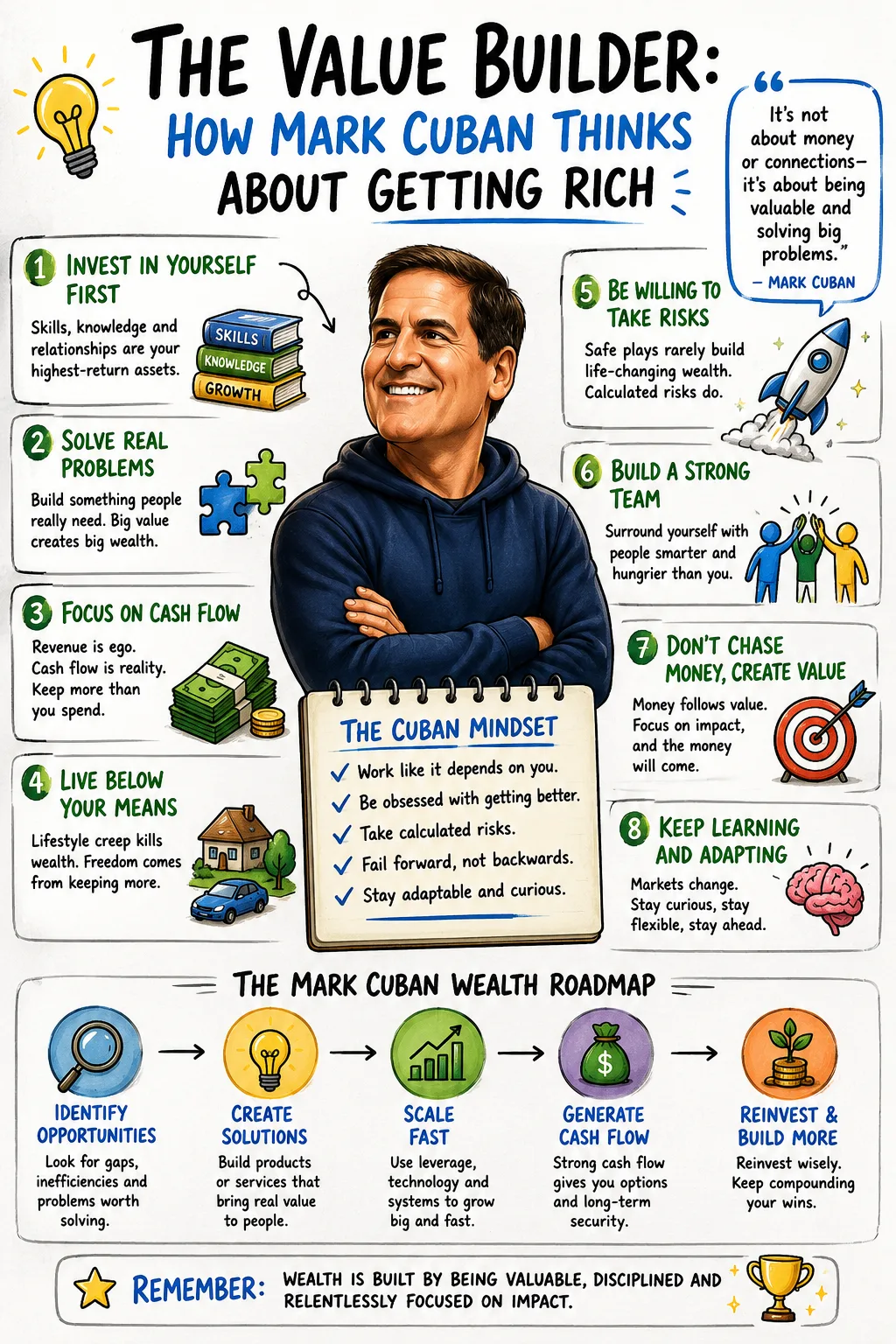
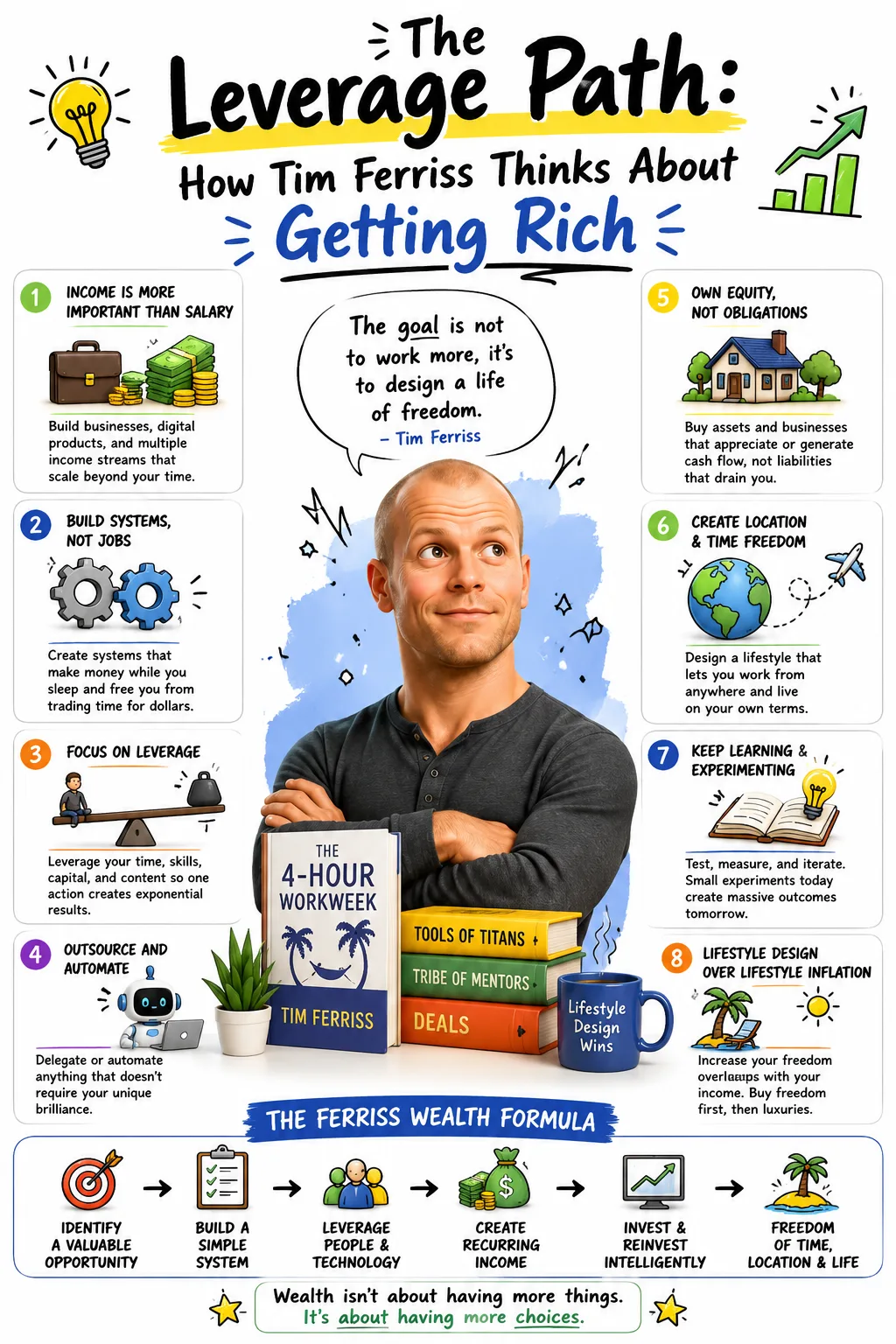
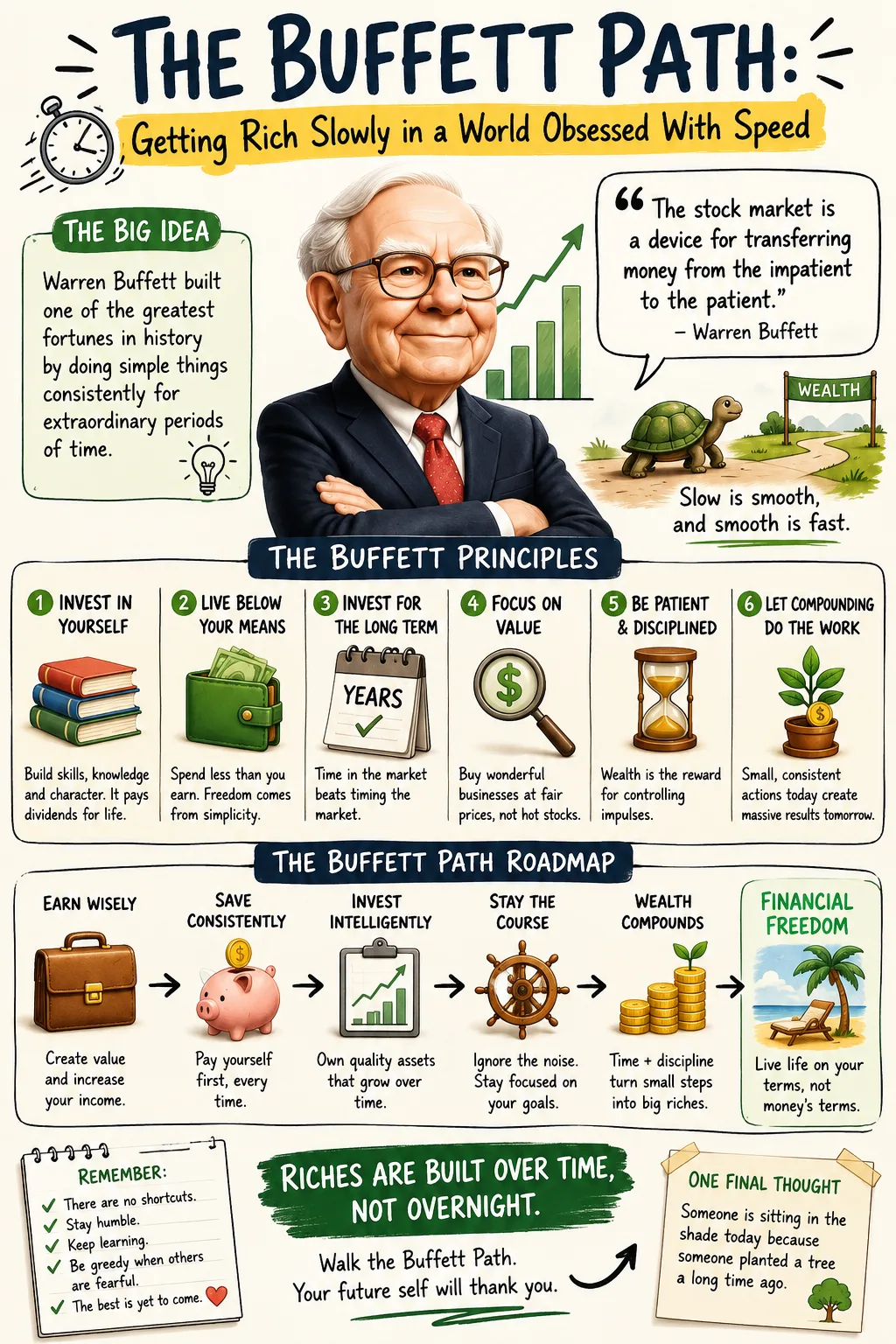
Steve Jobs’ wealth philosophy differs sharply from other well-known wealth thinkers. Mark Cuban emphasizes skill-building, sales, entrepreneurship, cash flow, and financial discipline. Ray Dalio emphasizes economic cycles, diversification, principles, and risk management. Warren Buffett emphasizes rational capital allocation, business quality, patience, and compounding. Tim Ferriss emphasizes leverage, systems, lifestyle design, and selective effort.
Jobs’ center is product excellence. He is closest to the founder-artist. He asks whether the thing being built deserves to exist. Cuban asks whether it solves a real problem and can generate cash. Dalio asks how it fits into risk and economic cycles. Buffett asks whether the business has durable economics and is worth the price. Ferriss asks whether the system creates freedom and leverage.
A strong wealth builder can learn from all of them. Use Jobs to raise the standard of what you create. Use Cuban to sell it and make the economics real. Use Buffett to think like an owner. Use Dalio to manage risk. Use Ferriss to design systems that free time and multiply output.
Jobs’ unique contribution is the reminder that wealth without taste can become ordinary. The world does not need only more assets. It needs better products, better experiences, better tools, and better companies. Create those, and wealth has something real to attach to.
The Jobs Wealth Framework
A practical Jobs-inspired wealth framework begins with the question of craft. What are you building or becoming that is meaningfully better than the alternative? This could be a company, product, career, service, brand, or body of work. The standard is not perfection. The standard is care visible enough that customers, employers, or partners notice.
Next, define the user. Who is the product or service for? What do they struggle with? What do they value? What frustrates them? What would delight them? Jobs’ best work was not technology for technology’s sake. It was technology translated into human experience.
Then eliminate. Remove unnecessary features, commitments, expenses, distractions, and projects. Focus on the few decisions that can make the work exceptional. Simplicity is not emptiness. It is disciplined clarity.
After that, build the brand through every detail. The email, packaging, website, proposal, meeting, interface, return policy, presentation, and follow-up all communicate. Wealth builders should stop treating brand as decoration. Brand is accumulated evidence.
Then seek ownership. Jobs’ wealth came from equity in companies, not salary alone. If you create value, find ways to own some of the value created. That might mean founding a company, earning equity, owning shares in productive businesses, creating intellectual property, or building a brand that becomes an asset.
Finally, think long term. Do not sacrifice trust for quick money. Do not damage quality for temporary margin. Do not chase every trend. Build assets that become stronger with time: reputation, product quality, customer loyalty, intellectual property, and ownership.
The Final Measure of Getting Rich According to Steve Jobs
To get rich according to Steve Jobs is not to make wealth the obsession. It is to make excellence the obsession. Wealth follows when excellence meets market demand, ownership, timing, and execution.
Jobs’ life shows that extraordinary financial outcomes can come from building products people love, focusing relentlessly, integrating design with technology, protecting brand trust, hiring exceptional people, and thinking beyond the next quarter. His story also shows that setbacks can become foundations. Apple fired him. NeXT struggled. Pixar took years. Yet those chapters became part of the larger architecture of his success.
The most practical lesson is that money is downstream from value. If you want to build wealth in the Jobs tradition, do not begin by asking only what will make money fastest. Ask what deserves to be made better. Ask where customers are tolerating poor experiences. Ask what complexity can be simplified. Ask what product, service, or company could earn trust through care. Ask what you can focus on long enough to make excellent.
Jobs’ philosophy is demanding because it leaves little room for mediocrity. It rejects the idea that business is only financial engineering. It insists that taste matters, details matter, users matter, and meaning matters. That may sound idealistic, but Apple’s history shows that these qualities can become enormous economic power when combined with execution and ownership.
For the individual reader, the path is clear. Build skill. Build taste. Build products or services that solve real problems beautifully. Say no more often. Own the upside where possible. Think in decades. Let money be the consequence of work that customers would miss if it disappeared.
That is the Jobs version of getting rich: create something exceptional enough that wealth becomes evidence of value, not a substitute for it.
 Article
 Article
 Article
 Article
 Article
 Article
 Article
 Article