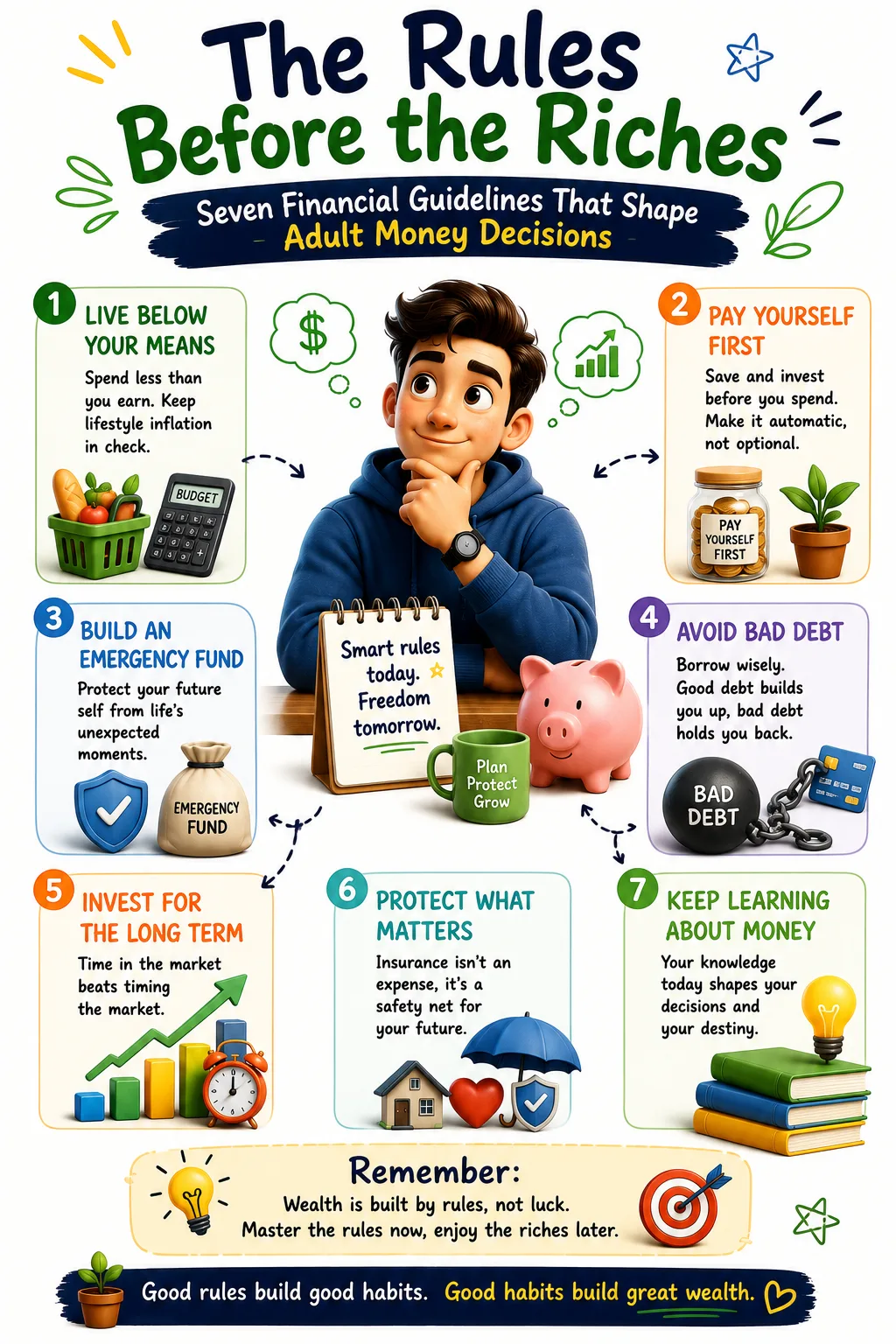
The Rules Before the Riches: Seven Financial Guidelines That Shape Adult Money Decisions
By 30, money is no longer an abstract subject. It has usually become rent, groceries, transport, debt, taxes, insurance, family support, career choices, investment decisions, and the quiet pressure of wondering whether you are behind. The twenties often begin with discovery and end with responsibility. Somewhere in that decade, the financial consequences of daily decisions become harder to ignore.
This is why financial rules of thumb matter. They are not perfect. They are not laws. They cannot know your city, your family obligations, your income, your health, your debt, your country, your career path, or your ambitions. But they give beginners something valuable: a starting point. They turn vague financial anxiety into measurable questions.
Can your lifestyle fit within your income? Do you have enough cash to survive a job loss or medical emergency? Is your rent leaving room for savings and investment? Is your car affordable or quietly consuming your future? Are you investing enough for long-term growth? Do you understand how compounding works? Could your retirement savings support your future spending?
These questions are not only mathematical. They are life-design questions. Money decisions determine how much pressure you live under, how much flexibility you have, how soon you can recover from setbacks, and how many choices remain available later. A person who earns well but ignores basic rules can reach 30 with debt, no savings, rising expenses, and a lifestyle that depends on constant income growth. Another person with a moderate income can reach 30 with emergency savings, manageable housing costs, early investments, low debt, and confidence.
The difference is rarely one dramatic decision. It is usually a pattern of small choices guided by principles.
The seven financial rules worth knowing by 30 are the 50/30/20 rule, the 4% rule, the 3–6 month emergency fund rule, the one-third rent rule, the 2× investing rule, the 20/4/10 car rule, and the Rule of 72. Some are widely used in financial planning. Others are more behavioral than technical. All are best understood as guidelines, not commandments.
The value of these rules is not that they give you a perfect financial life. The value is that they help you notice danger early. A rule of thumb is like a warning light on a dashboard. It does not repair the engine, but it tells you when to look more closely.
Why Financial Rules of Thumb Exist
Personal finance can become complicated quickly. Taxes, retirement accounts, interest rates, insurance policies, mortgage structures, investment products, inflation, market returns, loan terms, and estate planning can overwhelm people who are simply trying to make better decisions with their next paycheck.
Rules of thumb simplify the first layer. They help people act before they understand every detail. This is important because waiting for perfect knowledge can become a form of procrastination. A person does not need to master portfolio theory before saving money. They do not need to understand every tax rule before avoiding high-interest debt. They do not need to calculate retirement spending to the last decimal before beginning to invest.
Simple rules create movement. Spend less than you earn. Keep housing manageable. Build emergency savings. Avoid expensive car debt. Invest consistently. Understand compounding. These principles are not the whole of financial planning, but they prevent many common mistakes.
However, rules of thumb become dangerous when treated as universal truth. The same rent rule cannot fit a low-cost town and a high-cost city equally. The same emergency fund target may not fit a salaried employee and a freelancer. The same retirement withdrawal rule may not fit every country, market, tax system, inflation environment, or retirement length. The same budgeting percentage may not work for someone supporting relatives, paying medical bills, or rebuilding after debt.
A wise person uses rules of thumb as diagnostic tools. If your rent is above one-third of income, it does not automatically mean you have failed. It means housing deserves closer attention. If you cannot save 20 percent of income, it does not mean financial progress is impossible. It means you need to examine income, expenses, debt, and priorities. If the 4% retirement rule suggests a large target, it does not mean retirement is hopeless. It means spending, investing, pensions, and time horizon all matter.
The goal is not obedience. The goal is informed adaptation.
Rule One: The 50/30/20 Budget
The 50/30/20 rule is one of the most popular budgeting frameworks because it is simple. It divides after-tax income into three broad categories: 50 percent for needs, 30 percent for wants, and 20 percent for savings, investments, and debt repayment.
Needs are essential expenses. They include housing, basic food, utilities, transport to work, healthcare, minimum debt payments, insurance, and other obligations required to keep life functioning. Wants are discretionary expenses: dining out, entertainment, upgraded clothing, subscriptions, travel, hobbies, convenience spending, and lifestyle upgrades. The final 20 percent is directed toward financial progress: emergency savings, investing, retirement contributions, extra debt repayment, and long-term goals.
The strength of the rule is that it creates balance. It acknowledges that life has necessities, pleasure, and future obligations. Some budgeting systems fail because they are too restrictive. They treat every nonessential purchase as weakness, which can lead to guilt and eventual rebellion. The 50/30/20 rule gives enjoyment a place, but not the whole account.
For someone new to budgeting, the rule also creates a quick test. If needs consume 75 percent of income, the budget may be under pressure. If wants consume 45 percent, lifestyle may be crowding out progress. If savings and investments are consistently below 5 percent, the future is being underfunded. The categories reveal the problem.
But the rule has limitations. In expensive cities, rent and transport alone may push needs above 50 percent. For someone earning a low income, even basic expenses may consume most of the paycheck. For someone with high-interest debt, allocating only 20 percent to savings and debt repayment may be too slow. For someone living at home with low expenses, saving only 20 percent may be unnecessarily conservative.
The rule also depends on how categories are defined. Is a car a need or a want? If it is required to get to work in an area with no public transport, it may be a need. If it is a luxury upgrade chosen for status, it is partly a want. Is a phone a need? A basic reliable phone may be essential. The newest premium model may be a want. Is family support a need? In many households, yes. But the amount still requires boundaries.
The 50/30/20 rule works best when treated as a starting map. If your reality does not fit the percentages, do not abandon budgeting. Adjust the framework. A person with heavy debt might use 50/20/30: 50 percent needs, 20 percent wants, and 30 percent debt repayment and saving. A person in a high-cost city might temporarily use 60/20/20 while seeking ways to increase income or reduce housing costs. A person with low expenses might use 40/20/40 and build wealth faster.
The deeper lesson is that money needs categories before it disappears. Without a budget, every expense competes equally. Rent, restaurants, debt, investing, family support, entertainment, and impulse purchases all pull from the same pool. A budget imposes order. It says survival comes first, progress must be funded, and enjoyment is allowed within limits.
By 30, the habit matters more than the exact percentage. You should know what your life costs. You should know how much goes to needs, wants, debt, and future goals. You should know whether your income is building assets or simply passing through your account. The 50/30/20 rule helps begin that conversation.
Rule Two: The 4% Retirement Rule
The 4% rule is one of the most discussed retirement planning guidelines. It suggests that a retiree may be able to withdraw about 4 percent of a diversified investment portfolio in the first year of retirement, then adjust that amount for inflation each year, with a reasonable chance that the portfolio lasts for a traditional retirement period.
In practical terms, the rule leads to the 25-times-expenses target. If you expect to spend 4 lakh per year in retirement, a rough version of the rule suggests you would need around 1 crore invested. If you expect to spend 12 lakh per year, the rough target becomes 3 crore. The math is simple: annual expenses multiplied by 25.
This simplicity is powerful because retirement can feel vague. Many young adults think retirement planning is something to handle later. But the 4% rule shows that retirement is not mainly about age. It is about the relationship between assets and expenses. The higher your desired spending, the larger the portfolio required. The lower your expenses, the smaller the required portfolio.
This is a critical lesson for people in their twenties and thirties. Lifestyle inflation does not only affect today’s budget. It increases tomorrow’s freedom target. A more expensive lifestyle requires more assets to sustain. The cost of upgrading permanently is not just the monthly payment. It is the larger investment base required to support that lifestyle without work.
The 4% rule also teaches the importance of investing. Retirement savings kept entirely in cash may struggle to keep up with inflation over long periods. A retirement plan usually needs growth assets, income assets, or both. The exact mix depends on risk tolerance, time horizon, country, market access, taxes, and personal circumstances.
But the rule has serious limitations. It is not a guarantee. It was developed from historical market analysis under specific assumptions, including asset allocation, inflation adjustments, and retirement length. Future returns may differ from past returns. Inflation may be higher. Taxes may reduce spendable income. Investment fees may erode returns. Healthcare costs may rise faster than expected. Currency risk may matter. Someone retiring early may need assets to last 40 or 50 years, not 30.
The rule may also be less reliable outside the market conditions from which it became famous. Investors in different countries face different inflation rates, interest rates, currency stability, taxation, market depth, and investment options. A withdrawal rate that appears safe in one environment may be risky in another.
For this reason, younger people should not treat 4 percent as a promise. They should treat it as a planning lens. It helps answer three questions. How much does my lifestyle cost? How large would my assets need to be to support it? Am I currently saving and investing enough to move in that direction?
Retirement planning also includes more than portfolio withdrawals. Pensions, social security systems, provident funds, employer retirement plans, annuities, rental income, business income, part-time work, family obligations, housing status, and healthcare coverage all affect the final plan. A person with a paid-off home and pension may need less from investments than someone renting with no guaranteed income. A person with dependents may need more. A person retiring early may need much more.
The 4% rule is valuable because it makes retirement concrete. It turns the dream of “enough money” into an equation. But the equation should be refined as life becomes clearer. By 30, the goal is not to know the exact retirement number. The goal is to understand that retirement requires assets, expenses matter, and investing early gives compounding time to work.
Rule Three: The 3–6 Month Emergency Fund
The emergency fund is one of the least exciting and most important parts of personal finance. It is money set aside for true disruptions: job loss, medical emergencies, urgent repairs, family crises, delayed income, or other unexpected events that cannot reasonably be handled from ordinary monthly cash flow.
The common guideline is to keep three to six months of essential living expenses in a safe, accessible place. Essential expenses are not the full lifestyle budget. They are the costs required to keep life stable: housing, food, utilities, transport, insurance, minimum debt payments, healthcare, and basic family obligations.
The emergency fund matters because life does not wait until your investments are doing well or your salary arrives on time. Without cash reserves, a small emergency can become high-interest debt. A medical bill becomes a loan. A car repair becomes a credit card balance. A job loss becomes missed rent. A family emergency becomes financial panic.
An emergency fund is not designed to maximize returns. This is where many people misunderstand it. They compare the interest earned on cash with potential investment returns and conclude that emergency savings are inefficient. But the emergency fund has a different job. Its job is liquidity and safety. It protects the rest of the financial plan.
If all your money is invested and an emergency occurs during a market downturn, you may be forced to sell at a loss. If your money is locked in an illiquid asset, you may be unable to access it quickly. If you have no cash, you may borrow at expensive rates. The emergency fund prevents short-term shocks from damaging long-term plans.
The right size depends on personal circumstances. A salaried employee in a stable industry with no dependents may be comfortable with three months. A freelancer, business owner, commission-based worker, contractor, or person supporting family may need six months or more. Someone with health concerns, an unstable job, or high fixed expenses should lean toward a larger buffer. Someone with multiple income sources, strong family support, and low expenses may need less.
Building the fund can happen in stages. The first target is a starter emergency fund. This might be one month of essential expenses or a fixed amount that covers common disruptions. Once high-interest debt is under control, the fund can grow toward the full three to six months.
The fund should be separate from daily spending money. If it sits in the same account used for groceries, entertainment, and bills, it may slowly disappear. A separate savings account, money market account, or other safe liquid vehicle can create a boundary. The account should be easy enough to access during a real emergency but not so convenient that it becomes an impulse fund.
The word emergency must be protected. A holiday is not an emergency. A sale is not an emergency. A luxury upgrade is not an emergency. A predictable annual bill is not an emergency; it should have a sinking fund. Gifts, subscriptions, and lifestyle expenses should not raid emergency savings. If the fund is used, rebuilding it becomes a priority.
By 30, an emergency fund is not optional. It is the financial shock absorber. It does not make you rich, but it prevents ordinary life from making you poorer.
Rule Four: The One-Third Rent Rule
The one-third rent rule says housing costs should generally stay below one-third of monthly income. In many versions, this means rent should not exceed about 30 to 33 percent of gross income. The reason is simple: housing is usually the largest fixed expense. If it becomes too large, it crowds out everything else.
Housing affects financial freedom more than many people realize. A person can cut subscriptions, reduce dining out, and shop carefully, but if rent consumes half of income, the budget remains strained. Large fixed expenses are dangerous because they must be paid every month regardless of mood, emergencies, or income changes.
Keeping rent below one-third leaves room for food, transport, insurance, debt repayment, savings, investing, family support, and personal enjoyment. It creates margin. Margin is what allows financial progress.
But housing rules are especially sensitive to location. In high-cost cities, many people cannot easily keep rent below one-third, especially early in their careers. Housing shortages, urban job concentration, safety concerns, commute costs, and family needs all affect the decision. A cheaper home far from work may save rent but increase transport costs, time stress, and exhaustion. A slightly higher rent in a safe location with a short commute may improve quality of life and productivity.
This is why the one-third rule should be applied to total housing impact, not rent alone. Consider rent, utilities, service charges, maintenance fees, transport changes, safety, commute time, and lifestyle effects. A low rent that requires expensive daily transport may not be low in reality. A higher rent that reduces commuting and improves safety may be justifiable if the full budget still works.
The rule also differs based on gross versus net income. If taxes and deductions are high, one-third of gross income may still be a large share of take-home pay. A more conservative approach is to examine rent as a percentage of net income, especially for people with debt, dependents, or irregular income.
Housing decisions also carry emotional weight. A better apartment can feel like proof of adulthood. A certain neighborhood can signal status. Friends may live in more expensive places. Social media may normalize lifestyles that do not match your income. But rent is not just a lifestyle choice. It is a long-term claim on cash flow.
By 30, housing should be chosen with both dignity and discipline. You need a safe, functional place to live. But you also need a future. A home that makes you feel successful while preventing savings, investing, and debt repayment may be too expensive. The goal is not to live poorly. The goal is to avoid becoming house poor or rent poor: surrounded by comfort but financially trapped.
If rent is already above the guideline, the answer is not always immediate relocation. Moving has costs. Safety matters. Lease terms matter. Work location matters. Instead, use the rule as a signal. Can income increase? Can a roommate help? Can transport be optimized? Can other expenses be reduced temporarily? Is the high rent a short-term necessity or a permanent lifestyle choice? Are you still saving and investing?
Housing is one of the biggest levers in personal finance. Get it reasonably right, and many other goals become easier. Get it wrong, and every month begins under pressure.
Rule Five: The 2× Investing Rule
The 2× investing rule is less established than the other guidelines, but it is useful as a behavioral tool. The idea is simple: for every amount spent on a luxury item, invest an equal amount. If you buy shoes for 10,000, you invest 10,000. If you spend 50,000 on a holiday upgrade, you invest 50,000. The rule forces lifestyle spending and asset building to move together.
This is not a traditional financial planning rule. It is not based on retirement research or debt mathematics. Its value is psychological. It interrupts impulsive luxury spending by asking whether you can afford both the purchase and the future contribution.
The rule exposes the difference between being able to pay and being able to afford. Many people can pay for a luxury item from their account or with credit. That does not mean the purchase fits their financial life. If buying the item prevents saving, investing, or debt repayment, the real cost is higher than the price tag.
Matching luxury spending with investing creates a useful friction. If the item costs 20,000, the real decision becomes 40,000: 20,000 for consumption and 20,000 for ownership. If that feels too expensive, the luxury purchase may be too expensive. If you can comfortably do both, the purchase is less likely to harm long-term progress.
The rule also prevents lifestyle inflation from running ahead of wealth creation. As income rises, people often upgrade visible consumption first. Better clothes, better devices, better restaurants, better trips, better cars, better apartments. The 2× investing rule says every upgrade must be paired with ownership. It turns spending into a reminder to build assets.
However, this rule is not practical for everyone. A person with high-interest debt should probably direct extra money toward debt repayment before matching luxury purchases with investments. A person without an emergency fund should build cash reserves first. A low-income earner may need most surplus for essentials and stability. In those cases, the better rule might be: for every luxury purchase, save or repay debt by the same amount.
The rule also depends on what counts as luxury. A luxury is not always expensive. It is any nonessential upgrade beyond what is required. For one person, a restaurant meal is a luxury. For another, it is routine but still discretionary. A high-quality tool for work may look expensive but improve earning power. A designer item may provide pleasure but no financial return. The category requires judgment.
The deeper principle is mindful consumption. You do not need to eliminate pleasure to build wealth. But pleasure should not consistently outrun progress. A healthy financial life allows enjoyment while making sure assets grow. The 2× investing rule is one way to keep that balance visible.
By 30, this mindset is especially useful because lifestyle patterns are forming. If every raise becomes more consumption, the future becomes more expensive. If every raise funds both enjoyment and investment, wealth building accelerates without requiring a joyless life.
Rule Six: The 20/4/10 Car Rule
The 20/4/10 car rule is designed to prevent one of the most common middle-class financial traps: buying too much vehicle. The rule says you should make at least a 20 percent down payment, finance the car for no more than four years, and keep total car costs below 10 percent of income.
The rule exists because cars are emotionally powerful and financially dangerous. A car can provide mobility, safety, convenience, work access, family support, and status. In some places, it is necessary. In others, it is optional but desirable. The problem is that people often buy cars based on monthly payment rather than total cost.
A low monthly payment can hide an expensive loan. Longer financing terms reduce the monthly burden but increase the time spent in debt and often increase total interest. They can also leave the borrower owing more than the car is worth, especially because vehicles usually depreciate. A car that feels affordable monthly may be expensive over its full life.
The 20 percent down payment reduces borrowing and shows that the buyer has financial capacity. If saving 20 percent is impossible, the vehicle may be too expensive. The four-year maximum protects against long debt terms. The 10 percent cap recognizes that the car costs more than the loan payment. Insurance, fuel, maintenance, repairs, registration, parking, tolls, tires, and depreciation all matter.
This last point is crucial. Many buyers ask, “Can I afford the payment?” The better question is, “Can I afford the car?” A car with a manageable loan payment but high insurance, high fuel use, expensive parts, and frequent repairs may strain the budget. Total ownership cost matters.
The rule also protects investing capacity. Every extra amount spent on a car is money not invested, not saved, not used to pay down debt, and not available for flexibility. Over decades, repeated car upgrades can quietly reduce wealth. Vehicles are often depreciating assets. They may be necessary, but they usually do not build wealth unless used productively in a business or income-generating activity.
This does not mean everyone should buy the cheapest possible car. Reliability matters. Safety matters. Repair costs matter. A very cheap car that constantly breaks down may cost more in time, stress, and maintenance. The goal is not extreme frugality. The goal is appropriate transportation.
For people in cities with reliable public transport, delaying car ownership can be one of the strongest wealth-building decisions of early adulthood. The money that would have gone to down payments, loans, insurance, fuel, parking, and repairs can instead build emergency savings or investments. For people who need a car for work or family, the rule helps keep the purchase proportionate.
By 30, you should understand that a car is not only a transportation decision. It is a cash-flow decision. It can either support your life or quietly dominate your budget. The 20/4/10 rule keeps the machine from becoming the master.
Rule Seven: The Rule of 72
The Rule of 72 is a simple way to estimate how long it takes money to double at a given annual rate of return. Divide 72 by the annual return rate, and the result is the approximate number of years required to double.
At 6 percent, money doubles in about 12 years. At 8 percent, it doubles in about 9 years. At 10 percent, it doubles in about 7.2 years. The rule is not exact, but it is useful for understanding compounding quickly.
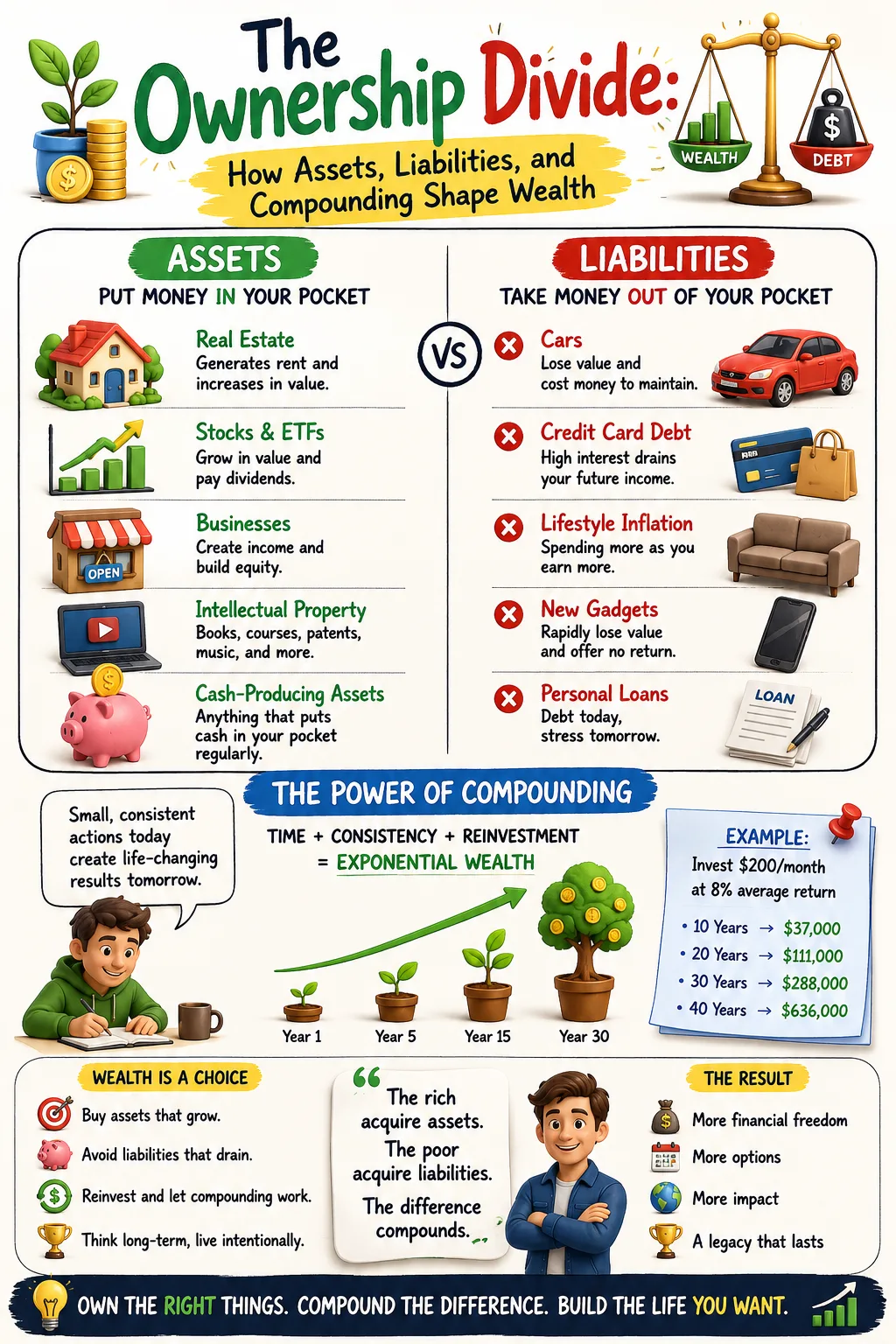
Compounding is one of the central forces in wealth building. It occurs when returns begin earning returns. If you invest money and reinvest the gains, the base grows. Future returns are then calculated on a larger amount. Over long periods, this can create powerful growth.
The Rule of 72 teaches several lessons. The first is that return matters. A higher return can double money faster. But higher expected returns usually come with higher risk. Chasing return without understanding risk can lead to losses. The goal is not to find the highest number advertised. The goal is to earn appropriate returns for your time horizon and risk capacity.
The second lesson is that time matters. Even moderate returns can become meaningful if given enough years. A young investor has an advantage because early contributions have more time to double, redouble, and grow. Waiting can be costly because lost time cannot easily be recovered without saving much more or taking more risk.
The third lesson is that fees and inflation matter. If an investment earns 8 percent before fees but fees reduce the return to 6 percent, the doubling time changes. If inflation is high, the purchasing power of money may double much more slowly than the nominal amount. A portfolio growing in numbers is not the same as a portfolio growing in real purchasing power.
The fourth lesson is that debt compounds too. The Rule of 72 can also show how quickly debt grows at high interest rates. At 24 percent interest, a debt can roughly double in three years if unpaid and compounding. At 36 percent, it can double in about two years. This is why high-interest debt is so dangerous. Compounding does not care whether it is helping you or hurting you.
The Rule of 72 is especially useful by 30 because it changes how you see small amounts. A modest investment made early can double several times before retirement. A delayed investment has fewer doubling periods. This does not mean every young person must invest aggressively without an emergency fund or debt plan. It means time is an asset, and wasting it has a cost.
Compounding rewards consistency, patience, and reinvestment. It punishes procrastination, high fees, high-interest debt, and emotional withdrawals. The Rule of 72 turns that invisible process into simple mental math.
What These Rules Leave Out
Even a strong set of financial rules is incomplete. Several important money topics are missing from the seven guidelines.
The first is high-interest debt repayment. Before investing aggressively, many people should focus on eliminating expensive debt. If a loan charges a very high interest rate, repaying it can provide a guaranteed improvement in financial position. Investing while carrying costly debt may expose you to uncertain returns while a guaranteed cost continues to grow.
The second is insurance. Health insurance, disability coverage, life insurance where dependents exist, property insurance, and liability protection can prevent a disaster from destroying financial progress. Insurance is not wealth creation, but it is wealth protection.
The third is diversification. Investing consistently is important, but concentration can be dangerous. Putting all money into one stock, one property, one business, one asset class, or one currency can expose a person to avoidable risk. Diversification does not eliminate losses, but it reduces dependence on a single outcome.
The fourth is tax planning. Taxes affect income, investing, business, retirement, property, and inheritance. Tax-efficient accounts, deductions, retirement contributions, capital gains treatment, and proper recordkeeping can influence long-term wealth. The right approach depends on local laws, so qualified advice may be valuable as finances grow more complex.
The fifth is estate planning. Wills, beneficiary designations, guardianship decisions, account access, and basic documentation matter more than many young adults realize. Estate planning is not only for the elderly or extremely wealthy. It is about making sure assets, responsibilities, and wishes are handled clearly if something happens.
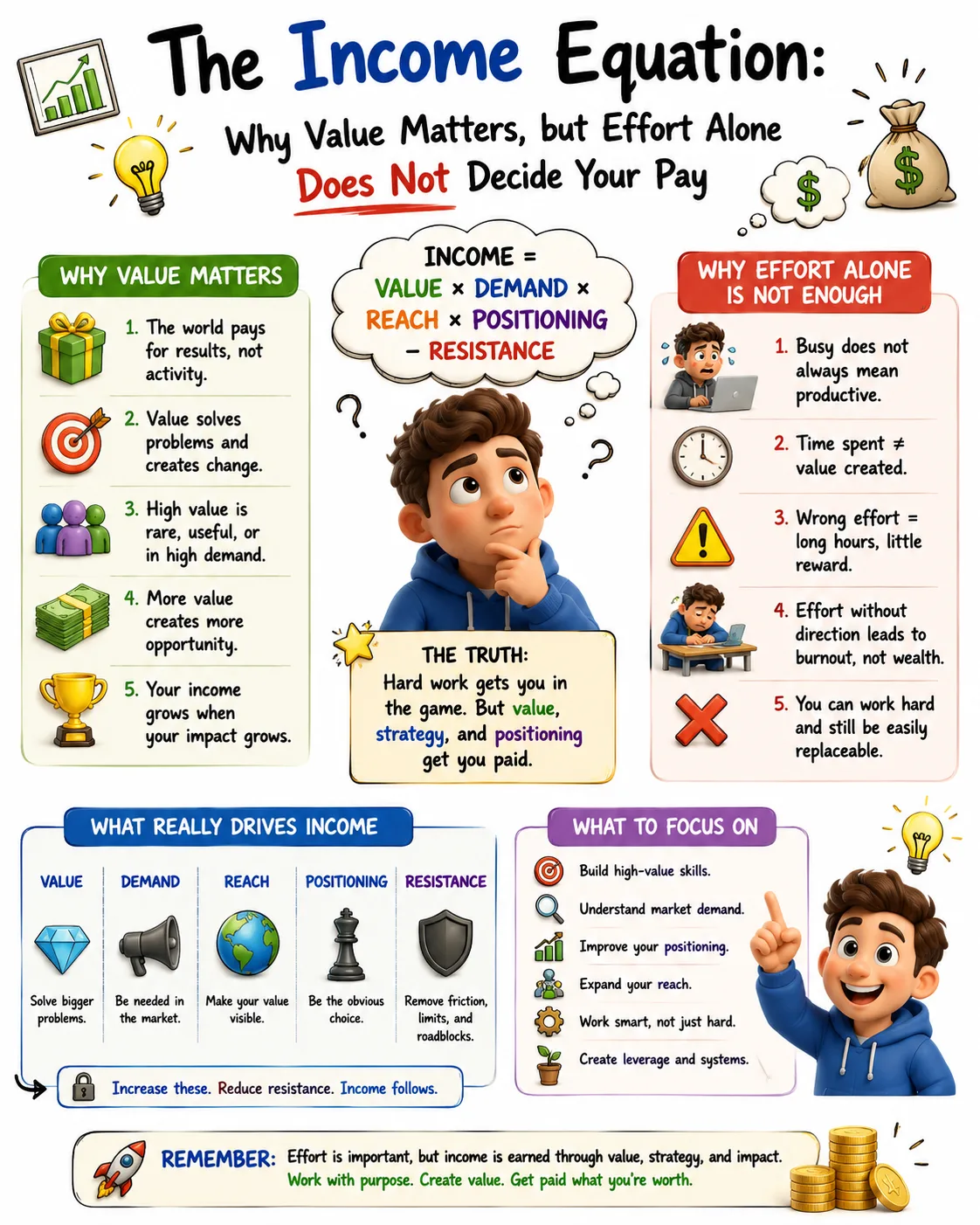
The sixth is income growth. Budgeting rules help manage money, but income determines the size of the system. Skills, career strategy, negotiation, business building, and professional networks can dramatically affect financial outcomes. Cutting expenses is useful, but earning power is also an asset.
The seventh is behavior. Financial rules fail when emotions overrule them. Fear, shame, comparison, greed, guilt, and impatience can distort decisions. A person may know the rules and still overspend, panic sell, borrow impulsively, or avoid looking at accounts. Good systems are needed to protect good intentions.
How to Adapt the Rules to Real Life
A young professional in a low-cost area with stable income might follow the rules closely. They may keep needs under 50 percent, rent under one-third, build a six-month emergency fund, avoid car debt, invest 20 percent or more, and use the Rule of 72 to stay motivated. For them, the rules provide a strong foundation.
A person in a high-cost city may need adaptation. Rent may exceed one-third temporarily. Needs may exceed 50 percent. The goal then becomes preventing the situation from becoming permanent. They may focus on increasing income, sharing housing, reducing transport costs, or finding a better long-term location. The rules reveal the pressure point.
A freelancer or entrepreneur may need a larger emergency fund than six months because income is irregular. They may also need tax reserves, business insurance, and separate personal and business accounts. For them, stability requires more cash planning than a salaried employee might need.
A person with high-interest debt may temporarily reduce investing beyond retirement matching and focus aggressively on repayment. Their best financial move may be stopping compounding from working against them.
A person supporting family may need a formal family support category in the budget. Without this, every request can disrupt savings and investing. Boundaries become part of financial planning.
A person with very low income may find the percentages unrealistic. In that case, the priority may be survival, avoiding predatory debt, building a small emergency fund, accessing support, and increasing earning power. Rules should not be used to shame people whose income cannot yet support ideal targets.
A high earner may need the rules for a different reason: preventing lifestyle inflation. High income can hide poor habits. The percentages may look easy, but luxury housing, vehicles, private schooling, travel, and social expectations can consume even large salaries. For high earners, discipline determines whether income becomes wealth.
A Practical Financial Order by 30
The seven rules are useful, but order matters. A practical sequence begins with understanding your real take-home income. Gross salary can mislead. Net income after taxes, deductions, and required contributions is the number that funds life.
Next, track spending for at least one month. Do not guess. Observe. Categorize needs, wants, debt, savings, investments, family support, and irregular expenses. Then build a budget, using 50/30/20 as a starting framework if appropriate.
After that, build a starter emergency fund. Even a small buffer can prevent new debt. Then attack high-interest debt. Once the most dangerous debt is under control, expand emergency savings toward three to six months of essential expenses.
At the same time, examine housing. If rent is far above one-third of income, decide whether it is temporary, necessary, or a lifestyle choice that needs correction. Housing is too important to leave unexamined.
Then review transportation. If buying a car, apply the 20/4/10 rule. If the car fails the test, consider a cheaper car, larger down payment, delayed purchase, public transport, car-sharing, or other alternatives where realistic.
Once the foundation is stable, automate investing. Use retirement accounts, pension plans, employer matching, diversified funds, or other suitable vehicles based on your country and goals. Learn the Rule of 72 so you understand why time and return matter.
Finally, use behavioral rules like the 2× investing rule to keep lifestyle spending from outrunning asset building. Enjoy money, but make sure every season of enjoyment is paired with progress.
The Mindset Behind the Rules
The purpose of financial rules is not to make life mechanical. It is to create freedom. A budget is not a cage; it is a map. An emergency fund is not idle money; it is protection. Rent discipline is not deprivation; it is margin. Car rules are not anti-comfort; they are anti-trap. Investing rules are not abstract math; they are future options. Retirement rules are not fear-based; they are preparation.
By 30, the goal is not to have every number perfect. Many people are still building careers, paying debt, supporting family, recovering from mistakes, or learning financial basics. The goal is to stop drifting. Drifting is expensive because time keeps moving whether or not money is being directed.
A person who reaches 30 with awareness can change quickly. They can review spending, restructure debt, begin investing, build savings, and make better housing and car decisions. A person who refuses to look may continue repeating patterns for another decade.
Financial maturity is not about never making mistakes. It is about correcting mistakes faster and designing systems that make better decisions easier.
The Cost of Ignoring These Rules
Ignoring financial guidelines does not always hurt immediately. That is what makes it dangerous. Overspending may feel fine while income is steady. No emergency fund may feel harmless until an emergency arrives. High rent may feel manageable until another cost rises. A long car loan may feel normal until the vehicle needs repairs while payments remain. Delayed investing may feel irrelevant until the lost years become visible. Retirement may feel distant until catching up requires painful sacrifice.
Many financial problems are slow-building. They do not announce themselves dramatically. They appear as a lack of options. You cannot leave a job because expenses are too high. You cannot help family because debt payments are too large. You cannot invest because lifestyle absorbs income. You cannot handle emergencies because savings were never built. You cannot retire when you want because compounding was delayed.
The rules are designed to prevent these quiet traps. They are not exciting, but they are protective.
How These Rules Build Wealth Together
The 50/30/20 rule creates a balanced cash-flow system. The emergency fund protects that system from shocks. The rent rule keeps the largest expense from overwhelming the budget. The car rule prevents transportation from becoming a debt burden. The 2× investing rule keeps luxury spending connected to asset building. The Rule of 72 explains why early and consistent investing matters. The 4% rule connects today’s savings and investments to tomorrow’s financial independence.
Together, they form a practical financial philosophy. Live within your income. Protect yourself from emergencies. Keep fixed costs manageable. Avoid debt traps. Invest consistently. Understand compounding. Connect present lifestyle to future freedom.
None of these rules requires extreme wealth to begin. They require attention and adjustment. A person can start with a small emergency fund, a modest investment contribution, a cheaper housing choice, or a decision not to buy an unaffordable car. Small decisions made repeatedly become financial direction.
What Knowing These Rules by 30 Really Means
Knowing these rules by 30 does not mean you must have achieved every target. It means you understand the financial forces shaping your life.
You know that income must be divided intentionally. You know that emergency savings are not optional. You know that retirement requires assets, not hope. You know that rent and cars can quietly determine whether you build wealth or stay under pressure. You know that luxury spending should not outrun investing. You know that compounding can either build your portfolio or expand your debt. You know that rules of thumb are starting points, not substitutes for judgment.
This knowledge creates power because it changes the questions you ask. Instead of asking, “Can I afford the payment?” you ask, “What is the total cost?” Instead of asking, “How much do I earn?” you ask, “How much do I keep and grow?” Instead of asking, “When should I start investing?” you ask, “What amount can I invest consistently now?” Instead of asking, “Why does money disappear?” you ask, “What system will direct it before it disappears?”
The shift is subtle, but it is life-changing. Money becomes less mysterious. Choices become clearer. Trade-offs become visible. Progress becomes measurable.
The Rules Are Not the Wealth. The Habits Are.
A rule written on paper does not build wealth. A rule repeated in behavior does.
The 50/30/20 rule matters only if income is actually allocated. The emergency fund rule matters only if money is actually saved and protected. The rent rule matters only if housing decisions reflect the budget. The car rule matters only if ego does not override affordability. The 2× investing rule matters only if luxury spending is matched by ownership. The Rule of 72 matters only if compounding is given money and time. The 4% rule matters only if retirement assets are actually built.
Financial rules are useful because they simplify decisions. But wealth comes from execution: automating transfers, saying no to unaffordable upgrades, negotiating income, tracking spending, paying debt, reviewing accounts, learning investments, protecting against risk, and staying consistent when progress feels slow.
By 30, the most valuable financial asset may not be the amount already accumulated. It may be the system you have built. A good system can turn future income into wealth. A weak system can waste even high income.
A Final Word on Financial Adulthood
Financial adulthood is not defined by age. Some people learn these principles at 22. Others learn them at 45 after painful mistakes. The best time to learn is before the cost of not knowing becomes too high.
The seven rules are not perfect, but they are practical. Use the 50/30/20 rule to give income structure. Use the 4% rule to understand the relationship between assets and future spending. Use the emergency fund rule to protect yourself from shocks. Use the one-third rent rule to keep housing from consuming your life. Use the 2× investing rule to make luxury spending more mindful. Use the 20/4/10 rule to avoid car debt that weakens your future. Use the Rule of 72 to respect compounding.
Then adapt them. Your life is not a spreadsheet template. Your country, family, income, goals, health, and opportunities matter. But do not use uniqueness as an excuse for chaos. Adjust the rules with intention, not avoidance.
The purpose of learning financial rules by 30 is not to become obsessed with money. It is to reduce the number of years spent making preventable mistakes. It is to give your income a structure before lifestyle, debt, and impulse claim it. It is to build enough stability that money becomes a tool for freedom rather than a constant source of pressure.
Wealth rarely begins with riches. More often, it begins with rules simple enough to follow and important enough not to ignore.
 Article
 Article
 Article
 Article
 Article
 Article
 Article
 Article