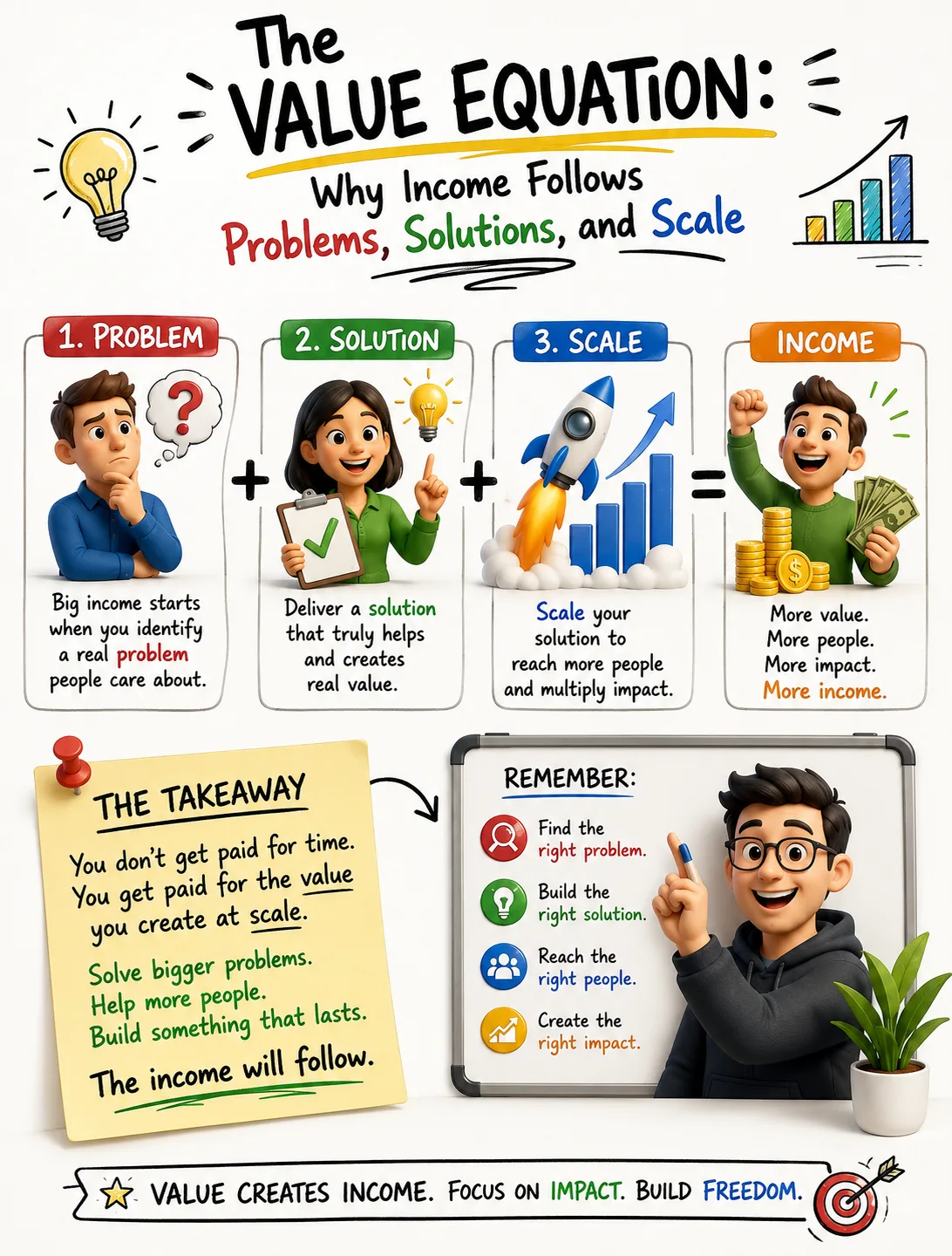
The Value Equation: Why Income Follows Problems, Solutions, and Scale
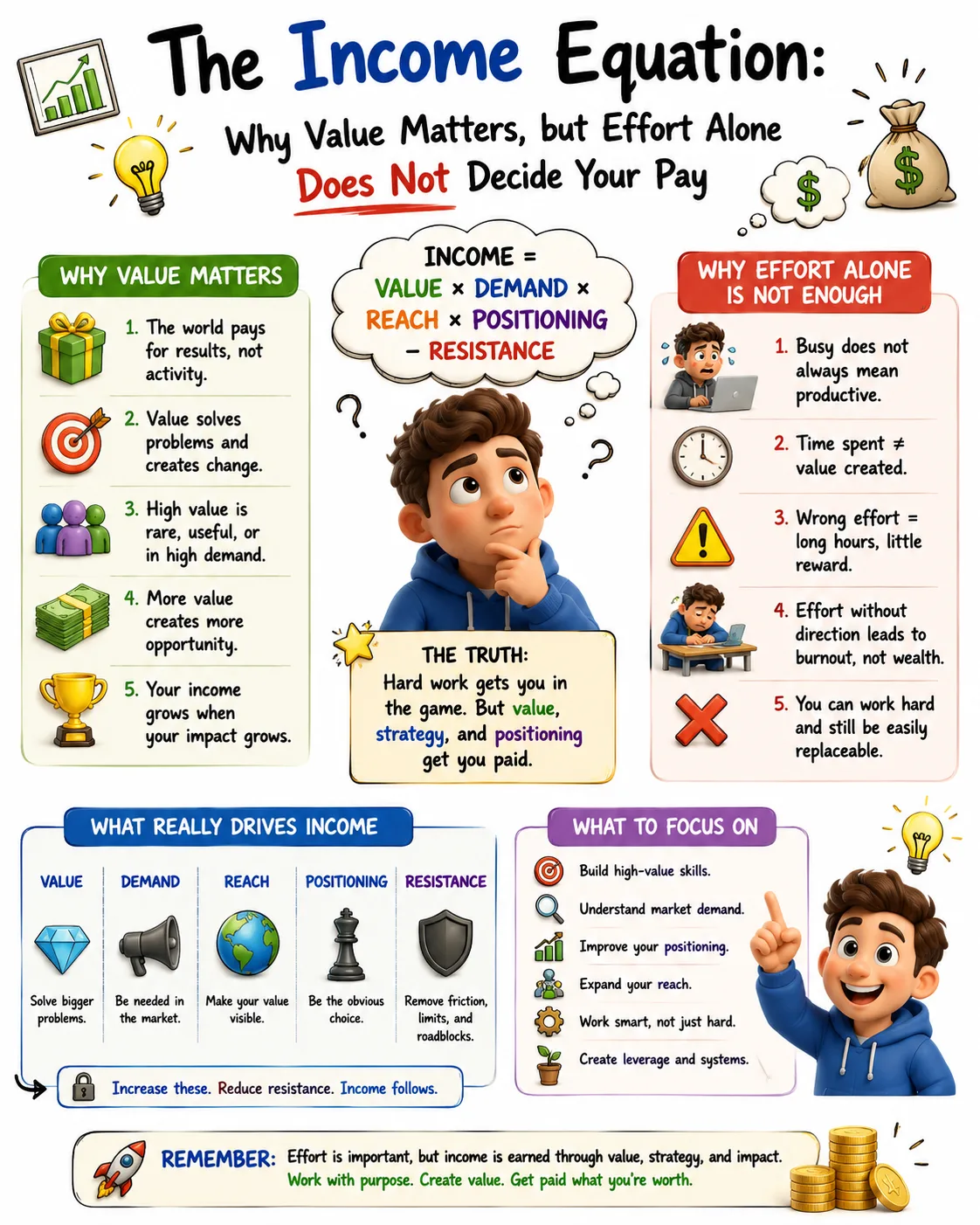
Income does not follow effort automatically. It does not follow good intentions automatically. It does not always follow intelligence, education, or long hours. Income most reliably follows value that other people recognize, need, trust, and are willing or able to pay for.
This is the truth behind the phrase “your income follows value.” It is a powerful idea because it shifts attention away from entitlement and toward usefulness. It asks a person to look beyond the paycheck and examine the problem being solved. What pain is being reduced? What outcome is being improved? What cost is being lowered? What risk is being removed? What opportunity is being created? Who benefits, how much do they benefit, and how many people can be reached?
At its best, this principle is one of the most practical income lessons in personal finance. A person who wants to earn more should not ask only, “How do I make more money?” A better question is, “What valuable problem can I solve better than I do today?” A business owner should not ask only, “How do I increase sales?” A better question is, “What customer problem can we solve so well that people return, refer others, and willingly pay?” A professional should not ask only, “How do I get promoted?” A better question is, “What measurable value can I create for the organization?”
But the phrase also needs nuance. Value creation is necessary, but not always sufficient. Many people create enormous social value without earning high incomes. Caregivers, teachers, public servants, community workers, artists, researchers, and nonprofit employees may improve lives in profound ways while receiving modest compensation. Markets do not reward all forms of value equally. Income depends not only on usefulness, but also on demand, scarcity, pricing power, business model, negotiation, regulation, ownership, geography, access to capital, competition, and scale.
That distinction matters. It prevents a good principle from becoming a simplistic slogan. Income often follows value, but only when value is connected to a market mechanism that can pay for it.
The practical framework is clear: solve bigger problems, help more people, create better solutions, and then capture part of the value created. This is not a guaranteed formula for wealth, but it is one of the strongest ways to think about increasing earning power over time.
What Value Creation Really Means
Value creation happens when someone’s situation is improved. A customer saves time. A business increases revenue. A patient receives better care. A family reduces financial stress. A company lowers risk. A student learns faster. A homeowner gets a repair done properly. A client avoids a legal or tax mistake. A team becomes more productive. A user gets a simpler tool. A community receives better service.
Value can take many forms. It can be economic, emotional, practical, strategic, social, or protective. A product may save money. A service may reduce frustration. A skill may increase efficiency. A professional may prevent costly errors. A business may create convenience. An adviser may improve decisions. A creator may educate, entertain, or inspire.
The financial question is not merely whether value exists. The question is whether the value is visible, measurable, trusted, differentiated, and monetizable.
A person may create value inside a workplace but fail to communicate it. A business may solve a real problem but price too low. A freelancer may be skilled but serve clients who cannot afford premium fees. A product may be useful but poorly distributed. A consultant may produce meaningful results but lack proof. A founder may build something clever but not something customers urgently need.
Value becomes income when it connects with willingness to pay. This is where many people misunderstand money. The market does not pay for how hard something feels. It pays for outcomes, scarcity, trust, timing, access, and alternatives. A difficult task that few people value may pay little. A simple solution to an expensive problem may pay well. A person who solves a costly business issue in one hour may earn more than someone who works all week on low-value tasks.
This can feel unfair, but it is useful to understand. Income is not a moral score. It is an economic signal shaped by demand, supply, bargaining power, and ownership structure.
The First Step: Solve Bigger Problems
One of the clearest ways to increase income is to solve bigger problems. Bigger does not always mean more dramatic. It means the problem has greater consequences, greater urgency, or greater economic value.
A business will pay more to solve a problem that affects millions in revenue than one that affects a small inconvenience. A household will pay more to solve a problem involving health, safety, housing, taxes, legal risk, education, or financial security than one involving minor preference. A company will pay more for a professional who can reduce regulatory risk, build revenue systems, manage major projects, improve operations, retain customers, or lead teams than for work that is easily replaced.
The size of the problem affects the value of the solution. If a software engineer helps a company reduce downtime, the value may be large because downtime costs money. If a salesperson brings in major accounts, the value is measurable. If an operations manager reduces waste, improves delivery speed, or lowers error rates, the benefit can be significant. If a tax adviser prevents a costly mistake, the value is larger than the time spent preparing forms.
This is why specialized skills often increase income. Specialization can move a person closer to more expensive problems. A general worker may complete tasks. A specialist may solve problems that few others understand. The more costly the problem and the fewer people who can solve it well, the greater the potential earning power.
Solving bigger problems requires deeper capability. It may require technical knowledge, judgment, emotional intelligence, industry experience, communication, leadership, creativity, or risk tolerance. It may also require credibility. People do not hand important problems to those they do not trust.
For employees, this means looking beyond job descriptions. The highest-value work is often connected to revenue, cost reduction, risk management, customer retention, speed, quality, and strategic execution. A person who understands how their work affects the organization’s economics can position themselves more effectively.
For entrepreneurs, it means avoiding the trap of building solutions in search of problems. The market rewards businesses that solve real needs. A founder may love an idea, but customers pay for outcomes. A better product begins with a better understanding of the problem.
How to Identify Bigger Problems
Bigger problems usually have several traits. They are urgent. They are expensive. They are recurring. They affect many people or valuable customers. They are painful enough that people actively seek solutions. They involve risk, money, time, status, health, safety, convenience, or opportunity.
In a career, bigger problems can be found by listening to what leaders discuss repeatedly. Where is money being lost? Where are customers unhappy? Where are projects delayed? Where are risks increasing? Where is the team inefficient? Where does the company depend on too few people? Where are competitors winning? Where are costs rising?
In business, bigger problems can be found by listening to customers. What do they complain about? What do they try to solve manually? What do they already pay for? What frustrates them about existing options? What creates stress, delay, waste, or embarrassment? What do they wish were simpler?
In personal services, bigger problems often appear around transitions and high-stakes decisions: buying a home, starting a business, managing taxes, planning retirement, caring for aging parents, recovering health, preparing for exams, changing careers, or handling legal matters. People pay for guidance when mistakes are costly.
The key is to avoid assuming value. Observe it. If people already spend time, money, or energy trying to solve a problem, the problem likely matters. If people praise an idea but will not pay, the value may be weaker than it appears.
The Second Step: Help More People
Solving a valuable problem for one person can create income. Solving it for many people can create scale. Scale is one of the main reasons some businesses and professionals earn far more than others.
A person who provides a service one-to-one is limited by time. A consultant, attorney, doctor, designer, tutor, coach, plumber, or accountant can only serve so many clients personally. Income may be high if the service is valuable, but the ceiling is tied to capacity.
Helping more people requires a different model. It may involve hiring employees, creating products, licensing intellectual property, building software, writing books, developing courses, franchising, creating templates, building media, investing in distribution, or designing systems that allow value to be delivered repeatedly.
Scale does not mean every business must become global. It means increasing reach without requiring the same increase in personal labor. A teacher who tutors one student at a time has one model. A teacher who creates a high-quality course, curriculum, or training program has another. A consultant who customizes every project has one model. A consultant who creates repeatable frameworks, group programs, or diagnostic tools has another. A software company can serve thousands of users with the same core product. A writer can sell one book to many readers. An investor can own shares in businesses that serve millions.
Scale is powerful because it separates income from direct time. But scale is not automatic. Reaching more people requires distribution. A product that no one discovers does not scale. A course without an audience does not sell. A software tool without trust or adoption remains unused. A franchise without operational discipline can fail. A business that expands too quickly can collapse under complexity.
Helping more people requires systems, marketing, quality control, capital, leadership, technology, partnerships, or brand trust. The more people served, the more important execution becomes.
The Difference Between Reach and Impact
Helping more people is valuable only if the solution remains useful at scale. Some businesses grow reach faster than quality. They attract attention but fail to deliver. That may create short-term revenue, but it weakens reputation. Long-term income follows sustained value, not merely exposure.
Reach without impact is noise. Impact without reach may be under-monetized. The strongest income opportunities often combine both: meaningful outcomes delivered to enough people through a model that captures part of the value created.
This is why reputation matters. As businesses and professionals scale, trust becomes a multiplier. People buy from those they believe can deliver. A trusted brand can enter new markets more easily. A respected professional can command higher fees. A creator with credibility can launch new products. A company known for quality can retain customers even when competitors offer lower prices.
Scale built on weak value is fragile. Scale built on trust can compound.
The Third Step: Create Better Solutions
Income does not follow problem size alone. It follows the ability to solve the problem better than available alternatives. Better may mean faster, cheaper, safer, simpler, more reliable, more beautiful, more convenient, more personalized, more durable, or more effective.
Innovation is often misunderstood as invention. Sometimes better solutions come from breakthrough technology. But many improvements are practical rather than revolutionary. A restaurant creates a better customer experience. A financial adviser explains complex ideas more clearly. A software company removes unnecessary steps. A logistics business delivers more reliably. A healthcare provider reduces waiting times. A contractor communicates better and finishes on schedule. A professional service firm makes pricing transparent. A retailer improves returns and customer support.
Better solutions create pricing power because they reduce the customer’s cost of choosing. Customers do not evaluate price alone. They evaluate value relative to alternatives. A higher-priced service may be attractive if it reduces risk, saves time, improves quality, or creates confidence. A lower-priced product may win if quality is acceptable and convenience is high. A premium brand may succeed if trust and experience justify the price.
To create better solutions, a person or business must understand the customer’s world. What does success look like for them? What do they fear? What frustrates them? What alternatives have disappointed them? What hidden costs do they face? What would make the experience easier?
Many people try to earn more by working harder at the same solution. Better income often requires improving the solution itself. This may mean redesigning the offer, specializing, packaging services differently, adding proof, improving delivery, reducing friction, or focusing on a more valuable customer segment.
Better Solutions Require Feedback
No one creates excellent solutions in isolation. Feedback reveals what customers actually value. It shows where the product is confusing, where service fails, where pricing feels unclear, where results fall short, and where demand is strongest.
Professionals can gather feedback through performance reviews, client conversations, project outcomes, referrals, repeat business, and measurable results. Businesses can use customer interviews, support tickets, reviews, retention data, sales patterns, refunds, and user behavior. Investors can examine financial results, competitive position, margins, and management decisions.
Feedback must be interpreted carefully. Customers may not always know the best solution, but they usually understand their pain. A good value creator listens for the problem beneath the request. A client may ask for a cheaper service when what they really need is clearer proof of value. A customer may request more features when the real issue is usability. An employer may ask for more hours when the real need is better prioritization.
Better solutions come from repeated improvement. This is why learning is part of income growth. Skills improve solutions. Experience improves judgment. Customer insight improves design. Repetition improves delivery. The person who keeps improving the solution can often increase income without simply working more hours.
The Fourth Step: Earn More Money
The final step in the poster sequence is “earn more money.” In reality, this step is not automatic. A person may solve bigger problems, help more people, and create better solutions, yet still fail to earn more if they do not capture value.
Value capture is the financial mechanism that turns usefulness into income. Employees capture value through salary, bonuses, commissions, promotions, benefits, equity, or better job opportunities. Freelancers capture value through fees. Businesses capture value through pricing, margins, recurring revenue, intellectual property, contracts, and ownership. Investors capture value through dividends, interest, appreciation, rents, or distributions.
Many people create value but under-capture it. An employee may become indispensable but never negotiate. A freelancer may underprice out of fear. A business may solve an important problem but use a weak pricing model. A creator may build a large audience but lack a monetization strategy. A consultant may deliver measurable results but charge by the hour instead of value delivered. A founder may build a useful product but give away too much margin through poor distribution economics.
To earn more, value must be connected to pricing, negotiation, positioning, and ownership. This is where financial education meets business strategy.
Why Monetization Matters
Monetization is not greed. It is how value creation becomes economically sustainable. A business that creates value but cannot earn enough will eventually fail. A professional who creates value but never captures it may burn out. A creator who helps many people but has no income model may be unable to continue the work.
Healthy monetization aligns benefit and reward. If a service saves a client significant money, the provider can reasonably charge for that result. If software improves productivity, customers may pay a subscription. If education helps professionals improve skills, the teacher may charge tuition. If a business reduces risk, pricing can reflect the seriousness of the problem.
The challenge is ethical value capture. A person should not exaggerate outcomes, exploit information gaps, or charge premium prices for weak solutions. But they also should not assume that being useful requires being underpaid. Sustainable service requires sustainable economics.
Pricing should reflect the value delivered, the alternatives available, the cost of delivery, the risk involved, the customer’s willingness to pay, and the provider’s positioning. Low pricing can sometimes increase access and scale. Premium pricing can support deeper service, quality, and expertise. The right price depends on the model.
The Market Does Not Reward All Value Equally
One of the most important nuances is that income does not perfectly measure human value. Some socially essential work is underpaid because buyers have limited ability to pay, budgets are constrained, labor supply is high, institutions set wages, or the value is difficult to monetize directly. Teaching, caregiving, social work, public health, and community service can create enormous human value without producing high private income.
This reality should keep the value equation humble. High income does not automatically mean high moral worth. Low income does not mean low value. Markets price economic value under specific conditions; they do not measure a person’s contribution to humanity.
Still, for individuals seeking to increase income, market value matters. The question is not, “Am I valuable as a human being?” That answer is not determined by income. The question is, “What does the market reward, and how can I create, communicate, and capture value in that environment?”
This distinction protects both dignity and strategy. It allows a person to recognize their worth while still making practical decisions about skills, markets, pricing, and opportunity.
The Role of Scarcity
Income often rises when valuable skills are scarce. If many people can perform a task adequately, pricing power is limited. If few people can solve a problem well, those people can often earn more. Scarcity may come from technical expertise, experience, credentials, relationships, creativity, trust, speed, judgment, or the ability to handle complexity.
This is why skill development matters. A person who builds rare and valuable capabilities can move into higher-income opportunities. Scarcity does not require being the best in the world. It may mean being highly capable in a specific niche. A general marketer may face many competitors. A marketer who specializes in compliance-heavy financial services may be rarer. A general software developer may compete broadly. A developer with deep expertise in cybersecurity, payments, or artificial intelligence infrastructure may command more. A general accountant may earn well. A tax specialist serving complex business owners may capture more value.
Scarcity should be paired with demand. A rare skill that no one needs will not necessarily pay well. The strongest position is the intersection of ability, scarcity, demand, and trust.
The Role of Ownership
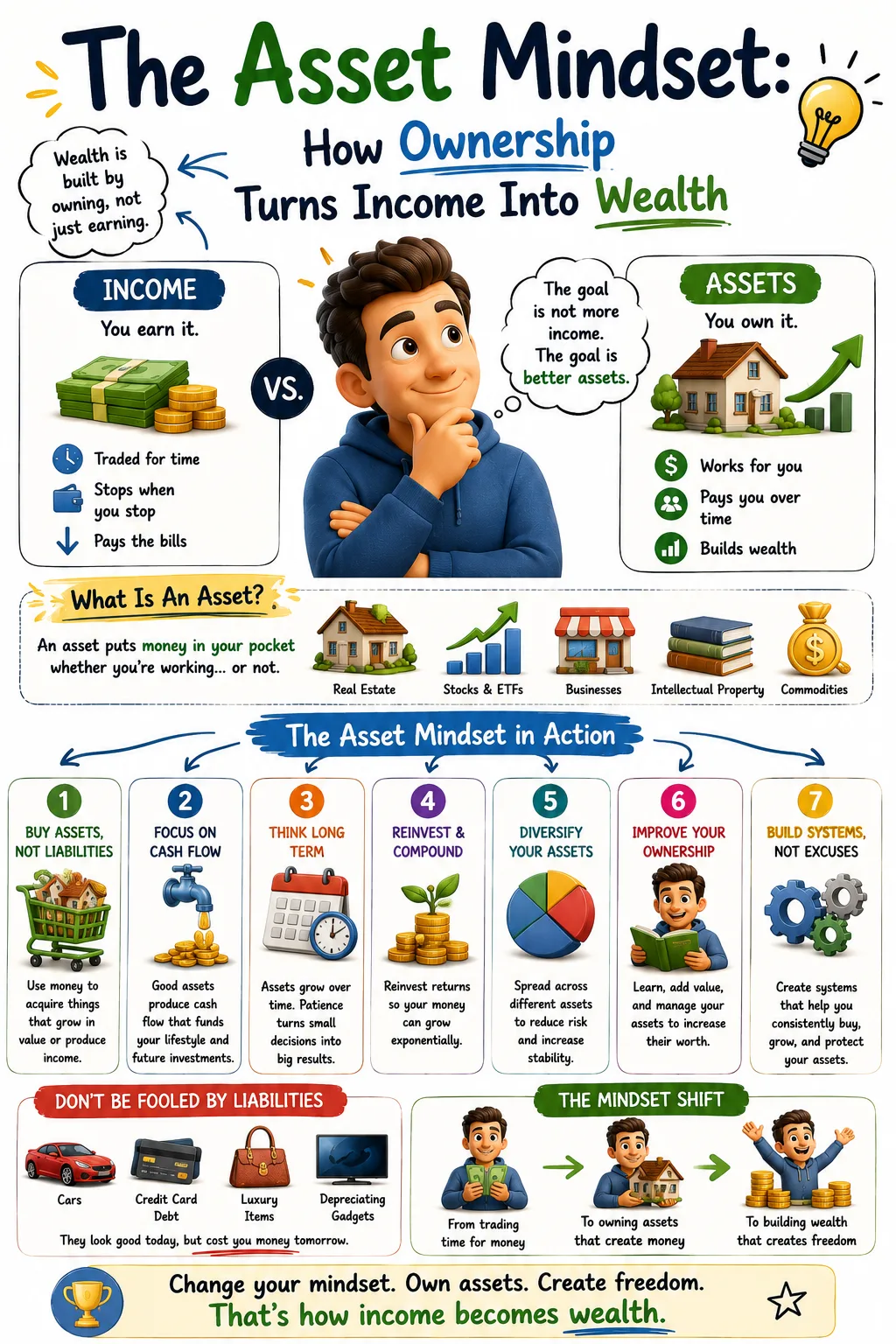
Ownership is one of the clearest ways to capture more value. Employees are paid for labor. Owners can participate in upside. A business owner may benefit from profits and the eventual sale of the business. A shareholder benefits when companies grow. A property owner may receive rent and appreciation. A creator who owns intellectual property may receive royalties. A professional with equity compensation may share in enterprise value.
This does not mean everyone should become a business owner immediately. Ownership carries risk. Businesses fail. Investments decline. Properties require capital. Intellectual property may not sell. Equity can become worthless. But over time, wealth is usually built by converting income into ownership of productive assets.
Value creation increases income potential. Ownership increases wealth potential.
A professional who earns more because they solve bigger problems should avoid letting all additional income become lifestyle spending. The surplus should be directed into assets. This is how value creation becomes wealth creation. Higher income without asset accumulation can still leave a person financially fragile. Higher income converted into ownership can create independence.
Employees: How Income Follows Value Inside a Career
For employees, the value equation begins with understanding the employer’s priorities. Organizations pay for results that help them survive and grow. These may include revenue growth, cost control, risk reduction, customer satisfaction, innovation, operational efficiency, talent retention, compliance, and strategic execution.
An employee who wants to earn more should identify the outcomes that matter most and become increasingly capable of producing them. This may require learning technical skills, improving communication, taking ownership of difficult projects, understanding business economics, managing people, or building cross-functional trust.
Visibility matters. Quiet competence is valuable, but invisible value may be under-rewarded. Employees should document results, communicate progress, ask for feedback, and connect their work to organizational outcomes. This is not bragging. It is making value legible.
Negotiation also matters. Some people assume good work will automatically be noticed and rewarded. Sometimes it is. Often, the employee must advocate professionally. That means understanding market compensation, timing conversations well, presenting evidence, and being prepared to pursue better opportunities if the current organization cannot reward the value created.
Career income often grows when employees move from task execution to problem ownership. Task executors wait for instructions. Problem owners understand objectives, anticipate obstacles, and deliver outcomes. Organizations tend to reward people who reduce the burden on leadership.
Freelancers and Consultants: Selling Outcomes, Not Hours
Freelancers and consultants face a different version of the value equation. Many begin by charging for time: hourly rates, project fees, or day rates. This is simple, but it can limit income if the work creates value far beyond the time required.
A consultant who helps a company save hundreds of thousands of dollars should not think only in terms of hours spent. A designer who improves conversion rates creates business value. A copywriter who increases sales creates revenue impact. A cybersecurity expert who prevents breaches reduces risk. A coach who helps executives make better decisions may influence large outcomes.
This does not mean every freelancer can charge premium fees immediately. Proof matters. Trust matters. Results matter. Positioning matters. But over time, higher income comes from selling outcomes, not merely labor.
Freelancers should also examine their client base. Some clients value quality and pay promptly. Others demand discounts, revisions, speed, and emotional labor while resisting fair pricing. Serving better clients can be as important as improving skill. The same service may be underpaid in one market and premium in another.
Packaging can improve value capture. Instead of selling vague services, a freelancer can offer clear deliverables, defined outcomes, diagnostic audits, implementation packages, retainers, or specialized solutions. Clear offers reduce buyer uncertainty and support stronger pricing.
Business Owners: Value Must Become a Business Model
Business owners must solve a hard problem: create value for customers while capturing enough value to survive and grow. A business can be loved and still fail if margins are weak, costs are too high, pricing is poor, cash flow is unstable, or operations are chaotic.
Value creation in business begins with product-market fit. Are customers willing to pay for the solution? Do they return? Do they refer others? Is the problem recurring? Can the business deliver profitably? Can quality be maintained as volume grows?
A better solution is not enough if customers do not know it exists. Distribution matters. Marketing, sales, partnerships, referrals, branding, location, search visibility, platform strategy, and customer experience all affect whether value reaches the market.
Operations matter too. A business that sells well but delivers poorly damages trust. A business that delivers well but cannot manage costs may struggle. A business that grows too quickly may run out of cash. A business that depends entirely on the owner may be an income source but not yet a scalable asset.
For business owners, income follows value only when value is embedded in a model that works economically. That means pricing, margins, systems, people, customer acquisition, retention, and cash management all matter.
Creators: Attention Is Not the Same as Value
Creators often operate in markets where attention is mistaken for value. A large audience can be valuable, but attention alone does not guarantee income. Monetization depends on trust, audience need, product fit, platform economics, advertising rates, sponsorships, subscriptions, intellectual property, and the creator’s ability to offer something people want enough to pay for.
A creator who educates deeply, solves specific problems, or builds strong trust may earn more with a smaller audience than someone with broad but shallow attention. The quality of the audience matters. The problem being solved matters. The offer matters.
Creators should ask: What transformation do I help people achieve? What do my readers, viewers, or listeners need? What would they pay to solve? What assets can I build from my expertise? Books, courses, memberships, templates, consulting, events, licensing, and software can all turn knowledge into income, but only when they deliver real value.
The creator economy rewards consistency and trust, but it also punishes dependence on platforms. Algorithms change. Advertising markets shift. Audiences move. A strong creator builds owned assets: email lists, intellectual property, products, brand reputation, and diversified income streams.
Investors: Capital Follows Value Too
The value equation applies to investing as well. Investors seek assets that can create or preserve economic value. A stock represents ownership in a business. A bond represents a claim on payments. A property represents land, structure, use, and potential income. A fund represents a basket of assets. The investor’s return depends on future cash flows, growth, valuation, risk, and time.
Investors should remember that price matters. A valuable business can be a poor investment if purchased at an excessive price. A boring business can be a good investment if it produces durable cash flows and is bought reasonably. A high-yield asset can be dangerous if the income is unsustainable. A fast-growing company can disappoint if expectations are unrealistic.
Investing is not simply buying things that sound valuable. It is allocating capital to assets where expected return justifies risk. For most households, diversified long-term investing is more practical than trying to identify individual winners. The principle remains: wealth grows when capital is placed into productive assets and allowed to compound.
Value Creation Without Financial Capture
Some people create value but repeatedly fail to earn more. This can happen for several reasons.
They may serve people who cannot pay. This is common in socially important work. The value is real, but the market mechanism is weak. They may underprice because of fear, guilt, or lack of confidence. They may lack negotiation skills. They may work inside organizations that do not reward performance well. They may create value that is difficult to measure. They may lack access to decision-makers. They may fail to communicate results. They may choose business models that do not scale. They may give away too much for free. They may lack ownership.
Solving this problem requires strategic adjustment. A person may need to move to a better market, serve a different customer segment, improve proof, change pricing, package services, negotiate, build credentials, develop distribution, or convert expertise into assets. The answer is not always to work harder. Sometimes it is to change the mechanism of value capture.
Value Creation and Ethics
The value equation should be rooted in ethics. The goal is not to extract the maximum amount of money regardless of harm. The goal is to create genuine benefit and receive fair compensation. Sustainable income is strongest when customers, clients, employers, or users are better off because of the exchange.
Short-term income can be made through manipulation, exaggeration, hidden fees, predatory lending, exploitative pricing, poor-quality products, or misleading promises. But such income often damages reputation and may create legal, financial, or moral consequences. Trust is a long-term asset. Once lost, it is difficult to rebuild.
Ethical value creation asks whether the solution genuinely helps, whether claims are honest, whether pricing is transparent, whether risks are disclosed, and whether the relationship can endure. Wealth built on trust is more durable than income built on deception.
The Role of Reputation
Reputation is a value multiplier. When people trust you, they are more willing to hire you, buy from you, refer you, promote you, invest in you, or partner with you. Reputation reduces perceived risk. It makes value easier to believe.
A professional reputation is built through repeated behavior: doing what you say, meeting deadlines, communicating clearly, telling the truth, solving problems, respecting confidentiality, and taking responsibility. A business reputation is built through product quality, customer service, consistency, fairness, and reliability.
Reputation also allows value to travel. A satisfied client tells another. A strong employer reference opens doors. A trusted brand enters new categories. A creator’s audience buys the next product. A founder raises capital more easily after prior execution. Reputation compounds because each trustworthy action increases the likelihood of future opportunity.
Protecting reputation may mean refusing money that conflicts with values. It may mean admitting mistakes. It may mean under-promising and over-delivering. It may mean choosing long-term trust over short-term revenue. This discipline is part of income growth because trust creates opportunity.
Scale, Systems, and Leverage
To help more people, value creators need leverage. Leverage means using tools, systems, capital, people, technology, or intellectual property to increase output beyond personal labor.
Labor leverage comes from hiring and delegation. A business owner builds a team. A professional firm trains associates. A contractor hires skilled workers. People leverage allows more customers to be served, but it requires leadership and quality control.
Technology leverage comes from software, automation, platforms, and digital systems. A company can serve customers more efficiently. A creator can distribute content globally. A small business can automate scheduling, billing, customer communication, or inventory. Technology can scale value, but it also creates dependence on systems that must be maintained.
Capital leverage comes from using money to acquire assets, fund growth, or improve capacity. This may include equipment, inventory, advertising, property, or investment portfolios. Borrowed capital can magnify results but also increases risk.
Intellectual property leverage comes from creating something once and selling or licensing it repeatedly: books, courses, software, patents, music, designs, frameworks, templates, or media. This can be powerful, but distribution and protection matter.
Leverage is the bridge between value and scale. Without leverage, income remains closely tied to personal time. With leverage, value can reach more people. But leverage must be handled carefully because it magnifies both strengths and weaknesses.
The Role of Pricing Power
Pricing power is the ability to charge more without losing too much demand. It comes from differentiation, trust, urgency, quality, scarcity, brand, switching costs, customer results, or lack of good alternatives.
A commodity provider has little pricing power because buyers can easily compare and switch. A differentiated provider has more. A tax professional specializing in complex cross-border issues may have more pricing power than a general preparer. A software company deeply integrated into a client’s operations may have more pricing power than a simple tool. A brand known for reliability may charge more than unknown competitors.
Increasing pricing power is one of the most direct ways to increase income. This can be done by specializing, improving results, serving higher-value customers, building proof, reducing risk for the buyer, improving customer experience, or creating a stronger brand.
However, pricing power must be earned. Raising prices without improving value, trust, or positioning can simply reduce demand. The goal is not to charge more because you want more money. The goal is to create and communicate enough value that the price is justified.
Why Execution Determines Outcomes
Ideas are abundant. Execution is scarce. Many people can identify valuable problems. Fewer can build reliable solutions. Even fewer can deliver consistently, market effectively, manage finances, handle customers, improve operations, and sustain trust over time.
Execution includes the unglamorous parts of value creation: showing up, making calls, writing proposals, testing offers, following up, tracking numbers, managing cash flow, hiring carefully, documenting systems, handling complaints, improving quality, and learning from failure. These activities are not always inspiring, but they determine whether value becomes income.
A person with a moderate idea and excellent execution may outperform someone with a brilliant idea and poor discipline. A professional who communicates clearly may outperform a more talented person who is unreliable. A business with strong operations may beat a competitor with better branding but weak delivery.
Income follows value only when value reaches the buyer and is delivered well. Execution is the delivery mechanism.
How to Apply the Value Equation Personally
Start by identifying your current value engine. How do you earn today? What problem are you paid to solve? Who benefits from your work? How is the value measured? What would make you more valuable? What skills would increase your ability to solve larger problems?
Next, examine your market. Are you serving a market that can pay? Is demand growing or shrinking? Are your skills common or scarce? Are there higher-value niches nearby? Could your work be applied in a better-paying industry? Could you serve clients directly? Could you package your knowledge?
Then improve the solution. Learn. Practice. Ask for feedback. Study the best people in your field. Improve communication. Reduce friction. Increase reliability. Build proof. Document results. Develop a specialty. Make your value easier to understand.
After that, improve value capture. Negotiate compensation. Raise prices where justified. Change clients if necessary. Build scalable offers. Seek equity where appropriate. Convert income into investments. Protect your reputation. Track results. Learn basic finance so increased income becomes wealth rather than spending.
Finally, expand carefully. Help more people only when quality can be maintained. Scale with systems, not chaos. Avoid growing so fast that the solution weakens. Expansion should increase freedom, not create uncontrolled complexity.
From Income Growth to Wealth Building
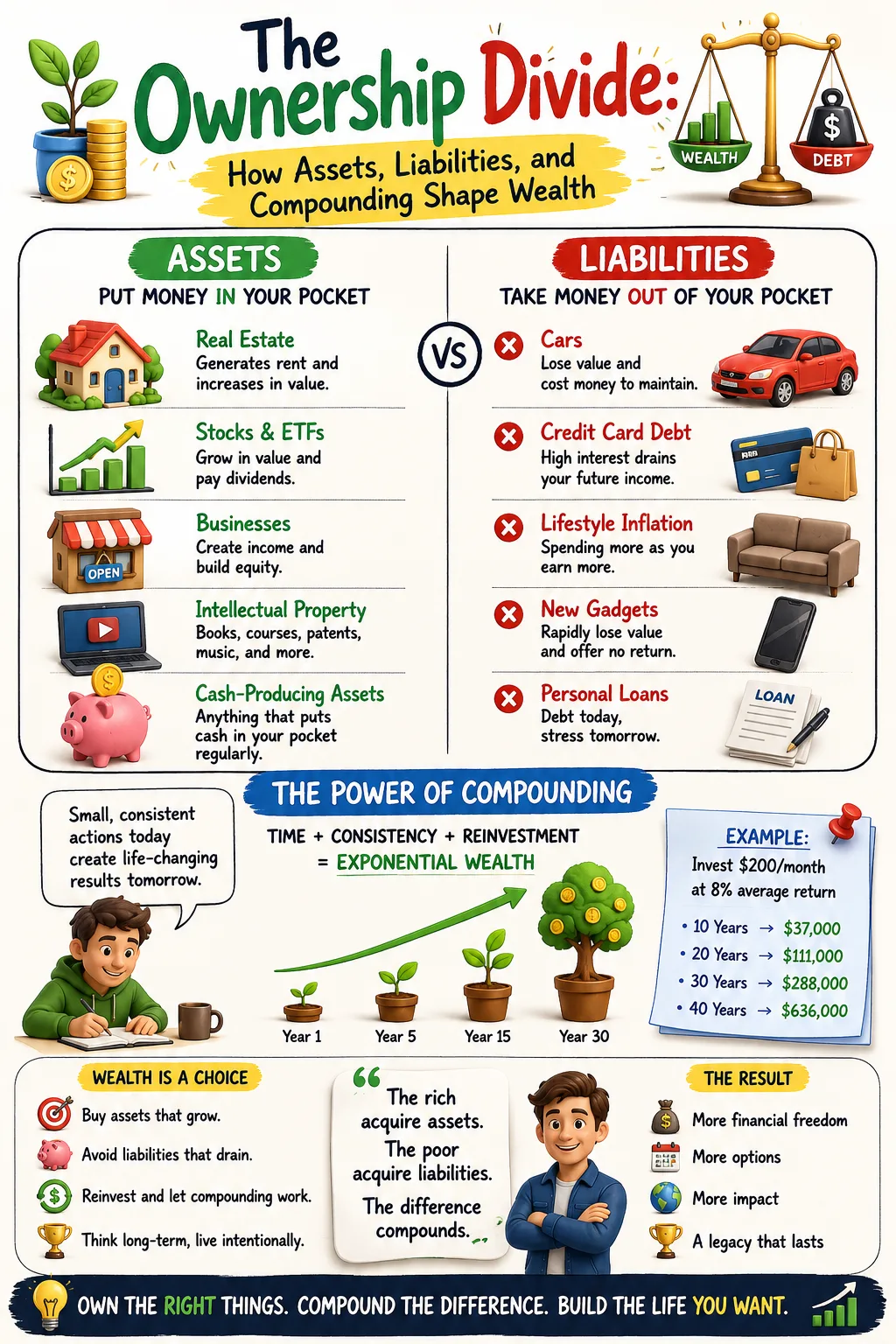
Earning more is not the same as becoming wealthy. Higher income creates opportunity, but wealth grows when surplus income is saved, invested, and protected. A person who earns more because they create more value should decide in advance how that additional income will be used.
Some should go toward financial defense: emergency savings, insurance, debt reduction, and protection. Some should go toward productive assets: retirement accounts, diversified investments, business equity, real estate where appropriate, or other assets aligned with the plan. Some can improve quality of life. Some can support generosity and legacy.
Without this structure, value-created income can disappear into lifestyle inflation. A larger paycheck becomes a larger car payment. A business profit becomes luxury spending. A promotion becomes a more expensive mortgage. The person earns more but remains dependent.
The wealth-building version of the value equation is: create value, earn income, retain surplus, buy assets, reinvest returns, protect the base, and repeat.
What to Avoid
Avoid assuming hard work alone guarantees high income. Avoid solving problems no one is willing or able to pay to solve if your goal is income growth. Avoid underpricing valuable work out of fear. Avoid confusing attention with trust. Avoid building products without understanding demand. Avoid expanding before quality is reliable. Avoid chasing scale without systems. Avoid believing that income measures human worth. Avoid letting higher income become higher consumption without asset accumulation.
Avoid unethical shortcuts. Misleading people may create temporary revenue, but it destroys trust. Avoid exploiting customers who lack information. Avoid exaggerating results. Avoid hiding risks. Sustainable wealth is easier to build when reputation is protected.
What to Do
Look for bigger problems. Build skills that solve them. Understand the people or organizations that experience those problems. Create better solutions through feedback and improvement. Communicate value clearly. Price and negotiate based on outcomes and market realities. Use systems, technology, people, capital, or intellectual property to reach more people where appropriate. Convert increased income into assets. Protect what you build.
Measure progress not only by income, but by the quality of the value engine. Are your skills improving? Are your customers better served? Are referrals increasing? Are results measurable? Is your reputation strengthening? Are you capturing value fairly? Are you building assets from the income you earn?
The Real Meaning of “Create Value. Change Lives.”
The phrase “create value, change lives” is more than motivational language when understood properly. Value creation changes the life of the customer, client, employer, patient, student, reader, user, or community. It also changes the life of the creator when value is captured and invested wisely.
A skilled professional can change a client’s business. A teacher can change a student’s future. A software product can save thousands of hours. A financial planner can reduce family stress. A contractor can make a home safer. A healthcare worker can improve quality of life. A business can employ people and serve communities. A creator can help people think differently.
Income is one possible result of value creation, but the larger principle is contribution. The most durable income is often built by becoming genuinely useful in ways that markets recognize and people trust. The strongest wealth is then built by turning that income into assets, options, and long-term security.
Your income may follow value, but not blindly. It follows value that solves real problems, reaches the right people, is delivered well, is priced intelligently, and is protected by trust. The person who understands this stops chasing money directly and starts building the capacity to create outcomes worth paying for.
Money is not the first question. Value is. Income is the echo.
 Article
 Article
 Article
 Article
 Article
 Article
 Article
 Article