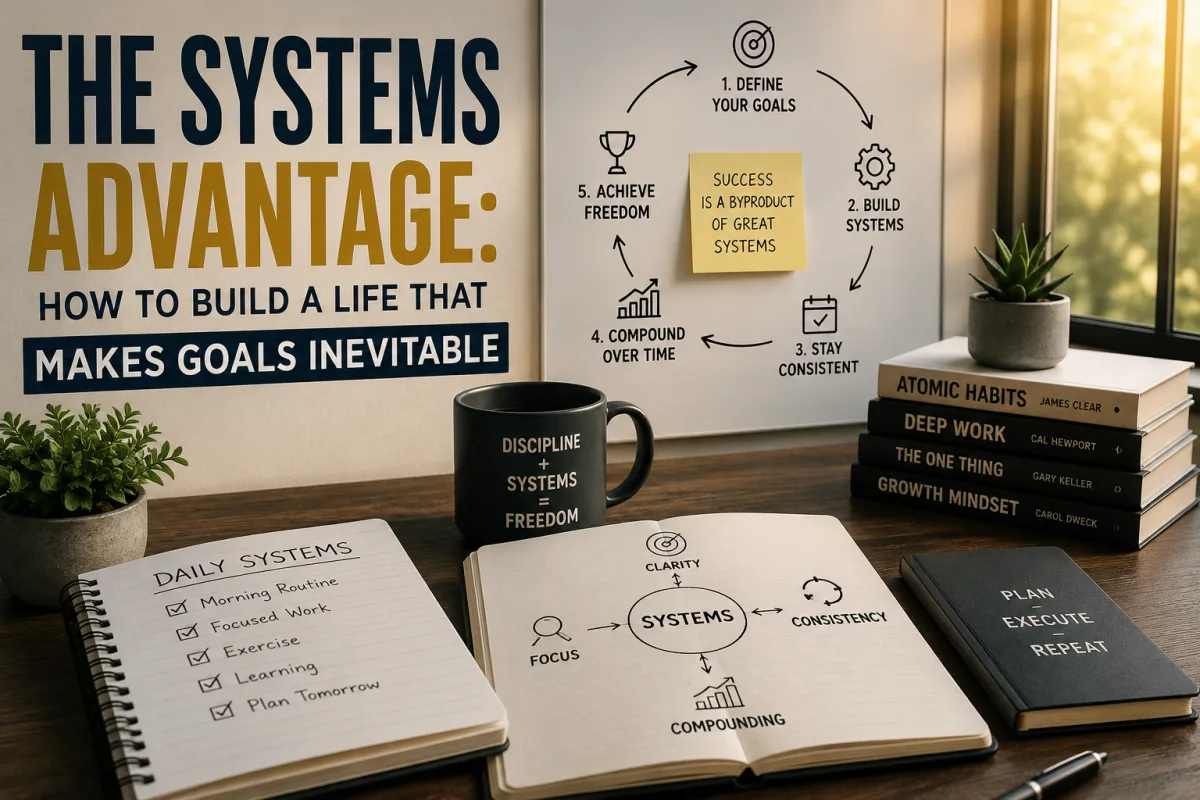
The Systems Advantage: How to Build a Life That Makes Goals Inevitable
Most people do not fail because their goals are too small. They fail because their systems are too weak.
A goal is a desired result. A system is the structure that produces results repeatedly. The goal says, “I want to save more money.” The system says, “Every payday, 20 percent of my income moves automatically into separate accounts before I can spend it.” The goal says, “I want to get in shape.” The system says, “I train three mornings a week, keep simple food in the house, and track the one number that tells me whether I am improving.” The goal says, “I want to build wealth.” The system says, “I increase income, control lifestyle inflation, invest automatically, review my finances monthly, and build assets that compound.”
The difference is not cosmetic. Goals depend on motivation. Systems depend on design.
Motivation rises and falls. Design remains when motivation disappears. Anyone can feel inspired on January 1, after a painful financial mistake, after seeing someone else succeed, or after reaching a breaking point. But inspiration is not a plan. It is a spark. A system is the engine.
This is why so many people repeat the same year financially, professionally, physically, and personally. They set goals, feel hope, make a brief effort, lose momentum, become discouraged, and eventually start again with a slightly different version of the same ambition. The issue is not that they lack desire. The issue is that desire has not been converted into structure.
Wealth is especially unforgiving in this regard. Nobody becomes financially secure by wanting security. Nobody builds assets by admiring investors. Nobody escapes debt by feeling bad about debt. Nobody creates a valuable business by dreaming about freedom. Progress requires repeated behavior, and repeated behavior requires a system that makes the right action easier than the wrong one.
The systems advantage is the ability to create conditions where progress happens consistently, even on ordinary days. It is not about becoming a machine. It is about accepting human nature and building around it. People get tired. People procrastinate. People avoid discomfort. People forget. People are influenced by their environment. People drift toward convenience. Good systems do not deny these realities. They account for them.
The person with strong systems does not need to be heroic every day. Their calendar protects priorities. Their money moves automatically. Their environment reduces temptation. Their routines lower decision fatigue. Their feedback loops reveal whether they are improving. Their relationships reinforce standards. Their identity supports the behavior they want to repeat.
That is how goals become more than wishes.
Why Goals Alone Are Not Enough
Goals are useful. They provide direction, urgency, and meaning. A person who has no goals may drift. But goals alone are incomplete because they describe the destination without explaining the machinery that will carry someone there.
“I want to earn more money” is not a system. “I will apply for better jobs” is closer, but still incomplete. A real system would specify which roles, which companies, how many applications per week, how the resume will be improved, who will review it, how interviews will be practiced, how progress will be tracked, and when the strategy will be adjusted.
“I want to invest more” is not a system. “I will invest when I have extra money” usually fails because extra money rarely appears by accident. A real system automatically transfers money into investment accounts before lifestyle spending expands.
“I want to read more” is not a system. A system places a book next to the bed, removes the phone from the bedroom, schedules 20 minutes before sleep, and tracks completed chapters.
The failure of goals usually comes from three weaknesses. The first is vagueness. A vague goal cannot direct behavior. “Be better with money” means almost nothing. Does it mean pay off debt, save more, earn more, invest more, stop impulse spending, improve credit, build a business, or learn financial principles? Without clarity, the mind has nothing concrete to execute.
The second weakness is dependence on emotional intensity. At the moment a goal is set, the desired outcome feels vivid. Later, the old environment returns. Work becomes demanding. Friends invite spending. Bills arrive. Energy drops. The goal still exists, but the emotional force behind it fades. Without a system, the old pattern wins.
The third weakness is lack of feedback. Many people do not know whether they are on track until failure becomes obvious. They discover too late that spending exceeded income, training was inconsistent, a project fell behind, or a business idea was never tested. Systems include measurement. Measurement turns vague hope into visible progress.
Goals tell you what you want. Systems tell you what to do when life becomes ordinary again.
The Financial Lesson Hidden Inside Systems
Personal finance is one of the clearest examples of systems thinking because money rewards consistency more than intensity.
A person can feel extremely motivated to save after watching a video about wealth. They may cut expenses for a week, cancel a subscription, avoid restaurants, and promise to change. But if their paycheck still lands in one account, bills are paid manually, credit cards remain easy to use, spending is not tracked, and savings happen only after everything else, the old system remains in control.
Financial systems decide financial outcomes long before willpower enters the conversation.
Consider two people earning the same income. The first person receives a paycheck, spends throughout the month, pays bills as they arrive, saves whatever remains, and occasionally invests when reminded. The second person has automatic transfers into emergency savings, retirement accounts, investment accounts, tax reserves, debt payments, and a spending account. The first person is relying on discipline after exposure to temptation. The second person has designed a system that removes temptation before it appears.
Over ten years, the difference can be enormous. The second person does not need to make better decisions every day. They made one better design decision that repeats.
This is the heart of wealth building. Small, repeatable actions become powerful when they are automated, protected, and allowed to compound. Paying yourself first is a system. Dollar-cost averaging is a system. Monthly net worth tracking is a system. Annual insurance review is a system. Debt snowball or debt avalanche repayment is a system. Business cash flow forecasting is a system. Tax planning before the end of the year is a system.
Without systems, people treat money emotionally. They spend when stressed, save when scared, invest when excited, sell when anxious, and borrow when impatient. With systems, money becomes governed by rules created during calm moments.
This matters because wealth is rarely built through one dramatic decision. It is usually built through repeated decisions that are boring at the time and powerful in hindsight. The automatic investment that feels small at first becomes meaningful after years. The avoided lifestyle upgrade creates room for assets. The monthly debt payment creates freedom. The regular skill-building routine raises earning power. The annual review prevents financial drift.
Systems turn financial wisdom into behavior.
Start With the Outcome, Then Build the Process Backward
A strong system begins with a clear outcome, but it does not stop there. Once the outcome is defined, the process must be reverse-engineered.
Suppose the goal is to save $12,000 in one year. The number is clear, but the system needs translation. That goal requires saving $1,000 per month, about $231 per week, or roughly $33 per day. The next question is not whether the goal feels inspiring. The next question is whether the current financial structure makes that behavior likely.
Where will the money come from? Will income increase, expenses decrease, or both? When will transfers happen? Which account will hold the money? How will progress be reviewed? What expenses usually interrupt saving? What happens during months with irregular costs? What rule prevents the savings from being spent?
Once those questions are answered, the goal becomes operational.
The same process applies to career growth. If the goal is to move into a higher-paying role within twelve months, the system might include skill acquisition, portfolio development, networking, interview practice, and application targets. A person might schedule two evenings per week for skill-building, one lunch per week for relationship-building, one Saturday morning per month for portfolio improvement, and a weekly review of job market requirements. The system converts ambition into calendar commitments.
Reverse-engineering works because it reveals the true cost of a goal. Many people set goals without understanding the required behavior. They want the outcome but have not accepted the process. A system forces honesty. If the desired result requires three hours of weekly practice, monthly financial reviews, difficult conversations, reduced spending, or repeated rejection, it is better to know that early.
A goal without a process is a fantasy. A process without a goal is busyness. The best systems connect both.
Build Around Identity, Not Just Activity
Systems work better when they are connected to identity.
Identity answers the question, “What kind of person am I becoming?” Activity answers, “What am I doing?” The difference matters because behavior that conflicts with identity feels temporary. Behavior that supports identity feels natural over time.
A person who says, “I am trying to save money” may treat saving as a temporary restriction. A person who says, “I am the kind of person who pays myself first” begins to build a different self-image. A person who says, “I need to work out” may negotiate with themselves every morning. A person who says, “I do not miss scheduled training” has a stronger standard.
Identity is not magic. It does not replace action. But it gives action emotional consistency. Every repeated behavior becomes evidence. When you invest automatically, you are proving that you are an investor. When you review your spending, you are proving that you are financially responsible. When you study a valuable skill every week, you are proving that you are a builder. Over time, the system trains the identity, and the identity protects the system.
This is especially important for wealth. Many people secretly identify as spenders even while wanting to become investors. They see investing as deprivation because spending feels like self-expression. Others identify as employees even while wanting to build businesses. They want ownership but think only in terms of permission, salary, and job titles. Some identify as people who are “bad with money,” and that identity becomes an excuse for not learning.
Changing financial outcomes often requires changing financial identity. You do not need to pretend to be rich. You need to become the kind of person who behaves in ways that build wealth.
A useful identity statement is specific and behavioral. “I am a disciplined wealth builder” is better than “I want to be rich.” “I am a person who invests before spending” is better than “I hope to save more.” “I am an owner, not only a consumer” is better than “I need more money.”
The system should then support that identity. If you identify as an owner, you need regular asset purchases. If you identify as a serious professional, you need structured skill development. If you identify as a healthy person, your environment must contain healthy defaults. Identity without evidence becomes self-deception. Evidence turns identity into belief.
Design the Environment Before Demanding More Discipline
Environment is stronger than willpower.
People like to believe they make independent choices, but much of daily behavior is shaped by surroundings. The food in the kitchen, the apps on the phone, the people in the group chat, the route home from work, the layout of the desk, the subscriptions on autopay, the notifications on the screen, and the default settings on financial accounts all influence behavior.
A person trying to spend less while keeping shopping apps, saved credit cards, promotional emails, and constant social comparison is fighting their own environment. A person trying to focus while working beside a phone full of alerts is making concentration unnecessarily difficult. A person trying to eat better while keeping only convenient junk food nearby is depending on heroic discipline every day.
Good systems reduce the need for heroism.
To build a better environment, begin by asking two questions. What makes the desired behavior harder? What makes the undesired behavior easier? Then reverse those conditions.
If the goal is to save money, remove saved card details from shopping websites, unsubscribe from promotional emails, create a 48-hour rule for nonessential purchases, and keep savings in a separate account that is not connected to daily spending. If the goal is to read more, place books where the phone usually sits. If the goal is to build a business, create a distraction-free workspace and block recurring time. If the goal is to exercise, prepare clothes the night before and choose a gym on the route you already travel.
The environment should make the next right action obvious.
This principle is also powerful in business. Companies achieve goals through environmental design. Sales teams use dashboards, scripts, customer relationship management systems, and pipeline reviews. Manufacturers use checklists, quality controls, and standard operating procedures. Investment firms use research templates, risk limits, and approval committees. Serious organizations do not rely on everyone remembering everything. They design environments where the desired behavior is built into the workflow.
Your personal life deserves the same seriousness.
Create Rules Before You Need Them
The worst time to make a financial decision is often when emotions are high.
People make poor choices when they are tired, excited, embarrassed, jealous, afraid, or under pressure. They buy investments during hype. They sell during panic. They overspend after a stressful week. They agree to commitments because they do not want to disappoint someone. They abandon goals because one difficult day feels like proof of failure.
Rules protect you from emotional negotiation.
A good rule is simple, clear, and created before the moment of temptation. “I wait 48 hours before any nonessential purchase over $200.” “I invest 15 percent of every paycheck before discretionary spending.” “I do not borrow money for depreciating lifestyle purchases.” “I review investment decisions when calm, not during market panic.” “I do not check work messages during my first hour of deep work.” “I never miss twice.”
Rules are not meant to make life rigid. They are meant to preserve priorities.
Financial rules are especially valuable because money touches emotion. A person may create a rule that every bonus is divided into three parts: taxes, investments, and enjoyment. Another may set a rule that any raise increases investing before lifestyle spending. A business owner may decide that profit distributions occur only after tax reserves, operating reserves, and reinvestment targets are met. These rules turn unpredictable income into structured progress.
Rules should be reviewed occasionally, but not constantly. A rule that changes every time it becomes inconvenient is not a rule. It is a suggestion. The strength of a rule is that it removes debate.
The top financial performers often have personal investment policies, business operating principles, spending guidelines, and risk limits. They know what they do before the market, the client, the salesperson, or the emotion demands an answer.
Ordinary discipline asks, “What do I feel like doing?” A system asks, “What did I already decide?”
Use Automation to Protect Your Future From Your Present Mood
Automation is one of the most effective tools for achieving goals because it removes repeated choice.
Every manual decision is a chance to fail. If saving money requires remembering, deciding, resisting temptation, logging into an account, and making a transfer, failure points multiply. If the transfer happens automatically on payday, the system wins before emotion enters.
Automation is especially powerful for wealth building. Automatic saving, automatic investing, automatic debt repayment, automatic bill payment, automatic tax reserves, and automatic retirement contributions create financial consistency. They also reduce decision fatigue. Instead of deciding every month whether to act, you make the decision once and let the system repeat it.
Automation does not mean ignoring your finances. It means automating the behaviors that should happen consistently and reviewing the system at scheduled intervals. Autopilot without review can create problems. Subscriptions can accumulate. Investment allocations can drift. Bills can rise unnoticed. A strong system combines automation with oversight.
One useful approach is to divide money immediately when it arrives. Income can flow into separate buckets: necessities, emergency savings, investing, taxes, debt repayment, future purchases, giving, and discretionary spending. Once the money is separated, each account has a job. This reduces the illusion that all available cash is spendable.
Automation can also support nonfinancial goals. Calendar blocks can repeat. Reminders can trigger reviews. Apps can limit distractions. Meal deliveries can support nutrition. Recurring appointments can maintain health. Scheduled study sessions can support skill growth.
The deeper principle is that future success should not depend entirely on present mood. You are not the same person every day. Some days you are focused. Some days you are distracted. Some days you are optimistic. Some days you are tired. Automation allows your best decisions to continue operating when your energy is lower.
A mature system is an agreement between your wise self and your future inconsistent self.
Build Feedback Loops That Tell the Truth
A system without feedback becomes guesswork.
Feedback loops show whether behavior is producing the desired result. They reveal problems early. They create accountability. They turn progress into something visible.
In finance, feedback loops include net worth tracking, monthly spending reviews, debt balances, investment contribution rates, savings rates, cash flow reports, credit score monitoring, and business profit and loss statements. In career development, they include applications submitted, interviews secured, skills completed, projects shipped, revenue generated, and feedback from managers or clients. In health, they include workouts completed, sleep quality, energy levels, body measurements, medical markers, and performance metrics.
The key is to measure what matters, not everything that can be measured.
Too many metrics create noise. Too few create blindness. A strong system identifies the few numbers that reveal whether the system is working. For personal wealth, the most useful metrics are often income, savings rate, investment contributions, debt reduction, net worth, and asset income. For a business, they may include revenue, gross margin, cash flow, customer acquisition cost, retention, and profit. For a career, they may include skill growth, market value, network strength, and opportunities created.
Feedback should be frequent enough to guide behavior but not so frequent that it creates anxiety. Checking investment balances every hour is not a useful feedback loop. Monthly or quarterly portfolio reviews may be enough for long-term investors. Daily spending awareness may help someone escaping debt, while a monthly review may work for someone with stable habits.
A good feedback loop leads to adjustment. If savings are not increasing, the system must change. If a business is busy but not profitable, pricing or costs must change. If a career goal is not moving, the strategy may require better skills, better relationships, or a different market.
The truth can be uncomfortable, but delayed truth is more expensive. Feedback loops allow small corrections before they become large failures.
Protect Focus Like Capital
Focus is a wealth-building asset.
Money grows when capital is allocated to productive assets. Progress grows when attention is allocated to meaningful work. A person who constantly fragments attention across messages, entertainment, shallow tasks, and other people’s priorities has little mental capital left for deep goals.
The modern world is built to capture attention. Notifications, feeds, news cycles, emails, meetings, and entertainment platforms compete for the hours that could be used to build skills, assets, relationships, health, or businesses. Without a focus system, the day gets spent before it is chosen.
Protecting focus begins with identifying the work that actually moves the goal forward. For wealth, that may mean sales, product development, investing, learning valuable skills, negotiating, creating, or improving operations. These tasks often require deep concentration. They are also easy to avoid because they are demanding.
A focus system gives these tasks protected space. It may include morning deep work, phone-free blocks, email windows, meeting limits, weekly planning, and a clear shutdown routine. The goal is not to eliminate all distractions forever. The goal is to place the most important work before the day becomes reactive.
Many people reverse this order. They begin with messages, respond to others, browse, handle small tasks, and then hope to work on meaningful goals later. By then, attention is depleted. The system has protected urgency instead of importance.
For financial goals, focus also means avoiding too many strategies. A person trying to build wealth may jump between day trading, real estate, online business, cryptocurrency, career changes, side hustles, and content creation without mastering any. Variety feels productive because it creates stimulation. Focus feels slower because it requires depth. But depth usually produces value.
A strong system limits active priorities. One major financial goal at a time may be enough: paying off high-interest debt, building an emergency fund, increasing income, acquiring a first rental property, launching a business, or investing consistently. Once the system is stable, another layer can be added.
Focus is not merely concentration. It is strategic refusal. Every serious goal requires saying no to attractive distractions.
Reduce Friction for Good Behaviors
Every behavior has friction. Friction is anything that makes action harder: time, confusion, effort, distance, uncertainty, embarrassment, setup, cost, or emotional resistance.
Systems work when they reduce friction for good behaviors and increase friction for bad ones.
If investing requires navigating a confusing platform, calculating amounts manually, and deciding which fund to buy every month, friction is high. If contributions are automatic and the investment plan is predetermined, friction is low. If exercising requires a long drive, searching for clothes, and deciding on a workout, friction is high. If the gym is nearby, clothes are ready, and the workout is written down, friction is low.
Many people blame themselves for lack of discipline when the real issue is bad design. They have made the right behavior inconvenient and the wrong behavior effortless.
To reduce friction, simplify the starting point. A person who wants to write a book may create a system of writing 500 words every weekday before checking messages. A person who wants to improve finances may begin with a weekly 20-minute money review instead of a complicated budgeting system. A person who wants to learn a high-income skill may keep the course open, schedule recurring study blocks, and remove competing distractions.
Starting friction is especially important. Once a person begins, momentum often helps. The challenge is crossing the threshold. Systems should make that threshold small. Put the notebook on the desk. Keep the savings app visible. Schedule the transfer. Lay out the clothes. Preload the document. Prepare the agenda.
Increasing friction for bad behaviors is equally useful. Delete apps. Remove saved payment information. Keep credit cards away from the phone. Add waiting periods. Require written justification for large purchases. Block distracting websites during work hours. Make impulsive behavior less convenient.
Human behavior follows the path of least resistance more often than people like to admit. The wise person designs the path.
Plan for Failure Before It Happens
A system that assumes perfect behavior will eventually break.
People miss workouts. Budgets fail. Projects stall. Markets fall. Emergencies happen. Children get sick. Clients delay payment. Motivation disappears. Travel interrupts routines. A strong system expects disruption and includes recovery rules.
One of the most useful recovery rules is simple: never miss twice. Missing once is human. Missing twice can become a new pattern. If you skip one workout, return at the next scheduled session. If you overspend one weekend, review and reset immediately. If you miss one writing day, write the next day. The rule prevents a single failure from becoming an identity.
Financial systems also need contingency planning. An emergency fund exists because life does not follow a spreadsheet. Insurance exists because catastrophic risks can overwhelm savings. Conservative debt levels exist because income can change. Diversification exists because predictions can fail.
Goal systems need the same realism. If your plan depends on waking up at 5 a.m. every day despite sleeping at midnight, it may fail. If your savings plan leaves no room for irregular expenses, it may collapse. If your business plan assumes every month will grow smoothly, it may disappoint. If your study plan requires five perfect evenings a week, one busy week can destroy momentum.
Design the minimum version of your system for difficult periods. What is the smallest action that keeps the chain alive? A ten-minute workout. A $25 investment transfer. A five-minute review. One sales call. One page read. One paragraph written. The minimum action is not the goal forever. It is the bridge through disruption.
Resilience is a system feature. It is what allows progress to continue after imperfection.
Create Weekly and Monthly Reviews
Reviews are where systems become intelligent.
Without review, people confuse activity with progress. They may stay busy while moving in circles. A weekly review asks what happened, what matters next, and what needs adjustment. A monthly review looks at larger patterns.
A useful weekly review can be simple. What were the most important wins? What did not get done? Why? What are the top priorities for next week? What obstacles are likely? What must be scheduled now? This review turns experience into planning.
A monthly financial review might include income, expenses, savings rate, debt balances, investments, net worth, upcoming bills, and one improvement for the next month. The purpose is not self-criticism. The purpose is visibility.
Monthly reviews are especially powerful because many financial leaks are small and recurring. Subscription creep, dining out, convenience purchases, unused memberships, bank fees, rising insurance costs, and interest charges may not feel dramatic individually. Together they can consume the capital needed for wealth building.
Reviews also create confidence. People often avoid looking at numbers because they fear bad news. But uncertainty is usually worse than truth. Once the numbers are visible, action becomes possible. Debt can be organized. Spending can be adjusted. Income gaps can be addressed. Progress can be celebrated.
Business owners already understand this principle. A company that never reviews financial statements, sales pipelines, customer complaints, or operating metrics is flying blind. A personal financial life deserves similar management.
The review is the meeting where you become the chief executive of your own life.
Make Standards More Important Than Moods
High achievement is built on standards.
A standard is a non-negotiable level of behavior. It does not depend entirely on mood. A person with a standard of financial responsibility pays bills on time, avoids reckless debt, and reviews money regularly. A person with a standard of professional excellence prepares well, communicates clearly, and improves skills. A person with a standard of health moves their body even when motivation is low.
Goals describe what you want to reach. Standards describe how you operate.
The top performers in any field tend to have standards that remove debate. They do not ask whether basic responsibilities matter. They know. This does not mean they are perfect. It means they return to the standard quickly after deviation.
Financial standards can be transformative. “I do not carry high-interest credit card balances.” “I invest before upgrading lifestyle.” “I keep three to six months of essential expenses available.” “I understand an investment before buying it.” “I do not make major financial decisions under social pressure.” “I negotiate compensation.” “I protect my earning power through learning.”
These standards become a personal constitution. They simplify decisions because behavior is already defined.
Standards also shape relationships. If you are surrounded by people whose standards conflict with your goals, your system will be under constant pressure. A person trying to build wealth while spending most of their time with people who mock saving, normalize debt, or equate success with consumption will face friction. This does not require abandoning everyone. It requires awareness. Your environment includes people, not only objects.
Raise standards gradually. A standard that is too far from current behavior may produce shame instead of progress. Start with one or two standards that matter most. Keep them visible. Build evidence. Then add more.
A life changes when standards become stronger than excuses.
Use Constraints to Create Better Systems
Constraints are often seen as obstacles, but they can improve design.
A person with unlimited time may procrastinate. A person with two focused hours must choose carefully. A business with unlimited funding may waste capital. A business with limited resources must discover what customers truly value. A household with a clear spending limit must prioritize.
Good systems use constraints to sharpen behavior.
A budget is a constraint. It does not exist to punish you. It exists to direct money toward priorities. A calendar block is a constraint. It protects time from being consumed by noise. A rule against taking on new projects before finishing current ones is a constraint. It protects focus. A debt limit is a constraint. It protects future cash flow.
Constraints force trade-offs, and trade-offs reveal values. If you say wealth matters but every dollar flows to lifestyle, the system reveals the truth. If you say health matters but the calendar contains no time for movement or sleep, the system reveals the truth. If you say family matters but work occupies every unprotected hour, the system reveals the truth.
Constraints are useful because they turn values into boundaries.
One powerful financial constraint is living on a percentage of income rather than the full amount. For example, a person may decide to live on 70 percent, invest 20 percent, and reserve 10 percent for giving or future goals. The percentages can vary, but the principle matters. The constraint prevents lifestyle from automatically expanding with income.
Another useful constraint is limiting major goals. A person may choose only three active priorities per quarter. This prevents the illusion that everything can be transformed at once. Progress accelerates when attention is concentrated.
Constraints are not cages. They are rails. They keep the system aligned with the destination.
Turn One-Time Effort Into Reusable Assets
A strong system looks for ways to make effort reusable.
This is one of the most important principles in wealth building. Poor systems require starting from zero every time. Strong systems convert work into assets, templates, checklists, processes, knowledge bases, scripts, automations, and investments that continue producing value.
A consultant who writes every proposal from scratch has a weak system. A consultant who builds a proposal template, case study library, pricing framework, onboarding checklist, and delivery process has a stronger system. A business owner who answers the same employee questions repeatedly has a weak system. A business owner who creates training materials and standard procedures has leverage. A household that solves the same financial problem every month has a weak system. A household that automates bills, sets categories, and reviews spending has a stronger system.
Reusable assets reduce future effort. They also improve quality because each repetition can refine the asset.
This principle applies to personal goals. A meal plan can become reusable. A workout routine can become reusable. A study schedule can become reusable. A morning routine can become reusable. A financial dashboard can become reusable. Once built, these assets reduce the need to invent life every day.
In business and investing, reusable systems are often the difference between income and ownership. If a person’s knowledge exists only in their head, they must be present for value to be delivered. If that knowledge becomes a process, product, course, software tool, operating manual, or trained team, value can scale.
The question to ask is simple: what am I doing repeatedly that could be turned into a reusable asset?
Answering that question can unlock time, income, and freedom.
Build Systems That Match Your Real Life
A system only works if it fits the person using it.
Many people fail because they copy systems designed for someone else’s life. They adopt a morning routine from a person with no children, a budget from someone with a different income, a workout plan from a professional athlete, or a productivity method from an entrepreneur with full schedule control. The system may be excellent in theory and unrealistic in practice.
Your system must respect your season of life, obligations, energy patterns, income volatility, family responsibilities, health, personality, and work demands. A young single professional may have more flexibility for intense skill-building. A parent with small children may need shorter routines and stronger automation. A business owner may need cash flow systems more than personal productivity hacks. A person recovering from burnout may need a system built around energy restoration before aggressive growth.
Realistic does not mean easy. It means executable.
A good system stretches you without breaking you. It asks for progress, not fantasy. If you can only commit to three focused workouts per week, build that system and make it consistent. If you can invest $100 per month, automate it and increase later. If you can study four hours per week, protect those hours instead of pretending you will study fifteen.
Consistency at a smaller scale beats inconsistency at an impressive scale.
Systems should evolve. A system that worked during one stage may not work forever. Income changes. Family needs change. Career demands change. Health changes. Goals change. The point is not to worship the system. The point is to use it as a tool.
The best system is the one you can actually live with long enough for compounding to begin.
The Wealth-Building System: A Practical Model
For readers focused on financial progress, a simple wealth-building system can be built around five pillars: earning, controlling, saving, investing, and protecting.
The earning system increases income. It includes skill development, career strategy, negotiation, business building, sales, networking, and reputation. Income is the raw material of wealth. Without sufficient income, saving and investing become harder. A strong earning system asks: what skill will increase my market value? Who needs to know my work? What opportunities am I pursuing? How am I improving my ability to create value?
The controlling system manages spending. It does not require extreme frugality. It requires intentionality. Money should flow toward values and assets, not unconscious leakage. This system includes budgets, spending categories, purchase rules, subscription reviews, and lifestyle inflation controls.
The saving system creates liquidity. Emergency funds, short-term reserves, sinking funds, and tax accounts prevent life from forcing bad decisions. Savings are not failed investments. They are shock absorbers.
The investing system buys assets. This may include retirement accounts, brokerage investments, real estate, business equity, or other vehicles appropriate to the person’s knowledge and risk tolerance. The investing system should be consistent, diversified where appropriate, and aligned with long-term goals.
The protecting system defends progress. It includes insurance, estate planning, debt management, cybersecurity, legal documents, health maintenance, and risk limits. Many people focus only on growth and ignore protection. But unprotected wealth is fragile.
These five systems work together. Income without spending control disappears. Saving without investing may fail to build long-term wealth. Investing without protection can be undone by emergencies. Protection without earning power may be insufficient. The system is strongest when each pillar supports the others.
Why Systems Create Freedom
Some people resist systems because they associate them with restriction. They imagine routines, rules, budgets, and reviews as limitations. In reality, good systems create freedom.
A budget creates freedom from financial confusion. An emergency fund creates freedom from panic. Automatic investing creates freedom from constant decision-making. A calendar creates freedom from other people controlling your time. A health routine creates freedom from preventable decline. A business process creates freedom from being the bottleneck. A learning system creates freedom from stagnation.
Freedom is not the absence of structure. Freedom is the result of the right structure.
A musician practices scales to gain freedom in performance. An athlete trains fundamentals to gain freedom in competition. A business builds processes to gain freedom to scale. An investor follows principles to gain freedom from emotional markets. Structure makes excellence repeatable.
The same is true in personal life. Without systems, urgent demands dominate. With systems, important priorities have a place to live. Without systems, money drifts. With systems, money receives direction. Without systems, goals remain dependent on mood. With systems, progress continues through ordinary days.
This is the quiet power of systems. They reduce the number of times you must win the same argument with yourself.
How to Start Today
The mistake is trying to build every system at once.
Choose one goal that matters. Make it specific. Then identify the repeated behavior that would make success likely. Build the smallest system that supports that behavior.
If the goal is financial stability, start with a weekly money review and automatic savings transfer. If the goal is debt freedom, list every debt, choose a repayment method, automate minimums, schedule extra payments, and review progress monthly. If the goal is higher income, schedule weekly skill-building and relationship-building blocks. If the goal is better health, create a repeatable training schedule and prepare the environment. If the goal is building a business, protect time for sales and product development before less important tasks.
Start small enough to repeat. A system that survives the first month is more valuable than an ambitious plan abandoned after four days.
Once the system works, improve it. Increase the savings rate. Add a second workout. Raise the outreach target. Improve the dashboard. Refine the routine. Automate another step. Remove another source of friction. Systems compound through refinement.
The goal is not perfection. The goal is reliable progress.
The Final Lesson: Build the Machine, Then Trust the Machine
People overestimate what can be achieved through intensity and underestimate what can be achieved through well-designed repetition.
One weekend of financial planning will not create wealth. A monthly money system can. One burst of networking will not transform a career. A weekly relationship-building system can. One inspired workout will not change health. A repeatable training system can. One business idea will not create freedom. A system for testing, selling, delivering, and improving can.
Goals matter because they point to the future. Systems matter because they shape the present. The future is built through the present repeated.
To achieve your goals, stop asking only how badly you want them. Ask what structure would make them likely. Ask what environment would support them. Ask what rules would protect them. Ask what feedback would reveal progress. Ask what automation would remove friction. Ask what identity would sustain the behavior. Ask what review would keep the system honest.
The people who appear unusually disciplined often have unusually strong systems. Their success is not effortless. It is designed.
Build the system, and the goal stops being a distant wish. It becomes the natural result of how you live.
 Article
 Article
 Article
 Article
 Article
 Article
 Article
 Article