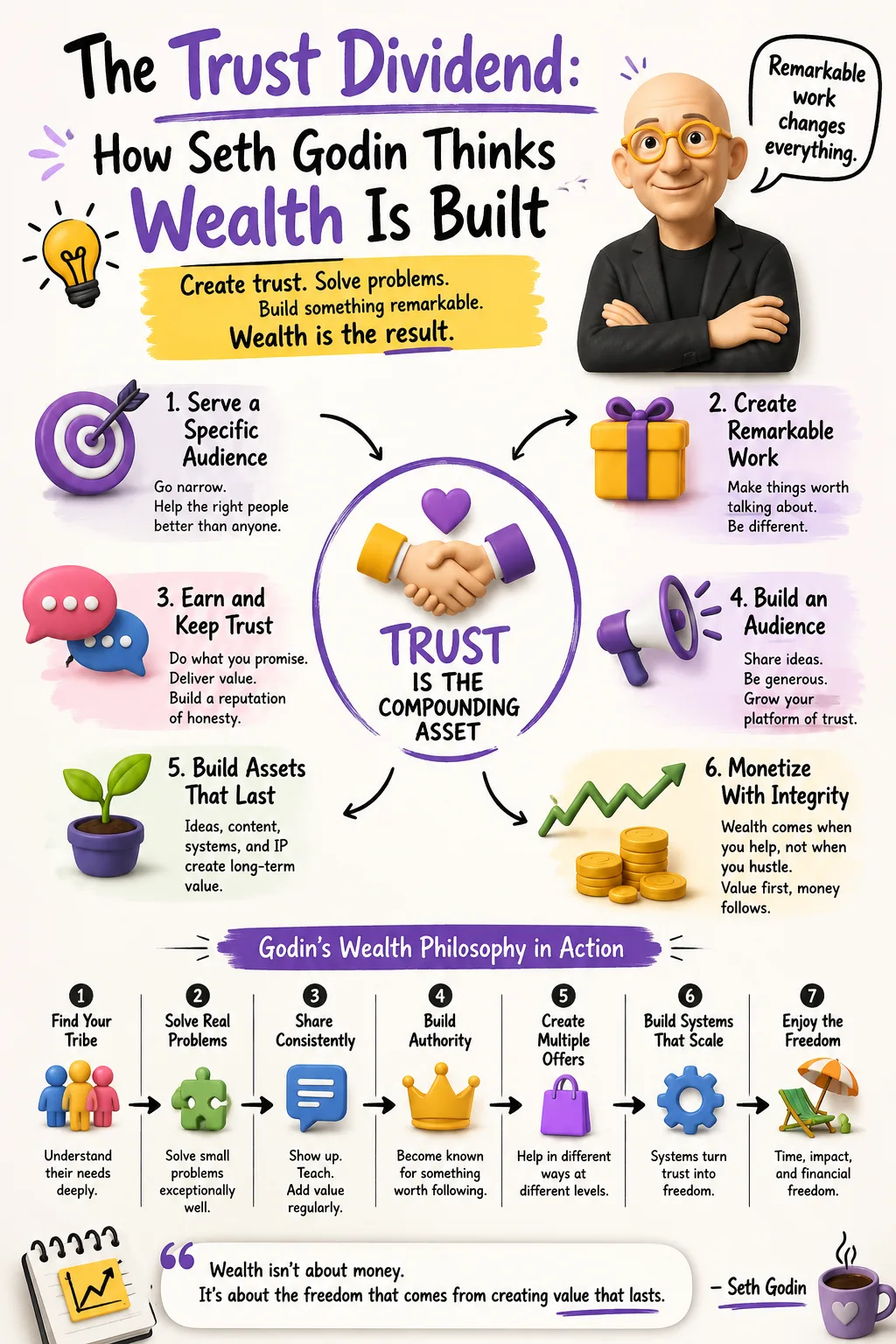
The Trust Dividend: How Seth Godin Thinks Wealth Is Built
Seth Godin’s philosophy of wealth begins with a quiet but demanding question: would anyone miss your work if it disappeared?
That question cuts through much of modern business noise. It is not asking whether a person is busy, visible, credentialed, optimized, or active on every platform. It is asking whether the work matters enough to earn trust, attention, loyalty, and word of mouth.
Godin’s approach to wealth is different from the formulas offered by investors, real estate entrepreneurs, sales trainers, or technology founders. He does not begin with leverage, capital markets, aggressive scaling, or domination of an industry. He begins with meaning. Create something remarkable. Serve a specific audience. Earn permission. Build trust. Ship consistently. Become indispensable. Let reputation compound.
For Godin, wealth is not merely the accumulation of money. It is the economic result of becoming trusted by people who value what you make. A trusted creator can sell books, courses, workshops, consulting, software, communities, or ideas. A trusted company can command loyalty and premium pricing. A trusted professional can earn opportunities unavailable to someone who merely performs average work. A trusted brand can reduce the cost of persuasion because the market already believes its promise.
This philosophy is especially relevant in a crowded digital economy. Products are abundant. Content is endless. Advertising follows consumers everywhere. Artificial intelligence can now generate average words, images, and campaigns at extraordinary speed. In such a world, sameness becomes cheap. Trust becomes scarce. Originality becomes more valuable. Human judgment, taste, generosity, and consistency become differentiators.
Godin’s most influential ideas, including the “purple cow,” permission marketing, the smallest viable audience, and the linchpin, all point toward the same principle: do not try to win by being slightly cheaper, louder, or more persistent than everyone else. Win by being meaningfully different for the people you are best positioned to serve.
His philosophy is not a shortcut. Building trust takes time. Serving a niche can feel small before it becomes powerful. Shipping creative work exposes a person to judgment. Intellectual property does not automatically produce income. A remarkable product still needs distribution. Generosity must be paired with a sustainable business model.
Yet the long-term lesson is powerful. Wealth can be built by creating work that people choose to talk about, return to, pay for, recommend, and trust. The economic value comes not from interruption, but from permission. Not from manipulating attention, but from earning it. Not from trying to serve everyone, but from serving the right people deeply enough that they become believers.
To understand how to get rich according to Seth Godin, the key is to understand his operating system: create remarkable work, choose the smallest viable audience, build trust through consistency, teach instead of interrupt, create intellectual property, ship before perfection, become indispensable, play long-term games, and practice generosity as a serious business strategy.
Be Remarkable or Be Invisible
One of Godin’s most famous ideas is the “purple cow.” A brown cow in a field is ordinary. A purple cow is remarkable. People notice it. They talk about it. It interrupts not because it is loud, but because it is worth noticing.
In business, being remarkable means creating something distinctive enough that people voluntarily remark on it. A remarkable product solves a problem in a way customers remember. A remarkable service makes people feel seen. A remarkable professional brings unusual judgment, care, creativity, or courage to the work. A remarkable brand creates an experience that customers want to share.
This matters because average work is difficult to market. When products are similar, companies compete on price, advertising spend, convenience, or distribution muscle. The business must keep pushing itself into the customer’s attention. That can be expensive and exhausting. Remarkable work changes the economics because customers become part of the distribution system.
Word of mouth is not magic. It is the social consequence of difference. People talk about what surprises them, helps them, delights them, challenges them, or gives them status when they share it. They rarely talk about something merely adequate.
Godin’s philosophy therefore places differentiation at the center of wealth creation. A person trying to get rich by doing ordinary work in an ordinary way faces intense competition. A person who creates something meaningfully different for a specific audience has a better chance of earning attention, trust, and pricing power.
Remarkable does not always mean extravagant. A remarkable accountant may explain tax issues with unusual clarity. A remarkable software company may remove a painful workflow. A remarkable local restaurant may create a level of hospitality that people remember for years. A remarkable consultant may ask better questions than anyone else in the field. A remarkable teacher may make difficult ideas feel accessible.
The key is not novelty alone. Something can be unusual and still useless. Godin’s version of remarkable requires relevance. It must matter to the audience. It must create value they recognize.
This is where many businesses make a mistake. They try to be different in ways customers do not care about. They redesign packaging but ignore service. They use clever slogans but fail to solve the real problem. They chase trends but neglect trust. Difference without usefulness is decoration. Useful difference is strategy.
For wealth builders, the practical question is direct: what makes your work worth choosing, remembering, and recommending? If the answer is unclear, the market will probably treat you as replaceable. If the answer is strong, you have the beginning of an economic advantage.
The Smallest Viable Audience
Godin often advises creators and entrepreneurs to focus on the smallest viable audience. This idea runs against the instinct to chase mass appeal immediately. Many people want everyone to like their product, follow their work, buy their service, or recognize their brand. Godin argues that trying to serve everyone usually leads to average work.
The smallest viable audience is the smallest group of people who can support the work and who will be meaningfully changed by it. It is not a tiny audience for the sake of being tiny. It is a focused audience large enough to sustain the project and specific enough to serve deeply.
This is a powerful wealth principle because specificity increases relevance. When a business knows exactly whom it serves, it can design better products, write clearer messages, solve sharper problems, and build stronger loyalty. The offer does not need to persuade everyone. It needs to resonate deeply with the right people.
A financial educator serving young physicians with student debt can speak more clearly than one trying to serve every adult with money questions. A software company built for independent architects can design more precise tools than one trying to serve every professional services firm. A consultant helping family-owned manufacturers modernize operations can build deeper authority than a general business coach with vague promises.
Niche focus also improves marketing efficiency. The business knows where the audience gathers, what language they use, what they fear, what they value, and what problem they are trying to solve. Instead of broadcasting generic messages, it can communicate with precision.
Serving a small audience does not mean staying small forever. Many large brands began by serving a narrow group exceptionally well. A strong niche can become a foundation for expansion. But expansion should come after trust has been earned, not before the business understands whom it truly serves.
The smallest viable audience also protects against one of the great traps of modern marketing: vanity scale. A large audience with weak trust may be less valuable than a small audience with strong commitment. One hundred loyal customers who buy, refer, and believe in the work may be more economically powerful than ten thousand passive observers.
For individuals, this principle can reshape careers. Instead of trying to be generally employable, become uniquely valuable to a specific market. Instead of saying, “I do marketing,” become known for helping healthcare startups explain complex products. Instead of saying, “I write,” become known for translating technical research into executive communication. Specificity creates memory.
Godin’s insight is that wealth often begins when a clearly defined group says, “This is for us.”
Trust as the Ultimate Business Asset
Trust is central to Godin’s philosophy. It is also one of the most valuable economic assets a person or company can build.
Trust reduces friction. When customers trust a brand, they require less persuasion. When clients trust a professional, they share information more openly. When readers trust a writer, they return. When employees trust a leader, they commit more deeply. When investors trust a founder, they listen longer. Trust lowers the cost of every future transaction.
Unlike cash, trust does not appear neatly on a balance sheet. But it affects revenue, retention, referrals, pricing power, partnerships, and resilience during mistakes. A trusted company can recover from problems more easily than one with no goodwill. A trusted professional can launch new work with an audience already willing to pay attention.
Godin’s version of trust is built slowly through promises kept. It is not a branding trick. It comes from consistency, honesty, reliability, and generosity. The market watches what you do repeatedly. Over time, that pattern becomes your reputation.
This is why short-term tactics can be so expensive. A company may increase revenue temporarily through exaggerated claims, manipulative urgency, hidden fees, or aggressive advertising. But if customers feel misled, trust declines. The business may win a transaction while weakening its future.
Godin’s philosophy favors the opposite. Make promises carefully. Keep them. Teach the customer. Respect their attention. Do not pretend the product is for everyone. Do not pressure people who are not a fit. Over time, this creates a reputation that compounds.
Trust also supports premium pricing. People do not always choose the cheapest option when the stakes are meaningful. They choose the option they believe will work. A trusted surgeon, advisor, software provider, school, consultant, or brand can charge more because the buyer is paying for reduced uncertainty.
For wealth builders, the lesson is that reputation is not separate from income. It is upstream from income. A person who becomes known for doing excellent work, telling the truth, and serving a specific audience well creates future earning power.
The trust dividend is the financial return on years of consistent behavior.
Permission Marketing: Earned Attention Instead of Interruption
Godin’s concept of permission marketing changed how many people think about business communication. Traditional advertising often interrupts people. A commercial interrupts a show. A billboard interrupts a drive. A pop-up interrupts a website. The advertiser pushes a message into attention that the customer did not volunteer.
Permission marketing takes a different approach. The customer chooses to hear from the business because the communication is expected, personal, and relevant. An email newsletter people actually want to read is permission marketing. A podcast listeners subscribe to is permission marketing. A course, community, or educational series people opt into is permission marketing.
The wealth-building power of permission is that it turns attention into an asset. A company that has earned permission can communicate repeatedly with people who have raised their hands. It does not need to begin from zero every time. It has a relationship.
This is especially important in digital markets, where paid attention can become expensive and unreliable. Advertising costs can rise. Algorithms can change. Platforms can restrict reach. Competitors can bid for the same audience. But a trusted permission asset, such as an email list, member community, subscriber base, or direct customer relationship, gives the business more control.
Permission must be protected. People grant attention because they expect value. If the business abuses that permission with irrelevant promotions, excessive frequency, misleading claims, or low-quality content, the audience withdraws. Unsubscribing is the market’s way of reclaiming attention.
Godin’s approach asks marketers to replace interruption with service. Teach. Help. Explain. Curate. Invite. Create reasons for people to return voluntarily. The business earns the right to make offers because it has already created value.
For creators and professionals, permission marketing can become a core wealth strategy. A consultant who writes a useful newsletter builds an audience of potential clients. A teacher who publishes valuable lessons builds trust before selling a course. A software company that educates its users builds loyalty. A financial advisor who explains concepts clearly earns permission to be considered when help is needed.
The principle is simple: attention that is earned is more durable than attention that is bought, borrowed, or forced.
Create Instead of Interrupt
Godin’s philosophy pushes people to create value rather than chase attention through interruption. This distinction matters because modern consumers are increasingly skilled at ignoring noise.
People skip ads, filter emails, mute accounts, block calls, and distrust exaggerated claims. They are surrounded by messages competing for attention. In this environment, louder marketing often becomes less effective. The better path is to create something people want to seek out.
Creation can take many forms. A business can create educational content, diagnostic tools, useful frameworks, research reports, communities, events, templates, software, stories, or experiences. A professional can create insight that helps their market understand a problem. A creator can make work that helps people feel connected, capable, or changed.
Creating instead of interrupting does not mean never selling. It means selling from a foundation of earned trust. The offer arrives after the relationship has begun, not as a cold demand for attention.
This approach aligns with the economics of reputation. Each useful act becomes a small deposit. A helpful article, a thoughtful reply, a clear explanation, a generous resource, a reliable product, a kept promise. Over time, these deposits become trust. Trust becomes opportunity.
There is a risk that creators misunderstand generosity as giving everything away without a business model. Godin’s philosophy is not anti-commerce. It is anti-selfish marketing. A sustainable business must charge for value. The difference is that the sale is an extension of service, not a substitute for it.
A strong creator-business might publish free insights while charging for implementation, community, advanced training, tools, or advisory work. A software company might educate the market freely while charging for the product that solves the problem. A consultant might share frameworks publicly while charging for custom application.
The best marketing becomes part of the value chain. It does not merely persuade people that a product is useful. It is useful.
Intellectual Property as a Wealth Engine
Godin’s career demonstrates the economic power of intellectual property. Books, frameworks, courses, workshops, speeches, communities, and ideas can become assets when they continue creating value beyond the moment of creation.
Intellectual property is powerful because it can scale. A consultant working one-on-one sells time. A book can reach thousands or millions of readers. A course can teach many students. A framework can be licensed, taught, repeated, and adapted. A brand can carry ideas into new formats. A community can become a durable platform for connection and learning.
This does not mean intellectual property is easy to monetize. Most books do not create fortunes. Most courses do not sell at scale. Most frameworks do not become widely adopted. The market is crowded, and quality varies. But when intellectual property is distinctive, trusted, useful, and connected to a specific audience, it can create leverage.
Godin’s ideas have value because they are memorable. “Purple Cow,” “permission marketing,” “smallest viable audience,” and “linchpin” are not merely phrases; they are portable mental models. People can use them in meetings, strategies, classrooms, and businesses. A strong idea travels.
For wealth builders, this suggests an important question: what knowledge, process, or framework do you have that could be turned into an asset?
A real estate expert might create a local investment analysis framework. A tax professional might build educational guides for a specific audience. A designer might create a methodology for brand clarity. A software engineer might build templates or tools. A leadership coach might develop a workshop system. A teacher might create a curriculum.
The key is to move from labor alone to repeatable value. Intellectual property allows expertise to be packaged. Packaging does not cheapen the expertise if it is done well. It makes the expertise accessible, transferable, and scalable.
Intellectual property also strengthens reputation. Publishing ideas publicly creates evidence of thinking. It allows potential customers, employers, partners, or students to understand how you see the world. It turns invisible expertise into visible trust.
In Godin’s philosophy, wealth can come from making ideas useful enough that they continue working after you create them.
Ship Your Work
Godin often emphasizes the importance of shipping. Many talented people do not fail because they lack ideas. They fail because they do not finish, publish, launch, sell, or share their work consistently.
Shipping means moving work from private intention to public reality. It means the article is published, the product is launched, the proposal is sent, the course is opened, the software is released, the offer is made, the presentation is delivered.
This matters because unshipped work cannot create wealth. A perfect idea trapped in a notebook has no customers. A course that is never launched has no students. A product that is endlessly refined but never released has no market feedback. A book that remains in drafts cannot build reputation.
Shipping requires courage because public work can be judged. People may ignore it, criticize it, misunderstand it, or reject it. Perfectionism often disguises fear. The creator says the work is not ready, but the deeper issue may be reluctance to face the market.
Godin’s philosophy does not celebrate careless work. The point is not to ship garbage. The point is to ship work that is good enough to begin a real conversation with the market, then improve through feedback. Creative and entrepreneurial progress happens through cycles of shipping, learning, and refining.
Consistent shipping also builds trust. An audience learns that you show up. A customer learns that you deliver. A team learns that projects reach completion. A market learns that your work has momentum.
For wealth builders, shipping is a financial discipline. It converts effort into evidence. It creates data. It reveals demand. It builds a portfolio. It compounds reputation. The person who ships consistently has more chances to be discovered, trusted, hired, referred, or paid.
A career can be transformed by shipped work. A series of thoughtful essays can lead to consulting. A set of open-source tools can lead to employment or investment. A niche newsletter can lead to a community. A workshop can lead to a business. A public portfolio can lead to clients.
Godin’s message is blunt but useful: the market cannot reward work it never sees.
Become Indispensable
In Linchpin, Godin argues that exceptional contributors become indispensable by bringing creativity, emotional labor, initiative, judgment, and humanity to their work. They do more than follow instructions. They solve problems that cannot be reduced to a manual.
This idea has major wealth implications. Replaceable work is priced like a commodity. Indispensable work earns more because it creates value that is difficult to replicate.
Being indispensable does not mean being irreplaceable in an arrogant or unhealthy sense. Every organization can eventually replace people. The point is to become someone whose contribution is unusually valuable because of how you think, connect, lead, and create.
A linchpin notices problems before they become crises. They understand customers. They make judgment calls. They communicate clearly. They build trust across teams. They bring emotional intelligence to difficult moments. They create art in the broad sense: work that carries personal responsibility and generosity.
In an economy increasingly shaped by automation and artificial intelligence, this idea becomes more important. Routine work is easier to copy, outsource, or automate. Human value shifts toward judgment, creativity, taste, leadership, empathy, and the ability to navigate ambiguity.
For employees, becoming indispensable can increase earning power, promotion potential, and career optionality. For entrepreneurs, it can create customer loyalty. For creators, it can build audience trust. For consultants, it can support premium fees.
The danger is becoming indispensable by hoarding information or creating dependency. That is not the same thing. True indispensability comes from creating value, not blocking others. The best linchpins raise the capability of the system around them.
Godin’s wealth lesson is that the safest work is not always the work with the most rules. It is often the work where your judgment matters so much that the market cannot easily compare you to everyone else.
Play Long-Term Games With Reputation
Godin’s philosophy is deeply long term. Trust, brand, audience, intellectual property, and reputation all compound slowly. They cannot be rushed without weakening the foundation.
Short-term thinking asks, “How can I get the sale today?” Long-term thinking asks, “How can I become the obvious choice for years?”
This changes decisions. A short-term marketer may exaggerate. A long-term marketer tells the truth because trust matters more than one conversion. A short-term freelancer may accept any client. A long-term professional chooses work that strengthens reputation. A short-term founder may chase every trend. A long-term founder builds a brand with a clear promise.
Reputation compounds because each interaction becomes part of the market’s memory. A kept promise makes the next promise easier to believe. A generous act makes the next invitation more welcome. A useful idea makes the next idea more likely to be read. A consistent standard makes the next offer less risky for the buyer.
The reverse is also true. Trust can be spent. Every misleading claim, poor experience, ignored customer, or low-quality shortcut withdraws from the account. Rebuilding trust is far harder than preserving it.
Long-term games also change how people think about competition. If the goal is a quick transaction, competitors are enemies. If the goal is long-term contribution, competitors can also expand the market, sharpen standards, and create opportunities for collaboration. A trusted person in a trusted field benefits when the category itself gains credibility.
Godin’s approach is patient but not passive. Long-term reputation requires daily action. Publish the work. Serve the audience. Improve the product. Keep the promise. Learn from feedback. Repeat long enough for the market to believe the pattern.
Wealth built through reputation often looks slow at first. Then it can become surprisingly strong because trust accumulates beneath the surface before it appears in revenue.
Generosity as Strategy
Godin frequently emphasizes generosity. In business, generosity means creating value before demanding value in return. It means teaching, helping, connecting, explaining, and serving in ways that build trust.
Generosity is often misunderstood. It does not mean giving away everything for free, avoiding profit, or allowing customers to exploit the business. It means approaching the market with the posture of service rather than extraction.
A generous business helps customers make better decisions. It educates them honestly. It makes the buying process clearer. It admits who the product is not for. It designs policies that respect the customer. It shares useful knowledge. It contributes to a community.
This kind of generosity can create economic returns because people remember who helped them. A person who learns from your free material may later buy your book, course, product, or service. A customer who feels respected may refer others. A community that receives value may support the creator’s paid work.
Generosity also differentiates. In markets full of pressure and manipulation, genuine helpfulness stands out. It signals confidence. A company that educates customers instead of hiding information suggests that it trusts its own value.
But generosity must be sustainable. A business cannot serve if it dies. Godin’s philosophy works best when free value and paid value are designed intentionally. The free work earns trust and helps the audience. The paid work delivers deeper transformation, convenience, access, implementation, or community.
For wealth builders, generosity expands the surface area of opportunity. Teaching what you know can attract clients. Helping others can build relationships. Sharing ideas can create reputation. Supporting a community can create trust before a transaction exists.
Generosity is not the opposite of wealth. Properly understood, it is one way trust becomes wealth.
Marketing Is the Work, Not the Wrapper
Godin’s philosophy rejects the idea that marketing is merely promotion added after a product is finished. In his view, marketing is part of the design of the work itself.
Traditional thinking often separates product and marketing. First build the product, then find a way to sell it. Godin’s approach asks marketing questions earlier. Who is this for? What change does it create? Why will this audience care? What story will they tell themselves about it? What promise are we making? What experience will spread?
This matters because many products fail not because the advertising was weak, but because the product was not designed for a specific audience with a meaningful problem. No amount of clever messaging can permanently rescue work that does not matter.
Marketing, in Godin’s sense, is the craft of making change happen. It involves empathy, positioning, product design, storytelling, trust, and delivery. It is not manipulation. It is understanding what people need and building something that helps them move from one state to another.
For entrepreneurs, this means marketing begins before launch. The founder must understand the audience’s worldview. What do they believe? What do they fear? What status are they seeking? What problem do they name, and what problem do they avoid naming? What language do they use? What would make them feel safe enough to try something new?
For professionals, the same applies. Career growth depends partly on whether the market understands the value you create. You may be skilled, but if your work is invisible, poorly positioned, or difficult to explain, opportunities may pass you by. Ethical self-positioning is not vanity. It is clarity.
Godin’s approach turns marketing into a wealth skill because it connects value with demand. People do not pay for value they cannot understand. Good marketing helps the right people see why the work matters.
AI, Abundance, and the Rising Value of Originality
Godin’s philosophy becomes even more relevant as artificial intelligence makes average content easier to produce. When the cost of generating words, images, summaries, and basic marketing materials falls, the market becomes flooded with adequate sameness.
In such a world, being remarkable becomes harder and more valuable. AI can help with production, but it cannot automatically create trust. It can generate variations, but not lived judgment. It can imitate patterns, but originality, taste, courage, and deep audience understanding remain scarce.
This does not mean creators and businesses should ignore AI. Tools can improve research, drafting, editing, analysis, design, customer support, and operational efficiency. Godin’s broader philosophy of adapting to change would encourage learning new tools. But using AI to create more generic output is not a durable advantage.
The opportunity is to use technology to support more human work. Better research can lead to better insight. Faster drafting can leave more time for judgment. Automation can free people to serve customers more thoughtfully. Data can reveal audience needs. But the final standard remains: is the work worth trusting?
As content becomes abundant, permission becomes more valuable. People will not want more messages; they will want better filters. Trusted voices, trusted brands, and trusted communities may become more important because they help people navigate overload.
This is a Godin-style environment. The winners are not necessarily those who produce the most. They are those who produce work that the right people would miss.
Where Godin’s Philosophy Can Go Wrong
Godin’s approach is powerful, but it can be misapplied.
The first risk is believing that quality alone guarantees success. Remarkable work needs distribution. A great product hidden from its audience may fail. Godin’s philosophy includes marketing precisely because value must be communicated.
The second risk is choosing a niche that is too small or economically weak. The smallest viable audience must be viable. If the audience cannot pay, does not care enough, or is too difficult to reach, the business may struggle.
The third risk is confusing generosity with a lack of boundaries. Giving value is useful, but a business must charge, protect time, and design sustainable economics. Free work should support the mission, not quietly destroy it.
The fourth risk is endless shipping without improvement. Publishing consistently is valuable only if feedback leads to better work. Volume without learning becomes noise.
The fifth risk is becoming too dependent on the creator’s personal reputation. Intellectual property businesses, personal brands, and communities can be fragile if everything depends on one person’s constant presence. Systems, teams, licensing, and durable products can reduce that risk.
The sixth risk is underestimating competition. Differentiation must be meaningful. Claiming to be different is easy. Being different in a way customers value is difficult.
The strongest version of Godin’s philosophy balances art with economics. Create remarkable work, but test demand. Serve a niche, but ensure it can sustain the business. Build trust, but maintain margins. Ship consistently, but improve. Be generous, but charge for transformation.
A Practical Godin-Inspired Wealth Strategy
A practical wealth strategy inspired by Seth Godin begins with choosing the audience. Who do you want to serve? Not everyone. A specific group with specific needs, language, frustrations, aspirations, and willingness to engage.
Next, identify the change you want to create. What will be different for this audience after they encounter your work? Will they be more capable, confident, efficient, informed, connected, healthy, wealthy, creative, or prepared?
Then design something remarkable for that audience. It may be a product, service, article series, software tool, course, workshop, community, book, consulting process, or brand experience. The work should be useful enough and distinct enough that people have a reason to choose it.
Build permission. Create a channel where people voluntarily hear from you: an email list, podcast, community, publication, event series, or customer network. Protect that permission by delivering value consistently.
Ship regularly. Do not wait for perfect conditions. Publish, launch, test, and improve. Each shipped piece of work creates feedback and proof.
Create intellectual property. Turn knowledge into assets. Develop frameworks, templates, guides, courses, books, research, tools, or methods that can continue creating value.
Practice generosity with intention. Teach freely enough to earn trust. Charge clearly for deeper value. Make the free work useful and the paid work transformative.
Become indispensable. Develop judgment, creativity, emotional intelligence, and problem-solving ability that make your work difficult to replace.
Play the long game. Reputation compounds slowly. Avoid tactics that produce short-term revenue at the expense of trust. Keep promises. Serve the audience. Improve the work.
Finally, connect trust to a business model. Wealth requires more than admiration. It requires a way to capture some of the value created. That may come through products, services, subscriptions, licensing, speaking, consulting, software, publishing, or communities.
The Real Meaning of Getting Rich According to Seth Godin
Seth Godin’s philosophy of getting rich is not about chasing mass attention, manipulating customers, or competing endlessly in crowded markets. It is about becoming trusted by the right people because your work is meaningfully different and consistently valuable.
He asks wealth builders to create something remarkable, serve a specific audience, earn permission, build intellectual property, ship their work, and play a long-term game with reputation. His approach is quieter than hustle culture and less mechanical than traditional investing advice, but it is deeply economic. Trust has value. Differentiation has value. Permission has value. Ideas have value. Reputation has value.
The person who follows Godin’s philosophy does not begin by asking, “How do I get everyone to notice me?” They ask, “Who is this for, and how can I serve them so well that they would choose me again?”
That shift changes everything. Marketing becomes service. Audience becomes community. Work becomes a promise. Reputation becomes an asset. Wealth becomes the byproduct of years of useful contribution.
For the modern economy, this may be one of the most durable lessons available. When average work becomes easier to produce, remarkable work becomes more valuable. When attention becomes harder to earn, permission becomes more valuable. When people are surrounded by claims, trust becomes more valuable.
According to Seth Godin, getting rich is not about being louder than everyone else. It is about making work that matters enough for the right people to care, return, share, and trust.
That is the trust dividend: the long-term financial return on generosity, consistency, differentiation, and work worth talking about.
 Article
 Article
 Article
 Article
 Article
 Article
 Article
 Article