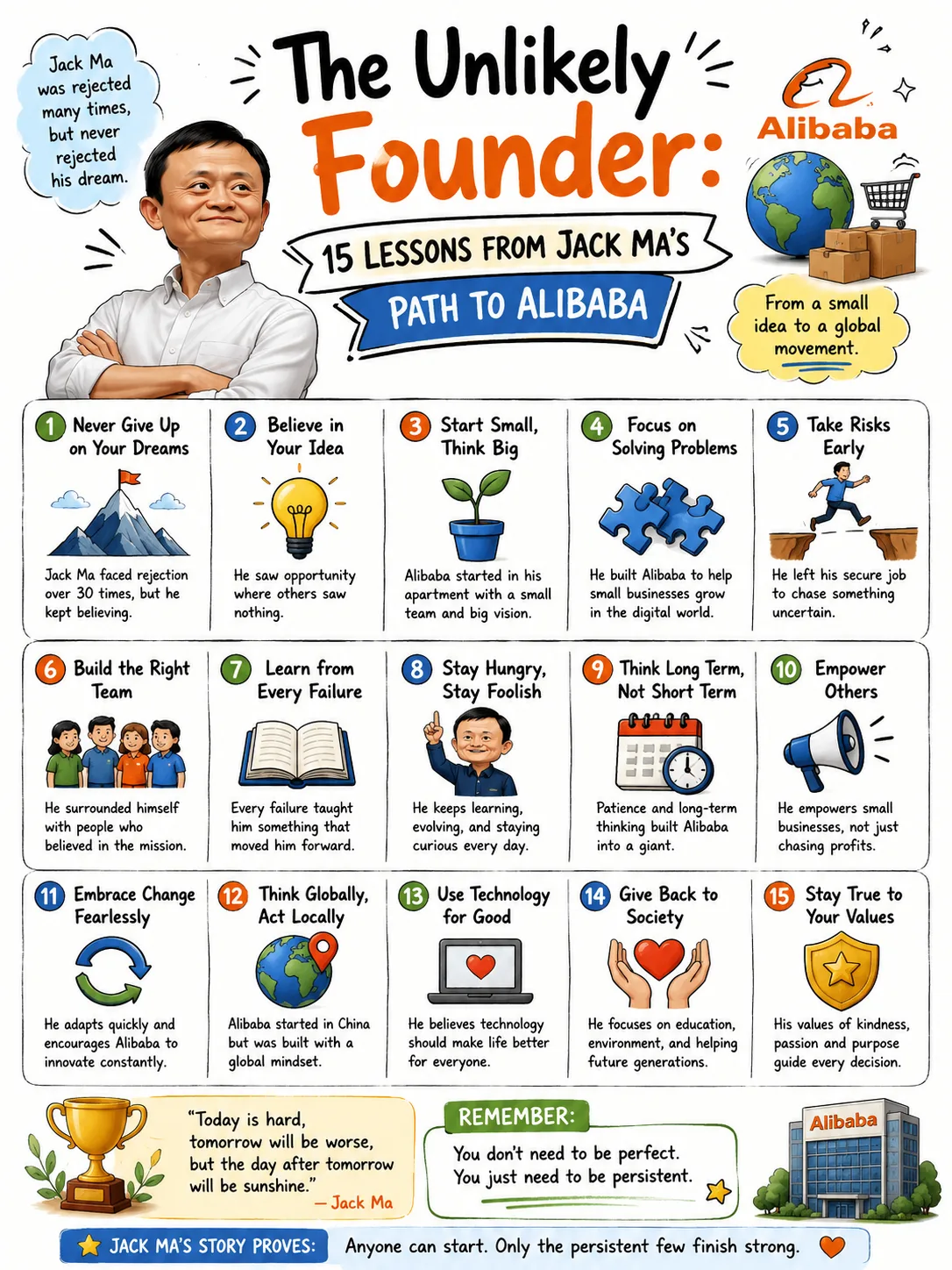
The Unlikely Founder: 15 Lessons from Jack Ma’s Path to Alibaba
Jack Ma’s story is often told as a motivational fable: the rejected student, the failed job applicant, the English teacher who discovered the internet and built one of the world’s most influential technology companies. The familiar version is simple, almost too simple. It compresses decades of curiosity, failure, timing, persuasion, risk, regulation, ownership and scale into a handful of viral anecdotes.
The fuller story is more useful.
Ma’s rise is not valuable because it proves that rejection automatically leads to success. Most rejection does not. It is not valuable because it suggests every nontechnical person can build a technology empire. Most cannot. It is not valuable because it celebrates hardship as destiny. Hardship alone does not create wealth.
The value of Jack Ma’s story is that it reveals how opportunity often appears at the intersection of skills that are not obviously financial. Language. Trust. Timing. Market insight. Persistence. Storytelling. Cross-cultural understanding. The ability to recruit people who know what you do not know. The discipline to see a gap before it becomes visible to the crowd.
Before Alibaba became a global name, Ma was not a software engineer, venture capitalist, investment banker or corporate heir. He was Ma Yun, a young man from Hangzhou who loved English, struggled with exams, worked as a teacher and became fascinated by the possibility that Chinese businesses could one day use the internet to reach the world.
That last idea sounds obvious now. It was not obvious in the 1990s.
China’s consumer internet was young. Global e-commerce was still experimental. Trust between unknown buyers and sellers across borders was difficult to establish. Payments, logistics, language, product discovery and commercial credibility were all major barriers. To imagine that millions of small Chinese suppliers could one day connect with buyers around the world through an online marketplace required more than optimism. It required a founder who understood communication as infrastructure.
That is the deeper lesson. Wealth is rarely built from one skill alone. It is built when skills compound. Ma’s English helped him meet foreigners. Those relationships widened his view of the world. His teaching sharpened his ability to explain ideas. His lack of technical expertise forced him to recruit and lead rather than code. His early failures gave him stories that later helped him motivate employees, investors and entrepreneurs. His experience with small businesses shaped Alibaba’s first commercial mission.
Here are 15 lesser-known facts about Jack Ma—and the financial principles behind them.
1. Jack Ma Was Born Ma Yun
Jack Ma was not born with the name the world came to know. He was born Ma Yun in Hangzhou, China, in 1964. “Jack” was reportedly a nickname given to him by an English-speaking acquaintance who found his Chinese name difficult to pronounce.
At first glance, that detail may seem biographical rather than financial. But names matter in commerce. A name is not just a label. It is a bridge between a person and a market.
Ma’s adoption of an English name reflected something that would later become central to his business life: he learned to move between worlds. He understood that opportunity often belongs to people who can translate—not only between languages, but between cultures, expectations and commercial systems.
Many entrepreneurs fail because they can see only one side of a transaction. They understand the seller but not the buyer. They understand the domestic market but not the foreign customer. They understand the product but not the story. Ma’s early comfort with cross-cultural communication gave him a rare advantage before Alibaba existed.
For wealth builders, the lesson is direct. Income often comes from labor, but wealth usually comes from leverage. One form of leverage is cultural fluency. The person who can explain one market to another, connect one group to another, or reduce friction between two sides of a transaction can create value without owning factories, patents or large amounts of capital at the start.
Alibaba’s earliest business model depended on this very idea. It was not simply a website. It was a bridge between Chinese suppliers and international buyers. The founder’s own life had trained him to understand why that bridge mattered.
2. He Learned English by Speaking with Tourists
As a teenager, Ma reportedly sought out foreign visitors in Hangzhou so he could practise conversational English. This was not classroom learning in the narrow sense. It was voluntary exposure to the wider world.
That matters because the most valuable education is not always formal. Ma’s English practice was informal, uncomfortable and practical. He was not only learning vocabulary. He was learning how people from other countries thought, joked, asked questions and interpreted China. He was building confidence through conversation.
In personal finance, people often underestimate the economic value of communication. They focus on technical skills, credentials, capital and market timing. Those things matter. But communication is the skill that turns knowledge into trust. Trust turns into opportunity. Opportunity can turn into ownership.
A person who can explain clearly has an advantage in almost every financial setting. They can negotiate salaries. They can sell products. They can raise capital. They can build partnerships. They can teach customers why a service matters. They can persuade talented people to join a difficult mission before the rewards are obvious.
Ma’s English did not make him rich by itself. But it opened doors. It allowed him to meet people he otherwise would not have met. It exposed him to stories beyond his immediate environment. It made international commerce feel imaginable rather than abstract.
The practical lesson is that small, consistent efforts to acquire a high-leverage skill can change a person’s opportunity surface. At the time, speaking with tourists may not have looked like career preparation. It looked like curiosity. Yet that curiosity became part of the foundation for a global business career.
3. An Australian Family Helped Reshape His Worldview
One of the most important relationships in Ma’s early life came through his friendship with the Morley family from Australia. After meeting them in Hangzhou, Ma developed a long connection with Ken Morley and his family. Ma later described the relationship—and a visit to Australia—as formative.
This part of the story is not just sentimental. It shows how networks shape financial imagination.
People often think of networking as a tactical activity: attend events, collect contacts, ask for favors. The more powerful kind of networking happens when relationships expand what a person believes is possible. Ma’s connection with the Morley family exposed him to life outside China in a personal way. He did not encounter the outside world only through newspapers or official narratives. He encountered it through people who knew him, hosted him and challenged his assumptions.
That kind of exposure is economically powerful. Many people do not pursue wealth-building opportunities because they have never seen them up close. They have never met someone who started a business, invested early, negotiated equity, acquired assets or expanded across borders. Their financial imagination is limited by their immediate environment.
Ma’s life suggests that relationships can act as windows. They can reveal different standards, different risks and different ambitions. A person who grows up in a narrow environment but builds relationships outside it can begin to see options that would otherwise remain invisible.
This does not mean every relationship should be judged by its financial utility. Quite the opposite. The most important relationships are often not transactional at the start. Ma did not meet the Morley family as a calculated business strategy. The friendship grew from language, curiosity and human connection.
But over time, that relationship changed his worldview. And worldview is one of the most underappreciated financial assets a person has.
4. He Later Donated Millions in Honour of That Friendship
Years after Alibaba’s rise, Ma honoured the Morley relationship through a major philanthropic commitment to the University of Newcastle for the Ma & Morley Scholarship Program. The donation was made through the Jack Ma Foundation and named in honour of Ken Morley.
This fact reveals another dimension of wealth: money eventually becomes a tool for memory, values and influence.
In the early stages of financial life, money is often about survival. Paying rent. Clearing debt. Buying food. Building an emergency fund. Later, it becomes about security and optionality. Eventually, for those who build substantial wealth, money becomes expressive. It can express gratitude, shape institutions, fund education, support research, preserve a legacy or influence public life.
Ma’s donation shows that wealth does not erase the importance of early relationships. It can magnify them. The friendship that helped shape his worldview later became connected to scholarships that could shape the lives of other students.
For ordinary investors and entrepreneurs, the lesson is not that everyone needs to become a philanthropist on a grand scale. The lesson is that money should not be viewed only as accumulation. Wealth becomes more meaningful when it is connected to purpose.
A person who builds wealth without values may gain purchasing power but lose direction. A person who connects wealth to values can make better decisions about spending, investing, giving and legacy. The question is not only “How much can I earn?” It is also “What should my resources make possible?”
5. He Reportedly Took China’s University Entrance Examination Three Times
Ma is widely reported to have struggled with China’s university entrance examination before eventually studying English at what is now Hangzhou Normal University. The details of scores and attempts are often repeated in biographical accounts, though some specifics are not independently documented in the way a formal academic record would be.
The broader point remains clear: Ma’s path was not defined by early academic dominance.
This matters because modern financial culture often treats early credentials as destiny. The school attended, the exam passed, the first employer joined, the first salary earned—these can become psychological anchors. People who start strongly may assume they are guaranteed success. People who start slowly may assume they are permanently behind.
Both assumptions are dangerous.
Academic performance can open doors, but it does not perfectly predict commercial judgment, resilience, timing or leadership. Markets reward value creation, not only credentials. A degree may help someone enter the room, but it does not guarantee they can identify an unmet need, build a team, price a product, manage risk or survive uncertainty.
Ma’s exam struggles are often used as motivational decoration. The more serious lesson is about time horizons. Early setbacks matter less when a person keeps building useful skills. Failure becomes costly when it becomes identity. It becomes instructive when it becomes feedback.
For personal finance, this principle applies beyond school. A person may start investing late. They may carry debt in their twenties. They may choose the wrong career first. They may miss an opportunity that others caught early. None of these errors are ideal. But none must be final.
Compounding rewards duration, but it also rewards behavior change. Someone who corrects course can still build meaningful wealth if they develop discipline, increase income, avoid destructive debt, invest consistently and make better decisions over time.
Ma’s life does not prove that academic failure leads to greatness. It proves something more grounded: early disappointment does not need to become a permanent ceiling.
6. His Degree Was in English, Not Computing or Business
One of the most surprising facts about Ma is that his academic background was in English, not computer science, engineering or finance. He became one of the best-known technology entrepreneurs in China without being a programmer by training.
This fact is often used to romanticize ignorance of technology. That is the wrong lesson.
Ma did not build Alibaba because technical knowledge was unnecessary. Alibaba required technology, systems, engineering talent, payments infrastructure, data, logistics and platform design. What Ma’s story shows is that the founder’s role does not always require mastery of every function. It requires the ability to assemble, align and lead the people who collectively possess those skills.
There is a major difference between being nontechnical and being anti-technical. A nontechnical founder can succeed if they respect technical expertise, recruit strong operators, understand customers deeply and make strategic decisions. An anti-technical founder who dismisses complexity usually fails.
Ma’s English background gave him strengths that technical founders sometimes lack. He could tell a story. He could sell a vision. He could communicate across cultures. He could understand the fears and needs of small exporters who did not want a lesson in software architecture; they wanted customers.
Business history is filled with founders whose original advantage was not technical. Some understood distribution. Some understood design. Some understood finance. Some understood branding. Some understood regulation. Some understood a specific customer better than anyone else. The key is not to possess every skill. The key is to know which skill is central to the opportunity and which gaps must be filled by others.
For wealth builders, this is liberating and demanding at the same time. You do not need to be an expert in everything before you begin. But you must be honest about what you do not know. You must learn enough to make sound decisions. You must partner wisely. You must avoid pretending that charisma can replace competence.
Ma’s English degree was not a disadvantage in the abstract. It was part of the unique mix that made him effective for the opportunity he pursued.
7. He Worked as a Teacher Before Becoming an Entrepreneur
Before Alibaba, Ma worked as an English teacher. That part of his biography is not incidental. Teaching became one of his lasting leadership assets.
A teacher’s job is to make unfamiliar ideas understandable. A teacher must read the room, adjust the message, repeat without sounding mechanical and keep people engaged when the subject feels difficult. Those skills are deeply relevant to entrepreneurship.
Founders are constantly teaching. They teach customers why a product matters. They teach employees why a mission is worth sacrifice. They teach investors how a market could become larger than it appears. They teach partners how cooperation can create mutual gain. They teach the public what a company stands for.
Ma’s ability to explain Alibaba’s mission was central to his leadership. The company was not built only on code. It was built on belief. Small businesses had to believe the internet could help them. Employees had to believe a young company in Hangzhou could compete in a changing digital economy. Investors had to believe the opportunity was larger than the early numbers.
Teaching is also a form of leverage. One person who understands an idea can act alone. One person who teaches an idea well can multiply action through others. This is why leadership communication is not soft. It is operational.
For personal finance, the teaching principle has a practical application. If you want to build wealth with a spouse, family, team or business partner, you must be able to explain money clearly. A household cannot follow a plan it does not understand. A business cannot execute a strategy that exists only in the founder’s head. An investor cannot stay disciplined through volatility if they do not understand why the plan was chosen.
Teaching turns knowledge into shared conviction. Shared conviction makes long-term behavior possible.
8. He Says He Was Rejected from Numerous Jobs
Ma has publicly recounted being rejected from many jobs, including a famous story about applying to KFC. Some of the precise numbers in these rejection stories come from Ma’s own retellings and should be treated as personal recollections rather than independently audited records.
That distinction matters. Good financial writing should not turn every founder anecdote into unquestioned fact. But the rejection theme is still meaningful because it reveals something about Ma’s public philosophy: he framed rejection as part of the process, not as proof of personal worthlessness.
Rejection is economically significant because it tests whether a person can continue seeking opportunity after social embarrassment. Many wealth-building activities involve repeated rejection. Sales. Fundraising. Job hunting. Negotiation. Publishing. Investing. Entrepreneurship. Even career advancement often requires asking for roles, compensation or responsibility before acceptance is guaranteed.
People with fragile egos avoid rejection by avoiding attempts. That can feel safe, but it is expensive. The safest emotional path is often the costliest financial path.
Ma’s rejection stories became part of his leadership mythology because they made him relatable. He was not presented as a flawless prodigy. He was presented as someone who heard “no” often enough to stop treating it as fatal.
The practical lesson is not to glorify rejection. Rejection is not automatically noble. Sometimes rejection reveals poor preparation, weak fit or bad strategy. The lesson is to separate rejection from identity. Ask what can be learned. Improve the offer. Change the market. Build new skills. Try again where the odds are better.
In finance, persistence without feedback becomes stubbornness. Persistence with learning becomes resilience.
9. He Reportedly Applied to Harvard Multiple Times
Ma has said that Harvard Business School rejected him multiple times. The specific number is widely repeated, but like several famous details in his biography, it appears to rest largely on his own statements rather than public verification from the institution.
The deeper point is not whether Harvard said no once, ten times or some other number. The deeper point is that elite institutional approval was not the gate through which Ma ultimately built his career.
Prestige can be valuable. Elite schools and employers can provide networks, credibility and training. It would be foolish to pretend otherwise. But prestige is not the same as value creation. A person can be approved by institutions and still fail to build assets. A person can be rejected by institutions and still build something valuable.
Financial independence requires understanding the difference between status and ownership. Status is being selected. Ownership is building or acquiring assets that produce value. Status can help create access, but it is not the asset itself.
Many people spend their lives trying to be chosen. Chosen by a school. Chosen by an employer. Chosen by a client. Chosen by a social circle. There is nothing wrong with seeking opportunity through selection. But wealth often requires shifting from being chosen to creating something others choose.
Alibaba represented that shift. Ma moved from applicant to builder. Instead of asking an institution to validate his future, he helped create an institution whose value came from serving millions of businesses and consumers.
This lesson is especially important for young professionals. A strong résumé can be useful, but it should not become the entire strategy. Build skills. Build relationships. Build judgment. Build assets. Build proof. Build something that exists beyond someone else’s permission.
10. His First Company Was Not Alibaba
Before Alibaba, Ma established a translation agency and later worked on China Pages, an early online business-directory venture. Alibaba was not his first attempt at entrepreneurship.
This is one of the most overlooked facts in his story. Successful companies often appear sudden from the outside because the public notices only the breakthrough. The earlier experiments, false starts and partial failures disappear from memory.
But the first venture matters because it teaches. A translation agency made sense for Ma because it grew from a skill he already had. It was not glamorous, but it connected language to commerce. China Pages then moved him closer to the internet opportunity. Each step taught him something about customers, business formation, communication and technology adoption.
Entrepreneurs often make the mistake of waiting for the perfect idea. They imagine that the first venture must be the grand one. In reality, early ventures are often apprenticeships. They reveal what customers will pay for, how hard sales can be, how partnerships break down, how cash flow behaves and how little theory matters when a client refuses to buy.
For wealth builders, this principle applies broadly. The first investment may not be the one that creates financial freedom. The first business may not scale. The first side income stream may be small. The first property may not be ideal. The first negotiation may be awkward. The first financial plan may need revision.
Starting creates information. Information improves judgment. Judgment improves future decisions.
Alibaba was not born from nowhere. It emerged after Ma had already begun testing the relationship between language, business directories, small companies and the internet. That sequence is important because major wealth creation often looks like a leap only after years of preparation have made the leap possible.
11. His First Internet Search Reportedly Changed His Career
Ma has often described an early encounter with the internet in the United States, where he searched for information about beer and was struck by the lack of Chinese results. Whether every detail of the story is documented or autobiographical, the larger insight is clear: he saw absence as opportunity.
Most people search for what exists. Entrepreneurs notice what is missing.
The absence of Chinese business information online suggested a gap. If international users could not easily find Chinese products, companies or suppliers, then the internet was not yet serving a massive commercial need. That gap could become a business.
This is one of the core principles of opportunity recognition. Markets are not created only by inventing something entirely new. They are often created by connecting demand and supply that already exist but cannot efficiently find each other.
Before Alibaba, Chinese manufacturers existed. International buyers existed. Trade existed. What was missing was a scalable trust and discovery layer. The internet could become that layer if someone understood the problem deeply enough.
In investing, this same logic appears in different form. Investors search for gaps between price and value. Entrepreneurs search for gaps between need and solution. Career builders search for gaps between skills and market demand. The ability to notice a gap before it becomes consensus is a major financial advantage.
But noticing is not enough. Many people can identify problems. Fewer can build systems that solve them profitably. Ma’s insight mattered because it eventually led to a platform model: a business that could become more valuable as more participants joined.
That is where the wealth-building principle becomes powerful. The best opportunities are not always the ones where you sell one product once. They are often the ones where you create infrastructure that allows many others to transact repeatedly.
12. Alibaba Began with 18 Founders in an Apartment
Alibaba was established in Hangzhou in 1999 by a founding group of 18 people led by Ma. The company began from an apartment, not a gleaming headquarters.
This fact challenges the founder-as-lone-genius narrative. Alibaba was not simply Jack Ma sitting alone with an idea. It was a collective effort. Ma was central, but the founding structure reminds us that major companies are built by teams.
Team formation is one of the most important financial decisions an entrepreneur makes. A weak team can destroy a good idea. A strong team can refine an imperfect one. Early employees and co-founders shape culture, execution speed, morale and problem-solving capacity.
The apartment setting is also instructive. Many companies that later become symbols of wealth begin in places that look unimpressive. A modest beginning does not guarantee future success, but it does reduce one common excuse: waiting for perfect conditions.
Capital helps. Offices help. Credentials help. But early-stage entrepreneurship often depends more on urgency, trust, discipline and shared belief than on appearances. A small team in an apartment can outperform a better-funded group if it understands the customer more clearly and moves with greater commitment.
For personal finance, the apartment origin carries a broader lesson. Wealth building rarely looks impressive at the beginning. The first automatic investment contribution may be small. The first emergency fund may look unimpressive. The first customer may be modest. The first debt repayment may feel slow. The early stage of compounding is visually boring.
People often abandon wealth-building behavior because it does not feel dramatic. But almost every large financial outcome begins in an undramatic way. Small systems, repeated over time, become powerful.
Alibaba’s origin story is not romantic because it was small. It is meaningful because the founders used limited resources to pursue a large market with conviction.
13. The Name “Alibaba” Was Chosen for Global Recognition
According to Alibaba’s own corporate explanations, the name was chosen partly because it was easy to pronounce across many languages and widely associated with “open sesame,” the phrase from the story of Ali Baba and the Forty Thieves. The imagery suggested access, discovery and hidden opportunity.
Naming is strategy. A business name can reduce friction or create it. It can travel across borders or remain trapped in one language. It can invite curiosity or require explanation every time it is spoken.
For a company with international ambitions, a globally recognizable name was not a cosmetic decision. It supported the business model. Alibaba’s early marketplace needed to connect Chinese suppliers with buyers beyond China. A name that international users could remember, pronounce and associate with opportunity helped the company communicate its purpose.
This is a branding lesson, but it is also a financial lesson. Brand is an intangible asset. It can lower customer acquisition costs, increase trust, support pricing power and attract talent. Not every brand becomes valuable, but when a brand does become valuable, it can compound for decades.
Many people think of assets only as physical or financial: property, stocks, cash, equipment. Businesses reveal a wider category. Brands, networks, software, trust, data, patents, distribution and reputation can all become assets if they create future economic benefit.
The name Alibaba worked because it aligned with the company’s promise. It suggested that the platform could open doors. That is what effective branding does at its best. It compresses a business strategy into a memorable symbol.
For individuals, the equivalent is reputation. Your name becomes a kind of personal brand in the markets where you operate. Are you trusted? Clear? Reliable? Generous with credit? Serious about execution? Over time, reputation can become an asset that creates opportunities before you ask for them.
14. Ma Has Repeatedly Described Himself as Nontechnical
Ma has often presented himself as a nontechnical founder, saying in public remarks that he did not write code and came to computers later than many technology entrepreneurs. The exact details come from his own statements, but the broader pattern is consistent: he was not the stereotypical engineer-founder.
That raises an important question. How can someone lead a technology company without being the primary technologist?
The answer lies in understanding the difference between product creation and market creation. Technical talent creates the systems. Market-oriented leadership identifies the problem, frames the mission, recruits the talent, attracts users and builds trust. In the best companies, these functions reinforce each other.
A technology company led only by vision can become empty hype. A technology company led only by engineering can build brilliant tools that customers do not understand or adopt. The strongest companies integrate both.
Ma’s nontechnical background may have helped him stay focused on the customer’s problem rather than the elegance of the technology itself. Small exporters did not care whether the platform was impressive to engineers. They cared whether it helped them find buyers. Buyers cared whether they could discover suppliers and reduce friction. The business value came from solving commercial problems, not from technology as decoration.
This distinction matters for investors. When evaluating a company, technology alone is not enough. Ask how the technology creates economic value. Does it reduce costs? Increase speed? Improve trust? Expand distribution? Create network effects? Raise switching costs? Unlock new demand? A technically impressive product without a strong business model may not become a strong investment.
For entrepreneurs, Ma’s example is encouraging but not permission to ignore expertise. If you are not technical, you must become excellent at customer insight, team building, capital allocation and communication. You must know enough to ask intelligent questions. You must respect the people who build what you cannot build yourself.
Leadership is not knowing everything. It is making sure the organization knows what it needs to know.
15. Education Remained Central After He Left Alibaba’s Leadership
Ma stepped down as Alibaba’s executive chairman in 2019 and later maintained a lower public profile, especially after China’s regulatory actions affecting Alibaba and Ant Group. He has continued to be associated with education, philanthropy and occasional public appearances, including a 2025 meeting involving Chinese private-sector business leaders and President Xi Jinping.
This later chapter complicates the simple founder story. Wealth and influence do not exist outside political, regulatory and social systems. A company can become enormously valuable and still face changing rules, public scrutiny and government pressure. Founders who appear larger than life during expansion can become more constrained when their companies become systemically important.
That is an essential lesson for investors. Business success does not eliminate risk. It changes the type of risk. A small company may face survival risk. A dominant company may face regulatory risk. A founder-led company may benefit from vision but suffer from key-person risk. A fast-growing financial technology business may attract attention from regulators concerned about consumer protection, competition, leverage or systemic stability.
Alibaba’s later history reminds investors that scale invites oversight. This is not unique to China. Around the world, large technology and financial firms face questions about data, market power, consumer protection, labor practices, competition and national interest. The larger the platform, the more stakeholders care about its behavior.
Ma’s continued interest in education also brings his story full circle. He began as a teacher. He built a company around enabling businesses. He later spoke often about teaching, entrepreneurship and philanthropy. The thread is not accidental. His wealth came from commerce, but his influence was deeply connected to his ability to educate and persuade.
For individuals building wealth, the later chapter offers a mature lesson: financial success is not the end of complexity. More money can create more options, but it can also create more visibility, responsibility and risk. Wealth should be managed with humility because markets, governments and public sentiment can change.
The Financial Principles Hidden in Jack Ma’s Story
The 15 facts above are interesting as biography, but their deeper value lies in the principles they reveal. Ma’s life shows that wealth creation is rarely a straight path from talent to reward. It is usually a compound process involving skill formation, opportunity recognition, relationship building, risk-taking and adaptation.
Communication Can Become Capital
Ma’s early English practice did not look like capital in the traditional sense. It was not cash in a bank account or equity in a business. Yet it became a form of human capital that later helped him build relationships, understand global commerce and communicate Alibaba’s mission.
In the modern economy, communication is a multiplier. The person who can explain complex ideas clearly can sell, teach, lead and negotiate. This is why financial education should not treat communication as secondary. A person with strong technical knowledge but weak communication may struggle to convert expertise into income. A person who communicates well can often mobilize the expertise of others.
Rejection Is Data, Not Destiny
Ma’s rejection stories endure because they speak to a universal fear. No one enjoys being told no. But financial progress often requires repeated exposure to situations where rejection is possible.
The disciplined response is to treat rejection as data. Was the offer wrong? Was the timing wrong? Was the audience wrong? Was preparation weak? Was the market not ready? A rejected job application, failed sales pitch or declined investment proposal can all contain useful information.
The danger is emotional overinterpretation. One rejection does not define a person’s future. A pattern of rejection may identify a problem, but that problem can often be studied, corrected or redirected.
Ownership Changes the Game
The shift from teacher and job applicant to founder changed Ma’s financial trajectory because ownership changes the economics of work. Employees earn wages for labor. Owners can benefit from systems that scale beyond their personal hours.
This does not mean everyone should start a company. Entrepreneurship carries real risk. Many businesses fail. Many founders earn less than employees for years. But the principle of ownership applies more widely. Investors own shares of productive companies. Landlords own income-producing property. Creators own intellectual property. Business owners own cash-flowing systems.
Wealth usually requires owning assets that can grow, produce income or appreciate independently of direct labor. Ma’s story illustrates this transition at an extraordinary scale.
Markets Reward Bridges
Alibaba’s original opportunity was a bridge: Chinese suppliers on one side, international buyers on the other. The platform’s value came from reducing friction between groups that wanted to transact but lacked an efficient way to find and trust each other.
Many profitable businesses are bridges. Payment companies bridge buyers and merchants. Marketplaces bridge supply and demand. Recruiters bridge employers and talent. Financial advisers bridge households and investment decisions. Logistics firms bridge producers and consumers.
When searching for opportunity, ask where friction exists. Who wants access to whom? What information is missing? What trust problem prevents transactions? What process is too slow, expensive or confusing? Friction is often where value can be created.
Nontechnical Does Not Mean Nonessential
Ma’s background challenges the idea that only technical founders matter in technology businesses. But it does not diminish the importance of technical talent. Rather, it shows that different forms of expertise can be essential at different stages.
A founder who understands customers, markets and narrative can be vital even without writing code. A technologist who can build reliable systems is equally vital. A company becomes powerful when these strengths align.
For professionals, this lesson is useful. You may not need to become someone else to create value. You need to understand your own edge and combine it with complementary skills.
What Jack Ma’s Story Teaches About Personal Wealth
Most readers will not build the next Alibaba. That is not the point. The point is to extract usable principles from an unusual career.
First, invest in skills before they are obviously profitable. Ma’s English practice became valuable long after it began. Many high-value skills work this way: writing, sales, negotiation, coding, financial literacy, public speaking, data analysis and leadership. They may not produce immediate income, but they expand future opportunity.
Second, build relationships outside your existing environment. New relationships can expose you to different ambitions, industries and ways of thinking. This is not about shallow networking. It is about widening your understanding of what is possible.
Third, do not confuse early setbacks with final outcomes. Failed exams, rejected applications and awkward beginnings can be painful, but they do not end the story unless they stop skill development.
Fourth, search for missing infrastructure. Many financial opportunities emerge where people want to transact but cannot do so easily. If you can make something easier, faster, safer or more trustworthy, you may be able to create value.
Fifth, pursue ownership thoughtfully. Ownership is powerful because it allows participation in upside. But ownership also carries risk. The goal is not reckless entrepreneurship. The goal is to gradually build or acquire assets that improve your financial position over time.
Sixth, respect regulation and systems. Alibaba’s later challenges show that no company operates in a vacuum. Investors and entrepreneurs must understand legal, political and social context. A business model that ignores those forces may look strong until conditions change.
The Myth and the Reality
Jack Ma’s public image contains both documented facts and heavily repeated anecdotes. The distinction matters. Some stories, such as Alibaba’s founding by 18 people in 1999, are supported by institutional accounts. Others, such as precise job rejection counts or repeated Harvard applications, are best presented as Ma’s own recollections.
This does not make the stories worthless. Founder narratives often function as teaching tools. They communicate values, motivate teams and simplify complex journeys. But responsible financial education should separate inspiration from verification.
The myth says: rejection made Jack Ma successful.
The reality is more demanding: rejection became useful because Ma kept learning, communicating, experimenting and building.
The myth says: a nontechnical teacher built a technology empire.
The reality is more precise: a nontechnical founder identified a commercial gap, communicated a vision, assembled people and built a platform around a massive market need.
The myth says: one man created Alibaba.
The reality is stronger: a founder-led team built a company whose value came from connecting millions of participants.
The myth is simpler. The reality is more useful.
The Wealth Lesson Behind Alibaba’s Rise
At the heart of Alibaba’s rise is a powerful financial principle: the greatest wealth is often created by enabling other people to create wealth.
Alibaba did not begin by selling a single product to a single buyer. It began by helping businesses find buyers. It served as infrastructure for commerce. That is why platform businesses can become so valuable. When they work, they do not merely capture demand; they organize markets.
This is also why the company’s original mission resonated. Small and medium-sized businesses often lack access. They may have products but not distribution, ambition but not visibility, capability but not trust. A platform that reduces those barriers can unlock economic activity at scale.
For individuals, this suggests a way to think about career and business opportunity. Ask not only, “How can I make money?” Ask, “Whose ability to make money can I improve?”
Can you help small businesses reach customers? Can you help families manage money better? Can you help workers learn valuable skills? Can you help investors understand risk? Can you help creators distribute their work? Can you help buyers find trustworthy sellers? Can you help companies reduce waste, delays or confusion?
When you help others create value, you place yourself near the flow of economic activity. That does not guarantee wealth, but it is a more durable starting point than chasing attention or speculation.
Why This Story Still Matters
Jack Ma’s public role has changed. Alibaba’s leadership has changed. China’s technology sector has changed. The global internet economy has changed. Yet the lessons from Ma’s path remain relevant because they speak to durable forces in wealth creation.
Skills compound. Relationships matter. Communication creates trust. Ownership creates upside. Teams build what individuals cannot. Markets reward people who reduce friction. Scale attracts regulation. Reputation can become an asset. Early failure does not have to define later potential.
Those principles are not limited to billionaires. They apply to a young professional building a career, a family trying to move from debt to investment, a small business owner searching for customers, or an investor learning to distinguish hype from durable value.
The danger of studying famous entrepreneurs is that their outcomes can feel unreachable. That can make their stories either intimidating or misleading. The better approach is to ignore the size of the fortune and study the mechanics of the journey.
Ma’s journey shows a person using available skills, expanding his worldview, enduring rejection, experimenting before the breakthrough, building a team, choosing a market with enormous friction and turning communication into commercial infrastructure.
That is not a fairy tale. It is a financial education.
Actionable Lessons for Readers
Start with the skill you already have, but do not stop there. Ma began with English and teaching, then moved toward translation, business directories and internet commerce. Your current skill may not be the final asset, but it can be the first bridge.
Practise communication deliberately. Write clearer emails. Learn to explain your work simply. Improve your negotiation skills. Speak with people outside your usual circle. Communication is not decoration; it is economic infrastructure.
Build relationships before you need them. The most valuable relationships often begin with curiosity, not extraction. A wider network can widen your view of risk, opportunity and possibility.
Treat rejection as market feedback. If a job application, pitch or proposal fails, study why. Improve the offer. Change the audience. Upgrade the skill. Do not let the first “no” become a lifetime identity.
Look for friction. Where are people struggling to find information, trust, access, financing, distribution or expertise? Friction is often an invitation to build value.
Do not worship credentials, but do not dismiss learning. Ma’s path shows that elite approval is not the only route to success. It does not show that education is unimportant. He was a teacher, learner and communicator throughout his life.
Think in platforms and systems. Even at a small scale, wealth grows faster when you build systems rather than rely only on one-time effort. A repeatable process, a useful product, an invested portfolio or a trusted brand can work beyond a single hour of labor.
Pursue ownership with discipline. Ownership creates upside, but it also brings risk. Build financial resilience before taking major risks. Protect cash flow. Understand downside. Avoid confusing ambition with recklessness.
Respect the environment around the asset. A business can be strong and still face regulatory, political or competitive pressure. Investors should study not only company growth, but also the rules and institutions surrounding that growth.
The Real Meaning of an Unlikely Founder
Jack Ma is often described as unlikely because he did not fit the expected profile of a technology founder. But perhaps the more important point is that the expected profile was too narrow.
Technology companies do not need only technologists. Markets do not need only financiers. Wealth creation does not need only perfect students. Economies grow through combinations of people who see different parts of the problem.
Ma saw language, trust and access as commercial problems. He saw the internet not only as a technical novelty, but as a way to connect businesses that had been separated by geography and information gaps. He understood that a marketplace is not just software. It is confidence organized at scale.
That insight remains valuable for anyone trying to build wealth. The world does not reward talent in isolation. It rewards talent applied to real problems. It rewards people who can make themselves useful where demand already exists but access is blocked. It rewards those who can learn from failure without becoming defined by it.
Ma’s story should not be reduced to slogans about never giving up. Persistence matters, but persistence alone is not enough. The more sophisticated lesson is this: keep learning, keep widening your perspective, keep building useful skills, keep looking for friction, and when the right opportunity appears, build with others.
That is how an English teacher became the face of one of the most important commercial platforms in Asia. Not by following a straight line. Not by being chosen early. Not by fitting the template.
He found a bridge the market needed and helped build it.
 Article
 Article
 Article
 Article
 Article
 Article
 Article
 Article