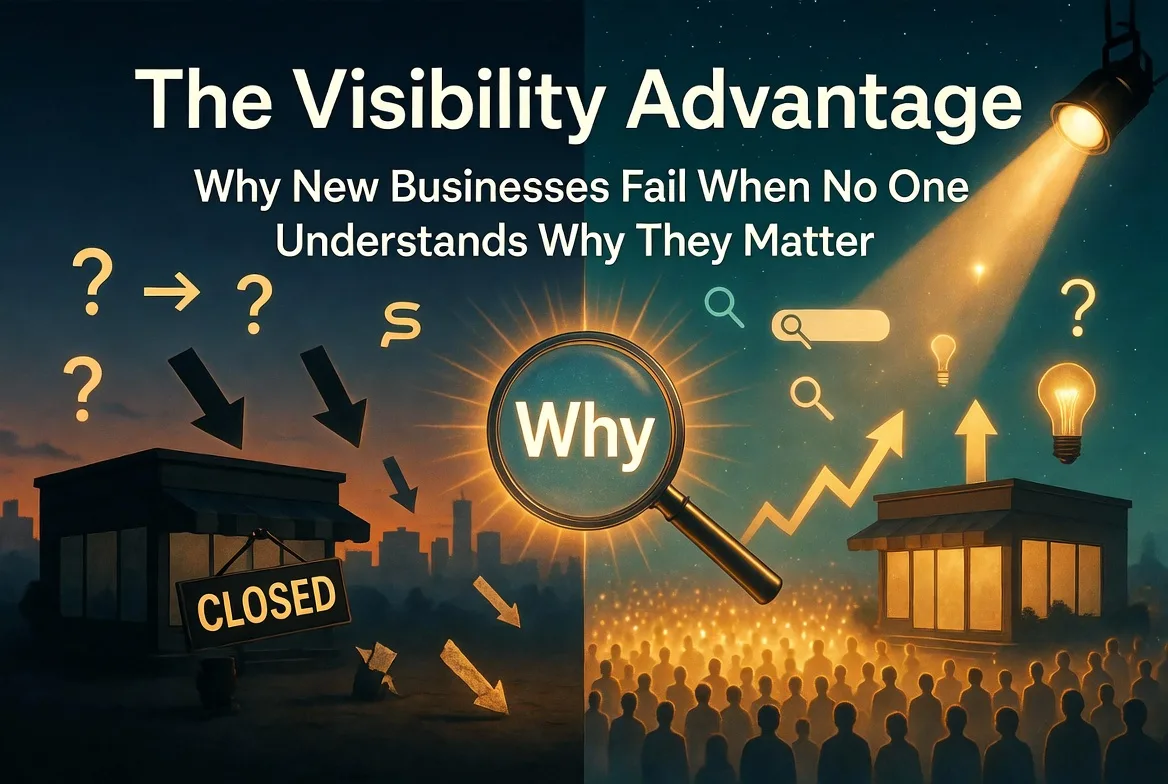
The Visibility Advantage: Why New Businesses Fail When No One Understands Why They Matter
The modern entrepreneur is not suffering from a shortage of tools.
A person can register a business, build a website, create a logo, open social media accounts, accept digital payments, launch an online store, design marketing materials, automate email, track customer behavior, and begin selling without ever renting an office or hiring a large team. The barriers that once made business ownership feel distant have fallen dramatically. A laptop, a phone, a payment processor, a niche skill, and enough persistence can place someone in the marketplace within days.
That access is powerful. It is also deceptive.
Because starting a business has become easier, many people confuse entry with survival. They believe the difficult part is launching. They spend energy on the name, the brand colors, the website template, the product, the first announcement, the founder story, and the excitement of finally being open. Then the market responds with silence.
The silence is where many businesses begin to fail.
Not because the founder is lazy. Not because the product is worthless. Not because entrepreneurship was a foolish dream. Many new businesses fail because the market never clearly understands who the business serves, why it matters, why it is different, why it should be trusted, and why the customer should act now rather than continue scrolling, waiting, comparing, or doing nothing.
This is the visibility problem.
Visibility is not fame. It is not noise. It is not posting constantly without a strategy. It is not copying the marketing style of large companies with budgets, teams, and brand recognition built over decades. Visibility is the ability to be found, understood, remembered, and trusted by the specific people whose problems your business is designed to solve.
For entrepreneurs who want to build wealth, visibility is not cosmetic. It is economic infrastructure.
A business without visibility is like a rental property no one knows is available, a shop hidden in an alley without a sign, a professional service described so vaguely that potential clients cannot tell whether it applies to them, or an investment portfolio with assets that never produce income. The value may exist, but value that cannot reach the right buyer remains trapped.
This matters even more when entrepreneurship becomes popular. When many people launch businesses at the same time, customers gain options. Options create competition. Competition raises the cost of confusion. A customer may be willing to take a chance when few alternatives exist. In a crowded market, they become more selective. They compare. They delay. They ask for proof. They want clarity. They look for signals that reduce risk.
That is why marketing cannot be treated as decoration added after the real business is built. Marketing is part of the business. It is the bridge between the value a company creates and the people who need that value enough to pay for it.
The entrepreneurs who understand this have a wealth-building advantage. They do not only make products. They make decisions easier. They do not only describe services. They translate outcomes. They do not only chase new customers. They build trust systems that turn first buyers into repeat buyers, advocates, referrals, and stable cash flow.
This is the difference between a business that creates temporary income and a business that becomes an asset.
The Business Formation Boom and the New Reality of Competition
Business creation often rises when people feel both ambition and uncertainty. Some launch because they see opportunity. Others launch because traditional employment feels less secure. Some want freedom. Some need supplemental income. Some want ownership. Some are responding to inflation, layoffs, childcare realities, remote work flexibility, technology shifts, or the desire to control more of their financial future.
Entrepreneurship has always carried a promise: the possibility that a person can convert skill, insight, labor, and risk into ownership. Unlike wages, which are usually tied to hours or salary agreements, a business can grow beyond the owner’s direct labor if it develops systems, brand trust, recurring customers, intellectual property, distribution channels, or employees. This is why business ownership has long been one of the pathways to wealth.
But the same door that opens for one person opens for others.
When more people enter the market, the first challenge is no longer simply whether a founder can create something useful. The challenge is whether the founder can become the obvious choice for a specific customer in a noisy environment. A good offer can disappear if it is poorly positioned. A talented service provider can struggle if prospects cannot understand the result. A strong product can stall if there is no trust. A founder can spend months improving the offer while ignoring the fact that nobody knows why they should care.
Many new entrepreneurs underestimate this because the early stage of business feels personal. The founder knows the idea intimately. They know the effort behind it. They know the late nights, the sacrifices, the quality, the intention, and the value. But customers do not experience the business from inside the founder’s mind. They experience it through a few signals: the message, the offer, the proof, the price, the buying process, the reputation, the follow-up, and the emotional feeling of risk or confidence.
In crowded markets, vague businesses are expensive to operate. They require more explanation, more persuasion, more discounting, and more chasing. Clear businesses reduce friction. Customers understand faster. Referrals become easier. Marketing content becomes sharper. Sales conversations become shorter. Pricing becomes more defensible.
The new entrepreneur must accept a hard truth: the market does not reward effort it cannot see, understand, or trust.
Marketing Is Not Manipulation When the Offer Is Honest
Many financially serious people are suspicious of marketing. They associate it with hype, exaggeration, pressure, vanity, and empty branding. That suspicion is not irrational. Markets are full of inflated claims. Consumers are tired of being sold to. Small business owners themselves are bombarded with gurus promising overnight growth.
But rejecting marketing entirely is a mistake.
Marketing, at its best, is disciplined communication. It helps the right people understand the right offer at the right time. It clarifies value. It reduces confusion. It explains trade-offs. It creates trust before the transaction. It helps customers decide whether the business is appropriate for them.
Honest marketing does not manufacture value that does not exist. It reveals value that might otherwise remain invisible.
A skilled accountant who helps freelancers avoid tax chaos needs marketing. Not because tax advice should be sensationalized, but because freelancers need to understand what makes that accountant different from a general provider. A fitness coach who helps women in midlife build strength needs marketing. Not because health should be reduced to slogans, but because the specific customer needs to recognize that the offer was designed for her life stage. A local contractor who communicates clearly, arrives on time, and provides transparent estimates needs marketing. Not because craftsmanship is unimportant, but because trust must be visible before someone opens their home and wallet.
Marketing becomes manipulation when the message outruns the truth. It becomes service when the message makes the truth easier to understand.
For wealth builders, this distinction matters. A business that markets dishonestly may generate short-term revenue but damages long-term enterprise value. Refunds rise. Reputation suffers. Referrals weaken. Customer acquisition becomes more expensive because trust must be rebuilt constantly. A business that markets honestly and delivers consistently creates compounding advantages. Each satisfied customer becomes evidence. Each result becomes proof. Each referral lowers future acquisition cost.
Trust is not a soft asset. It is an economic asset.
The First Wealth Principle of Business: Know Exactly Who You Serve
Many founders begin with a broad statement because they fear narrowing their market. They say they serve small businesses, busy professionals, families, homeowners, entrepreneurs, students, women, parents, or anyone who needs help. This feels safe because it appears to preserve opportunity. In reality, it often weakens the business.
Broad positioning forces the customer to do the work of interpretation. The prospect must ask, “Is this really for me?” Most people will not spend long trying to answer that question. They move on to the business that speaks more directly to their situation.
Specificity creates recognition.
There is a difference between “marketing services for small businesses” and “email marketing for independent fitness studios that need more repeat bookings.” There is a difference between “financial coaching” and “debt payoff coaching for nurses earning good incomes but living paycheck to paycheck.” There is a difference between “business consulting” and “operations consulting for solo consultants who are booked out but not profitable.”
The narrower message does not necessarily mean the business can never serve anyone else. It means the business has a clear center of gravity. It knows its primary customer. It understands that customer’s pain, language, constraints, fears, alternatives, and desired outcome.
This is valuable because money follows perceived relevance. A customer is more likely to pay when they feel understood. They are more likely to trust when the business describes their problem accurately. They are less likely to obsess over price when the solution appears designed for their specific situation.
New founders often resist this because they confuse niche with limitation. But niche is often a doorway. A business that becomes known for solving a specific problem can expand later from a position of credibility. A business that starts by trying to be everything to everyone may never become memorable enough to earn that chance.
Wealth is built through concentration before expansion. Investors understand this when they focus capital. Professionals understand this when they develop expertise. Businesses must understand it in positioning.
Customers Buy Outcomes, Not Effort
Founders often describe what they do. Customers care about what changes.
This is one of the most important shifts in business communication. A founder may be proud of the tools, methods, process, technology, credentials, ingredients, training, or hours that go into the offer. Those details may matter, but they are rarely the first reason a customer buys. Customers buy relief, progress, status, savings, time, confidence, safety, beauty, convenience, profit, peace, belonging, or avoided pain.
A customer does not primarily buy bookkeeping. They buy fewer financial surprises, cleaner tax preparation, better cash flow visibility, and the confidence that their business numbers are not a mystery. A customer does not primarily buy a meal delivery service. They buy time, health support, reduced decision fatigue, and the ability to avoid another rushed dinner. A customer does not primarily buy a website. They buy credibility, inquiries, bookings, sales, and a professional first impression.
The founder must translate features into outcomes.
This does not mean making unrealistic promises. It means connecting the offer to the customer’s real world. What becomes easier? What becomes less risky? What becomes faster? What becomes more profitable? What becomes less stressful? What future cost is avoided? What emotional burden is reduced?
Outcome language is especially important when customers are financially cautious. When households and businesses are watching every dollar, vague benefits lose power. People want to understand the return on the decision. That return may be financial, emotional, practical, or strategic, but it must be clear.
A business that sells outcomes also prices better. If customers see only tasks, they compare hourly rates. If they understand outcomes, they compare value. This does not guarantee premium pricing, but it gives the business a stronger foundation than competing only on cost.
Many founders underprice because they have not learned to articulate the economic value of what they provide. They describe the work as “a few sessions,” “a simple audit,” “a package,” “a report,” or “a service.” But the customer may be gaining thousands in saved time, avoided mistakes, better decisions, increased revenue, or reduced risk. If the founder cannot explain that, the market may never fully value it.
Marketing is often the art of naming the value that is already there.
Trust Must Be Built Before the Customer Is Ready to Buy
New businesses face a credibility gap. Customers do not know whether the business will deliver. They do not know whether the founder is reliable. They do not know whether the product works. They do not know whether the service will be worth the money. In an uncertain economy, that gap becomes wider because customers are more protective of cash.
The founder’s job is to reduce perceived risk.
Trust can be built through many signals: testimonials, case studies, demonstrations, guarantees, transparent pricing, educational content, professional presentation, consistent communication, clear policies, visible expertise, referrals, partnerships, reviews, samples, trial offers, and reliable follow-up. None of these alone guarantees success. Together, they create confidence.
Early founders sometimes believe they cannot build trust because they do not yet have many customers. But trust-building begins before scale. A founder can document the process. They can explain their method. They can show before-and-after examples where appropriate. They can offer a small pilot. They can collect feedback from early users. They can publish useful educational content. They can be transparent about who the offer is and is not for. They can respond quickly and professionally.
Consistency is one of the most underrated trust signals. A business that appears once and disappears feels risky. A founder who communicates regularly becomes familiar. Familiarity does not automatically create trust, but it lowers the psychological distance between the customer and the business.
This is why sporadic marketing often fails. A founder posts intensely for two weeks, sees little response, stops for a month, returns with a new message, changes the offer, experiments with another platform, then disappears again. The market never receives a stable signal long enough to remember or trust it.
Trust compounds through repetition.
The business does not need to be everywhere. It needs to show up consistently where the right customer already pays attention. A local service business may benefit more from community relationships, referral partners, neighborhood groups, and local search than from chasing every social platform. A business-to-business consultant may benefit more from LinkedIn, targeted email, speaking opportunities, and thoughtful case studies. A product brand may need demonstrations, customer reviews, creator partnerships, or retail visibility.
The channel should follow the customer, not the founder’s ego.
Owned Channels Are Wealth Assets
One of the most important distinctions in modern marketing is the difference between rented attention and owned access.
Rented attention lives on platforms controlled by others. Social media can be valuable, but the business does not own the algorithm, the audience list, the rules, or the distribution. A platform can change overnight. Reach can fall. Accounts can be restricted. Trends can shift. Advertising costs can rise. The founder who builds only on rented attention is vulnerable.
Owned access includes email lists, customer databases, direct relationships, community memberships, referral networks, and brand search demand. These assets allow a business to reach people with less dependence on unpredictable platforms.
An email list may not feel as glamorous as a viral post, but it can be far more valuable. A thousand people who have chosen to hear from a business can become a powerful base for launches, education, repeat sales, referrals, and relationship building. A customer database with purchase history can inform better offers. A referral network can lower acquisition costs. A community can create loyalty that advertising alone cannot buy.
For wealth builders, owned channels matter because they increase enterprise value. A business with direct customer relationships is usually more durable than a business dependent entirely on platform visibility. The more a company can reach, serve, retain, and understand its customers directly, the stronger its economic position becomes.
This does not mean social media is useless. Social platforms can create discovery. They can help a business demonstrate expertise, personality, proof, and relevance. But discovery should lead somewhere. The founder should ask: How do we convert attention into relationship? How do we invite interested people into an email list, consultation, community, event, download, trial, or purchase path? How do we avoid building an audience that entertains but never converts?
Attention is not wealth. Attention must be converted into trust, revenue, customer equity, or strategic leverage.
Make the Buying Decision Easier
Many businesses lose customers not because the customer said no, but because the business made yes too difficult.
The website is confusing. The pricing is hidden. The next step is unclear. The offer has too many options. The checkout process is clumsy. The inquiry form asks too much. The sales call feels vague. The customer cannot tell what happens after payment. The guarantee is unclear. The business takes too long to respond. The founder assumes interest will survive friction.
It often will not.
A customer’s attention is fragile. Their confidence is even more fragile. Every unclear step gives doubt a place to grow. In crowded markets, the competitor who makes the decision easier often wins.
Reducing friction does not mean pressuring people. It means respecting the customer’s time and uncertainty. Clear pricing helps people understand whether the offer fits. A clear call to action tells them what to do next. A simple starter offer lets cautious buyers experience value before a larger commitment. A well-written frequently asked questions section answers concerns before they become objections. A transparent process reduces fear.
For service businesses, this might mean a clear diagnostic call, a published starting price, a short explanation of deliverables, and a defined timeline. For product businesses, it might mean better photos, reviews, shipping clarity, return policies, and comparison information. For local businesses, it might mean accurate hours, easy booking, maps, phone responsiveness, and visible proof of reliability.
The founder should regularly walk through the business as if they were a skeptical customer. What would confuse them? What would make them hesitate? What information would they need before spending money? What risk do they feel? What would make the next step feel safe?
Every reduced friction point is a small increase in conversion. Over time, those small increases can become meaningful profit.
Retention Is the Hidden Engine of Wealth
New founders often obsess over acquisition. They want more leads, more traffic, more followers, more first-time buyers, more inquiries, and more visibility. Acquisition matters, but it is only one side of the business.
Retention is where wealth often becomes possible.
A business that must constantly replace customers is expensive to operate. Marketing costs rise. Sales pressure increases. Cash flow becomes unstable. The founder spends energy filling a leaking bucket. A business that retains customers, increases repeat purchases, earns referrals, and builds long-term relationships has a stronger foundation.
Retention begins with delivery. The customer must receive the value promised. But retention does not happen automatically after delivery. It requires intentional follow-up. Does the business check in after the purchase? Does it ask for feedback? Does it offer the next logical step? Does it educate customers on how to get better results? Does it make reordering simple? Does it create reasons to return? Does it reward referrals? Does it remember the customer?
Many small businesses leave retention to chance. They serve a customer once, then disappear until they need another sale. That is not a relationship strategy. It is a transaction habit.
Retention is powerful because trust has already been partially earned. A satisfied customer is easier to sell to than a stranger. They understand the business. They have experienced the value. They have less fear. If the next offer is relevant and timely, the sale may require less persuasion.
Retention also improves learning. Repeat customers reveal what the business does well and where it can improve. They provide testimonials, referrals, usage patterns, objections, and product ideas. They help the founder refine the offer based on reality rather than assumptions.
In wealth terms, retention turns revenue from a series of isolated events into a more predictable stream. Predictable revenue supports hiring, investment, inventory planning, debt repayment, owner pay, and long-term decision-making. It also makes the business more valuable if the owner ever wants to sell, borrow, partner, or expand.
Customer loyalty is not merely a marketing metric. It is a business asset.
The Founder’s Personal Finances Shape the Business
Marketing discipline is easier when the founder’s personal finances are stable.
This connection is often overlooked. A founder under personal financial pressure may make desperate business decisions. They may discount too quickly, chase poor-fit customers, abandon strategy too soon, overspend on advertising, underinvest in trust-building, or become impatient with the slow work of positioning. Their household anxiety leaks into the business.
A founder with a stronger personal financial base has more patience. They can test channels, refine messaging, say no to bad customers, invest in retention, and avoid confusing urgency with strategy. This does not mean only wealthy people can start businesses. It means personal financial planning is part of entrepreneurial strategy.
Before launching or expanding, a founder should understand household expenses, emergency reserves, debt obligations, insurance needs, tax responsibilities, and the minimum income required from the business. Without this clarity, the founder may treat every sale as survival, which makes strategic thinking difficult.
Business income is not the same as personal income. Revenue must cover business expenses, taxes, reinvestment, and reserves before it becomes owner pay. Many new entrepreneurs learn this painfully. They see money enter the business account and spend too much personally, only to face tax bills, slow months, or operating costs later.
A wealth-building entrepreneur separates business finances from personal finances. They maintain clean accounts, track margins, set aside taxes, pay themselves intentionally, build reserves, and review numbers regularly. This financial discipline supports better marketing because the founder can measure what actually works.
Marketing without financial tracking can become guesswork. A campaign may generate revenue but no profit. A channel may bring customers who churn quickly. A discount may increase sales while damaging margins. A popular product may be less profitable than a less visible one. The founder needs numbers to distinguish activity from progress.
The goal is not to become obsessed with spreadsheets. The goal is to know whether the business is creating wealth or merely movement.
The Difference Between a Hustle and an Asset
Many people start businesses as side hustles. There is nothing wrong with that. A side hustle can create extra income, test an idea, build skills, reduce dependence on a paycheck, or open a path to full-time ownership. But not every hustle becomes an asset.
A hustle depends almost entirely on continuous personal effort. When the founder stops, income stops. An asset has elements that can produce value beyond immediate labor: repeat customers, systems, intellectual property, brand trust, trained employees, documented processes, recurring revenue, distribution channels, or proprietary knowledge.
Marketing helps move a business from hustle to asset because it creates market memory. A business with clear positioning, owned channels, proof, repeat customers, and a recognizable promise becomes more than the founder’s labor. It becomes a system for attracting and serving a defined market.
This distinction matters for wealth building. A person can work very hard in a hustle and still own little beyond a demanding job they created for themselves. They may earn income, but they cannot step away. They may have customers, but no process. They may have a brand, but no repeatable acquisition. They may have revenue, but no transferable value.
A business becomes more asset-like when it can answer several questions. Who exactly do we serve? How do those people find us? Why do they trust us? What do they buy first? What do they buy next? How do we deliver consistently? How do we retain them? What can be repeated without the founder reinventing everything? What proof makes future sales easier?
Marketing is not separate from these questions. It is embedded in them.
Why Copying Large Brands Fails Small Businesses
New founders often copy the marketing of large companies because large companies are visible. They imitate polished slogans, vague mission language, cinematic visuals, broad awareness campaigns, and lifestyle branding. The problem is that large companies operate with advantages small businesses do not have.
Large brands can spend money simply to remain familiar. They can run campaigns that do not produce immediate sales because they already have distribution, capital, recognition, and customer data. They can afford abstraction. A new business usually cannot.
Small businesses need directness. They need to explain who they help, what problem they solve, what result they create, why they can be trusted, and what the customer should do next. Cleverness is less important than clarity. A beautiful brand that no one understands is not a strategy.
This does not mean small businesses should look unprofessional. Presentation matters. But polish should support communication, not replace it. The founder should not hide behind vague phrases such as “empowering solutions,” “innovative experiences,” “next-generation services,” or “premium lifestyle transformation” when a clear sentence would work better.
Specific language sells because it reduces mental work.
A small business can also use advantages large companies struggle to maintain: founder access, local knowledge, personal relationships, speed, authenticity, specialization, and customer intimacy. A founder can reply personally. A local operator can understand community needs. A specialist can speak with unusual depth. A small team can adjust quickly. These advantages should appear in the marketing.
The goal is not to look like a large corporation. The goal is to become the most trusted answer for a specific customer.
Pricing Is Part of Positioning
Pricing is not only a financial decision. It is also a message.
A very low price may communicate accessibility, but it can also create suspicion or attract customers who do not value the offer. A high price may communicate quality, but only if supported by proof, positioning, delivery, and the right market. Hidden pricing may create flexibility, but it can also create friction. Discounts may drive action, but overuse can train customers to wait.
New founders often set prices based on fear. They worry no one will buy, so they undercharge. Undercharging creates several problems. It can make the business unprofitable, reduce the founder’s ability to serve well, attract poor-fit customers, and create resentment. It can also prevent investment in marketing, systems, and quality.
Pricing should be connected to cost, value, market alternatives, positioning, and business goals. What does it cost to deliver the offer? What value does the customer receive? What alternatives does the customer compare? What level of service is promised? What margin is required for the business to survive and grow?
Outcome-based messaging supports better pricing because it helps customers understand value. If a service saves a business owner ten hours a month, prevents costly errors, or increases revenue, the price should be framed against that outcome. If a product lasts longer, works better, reduces waste, or improves daily life, the marketing should make that value visible.
Pricing is where vague marketing becomes financially painful. If customers cannot see the value, they negotiate against the price. If they understand the value, price becomes part of a larger decision.
The First 12 Months: Building Momentum Without Burning Cash
The first year of a business is often emotionally intense. The founder wants proof that the risk was worth it. They may be tempted to try everything: paid ads, social media, events, influencers, discounts, partnerships, content, search engine optimization, email, cold outreach, and new offers. Some experimentation is necessary. But scattered effort can drain both money and confidence.
A better approach is focused momentum.
Choose a specific customer. Build one clear core offer. Select one or two channels where that customer already pays attention. Create a simple trust system. Make the buying path clear. Follow up with every customer. Track results. Improve weekly.
This may sound less exciting than a grand launch, but businesses are often built through disciplined repetition. A founder who sends useful weekly emails for a year may build more durable trust than a founder who posts randomly across five platforms. A local business that develops referral relationships with twenty complementary providers may outperform one that spends blindly on ads. A consultant who publishes detailed case studies may convert better than one who constantly changes their message.
Cash discipline matters. Paid advertising can work, but it should not be the first refuge of a business that has not clarified its offer, conversion path, margins, and customer lifetime value. Advertising amplifies what already exists. If the message is unclear, ads amplify confusion. If the offer is weak, ads amplify waste.
Low-cost marketing channels require time and consistency, but they can create strong foundations. Educational content, email, referrals, community participation, partnerships, local search, customer reviews, webinars, workshops, demonstrations, and direct outreach can all work when matched to the right market.
The founder should not ask, “What is everyone using?” The better question is, “Where does my specific customer already look for trust?”
Customer Proof Is the New Collateral
Traditional lending relies on collateral: assets that give confidence to the lender. In the marketplace, customer proof plays a similar role. It gives confidence to the buyer.
Testimonials, reviews, case studies, usage examples, client logos, before-and-after evidence, ratings, referrals, and repeat purchases all reduce perceived risk. They show that other people have crossed the decision line and benefited.
New founders should collect proof from the beginning. This does not mean pressuring customers for praise. It means creating a process. After delivery, ask what improved. Ask what concern they had before buying. Ask what made them decide. Ask what they would tell someone considering the offer. With permission, turn those answers into testimonials or case studies.
Specific proof is stronger than generic praise. “Great service” is helpful but limited. “They helped us reduce invoice delays and understand cash flow within the first month” is more useful. “I loved the product” is pleasant. “The meal plan saved me three hours each week and helped me stop ordering takeout after work” is stronger.
Proof should match the promise. If the business promises speed, show speed. If it promises savings, show savings. If it promises peace of mind, show the emotional before and after. If it promises quality, show durability, process, materials, or expert validation.
Over time, proof becomes a moat. Competitors can copy language more easily than they can copy a history of satisfied customers.
The Founder Must Become a Student of the Customer
The best marketing does not begin with talking. It begins with listening.
Founders should study the customer’s language. What words do customers use to describe the problem? What frustrates them? What have they already tried? What do they fear will happen if they choose wrong? What would make them feel safe? What result would make the purchase worth it? What objections appear repeatedly?
Many businesses weaken their marketing by using insider language. They describe the offer in terms familiar to the founder but not meaningful to the buyer. The customer may not know they need “workflow optimization.” They may know they are losing two hours a day to administrative confusion. The customer may not search for “holistic financial architecture.” They may search for help getting out of debt, saving consistently, or understanding where their income goes.
Customer language is valuable because it reveals the real buying conversation. A founder who uses that language ethically becomes easier to understand. The customer feels seen.
This does not mean pandering. It means translating expertise into relevance.
The founder can collect customer language through sales calls, reviews, support emails, surveys, social media comments, community discussions, search queries, and direct conversations. Patterns matter. If the same concern appears repeatedly, address it in the marketing. If the same desired outcome appears repeatedly, highlight it. If the same objection blocks purchases, reduce that friction.
Marketing improves when it becomes a feedback loop rather than a broadcast.
Financial Metrics Every New Founder Should Watch
A wealth-building business needs more than revenue. It needs financial visibility.
Revenue shows the money coming in, but gross margin shows how much remains after direct costs. Net profit shows what remains after operating expenses. Cash flow shows whether the business can meet obligations when they come due. Customer acquisition cost shows how much it costs to win a buyer. Customer lifetime value estimates how much a customer is worth over the relationship. Retention rate shows whether customers stay. Conversion rate shows how effectively interest becomes action.
These metrics do not need to be complicated in the beginning. A simple spreadsheet can reveal enough to improve decisions. The danger is not simplicity. The danger is blindness.
A founder may feel successful because sales are rising while profit is shrinking. Another may feel discouraged by modest sales while actually building a loyal, profitable customer base. Another may spend heavily on marketing without knowing which channel creates quality customers. Another may celebrate a large order that consumes too much labor and damages margins.
Numbers protect the founder from emotional interpretation.
Marketing should be judged by business outcomes, not vanity metrics alone. Followers, likes, impressions, and website visits may matter, but only if they support trust, leads, sales, retention, or strategic positioning. A small audience of serious buyers can be more valuable than a large audience of casual observers.
The founder should ask: Which channel brings customers who buy? Which offer has the best margin? Which customers return? Which message creates inquiries? Which objections prevent sales? Which activities feel productive but do not move the business?
This is how marketing becomes an investment rather than an expense.
The Entrepreneur’s Wealth Stack
For a business owner, wealth is built in layers.
The first layer is survival income. The business must generate enough money to justify its existence and support the owner’s basic needs, either immediately or after a planned runway.
The second layer is stability. The business develops reserves, predictable sales activity, tax discipline, and enough operational consistency to reduce panic.
The third layer is profitability. The founder understands margins, prices appropriately, controls costs, and stops confusing revenue with success.
The fourth layer is repeatability. The business can attract customers through identifiable channels, deliver consistent results, and retain buyers.
The fifth layer is transferability. The business has systems, documentation, customer relationships, brand equity, and processes that do not depend entirely on the founder’s constant presence.
The sixth layer is personal wealth conversion. The owner uses business profits to build assets outside the business: emergency reserves, retirement accounts, brokerage investments, real estate, education funds, insurance protection, and debt reduction.
Many entrepreneurs stop at the first layer. They create income but not wealth. Others reach profitability but reinvest everything without ever strengthening personal finances. Some build a valuable business but remain personally exposed because they lack diversification. The goal is to move through the layers deliberately.
Marketing supports every layer because it creates the demand side of the business. Without demand, survival is hard. Without trust, stability is fragile. Without clear positioning, profitability suffers. Without retention, repeatability weakens. Without brand equity, transferability declines.
Reputation Compounds Faster Than Advertising
Advertising can create attention quickly. Reputation creates trust slowly. Both can matter, but reputation is harder to buy and harder for competitors to copy.
Reputation is built when a business repeatedly does what it said it would do. It is built through on-time delivery, honest communication, quality, fairness, accountability, and customer care. It is built when the business handles mistakes well. It is built when customers feel respected after the sale, not only before it.
Many new founders focus intensely on the front end of marketing and neglect the back end of experience. They work hard to win the customer, then become slow, vague, or inconsistent after payment. That damages the most valuable marketing asset they have: word of mouth.
Word of mouth is powerful because it transfers trust. A recommendation from a friend, colleague, family member, or respected community member can shortcut the skepticism that greets unfamiliar businesses. But word of mouth must be earned. It comes from experiences strong enough to be remembered and shared.
Founders can encourage referrals, but they should not rely on hope. They can create referral prompts, thank customers, make sharing easy, offer referral rewards where appropriate, and stay visible after delivery. Still, the foundation is the experience itself.
A business that delights customers while communicating clearly has marketing working on two fronts: intentional outreach and customer-driven advocacy.
When to Expand and When to Focus
Opportunity can be dangerous for new businesses. A founder begins to gain traction, then sees adjacent markets, new products, partnership ideas, speaking invitations, content channels, and customer requests. Growth feels exciting. But premature expansion can weaken the core.
Before expanding, the founder should ask whether the current offer is truly working. Is there a defined customer? Are sales repeatable? Are margins healthy? Is delivery consistent? Are customers satisfied? Is retention improving? Can the founder explain why people buy? If not, expansion may multiply confusion.
Focus does not mean stagnation. It means strengthening the engine before adding weight. A business with a strong core offer can expand intelligently. It can add complementary services, serve adjacent segments, create higher or lower price tiers, build partnerships, or develop products. But those moves should be based on customer insight and financial logic, not restlessness.
Many founders mistake motion for growth. They create new offers because marketing the existing one feels hard. They rebrand because sales are slow. They change platforms because consistency is boring. They chase a new audience because the first one has not responded quickly enough.
Sometimes change is necessary. But sometimes the founder has not stayed focused long enough for trust to compound.
The Ethical Edge
In crowded markets, ethical marketing can become a differentiator.
Customers are increasingly skeptical of exaggerated claims, fake urgency, manipulated reviews, hidden fees, and pressure tactics. A business that communicates honestly, sets realistic expectations, explains limitations, and treats customers with respect can stand out precisely because it does not insult the buyer’s intelligence.
Ethics is not the opposite of profit. It supports durable profit.
A business that acquires customers through deception must spend energy managing disappointment. A business that attracts the right customers through honest positioning can deliver better results, earn better testimonials, and retain longer. Clear boundaries also protect the founder. If the marketing states who the offer is not for, fewer poor-fit customers enter the system.
Ethical marketing includes truthful claims, transparent pricing, respectful urgency, real testimonials, clear terms, privacy protection, and promises the business can actually fulfill. It also includes the courage not to sell when the offer is not right for the customer.
This may reduce some short-term revenue. It can increase long-term trust.
The Founder as Educator
One of the most effective ways for a new business to build trust is to teach.
Education demonstrates expertise before the sale. It helps customers understand their problem, evaluate options, avoid mistakes, and see the value of solving the issue properly. It also attracts people who are not ready to buy today but may become customers later.
A financial coach can teach the difference between income and cash flow. A contractor can teach homeowners how to evaluate estimates. A skincare brand can teach ingredient literacy. A consultant can teach warning signs of operational bottlenecks. A software company can teach how to reduce manual work. A tax advisor can teach common mistakes made by freelancers.
Teaching should not give away every part of the business in a way that destroys value. It should create informed trust. The more customers understand the stakes, the more they appreciate a skilled provider.
Education also improves customer quality. An educated customer has clearer expectations, asks better questions, and is more likely to value the work. This reduces friction during delivery.
For founders with limited advertising budgets, education is a powerful low-cost channel. It can take the form of articles, short videos, workshops, webinars, newsletters, guides, community talks, podcasts, or simple social posts. The format matters less than the usefulness.
Consistent education turns expertise into visibility.
Building a Business That Builds the Owner
Entrepreneurship is often presented as a path to freedom. It can be. It can also become a more demanding job than the one the founder left.
A business that depends on constant urgency, unclear marketing, unstable customers, weak margins, and no systems can trap the owner. The founder may have autonomy but no rest. Revenue but no wealth. Customers but no leverage. Activity but no direction.
The purpose of marketing discipline is not merely to sell more. It is to build a business that becomes healthier over time. Clear positioning reduces wasted effort. Trust systems reduce sales pressure. Owned channels reduce platform dependence. Retention reduces the need to constantly chase strangers. Financial tracking reduces surprises. Ethical marketing reduces reputation risk.
These systems do not remove work. They make work more productive.
A founder should regularly ask: Is this business making my financial life stronger or more fragile? Is it creating assets or only obligations? Is it building customer equity or chasing transactions? Is it helping me develop skills, judgment, and resilience? Is it aligned with the life I said I wanted?
Business ownership should not be romanticized. It involves risk, uncertainty, responsibility, taxes, rejection, competition, and pressure. But when built carefully, it can become one of the most powerful forms of wealth creation because it combines income, ownership, skill, and market value.
The Practical Playbook for New Entrepreneurs
A founder who wants to build the visibility advantage should begin with a disciplined sequence.
First, define the specific customer. Do not describe the market broadly. Name the person or business with enough clarity that they recognize themselves.
Second, define the costly problem. What pain, inefficiency, desire, risk, or missed opportunity does the customer already feel? A problem the customer does not recognize will be expensive to sell.
Third, define the outcome. What improves after the customer buys? Use language connected to time, money, confidence, convenience, status, safety, growth, or relief.
Fourth, build proof. Collect testimonials, examples, demonstrations, case studies, reviews, and data. Show evidence before customers ask for it.
Fifth, choose one or two channels. Do not try to be everywhere. Go where the specific customer already looks for information and trust.
Sixth, create an owned channel. Build an email list, customer database, referral system, or community. Do not leave every relationship at the mercy of platforms.
Seventh, simplify the buying path. Make the next step obvious. Reduce confusion. Clarify price, process, timeline, expectations, and risk reversal where appropriate.
Eighth, design retention. Follow up. Ask for feedback. Offer the next logical step. Create repeat value. Make referrals easy.
Ninth, track the money. Know revenue, costs, margins, acquisition sources, retention, and cash flow. Do not let activity hide weak economics.
Tenth, protect trust. Deliver what was promised. Communicate clearly. Fix mistakes. Avoid hype. Build reputation deliberately.
This is not glamorous. It is better than glamorous. It is durable.
The Real Advantage
The entrepreneurship boom will create inspiring success stories. It will also create disappointment. Many people will discover that launching is easier than earning, and earning is easier than building something that lasts.
The difference will not always be intelligence, passion, or even product quality. Often, the difference will be clarity. The winning businesses will be easier to understand. They will speak to a specific customer. They will lead with outcomes. They will build trust before asking for commitment. They will use channels strategically. They will make buying less risky. They will retain customers rather than constantly replacing them.
Those practices may sound like marketing tactics, but together they form a wealth strategy.
A business becomes valuable when it can repeatedly attract, serve, and retain customers profitably. Marketing is the system that makes attraction possible. Operations make delivery possible. Finance makes survival measurable. Trust makes the whole machine stronger over time.
For the founder, the lesson is clear: do not hide behind the product. Do not wait until the offer is perfect before learning how to communicate. Do not assume customers will discover value on their own. Do not mistake a launch announcement for a market strategy.
Build the visibility advantage.
Become known for solving a specific problem. Teach the market how to think about that problem. Show proof. Reduce risk. Make the decision easy. Serve well after the sale. Turn customers into relationships. Turn relationships into reputation. Turn reputation into repeatable revenue. Turn revenue into profit. Turn profit into assets.
That is how a small business begins to move from survival to wealth.
In a crowded economy, the best idea does not always win. The clearest, most trusted, most useful business often does.
And for the entrepreneur who wants more than a temporary hustle, that clarity may be the first real asset they build.
 Article
 Article
 Article
 Article
 Article
 Article
 Article
 Article