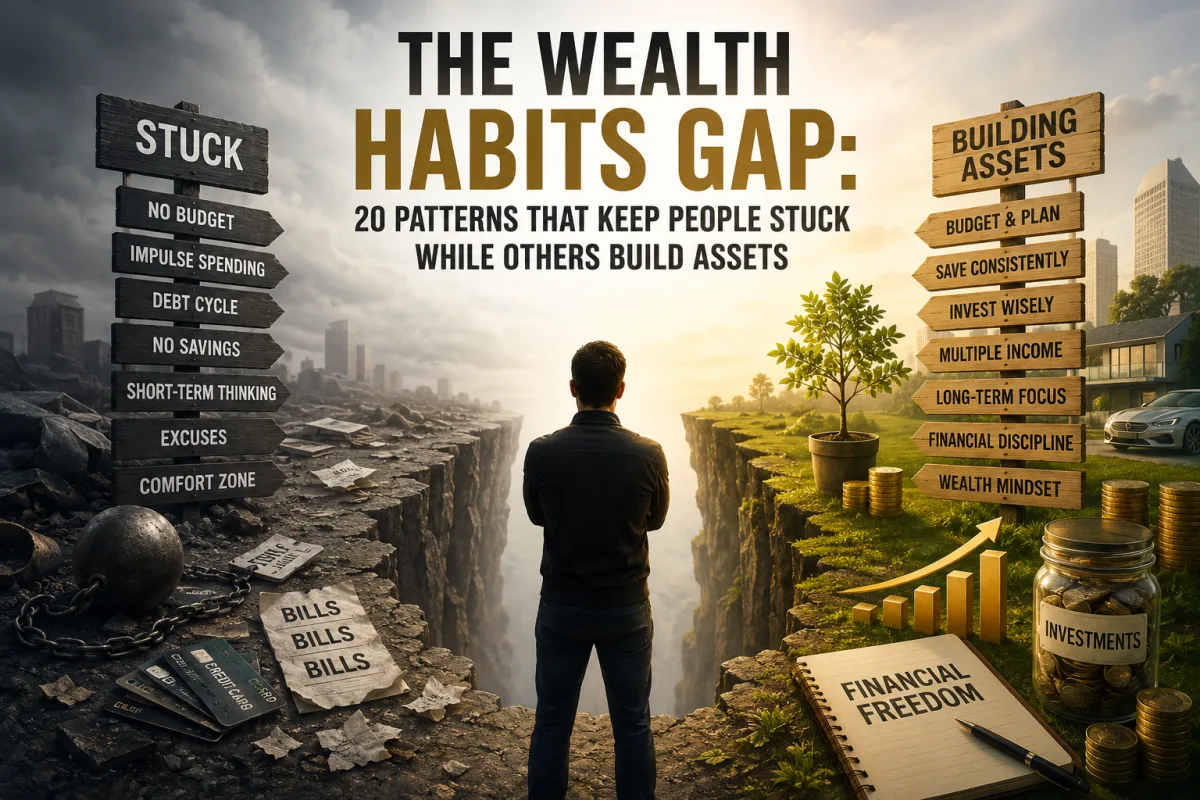
The Wealth Habits Gap: 20 Patterns That Keep People Stuck While Others Build Assets
Wealth is not built only in bank accounts. It is built in habits, assumptions, decisions, expectations, and the quiet routines that govern how money moves through a life. Two people can earn similar incomes and arrive at very different financial outcomes because one repeatedly converts income into assets while the other repeatedly converts income into consumption, debt, and short-term relief.
The phrase “poor people” can sound harsh because poverty is not always a personal failure. Many people are born into difficult circumstances, face low wages, medical crises, family obligations, discrimination, unstable housing, poor schools, or economic shocks they did not create. A serious conversation about money must acknowledge that reality. Not everyone starts at the same line, and not everyone has access to the same tools.
Yet it is also true that certain financial behaviors tend to keep people stuck, while other behaviors increase the odds of building wealth. The purpose of this article is not to shame people who struggle. It is to identify patterns. Some patterns are emotional. Some are practical. Some are cultural. Some are learned from families where money was always scarce. The good news is that patterns can change.
Wealthy households are not perfect. They overspend, make emotional decisions, buy status symbols, take foolish risks, and lose money too. But people who build lasting wealth tend to behave differently in several important ways. They think longer. They buy assets. They protect their time. They manage debt carefully. They treat money as a tool rather than a reward. They understand that income is only one part of wealth.
Here are 20 habits and mindsets that often separate people who stay financially stuck from people who build durable wealth.
1. They Spend to Feel Successful Instead of Becoming Financially Strong
One of the most expensive traps in personal finance is the desire to look successful before becoming secure. A person may buy the car, clothes, phone, apartment, vacations, and lifestyle that signal success, while the balance sheet underneath remains fragile. This creates the illusion of progress. From the outside, everything looks impressive. Internally, the household may be one emergency away from collapse.
Wealth builders usually reverse the order. They allow financial strength to come before financial display. They may live below their means for years while building savings, investing, paying down debt, and acquiring productive assets. To an observer, their lifestyle may look ordinary. But behind the scenes, their net worth is growing.
The poor habit is spending money to communicate status. The wealthy habit is building assets that make status unnecessary.
This difference is subtle but powerful. Status spending often produces immediate emotional satisfaction. It says, “I have arrived.” Wealth building often produces delayed satisfaction. It says, “I am becoming harder to break.” The first is visible. The second is quiet. The first impresses other people. The second changes your future.
Many people fall into status spending because they feel invisible. They want proof that their hard work matters. They want to enjoy life after years of sacrifice. They may feel pressure from friends, family, social media, or their neighborhood. But buying symbols of wealth before building wealth often turns income into financial pressure.
A wealthy mindset asks a different question: does this purchase make me stronger or weaker? If it increases debt, reduces flexibility, drains savings, or requires future income to support yesterday’s decision, it may be a sign of weakness disguised as success.
2. They Confuse Income With Wealth
Income is what comes in. Wealth is what remains, grows, and works for you. Many people focus almost entirely on income because it is the most visible part of money. They say, “I need to make more.” Often, they are right. Higher income can create opportunities. But income alone does not guarantee wealth.
A person earning a high salary can still be broke if every dollar is already promised to rent, cars, credit cards, subscriptions, restaurants, taxes, and lifestyle upgrades. Another person earning a moderate income can build wealth by saving consistently, investing early, avoiding destructive debt, and increasing skills over time.
Wealthy people tend to understand the difference between income and net worth. They measure financial progress not only by what they earn, but by what they own. They ask: how much equity do I have? How much investment income is being created? How many months could I survive without work? How much of my income is converted into assets?
Poor financial habits often center on cash flow only. If the monthly payment fits, the purchase feels affordable. If the paycheck arrives, the lifestyle continues. If the account balance is positive, everything seems fine. But cash flow can hide fragility. A household can appear stable while owning nothing and owing much.
The rich habit is to build a balance sheet. A balance sheet shows assets, liabilities, and net worth. It reveals whether a person is moving toward ownership or dependency. Without that view, money becomes a cycle of earning and spending rather than a system for building freedom.
3. They Let Lifestyle Rise as Fast as Income
Lifestyle inflation is one of the great wealth killers. It happens when every raise, bonus, promotion, or business improvement is absorbed into a more expensive life. A better apartment. A newer car. More dining out. Better vacations. More subscriptions. Higher expectations. Soon the person earns more but feels no freer.
This habit is common because it feels natural. People work hard and want to enjoy the reward. They may tell themselves they deserve it. And sometimes they do. But if income rises and savings do not rise, the future has not improved as much as it appears.
Wealth builders often create a gap between income and lifestyle. That gap is where wealth is born. If income grows but expenses remain controlled, the surplus can be invested. If every income increase becomes a spending increase, there is no surplus. Without surplus, there is no capital. Without capital, there is no ownership.
The issue is not whether someone should enjoy life. The issue is proportion. A financially strong person may enjoy some of the raise while investing the rest. A financially weak pattern spends the raise before it has a chance to become an asset.
A practical rule is to decide in advance what happens when income increases. For example, a person might commit that half of every raise goes toward investing, debt reduction, or emergency savings. This prevents lifestyle from automatically consuming progress.
The rich do not avoid lifestyle upgrades forever. They sequence them. They build the engine first, then enjoy more of what the engine produces.
4. They Use Debt to Buy Depreciating Things
Debt is not always bad. Used wisely, debt can finance education, business growth, real estate, or productive assets. But debt becomes dangerous when it is used to buy things that lose value, create no income, and require future labor to repay.
Many financially struggling households rely on debt for cars, electronics, furniture, clothes, vacations, emergencies, and daily expenses. This creates a painful cycle. Future income is already committed to past consumption. The person may work hard, but the paycheck does not fully belong to them. It belongs to lenders.
Wealthy people are often more careful about the purpose of debt. They may borrow to acquire an asset that can appreciate, produce income, improve business capacity, or increase long-term earning power. They may also borrow against assets strategically. But they are less likely to view debt as a way to make unaffordable consumption feel affordable.
The monthly payment is one of the most seductive ideas in modern finance. A seller does not ask, “Can you afford the total cost?” The seller asks, “Can you afford the payment?” This shifts attention from price to cash flow. A person may buy far more than they should because the payment seems manageable.
The wealthy mindset looks beyond the payment. It asks about total cost, interest, depreciation, opportunity cost, risk, and flexibility. A car loan is not just a payment. It is capital that cannot be invested. Credit card interest is not just a fee. It is a tax on impatience. Buy-now-pay-later plans are not just convenience. They can become a habit of spending money before earning it.
5. They Ignore Small Leaks Because Each One Seems Harmless
Large financial mistakes get attention, but small recurring leaks can be just as damaging. A subscription here, a delivery fee there, impulse purchases, unused memberships, daily convenience spending, late fees, overdraft charges, and interest payments can quietly consume hundreds or thousands of dollars a year.
People who struggle often dismiss these amounts because each one seems too small to matter. The wealthy are more likely to understand that recurring costs have a lifetime value. A $50 monthly habit is not just $50. It is $600 a year. Invested over decades, it could represent thousands of dollars in future wealth.
This does not mean every small pleasure must be eliminated. A joyless financial life is difficult to sustain. The issue is unconscious spending. If a person intentionally spends on what they value and still builds wealth, that is healthy. If money disappears without awareness, the household has a system problem.
Wealth builders audit their spending. They know which expenses improve their lives and which simply drain them. They cut waste aggressively so they can spend generously on priorities. This is different from being cheap. Cheapness focuses only on price. Financial intelligence focuses on value.
The poor habit is saying, “It is only a little.” The wealthy habit is asking, “What does this become if repeated for ten years?”
6. They Buy Liabilities Before Assets
One of the clearest differences between financial struggle and wealth building is the order of acquisition. Many people buy liabilities first: cars, lifestyle upgrades, luxury goods, consumer debt, and houses that stretch their budget. Wealth builders try to buy assets first: investments, businesses, income-producing real estate, skills, retirement accounts, and intellectual property.
A liability takes money from your pocket. An asset puts money into your pocket or has a strong chance of growing in value over time. The distinction is not always perfect, but it is useful. A car may be necessary, but it is usually not a wealth-building asset. A larger home may improve quality of life, but if it consumes all surplus cash, it can delay investing. A business tool may be expensive, but if it increases income, it may be productive.
Poor financial behavior often prioritizes comfort before capacity. Wealth-building behavior prioritizes capacity so comfort becomes easier later. The order matters. Buying liabilities first increases pressure. Buying assets first increases options.
This is why two households with the same income can diverge dramatically. One uses surplus money for payments. The other uses surplus money for ownership. After ten years, one has bills and used possessions. The other has investments, equity, and cash flow.
The lesson is not to avoid every liability. Life requires housing, transportation, tools, and enjoyment. The lesson is to make sure assets are growing faster than lifestyle obligations.
7. They Treat Saving as What Is Left Over
Many people save only after spending. The problem is that money rarely remains by accident. Modern life is designed to absorb income. If saving is optional, delayed, or dependent on discipline at the end of the month, it often does not happen.
Wealth builders usually pay themselves first. They move money into savings, investments, retirement accounts, or debt reduction before lifestyle spending expands. This makes wealth building automatic rather than emotional.
Automation matters because willpower is unreliable. A person may be disciplined in January and exhausted by March. They may have good intentions on payday and weak resistance by the weekend. Automated investing removes the monthly debate. The decision is made once and repeated consistently.
Poor financial habits depend on motivation. Wealthy habits depend on systems.
A system might include automatic retirement contributions, scheduled transfers to an emergency fund, automatic brokerage investments, separate accounts for bills and spending, and a rule that unexpected income is partly saved before it is touched. These structures reduce the temptation to spend everything that appears available.
The amount matters less at first than the habit. A person who saves $25 every week is building identity and momentum. Over time, as income rises or debt falls, the amount can grow. The key is to stop treating saving as leftovers and start treating it as the first claim on income.
8. They Avoid Looking at the Numbers
Financial avoidance is common. Many people do not check account balances, open bills, review debt totals, calculate interest, or measure net worth because the truth feels stressful. Avoidance provides temporary emotional relief. But it also allows problems to grow.
Wealth builders face numbers directly. They may not always like what they see, but they understand that clarity is power. You cannot improve what you refuse to measure. A budget, balance sheet, debt list, investment statement, or cash flow review is not a punishment. It is a dashboard.
A person who avoids money often lives in financial fog. They guess. They hope. They react. A person who tracks money can make decisions. They know which debt is most expensive, which expenses are rising, which investments are growing, and which goals are on track.
Looking at the numbers can be painful at first. Someone may discover they owe more than they thought, spend more than they realized, or own less than they assumed. But that discomfort is the beginning of control.
The poor habit is hiding from reality. The wealthy habit is seeking accurate information, even when it is uncomfortable.
9. They Depend on One Income Stream
A single paycheck can feel stable until it disappears. Many financially fragile households rely entirely on one employer, one client, one business, or one source of income. If that source is interrupted, everything is at risk.
Wealthy households often build multiple streams of income over time. These may include salaries, business profits, rental income, dividends, interest, royalties, consulting income, capital gains, pensions, or distributions from investments. Not all streams are large at first. The point is diversification.
Multiple income streams reduce dependency. They also change psychology. A person with only one paycheck may feel trapped. A person with savings, investments, skills, and side income has more bargaining power. They can leave a bad job, negotiate better, survive a downturn, or take calculated risks.
This does not mean everyone should chase every side hustle. Spreading attention too thin can be counterproductive. The best income streams often develop from skills, assets, or unfair advantages a person already has. A teacher may tutor. A designer may sell templates. A homeowner may rent a room. An investor may build dividend income. A professional may consult.
The wealthy principle is not busyness. It is resilience. A household becomes stronger when income does not depend entirely on one gatekeeper.
10. They Stop Learning After School
Formal education can help, but financial success often depends on continuous learning. Markets change. Industries evolve. Technology disrupts jobs. Tax rules shift. Business models appear and disappear. Skills that were valuable ten years ago may become ordinary today.
People who remain financially stuck often stop investing in their earning power. They may work hard but not strategically improve skills, credentials, communication, technology literacy, sales ability, leadership, or financial knowledge. Hard work matters, but hard work without skill growth can lead to exhaustion rather than advancement.
Wealth builders usually keep learning. They read, ask questions, study successful people, attend training, improve negotiation skills, understand investing, and seek mentors. They treat knowledge as an asset because it can raise income, reduce mistakes, and reveal opportunities.
One of the highest-return investments is becoming more valuable in the marketplace. A person who increases earning power by 20%, 50%, or 100% changes the entire financial equation. Saving becomes easier. Debt repayment accelerates. Investing grows faster. Options expand.
The poor habit is assuming learning ended with school. The wealthy habit is treating life as a continuing education in value creation.
11. They Work Only for Money, Not for Equity
Most people earn by selling time. They work hours and receive wages. This is necessary for many stages of life, but it has limits. Time is finite. If income depends only on hours worked, wealth growth is constrained by energy, schedule, and wage rates.
Wealthy people often seek equity. Equity means ownership. It may be ownership in a business, stock, real estate, intellectual property, or a partnership. Equity can grow while the owner sleeps. It can be sold. It can produce cash flow. It can appreciate beyond the value of the owner’s labor.
This is one of the largest differences between workers and wealth builders. A worker may help build a valuable company and receive only wages. An owner may benefit from the company’s increasing value. A tenant pays rent. A landlord builds equity. A consumer buys products. A shareholder owns part of the companies selling those products.
Not everyone can become a business owner immediately. But almost anyone can begin moving toward ownership through retirement accounts, index funds, small business projects, real estate savings, or skill-based ventures. The goal is to slowly shift from only earning income to also owning assets that participate in economic growth.
The poor habit is trading time for money forever. The wealthy habit is using money to buy assets that reduce dependence on time.
12. They Make Emotional Purchases and Rationalize Them Later
Many bad financial decisions begin as emotional decisions. Stress, boredom, insecurity, excitement, envy, loneliness, and anger can all lead to spending. The purchase happens first. The justification comes later.
Someone may buy an expensive car because they feel behind in life. They may book a trip because work has been exhausting. They may buy clothes to feel confident. They may upgrade a phone because everyone else has one. The emotion is real, but the financial consequence is also real.
Wealth builders are not emotionless. They simply create rules that protect them from emotional timing. They wait before large purchases. They compare prices. They calculate opportunity cost. They discuss major decisions with a spouse, adviser, or trusted friend. They separate wanting from needing.
A cooling-off period is one of the simplest tools. Waiting 24 hours, seven days, or thirty days before a nonessential purchase can reveal whether the desire is durable or temporary. Many impulses fade when not immediately fed.
The wealthy habit is not never spending. It is spending from intention rather than impulse.
13. They Surround Themselves With People Who Normalize Bad Money Decisions
Money behavior is contagious. If everyone around you finances cars they cannot afford, carries credit card debt, laughs at budgeting, mocks investing, and treats overspending as normal, it becomes harder to act differently. Social pressure can quietly shape financial outcomes.
Wealth builders often seek environments where growth is normal. They spend time with people who discuss business, investing, ownership, discipline, health, books, skills, and long-term goals. They are exposed to different standards. This changes what feels possible.
This does not mean abandoning friends or family because they struggle. It means being honest about influence. A person can love people deeply while refusing to copy their habits. Boundaries are not betrayal.
Financial change can be lonely at first. If a person stops going out every weekend, says no to expensive trips, drives an older car, or starts investing instead of spending, others may criticize. Sometimes criticism is really discomfort. Your discipline may remind others of choices they do not want to examine.
The poor habit is letting the group set your financial ceiling. The wealthy habit is choosing influences that expand your vision.
14. They Wait for Rescue Instead of Building Agency
Some people remain financially stuck because they are waiting for something external to change everything: a lottery win, an inheritance, a perfect job, a government program, a partner, a lawsuit settlement, a business idea, or a lucky break. Hope is not wrong, but hope without agency becomes passive.
Wealth builders take responsibility for what they can control. They may not control the economy, tax policy, inflation, family background, or market cycles. But they can control learning, saving rate, spending decisions, skill development, debt behavior, effort, relationships, and risk management.
Agency is the belief that your actions matter. Without agency, financial advice feels pointless. With agency, even small steps become meaningful.
This does not mean every obstacle can be overcome easily. Some situations are genuinely difficult. But waiting for rescue often delays the actions that would improve the odds. A person may not be able to transform their finances in one year, but they can usually make the next year stronger than the last.
The poor habit is saying, “Nothing will change unless someone saves me.” The wealthy habit is asking, “What can I do with the resources I have now?”
15. They Underestimate the Cost of Bad Health
Health and wealth are connected. Poor health can reduce income, increase expenses, limit energy, create debt, and shorten the time horizon for compounding. A person who neglects sleep, nutrition, movement, stress, and preventive care may pay later in both money and quality of life.
Wealthy people often treat health as an asset. They may invest in exercise, good food, medical care, rest, mental health, and routines that preserve performance. This is not only about living longer. It is about having the energy and clarity to earn, decide, lead, build, and enjoy wealth.
Financially struggling people may neglect health for understandable reasons. Healthy food can cost more. Safe places to exercise may be limited. Stress may be constant. Medical care may be expensive. Long work hours may leave little time. But even small health habits can have financial value.
Walking, sleeping better, drinking less, reducing smoking, cooking more often, managing stress, and seeking preventive care when possible can improve both life and finances. Health problems are not always preventable, but neglect increases risk.
The wealthy habit is viewing the body as productive capital. Without health, every financial plan becomes harder.
16. They Do Not Negotiate
Many people accept the first offer: the salary offered, the rent increase, the loan terms, the insurance premium, the contractor quote, the bank fee, the medical bill, or the price presented. Over a lifetime, failing to negotiate can cost enormous amounts of money.
Wealth builders negotiate because they understand that many prices are not fixed. They negotiate salaries, equity, fees, interest rates, contracts, business deals, real estate terms, and service costs. They do not always win, but they ask.
Salary negotiation is especially powerful because raises compound. A higher starting salary can affect future raises, bonuses, retirement contributions, and career expectations. Yet many people avoid negotiating because they fear rejection, conflict, or appearing ungrateful.
Negotiation is not aggression. It is communication about value. A person can negotiate respectfully, with data, timing, and professionalism. They can ask for better terms without damaging relationships.
The poor habit is assuming the offer is the limit. The wealthy habit is understanding that terms can often be improved by asking well.
17. They Mistake Cheap for Smart
Being frugal can build wealth. Being cheap can destroy value. The difference is important. Frugality means spending carefully to maximize long-term benefit. Cheapness means choosing the lowest immediate cost even when it creates future problems.
A cheap person may buy low-quality shoes that must be replaced constantly, skip maintenance until repairs become expensive, avoid professional advice and make costly mistakes, or choose poor insurance coverage that leaves them exposed. A frugal person looks at total value over time.
Wealthy households are often willing to pay for quality, expertise, durability, convenience, and risk reduction when the value is clear. They may hire a good accountant, buy reliable equipment, maintain property, purchase proper insurance, or invest in education. They understand that the lowest price is not always the lowest cost.
This principle applies to time as well. A person may save $20 but waste five hours. If those hours could have been used to earn, learn, rest, or build relationships, the saving may not be worth it.
The poor habit is focusing only on the price tag. The wealthy habit is calculating value, lifespan, risk, and opportunity cost.
18. They Ignore Taxes Until Filing Season
Many households think about taxes once a year. They gather documents, file returns, hope for a refund, and move on. Wealth builders think about taxes throughout the year because tax planning affects investment returns, business decisions, retirement contributions, charitable giving, estate planning, and cash flow.
Tax filing is historical. It reports what already happened. Tax planning is strategic. It shapes what happens before the year ends.
A business owner may time expenses and income. An investor may harvest losses. A worker may adjust retirement contributions. A family may contribute to tax-advantaged accounts. A donor may give appreciated assets. A homeowner may track deductible expenses. These decisions often need to happen before December 31, not when the return is prepared months later.
Ignoring taxes can cause people to miss opportunities. They may fail to contribute enough to retirement accounts, sell investments inefficiently, overlook deductions or credits, or create surprise tax bills. Wealthy people often work with professionals not because they enjoy complexity, but because the cost of poor planning can be high.
The poor habit is treating taxes as paperwork. The wealthy habit is treating taxes as part of financial strategy.
19. They Avoid Risk Completely or Take the Wrong Kind
People who struggle financially often have a complicated relationship with risk. Some avoid productive risk entirely. They never invest, never apply for better roles, never start a business, never negotiate, and never learn new skills because failure feels too dangerous. Others take destructive risks: gambling, speculative trading, scams, high-interest debt, or business ventures they do not understand.
Wealth builders usually distinguish between smart risk and reckless risk. Smart risk has research, preparation, downside protection, skill development, and a reasonable expected return. Reckless risk depends on luck, hype, urgency, or emotion.
Investing in a diversified portfolio over decades is risk, but it is different from putting rent money into a hot stock tip. Starting a small business after testing demand is risk, but it is different from borrowing heavily for an unproven idea. Changing careers after building skills is risk, but it is different from quitting impulsively with no plan.
The rich do not avoid risk. They manage it. They ask: what can go wrong? How much can I lose? What evidence supports this decision? What skills do I need? What is the upside? What is the time horizon? Can I survive failure?
The poor habit is either fearing all risk or chasing dangerous risk. The wealthy habit is taking calculated risks that can improve the future.
20. They Think Only About the Next Paycheck
Financial scarcity narrows time. When bills are overdue and money is tight, it is natural to focus on the next paycheck, the next rent payment, the next meal, or the next emergency. Survival demands attention. But when short-term thinking becomes permanent, wealth building becomes nearly impossible.
Wealthy people tend to think in longer time frames. They consider the next year, decade, generation, and legacy. They ask what today’s decision will become if repeated. They understand compounding, patience, and delayed rewards.
Long-term thinking changes daily behavior. Saving becomes easier when connected to freedom. Investing becomes easier when connected to future income. Avoiding debt becomes easier when connected to flexibility. Learning becomes easier when connected to future earning power.
A person trapped in paycheck thinking may make choices that solve today but harm tomorrow. Payday loans, credit card spending, skipping maintenance, ignoring health, and selling assets too early can all provide short-term relief while deepening long-term struggle.
The path out begins by extending the time horizon little by little. Build a one-week cushion. Then one month. Then three months. Start investing small amounts. Reduce one debt. Learn one skill. Plan one year ahead. Each step creates more space between survival and decision-making.
The wealthy habit is not predicting the future perfectly. It is preparing for the future consistently.
The Deeper Pattern: Consumption Versus Ownership
Behind most of these habits is one central difference: consumption versus ownership. Financially stuck households often consume most of what they earn. Wealth-building households convert part of what they earn into ownership.
Consumption is not evil. Everyone needs food, shelter, transportation, clothing, communication, and joy. But consumption alone does not create freedom. Once money is spent, it is gone. Ownership is different. An asset can grow, produce income, provide security, or create options.
This is why wealthy people often seem patient. They are not always more disciplined by nature. They have learned to enjoy the process of turning income into assets. They understand that every investment is a future employee. Every dollar invested has the potential to work, earn, and multiply.
The poor financial pattern says, “I worked, so I deserve to spend.” The wealthy pattern says, “I worked, so some of this money must work for me.”
That single shift can change a life.
Why Habits Matter More Than Motivation
Motivation is useful, but it fades. Habits remain. A person may feel motivated after reading a book, watching a video, or experiencing a financial scare. But unless that motivation becomes a system, the old pattern returns.
Systems are stronger than moods. Automatic saving, scheduled investing, written budgets, debt payoff plans, spending limits, calendar reminders, financial reviews, and accountability partners turn good intentions into repeated action.
Wealth builders design their environment. They make good decisions easier and bad decisions harder. They remove temptation, automate progress, seek better influences, and measure results. They do not rely on feeling disciplined every day.
A person who wants to become financially stronger should not ask, “How do I stay motivated forever?” A better question is, “What system will keep working when I am tired, stressed, busy, or distracted?”
How to Start Closing the Gap
The gap between financial struggle and wealth building can feel overwhelming, especially for someone starting with debt, low income, unstable work, or no savings. The answer is not to change everything at once. The answer is to create momentum.
Start with clarity. Write down income, expenses, debts, interest rates, assets, and net worth. The numbers may be uncomfortable, but they are the map. Without a map, effort is scattered.
Next, create a small emergency buffer. Even a modest cushion can reduce reliance on credit cards or payday borrowing. The first goal is not to become rich. It is to become less fragile.
Then attack high-interest debt. Expensive consumer debt destroys compounding. Paying it down can produce a guaranteed improvement in financial position.
At the same time, invest in earning power. Cut costs where possible, but do not build an entire financial life around cutting. There is a limit to how much can be saved, but income can grow through skills, negotiation, better jobs, business ownership, and investing.
Begin ownership early, even if the amount is small. A retirement contribution, index fund investment, small business asset, or education fund changes identity. You are no longer only a consumer. You are becoming an owner.
Finally, protect progress. Use insurance wisely. Avoid lifestyle inflation. Maintain health. Keep learning. Choose better influences. Review the plan regularly.
The Wealth Habit Standard
The goal is not to imitate every behavior of rich people. Some wealthy people are poor examples. The goal is to adopt the habits that create resilience, ownership, and long-term freedom.
A strong financial habit should do at least one of five things: increase income, reduce waste, build assets, lower risk, or improve future options. If a habit does none of these, it deserves examination.
Every purchase, debt, relationship, routine, and financial decision can be viewed through that lens. Does it make the future stronger or weaker? Does it increase freedom or reduce it? Does it create ownership or dependency? Does it help money grow or merely help money leave?
These questions are simple, but they are not easy. They require honesty. They may require saying no to things that feel good now. They may require disappointing people who benefit from your old habits. They may require patience when progress feels slow.
But wealth is often built in the quiet space between impulse and decision. It grows when a person chooses the asset over the appearance, the skill over the shortcut, the plan over the panic, the long term over the moment.
The Real Difference
The real difference between people who stay stuck and people who build wealth is rarely intelligence alone. It is not luck alone. It is not income alone. It is the repeated conversion of choices into either pressure or power.
Some choices create pressure: unnecessary debt, status spending, avoidance, impulse buying, poor health, low-value relationships, and short-term thinking. Other choices create power: saving, investing, learning, negotiating, owning, planning, and protecting assets.
At first, the difference may be invisible. One person drives the nicer car. Another owns the appreciating portfolio. One person looks wealthy. Another is becoming wealthy. Over time, the truth appears. The person who bought liabilities must keep working to support them. The person who bought assets has something working in return.
That is the wealth habits gap. It is not closed by shame. It is closed by awareness, discipline, systems, and ownership.
Financial transformation begins when a person stops asking only, “What can I afford this month?” and starts asking, “What will this decision do to my life ten years from now?”
That question is where wealth begins.
 Article
 Article
 Article
 Article
 Article
 Article
 Article
 Article