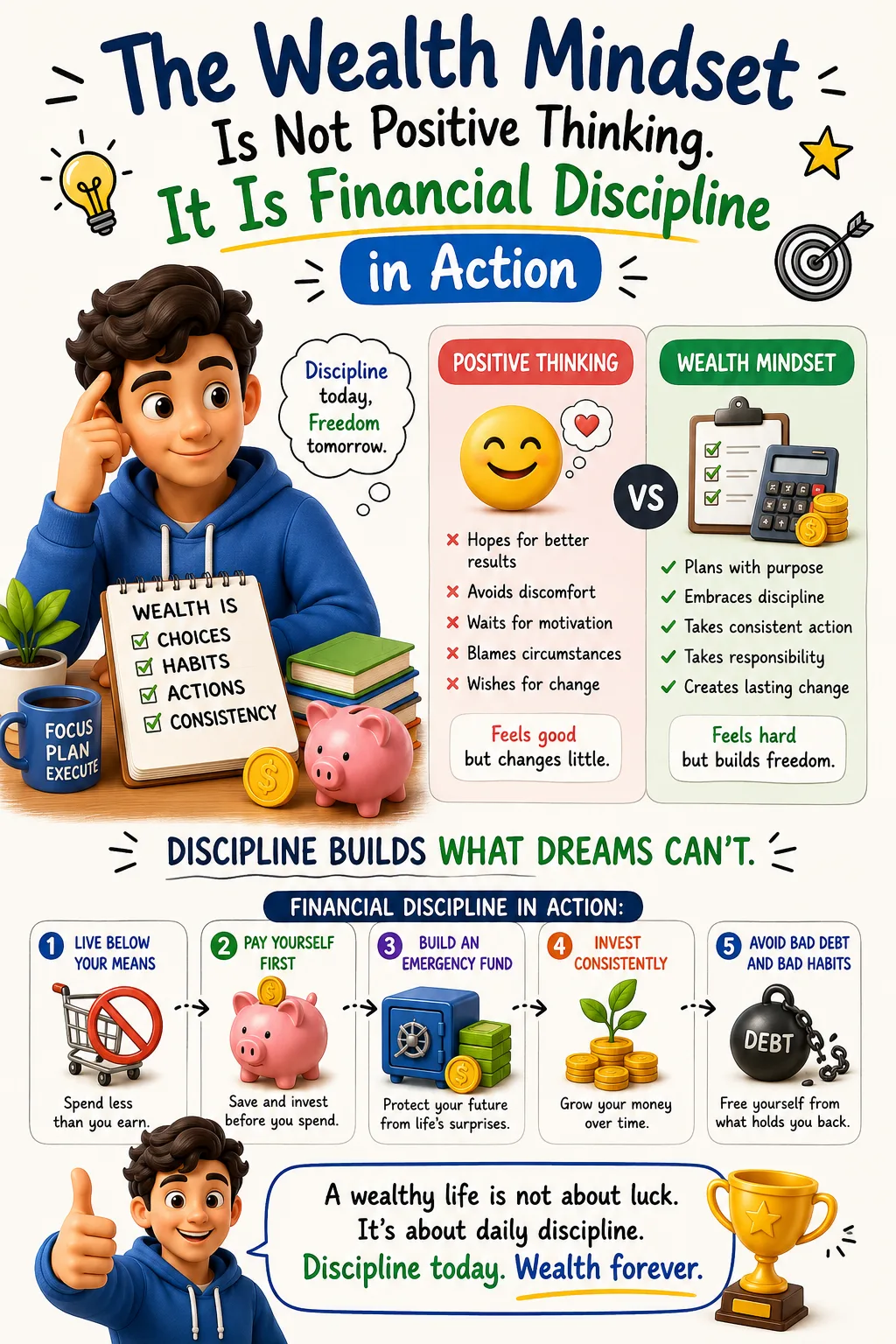
The Wealth Mindset Is Not Positive Thinking. It Is Financial Discipline in Action
\nThe phrase “rich mindset” is everywhere. It appears on social media graphics, motivational videos, business podcasts, financial coaching pages, and self-improvement accounts. The message is usually simple: poor people think one way, rich people think another way. Poor people save, avoid risk, blame circumstances, seek comfort, and follow the crowd. Rich people invest, manage risk, take responsibility, seek growth, and create their own path.
\nThere is a reason this type of comparison spreads so easily. It is memorable. It is emotionally satisfying. It suggests that wealth begins with thought, and in one sense, that is true. How a person thinks about money affects how they earn, spend, save, borrow, invest, and respond to setbacks. A person who sees every salary as money to consume will usually behave differently from someone who sees income as capital to allocate. A person who fears every form of risk will make different choices from someone who studies risk and uses it carefully. A person who spends first and saves later will build a different financial life from someone who pays their future self before lifestyle expenses expand.
\nBut the popular “poor vs rich mindset” framing also has a serious weakness. It can turn financial education into moral judgment. It can imply that poverty is simply a thinking problem, that people struggle because they lack ambition, discipline, or responsibility. That is not only incomplete; it is often unfair. Health, family background, education, wages, discrimination, economic shocks, inflation, caregiving duties, unstable employment, geography, debt, and access to capital all shape financial outcomes. A person can work hard, think responsibly, and still face difficult constraints.
\nA serious discussion of wealth mindset must hold two truths at once. First, personal financial habits matter enormously. Saving, investing, learning, planning, and taking calculated risks can change the trajectory of a life. Second, financial outcomes are not determined by mindset alone. Systems, opportunities, timing, and starting points matter. The goal is not to shame people with less money or glorify people with more. The goal is to identify the habits, principles, and decisions that increase financial resilience and ownership over time.
\nA real wealth mindset is not a slogan. It is not blind optimism. It is not pretending that obstacles do not exist. It is the practice of making decisions that convert income into security, security into opportunity, and opportunity into ownership.
\nThe Problem With Calling Saving a “Poor Mindset”
\nOne of the most misleading ideas in popular wealth content is that poor people focus on saving money while rich people focus on making money. There is a small truth inside the statement, but it is dangerously incomplete.
\nYes, increasing income matters. A person cannot cut expenses forever. There is a limit to how much can be saved when income is too low, rent is high, dependents need support, and basic costs consume most of the paycheck. Wealth building becomes much easier when earning power rises. Skills, promotions, business income, professional networks, and ownership opportunities all matter.
\nBut saving is not a poor habit. Saving is a survival habit, a stability habit, and a wealth habit. Wealthy households save. Successful businesses save. Governments build reserves. Investors hold cash for opportunities. Families build emergency funds. Entrepreneurs maintain liquidity because cash gives them room to survive mistakes and seize openings. The issue is not whether someone saves. The issue is whether saving is the only strategy.
\nSaving protects the financial foundation. Without savings, every emergency becomes a crisis. A medical bill becomes debt. A job loss becomes panic. A car repair becomes a loan. A delayed salary becomes humiliation. Savings create the space between inconvenience and disaster.
\nThe problem appears when saving becomes the entire financial plan. If money is only saved and never invested, its purchasing power may be eroded by inflation. If a person saves small amounts but never develops skills, negotiates income, starts a business, or invests in productive assets, financial progress may remain slow. Saving alone rarely creates substantial wealth unless income is very high and expenses are controlled. But without saving, investing becomes fragile.
\nThink of saving as the foundation and investing as the structure. A building without a foundation is unstable. A foundation without a building is incomplete. Wealth requires both.
\nMaking Money Matters, But So Does Keeping It
\nAnother common comparison says that a poor mindset focuses on saving money while a rich mindset focuses on making money. This sounds empowering because it shifts attention from scarcity to growth. But making money and keeping money are not enemies. They are partners.
\nMany people increase income and remain financially stressed because every increase is consumed. A raise becomes a larger apartment. A bonus becomes a vacation. A promotion becomes a car loan. A new business contract becomes a lifestyle upgrade. More money enters, but little stays. The person feels successful from the outside but fragile on the inside.
\nThis is why income is not wealth. Income is the flow of money. Wealth is what remains and grows after money is used wisely. A high-income professional with no savings, large debts, and expensive obligations may have less financial freedom than a modest earner with emergency savings, low debt, and a growing investment portfolio.
\nThe wealth mindset does not ask only, “How can I earn more?” It also asks, “How much of what I earn becomes lasting value?” That lasting value may take the form of investments, retirement accounts, business equity, property, intellectual property, professional credentials, or debt freedom.
\nEarning more is powerful when the additional income is directed intentionally. If every raise is divided between better living, higher savings, debt reduction, and investing, income growth accelerates wealth. If every raise is absorbed by lifestyle inflation, it only increases dependence on the next paycheck.
\nThe Difference Between Avoiding Risk and Managing Risk
\nRisk is one of the most misunderstood ideas in personal finance. Motivational content often presents risk as something poor people avoid and rich people embrace. That is too simplistic. Successful wealth builders are not reckless. They are selective.
\nAvoiding all risk can be costly. Someone who refuses to invest may avoid market volatility but face inflation risk, meaning their cash buys less over time. Someone who refuses to learn new skills may avoid the discomfort of study but face career stagnation. Someone who refuses to start a business, apply for a better job, negotiate pay, or move industries may avoid rejection but lose years of growth.
\nBut taking risk without understanding it is not a rich mindset. It is gambling with better branding. Speculative trading, unresearched business ventures, high-interest borrowing to invest, get-rich-quick schemes, and concentrated bets can destroy wealth faster than caution ever would.
\nThe real distinction is not risk versus no risk. It is unmanaged risk versus calculated risk.
\nCalculated risk has several characteristics. The downside is understood. The potential reward is realistic. The person can survive if the outcome is unfavorable. The decision is based on evidence, not hype. The risk fits the person’s time horizon, knowledge, and financial capacity. There is a plan for what happens if things go wrong.
\nAn emergency fund is a risk management tool. Insurance is a risk management tool. Diversification is a risk management tool. Skill development is a risk management tool. Avoiding high-interest debt is a risk management tool. Even saying no to an opportunity can be wise if the risk is misunderstood, mispriced, or emotionally driven.
\nWealth is not built by fearing risk or worshiping risk. It is built by studying risk, pricing risk, reducing unnecessary risk, and taking intelligent risk when the potential reward justifies it.
\nWorking for Money Is Not the Problem
\nAnother popular statement says that poor people work for money while rich people make money work for them. Again, there is truth here, but the phrase can be misleading.
\nMost wealthy people worked for money at some point. Many still do. Entrepreneurs work. Executives work. Doctors, lawyers, engineers, fund managers, business owners, consultants, and creators work. The issue is not whether someone works. Work is honorable, necessary, and often the starting point of capital formation.
\nThe deeper question is what happens to the money produced by work.
\nIf all income from labor is consumed, the person remains dependent on labor alone. They must keep exchanging time and energy for money because no other financial engine exists. If part of labor income is converted into assets, the equation begins to change. Investments can produce dividends, interest, rent, capital gains, or business profits. Skills can produce higher earning power. A business can produce income beyond one person’s hourly effort. Intellectual property can generate royalties. Retirement accounts can compound over decades.
\nMaking money work for you does not mean refusing to work. It means using work income to buy or build assets that can eventually share the burden.
\nThe first stage of financial life is often labor-dependent. That is normal. The second stage is capital-building: saving, investing, paying down debt, and increasing income. The third stage is ownership-supported: assets begin to contribute meaningfully to financial security. The fourth stage, for some, is financial independence: work becomes a choice rather than an absolute necessity.
\nThe transition does not happen through mindset alone. It happens through repeated allocation. Every paycheck asks the same question: will this money disappear into consumption, or will part of it be converted into something that strengthens the future?
\nLong-Term Thinking Is a Wealth Advantage
\nOne of the strongest ideas in the “rich mindset” framework is long-term thinking. Wealth usually rewards patience. Not passive waiting, but patient action.
\nShort-term thinking asks, “What can I buy now?” Long-term thinking asks, “What will this decision cost or create over time?” Short-term thinking focuses on the payment. Long-term thinking focuses on the total cost. Short-term thinking asks whether an investment is exciting today. Long-term thinking asks whether the asset is likely to create value over years. Short-term thinking reacts to market noise. Long-term thinking builds through cycles.
\nLong-term thinking is powerful because many financial rewards are delayed. Education may take years to translate into income. A professional reputation is built slowly. A retirement account compounds quietly. A business may require reinvestment before profit. Debt repayment may feel unrewarding until the burden is gone. Emergency savings may feel boring until the emergency arrives.
\nThe modern economy constantly attacks long-term thinking. Advertising encourages immediate consumption. Social media encourages comparison. Easy credit turns future income into present spending. Market speculation promises fast gains. Influencer culture rewards visible lifestyle over invisible balance sheets. Against that pressure, long-term thinking becomes a competitive advantage.
\nLong-term thinking does not mean ignoring the present. People need food, shelter, rest, relationships, and joy. A person who sacrifices everything today for a future they may not enjoy can become financially rigid and emotionally exhausted. The goal is balance: enjoy life while refusing to let short-term desire steal long-term freedom.
\nResponsibility Without Denial
\n“Rich people take responsibility; poor people blame circumstances” is one of the most emotionally charged claims in mindset content. It points to an important principle but often says it in a careless way.
\nPersonal responsibility matters. A person who refuses to examine their choices will struggle to improve. If spending is uncontrolled, debt is ignored, skills are not developed, and opportunities are avoided, blaming the world will not help. Financial progress requires ownership of the decisions within one’s control.
\nBut circumstances also matter. A person born into poverty may face weaker schools, fewer networks, unsafe neighborhoods, limited healthcare, unstable housing, and pressure to support family early. Someone facing illness, disability, discrimination, job loss, economic crisis, or caregiving responsibilities is dealing with real constraints. Pretending those forces do not exist is not wisdom. It is denial.
\nA mature wealth mindset separates responsibility from blame. Blame says, “Everything is my fault” or “nothing is my fault.” Responsibility says, “Given the reality I face, what can I do next?”
\nThis distinction matters. Shame can paralyze people. So can helplessness. Responsibility is different. It is practical. It looks at the facts, identifies available choices, and takes the next constructive step.
\nIf income is low, responsibility may mean building skills or seeking better work. If debt is high, it may mean calling lenders, creating a repayment plan, and cutting unnecessary expenses. If family demands are overwhelming, it may mean setting boundaries. If financial knowledge is weak, it may mean learning. If the environment is limiting, it may mean finding mentors, networks, or opportunities beyond the immediate circle.
\nResponsibility does not guarantee instant success. It does, however, restore agency. And agency is one of the most valuable assets a person can develop.
\nInvest First, Spend Later
\nThe habit of investing first and spending later is one of the clearest differences between people who build wealth and people who merely handle income. It is also one of the hardest habits to develop because it goes against the emotional rhythm of payday.
\nWhen money arrives, wants become louder. Bills appear. Friends call. Family needs help. A sale begins. A device needs upgrading. A restaurant feels deserved. If saving and investing wait until the end of the month, they must compete against every other demand. Often, they lose.
\nInvesting first does not mean ignoring necessities. Rent, food, transport, utilities, insurance, and essential obligations must be covered. But once essentials are accounted for, the future should receive its share before discretionary spending begins.
\nThis is the core of paying yourself first. The future version of you is treated as a serious financial obligation. Retirement contributions, investment transfers, emergency savings, and debt repayments are scheduled rather than improvised.
\nThe amounts can begin small. What matters is the order. A person who invests a modest amount consistently builds a habit of ownership. A person who waits for a perfect surplus may never begin because lifestyle naturally expands into available cash.
\nAutomation strengthens this habit. If money moves automatically into savings or investment accounts shortly after payday, there is less room for negotiation. The system acts before impulse. Over time, the investor adapts to living on what remains. This is not deprivation. It is financial architecture.
\nComfort Has a Cost
\nComfort is not bad. A safe home, good food, rest, family time, and peace are legitimate goals. The danger is not comfort itself. The danger is choosing comfort so consistently that growth never occurs.
\nGrowth often requires discomfort. Learning a new skill is uncomfortable. Applying for a better job is uncomfortable. Negotiating salary is uncomfortable. Starting a business is uncomfortable. Admitting financial mistakes is uncomfortable. Living below one’s means can be uncomfortable when peers are upgrading. Investing during market declines is uncomfortable. Saying no to social pressure is uncomfortable.
\nA growth mindset does not seek pain for its own sake. It accepts useful discomfort when the result is greater capability. There is a difference between destructive stress and constructive challenge. Working three jobs with no sleep may damage health. Studying after work to qualify for a better role may build future freedom. Reckless risk may create chaos. Carefully stretching beyond one’s current skill level may create opportunity.
\nComfort becomes expensive when it keeps a person in financial patterns that no longer serve them. The familiar job with no growth. The spending habit that relieves stress temporarily. The social circle that mocks ambition. The refusal to learn because being a beginner feels embarrassing. The avoidance of money conversations because numbers feel intimidating.
\nWealth building often begins with a willingness to be temporarily uncomfortable for a better long-term position.
\nFailure Is Data, Not Identity
\nFear of failure can keep people financially stuck. They do not invest because they fear losing money. They do not apply for better roles because they fear rejection. They do not start a side business because they fear embarrassment. They do not ask questions because they fear looking ignorant. They do not make a plan because they fear discovering how far behind they are.
\nFailure is painful. Financial failure can be especially painful because money is tied to survival, status, family expectations, and self-worth. But avoiding every possible failure can create a larger failure: the failure to grow.
\nA healthier approach treats failure as data. A failed budget reveals unrealistic assumptions. A failed business idea reveals customer behavior, pricing problems, execution gaps, or market weakness. A bad investment reveals the cost of poor research, overconfidence, concentration, or emotional decision-making. A rejected job application reveals a need for stronger skills, better positioning, or a wider search.
\nThis does not mean failure should be romanticized. Some failures are costly and preventable. Losing savings to a scam is not noble. Taking excessive debt for a poorly understood venture is not admirable. Repeating the same mistake without reflection is not growth. The point is not to celebrate failure. The point is to learn from it quickly, honestly, and without letting it become a permanent identity.
\nSuccessful wealth builders are not people who never fail. They are people who keep failures survivable, extract lessons, and adjust behavior.
\nProblems Versus Solutions
\nAnother common mindset comparison says poor people talk about problems while rich people focus on solutions. This can sound harsh, but there is a useful lesson when framed carefully.
\nProblems deserve to be named. Debt is real. Low wages are real. Inflation is real. Family pressure is real. Medical expenses are real. Bad luck is real. Naming a problem is not weakness. It is the first step in solving it.
\nThe issue is whether attention stops at the problem. A problem-focused mindset repeats the difficulty without creating a plan. A solution-focused mindset asks what action is possible, even if the action is small.
\nIf expenses exceed income, the solution may involve cutting costs, increasing income, renegotiating obligations, finding support, or changing housing. If debt is growing, the solution may involve freezing new borrowing, ranking debts by interest, negotiating terms, or consolidating carefully. If income is stagnant, the solution may involve skills, certifications, networking, job applications, freelance work, or relocation. If investing feels confusing, the solution may involve education and simple diversified products rather than speculation.
\nSolution-focused thinking is not pretending everything is easy. It is refusing to give the problem complete control of the conversation.
\nFollowing the Crowd Can Be Financially Dangerous
\nThe crowd is not always wrong. Sometimes common behavior is common because it works. Saving regularly, buying insurance, investing for retirement, and avoiding high-interest debt are widely recommended for good reason. The danger is following the crowd without thought.
\nFinancial crowds often move through emotion. When markets rise, the crowd becomes excited and risk feels low. When markets fall, the crowd becomes fearful and opportunity feels dangerous. When a lifestyle trend becomes popular, the crowd normalizes spending. When credit becomes easily available, the crowd borrows. When a speculative asset rises quickly, the crowd confuses price movement with intelligence.
\nIndependent financial thinking does not mean rejecting every popular idea. It means asking better questions. Does this decision fit my goals? Do I understand the risk? Can I afford the downside? Am I buying because I need it, value it, or want to be seen with it? Am I investing because the asset is sound or because others are making money? Am I borrowing because it improves my future or because it helps me imitate someone else’s present?
\nCreating your own path is not about rebellion. It is about alignment. Your financial decisions should match your income, responsibilities, values, and long-term goals, not the spending habits of people around you.
\nThe Role of Skills in Wealth Mindset
\nA serious wealth mindset includes skill development. Money does not exist separately from value creation. In most cases, income rises when a person becomes more capable of solving valuable problems.
\nSkills can be technical, commercial, creative, managerial, or interpersonal. Coding, accounting, sales, design, engineering, writing, data analysis, project management, negotiation, leadership, public speaking, financial analysis, marketing, and operations can all increase earning power depending on context. Even basic professional habits—reliability, communication, punctuality, problem-solving, and follow-through—can separate a worker from peers.
\nMany people focus only on cutting expenses because skill growth feels slower and less certain. But the upside of skill development can be much larger than the upside of frugality alone. Reducing expenses by a small amount helps. Increasing income by a large amount while maintaining discipline can transform a financial life.
\nThe best skill investments are strategic. They are connected to market demand. They are practiced, not merely consumed as content. They lead to better work, higher pay, stronger business capability, or more valuable networks. Buying courses without implementation is not skill development. Reading without action is not enough. Credentials without competence have limited value.
\nA wealth mindset asks, “What can I learn that will make me more useful, more adaptable, and more valuable over time?”
\nAssets Are the Center of Wealth
\nThe deepest difference between a consumption mindset and a wealth-building mindset is the treatment of assets. A consumer asks, “What can this money buy me today?” A wealth builder asks, “What can this money become?”
\nAssets are resources that can produce value. They may generate income, appreciate, reduce future costs, or increase earning power. Stocks, bonds, retirement funds, rental property, businesses, productive equipment, intellectual property, and certain forms of education can all function as assets. Not every asset is suitable for every person, and not every asset is equally safe or productive. But wealth generally requires ownership of something beyond a paycheck.
\nLiabilities, by contrast, take money out. Some liabilities are necessary or strategic, such as a reasonable mortgage or education loan under the right conditions. Others are purely consumptive, such as high-interest debt used for lifestyle spending. The wealth mindset pays attention to the difference.
\nThis distinction changes everyday decisions. A person may still buy clothes, travel, dine out, and enjoy life. But they do not let consumption crowd out asset accumulation. They understand that every month without saving or investing is a month where income failed to reproduce itself.
\nAsset building starts small. A first investment contribution may seem insignificant. A retirement account may grow slowly at first. A business idea may begin as a side project. But the early stage is where identity forms. The person begins to see themselves as an owner, not only a worker or spender.
\nDebt Can Destroy the Wealth Mindset
\nDebt deserves special attention because it can quietly reverse financial progress. When debt is used carelessly, it turns future income into payment for past consumption. It reduces flexibility before the salary even arrives.
\nHigh-interest consumer debt is especially harmful. It grows quickly and often finances things that do not grow in value. The borrower pays interest on meals already eaten, clothes already worn, trips already taken, or devices already depreciating. This creates a painful mismatch: the pleasure is short-lived, but the payment remains.
\nA wealth mindset treats debt with caution. It asks why the debt exists, what it costs, how it will be repaid, and whether it improves future earning power or asset ownership. Borrowing to acquire a productive asset may be reasonable if the risk is understood. Borrowing to maintain an unaffordable lifestyle is dangerous.
\nDebt also affects the mind. It creates stress, narrows choices, and can make people feel trapped. A person with heavy monthly repayments may stay in a bad job, delay investing, postpone family goals, or rely on more borrowing when emergencies arise.
\nPaying down debt is not glamorous, but it is a form of wealth building. Every balance reduced lowers the claim others have on future income. Every high-interest loan eliminated increases freedom. Debt repayment may not feel like investing, but it often produces a guaranteed improvement in financial position.
\nEmergency Savings Are Not Optional
\nA wealth mindset is not only aggressive. It is defensive when necessary. Emergency savings are one of the clearest examples.
\nSome people dismiss emergency funds because they want every coin invested. Others feel that cash sitting in an account is lazy. But emergency savings serve a different purpose from investments. Investments are for growth. Emergency savings are for resilience.
\nWithout emergency savings, a person may be forced to sell investments at a bad time, borrow at high interest, miss payments, or depend on others. A small emergency can interrupt years of progress. The emergency fund protects the investment plan by preventing every surprise from becoming a financial detour.
\nThe right emergency fund depends on personal circumstances. Someone with stable employment, no dependents, and low expenses may need less cash than someone supporting family, working in a volatile industry, or managing health concerns. A common goal is three to six months of essential expenses, but even a starter fund can reduce anxiety and prevent small crises from becoming debt.
\nSaving for emergencies is not a poor mindset. It is professional risk management at the household level.
\nWealth Mindset and Family Responsibility
\nFinancial advice often assumes an individualistic world where every person manages only their own expenses. Many people do not live in that world. Their income supports parents, siblings, children, relatives, community obligations, religious giving, or family emergencies.
\nA wealth mindset must make room for responsibility without allowing responsibility to become financial self-destruction. Supporting family can be honorable. It can also become unsustainable if there are no limits, no planning, and no distinction between genuine need and endless demand.
\nThe solution is not selfishness. It is structure. A person can set a family support budget, communicate limits, prioritize emergencies, and avoid borrowing to meet every request. They can help in non-cash ways, such as planning, research, budgeting, or connecting relatives with opportunities. They can support education or medical needs while saying no to lifestyle demands that would damage their own stability.
\nThis is difficult because money is emotional. Saying no can feel like betrayal. But a person who gives everything away may never build the stability that would allow them to help sustainably. Financial boundaries are not a rejection of family. They are a way to prevent one income from collapsing under unlimited expectations.
\nThe Quiet Power of Living Below Your Means
\nLiving below your means is not fashionable advice, but it remains one of the most reliable principles in personal finance. It means spending less than you earn and directing the gap toward savings, investments, debt reduction, and goals.
\nThe phrase is simple, but the practice is difficult because modern life is designed to absorb income. Every stage of progress comes with new spending opportunities. A better job invites better clothes. A raise invites better housing. A new social circle invites expensive outings. A growing business invites visible success. If spending rises automatically with income, the gap never grows.
\nLiving below your means does not require misery. It requires priority. Spend generously on what truly matters and cut ruthlessly from what does not. The goal is not to win a contest of deprivation. The goal is to create a surplus. Surplus is the raw material of wealth.
\nWithout surplus, there is no emergency fund, no investing, no debt acceleration, no opportunity capital, and no freedom. With surplus, even modest income can become powerful over time.
\nMindset Is Proven Through Systems
\nMany people say they have a wealth mindset because they believe in growth, investing, and responsibility. But belief is not enough. Mindset becomes real only when it is translated into systems.
\nA budget is a system. Automatic investing is a system. A debt repayment schedule is a system. A separate emergency fund is a system. A monthly net worth review is a system. A skill development plan is a system. Insurance coverage is a system. A rule for raises is a system. A family support limit is a system.
\nSystems matter because motivation is unreliable. A person may feel disciplined after watching a financial video, but the feeling fades. Payday excitement, stress, fatigue, social pressure, and emergencies can override good intentions. Systems continue working when motivation weakens.
\nFor example, someone who wants to invest may manually decide each month whether to transfer money. Some months they will. Other months they will not. Someone with an automatic transfer has removed the decision. The system protects the goal from mood.
\nThe same applies to spending. A person who keeps all money in one account may overspend because the balance looks available. A person who separates bills, savings, investments, and spending money creates boundaries. The system makes the better behavior easier.
\nA wealth mindset is not measured by what a person says about money. It is measured by what their systems do with money when life becomes busy.
\nThe Danger of Wealth Shaming and Poverty Shaming
\nDiscussions about mindset can become toxic in two directions. One direction is poverty shaming: assuming that people with less money are lazy, irresponsible, or mentally weak. The other direction is wealth shaming: assuming that people with money are greedy, lucky, or immoral. Both views are too shallow.
\nSome people become wealthy through discipline, innovation, risk, patience, and service. Some inherit wealth. Some benefit from favorable timing. Some use unfair advantages. Some work extraordinarily hard. Some are simply lucky. Wealth has many paths.
\nSimilarly, people struggle financially for many reasons. Some make poor choices. Some face low wages, family burdens, illness, economic instability, exploitation, or lack of opportunity. Some are recovering from past mistakes. Some are supporting others. Some are one emergency away from stability and simply need time.
\nA useful wealth mindset does not require contempt for anyone. It studies what works without turning money into a measure of human worth. The goal is not to feel superior. The goal is to become more capable, secure, generous, and free.
\nWhat an Evidence-Based Wealth Mindset Looks Like
\nA more useful framework replaces “poor vs rich” with effective versus ineffective financial habits.
\nAn effective financial mindset budgets consistently. It understands where money goes. It spends less than it earns when possible. It builds emergency savings. It pays off high-interest debt. It invests regularly for long-term growth. It increases earning power through skills and relationships. It takes calculated risks. It learns from mistakes. It protects against major losses. It avoids lifestyle inflation. It thinks in terms of assets, not only income.
\nAn ineffective financial mindset ignores numbers. It spends first and hopes to save later. It borrows for appearances. It confuses speculation with investing. It avoids learning because money feels intimidating. It lets social pressure decide spending. It blames everything without acting or blames itself so harshly that action becomes impossible. It seeks comfort at the expense of growth. It treats every raise as permission to consume more.
\nThis framing is better because habits can change. Labels often trap people. A person is not permanently “poor minded” because they made mistakes or started with little. A person is not automatically wise because they have money. What matters is whether their habits move them toward resilience and ownership.
\nA Practical Wealth Mindset Plan
\nThe first step is awareness. Track income, expenses, debts, and assets. Most people cannot improve what they refuse to measure. This does not require obsession. A simple monthly review can reveal patterns that memory hides.
\nThe second step is stability. Build a starter emergency fund, cover essential expenses, and stop high-interest debt from growing. Stability gives the mind room to think beyond survival.
\nThe third step is surplus. Find ways to increase the gap between income and expenses. This can happen through careful spending, higher income, side work, negotiation, skill development, or reducing debt payments over time.
\nThe fourth step is ownership. Direct surplus toward investments, retirement accounts, business assets, or other productive uses. The goal is to make part of your income permanent by converting it into assets.
\nThe fifth step is protection. Use insurance, diversification, emergency savings, and cautious borrowing to avoid catastrophic setbacks. Wealth building is not only about growth; it is also about staying in the game.
\nThe sixth step is growth. Keep learning. Increase earning power. Improve judgment. Build networks. Study markets. Understand taxes, investing, business, and negotiation. A wealth mindset is not static. It keeps upgrading its decision-making capacity.
\nThe seventh step is purpose. Money without purpose becomes accumulation for its own sake or spending without direction. Define what wealth is meant to do: security, family support, freedom, generosity, meaningful work, ownership, travel, education, or independence. Purpose helps prevent both reckless spending and joyless hoarding.
\nHow to Teach This Mindset Without Misleading People
\nFinancial educators, parents, mentors, and content creators should be careful with mindset language. The goal should be empowerment, not shame. A good message does not say, “Poor people think badly.” It says, “These habits tend to weaken financial stability, and these habits tend to strengthen it.”
\nA good message does not say, “Saving is for poor people.” It says, “Saving protects you, but investing and income growth help you build.”
\nA good message does not say, “Avoiding risk makes you poor.” It says, “Avoid reckless risk, but learn to take calculated risks that fit your goals.”
\nA good message does not say, “If you are struggling, it is your fault.” It says, “Your circumstances may be difficult, but there may still be decisions within your control that can improve your position.”
\nA good message does not say, “Rich people are better.” It says, “Certain behaviors make wealth more likely, and anyone who can adopt them improves their odds.”
\nThis distinction matters because people learn better when they are respected. Shame may create temporary motivation, but it often produces avoidance. Respect creates the possibility of honest change.
\nThe Wealth Mindset in Daily Life
\nA wealth mindset is built in ordinary decisions. It appears when someone checks their budget before making a purchase. It appears when they choose a modest apartment to keep investment contributions alive. It appears when they negotiate salary instead of silently accepting underpayment. It appears when they read about investing before chasing a trend. It appears when they build an emergency fund instead of assuming nothing will go wrong. It appears when they pay off high-interest debt instead of pretending minimum payments are progress.
\nIt also appears when they rest. Burnout is not wealth. Health is an asset. Relationships are assets. Reputation is an asset. Peace of mind is an asset. A mature wealth mindset does not destroy the person in pursuit of the portfolio.
\nThe goal is not to become obsessed with money. The goal is to become competent with money so it no longer controls every decision. Financial strength gives people options: to leave harmful situations, support family, take opportunities, survive setbacks, and choose work with greater freedom.
\nFrom Mindset to Ownership
\nThe most important shift is from earning to owning. Earning pays bills. Owning builds wealth. The path from one to the other is created by disciplined allocation.
\nEvery month, income arrives. Some must go to necessities. Some may go to family. Some may go to debt. Some should go to protection. Some should go to enjoyment. But some must go to ownership if wealth is the goal.
\nOwnership may begin with a retirement contribution. It may begin with a diversified fund. It may begin with a small business. It may begin with a professional certification that raises income. It may begin with paying off a debt so future cash flow belongs to you again. The form can vary. The principle remains.
\nA person who owns nothing and saves nothing is fully dependent on the next paycheck. A person who gradually accumulates assets is building a second source of strength. At first, the assets may seem small. Over time, they can become the difference between financial anxiety and financial choice.
\nContinue Building a Stronger Money Mindset
Use these guides to strengthen the beliefs, habits, systems, and financial decisions discussed in this article.
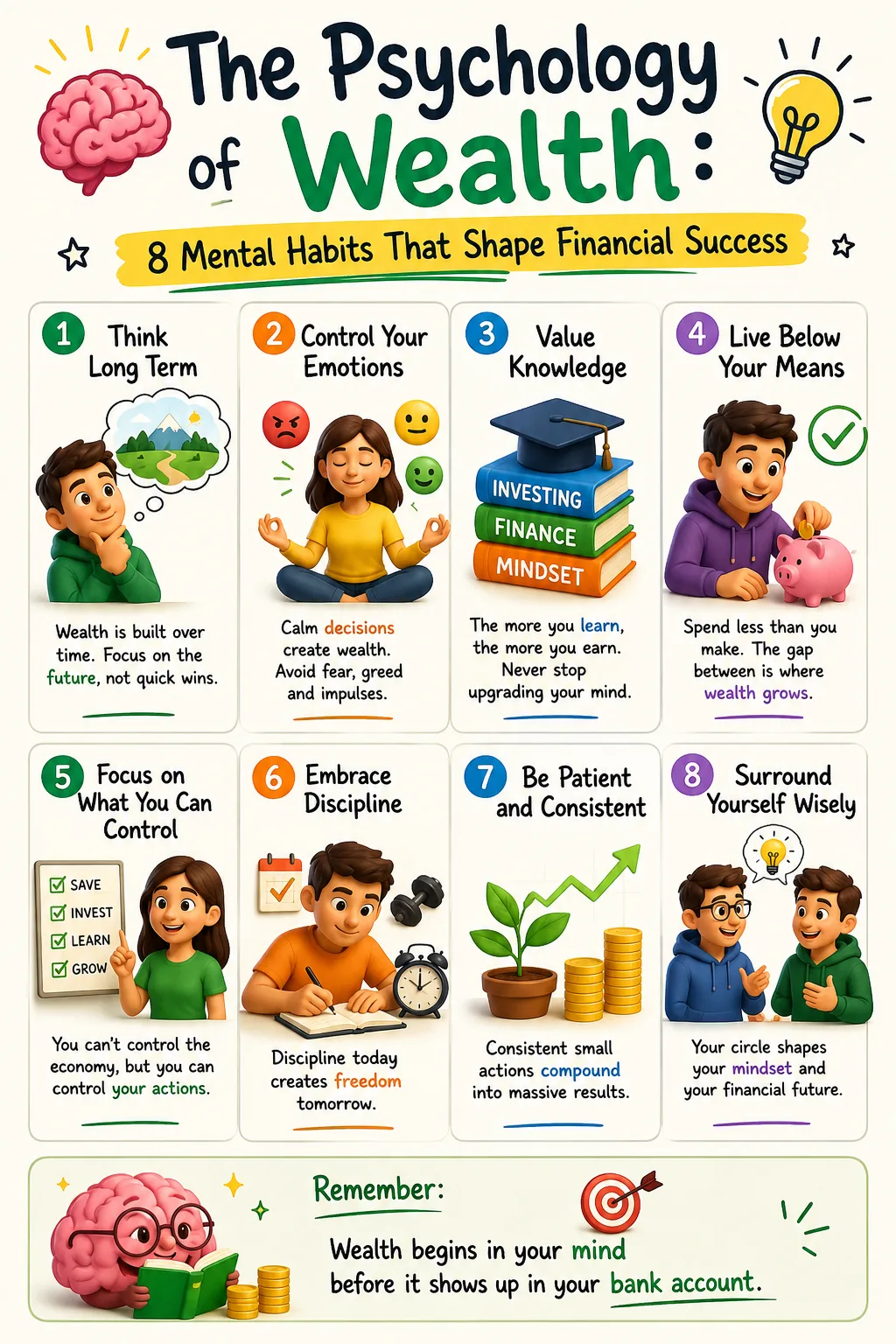
- Understand the mental habits that shape financial success
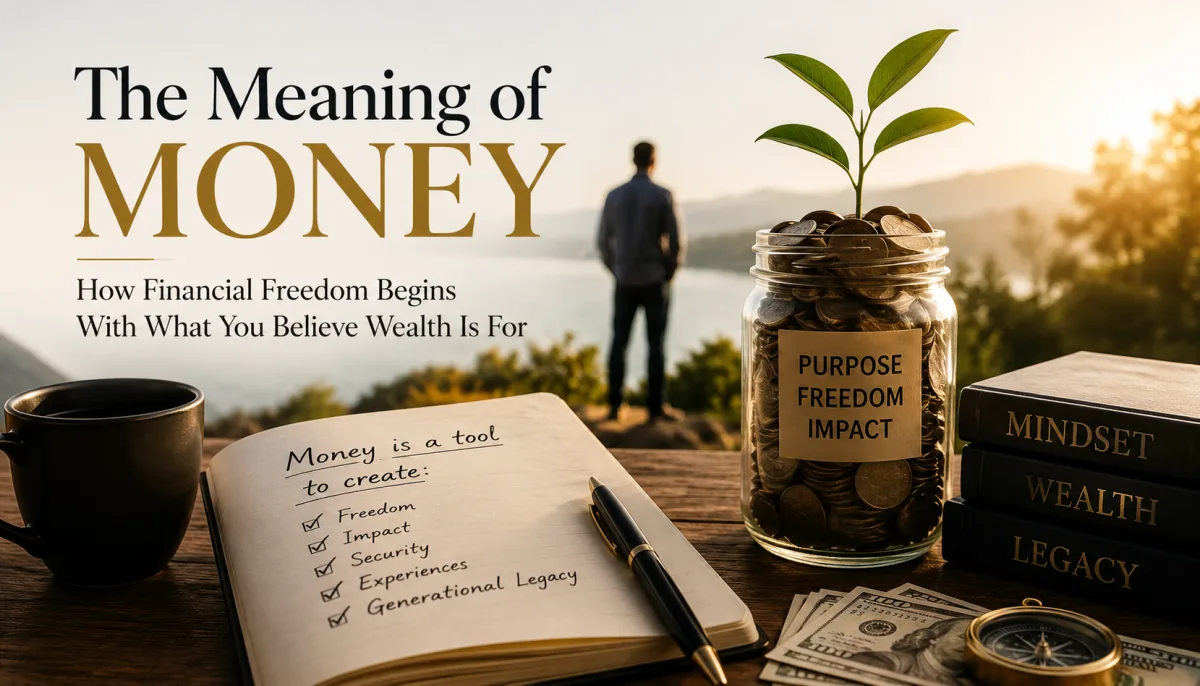
- Clarify what money and wealth are meant to support
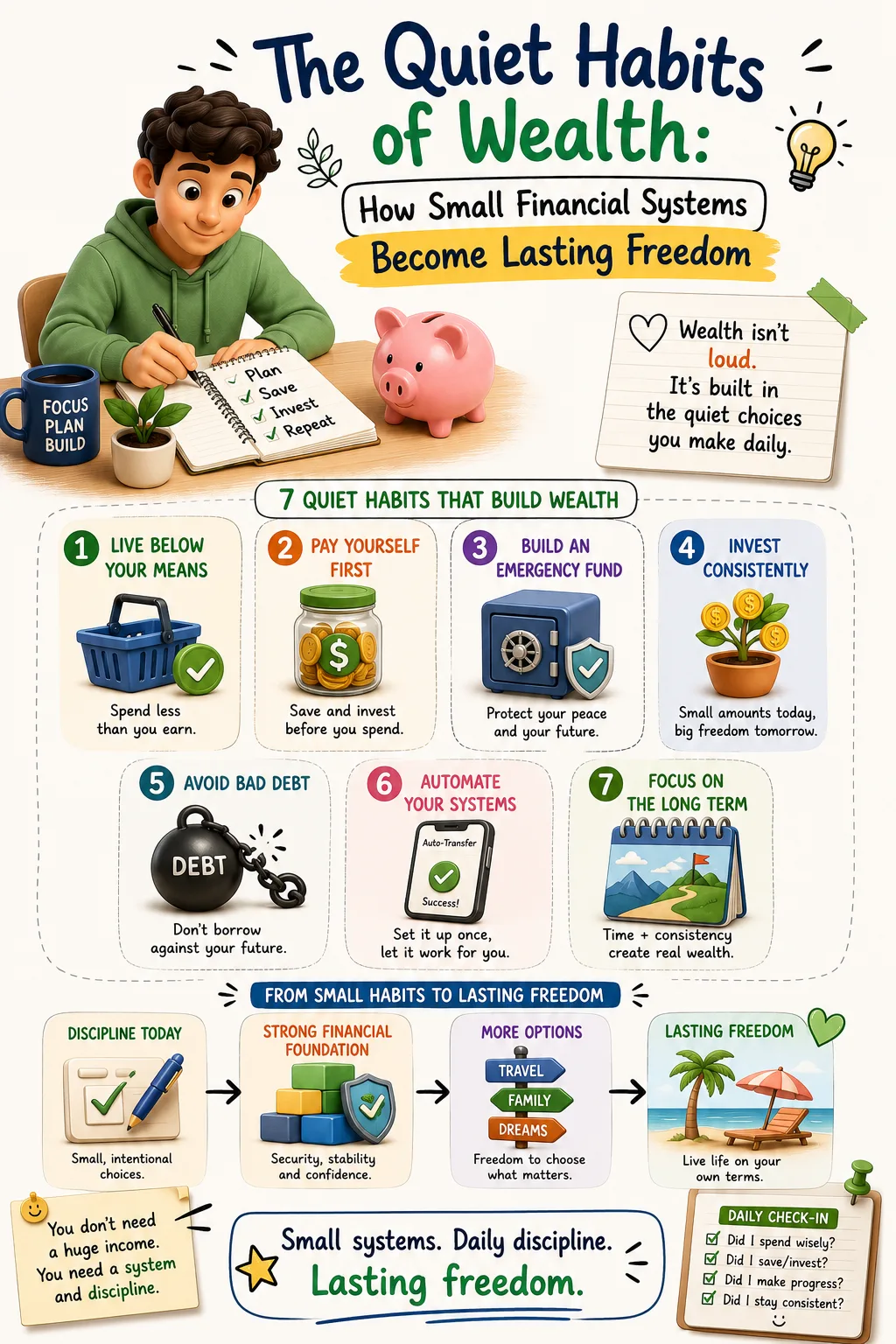
- Build quiet financial discipline through repeatable habits
- Identify the habits that separate consumption from ownership
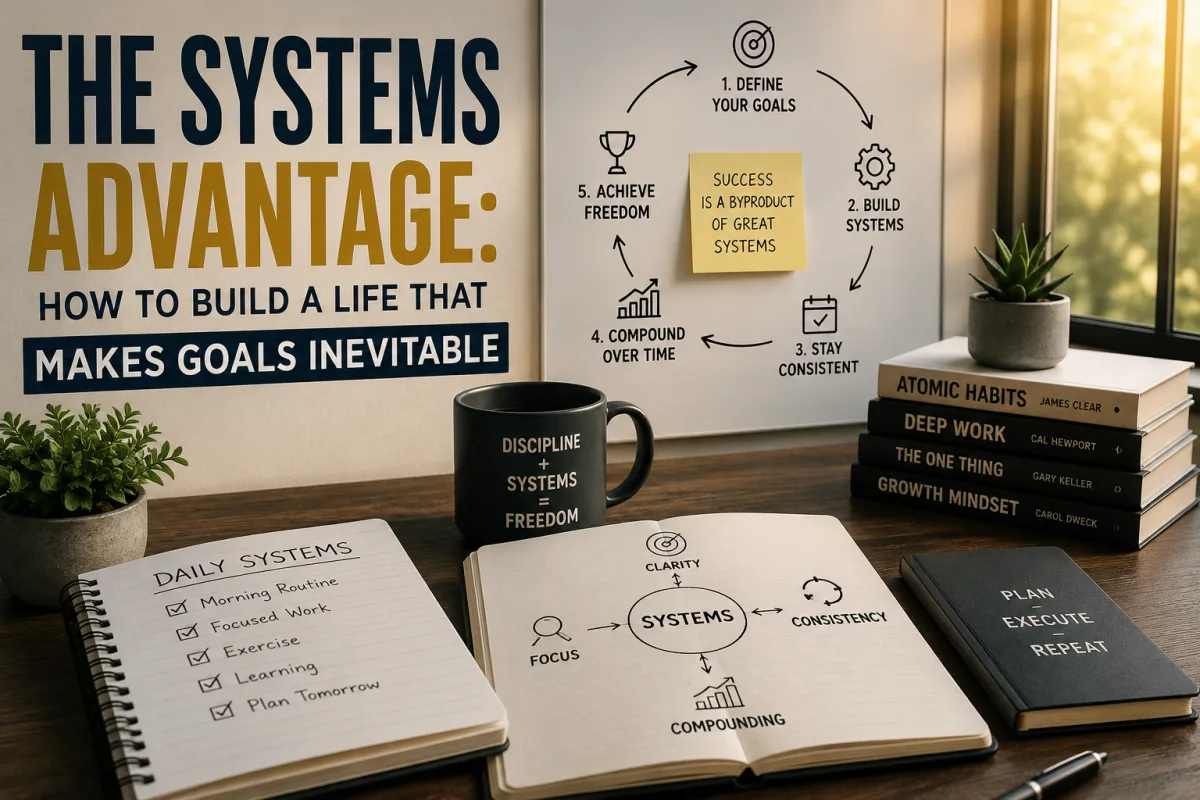
- Replace motivation with systems that support better decisions
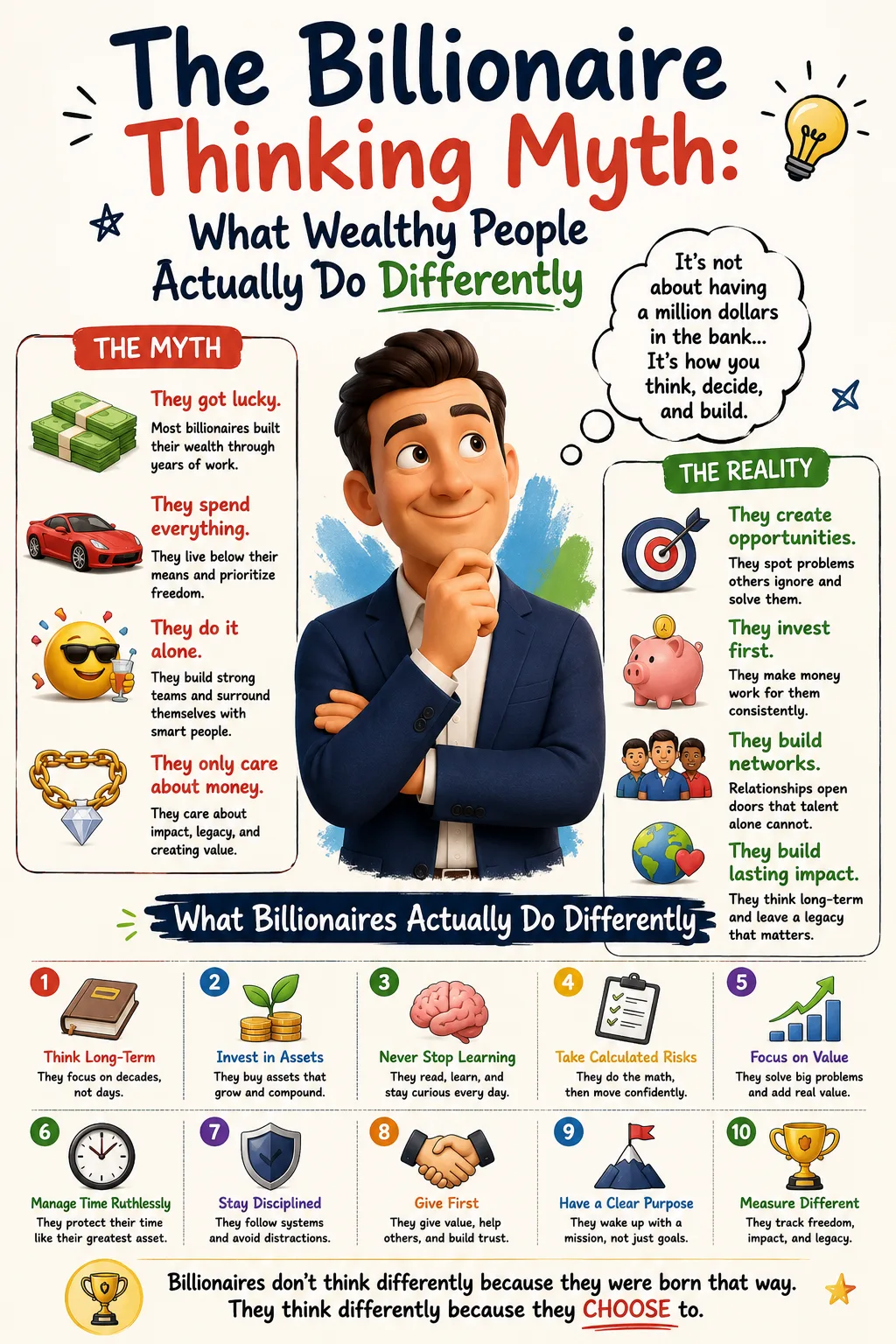
- Separate real wealth habits from billionaire mythology
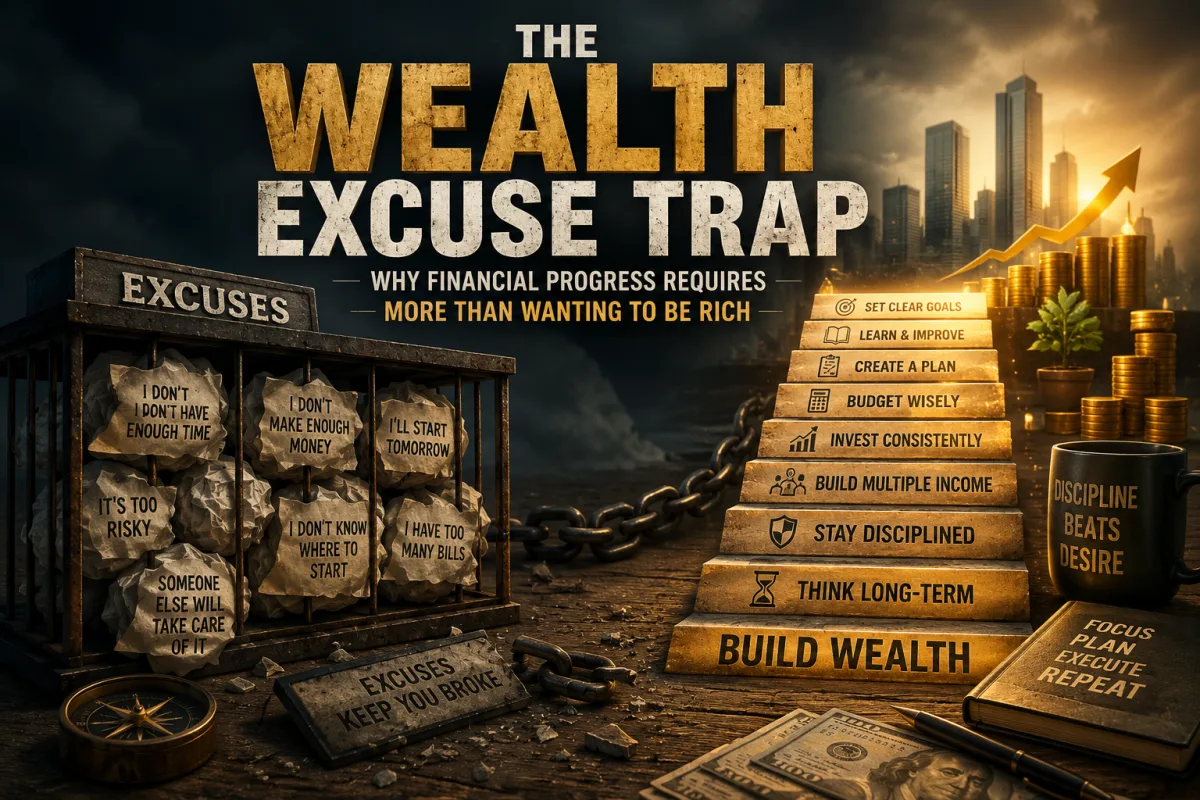
- Recognize excuses that delay financial progress
- Protect time, attention, discipline, and personal direction
- Review hard lessons about money, work, discipline, and life
- Turn mindset into a complete personal financial system
- Understand how debt habits affect long-term financial freedom
- Connect mindset with informed investing and risk management
- Connect financial discipline to the complete wealth-building process
Frequently Asked Questions About Money Mindset
What is a money mindset?
A money mindset is the collection of beliefs, emotions, habits, and assumptions that influence how a person earns, spends, saves, borrows, invests, and plans.
Is a wealth mindset the same as positive thinking?
No. Positive thinking may influence attitude, but a wealth mindset is demonstrated through disciplined behavior, informed risk-taking, ownership, saving, investing, and long-term decision-making.
What is a scarcity mindset?
A scarcity mindset focuses heavily on shortage, fear, and immediate survival. It may lead to avoidance, excessive caution, impulsive spending, or difficulty planning beyond the present.
What is an abundance mindset?
An abundance mindset recognizes that skills, value creation, relationships, ownership, and opportunity can expand financial options. It should remain grounded in realistic numbers, risk, and personal responsibility.
How does emotional spending affect wealth?
Emotional spending can convert stress, insecurity, boredom, comparison, or status pressure into repeated financial leakage. Awareness, spending boundaries, and planned alternatives can reduce the pattern.
How can I improve delayed gratification?
Create clear goals, automate saving, reduce exposure to temptation, separate wants from needs, and connect present decisions to specific future benefits.
Why does identity matter in personal finance?
People often repeat behavior that matches how they see themselves. Identifying as a planner, saver, investor, or owner can reinforce habits that support long-term financial progress.
Can financial confidence be learned?
Yes. Confidence usually grows through knowledge, accurate numbers, small successful decisions, clear systems, and repeated exposure to financial tasks that once felt uncomfortable.
How do relationships affect money mindset?
Family, friends, partners, and social environments influence spending norms, ambition, risk tolerance, debt, generosity, and financial expectations. Strong boundaries help protect long-term goals.
How does comparison damage financial progress?
Comparison can encourage status spending, unnecessary debt, lifestyle inflation, and dissatisfaction. Personal financial decisions should be based on goals, resources, and values rather than appearances.
What is the difference between motivation and discipline?
Motivation changes with emotion and circumstances. Discipline relies on standards, routines, automation, and systems that continue working even when enthusiasm is low.
How do I change destructive money habits?
Identify the trigger, measure the financial cost, replace the behavior with a specific alternative, reduce access to temptation, automate better actions, and review progress regularly.
Can mindset alone create wealth?
No. Mindset influences behavior, but wealth also requires income, financial margin, productive assets, protection, knowledge, and time. Mindset is a foundation, not a substitute for action.
The Real Difference
\nThe real difference is not poor people versus rich people. It is not good people versus bad people. It is not positive thinking versus negative thinking. The real difference is between money that is consumed without direction and money that is assigned to a future.
\nA weakening financial pattern spends first and saves later. It avoids the numbers. It borrows casually. It follows social pressure. It seeks comfort even when discomfort would produce growth. It treats income as the finish line.
\nA strengthening financial pattern plans before spending. It saves for emergencies. It invests consistently. It pays down expensive debt. It develops skills. It manages risk. It learns from mistakes. It takes responsibility without denying reality. It treats income as raw material for ownership.
\nThat is the wealth mindset worth learning. Not a slogan. Not a false binary. Not contempt for those who struggle. Not blind admiration for those who have more. A real wealth mindset is practical, disciplined, patient, and honest. It respects the difficulty of life while refusing to surrender to it.
\nWealth begins when money is no longer handled only as something to spend, but as something to direct. It grows when income becomes savings, savings become investments, investments become assets, and assets create options. It survives when risk is managed, debt is controlled, and emergencies are anticipated. It matures when financial strength is used not only for personal comfort, but for freedom, responsibility, generosity, and purpose.
\nThe mind matters. But only when it changes behavior. The behavior matters. But only when it becomes a system. The system matters. But only when it is repeated long enough to turn ordinary income into lasting financial power.
 Article
 Article
 Article
 Article
 Article
 Article
 Article
 Article