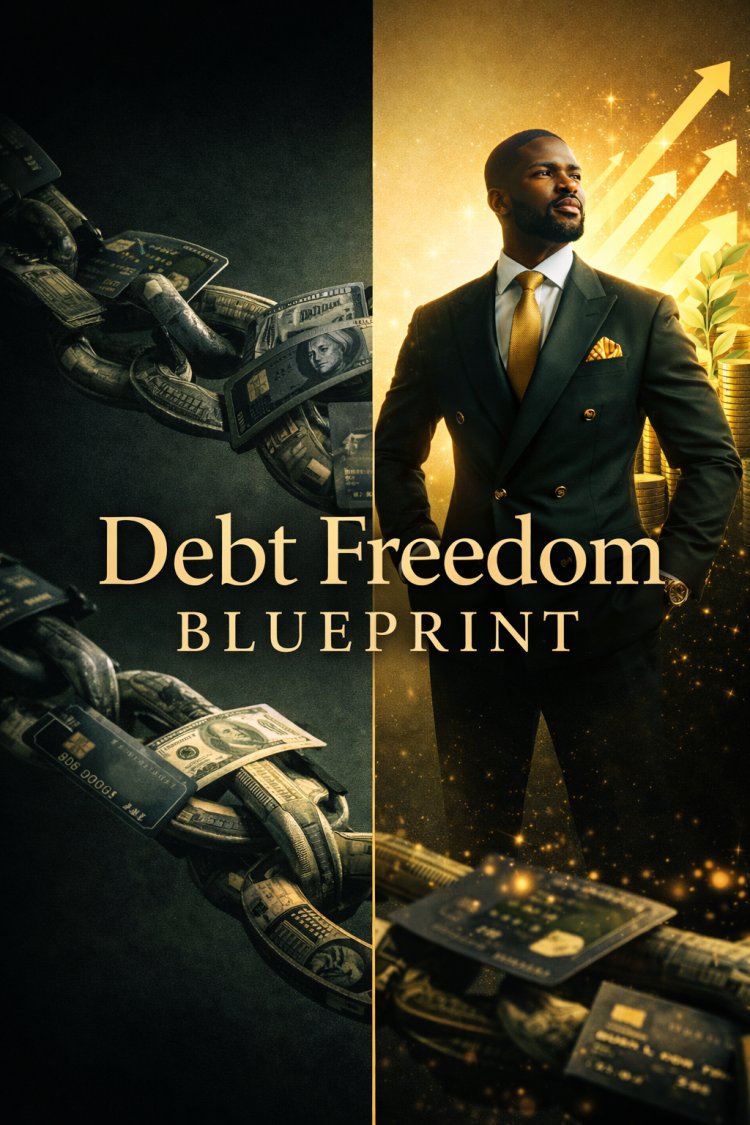
Debt Freedom Blueprint: The Ultimate Guide to Getting Out of Debt and Building Wealth
Struggling with debt? Discover the proven step-by-step blueprint to eliminate debt fast, stop the cycle of borrowing, and start building real wealth. Practical strategies for anyone, anywhere in the world.
By Maertin K | Wealth Insights Global | wealthinsights.co.ke
Debt is one of the most powerful forces working against your financial future. It does not matter where you live — whether you are in New York, Nairobi, London, Lagos, Sydney, or Singapore — debt has the same effect everywhere. It drains your income, limits your choices, destroys your peace of mind, and keeps you locked in a cycle that feels almost impossible to break.
But here is the truth that most people are never told: debt is not a life sentence. It is a financial problem, and like every financial problem, it has a solution. Millions of people around the world have gone from drowning in debt to complete financial freedom — not because they had high incomes or lucky breaks, but because they followed a clear, proven plan.
This guide is that plan. Whether you are dealing with credit card debt, student loans, car loans, personal loans, or a combination of all of them, the Debt Freedom Blueprint will give you the exact steps to take — starting today — to eliminate your debt and begin building the wealth you deserve.
Understanding Debt: Why It Feels So Impossible to Escape
Before we talk about solutions, we need to understand the problem. Most people feel trapped in debt not because they are irresponsible, but because the system is designed to keep them there.
Here is how debt traps work. When you borrow money, you pay back the original amount — called the principal — plus interest. The longer it takes you to repay, the more interest accumulates. Credit card companies in particular structure minimum payments in a way that keeps you paying interest for years, sometimes decades, on a single purchase.
Consider this: if you have $5,000 in credit card debt at 20% interest and you only make the minimum payment each month, it will take you over 20 years to pay it off — and you will pay more than $8,000 in interest alone. You borrow $5,000 and end up paying back over $13,000. That is how the debt trap works.
Understanding this is the first step. Because once you see the mechanics clearly, you stop feeling like you are failing and start seeing debt for what it truly is: a math problem waiting to be solved.
Step 1: Face Your Debt Head On — Know Exactly What You Owe
The first step to getting out of debt is one that most people avoid because it feels uncomfortable: you need to sit down and look at the full picture of your debt. Not just the rough number in your head — the complete, detailed reality.
Create a debt inventory. Write down every single debt you have, including:
- The name of the lender or creditor
- The total balance owed
- The interest rate (APR)
- The minimum monthly payment
- The due date each month
This exercise can feel overwhelming at first. Many people discover they owe more than they thought. But this moment of clarity is powerful. You cannot fight an enemy you refuse to look at. Once you have the full picture, you have something even more important: a starting point.
List all your debts from the smallest balance to the largest. Then list them again from the highest interest rate to the lowest. You will use these two lists to choose your repayment strategy in the next step.
Step 2: Choose Your Debt Repayment Strategy
There are two proven strategies used by millions of people around the world to eliminate debt. Both work — what matters is that you pick one and commit to it.
The Debt Snowball Method
The debt snowball method, popularized by personal finance expert Dave Ramsey, focuses on psychology over mathematics. Here is how it works:
- List your debts from smallest balance to largest
- Make minimum payments on all debts
- Put every extra dollar toward the smallest debt first
- Once the smallest debt is paid off, roll that payment to the next smallest
- Repeat until all debts are eliminated
The power of this method is momentum. Every time you eliminate a debt — no matter how small — you get a psychological win that fuels your motivation to keep going. The snowball gets bigger and faster as it rolls down the hill.
The Debt Avalanche Method
The debt avalanche method is mathematically optimal. Here is how it works:
- List your debts from highest interest rate to lowest
- Make minimum payments on all debts
- Put every extra dollar toward the highest interest rate debt first
- Once that debt is eliminated, move to the next highest rate
- Repeat until debt-free
This method saves the most money in interest over time. If you have high-interest credit card debt, the avalanche method can save you thousands of dollars compared to the snowball.
Which should you choose? If you need quick wins to stay motivated, choose the snowball. If you are disciplined and want to save the most money, choose the avalanche. Either way, pick one and start immediately.
Step 3: Build a Bare-Bones Budget and Find Extra Money
A budget is not a punishment. It is a plan. And when you are trying to eliminate debt, your budget becomes your most powerful weapon.
Start by tracking every single shilling, dollar, euro, or naira you spend for one full month. Most people are shocked by what they find. Money leaking out in subscriptions they forgot about, daily coffee runs, impulsive online purchases, and dining out adds up to hundreds — sometimes thousands — of dollars every month.
Once you know where your money is going, build a bare-bones budget. This means cutting your spending down to the essentials temporarily:
- Housing and utilities
- Basic groceries and food
- Transportation to work
- Minimum debt payments
- Essential insurance
Everything else — subscriptions, entertainment, eating out, luxury purchases — gets paused until your high-interest debt is eliminated. This is not forever. It is a temporary sacrifice for a permanent result.
The goal of the bare-bones budget is to find as much extra money as possible to throw at your debt every single month. Even an extra $100 or $200 per month can shave years off your debt repayment timeline and save thousands in interest.
"A budget is telling your money where to go instead of wondering where it went." — John Maxwell
Step 4: Increase Your Income — Attack Debt From Both Sides
Cutting expenses alone will only take you so far. The real acceleration happens when you attack debt from both sides — cutting spending and increasing income at the same time.
Here are practical ways people all over the world are increasing their income to pay off debt faster:
- Freelancing: Offer your existing skills — writing, design, coding, marketing, teaching — on platforms like Upwork, Fiverr, or Toptal
- Sell unused items: Go through your home and sell everything you do not use on eBay, Facebook Marketplace, Craigslist, or local platforms
- Gig economy work: Drive for Uber, deliver food, run errands — whatever is available in your city
- Monetize a skill or knowledge: Teach online, create content, consult, or coach in your area of expertise
- Ask for a raise: If you have been performing well at work and have not asked for a raise recently, now is the time
- Take on overtime: If your employer offers it, say yes to every opportunity temporarily
Every extra dollar you earn during this period should go directly to your debt. Not to lifestyle upgrades, not to savings — directly to debt elimination. Once you are debt-free, then you redirect that extra income to building wealth.
Step 5: Stop Creating New Debt
This sounds obvious, but it is where most people fail. You cannot fill a bucket with a hole in it. If you are working hard to pay off debt but continuing to borrow — putting expenses on credit cards, taking new loans, using buy-now-pay-later schemes — you will never make meaningful progress.
Here are the rules to follow strictly during your debt elimination journey:
- Stop using credit cards for daily spending — use cash or a debit card only
- Do not take any new loans unless it is a genuine emergency
- Avoid buy-now-pay-later schemes — they are designed to make you spend more than you intend
- Build a small emergency fund of $500 to $1,000 first — so that unexpected expenses do not force you back into debt
- If you must use a credit card, pay the full balance every single month
The emergency fund is critical. Without one, every unexpected car repair, medical bill, or home expense becomes a new debt. A small cash buffer breaks this cycle and protects your debt repayment progress.
Step 6: Explore Debt Consolidation and Negotiation
If you have multiple high-interest debts, consolidation and negotiation are tools worth exploring. They will not solve the problem on their own, but they can make the journey faster and cheaper.
Debt Consolidation
Debt consolidation means combining multiple debts into a single loan — ideally at a lower interest rate. This simplifies your payments and can significantly reduce the amount of interest you pay. Options include:
- Personal consolidation loans from banks or credit unions
- Balance transfer credit cards with 0% introductory rates
- Home equity loans (if you own property — though this carries risk)
Be careful: consolidation only works if you stop accumulating new debt. Many people consolidate their credit cards, feel relieved, and then max them out again — leaving them worse off than before.
Negotiating with Creditors
Most people do not realize that creditors will often negotiate. If you are struggling to make payments, call your creditor directly and ask about:
- Hardship programs with reduced interest rates
- Temporary payment deferrals
- Settlement offers — paying a lump sum for less than the full balance
Creditors would rather receive something than nothing. Do not be afraid to have the conversation. The worst they can say is no.
Step 7: Stay the Course — The Psychology of Debt Freedom
Getting out of debt is not just a financial challenge — it is a psychological one. The journey is long, progress can feel slow, and there will be moments of frustration, temptation, and discouragement. This is normal. Everyone who has achieved debt freedom has gone through it.
Here is how to protect your mindset during the journey:
- Celebrate every milestone: Every debt you eliminate is a victory worth acknowledging. Do not wait until you are completely debt-free to feel proud of your progress
- Track your progress visually: Create a debt payoff chart on paper or use an app — seeing the numbers go down week by week is powerfully motivating
- Find your community: Join online communities of people on debt-free journeys. The support, accountability, and shared wisdom make an enormous difference
- Remind yourself of your why: Write down exactly why you want to be debt-free — for your family, your freedom, your future, your peace of mind — and read it every morning
- Give yourself grace: You will have setbacks. An unexpected expense will hit. You will slip up. That is not failure — that is life. What matters is that you get back on track immediately
"Financial freedom is not about being rich. It is about having choices — and debt takes away your choices one payment at a time."
Life After Debt: What Happens When You Are Free
Here is what most financial content fails to show you — what life actually looks like on the other side of debt. And the answer is this: it is transformational.
When you eliminate your debt, every dollar you were sending to creditors is suddenly yours to keep. If you were paying $800 per month in debt payments, that is $9,600 per year that now belongs to you. That money can now be redirected to:
- Building a 3 to 6 month emergency fund
- Investing in index funds, stocks, or real estate
- Starting or growing a business
- Building retirement wealth through pension plans or investment accounts
- Saving for your children's education
- Traveling, experiencing life, and giving generously
The same discipline that got you out of debt will build your wealth. You already proved you can live on less than you earn. Now you simply redirect that surplus from debt payments to wealth building. This is where the real financial transformation begins.
Your Debt Freedom Action Plan — Start Today
Do not wait for the perfect moment. There is no perfect moment. The best time to start your debt freedom journey is right now. Here is your immediate action plan:
- Today: Write down every debt you have — balance, interest rate, minimum payment
- This week: Choose your repayment strategy — snowball or avalanche
- This week: Track all your spending and build your bare-bones budget
- This month: Make your first extra payment toward your target debt
- This month: Identify at least one way to increase your income
- Ongoing: Stay consistent, track progress, and celebrate every win
Debt freedom is not a dream reserved for people with high incomes or perfect circumstances. It is a decision — followed by a plan — followed by consistent action. Thousands of people achieve it every single month. You can be next.
Conclusion: Your Financial Freedom Starts With One Decision
Debt is heavy. It weighs on your mind when you wake up in the morning and keeps you up at night. It limits what you can do, where you can go, and who you can become. But it does not have to be permanent.
The Debt Freedom Blueprint is not complicated. It is not glamorous. It requires honesty, discipline, sacrifice, and time. But every single step is doable — no matter your income, no matter your country, no matter how deep in debt you currently are.
Face your debt. Make a plan. Cut your spending. Increase your income. Stop borrowing. Stay consistent. And one day — sooner than you think — you will make your final payment, and you will be free.
That day is worth every sacrifice you make today.
Ready to Take Control of Your Financial Life?
Join thousands of readers from around the world building financial intelligence every week at Wealth Insights Global.
Visit: www.wealthinsights.co.ke
Follow Maertin K across all platforms for daily financial education, wealth building strategies, and real talk about money.
#DebtFreedom #PersonalFinance #WealthBuilding #FinancialFreedom #MaertinK #WealthInsightsGlobal
What's Your Reaction?