Most people buy life insurance they do not understand. Then they pay for it for decades.
The confusion is not an accident. The industry profits when you stay confused. Two words get thrown around, term and whole life, and most buyers never learn the real difference.
This guide fixes that. By the end you will know exactly which type fits your life, how much you actually need, and the traps that cost families thousands.
Let us start with the simple truth.
What Life Insurance Actually Does
Life insurance has one job. It replaces your income when you die.
If people depend on your earnings, your death creates a financial hole. A spouse who counts on your salary. Children who need food and school fees. A mortgage that still has to be paid.
Life insurance fills that hole with a lump sum. Your family gets money to survive without you.
That is the entire purpose. Everything else the industry adds on top is extra. Some of it useful. Most of it expensive.
Keep this in mind as we go. The product exists to protect the people who depend on you. When a salesperson drifts from that, pay attention.
The Two Main Types
There are many products with fancy names. But almost all of them are versions of two things.
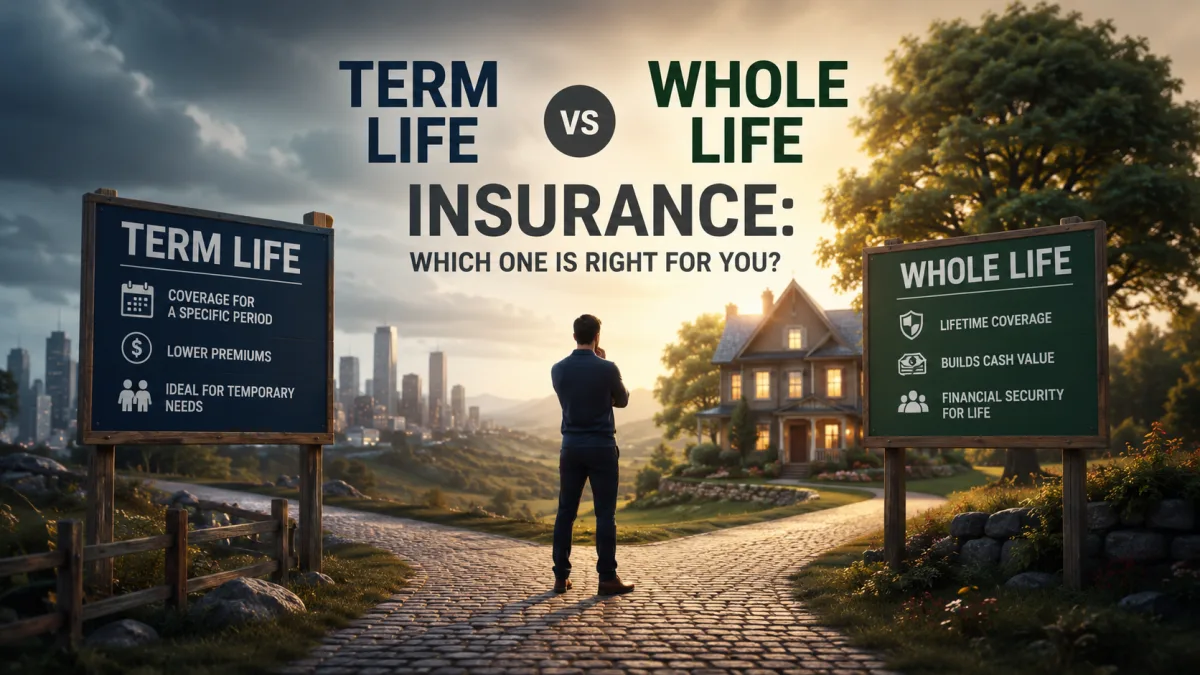
Term life insurance. You pay for coverage over a set period. Ten years. Twenty years. Thirty years. If you die during that term, your family gets the payout. If the term ends and you are alive, the coverage stops. Simple.
Whole life insurance. Coverage lasts your entire life. It never expires as long as you pay. It also builds a cash value over time, a kind of savings pool inside the policy. It costs far more than term.
That is the core split. Term is pure protection for a period. Whole life is protection for life plus a savings feature.
Now let us go deeper, because the details are where the money is won or lost.
How Term Life Works
Term life is the cleanest product in the entire insurance world.
You choose three things. The amount of coverage. The length of the term. Then you pay a fixed premium.
Say you pick $500,000 of coverage for 20 years. You pay the same premium every year for 20 years. If you die in year 3 or year 19, your family receives $500,000. If you outlive the term, the policy simply ends.
The price is low because the insurer is taking a limited bet. They cover you only for a window, not forever. Most people outlive their term, so the insurer rarely pays out on these policies.
That low cost is the whole advantage. You get a large payout for a small premium. A healthy person in their thirties can often get substantial coverage for the price of a few coffees a month.
Why Term Fits Most People
Here is something the industry rarely says plainly. Most families only need life insurance for a season of life.
Think about when you need it most. You have young children. You have a mortgage. Your spouse depends on your income. Your earnings are the foundation the household stands on.
Now picture 25 years later. The mortgage is paid. The children are grown and earning. You have savings and investments built up. Your death would hurt emotionally, but it would not destroy anyone financially.
The need fades as your wealth grows. Term insurance matches that reality. It covers the high-need years, then steps aside once you no longer need it.
This is the key insight. Insurance is not meant to be permanent for most people. It is a bridge across your most vulnerable years.
How Whole Life Works
Whole life is more complex, and complexity is where costs hide.
You pay a premium for life. Part of that premium covers the insurance itself. Another part goes into a cash value account that grows slowly over time.
That cash value is the selling point. The agent will tell you it builds savings, that you can borrow against it, that it grows tax-advantaged. All of this is technically true.
But the premium is dramatically higher than term. Often five to fifteen times more for the same coverage amount. You are paying for the insurance and funding the savings pool at the same time.
In the early years, most of your money goes to fees and commissions. The cash value barely moves. It can take many years before the savings feature shows meaningful growth.
The Cash Value Trap
Here is where families get hurt. The cash value sounds like a great deal. It rarely is for the average person.
Three problems sit inside it:
- The growth is slow, often lower than what simple long-term investing would return
- The fees in the early years eat most of your contributions
- If you borrow against the cash value and die, the loan reduces what your family receives
There is one more catch that surprises people. In many whole life policies, when you die your family gets the death benefit, but the cash value you built up often stays with the insurer. You funded that pool for decades and your family may never see it directly.
This is why the math rarely favors whole life for ordinary families. You pay far more, the savings grow slowly, and the structure favors the insurer.
The Core Comparison
Let us put the two side by side in plain terms.
Cost. Term is cheap. Whole life is expensive. This is the biggest practical difference. For the same coverage, term costs a fraction of whole life.
Duration. Term covers a set period. Whole life covers your entire life. But remember, most people do not need lifelong coverage.
Savings feature. Term has none, it is pure protection. Whole life builds cash value, but slowly and with heavy fees.
Simplicity. Term is easy to understand and compare. Whole life is complex, which makes it hard to know if you are getting a fair deal.
Best fit. Term fits people protecting their high-need years. Whole life fits a small set of specific situations we will cover shortly.
The pattern is clear. For most families, term gives more protection for less money. The savings feature of whole life sounds attractive but rarely beats a simpler approach.
The Strategy That Beats Both Sales Pitches
There is an approach that captures the best of both worlds. It is so simple the industry hates explaining it.
Buy term insurance and invest the difference.
Here is how it works. You buy affordable term insurance for your high-need years. Then you take the money you would have spent on expensive whole life premiums and invest it yourself.
The term protects your family during the vulnerable years. The investments build real wealth over time, wealth that you control, that grows faster, and that your family fully inherits.
By the time your term ends, the goal is that your investments have grown large enough that you no longer need insurance. You became self-insured through your own wealth.
This is the path most independent financial thinkers recommend. It separates the two jobs that whole life bundles together. Protection is handled by cheap term. Wealth building is handled by investing, where your money works harder.
The whole life pitch bundles these on purpose. Bundling makes it harder to see how much you overpay for the savings feature.
When Whole Life Actually Makes Sense
To be fair, whole life is not always wrong. There are specific cases where it fits.
- You have a lifelong dependent, such as a child with special needs who will need support after you are gone
- You have a large estate and need lifelong coverage for estate planning reasons
- You have already maxed out every other tax-advantaged investing option and want another place to put money
- You own a business and need coverage tied to a buy-sell agreement
Notice the pattern. These are specific, often advanced situations. They are not the typical young family trying to protect against an early death.
If none of these describe you, term is almost certainly the better choice. Do not let a salesperson convince you that a niche product is a universal solution.
How Much Coverage You Actually Need
Picking the type is half the decision. The amount matters just as much.
A common starting point is to cover ten times your annual income. If you earn $50,000, that suggests around $500,000 of coverage. This is a rough guide, not a rule.
For a more precise number, add up what your family would need:
- Replace your income for the years your family depends on it
- Pay off the mortgage and any major debts
- Cover future costs like children's education
- Add a buffer for the unexpected
Then subtract what you already have. Existing savings, investments, and any coverage through work reduce the gap. The number left is roughly what you need to buy.
Be honest here. Too little coverage leaves your family exposed. Too much means you overpay for protection you do not need. Aim for the real number, not a guess.
The Mistakes That Cost Families Most
Knowing the products is not enough. The errors people make are predictable. Avoid these.
Buying whole life when term would do. This is the most expensive mistake. Families lock into high premiums for a savings feature they could beat with simple investing.
Waiting too long to buy. Insurance gets more expensive as you age and as health issues appear. The best time to buy was years ago. The second best time is now, while you are younger and healthier.
Buying too little coverage. Some people pick a small policy to save on premiums. Then their family discovers the payout does not cover the mortgage, let alone years of lost income.
Letting term lapse by accident. Missing payments can cancel your coverage. Set it on automatic so a forgotten bill does not leave your family exposed.
Not reviewing coverage after big life changes. A new child, a new home, a new income level. Each changes how much protection you need. Review your policy when life shifts.
What to Do Before You Buy
Walk through these steps before signing anything.
- Decide why you need coverage and for how long
- Calculate the amount your family would actually need
- Get term life quotes from several providers and compare
- Be skeptical of any pitch that pushes whole life as your only option
- Read the policy terms, especially around payouts and lapses
- Buy the coverage, then set premiums to pay automatically
The goal is a decision you understand fully. If a salesperson rushes you or makes the product sound complicated, slow down. Clarity is your protection against overpaying.
The Mindset Behind Smart Coverage
Step back and see the bigger picture. Life insurance is one piece of a larger plan, not the plan itself.
The point of insurance is to become wealthy enough that you no longer need it.
That line captures the whole strategy. Insurance protects you while you build. As your savings and investments grow, your dependence on insurance shrinks. Eventually your own wealth becomes the safety net.
This is why the buy-term-and-invest approach fits the long game. You protect the vulnerable years cheaply, then pour your energy into building wealth that lasts beyond any policy.
A policy pays your family once. Wealth supports your family for generations. Keep both in view.
Your First Move Today
Do not try to solve everything at once. Take one clear step.
Calculate your number. Add up what your family would need if your income disappeared tomorrow. Just that. Face the real figure.
Once you know the number, the rest of the decision becomes simple. You will know how much term coverage to price out, and you will see through any pitch that does not serve your actual need.
You can protect the people who depend on you without overpaying. It starts with understanding what you are buying.
Ready to build a financial life that protects and grows? Get weekly wealth insights delivered straight to your inbox.

