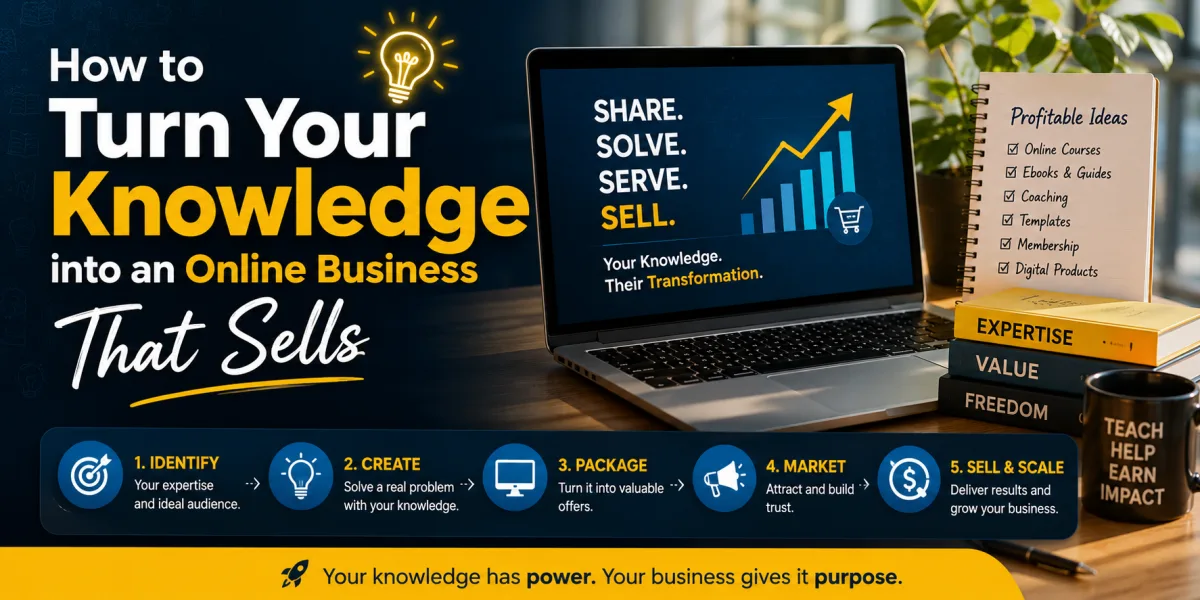
The Knowledge Dividend: How to Turn What You Know into an Online Business
Knowledge becomes wealth when it is organized, trusted, and applied to a problem someone cares enough to solve.
Many people underestimate what they know because their expertise feels ordinary to them. A nurse understands patient communication. A teacher understands lesson planning. A bookkeeper understands financial organization. A project manager understands deadlines and team coordination. A parent who navigated a complex school system understands a process that may overwhelm another parent. A fitness enthusiast who lost weight sustainably understands habits that a beginner has not yet built. A software professional understands tools that small businesses struggle to use.
What feels obvious to one person can be valuable to another.
The internet has made it possible to turn knowledge into income without a classroom, office, publisher, storefront, or employer. A person can teach, coach, consult, publish, sell templates, build a paid community, create courses, write guides, host workshops, or develop simple tools for a specific audience. The opportunity sits inside a larger digital economy: Grand View Research estimated the global creator economy at $252.3 billion in 2025 and projected it to grow to $1.35 trillion by 2033, while Research and Markets estimated the online education market at $101.09 billion in 2026 with projected growth to $225.33 billion by 2030.
Those numbers are encouraging, but they can also mislead. A growing market does not guarantee an individual business. The internet is full of people selling courses nobody finishes, templates nobody uses, newsletters nobody opens, and coaching packages nobody buys. Knowledge alone is not enough. The market rewards useful knowledge packaged for a clear buyer and delivered through a trustworthy system.
The central question is not “What do I know?” The stronger question is “Whose problem can my knowledge help solve, and what result would they pay to achieve?”
This article explains how to turn knowledge into an online business with commercial discipline. It is not about becoming famous. It is not about pretending to be an expert overnight. It is not about selling generic advice. It is about converting experience into value, value into offers, offers into revenue, and revenue into a business that can grow beyond your available hours.
Start with Useful Knowledge, Not Perfect Expertise
Many people never begin because they believe they are not expert enough. They assume they need a degree, certification, massive audience, bestselling book, or extraordinary life story before anyone will pay for their knowledge.
Credibility matters, but perfection is not required. In many markets, customers do not need the world’s leading authority. They need someone who is far enough ahead to help them reach the next stage.
A person who paid off debt can help beginners organize a debt payoff plan. A freelancer who built a stable client base can help new freelancers create offers and outreach systems. A parent who successfully homeschooled for several years can help new homeschooling families avoid confusion. A manager who has hired dozens of employees can help job seekers improve resumes and interviews. A photographer who has mastered product photos for small shops can teach business owners how to create better images at home.
The key is honest positioning. Do not claim mastery you do not have. Do not exaggerate credentials. Do not promise outcomes you cannot control. Instead, define the level of customer you can responsibly serve.
There is a large market for beginner-to-intermediate help because most people are not trying to become world-class. They are trying to solve a practical problem. They want to understand taxes better, organize their money, improve their meals, write stronger resumes, set up a website, use software, learn basic investing, plan content, manage a team, or start a side business.
Useful knowledge often comes from three places: professional experience, personal transformation, and repeated problem-solving. Professional experience includes what you learned at work. Personal transformation includes problems you solved in your own life. Repeated problem-solving includes patterns you have helped friends, colleagues, clients, students, or family members navigate.
The mistake is thinking knowledge must be rare to be valuable. Often, it only needs to be organized better than the customer can organize it alone.
Identify the Problem Hidden Inside Your Knowledge
Knowledge does not sell well in raw form. Problems sell. Outcomes sell. Relief sells. Speed sells. Confidence sells.
“I know nutrition” is not a business. “I help busy professionals plan high-protein meals in 30 minutes a week” is closer. “I understand Excel” is not a business. “I build simple cash flow dashboards for freelancers who do not know what they can safely spend” is closer. “I know marketing” is not a business. “I help local service businesses turn website visitors into booking inquiries” is closer.
To find the business inside your knowledge, translate what you know into problems you can solve. Start by listing common frustrations people have in your area. What do beginners misunderstand? Where do people waste money? What steps do they skip? What mistakes repeat? What questions do people ask you? What do you explain often? What do people fear? What would save them time, money, stress, or embarrassment?
For example, someone with experience in human resources might identify several problems: job seekers do not know how applicant tracking systems work; new managers do not know how to conduct performance conversations; small businesses do not have onboarding checklists; employees do not understand benefits enrollment; career changers do not know how to explain transferable skills.
Each problem can become a business opportunity, but not all opportunities are equal. The best problems are painful, recurring, specific, and connected to a willingness to pay.
A painful problem creates urgency. A recurring problem creates repeat demand. A specific problem creates clear messaging. Willingness to pay creates commercial viability.
One of the simplest tests is to ask whether people already spend money in the category. If customers already pay for tutors, coaches, consultants, templates, software, courses, books, workshops, agencies, or tools, the market has proof of spending. Your task is not to invent the desire from nothing. It is to serve a segment better.
Choose a Narrow Audience First
Beginners often want their knowledge business to help everyone. This is natural. It also makes selling harder.
A broad audience creates vague messaging. “I help people become more productive” could mean students, executives, parents, entrepreneurs, writers, nurses, or retirees. Each group has different constraints, language, budgets, and goals. A narrow audience makes the offer easier to understand.
Compare these two statements:
“I teach productivity.”
“I help first-year managers organize their week so they can lead meetings, track team priorities, and stop working late every night.”
The second statement is more commercially useful. It names the customer, problem, and desired result. It also suggests future products: a weekly planning template, a manager onboarding course, a meeting agenda library, a coaching program, or a paid newsletter for new managers.
Narrow does not mean small forever. It means focused at the start. A business can expand later after it gains proof, testimonials, revenue, and clearer positioning. Many strong businesses begin with a narrow wedge because it is easier to earn trust in a defined market.
To choose your first audience, look for overlap among three things: people you understand, problems you can solve, and customers with ability or motivation to pay. If you understand teachers but they have limited budgets for your offer, you may need a lower-priced product or institutional buyer. If you understand business owners and your knowledge saves them time or increases revenue, pricing power may be stronger. If you understand students, parents may be the paying customer.
Always identify who experiences the pain and who pays the bill. They may not be the same person.
Package Knowledge into a Sellable Offer
An offer is the bridge between what you know and what the customer buys. It must be clear enough that a buyer understands the result, process, price, and next step.
Many knowledge businesses fail because they sell access to the expert instead of a defined outcome. “Book a coaching call with me” is vague. “In one 90-minute session, we will review your resume, rewrite your positioning statement, and identify the three strongest roles to target next” is clearer.
A strong offer usually contains five parts: the customer, the problem, the outcome, the delivery format, and the price or next action.
For example: “I help freelance designers organize their business finances in one week. You receive a cash flow spreadsheet, tax savings system, expense categories, and a 60-minute walkthrough call.”
This offer is specific. It does not promise financial freedom. It promises a defined system for a defined customer. That is easier to buy.
Knowledge can be packaged in many ways. Services convert knowledge into done-for-you help. Coaching converts knowledge into guidance and accountability. Consulting converts knowledge into diagnosis and recommendations. Courses convert knowledge into structured education. Templates convert knowledge into reusable tools. Memberships convert knowledge into ongoing support. Newsletters convert knowledge into recurring insight. Books and guides convert knowledge into organized instruction. Software converts knowledge into automated workflow.
The best early offer is often a service or live workshop because it produces feedback quickly. A course may sound scalable, but a beginner can waste months building lessons without proving demand. One-on-one work reveals what customers struggle with, what they value, what language they use, and what they are willing to pay for.
Start close to the customer. Scale later.
Begin with Services Before Products
Digital products are attractive because they can sell repeatedly. But many successful products begin as services.
Service work is market research that pays you. When you coach, consult, tutor, audit, review, build, or advise, customers reveal their real problems. They show you where they get confused. They ask questions you would not have predicted. They object to prices. They explain constraints. They tell you what they tried before. They reveal the language that future marketing should use.
A financial coach might discover that clients do not primarily need a budgeting course. They need a subscription audit, debt payoff calculator, and weekly money meeting script. A career coach might discover that job seekers do not need a general career course. They need interview answer templates for career-change questions. A marketing consultant might discover that small business owners do not need strategy theory. They need a one-page local lead generation checklist.
These discoveries become products.
Services also generate proof. Testimonials, case studies, before-and-after examples, and referrals build the trust required to sell scalable offers. A course from someone with no student results is harder to sell than a course from someone who has helped twenty clients achieve a specific outcome.
This does not mean you must remain a service provider forever. The path can move from one-on-one service to group service, from group service to course, from course to templates, from templates to membership, from membership to certification, and from certification to a larger education company. But the first stage should create customer insight and cash flow.
Create a Product Ladder
A knowledge business becomes stronger when it has multiple ways for customers to buy at different levels of trust, budget, and need. This is called a product ladder.
At the bottom of the ladder, you may have free content: articles, videos, social posts, podcasts, checklists, or newsletters. Free content builds awareness and trust. It shows how you think.
The next level might be a low-priced product: a template, guide, mini-course, checklist bundle, or paid workshop. This creates the first transaction. A buyer who spends $19 or $49 has moved from audience member to customer.
The middle level might be a more substantial product: a full course, group program, resource library, or membership. This serves customers who want more structure and support.
The higher level might be coaching, consulting, implementation, certification, private advising, or done-for-you service. These offers require more of your time but can command higher prices.
A product ladder helps because not every customer is ready for the same commitment. Some want to learn alone. Some want templates. Some want accountability. Some want you to do the work for them. The same knowledge can be delivered in multiple formats.
For example, a person who teaches small business bookkeeping could offer free articles about expense categories, a $29 tax-season checklist, a $99 bookkeeping spreadsheet, a $299 workshop on monthly financial routines, a $1,500 group program for freelancers, and a higher-priced consulting package for business owners who want their systems set up.
The ladder should not become cluttered. Each level should serve a clear purpose. Too many offers create confusion. Build one strong offer at a time.
Build Trust Before Asking for Scale
Knowledge businesses are built on trust. Customers are buying guidance, judgment, experience, and transformation. They need to believe you understand their situation and can help them make progress.
Trust comes from several sources. Credentials can help, especially in fields such as finance, health, law, education, accounting, or technical training. But credentials are not the only form of trust. Case studies, testimonials, public examples, clear explanations, useful free content, transparent limitations, and professional conduct all matter.
The fastest way to build trust is to teach clearly in public. Explain one problem at a time. Show examples. Break down mistakes. Share frameworks. Answer common questions. Demonstrate judgment. Avoid hype.
For a knowledge business, content is not merely marketing. It is proof of competence.
A tax professional who explains quarterly tax mistakes for freelancers builds trust. A career coach who rewrites weak resume bullets into stronger ones builds trust. A nutrition coach who shows how to build simple meals for busy people builds trust. A software trainer who explains common spreadsheet errors builds trust.
Trust also comes from honesty. Admit who your offer is not for. Explain limits. Use realistic language. A person selling “guaranteed success” often sounds less credible than someone who explains what the customer must do, what the product can support, and what results depend on.
In knowledge businesses, the long-term asset is reputation.
Choose the Right Platform, but Do Not Worship Platforms
Platforms help you distribute knowledge, but they are not the business itself. A YouTube channel, TikTok account, newsletter, podcast, LinkedIn profile, course platform, membership site, or marketplace can help you reach people. But the platform is rented land. Algorithms change. Policies change. Monetization rules change. Accounts can be limited. Audiences can become harder to reach.
The smart strategy is to use platforms for discovery while building owned relationships. An email list, customer database, website, and direct payment system give you more control. Social media can create attention. Email and customer relationships preserve it.
Choose platforms based on where your audience already spends time and how your knowledge is best delivered. Visual skills may perform well on YouTube, Instagram, TikTok, or Pinterest. Professional expertise may work on LinkedIn, newsletters, webinars, or podcasts. Technical education may work through courses, documentation, GitHub, YouTube, or community forums. Local or niche knowledge may work through Facebook groups, webinars, partnerships, or search-based content.
Do not try to master every platform at once. A beginner with limited time should choose one primary platform for discovery and one owned channel for retention. For example, publish LinkedIn posts and build an email list. Or publish YouTube tutorials and collect newsletter subscribers. Or write search-friendly articles and offer a free checklist in exchange for email signup.
Attention is fragile. Relationships are stronger.
Turn Content into a Sales System
Content should not be random. A knowledge business needs content that attracts the right audience, teaches useful ideas, and leads naturally to paid offers.
There are four useful content types.
Problem content names the pain. It helps the audience recognize what is going wrong. Example: “Why freelancers feel broke even when revenue is rising.”
Education content teaches a principle. It helps the audience understand the problem better. Example: “How to separate tax money, operating cash, and owner pay.”
Proof content shows results, examples, case studies, or before-and-after transformations. Example: “How a freelance designer created a simple monthly cash flow system.”
Offer content explains how to work with you or buy from you. Example: “I created a one-week finance setup package for freelancers who want a clean system before tax season.”
Many experts create education content but never make offers. Their audience learns for free but does not know how to buy. Others make constant offers without providing enough value, which erodes trust. A healthy content system includes both teaching and selling.
The purpose of content is not to impress peers. It is to help the right customer take the next step.
Price Knowledge Based on Value, Not Only Time
Pricing is one of the hardest parts of turning knowledge into a business. Beginners often undercharge because they feel guilty selling what comes naturally to them. But customers are not paying for how difficult the knowledge feels to you. They are paying for the result it creates for them.
If your advice helps a business owner save ten hours per month, avoid a costly mistake, increase sales, get organized for taxes, hire better employees, or improve customer retention, the value can exceed the time spent delivering it.
At the same time, pricing must reflect trust and proof. A beginner may need founding-client pricing while building testimonials. A proven expert with strong outcomes can charge more. A self-paced guide costs less than private consulting. A group program costs less than one-on-one advisory but more than a template. A certification-level program costs more than a short workshop.
Do not price only by comparing competitors. Competitor prices are useful, but your offer may differ in specificity, support, audience, proof, and outcome. A generic course may sell for $49. A specialized implementation program for business owners may sell for $2,000 or more if it solves a financially meaningful problem.
One useful pricing principle is to match price to proximity. The more access customers get to your judgment, feedback, and customization, the higher the price can be. A PDF is low proximity. A live workshop is higher. A group coaching program is higher still. Private consulting is highest.
As you move up the ladder, you are not only selling information. You are selling interpretation, accountability, personalization, and decision support.
Protect Credibility in Sensitive Topics
Some knowledge areas require extra caution. Finance, investing, tax, law, health, mental health, fitness, nutrition, immigration, employment, and education can affect people’s money, rights, safety, or wellbeing. If your knowledge business operates in these areas, credibility and boundaries matter.
Do not present general education as personalized professional advice unless you are qualified and licensed where required. Use disclaimers where appropriate, but do not rely on disclaimers to excuse careless claims. Avoid exaggerated promises. Stay within your competence. Refer customers to qualified professionals when needed.
Trustworthy knowledge businesses are careful with claims. “This framework can help you organize your budget” is more responsible than “This will make you rich.” “This training can help you prepare for interviews” is more credible than “This guarantees a job.” “This fitness plan may help beginners build consistency” is safer than promising specific medical outcomes.
Long-term reputation is worth more than short-term sales.
Build Intellectual Property Carefully
Your knowledge business should develop assets that become more valuable over time. These assets include frameworks, templates, checklists, lesson plans, case studies, recordings, email sequences, articles, research, worksheets, scripts, and processes.
Do not treat every customer project as a one-off. Look for patterns. If you explain the same concept repeatedly, turn it into a lesson. If you build the same spreadsheet repeatedly, turn it into a template. If you answer the same onboarding question repeatedly, turn it into a guide. If you use the same diagnostic process repeatedly, turn it into a framework.
This is how knowledge compounds. The first time you solve a problem, it is labor. The tenth time, it should become a system. The fiftieth time, it may become intellectual property.
Protect your assets with clear terms. If you sell templates, define usage rights. If clients receive materials, state whether they can share, resell, or modify them. If you use customer examples, obtain permission and remove sensitive details. If you collaborate with contractors, clarify ownership of work.
Knowledge businesses often begin informally, but assets deserve professional treatment.
Use Customer Results to Improve the Business
The best knowledge businesses evolve through customer outcomes. Pay attention not only to who buys, but to who succeeds.
Which customers get the best results? Which customers struggle? What questions appear repeatedly? What parts of your product create confusion? Which lessons do people return to? Which templates are used most? Which promises attract buyers but create support problems? Which customers refer others?
This feedback should shape future offers. If beginners struggle with implementation, add walkthrough videos. If advanced customers want more depth, create a higher-level program. If one template sells better than all others, build around that problem. If customers ask for accountability, consider a group program. If private clients are too time-intensive, productize the first step.
A knowledge business should become more precise over time. Early offers may be broad because you are learning. Mature offers should be sharper because customers have taught you what matters.
Move from Income to Assets
At the beginning, a knowledge business may look like self-employment. You trade time for money through coaching, consulting, tutoring, advising, or services. That can be valuable. It can create income, flexibility, and proof.
But the larger wealth opportunity comes from converting repeated knowledge into assets.
An asset is something that can produce value beyond the original hour of labor. A course is an asset. A template library is an asset. A paid newsletter archive is an asset. A membership community is an asset. A certification curriculum is an asset. A software tool is an asset. A book is an asset. A repeatable consulting process is an asset if others can help deliver it.
The transition from income to assets is not automatic. It requires documentation, systems, customer support, marketing, and product improvement. But it is the difference between selling expertise only through your calendar and building a business that can scale.
A simple path looks like this: start with one-on-one work, document repeated problems, create templates, teach a live workshop, turn the workshop into a course, add a community or office hours, create higher-level consulting for customers who need more help, and build an email list that supports every offer.
This is not passive income in the effortless sense. It is leveraged income. The work can be reused, improved, and sold to more people.
Common Mistakes to Avoid
The first mistake is building a course before finding buyers. Courses are attractive, but they are often the wrong first product. Teach live, sell a service, or test a workshop before recording a large curriculum.
The second mistake is being too broad. “I help people improve their lives” is not a business. “I help new managers run better one-on-one meetings” is clearer.
The third mistake is confusing audience size with business quality. A small audience of the right buyers can outperform a large audience of casual followers. Revenue depends on trust, relevance, and offer strength, not only reach.
The fourth mistake is underpricing. Low prices can attract customers who are less committed while leaving you without enough profit to improve the business. Charge fairly for value.
The fifth mistake is over-automating too early. Automation works after you understand the customer journey. Automating a weak offer only creates a smoother path to poor results.
The sixth mistake is copying creators instead of serving customers. Do not build what another creator built simply because it looks profitable. Build what your audience needs and what you can deliver credibly.
A Practical 90-Day Path
The first 30 days should focus on discovery. Choose a knowledge area. Identify a specific audience. Speak to potential customers. Listen for repeated pain. Publish simple content that teaches useful ideas. Avoid building a major product yet.
The next 30 days should focus on the first offer. Package a service, audit, workshop, or coaching session around one specific outcome. Sell it manually. Use conversations, referrals, direct outreach, and content. Collect feedback from every buyer and every rejection.
The final 30 days should focus on refinement. Improve the offer language. Add proof. Raise or adjust pricing if needed. Turn repeated explanations into templates or lessons. Begin building an email list. Decide whether the next step is more clients, a group offer, a workshop, or a low-priced digital product.
This path keeps the business close to reality. It prevents months of private building. It creates customer contact, revenue, and proof.
The Bigger Lesson
Turning knowledge into an online business is not about selling information. Information is abundant. The business is in organization, application, trust, and transformation.
People pay when your knowledge helps them make progress faster than they could alone. They pay when you reduce confusion, save time, improve decisions, create structure, increase confidence, or help them avoid costly mistakes. They pay when your experience becomes their shortcut.
The internet gives knowledge workers enormous leverage. A lesson can become a video. A process can become a template. A framework can become a course. A weekly insight can become a newsletter. A group of learners can become a community. A repeated manual process can become software. A personal skill can become an asset.
But the foundation remains simple: choose a real customer, solve a real problem, make a clear offer, deliver value, build trust, and improve from feedback.
Your knowledge does not need to be perfect to become valuable. It needs to be useful, honest, organized, and connected to demand.
That is how expertise becomes income. That is how income becomes an asset. And that is how what you know can become a business that serves others while expanding your own financial options.
 Article
 Article
 Article
 Article
 Article
 Article
 Article
 Article