The AI Launch Advantage: How Artificial Intelligence Can Help You Start an Online Business
Starting an online business has never been easier in a technical sense. A person can create a website, open a payment account, write product descriptions, design graphics, publish content, send emails, build a simple store, and reach potential customers from a laptop. Yet starting a business has not become easy in the commercial sense. Customers still need a reason to buy. Offers still need to be clear. Products still need to solve problems. Marketing still needs trust. Operations still need discipline. Profit still depends on numbers.
This is where artificial intelligence can help.
AI tools can reduce the friction between an idea and a first version of a business. They can help a beginner research a market, identify customer problems, draft offers, create content, build simple workflows, analyze feedback, write emails, design visuals, plan products, summarize competitors, and automate repetitive work. Used well, AI can act like a research assistant, writing assistant, strategy partner, operations helper, and production accelerator.
But AI cannot replace the business itself. It cannot decide what customers value without human judgment. It cannot guarantee demand. It cannot create trust automatically. It cannot turn a weak offer into a strong business simply by generating more output. It can make you faster, but speed only matters when pointed in the right direction.
The opportunity is significant because AI adoption has moved beyond curiosity. A 2026 Goldman Sachs survey found that 93% of small businesses using AI reported a positive business impact, while only 14% had fully integrated AI into core operations. That gap reveals the practical opportunity for new entrepreneurs: AI is already useful, but most people are still learning how to turn it into a system rather than a collection of experiments.
JPMorgan Chase Institute also reported that AI adoption among small businesses increased steadily from 2019 to 2025, with a notable rise beginning around 2023. That matters because entrepreneurs are no longer adopting AI in isolation; they are entering a business environment where customers, competitors, platforms, and service providers are also learning to use these tools.
The central question is not whether AI can help you start an online business. It can. The better question is how to use AI without confusing activity for progress.
A business is not built by producing more words, images, videos, plans, or spreadsheets. A business is built by identifying demand, creating value, earning trust, receiving payment, delivering well, and improving over time. AI can support every stage of that process if the founder remains responsible for judgment.
AI Lowers the Cost of Starting, Not the Need for Strategy
Before AI tools became widely available, many beginners faced practical barriers. They needed help writing website copy, designing graphics, researching competitors, planning content, analyzing customer feedback, creating product descriptions, and organizing operations. If they lacked those skills, they had to learn slowly, hire help, or accept weak execution.
AI reduces many of those barriers. A founder can now draft a landing page in minutes, generate twenty business name ideas, summarize competitor reviews, create a customer persona, rewrite an email in a more professional tone, generate product description variations, or create a simple checklist for launching a digital product.
That is powerful. It also creates a trap.
Because AI makes production easy, beginners can produce things before they understand whether those things matter. They can create a logo before validating demand, write fifty social posts before defining the customer, generate an ebook before knowing what problem it solves, or build a chatbot before anyone visits the website. The business looks busy, but the market remains untested.
AI lowers the cost of execution. It does not remove the need for strategy.
A strong online business still begins with the same questions: Who is the customer? What problem do they have? How painful is that problem? What are they already using to solve it? What would they pay for a better solution? How will they find you? What will it cost to deliver the result? What proof will make them trust you?
AI can help answer those questions, but it cannot answer them responsibly without evidence. It can suggest possible customer pains, but you still need to speak with real people. It can summarize market trends, but you still need to verify sources. It can draft an offer, but customers decide whether the offer is worth paying for.
The entrepreneur’s job is to combine AI speed with market truth.
Use AI to Find Business Ideas, But Start with Problems
Many beginners ask AI for online business ideas. That can be useful, but only if the exercise leads to specific customer problems. A list of ideas is not a business. “Start a digital product store,” “launch a newsletter,” “sell templates,” or “offer social media services” are categories, not opportunities.
A better prompt is problem-based. Ask AI to identify common problems faced by a specific group. For example, “What recurring problems do independent fitness coaches face when trying to manage clients online?” or “What operational problems do small cleaning companies have that could be solved with digital templates or services?”
This shifts the conversation from what you could sell to what someone might need.
AI can help generate problem maps. For a target audience, it can list pain points, current solutions, frustrations, buying triggers, seasonal needs, and possible offers. It can help compare business models: service, digital product, membership, course, ecommerce store, affiliate content, or software tool. It can help you see possibilities you may have missed.
But AI-generated ideas should be treated as hypotheses, not conclusions. The next step is validation. Search forums, reviews, social media comments, marketplace listings, YouTube comments, Reddit discussions, customer testimonials, and competitor FAQs. Talk to potential customers. Ask what they struggle with. Look for repeated pain in their own words.
If AI says freelancers struggle with cash flow, do not stop there. Find freelancers discussing irregular income, tax surprises, late invoices, and budgeting stress. If the pattern is real, the opportunity becomes stronger. If you cannot find evidence, the idea may be too weak or too broad.
AI is excellent for expanding possibilities. Customers are the final proof.
Use AI for Market Research and Competitor Analysis
Market research is often intimidating for new entrepreneurs. They imagine expensive reports, complex spreadsheets, and corporate strategy teams. In reality, early market research can be simple: understand who already serves your customer, what they offer, how they price, what customers praise, and what customers complain about.
AI can accelerate this work. It can summarize competitor websites, compare positioning, extract themes from reviews, organize customer complaints, identify common features, and help you spot gaps. If you are considering an online store, AI can help analyze product reviews to find quality issues, sizing complaints, shipping frustrations, missing features, or common use cases. If you are considering a service business, AI can help compare offers across competitors and identify how they package value.
Review mining is especially useful. Customer reviews are public market research. A five-star review tells you what customers value. A one-star review tells you what they resent. A repeated complaint can become a product improvement, service angle, or marketing message.
For example, if many customers complain that budgeting templates are too complicated, a beginner could create a simpler version for people who dislike spreadsheets. If small business owners complain that social media agencies do not understand their local market, a founder could offer location-specific content packages. If online course buyers complain that courses provide theory but no templates, a seller could create implementation kits.
AI can organize these signals quickly. It can group complaints by theme, rank frequency, and suggest product angles. But the entrepreneur must check the original sources and avoid drawing conclusions from too little evidence.
The point of research is not to copy competitors. It is to understand the market well enough to serve a customer more clearly.
Use AI to Define Your First Customer
One of the most expensive mistakes in online business is trying to serve everyone. AI can help narrow your first customer by comparing segments and identifying which group may have stronger demand, clearer pain, higher ability to pay, and easier access.
Suppose you want to turn your knowledge of personal finance into an online business. AI might help you compare possible audiences: recent graduates, young families, freelancers, teachers, small business owners, immigrants, single parents, or high-income professionals. Each group has different needs and budgets. Recent graduates may need debt repayment and basic budgeting. Freelancers may need tax planning and irregular income systems. Small business owners may need cash flow dashboards. High-income professionals may need investing and tax coordination.
A beginner could ask AI to compare these audiences by urgency, willingness to pay, content opportunities, service opportunities, and product ideas. The result will not be perfect, but it can help you think more strategically.
The best first customer usually has three qualities. You understand them. They have a problem you can solve. You can reach them without spending heavily.
AI can help create a customer profile, but do not let it become fictional theater. A persona with a name, age, favorite coffee, and imaginary hobbies is less useful than a clear understanding of pain, budget, decision process, objections, and desired outcome.
Useful customer definition sounds like this: “Freelance designers earning $3,000 to $8,000 per month who struggle with irregular income, tax savings, and knowing how much they can safely pay themselves.” That is more valuable than “Sarah, 32, loves creativity and wants financial freedom.”
Specificity gives your business sharper offers, better content, and easier sales conversations.
Use AI to Create and Refine Your Offer
An offer is the package a customer buys. It includes the problem, outcome, deliverable, process, price, timeline, and next step. AI can help turn a vague idea into a clearer offer.
A weak offer might be, “I help small businesses with AI.” A stronger offer might be, “I help local service businesses turn their most common customer questions into a website FAQ, email response library, and chatbot-ready knowledge base in one week.”
The second offer is easier to understand because it names the customer, deliverables, timeline, and outcome. AI can help you generate variations like this. It can suggest package names, scope, deliverables, pricing tiers, bonuses, guarantees, onboarding questions, and sales page sections.
But AI cannot decide what you can actually deliver. That is your responsibility. A strong offer must be credible. Do not promise complex automations if you cannot maintain them. Do not sell financial advice if you are not qualified. Do not promise guaranteed revenue, job placement, weight loss, or investment returns. The best offers are ambitious but honest.
AI can also help identify objections. For example, a customer might wonder: Will this take too much time? Is this worth the price? Can I trust this person? What happens if it does not work? Why not use a cheaper alternative? Why not do it myself with AI?
Once you know the objections, you can address them in the offer. Add examples, explain your process, define deliverables, include a limited guarantee if appropriate, show testimonials, or create a smaller entry-level product.
AI is useful for offer development because it helps you see the offer from multiple angles. Customers still decide whether it is compelling.
Use AI to Build a Lean Website or Landing Page
A beginner does not need a complicated website to start an online business. In many cases, one strong landing page is enough. It should explain who you help, what problem you solve, what result you provide, how the process works, what proof supports you, and what the visitor should do next.
AI can help draft the page. It can create headlines, subheadings, service descriptions, FAQs, calls to action, about sections, and email signup copy. It can rewrite the page for clarity, simplify jargon, and create different tone options. It can also help outline product pages for an online store or sales pages for digital products.
The danger is generic copy. AI often produces polished language that sounds like every other website. “Unlock your potential,” “take your business to the next level,” and “empower your journey” do not sell because they do not say anything specific.
The best website copy uses customer language. If customers say, “I have no idea what to post on social media,” do not write, “We optimize your digital presence.” Say, “Stop wondering what to post every week. We turn your services, customer questions, and local expertise into a simple monthly content plan.”
AI can help polish the message, but the raw material should come from real customer pain.
For beginners, AI can also help create a basic site structure. Suggested pages might include Home, Services, About, Contact, FAQs, Blog, and Privacy Policy. For ecommerce, it can suggest Homepage, Product Pages, Collection Pages, Shipping Policy, Returns, Contact, and About. For digital products, it can help plan a sales page, checkout flow, and delivery emails.
Do not overbuild. The first website should help you sell and learn. It does not need to look like a large company.
Use AI to Create Content Without Becoming Generic
Content helps online businesses earn attention and trust. Articles, videos, newsletters, social posts, podcasts, guides, tutorials, and case studies can show customers that you understand their problem. AI can make content creation faster by generating outlines, drafting posts, repurposing long-form material, creating headline options, summarizing interviews, and turning one idea into multiple formats.
This can be valuable for beginners because consistent content is hard. Many founders know their subject but struggle to publish. AI can help overcome the blank page.
The risk is flooding the internet with generic content. AI-generated posts that repeat obvious advice rarely build trust. Customers do not need more vague tips. They need useful insight, examples, clarity, and perspective.
The strongest AI-assisted content begins with your own knowledge or customer research. Record a voice note explaining a common problem. Paste in anonymized customer questions. Summarize a real case study. List mistakes you have seen. Then use AI to structure and polish the material.
For example, instead of asking AI to “write a post about bookkeeping,” provide a specific situation: “A freelance photographer earned $6,000 last month but has no idea how much to save for taxes, what expenses to categorize, or how much owner pay is safe.” Then ask AI to help turn your advice into a post, checklist, or email.
AI should help express your thinking, not replace it. The more specific your input, the more useful the output.
Use AI to Repurpose One Idea into Many Formats
One of the most practical uses of AI for online business is repurposing. A beginner may not have time to create original content for every platform. AI can help turn one core idea into multiple assets.
A recorded video can become a blog post, email newsletter, short social posts, quote graphics, a checklist, and a podcast summary. A customer FAQ can become a website section, chatbot response, email sequence, and short-form video script. A workshop can become a course module, workbook, sales page, and lead magnet.
This matters because small businesses often waste their best ideas by using them once. AI helps extend the value of original thinking.
Suppose you run an online business teaching busy parents how to meal plan. You record a 20-minute video explaining how to plan five dinners around overlapping ingredients. AI can help create a written guide, shopping checklist, five social posts, a newsletter, a downloadable template, and a short video script. The idea remains yours. AI helps convert it into formats different customers can consume.
This is far better than asking AI to generate random content from scratch. Repurposing starts with original expertise and expands its reach.
Use AI to Build Digital Products Faster
Digital products are attractive for online businesses because they can be sold repeatedly. Examples include templates, ebooks, checklists, workbooks, courses, prompt systems, spreadsheets, Notion dashboards, design assets, lesson plans, and resource libraries.
AI can help create digital products by organizing material, drafting instructions, generating examples, simplifying language, creating product outlines, designing exercises, writing sales copy, and producing customer onboarding emails. It can also help identify product gaps by analyzing customer questions and competitor reviews.
But AI should not be used to create low-effort products that provide no real value. The internet is already full of generic ebooks and prompt packs. Buyers are becoming more skeptical. A digital product must be useful enough that the customer saves time, gains clarity, or achieves a result.
The best digital products often come from repeated problems. If people ask you the same questions, need the same spreadsheet, or struggle with the same process, that repetition may be a product opportunity. AI can help turn your manual solution into a polished asset.
For example, if you help freelancers organize finances, AI can help you create a workbook, glossary, email course, and instructions for a cash flow spreadsheet. But the spreadsheet logic, financial judgment, and customer fit should come from real understanding.
AI accelerates product creation. It does not guarantee product-market fit.
Use AI to Create Better Customer Communication
Customer communication is one of the easiest places to use AI profitably. Many online businesses lose trust because their emails are unclear, slow, inconsistent, or poorly written. AI can help draft and improve customer messages at every stage: inquiry replies, welcome emails, onboarding instructions, order confirmations, support responses, refund messages, follow-ups, testimonial requests, and reactivation campaigns.
A service business can use AI to create a client onboarding sequence. An online store can use AI to draft shipping delay messages and product care instructions. A digital product seller can use AI to create post-purchase emails that help customers use the product. A coach can use AI to write reminders, worksheets, and recap emails.
The value is not only speed. Good communication reduces confusion. Fewer confused customers means fewer support requests, fewer refunds, and stronger trust.
AI-generated customer messages should always be reviewed. Tone matters. A refund response should feel human. A shipping delay message should be honest. A support reply should answer the specific question. Customers can sense when a message is robotic or evasive.
Use AI to draft quickly, then add judgment and empathy.
Use AI to Automate Repetitive Work
Online businesses create repetitive tasks. Leads need follow-up. Orders need confirmation. Customers ask common questions. Content needs scheduling. Invoices need reminders. Meeting notes need summarizing. Files need organizing. Reports need creating.
AI can help automate parts of this work, especially when combined with tools such as CRMs, email platforms, ecommerce systems, workflow automators, chatbots, and meeting assistants. The goal is not to automate everything. The goal is to remove repetitive friction from low-risk tasks.
Examples include creating email drafts from website inquiries, summarizing discovery calls, routing leads based on form answers, generating weekly content ideas from a database of customer questions, categorizing support requests, drafting invoice reminders, or creating a first version of a proposal from an intake form.
AI automation becomes especially valuable when the business starts getting traction. At the very beginning, manual work is often better because it teaches you how customers behave. Once a task repeats and the process is clear, automation becomes useful.
Automating too early can be dangerous. You may build the wrong workflow before understanding the customer. You may create errors that are hard to see. You may make the business feel impersonal before trust is established.
A good rule is simple: do it manually until you understand it, document it, then automate the repetitive parts.
Use AI to Improve Sales and Follow-Up
Many beginners focus heavily on creating the business and not enough on selling it. AI can help with sales preparation and follow-up, especially for service businesses, consulting, coaching, digital products, and B2B offers.
AI can help write outreach messages, create discovery call questions, summarize prospect research, draft proposals, prepare objection responses, create follow-up emails, and build simple sales scripts. It can also help tailor communication to different customer segments.
For example, if you sell website design to local businesses, AI can help you create a short audit of a prospect’s website, identify missing trust signals, draft a personalized outreach email, and prepare a proposal structure. If you sell a digital product, AI can help write email sequences that educate buyers before making an offer.
The important word is personalized. AI makes it easy to send generic outreach at scale. That can damage reputation. A thoughtful, specific message to 20 good prospects is often better than 1,000 generic messages.
Sales is not manipulation. It is helping the right customer understand why the offer solves their problem. AI can help organize that communication, but the offer must be real.
Use AI for Simple Financial Planning
Starting an online business requires money decisions. What will it cost to launch? What monthly tools are necessary? What price should you charge? How many sales are needed to break even? What margin remains after fees? How much should be set aside for taxes? Which expenses are optional?
AI can help create basic financial models, startup cost checklists, pricing scenarios, break-even calculations, and cash flow templates. It can help you think through different cases: conservative, base, and optimistic. It can also help explain financial concepts such as gross margin, contribution profit, customer acquisition cost, and recurring revenue.
The U.S. Small Business Administration advises entrepreneurs to calculate startup costs to estimate funding needs, attract financing, and understand when the business may become profitable. AI can help organize that calculation, but the founder must provide realistic numbers.
Do not let AI create fantasy projections. Beginners often overestimate revenue and underestimate costs. A business model should include platform fees, payment processing, software subscriptions, advertising, shipping, refunds, taxes, contractor costs, customer support, and your own time.
AI can help you see the math. It cannot make bad economics good.
Use AI to Build a Simple Business Plan
A business plan does not need to be a long corporate document. For a beginner, a useful plan can be one to three pages. It should explain the customer, problem, offer, pricing, delivery method, marketing channels, startup costs, risks, and next experiments.
AI can help turn rough thoughts into a structured plan. This is valuable because many entrepreneurs have ideas scattered across notes, conversations, and excitement. A plan forces clarity.
Research on an AI-powered business planning tool deployed in a small business center found that AI could help entrepreneurs translate ideas into “business language,” while also raising an important concern: instant AI outputs can sometimes reduce the sensemaking that makes planning useful.
That is an important lesson. The value of a business plan is not the document itself. The value is the thinking required to create it. If AI writes a polished plan and the founder does not understand the assumptions, the plan is decorative. If AI helps the founder think more clearly, the plan is useful.
Use AI to ask better questions, test assumptions, and organize strategy. Do not use it to avoid the hard thinking.
Use AI to Learn Skills Faster
Every online business requires skill development. You may need to learn copywriting, sales, email marketing, website setup, ecommerce operations, bookkeeping, video editing, design, analytics, SEO, customer service, or automation. AI can become a personalized tutor for these skills.
Instead of searching endlessly, you can ask AI to explain concepts, create practice exercises, review your work, quiz you, simplify technical terms, compare tools, and create learning plans. A beginner can learn enough to launch faster, especially when paired with official documentation, reputable courses, and real practice.
For example, AI can teach you the difference between a landing page and a homepage, explain how email sequences work, show how to calculate gross margin, or review your product description for clarity. It can help translate complex topics into beginner-friendly steps.
The key is active learning. Do not only read AI explanations. Apply them. Build the page. Write the email. Calculate the margin. Send the outreach message. Review the result.
AI can shorten the learning curve, but it cannot replace experience.
Use AI to Test Multiple Business Models
One advantage of AI is that it makes comparison easier. A beginner can use AI to explore different ways to monetize the same knowledge or skill.
Suppose you know a lot about organizing personal finances for freelancers. AI can help you compare possible models: one-on-one coaching, a cash flow spreadsheet, a paid workshop, a newsletter, a course, a membership, bookkeeping support, a template shop, or a YouTube channel with affiliate revenue. It can help estimate startup complexity, time to first revenue, pricing power, scalability, and operational burden.
This helps avoid a common mistake: choosing the most glamorous model instead of the most practical one. A course sounds scalable, but coaching may produce revenue and customer insight faster. A software tool sounds valuable, but a spreadsheet may validate demand first. A newsletter sounds simple, but a service may be easier to sell without an audience.
AI can help map paths. The founder must choose based on resources and reality.
Where AI Helps Most in the Early Stage
AI is most useful in the early stage when it reduces blank-page problems, speeds up research, and helps a founder organize uncertainty.
It can help you name possible customer groups. It can help turn messy notes into a business plan. It can draft landing pages and emails. It can generate content ideas from customer questions. It can summarize competitor positioning. It can create checklists. It can help prepare for sales calls. It can build simple financial models. It can help document processes. It can draft digital product materials.
These tasks matter because early entrepreneurs often lack support. They do not have employees, agencies, analysts, designers, or operations teams. AI gives one person more capacity.
But the early stage also requires direct market contact. You still need to talk to potential customers, make offers, ask for payment, deliver work, handle objections, and learn from feedback. AI can prepare you for those conversations. It cannot replace them.
The strongest beginner uses AI to get into the market faster, not to stay behind the screen longer.
Where AI Can Hurt a New Business
AI can create problems when used without judgment.
The first risk is generic positioning. If many founders use the same tools with similar prompts, their websites, posts, offers, and products begin to sound identical. Customers ignore sameness.
The second risk is inaccurate information. AI can produce confident errors. This is dangerous in finance, health, law, tax, insurance, employment, education, and technical topics. Verify facts and avoid giving advice beyond your competence.
The third risk is false productivity. A founder may generate hundreds of ideas, posts, names, and product outlines without ever selling. More output feels like progress, but sales reveal truth.
The fourth risk is weak differentiation. If your product is simply something AI can generate instantly for anyone, pricing power will be low. You need expertise, taste, process, data, examples, customer understanding, or implementation support.
The fifth risk is trust. Customers are becoming more aware of AI-generated content and synthetic marketing. An academic analysis of YouTube videos about monetizing generative AI found recurring tensions around unverifiable income claims, content misappropriation, synthetic engagement practices, and shifting authorship norms.
That research highlights a practical business lesson: trust will matter more as AI output becomes easier to produce. Honest businesses should avoid fake results, copied content, misleading claims, and low-effort products.
Responsible AI Use Builds Trust
If AI is part of your business, build responsible habits from the beginning.
Do not enter sensitive customer data into tools unless you understand how that data is handled. Do not publish AI-generated claims without verifying them. Do not pretend to have credentials you do not have. Do not copy another creator’s style or work. Do not use AI-generated testimonials, fake reviews, or invented case studies. Do not rely on AI for legal, tax, medical, or financial advice without qualified review.
Use AI as an assistant, not a disguise. Customers do not necessarily need to know every internal tool you use, but they do need honest deliverables. If AI materially affects the product or if disclosure is expected in your field, be transparent.
Responsible AI can become part of your brand. You can tell customers that you use AI to work efficiently while applying human review, expertise, and quality control. That is a more trustworthy position than pretending everything is handmade or, at the other extreme, acting as if AI makes expertise unnecessary.
Trust is an asset. Protect it early.
A Practical AI-Assisted Launch Plan
During the first week, use AI for discovery. Choose three possible customer groups and ask AI to identify their recurring problems, current solutions, likely objections, and possible offers. Then verify the ideas by reading reviews, forums, social comments, and competitor pages. Speak to real people if possible.
During the second week, use AI to shape the offer. Choose one customer and one problem. Draft a simple service, digital product, workshop, or store concept. Ask AI to create several versions of the offer, then refine the strongest one in plain language. Build a one-page landing page or offer document.
During the third week, use AI for outreach and content. Draft personalized messages to potential customers, create a short FAQ, write three educational posts, and prepare answers to common objections. Do not hide behind content. Make direct offers.
During the fourth week, use AI to improve delivery. If customers buy, use AI to create onboarding forms, checklists, emails, templates, summaries, and follow-up messages. If customers do not buy, use AI to analyze objections and revise the offer. The market feedback matters more than the original idea.
This plan keeps AI tied to action. Each week produces market contact, not just documents.
The Best AI Tools Depend on the Business
There is no single best AI tool for starting an online business. The right tool depends on the work.
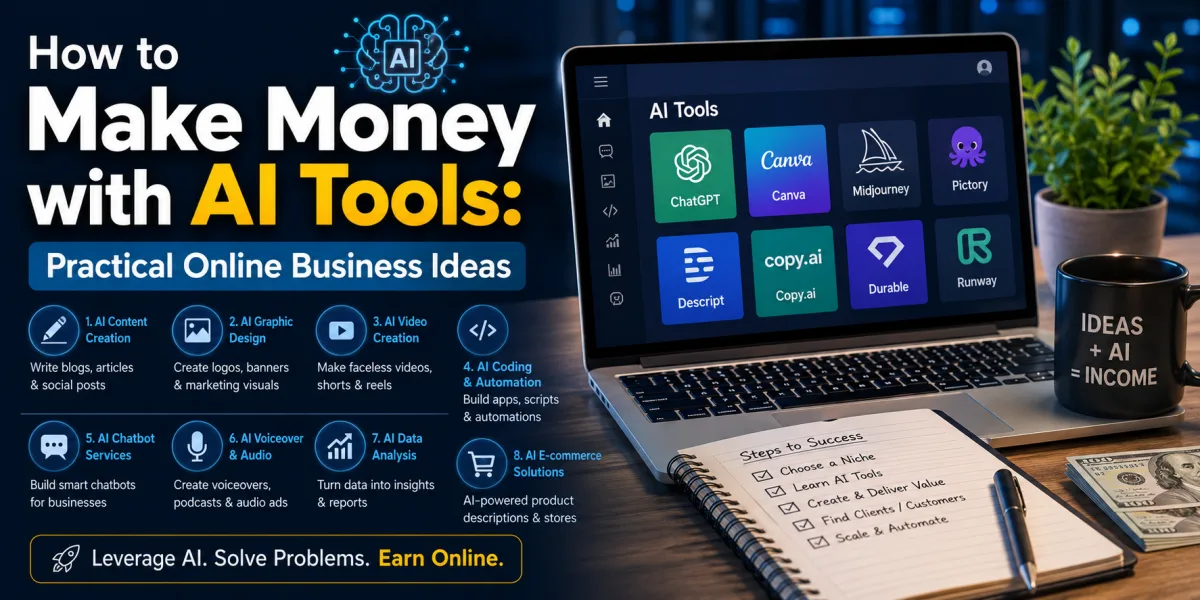
A general assistant can help with brainstorming, writing, planning, and research. A design tool can help create graphics and digital product visuals. A website builder with AI features can help launch a basic site. An ecommerce platform with AI can help write product descriptions and store copy. A meeting assistant can summarize customer calls. An automation tool can connect forms, email, spreadsheets, and CRMs. A video tool can repurpose content. A research tool can summarize sources and competitor information.
The best stack is small at first. One general AI assistant, one website or store platform, one design tool, one email tool, and one payment system may be enough. Too many tools create subscription waste and confusion.
Start with the workflow, then choose the tool. Do not collect tools hoping they become a business.
AI and the Future of Beginner Entrepreneurship
AI changes the starting line for online business. Beginners can now do more without hiring. They can learn faster, test faster, publish faster, and operate with more sophistication. This gives individuals and small teams more leverage than previous generations had.
It also raises the standard. If everyone can produce decent content, decent design, and decent copy, then “decent” becomes less valuable. The market will reward specificity, trust, taste, expertise, service, speed, and results.
AI will likely make weak businesses noisier and strong businesses more efficient. It will not remove the difference between them.
A weak business uses AI to create more output without understanding the customer. A strong business uses AI to understand the customer faster, deliver value better, and build systems sooner.
This is the real advantage. AI allows a disciplined beginner to act more like a small team. But the founder must still think like an owner.
The Bigger Lesson
AI can help you start an online business by reducing the cost of thinking, drafting, designing, researching, organizing, and automating. It can help you move from idea to offer faster. It can help you create a website, write emails, produce content, build digital products, analyze competitors, summarize customer feedback, and manage operations.
But AI is not the entrepreneur. You are.
You choose the customer. You define the problem. You make the offer. You verify demand. You protect trust. You decide what is accurate. You collect payment. You deliver value. You improve the system.
The best use of AI is not to avoid the hard parts of business. It is to reach the hard parts faster and handle them with better preparation.
Start with a real problem. Use AI to research it. Talk to customers. Use AI to shape the offer. Sell before overbuilding. Use AI to create supporting assets. Deliver manually until the process is clear. Use AI to automate what repeats. Keep human judgment where stakes are high. Build trust at every step.
AI can make launching easier. It cannot make value optional.
The entrepreneurs who understand that distinction will use AI not as a shortcut around business, but as leverage inside it.
 Article
 Article
 Article
 Article
 Article
 Article
 Article
 Article