
The Remote Work Filter: How to Find Legitimate Work-From-Home Jobs
Work-from-home jobs promise something deeply valuable: income without the daily commute, more control over time, access to opportunities beyond your local area, and the ability to build a career from a laptop, phone, and reliable internet connection. For parents, caregivers, people in smaller towns, workers with health constraints, and professionals seeking flexibility, remote work can change the economics of daily life.
But the same promise attracts scams, unrealistic job ads, overcrowded listings, low-paying platforms, fake recruiters, and roles that appear remote until the fine print reveals otherwise. The work-from-home market contains real opportunity, but it also requires sharper judgment than a traditional local job search.
The first lesson is simple: legitimate remote work is still work. It has real employers, real clients, real responsibilities, real interviews, real pay structures, and real performance expectations. It is not a secret shortcut to easy money. It is not a guaranteed path to high income without skill. It is not a category where every listing deserves trust.
Finding legitimate work-from-home jobs requires a filter. You need to know which roles are commonly remote, where credible employers post, how to verify companies, how to read job descriptions carefully, how to avoid scams, and how to present yourself as someone who can perform without physical supervision.
The remote job market has also become more competitive. Robert Half reported that across roles it analyzed in Q1 2026, 77% of new job postings were fully on-site, 19% were hybrid, and only 4% were fully remote. That does not mean remote work is disappearing, but it does mean fully remote openings are scarcer and more competitive than many applicants expect.
At the same time, the risk of job scams has become more serious. The Federal Trade Commission warns that scammers use work-from-home job ads to lure people with claims of high monthly earnings, and in April 2026 it warned about fake recruiter texts claiming to offer remote jobs while stealing real money.
This article explains how to find legitimate work-from-home jobs with financial discipline. The goal is not merely to apply to more listings. The goal is to apply to better listings, avoid fraudulent ones, protect your identity, and position yourself for remote roles that can produce stable income.
Understand What Legitimate Remote Work Looks Like
A legitimate work-from-home job has the same core features as any credible job. The employer or client is identifiable. The role has clear responsibilities. The pay structure is explained. The interview process makes sense. The company communicates through professional channels. The job does not require you to pay for access. The work produces value for a real business or customer.
Remote does not mean informal. A legitimate remote employer may still require interviews, background checks, work samples, references, training, software use, performance metrics, team meetings, and scheduled availability. Some remote roles offer flexibility over location but not necessarily flexibility over hours. A customer support role may require fixed shifts. A remote sales role may require daily activity targets. A remote project coordinator may attend scheduled meetings across time zones.
Many scams succeed because job seekers confuse remote work with effortless work. They believe a role can pay unusually well for simple tasks without interviews, accountability, or proof of skill. That is rarely how legitimate employment works.
Real remote jobs usually fall into recognizable categories: customer support, technical support, sales, account management, writing, editing, marketing, project management, bookkeeping, accounting, virtual assistance, data analysis, software development, design, tutoring, healthcare administration, recruiting, operations, and specialized consulting.
FlexJobs’ 2026 list of top companies for remote jobs also showed that job seekers frequently searched categories such as data entry, customer service, virtual admin, medical and health, project management, writing, translation, marketing, accounting and finance, and computer and IT.
The more a role connects to a real business function, the more credible it tends to be. A remote job that says “earn $900 per week by liking posts” is suspicious because the business value is unclear. A remote job that says “customer success specialist for a software company, responsible for onboarding clients, answering support tickets, and tracking renewal risks” is more credible because the work maps to a real business need.
Know the Most Realistic Work-From-Home Job Categories
Some work-from-home categories are more common and legitimate than others. Understanding these categories helps you search with better keywords and avoid vague listings.
Customer support is one of the most common remote categories. Businesses need employees or contractors to answer emails, chats, phone calls, and support tickets. Legitimate roles usually include clear shift expectations, product training, software tools, and performance metrics. Technical support is a higher-skill version that may pay more because it requires troubleshooting ability.
Virtual assistant roles support business owners, executives, creators, consultants, and teams with scheduling, inbox management, research, data entry, CRM updates, document organization, customer communication, and operations tasks. Legitimate roles explain the type of support needed and usually involve interviews or trial tasks.
Writing, editing, and content roles can be remote because deliverables are digital. These may include blog writing, copywriting, technical writing, grant writing, social media content, newsletters, product descriptions, and editing. Legitimate clients usually ask for samples, portfolio links, or a paid test project.
Marketing roles include email marketing, social media management, SEO, paid ads coordination, content strategy, analytics reporting, and marketing operations. These roles are often remote-friendly because most tools are cloud-based.
Sales and business development roles are increasingly remote because prospecting, calls, demos, follow-up, and CRM work can happen online. FlexJobs reported that sales and business development led growth in fully remote jobs in its 2026 Remote Work Index.
Accounting, bookkeeping, and finance support can often be remote because bank feeds, invoices, receipts, reconciliations, reports, and payroll systems are digital. These roles require accuracy and confidentiality.
Project management and operations roles can be remote when teams use digital project tools. These jobs require organization, communication, and follow-through.
Technology roles such as software development, web development, QA testing, data analysis, cybersecurity, and product management have long been remote-friendly, though competition can be intense and skill requirements are higher.
Healthcare administration and medical support roles may include billing, coding, scheduling, prior authorization, patient support, medical writing, and telehealth coordination. Some require certifications or experience.
Tutoring, teaching, and training can be remote through video calls and learning platforms. Legitimate roles usually require subject expertise, credentials, experience, or proof of teaching ability.
The best category for you depends on your skills, experience, schedule, equipment, and income needs. A legitimate search begins by matching yourself to real business functions, not by chasing any listing labeled “remote.”
Use Trusted Job Boards, But Do Not Trust Them Blindly
Job boards are useful, but they are not a guarantee. Scam listings can appear almost anywhere, and legitimate listings can still be low-paying or poorly structured. The platform is a starting point, not a substitute for verification.
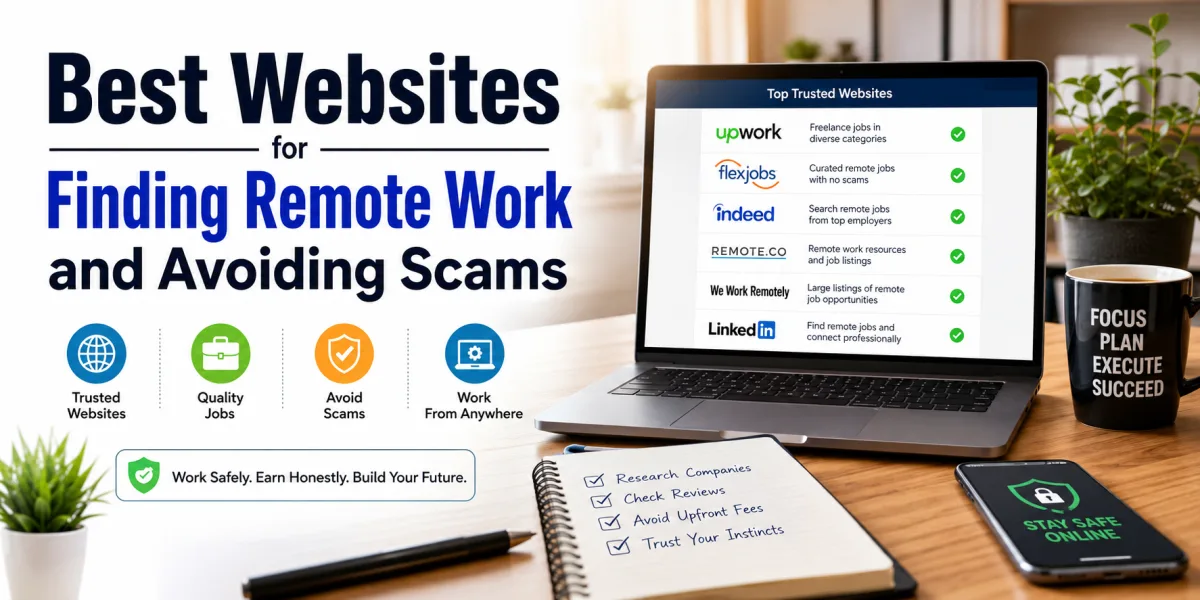
General job boards such as LinkedIn, Indeed, Glassdoor, ZipRecruiter, and company career pages can be useful for remote roles. Remote-focused job boards such as FlexJobs, We Work Remotely, Remote.co, Remotive, and Wellfound can help narrow the search. TechRadar’s 2026 job site review identified LinkedIn Jobs, Indeed, ZipRecruiter, Glassdoor, FlexJobs, Wellfound, Ladders, and other platforms as useful for different job-seeking needs, with FlexJobs highlighted for remote and flexible jobs.
The best job seekers use multiple channels. They do not rely on one board. They search company career pages directly. They follow employers known for remote hiring. They build LinkedIn visibility. They join professional communities. They ask for referrals. They apply early to fresh listings. They track applications.
Company career pages deserve special attention because they reduce impersonation risk. If you see a remote listing on a third-party site, visit the company’s official website and look for the same role on its careers page. If the job is not listed there, that does not always mean it is fake, but it deserves closer inspection.
For freelance or contract work, platforms such as Upwork, Contra, Fiverr, Freelancer, specialized industry boards, and professional communities can be useful. But freelance platforms have their own risks: low rates, unpaid tests, vague clients, scope creep, and platform impersonation. Use contracts, milestone payments, platform protections, and clear deliverables.
A trusted platform helps you find opportunities. Your verification process helps you avoid bad ones.
Search with Better Keywords
Many people search for “work from home jobs” and end up in the most crowded, scam-heavy part of the internet. Better searches use role-specific keywords.
Instead of “work from home job,” search “remote customer support specialist,” “remote billing coordinator,” “remote executive assistant,” “remote junior bookkeeper,” “remote email marketing assistant,” “remote sales development representative,” “remote project coordinator,” “remote technical support,” “remote medical scheduler,” “remote content editor,” or “remote QA tester.”
Specific searches produce better listings because they map to real job titles. They also help job boards understand your intent. A vague search attracts vague opportunities. A role-specific search attracts employers looking for defined skills.
Use variations. Some employers use “remote,” others use “work from home,” “distributed,” “virtual,” “telecommute,” “home-based,” or “location independent.” Some roles are listed as “hybrid,” “remote eligible,” or “remote within United States only.” Read carefully.
Geography matters. A job may be remote but limited to a country, state, province, or time zone because of payroll, taxes, licensing, security, or client requirements. Do not assume “remote” means “work from anywhere.” Many legitimate jobs have location restrictions.
Also search by company type. If you want customer support, search remote-first software companies. If you want bookkeeping, search cloud accounting firms. If you want tutoring, search online education platforms. If you want marketing, search agencies and SaaS companies. A company’s business model often predicts remote compatibility.
Verify the Employer Before You Apply Deeply
Verification should happen early, especially before sharing sensitive information. Start by confirming that the company exists. Look for an official website, physical or registered business information, leadership team, LinkedIn company page, employee profiles, recent activity, customer reviews, press mentions, and a careers page.
Check whether the job appears on the official company site. If a recruiter contacts you, verify that the recruiter works for the company. Look at their LinkedIn profile, email domain, employment history, and whether the role appears publicly. Be cautious if communication comes from a free email address, messaging app, or domain that slightly imitates a real company.
Search the company name plus terms such as “scam,” “review,” “complaint,” “job scam,” and “remote job.” The FTC advises job seekers to search online for the company or hiring person plus words like “scam,” “review,” or “complaint.”
Look for consistency. Does the salary range make sense for the role? Does the job description match the company’s industry? Does the recruiter’s email domain match the official website? Does the interview process align with the role’s seniority? Does the company ask for sensitive information too early?
Verification is not cynicism. It is financial self-defense. A legitimate employer will understand reasonable caution. A scammer will pressure you to move quickly, avoid questions, or bypass normal hiring processes.
Recognize the Most Common Work-From-Home Scams
Work-from-home scams often follow familiar patterns. The details change, but the structure remains similar.
The fake recruiter scam begins with a text, email, or message from someone claiming to represent a legitimate company. The job may be described vaguely as a remote role, online assessor, assistant, product reviewer, or task-based job. The FTC warned in April 2026 about fake recruiter texts offering work-from-home jobs and mentioning pay without details about the actual work.
The upfront payment scam asks you to pay for training, equipment, background checks, software, certification, onboarding, or job access. Legitimate employers do not make you pay to receive a job. Some legitimate professions require licenses or training, but the employer should not demand payment to unlock employment.
The fake check scam sends you a check to buy equipment, then asks you to send money to a vendor or return excess funds. The check may initially appear to clear, then later bounce. You can be left responsible for the money you sent.
The task scam asks you to perform simple online tasks such as rating products, liking videos, optimizing apps, or processing orders. The platform may show growing “earnings,” then require deposits or fees before withdrawal. These scams often disguise themselves as remote work but function like financial fraud.
The reshipping scam asks you to receive packages at home and send them elsewhere. These packages may involve stolen goods or fraudulent purchases. This can expose you to legal and financial risk.
The identity theft scam collects your Social Security number, bank details, passport, driver’s license, or tax information before a legitimate hiring process has occurred. Real employers need tax and payroll information after hiring, not during a suspicious early conversation.
The cryptocurrency or payment-processing scam asks you to move money, open accounts, receive transfers, convert funds, or use your bank account for business activity. This can involve money laundering or theft.
Academic research published in 2026 studying message-based job scams found large-scale scam operations using remote job opportunities as bait, impersonating well-known brands, reusing templates and domains, and causing millions of dollars in cryptocurrency losses.
The patterns are clear: scammers exploit hope, urgency, financial pressure, and the desire for flexible work. The best defense is to slow the process down.
Use a Scam Red Flag Checklist
A work-from-home job deserves suspicion if the pay is extremely high for simple work, the responsibilities are vague, the company is hard to verify, the recruiter uses a personal email address, the interview happens only through text, the employer hires immediately without meaningful screening, or you are asked to pay money upfront.
Other red flags include pressure to act quickly, requests to deposit checks, instructions to buy equipment from a specific vendor, poor grammar from a supposedly professional recruiter, mismatched company domains, job offers for roles you never applied to, requests for sensitive information before an offer, and refusal to provide a video or phone interview.
Indeed’s 2026 guidance on work-from-home scams lists warning signs such as jobs that seem too good to be true, little company information, online warnings, overly eager hiring, requests to pay to work, and poor communication.
A legitimate job may be fast-moving, but it should still make sense. A legitimate employer may ask for a background check, but not through a strange link before an interview. A legitimate company may provide equipment, but it will not send a fake check and ask you to buy from an unknown vendor. A legitimate recruiter may text you, but they should be able to verify identity through official channels.
When in doubt, pause. Talk to someone you trust. Search the company. Contact the company through its official website, not through the number or email provided by the suspicious recruiter.
Read Job Descriptions Like a Contract Preview
A job description reveals more than duties. It reveals how the company thinks. Read it carefully.
Look for clear responsibilities. A legitimate listing should explain what the person will do, who they will work with, what tools they may use, what experience is required, and how success will be measured. Vague descriptions such as “help with online tasks” or “earn money from home using your phone” are weak signals.
Look for pay transparency where available. Some jurisdictions require salary ranges, and many credible companies include them voluntarily. A missing salary range does not always mean a scam, but it may make comparison harder.
Look for employment type. Is it full-time, part-time, contract, freelance, temporary, commission-only, or internship? A contractor role may not include benefits or tax withholding. A commission-only role may produce no income if leads are poor. A part-time role may not provide enough hours.
Look for location restrictions. A role may be remote but only within the United States, Canada, the United Kingdom, a particular state, or a specific time zone. Some jobs require occasional travel, on-site training, or hybrid attendance.
Look for equipment requirements. Does the company provide equipment? Do you need your own laptop, headset, internet speed, private workspace, or phone line? Legitimate requirements should be reasonable and explained clearly.
Look for signs of professional structure: named department, reporting line, tools, training process, measurable outcomes, application process, and company information. The more a listing resembles a real business need, the better.
Strengthen Your Resume for Remote Work
Remote employers look for skill, but they also look for evidence that you can work independently. Your resume should show that you are reliable without direct supervision.
Highlight remote-relevant skills: written communication, time management, self-direction, digital collaboration, customer service, project tracking, documentation, problem solving, and comfort with tools. Mention platforms you know, such as Slack, Zoom, Microsoft Teams, Google Workspace, Asana, Trello, ClickUp, HubSpot, Salesforce, Zendesk, Shopify, QuickBooks, Canva, Excel, or industry-specific tools.
Show outcomes. Instead of “handled emails,” write “managed a shared inbox of 80+ customer inquiries per day while maintaining response time targets.” Instead of “helped with social media,” write “scheduled weekly content across three platforms and tracked engagement in a monthly report.” Instead of “used spreadsheets,” write “built a tracking spreadsheet that reduced missed follow-ups.”
If you have remote experience, state it clearly. If you do not, emphasize independent work, online collaboration, freelance projects, digital coursework, volunteer coordination, or any role where you managed tasks without constant supervision.
AP reporting on remote job competition noted that applicants can stand out by emphasizing autonomy, time management, remote experience, portfolios, and proficiency with communication tools.
A remote resume should make the employer feel that hiring you will reduce uncertainty, not create it.
Create Proof Before You Need It
Remote hiring is trust-sensitive. The employer cannot meet you casually in an office. They need evidence that you can deliver. Proof helps.
For writers, proof means samples. For designers, a portfolio. For virtual assistants, process examples, task lists, or testimonials. For bookkeepers, certifications, sample reports, or software badges. For marketers, campaign examples. For tutors, subject credentials and student results where appropriate. For developers, GitHub, websites, or projects. For data analysts, dashboards or case studies.
If you are new, create sample projects. A social media manager can build a sample content calendar for a fictional local business. A web designer can create a mock landing page. A bookkeeper can create a sample monthly reporting dashboard using fictional data. A data analyst can analyze public data and create a short report. A customer support applicant can write sample responses to common scenarios.
Proof is especially useful for applicants without formal credentials. It gives hiring managers and clients something concrete to evaluate.
Do not wait for a job to create evidence. Build the evidence first.
Network Without Begging for a Job
Many legitimate work-from-home jobs are highly competitive when posted publicly. Networking can help you access opportunities earlier or with more trust.
Networking does not mean asking strangers for jobs. It means becoming visible and useful in the market where you want to work. Join professional groups. Comment thoughtfully on industry posts. Attend virtual events. Connect with people in roles you want. Ask informed questions. Share small examples of your work. Tell your existing network exactly what kind of remote role you are seeking.
A message such as “I’m looking for remote work, let me know if you hear of anything” is too broad. A stronger message is, “I’m looking for remote customer support or client coordinator roles with small software companies. I have experience handling customer inquiries, updating CRM records, and writing help documents. If you know a team hiring for support operations, I’d appreciate an introduction.”
Specificity makes it easier for people to help you.
Networking also helps with verification. If someone inside a company confirms that a role is real, your confidence increases. If a supposed recruiter cannot be connected to anyone real, caution increases.
Apply Early and Track Everything
Remote roles can attract hundreds or thousands of applicants. Speed matters. Applying early does not guarantee success, but it can increase visibility before a listing becomes saturated.
Create a job search tracker. Include company, role, link, date applied, source, contact person, salary range, remote restrictions, follow-up date, status, and notes. This protects you from applying twice, forgetting follow-ups, or confusing legitimate employers with suspicious ones.
A tracker also helps you see patterns. Are you getting interviews for customer support but not marketing? Are you applying to roles that require skills you lack? Are most listings outside your location? Are you spending time on low-quality boards?
Remote job searching should be managed like a project. A scattered search produces scattered results.
Customize Applications Without Rewriting Everything
Custom applications perform better than generic ones, but you do not need to rewrite your resume from scratch each time. Create a strong base resume and adjust the summary, skills, and selected bullet points for each role category.
For customer support roles, emphasize communication, ticketing systems, problem resolution, and empathy. For virtual assistant roles, emphasize organization, scheduling, inbox management, and tools. For marketing roles, emphasize content, analytics, campaigns, and software. For project coordination, emphasize deadlines, task tracking, documentation, and stakeholder communication.
Use the job description as a guide. If the employer mentions Zendesk, Salesforce, Google Sheets, remote collaboration, or customer retention, make sure relevant experience appears naturally in your application if truthful.
Cover letters should be concise and specific. Explain why the role fits your background, how you have done similar work, and why remote work suits your strengths. Avoid generic statements about wanting flexibility. Employers care about flexibility, but they are hiring for performance.
Prepare for Remote Interviews
A remote interview tests more than answers. It tests your setup, communication, preparation, and professionalism.
Before the interview, test your internet, camera, microphone, lighting, and meeting link. Choose a quiet location. Keep notes nearby. Research the company. Review the job description. Prepare examples that show remote-relevant skills: handling deadlines, solving problems independently, communicating with distributed teams, learning tools quickly, and managing competing priorities.
Be ready to answer why you want remote work without making it sound like you want less accountability. A strong answer might be: “I do my best work when I can organize focused blocks of time, communicate clearly in writing, and track progress through shared tools. In my last role, I managed deadlines across email, spreadsheets, and weekly check-ins, so remote collaboration fits how I work.”
Ask questions that reveal legitimacy and fit. What tools does the team use? How is onboarding handled remotely? What does success look like in the first 90 days? How are schedules managed? How often does the team meet? Is the role fully remote permanently or temporarily? Are there location restrictions?
Legitimate employers should answer these questions clearly.
Understand Employee, Contractor, and Freelance Differences
Work-from-home income can come through employment or self-employment. The distinction affects taxes, benefits, stability, control, and risk.
An employee usually has taxes withheld, may receive benefits, and works under employer direction. A contractor or freelancer is usually responsible for taxes, may not receive benefits, and often controls how work is delivered within agreed terms. Some companies misuse contractor labels, so understand local rules.
Contract roles can be legitimate and profitable, but you must price differently. A $25-per-hour employee job and a $25-per-hour freelance role are not equal. The freelancer must cover taxes, unpaid time, equipment, software, health insurance, retirement contributions, and business expenses.
If a remote job is contract-based, ask about payment terms, invoice schedule, expected hours, scope, equipment, confidentiality, termination, and whether work is ongoing. Use written agreements. Avoid starting work based only on vague messages.
The more remote work resembles self-employment, the more financial discipline you need.
Do Not Ignore Hybrid or Remote-Eligible Roles
Fully remote jobs are attractive, but they are also more competitive. Hybrid or remote-eligible roles may provide a practical pathway, especially if you live near employers but want flexibility.
Robert Half’s 2026 data showing only 4% of analyzed new job postings as fully remote compared with 19% hybrid suggests that hybrid roles remain a larger share of flexible job postings. If your life allows occasional office presence, hybrid roles may reduce competition and increase options.
Some roles also become remote after trust is established. An employer may prefer local candidates during training but allow remote work later. A current employer may agree to partial remote work if you propose a structured plan. A freelance client may begin with project work and evolve into remote retainer work.
Do not let the perfect remote arrangement blind you to flexible arrangements that still improve your life and income.
Protect Your Personal Information
A legitimate employer will eventually need sensitive information for payroll, tax forms, and identity verification. But timing matters. Do not provide your Social Security number, bank account details, passport, driver’s license, or tax documents before you have verified the employer and received a legitimate offer through official channels.
Use a separate email address for job searching if helpful. Enable multi-factor authentication. Do not click suspicious links. Do not download unknown software from a recruiter. Do not provide remote access to your computer. Do not send copies of identity documents through unsecured channels.
If equipment is provided, the company should have a professional process. Be suspicious of checks, reimbursements before purchase, or instructions to buy from a specific unknown vendor.
Your identity is an asset. Protect it like money.
Evaluate Pay Honestly
A legitimate work-from-home job can still be a poor financial choice if the pay is too low, hours are unstable, or costs are high.
Calculate the real hourly rate. Include unpaid training, platform fees, required equipment, software, internet upgrades, taxes, unpaid administrative time, and inconsistent scheduling. A job advertised at $20 per hour may be strong if hours are steady and employment status is clear. A “task” job promising high daily earnings may produce little or no real pay.
For freelance roles, divide project pay by total time, including client communication, revisions, research, invoicing, and waiting. A $100 project that takes eight hours is not strong remote income.
Look for roles where pay connects to skill and value. Technical support, bookkeeping, sales, tutoring, project coordination, writing, design, marketing, and data work often have better income paths than generic task work.
Build Skills While Searching
Because fully remote jobs are competitive, skill development can improve your odds. Choose skills tied to real remote categories.
For customer support, learn ticketing systems, help desk writing, conflict resolution, and product documentation. For virtual assistance, learn scheduling tools, inbox management, Google Workspace, Microsoft 365, project tools, and CRM basics. For bookkeeping, learn QuickBooks, Xero, reconciliation, invoicing, and financial reports. For marketing, learn email platforms, Canva, analytics, social scheduling, SEO basics, and copywriting. For tech roles, learn coding, QA testing, data analysis, or cloud tools.
Build small proof projects as you learn. A certificate alone is less persuasive than a certificate plus a sample project.
Remote work rewards self-directed learning because remote employees must often solve problems without someone sitting beside them.
Create a Safer Weekly Job Search System
A legitimate remote job search should be systematic, not emotional.
Set a weekly target for applications, networking messages, skill practice, and follow-ups. For example, apply to five to ten well-matched roles, send three networking messages, improve one portfolio item, and follow up on prior applications. Quality matters more than volume.
Use a verification step before investing deeply. Check the company, role, recruiter, salary, and application link. Save job descriptions as PDFs or screenshots because scammers may delete posts later, and legitimate listings may close.
Review your results every two weeks. If you are not getting responses, improve your resume or target roles more precisely. If you are getting interviews but no offers, practice interview answers. If you are attracting suspicious messages, adjust where you search and what information you publish.
Treat the search like a financial project because that is what it is. Your time, identity, and future income are at stake.
The Bigger Lesson
Legitimate work-from-home jobs exist, but they are not found by trusting every remote listing or chasing easy-money promises. They are found by matching real skills to real business needs, using credible search channels, verifying employers, reading job descriptions carefully, and protecting yourself from scams.
The remote job market rewards clarity. Know the role you want. Use specific keywords. Build proof. Apply early. Customize applications. Prepare for remote interviews. Ask serious questions. Track everything. Keep learning.
The market also rewards caution. Do not pay to get a job. Do not deposit checks from strangers. Do not move money for employers. Do not share sensitive information too early. Do not trust vague high-paying offers sent by text. Do not confuse urgency with opportunity.
Remote work can expand access to income and career mobility. Research published in 2026 using millions of U.S. job transitions found that entering remote-eligible jobs was associated with higher wage growth and upward seniority mobility compared with fully on-site roles, especially for lower-income workers and those from regions with fewer high-skill opportunities.
That is the promise worth pursuing. But the promise belongs to job seekers who use judgment.
A legitimate work-from-home job should make sense on paper, survive verification, respect your time, protect your identity, and pay for real work. Anything else deserves skepticism.
The best remote job search is not desperate. It is disciplined. And discipline is what turns the work-from-home dream into a real income strategy.
 Article
 Article
 Article
 Article
 Article
 Article
 Article
 Article